REVIEW 4 major objections 5 minor 22 references
Heuristic-Free Multi-Teacher Learning
T0 review · 4 major / 5 minor · reviewed 2026-08-12 · deepseek-v4-flash
Pith's one-line read Teacher2Task claims that multi-teacher learning can drop aggregation heuristics entirely by turning each teacher's confidence score into an auxiliary prediction task conditioned on a teacher identity token.
desk verdict Neat teacher-conditioning trick, but the 'heuristic-free' claim is undercut by the authors' own inference-time teacher selection. read the letter →
The pith
A machine-rendered reading of the paper's core claim, the machinery that carries it, and where it could break.
The reading
What carries the argument
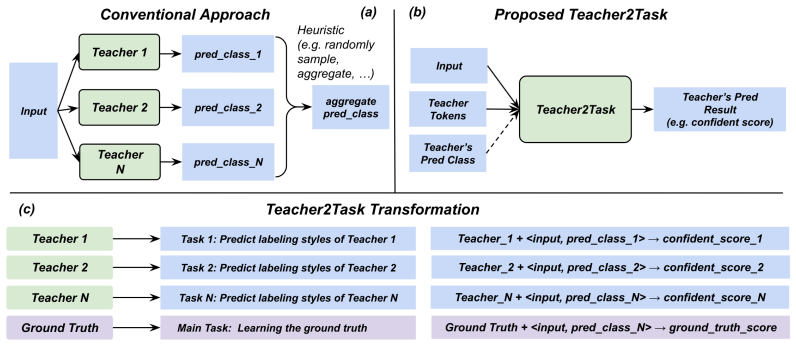
The central object is a teacher-specific input token that turns one training sample into N+1 tasks: for each teacher, predict that teacher's confidence score for the given input–class pair; for the ground truth, predict the true label. The token lets a single network represent N different labeling styles simultaneously, converting conflicting annotations from a problem to be resolved heuristically into separate well-defined auxiliary regression targets. The absolute determinism of a fixed teacher network is what makes the confidence-score map a well-posed target, and the joint training of auxiliary plus primary tasks is what lets the student exceed any single teacher.
What would settle it
Take a held-out set of topics that provably did not appear in any teacher's pretraining (for example, synthetic images of novel visual concepts), have each teacher score them, train a student with Teacher2Task on those teacher scores plus a small set of ground-truth labels, and check whether the student's PR-AUC still exceeds every teacher's. Also, add a deliberately random teacher to the training mix and verify that the student's PR-AUC does not improve: if it does, the auxiliary tasks can absorb noise rather than style, contradicting the paper's mechanism.
Extended reading notes
Core claim
The paper claims that the correct object to predict from a teacher is not the teacher's label but the teacher's confidence score for an input–class pair, conditioned on a teacher-identity token. Because a trained neural network is a fixed function, for every teacher there is a deterministic map from an input and a candidate class to that teacher's confidence; the student learns this map as an auxiliary task for each teacher, while a primary task keeps it tied to human ground truth. Conflicts between teachers are resolved implicitly—the model sees which teacher is speaking—and inaccurate teacher predictions never become pseudo-labels for the main task. The empirical claim is that this formulation lets a compact student interpolate between teachers and the ground truth, and that scaling the number of teachers monotonically improves the student's precision–recall area under the curve.
Load-bearing premise
The claim that the evaluation topics are unseen during training is the load-bearing premise: if the teacher models have already memorized the test distribution during their own pretraining, the reported student gains could come from leakage through the teachers rather than from the Teacher2Task formulation.
Editorial extensions
If this is right
- With Teacher2Task, adding a teacher means adding one auxiliary task and one token, so the framework scales to a very large number of teachers without any re-aggregation step.
- Teacher predictions become extra training samples rather than pseudo-labels, so annotation cost per teacher prediction is lower than in ensemble methods, and label noise is kept out of the primary task.
- A student with 150M parameters can surpass substantially larger teacher models (Gemini) on open-vocabulary image classification, suggesting the formulation transfers knowledge rather than merely compressing it.
- Including a self-training teacher yields consistent gains per iteration, indicating the method is compatible with iterative semi-supervised learning without confirmation bias.
Reading between the lines
- If the mechanism is truly learning per-teacher confidence functions, the student should be able to emulate a teacher's score without ever seeing that teacher during training on a given topic—a testable interpolation property that the paper does not directly report.
- The method implicitly assumes each teacher is a stationary function; in practice, LLM prompts and model updates change teacher behavior, so the 'fixed function' argument may need re-derivation when teachers evolve over time.
- A natural extension is to apply the same token-conditioned auxiliary task to ranking or regression settings, where confidence scores are scalar, and to test whether deliberately poor teachers (e.g., random labelers) still improve the student—the paper's noise-mitigation claim implies they should not.
- The reported gains over Gemini could partly reflect teacher pretraining leakage into the evaluation topics; the topic-split design reduces but does not eliminate this, since the teachers themselves were trained on web-scale data.
Signed reviews
Editorial analysis
A structured set of objections, weighed in public.
Referee Report
Summary. The paper proposes Teacher2Task, a multi-teacher learning framework that avoids aggregating teacher predictions. Instead of combining labels with a weighting or selection heuristic, the method prepends teacher-specific tokens to inputs and creates N+1 training tasks: N auxiliary tasks that predict each teacher's confidence score for an input-class pair, and one primary task that learns ground-truth labels. The authors report that a 150M-parameter student achieves 84% PR-AUC on open-vocabulary image classification, surpassing its best individual teacher (Gemini at 82.2%), and that adding teachers improves video PR-AUC from 75.6% (human-only baseline) to 80.0% (seven teachers). Ablations cover embedding size, model architecture, and model size.
Significance. If the claims were fully supported, Teacher2Task would be a simple and attractive contribution: it converts teacher disagreements into separable auxiliary tasks, supports heterogeneous teacher types (humans, LLMs, domain models, self-training), and suggests a 'teacher-scaling' direction analogous to data scaling. The paper has strengths: the formulation is architecture-agnostic, the empirical scope spans image and video, and the ablations give some intuition about where gains come from. However, the central 'heuristic-free' claim is currently undermined by the inference procedure, and the empirical evidence lacks baseline comparisons and variance estimates. The significance is therefore conditional on substantial revision.
major comments (4)
- [§2.4 and §4.2] The central claim of being 'heuristic-free' is internally contradicted. Section 2.4 states, 'To maximize performance, we typically default to the most accurate teacher, often human annotators,' which is exactly a teacher-selection rule based on validation accuracy, the kind of heuristic that Section 4.2 claims the framework removes ('we remove the need for weight aggregation, teacher selection, or domain separation'). Since the reported 84% PR-AUC is presumably obtained with this default teacher, the deployed system is essentially a human-label scoring function regularized by auxiliary teacher tasks, not a heuristic-free multi-teacher inference mechanism. The paper should specify and evaluate a fixed combination rule over teacher-token outputs (e.g., averaging teacher heads or using a fixed learned combination) and report results under that rule; without this, the headline claim rests on an unstated selection heuristic.
- [§3.3 and §4.2] The paper criticizes weighted aggregation, teacher selection, and domain separation, but never compares Teacher2Task to any of these baselines. Section 3.3.1 and Table 1 show only Teacher2Task against individual teachers (PaLI, Gemini, single-teacher video baseline), so the claimed advantage over 'manual aggregation heuristics' is not demonstrated. Experiments should include uniform averaging, fixed or validation-tuned weights, learned instance-level weights, and random teacher selection as baselines, trained with the same teacher data and evaluated with the same protocol; without these comparisons, the paper cannot substantiate that it improves on the heuristics it criticizes.
- [§3.2] The topic-split evaluation does not control for teacher pretraining leakage. The paper states that the majority of evaluation topics are unseen during training, but the teachers (PaLI, Gemini, domain-specific models) were pretrained on web-scale data that plausibly includes these topics and possibly the test images. If so, the reported 84% PR-AUC partly reflects the teachers' memorization of the evaluation distribution rather than the Teacher2Task transformation. The authors should address this by ablating with teachers whose pretraining data excludes the evaluation topics, or by measuring sensitivity to topic overlap, and should at minimum discuss this leakage risk.
- [§3.3] All headline metrics are reported as single PR-AUC values without error bars, standard deviations, or the number of runs/seeds. The image claim that a 150M-parameter student 'surpasses' Gemini (84.0% vs. 82.2%) is a 1.8-point gap; without variance information, it is impossible to assess whether this is statistically reliable. The video teacher-scaling gains (75.6, 78.1, 80.0) should also be accompanied by repeated-run statistics, especially given that only a single configuration is reported.
minor comments (5)
- [§2.1 and §3.1] There are several typos and imprecise phrases: 'confident score' appears instead of 'confidence score', 'OpenV ocab' instead of 'OpenVocab', and 'absolute mathematical formulate' instead of 'absolute mathematical formula'; these should be corrected.
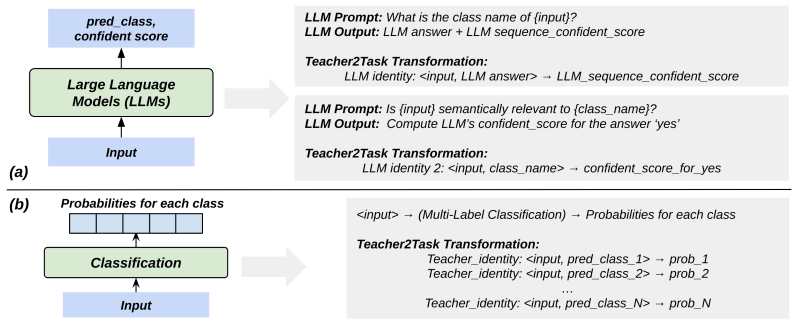
- [§2.3] The mechanism for extracting confidence scores from open-ended LLM outputs is not described; please specify how free-text responses such as 'Yes'/'No' are mapped to numeric confidence scores.
- [§3.2] The topic-split protocol is under-specified: the number of train and evaluation topics, the split ratio, and the fraction of evaluation topics that might overlap with teacher pretraining data are not reported.
- [§2.4] The total training loss is not defined precisely; the paper says MSE loss is generally used but does not state whether the auxiliary teacher tasks and the primary ground-truth task are weighted equally, or how multiple tasks are balanced.
- [References] Reference [13] is formatted as 'e. a. Xi Chen'; this should be corrected to an author et al. format consistent with the rest of the bibliography.
Circularity Check
Heuristic-free claim is contradicted by the method's own inference-time teacher selection; otherwise no formal circularity.
-
fitted input called prediction
[Section 2.4 (Model Training), Section 4.2 (Comparison to Multi-Teacher algorithms), Section 3.3.1]
"At inference, Teacher2Task allows us to predict the confidence score that any trained teacher would assign to an input-class pair. To maximize performance, we typically default to the most accurate teacher, often human annotators. ... we remove the need for weight aggregation, teacher selection, or domain separation."
Selecting the 'most accurate teacher' is a teacher-selection heuristic, and Section 4.2 itself classifies teacher selection as a special case of weighted averaging. The reported 84% image PR-AUC is therefore obtained by defaulting to the human teacher, making the primary inference output a single-teacher confidence predictor trained on the same human labels used for evaluation. The headline claim that the framework 'removes the need for ... teacher selection' is thus contradicted by its own inference rule, and the claimed superiority over Gemini reduces to access to human annotations rather than to a multi-teacher combination.
full rationale
There is no mathematical derivation chain in the paper, so no equation-level circularity can be exhibited. The auxiliary tasks are trained on teacher confidence scores while the primary task is trained on ground-truth labels, and these are distinct supervised targets rather than definitions of one another. There is also no load-bearing self-citation, uniqueness theorem, or ansatz smuggled in via citation. The only significant circular-adjacent issue is the tension between the central 'heuristic-free' claim and the explicit inference rule: 'we typically default to the most accurate teacher.' This is a teacher-selection heuristic, which the paper itself identifies as a form of weighted aggregation. Consequently, the headline 84% PR-AUC result is not demonstrated to be a heuristic-free multi-teacher combination; it is obtained by selecting the human teacher's confidence predictor. That said, the underlying teacher-token multi-task training has independent empirical content, as shown by the video teacher-scaling results, so the issue is partial rather than total circularity.
Assumptions & free parameters
free parameters (2)
- Inference teacher head selection =
N/A (human head by default)
- Teacher prompt templates =
PaLI: 'Is topic the primary focus of this image?'; Gemini: 'Answer strictly with YES/NO.
assumptions (3)
- domain assumption A single student model can approximate each teacher's confidence function on input-class pairs when conditioned on a teacher token.
- domain assumption The topic-split evaluation contains topics unseen by the student and, implicitly, by the teachers.
- ad hoc to paper For any fixed teacher, the mapping from input and output class to confidence score is deterministic and learnable.
Cite this review
Pith. "Pith review of Heuristic-Free Multi-Teacher Learning." pith.science (2026). https://pith.science/paper/NNYAG6UE
@misc{pith2026241112724,
  author       = {Pith},
  title        = {Pith review of: Heuristic-Free Multi-Teacher Learning},
  year         = {2026},
  howpublished = {\url{https://pith.science/paper/NNYAG6UE}},
  note         = {Machine review of arXiv:2411.12724}
}
read the original abstract
We introduce Teacher2Task, a novel framework for multi-teacher learning that eliminates the need for manual aggregation heuristics. Existing multi-teacher methods typically rely on such heuristics to combine predictions from multiple teachers, often resulting in sub-optimal aggregated labels and the propagation of aggregation errors. Teacher2Task addresses these limitations by introducing teacher-specific input tokens and reformulating the training process. Instead of relying on aggregated labels, the framework transforms the training data, consisting of ground truth labels and annotations from N teachers, into N+1 distinct tasks: N auxiliary tasks that predict the labeling styles of the N individual teachers, and one primary task that focuses on the ground truth labels. This approach, drawing upon principles from multiple learning paradigms, demonstrates strong empirical results across a range of architectures, modalities, and tasks.
Figures

Figures from the paper (2 more)


Reference graph
Works this paper leans on
-
[1]
Imagenet classification with deep convolutional neural networks,
A. Krizhevsky, I. Sutskever, and G. E. Hinton, “Imagenet classification with deep convolutional neural networks,” in Advances in Neural Information Processing Systems , F. Pereira, C. Burges, L. Bottou, and K. Weinberger, Eds., vol. 25. Curran Associates, Inc., 2012. [Online]. Available: https://proceedings.neurips.cc/paper_files/paper/2012/file/ c399862d...
work page 2012
-
[2]
Zhou, Ensemble Methods: Foundations and Algorithms, 1st ed
Z.-H. Zhou, Ensemble Methods: Foundations and Algorithms, 1st ed. Chapman & Hall/CRC, 2012
work page 2012
-
[3]
Ensemble methods in machine learning,
T. G. Dietterich, “Ensemble methods in machine learning,” in Proceedings of the First In- ternational Workshop on Multiple Classifier Systems , ser. MCS ’00. Berlin, Heidelberg: Springer-Verlag, 2000, p. 1–15
work page 2000
-
[4]
Efficient knowledge distillation from an ensemble of teachers,
T. Fukuda, M. Suzuki, G. Kurata, S. Thomas, J. Cui, and B. Ramabhadran, “Efficient knowledge distillation from an ensemble of teachers,” in Interspeech, 2017. [Online]. Available: https://api.semanticscholar.org/CorpusID:30258763
work page 2017
-
[5]
M.-C. Wu, C.-T. Chiu, and K.-H. Wu, “Multi-teacher knowledge distillation for compressed video action recognition on deep neural networks,” inICASSP 2019 - 2019 IEEE International Conference on Acoustics, Speech and Signal Processing (ICASSP), 2019, pp. 2202–2206
work page 2019
-
[6]
Distilling knowledge from ensembles of neural networks for speech recognition,
Y . Chebotar and A. Waters, “Distilling knowledge from ensembles of neural networks for speech recognition,” in Interspeech, 2016. [Online]. Available: https://api.semanticscholar. org/CorpusID:18195425
work page 2016
-
[7]
Adaptive Multi-Teacher Multi-level Knowledge Distillation
Y . Liu, W. Zhang, and J. Wang, “Adaptive multi-teacher multi-level knowledge distillation,” CoRR, vol. abs/2103.04062, 2021. [Online]. Available: https://arxiv.org/abs/2103.04062
work page Pith review arXiv 2021
-
[8]
Collaborative multi-teacher knowledge distillation for learning low bit-width deep neural networks,
C. Pham, T. Hoang, and T.-T. Do, “Collaborative multi-teacher knowledge distillation for learning low bit-width deep neural networks,” in 2023 IEEE/CVF Winter Conference on Ap- plications of Computer Vision (WACV), 2023, pp. 6424–6432
work page 2023
Show all 22 references
-
[9]
Reinforced multi-teacher selection for knowledge distillation,
F. Yuan, L. Shou, J. Pei, W. Lin, M. Gong, Y . Fu, and D. Jiang, “Reinforced multi-teacher selection for knowledge distillation,” CoRR, vol. abs/2012.06048, 2020. [Online]. Available: https://arxiv.org/abs/2012.06048
2012 arXiv
-
[10]
Multilingual neural machine translation with knowledge distillation,
X. Tan, Y . Ren, D. He, T. Qin, Z. Zhao, and T.-Y . Liu, “Multilingual neural machine translation with knowledge distillation,” 2019. [Online]. Available: https://arxiv.org/abs/1902.10461
2019 arXiv
-
[11]
Distilling the knowledge in a neural network,
G. Hinton, O. Vinyals, and J. Dean, “Distilling the knowledge in a neural network,” 2015. [Online]. Available: https://arxiv.org/abs/1503.02531 9
2015 arXiv
-
[12]
PaLI: A jointly-scaled multilingual language-image model,
X. Chen, X. Wang, S. Changpinyo, A. Piergiovanni, P. Padlewski, D. Salz, S. Goodman, A. Grycner, B. Mustafa, L. Beyer, A. Kolesnikov, J. Puigcerver, N. Ding, K. Rong, H. Akbari, G. Mishra, L. Xue, A. V . Thapliyal, J. Bradbury, W. Kuo, M. Seyedhosseini, C. Jia, B. K. Ayan, C. ...
2023
-
[13]
Pali-x: On scaling up a multilingual vision and language model,
e. a. Xi Chen, “Pali-x: On scaling up a multilingual vision and language model,” 2023. [Online]. Available: https://arxiv.org/abs/2305.18565
2023 arXiv
-
[14]
Gemini: A family of highly capable multimodal models,
G. Team, “Gemini: A family of highly capable multimodal models,” 2024. [Online]. Available: https://arxiv.org/abs/2312.11805
2024 arXiv
-
[15]
Self-training with noisy student improves ima- genet classification,
Q. Xie, M.-T. Luong, E. Hovy, and Q. V . Le, “Self-training with noisy student improves ima- genet classification,” in 2020 IEEE/CVF Conference on Computer Vision and Pattern Recog- nition (CVPR), 2020, pp. 10 684–10 695
2020
-
[16]
Meta pseudo labels,
H. Pham, Z. Dai, Q. Xie, and Q. V . Le, “Meta pseudo labels,” in 2021 IEEE/CVF Conference on Computer Vision and Pattern Recognition (CVPR), 2021, pp. 11 552–11 563
2021
-
[17]
Exploring the limits of transfer learning with a unified text-to-text transformer,
C. Raffel, N. Shazeer, A. Roberts, K. Lee, S. Narang, M. Matena, Y . Zhou, W. Li, and P. J. Liu, “Exploring the limits of transfer learning with a unified text-to-text transformer,”J. Mach. Learn. Res., vol. 21, no. 1, jan 2020
2020
-
[18]
mt5: A massively multilingual pre-trained text-to-text transformer,
L. Xue, N. Constant, A. Roberts, M. Kale, R. Al-Rfou, A. Siddhant, A. Barua, and C. Raffel, “mt5: A massively multilingual pre-trained text-to-text transformer,” 2021. [Online]. Available: https://arxiv.org/abs/2010.11934
2021 arXiv
-
[19]
Deep residual learning for image recognition,
K. He, X. Zhang, S. Ren, and J. Sun, “Deep residual learning for image recognition,” in 2016 IEEE Conference on Computer Vision and Pattern Recognition (CVPR), 2016, pp. 770–778
2016
-
[20]
Pseudo-labeling and confirmation bias in deep semi-supervised learning,
E. Arazo, D. Ortego, P. Albert, N. E. O’Connor, and K. McGuinness, “Pseudo-labeling and confirmation bias in deep semi-supervised learning,” 2020. [Online]. Available: https://arxiv.org/abs/1908.02983
2020 arXiv
-
[21]
Bert: Pre-training of deep bidirectional transformers for language understanding,
J. Devlin, M.-W. Chang, K. Lee, and K. Toutanova, “Bert: Pre-training of deep bidirectional transformers for language understanding,” arXiv preprint arXiv:1810.04805, 2018
2018 arXiv
-
[22]
A simple framework for contrastive learn- ing of visual representations,
T. Chen, S. Kornblith, M. Norouzi, and G. Hinton, “A simple framework for contrastive learn- ing of visual representations,” inInternational conference on machine learning. PMLR, 2020, pp. 1597–1607. 10
2020
Reviewed August 12, 2026 · model on record in the stance chip above.
Discussion (0). Continue with ORCID to comment.