REVIEW 3 major objections 5 minor 2 cited by
Neural Internal Model Control: Learning a Robust Control Policy via Predictive Error Feedback
T0 review · 3 major / 5 minor · reviewed 2026-08-12 · deepseek-v4-flash
Pith's one-line read This paper proposes Neural Internal Model Control, which feeds a rigid-body predictive-error signal into an RL policy, and presents evidence that this signal improves trajectory tracking and robustness on quadrotors and quadrupedal robots.
desk verdict NeuralIMC offers a genuinely simple plug-in disturbance signal for RL control, with strong simulation work and a real drone demo, but the paper never specifies how policy commands become the predictor's acceleration inputs—and for quadrupeds that gap may empty out the signal. read the letter →
The pith
A machine-rendered reading of the paper's core claim, the machinery that carries it, and where it could break.
The reading
What carries the argument
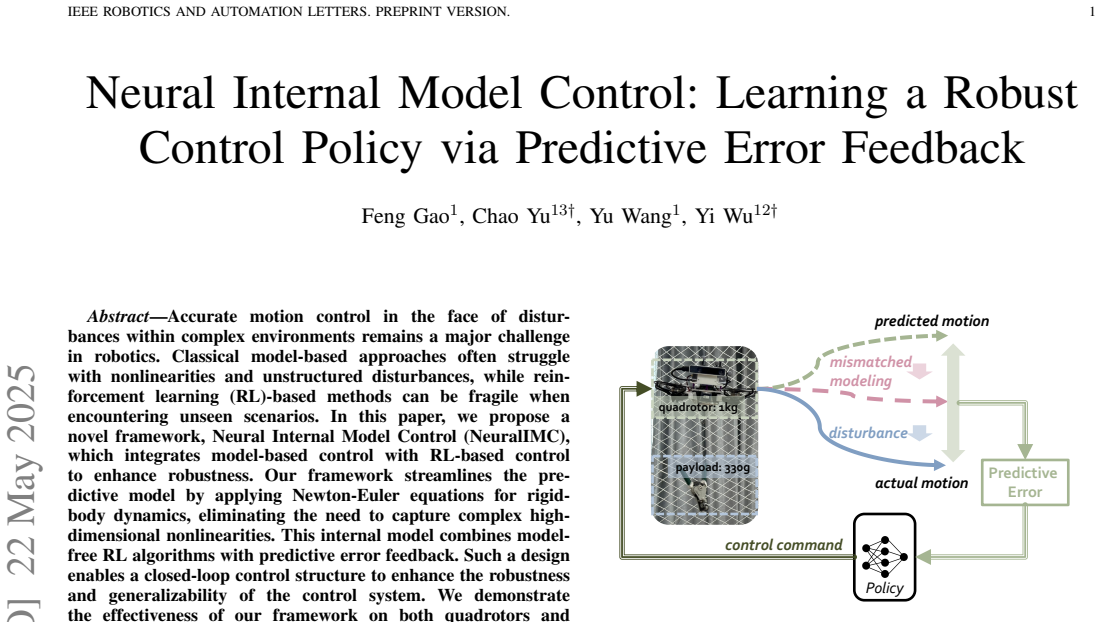
The load-bearing object is the predictive error feedback loop: an explicit predictor built from the Newton-Euler update equations converts the policy's command into a next-body-state prediction, and the gap between prediction and observation is encoded as a small error vector fed back into the policy at the next step. The deliberate simplification is to model only the robot body as a rigid transformation, so the predictor needs no actuator models, terrain models, or learned latent dynamics. In the Internal Model Control tradition, the difference between plant and model responses carries the disturbance information; here the RL policy learns to compensate for whatever the simplified predictor misses, which is why the authors describe the loop as closing model-based and model-free control.
What would settle it
Train a quadrotor policy with and without predictive error feedback while intentionally mis-specifying the mass used to convert collective thrust into acceleration and applying no external disturbance; if the error-feedback policy is not clearly better in that clean setting, the error signal is dominated by conversion error rather than by external disturbances, and the claimed mechanism is not the one producing robustness.
Extended reading notes
Core claim
The central claim is that a white-box rigid-body predictor, using only Newton-Euler kinematics for the main body, provides a feedback signal that makes an RL-trained control policy robust to disturbances and out-of-distribution dynamics. The predictor integrates the policy's acceleration and angular-acceleration commands into a next body state, and the predictive error vector, composed of position, velocity, angular velocity, and orientation cosine distance between predicted and observed states, is appended to the policy input. The paper asserts that this error directly signals state drift and disturbance magnitude, and that a policy trained on it outperforms estimator-based and estimator-free baselines on quadrotor trajectory tracking and quadruped locomotion, including under randomized external forces and unseen dynamics. Real-world deployment on a quadrotor with rope-suspended payloads is offered as evidence that the benefit survives sim-to-real transfer.
Load-bearing premise
The method's feedback signal only carries disturbance information if the policy's raw output can be treated as an acceleration or angular-acceleration command for the rigid-body model, and the paper does not specify or validate the conversion for collective thrust and reference velocity commands.
Editorial extensions
If this is right
- Adding predictive error feedback to a PPO-trained policy reduces trajectory tracking error on quadrotors compared with L1-based controllers, CAL, RMA, and DATT baselines, with the largest gains under out-of-distribution dynamics.
- On quadrupedal robots the same feedback structure improves linear velocity and yaw-rate tracking over PPO and HIM, and matches or exceeds a privileged RMA variant that receives ground-truth disturbances.
- One-step predictive error feedback is sufficient: longer short-term or long-term input histories do not improve performance, according to the paper's ablations.
- The simplified rigid-body predictor performs nearly as well as a full-dynamics model on quadrotor tracking, indicating that the simplification is not the main source of degradation.
- Real quadrotor experiments with 200 g and 330 g rope-suspended payloads show the method keeps tracking stable, and removing the predictive error feedback degrades altitude control under the payload.
Reading between the lines
- The paper leaves open exactly how command-to-acceleration conversions are implemented; a direct test would vary that conversion across a range of nominal masses and observe when the predictive error stops improving control.
- Because the predictor is morphology-agnostic, the same error vector could be applied to other robots with body-state estimation, such as humanoids or aerial manipulators, whenever a command-to-acceleration proxy can be defined.
- The result that predictive error feedback matches or beats a privileged teacher receiving ground-truth disturbances suggests that explicit rigid-body error can replace learned latent disturbance encoders in other teacher-student pipelines; that replacement is testable by removing the encoder and keeping the error input.
Editorial analysis
A structured set of objections, weighed in public.
Referee Report
Summary. The paper proposes Neural Internal Model Control (NeuralIMC), which combines a simplified Newton-Euler rigid-body predictive model with model-free RL policies by feeding the predictive error—the difference between the predicted next body state and the actual measured state—as an additional input to the policy. The method is implemented for quadrotors using a CTBR action space and for quadrupedal robots using reference velocity commands, and evaluated in simulation against several baselines (PPO, RMA, HIM, DATT, CAL, L1-based controllers) as well as in a real-world quadrotor experiment with suspended payloads. The authors claim consistent improvements in tracking accuracy and robustness across in-distribution and out-of-distribution dynamics, and release source code.
Significance. If the claims hold, the paper offers a simple, arguably general plug-in mechanism for improving robustness in RL-based control: replacing learned or handcrafted disturbance estimators with an explicit white-box rigid-body prediction and using the mismatch as policy feedback. The experimental effort is substantial—five seeds with 1024 parallel quadrotor trials and 4096 parallel environments for quadrupeds, OOD evaluation, ablations on history length, noise tolerance, and model complexity, plus a real-world deployment. The release of code and the explicit nature of the predictive model are clear strengths. However, the paper itself acknowledges limited hyperparameter tuning of baselines, and the precise definition of the predictive model inputs is under-specified, which currently leaves the central claim partially unsupported.
major comments (3)
- [§III-C1–III-C2, Eqs. (1)–(6)] The predictive model requires acceleration inputs a_k and \dot{\omega}_k, but the paper never specifies how these are derived from the actual action spaces: for quadrotors, the CTBR action contains collective thrust and bodyrate (a force and an angular velocity, not accelerations), and for quadrupeds the reference velocity commands are piecewise constant so their derivative is zero almost everywhere, making the predictor's acceleration input zero and the 'predictive error' degenerate to the measured velocity increment. Please specify the exact command-to-acceleration mapping used in the implementation, including the nominal mass used for thrust conversion and the treatment of \dot{\omega}_k; if the quadruped predictor is indeed driven by zero acceleration, state how the resulting signal differs from a simple state-difference feedback and why the IMC interpretation remains valid.
- [§IV-B, Table II and the paragraph following it] The paper acknowledges that 'limited hyperparameter sweeps in our experiments may contribute to the baselines’ degraded performance.' Since the central comparative claim is that NeuralIMC 'surpasses recent state-of-the-art control methods,' this admission is a direct caveat on that claim; the privileged variants DATT(GT) and RMA(T) mitigate but do not eliminate the concern, because those privileged variants are not the actual deployed baselines. Please either report additional hyperparameter tuning for the baselines or rephrase the conclusions to reflect that the comparison is against a particular (possibly suboptimally tuned) set of baselines.
- [§IV-D, Table V] In the model-complexity ablation, the full-dynamics model actually achieves lower evaluation errors than the simplified model under both static (0.095 vs 0.101 m) and disturbed (0.105 vs 0.119 m) conditions on the zigzag task, so the claim that 'performance degradation is marginal' is misleading; the text should report these numbers accurately and should not extrapolate from this single-morphology experiment to the claim that simplification 'improves generalization across different morphologies.'
minor comments (5)
- [Fig. 2 caption] The caption contains a typo: 'applirope' should likely be 'applicable to'.
- [Sec. II-B] There is a typo in the text: 'RL-baesd' should be 'RL-based'.
- [Sec. III-C2] The sentence 'To integrate our predictive model into the control loop,, we use reference velocity commands as model inputs' contains a double comma after 'loop'.
- [Sec. IV-E] The text reads 'MA VROS' but the intended name of the ROS-to-MAVLink bridge is 'MAVROS'.
- [Table II] The row labels 'Train' and 'Eval' are ambiguous; they appear to distinguish in-distribution from out-of-distribution dynamics evaluation, but the caption only explains the blue cells and percentages, not the row grouping.
Circularity Check
For the quadruped instantiation, the predictive model's acceleration inputs vanish on the constant-command evaluation protocol, so the 'predictive error' reduces to a finite difference of the observed body state; the claimed internal-model prediction is a renaming of standard state-history feedback in that domain.
-
renaming known result
[Sec. III-C.2 (Quadrupedal robots), Eqs. (2)-(7), with the evaluation protocol in Sec. IV-A.2]
"To integrate our predictive model into the control loop,, we use reference velocity commands as model inputs, deriving linear and angular accelerations by differentiating consecutive commands. Setting other accelerations to zero ensures seamless integration with existing policies. ... The x-y linear velocity command is sampled from [-1.0, 1.0] m/s, and the yaw rate command from [-1.0, 1.0] rad/s."
Under the sampled, held reference-velocity commands used in evaluation, the differentiated command acceleration a_k is zero almost everywhere. Substituting a_k=0 into Eq. (2) gives tilde-v_{k+1}=v_k, so the 'predicted' next velocity is just the current velocity, and the velocity component of the predictive error (Eq. (7)) is v_k - v_{k+1}, which is the negative of the measured velocity increment--a signal computable directly from successive body states with no internal model. The position error similarly reduces to a finite-difference velocity estimate.
full rationale
The quadrotor side of the paper is self-contained: the predictive error is computed by explicit Newton-Euler integration of the policy's collective-thrust and bodyrate commands, with no fitted parameters and no use of the target result in the derivation. The real-world deployment provides external evidence. The self-citations ([8], [25]) are used for background and simulator infrastructure, not as load-bearing justification for the method's central claim. The paper's own limitation statement about hyperparameter sweeps concerns baseline fairness, not circularity. The one concrete circular reduction is in the quadruped instantiation: because evaluation holds reference velocity commands constant, the command accelerations obtained by differentiation are zero, so Eq. (2) makes the predicted next velocity equal to the current velocity. The 'predictive error' then degenerates to a finite difference of the observed state, which is a known and standard feedback signal rather than a model-based prediction. This makes the internal-model framing partially a renaming of state-history feedback in the quadruped domain, while leaving the quadrotor contribution independently meaningful.
Assumptions & free parameters
free parameters (1)
- Nominal quadrotor mass used in the predictor =
1 kg
assumptions (4)
- domain assumption Newtonian rigid-body kinematics (Eqs. 1-6) describe the commanded motion of the robot's body.
- ad hoc to paper The policy's action can be converted to an acceleration command for the predictor (collective thrust to linear acceleration via nominal mass; velocity command differentiated to acceleration).
- domain assumption The actual body state is available at every control step (from motion capture or VIO).
- domain assumption The predictive error is an informative and sufficient disturbance signal for the RL policy.
Cite this review
Pith. "Pith review of Neural Internal Model Control: Learning a Robust Control Policy via Predictive Error Feedback." pith.science (2026). https://pith.science/paper/75AJLYJ4
@misc{pith2026241113079,
  author       = {Pith},
  title        = {Pith review of: Neural Internal Model Control: Learning a Robust Control Policy via Predictive Error Feedback},
  year         = {2026},
  howpublished = {\url{https://pith.science/paper/75AJLYJ4}},
  note         = {Machine review of arXiv:2411.13079}
}
read the original abstract
Accurate motion control in the face of disturbances within complex environments remains a major challenge in robotics. Classical model-based approaches often struggle with nonlinearities and unstructured disturbances, while RL-based methods can be fragile when encountering unseen scenarios. In this paper, we propose a novel framework, Neural Internal Model Control, which integrates model-based control with RL-based control to enhance robustness. Our framework streamlines the predictive model by applying Newton-Euler equations for rigid-body dynamics, eliminating the need to capture complex high-dimensional nonlinearities. This internal model combines model-free RL algorithms with predictive error feedback. Such a design enables a closed-loop control structure to enhance the robustness and generalizability of the control system. We demonstrate the effectiveness of our framework on both quadrotors and quadrupedal robots, achieving superior performance compared to state-of-the-art methods. Furthermore, real-world deployment on a quadrotor with rope-suspended payloads highlights the framework's robustness in sim-to-real transfer. Our code is released at https://github.com/thu-uav/NeuralIMC.
Figures


Figures from the paper (2 more)


Forward citations
Cited by 2 Pith papers
-
What Matters in Learning A Zero-Shot Sim-to-Real RL Policy for Quadrotor Control? A Comprehensive Study
SimpleFlight, a PPO framework combining five design choices, cuts real-world quadrotor tracking error by over 50% and successfully tracks infeasible zigzag trajectories zero-shot.
-
ASAP: Aligning Simulation and Real-World Physics for Learning Agile Humanoid Whole-Body Skills
ASAP trains a residual action model on real-world rollouts and fine-tunes simulation policies through it, reducing humanoid whole-body motion tracking error in sim-to-real transfer.
Reference graph
Works this paper leans on
-
[1]
Adaptive control [second edition, by karl j. astrom and bjorn wittenmark, addison wesley (1995)],
B. Pasik-Duncan, “Adaptive control [second edition, by karl j. astrom and bjorn wittenmark, addison wesley (1995)],” IEEE Control Systems Magazine, vol. 16, no. 2, pp. 87–, 1996
work page 1995
-
[2]
N. T. Nguyen and N. T. Nguyen, Model-reference adaptive control . Springer, 2018
2018
-
[3]
Internal model control: Pid controller design,
D. E. Rivera, M. Morari, and S. Skogestad, “Internal model control: Pid controller design,” Industrial & engineering chemistry process design and development, vol. 25, no. 1, pp. 252–265, 1986
work page 1986
-
[4]
K. J. ˚Astr¨om and B. Wittenmark, “On self tuning regulators,” Automat- ica, vol. 9, no. 2, pp. 185–199, 1973
work page 1973
-
[5]
Self-tuning of pid controllers by adaptive interaction,
F. Lin, R. D. Brandt, and G. Saikalis, “Self-tuning of pid controllers by adaptive interaction,” in Proceedings of the 2000 American Control Conference. ACC (IEEE Cat. No. 00CH36334) , vol. 5. IEEE, 2000, pp. 3676–3681
work page 2000
-
[6]
The internal model principle of control theory,
B. A. Francis and W. M. Wonham, “The internal model principle of control theory,” Automatica, vol. 12, no. 5, pp. 457–465, 1976
1976
-
[7]
Deepmimic: Example-guided deep reinforcement learning of physics-based character skills,
X. B. Peng, P. Abbeel, S. Levine, and M. van de Panne, “Deepmimic: Example-guided deep reinforcement learning of physics-based character skills,” ACM Trans. Graph. , vol. 37, no. 4, pp. 143:1–143:14, Jul
-
[8]
Learning Agile Bipedal Motions on a Quadrupedal Robot
Y . Li, J. Li, W. Fu, and Y . Wu, “Learning agile bipedal motions on a quadrupedal robot,” arXiv preprint arXiv:2311.05818 , 2023
work page Pith review arXiv 2023
Show all 47 references
-
[9]
Champion-level drone racing using deep reinforcement learning,
E. Kaufmann, L. Bauersfeld, A. Loquercio, M. M ¨uller, V . Koltun, and D. Scaramuzza, “Champion-level drone racing using deep reinforcement learning,” Nature, vol. 620, no. 7976, pp. 982–987, 2023
2023
-
[10]
Reach- ing the limit in autonomous racing: Optimal control versus reinforcement learning,
Y . Song, A. Romero, M. M ¨uller, V . Koltun, and D. Scaramuzza, “Reach- ing the limit in autonomous racing: Optimal control versus reinforcement learning,” Science Robotics, vol. 8, no. 82, p. eadg1462, 2023
2023
-
[11]
Learning agile and dynamic motor skills for legged robots,
J. Hwangbo, J. Lee, A. Dosovitskiy, D. Bellicoso, V . Tsounis, V . Koltun, and M. Hutter, “Learning agile and dynamic motor skills for legged robots,” Science Robotics , vol. 4, no. 26, p. eaau5872, 2019. [Online]. Available: https://www.science.org/doi/abs/10.1126/scirobotics.aau5872
2019 doi
-
[12]
Rma: Rapid motor adaptation for legged robots,
A. Kumar, Z. Fu, D. Pathak, and J. Malik, “Rma: Rapid motor adaptation for legged robots,” arXiv preprint arXiv:2107.04034 , 2021
2021 arXiv
-
[13]
Hybrid internal model: Learning agile legged locomotion with simulated robot response,
J. Long, Z. Wang, Q. Li, L. Cao, J. Gao, and J. Pang, “Hybrid internal model: Learning agile legged locomotion with simulated robot response,” in The Twelfth International Conference on Learning Repre- sentations, 2024
2024
-
[14]
Reinforcement learning for versatile, dynamic, and robust bipedal locomotion control,
Z. Li, X. B. Peng, P. Abbeel, S. Levine, G. Berseth, and K. Sreenath, “Reinforcement learning for versatile, dynamic, and robust bipedal locomotion control,” arXiv preprint arXiv:2401.16889 , 2024
2024 arXiv
-
[15]
Real-world humanoid locomotion with reinforcement learning,
I. Radosavovic, T. Xiao, B. Zhang, T. Darrell, J. Malik, and K. Sreenath, “Real-world humanoid locomotion with reinforcement learning,” Sci- ence Robotics, vol. 9, no. 89, p. eadi9579, 2024
2024
-
[16]
Sim-to- real transfer of robotic control with dynamics randomization,
X. B. Peng, M. Andrychowicz, W. Zaremba, and P. Abbeel, “Sim-to- real transfer of robotic control with dynamics randomization,” IEEE International Conference on Robotics and Automation , 2017
2017
-
[17]
Learning to walk in minutes using massively parallel deep reinforcement learning,
N. Rudin, D. Hoeller, P. Reist, and M. Hutter, “Learning to walk in minutes using massively parallel deep reinforcement learning,” in 5th Annual Conference on Robot Learning , 2021. [Online]. Available: https://openreview.net/forum?id=wK2fDDJ5VcF
2021
-
[18]
Neural-fly enables rapid learning for agile flight in strong winds,
M. O’Connel, G. Shi, X. Shi, K. Azizzadenesheli, A. Anandkumar, Y . Yue, and S.-J. Chung, “Neural-fly enables rapid learning for agile flight in strong winds,” Science Robotics, vol. 7, no. 66, p. eabm6597, 2022
2022
-
[19]
Bridging model- based safety and model-free reinforcement learning through sys- tem identification of low dimensional linear models,
Z. Li, J. Zeng, A. Thirugnanam, and K. Sreenath, “Bridging model- based safety and model-free reinforcement learning through sys- tem identification of low dimensional linear models,” arXiv preprint arXiv:2205.05787, 2022
2022 arXiv
-
[20]
DATT: Deep adaptive trajectory tracking for quadrotor control,
K. Huang, R. Rana, A. Spitzer, G. Shi, and B. Boots, “DATT: Deep adaptive trajectory tracking for quadrotor control,” in 7th Annual Conference on Robot Learning , 2023. [Online]. Available: https://openreview.net/forum?id=XEw-cnNsr6
2023
-
[21]
L1 adaptive control theory: Guaranteed robustness with fast adaptation (hovakimyan, n. and cao, c.; 2010 [bookshelf],
F. L. Lewis, “L1 adaptive control theory: Guaranteed robustness with fast adaptation (hovakimyan, n. and cao, c.; 2010 [bookshelf],” IEEE Control Systems Magazine , vol. 31, no. 5, pp. 112–114, 2011
2010
-
[22]
L1 adaptive controller for attitude control of multirotors,
S. Mallikarjunan, B. Nesbitt, E. Kharisov, E. Xargay, N. Hovakimyan, and C. Cao, “L1 adaptive controller for attitude control of multirotors,” in AIAA guidance, navigation, and control conference , 2012, p. 4831
2012
-
[23]
L1-adaptive mppi architecture for robust and agile control of multirotors,
J. Pravitra, K. A. Ackerman, C. Cao, N. Hovakimyan, and E. A. Theodorou, “L1-adaptive mppi architecture for robust and agile control of multirotors,” in 2020 IEEE/RSJ International Conference on Intelli- gent Robots and Systems (IROS) . IEEE, 2020, pp. 7661–7666
2020
-
[24]
Orbit: A unified simulation framework for interactive robot learning environments,
M. Mittal, C. Yu, Q. Yu, J. Liu, N. Rudin, D. Hoeller, J. L. Yuan, R. Singh, Y . Guo, H. Mazhar, A. Mandlekar, B. Babich, G. State, M. Hutter, and A. Garg, “Orbit: A unified simulation framework for interactive robot learning environments,” IEEE Robotics and Automation Letters...
2023
-
[25]
Omnidrones: An efficient and flexible platform for reinforcement learning in drone control,
B. Xu, F. Gao, C. Yu, R. Zhang, Y . Wu, and Y . Wang, “Omnidrones: An efficient and flexible platform for reinforcement learning in drone control,” IEEE Robotics and Automation Letters , 2023
2023
-
[26]
Learning a single near-hover position controller for vastly different quadcopters,
D. Zhang, A. Loquercio, X. Wu, A. Kumar, J. Malik, and M. W. Mueller, “Learning a single near-hover position controller for vastly different quadcopters,” in 2023 IEEE International Conference on Robotics and Automation (ICRA). IEEE, 2023, pp. 1263–1269
2023
-
[27]
Prox- imal policy optimization algorithms,
J. Schulman, F. Wolski, P. Dhariwal, A. Radford, and O. Klimov, “Prox- imal policy optimization algorithms,” arXiv preprint arXiv:1707.06347, 2017
2017 arXiv
-
[28]
Model-plant mismatch compensation using reinforcement learning,
I. Koryakovskiy, M. Kudruss, H. Vallery, R. Babu ˇska, and W. Caarls, “Model-plant mismatch compensation using reinforcement learning,” IEEE Robotics and Automation Letters , vol. 3, no. 3, pp. 2471–2477, 2018
2018
-
[29]
Adapting rapid motor adaptation for bipedal robots,
A. Kumar, Z. Li, J. Zeng, D. Pathak, K. Sreenath, and J. Malik, “Adapting rapid motor adaptation for bipedal robots,” in 2022 IEEE/RSJ International Conference on Intelligent Robots and Systems (IROS) . IEEE, 2022, pp. 1161–1168
2022
-
[30]
An internal model control strategy for nonlinear systems,
M. A. Henson and D. E. Seborg, “An internal model control strategy for nonlinear systems,” AIChE Journal, vol. 37, no. 7, pp. 1065–1081, 1991
1991
-
[31]
Approximate nonlinear regulation via identification-based adaptive internal models,
M. Bin, P. Bernard, and L. Marconi, “Approximate nonlinear regulation via identification-based adaptive internal models,” IEEE Transactions on Automatic Control, vol. 66, no. 8, pp. 3534–3549, 2020
2020
-
[32]
Vins-mono: A robust and versatile monocular visual-inertial state estimator,
T. Qin, P. Li, and S. Shen, “Vins-mono: A robust and versatile monocular visual-inertial state estimator,” IEEE Transactions on Robotics , vol. 34, no. 4, pp. 1004–1020, 2018
2018
-
[33]
Direct sparse visual- inertial odometry using dynamic marginalization,
L. V on Stumberg, V . Usenko, and D. Cremers, “Direct sparse visual- inertial odometry using dynamic marginalization,” in 2018 IEEE Inter- national Conference on Robotics and Automation (ICRA) . IEEE, 2018, pp. 2510–2517
2018
-
[34]
Visual-inertial tracking case study,
Intel RealSense, “Visual-inertial tracking case study,”
-
[35]
Deep patch visual odometry,
Z. Teed, L. Lipson, and J. Deng, “Deep patch visual odometry,” in Advances in Neural Information Processing Systems , A. Oh, T. Naumann, A. Globerson, K. Saenko, M. Hardt, and S. Levine, Eds., vol. 36. Curran Associates, Inc., 2023, pp. 39 033–39 051. [Online]. Available: http...
2023
-
[36]
Newton, Philosophiæ Naturalis Principia Mathematica
I. Newton, Philosophiæ Naturalis Principia Mathematica . London: Royal Society, 1687
-
[37]
Practical parameterization of rotations using the expo- nential map,
F. S. Grassia, “Practical parameterization of rotations using the expo- nential map,” Journal of graphics tools , vol. 3, no. 3, pp. 29–48, 1998
1998
-
[38]
[Online]
PX4, Controller Diagrams — PX4 User Guide , 2024. [Online]. Available: https://docs.px4.io/main/en/flight stack/controller diagrams. html
2024
-
[39]
A benchmark com- parison of learned control policies for agile quadrotor flight,
E. Kaufmann, L. Bauersfeld, and D. Scaramuzza, “A benchmark com- parison of learned control policies for agile quadrotor flight,” in 2022 International Conference on Robotics and Automation (ICRA) . IEEE, 2022, pp. 10 504–10 510
2022
-
[40]
Thrust mixing, saturation, and body-rate control for accurate aggressive quadrotor flight,
M. Faessler, D. Falanga, and D. Scaramuzza, “Thrust mixing, saturation, and body-rate control for accurate aggressive quadrotor flight,” IEEE Robotics and Automation Letters , vol. 2, no. 2, pp. 476–482, 2016
2016
-
[41]
S ¨uli and D
E. S ¨uli and D. F. Mayers, An introduction to numerical analysis . Cambridge university press, 2003
2003
-
[42]
Jetson xavier nx developer kit,
NVIDIA Corporation, “Jetson xavier nx developer kit,” https://developer. nvidia.com/embedded/jetson-xavier-nx
-
[43]
Px4: A professional autopilot,
L. Meier et al., “Px4: A professional autopilot,” https://px4.io and https: //github.com/PX4/PX4-Autopilot, 2021
2021
-
[44]
Mavros: Mavlink extendable communication node for ros,
MA VROS contributors, “Mavros: Mavlink extendable communication node for ros,” https://github.com/mavlink/mavros
-
[45]
Learning h-infinity locomotion control,
J. Long, W. Yu, Q. Li, Z. Wang, D. Lin, and J. Pang, “Learning h-infinity locomotion control,” in 8th Annual Conference on Robot Learning, 2024
2024
-
[2018]
Available: http://doi.acm.org/10.1145/3197517.3201311 8 IEEE ROBOTICS AND AUTOMATION LETTERS
[Online]. Available: http://doi.acm.org/10.1145/3197517.3201311 8 IEEE ROBOTICS AND AUTOMATION LETTERS. PREPRINT VERSION
-
[2024]
Available: https://www.intelrealsense.com/ visual-inertial-tracking-case-study/
[Online]. Available: https://www.intelrealsense.com/ visual-inertial-tracking-case-study/
Reviewed August 12, 2026 · model on record in the stance chip above.
Discussion (0). Continue with ORCID to comment.