REVIEW 3 major objections 7 minor 39 references
What Matters in Learning A Zero-Shot Sim-to-Real RL Policy for Quadrotor Control? A Comprehensive Study
T0 review · 3 major / 7 minor · reviewed 2026-08-11 · deepseek-v4-flash
Pith's one-line read SimpleFlight claims that five concrete training choices—velocity and rotation-matrix actor inputs, critic time vector, action-difference smoothness, selective domain randomization, and large batches—make a PPO quadrotor policy transfer…
desk verdict Useful empirical recipe for zero-shot quadrotor RL, but the headline margin is partly in-sample because key hyperparameters were tuned on the same real-world tasks used for evaluation. read the letter →
The pith
A machine-rendered reading of the paper's core claim, the machinery that carries it, and where it could break.
The reading
What carries the argument
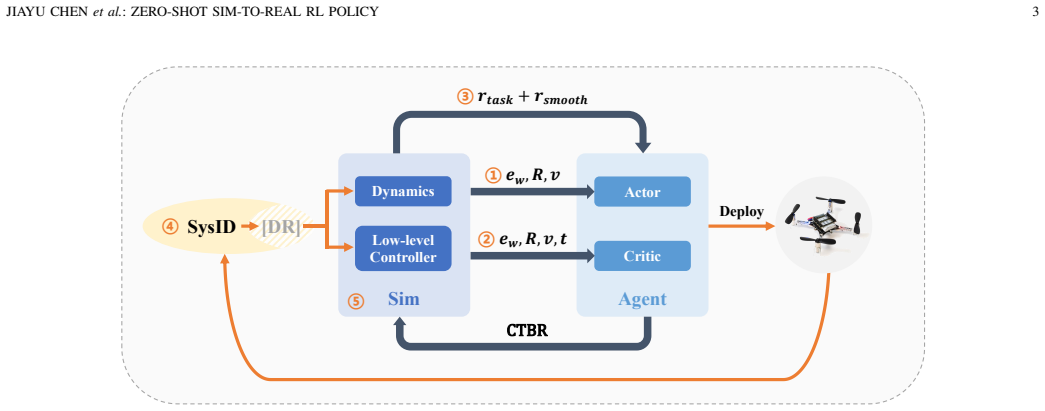
The machinery is the SimpleFlight training pipeline: an asymmetric actor-critic PPO setup whose actions are CTBR commands (collective thrust and body rates). The actor observes relative positions to ten future reference points, linear velocity, and the rotation matrix; the critic observes the same plus a scalar time vector. The reward augments the tracking task with $e^{-\|u_t-u_{t-1}\|_2}$, which directly penalizes jumps between successive commands. Before training, four dynamic parameters (mass, inertia, thrust coefficient, and motor time constant) are calibrated, and domain randomization is applied selectively, principally to the thrust coefficient; the low-level controller inside the simulator is aligned to the firmware's response. Training runs in a GPU-parallel simulator with large batches, and the resulting policy is deployed without modification.
What would settle it
Run the paper's Offset+30% condition on a real quadrotor: if deliberately shifting the thrust coefficient $k_f$ by +30% does not raise tracking error well above the calibrated policy's error, the claim that $k_f$ is a sensitive parameter and that system identification is load-bearing is contradicted. A complementary test is to compare simulated and real motor step responses, since the low-level controller alignment premise must hold for any zero-shot transfer.
Extended reading notes
Core claim
SimpleFlight claims that a PPO-based policy trained with five specific choices—velocity and rotation matrix in the actor's observation, a time vector in the critic's observation, an action-difference smoothness reward $\|u_t-u_{t-1}\|_2$, calibrated dynamics with domain randomization applied only to the thrust coefficient, and large training batch sizes—can be deployed directly on real quadrotors without fine-tuning. In real-world tests on a nano quadrotor, it reports a reduction of more than 50% in mean Euclidean distance to the reference trajectory compared with state-of-the-art RL baselines, and it is the only tested policy that completes all benchmark trajectories, including fast pentagram and infeasible zigzag paths. The same policy class also transfers to a larger custom quadrotor, where it slightly outperforms a finely tuned model-predictive controller. The paper's claim is that the five factors, not any new algorithm or architecture, are what make zero-shot transfer work.
Load-bearing premise
The whole zero-shot claim rests on the simulated low-level controller and the rigid-body dynamics matching the real quadrotor's firmware and airframe closely enough that a policy trained in simulation faces the same input-output mapping on hardware.
Editorial extensions
If this is right
- Any future RL quadrotor controller that adopts these five factors should expect at least a halving of trajectory tracking error on smooth trajectories compared with current RL baselines, under zero-shot deployment.
- Small thrust-to-weight quadrotors can track infeasible zigzag trajectories that previously required optimization-based methods, because the action-difference smoothness regularizer supports long-horizon planning without clipping agility.
- Larger batch sizes are a free lunch: they improve real-world generalization with no change to architecture or reward.
- Domain randomization should be applied selectively; randomizing well-calibrated mass or inertia can hurt real-world performance, while randomizing the thrust coefficient helps when calibration is imperfect.
- The recipe is platform-transferable: the same policy class transfers to a second, larger custom quadrotor and remains competitive with a finely tuned MPC controller.
Reading between the lines
- The paper's ablations imply that rotation-matrix inputs are a first-order factor for agile flight, so the same representation choice likely matters for other rotation-controlled robots, not just quadrotors.
- Since the lookahead horizon is fixed at $N=10$ without ablation, a natural extension is to sweep $N$ on infeasible trajectories, where longer horizons should matter most.
- The selective-domain-randomization result suggests a practical tuning rule: randomize only parameters that are hard to measure and performance-sensitive, and leave precisely measurable ones fixed.
- The time-vector result hints that adding task-phase information to value networks could be a cheap general trick for non-stationary RL problems beyond quadrotor control.
Editorial analysis
A structured set of objections, weighed in public.
Referee Report
Summary. The paper identifies five factors for learning zero-shot sim-to-real RL policies for quadrotor trajectory tracking: actor inputs including velocity and rotation matrix, critic-only time vector, action-difference smoothness regularization, system identification with selective domain randomization, and large batch sizes. These factors are combined into a PPO-based framework called SimpleFlight. The authors validate SimpleFlight on a Crazyflie 2.1 and a custom 'Air' quadrotor, reporting over 50% reduction in mean Euclidean distance tracking error against two RL baselines (Fly, DATT) and comparable or better performance than a fine-tuned MPC baseline (PAMPC). The paper also integrates SimpleFlight into the Omnidrones simulator and open-sources code and checkpoints.
Significance. If the central claim holds, this is a valuable empirical study that consolidates several known-but-scattered design choices into a concrete recipe and demonstrates real-world viability on low-thrust-to-weight quadrotors. The open-source release and Omnidrones integration are concrete assets for reproducibility. However, the headline quantitative claim is compromised by the fact that several recipe components were selected using real-world performance on the same figure-eight benchmark that appears in the final evaluation, and the paper itself acknowledges that the baseline comparison is not entirely fair. These issues make the reported 50% improvement an in-sample estimate rather than a validated zero-shot prediction, so the strongest claims in the abstract and Section V need revision or additional holdout experiments before they can be accepted as stated.
major comments (3)
- [§V-B2, V-B3, V-B4; Fig. 4; Table II; Fig. 5; Table III] The smoothness reward coefficient λ is set to 0.4 based on real-world figure-eight tracking performance (Fig. 4), the domain-randomization ranges and conclusions are derived from real-world figure-eight experiments (Table II), and the batch-size recommendation is based on real-world figure-eight curves (Fig. 5). These same figure-eight trajectories (slow, normal, fast) are then reported in the final comparison of Table III. Consequently, the reported "more than 50% reduction" and the "only one capable of successfully completing all benchmarking trajectories" claims are in-sample estimates rather than predictive evidence for a zero-shot recipe. The paper should provide a holdout evaluation on trajectory types or parameter settings that were not used for any hyperparameter selection, or it should explicitly state that the final comparison shares the tuning tasks and correspondingly soften the zero-shot claim.
- [§V-C2 and Table III] The paper states that the comparison in Table III "may not be entirely fair" because the policies use different simulators, modeling approaches, and input/output spaces. Since the headline claim of over 50% error reduction is relative to these baselines, this caveat should be stated in the abstract and in the main text where the claim is made, not only at the end of Section V-C2. Additionally, for DATT on zigzag trajectories, the footnote reports that 4 out of 10 attempts failed and only the successful trials are averaged; the failure rate itself is a primary metric and should be reported in the table or text before any claim that SimpleFlight is "the only one" capable of completing all benchmarks.
- [§V-B3 and Table II] The selective-DR conclusion is based on artificially induced +30% parameter offsets to simulate miscalibration. While this is a reasonable synthetic test, the real calibration errors of the Crazyflie are not quantified, so the practical recommendation that DR should be applied only to thrust coefficient kf is not directly supported by measured calibration uncertainty. A sensitivity analysis over the actual estimated parameter errors, or a statement of the calibration accuracy, would strengthen the factor-4 claim.
minor comments (7)
- [Abstract] The word "polynominal" is a typo and should be "polynomial."
- [Section I] The text "U A Vs" in the introduction should be "UAVs" without spaces.
- [Section III-B] The text "17-dimensinal" is a typo and should be "17-dimensional."
- [Section V-B1] The observed "approximately 63.6%" performance degradation when replacing the rotation matrix with a quaternion is not derived from any displayed curve; please specify the exact quantities or figure from which this percentage is computed.
- [Section V-B2 and Table I] The smoothness reward is presented in Eq. (4) as a generic rsmooth, but Table I evaluates components using raux = e^{-A}; please clarify the relationship between these two formulations, particularly how ||ut - ut-1||2 is inserted as A.
- [Table III] For trajectories where some trials fail, the MED is reported only over successful trials (e.g., DATT zigzag). Please add a column or annotation showing the number of successful trials per method and trajectory, since "∞" alone does not distinguish partial from total failure.
- [References] References [7] and [39] both cite Williams et al. on information-theoretic MPC; please merge or differentiate them.
Circularity Check
No significant circularity: the five-factor recipe is an empirical ablation validated by real-world deployment; the figure-eight hyperparameter selection is a test-set fairness caveat, not a circular derivation.
full rationale
The central claim is an experimental result: PPO policies trained in OmniDrones with five specified factors are deployed zero-shot on Crazyflie and Air, and their measured mean Euclidean distances are compared with baselines. The five factors are identified through ablations (Fig. 3, Tab. I, Tab. II, Fig. 5), not derived from the final metric by construction. The reported tracking errors are determined by simulation training and real flight measurements, not by a fitted equation, so no step equates the prediction to its input by construction. The self-citation to OmniDrones [17] is a tool citation and is not load-bearing: the transfer results are real-world measurements, and the simulator is open-source. The only in-scope caveat is that lambda, DR ranges, and batch size are selected using real-world figure-eight experiments (Sec. V-B2: 'Based on these findings, we set lambda = 0.4'; Sec. V-B3; Sec. V-B4: 'we test simulation and real-world performance using figure-eight trajectories'), and the same figure-eight task reappears in the final comparison in Tab. III. This makes the figure-eight column an in-sample estimate rather than an independent prediction, and the paper's own remark that the Tab. III comparison 'may not be entirely fair' reinforces caution about the exact margins. However, this is test-set selection, not circular derivation: the figure-eight MED is not equal to lambda or to the tuning objective by construction, and the central zero-shot claim also rests on out-of-distribution pentagram/zigzag results and cross-platform Air experiments that were not tuned on those real-world tasks. No self-definitional, uniqueness-import, ansatz-smuggling, or renaming circularity is present.
Assumptions & free parameters
free parameters (7)
- lambda (smoothness reward weight) =
0.4
- N (lookahead waypoint count) =
10
- k (time vector dimension) =
1
- Mass m =
not reported
- Inertia matrix I =
not reported
- Thrust coefficient k_f =
not reported
- Motor time constant T_m =
not reported
assumptions (5)
- domain assumption Quadrotor dynamics follow a 6-DOF rigid-body model with first-order motor response (Eq. (1)-(3)).
- domain assumption After calibration, the simulated low-level CTBR controller matches the real firmware.
- standard math PPO with the specified MLP architecture can represent the optimal control policy.
- domain assumption Motion capture provides accurate state at 100 Hz and the offboard control loop meets the timing.
- ad hoc to paper The five selected factors are the critical determinants of zero-shot sim-to-real performance.
Cite this review
Pith. "Pith review of What Matters in Learning A Zero-Shot Sim-to-Real RL Policy for Quadrotor Control? A Comprehensive Study." pith.science (2026). https://pith.science/paper/6OXUH6ZR
@misc{pith2026241211764,
  author       = {Pith},
  title        = {Pith review of: What Matters in Learning A Zero-Shot Sim-to-Real RL Policy for Quadrotor Control? A Comprehensive Study},
  year         = {2026},
  howpublished = {\url{https://pith.science/paper/6OXUH6ZR}},
  note         = {Machine review of arXiv:2412.11764}
}
read the original abstract
Executing precise and agile flight maneuvers is critical for quadrotors in various applications. Traditional quadrotor control approaches are limited by their reliance on flat trajectories or time-consuming optimization, which restricts their flexibility. Recently, RL-based policy has emerged as a promising alternative due to its ability to directly map observations to actions, reducing the need for detailed system knowledge and actuation constraints. However, a significant challenge remains in bridging the sim-to-real gap, where RL-based policies often experience instability when deployed in real world. In this paper, we investigate key factors for learning robust RL-based control policies that are capable of zero-shot deployment in real-world quadrotors. We identify five critical factors and we develop a PPO-based training framework named SimpleFlight, which integrates these five techniques. We validate the efficacy of SimpleFlight on Crazyflie quadrotor, demonstrating that it achieves more than a 50% reduction in trajectory tracking error compared to state-of-the-art RL baselines. The policy derived by SimpleFlight consistently excels across both smooth polynominal trajectories and challenging infeasible zigzag trajectories on small thrust-to-weight quadrotors. In contrast, baseline methods struggle with high-speed or infeasible trajectories. To support further research and reproducibility, we integrate SimpleFlight into a GPU-based simulator Omnidrones and provide open-source access to the code and model checkpoints. We hope SimpleFlight will offer valuable insights for advancing RL-based quadrotor control. For more details, visit our project website at https://sites.google.com/view/simpleflight/.
Figures


Figures from the paper (1 more)

Reference graph
Works this paper leans on
-
[1]
Low-cost autonomous uav- based solutions to package delivery logistics,
J. Grzybowski, K. Latos, and R. Czyba, “Low-cost autonomous uav- based solutions to package delivery logistics,” in Advanced, Contemporary Control: Proceedings of KKA 2020—The 20th Polish Control Conference, Łód´ z, Poland, 2020. Springer, 2020, pp. 500–507
work page 2020
-
[2]
An autonomous multi-uav system for search and rescue,
J. Scherer, S. Yahyanejad, S. Hayat, E. Yanmaz, T. Andre, A. Khan, V . Vukadinovic, C. Bettstetter, H. Hellwagner, and B. Rinner, “An autonomous multi-uav system for search and rescue,” in Proceedings of the first workshop on micro aerial vehicle networks, systems, and applications for civilian use , 2015, pp. 33–38
work page 2015
-
[3]
A uav system for inspection of industrial facilities,
J. Nikolic, M. Burri, J. Rehder, S. Leutenegger, C. Huerzeler, and R. Siegwart, “A uav system for inspection of industrial facilities,” in 2013 IEEE Aerospace Conference . IEEE, 2013, pp. 1–8
work page 2013
-
[4]
Minimum snap trajectory generation and control for quadrotors,
D. Mellinger and V . Kumar, “Minimum snap trajectory generation and control for quadrotors,” in 2011 IEEE International Conference on Robotics and Automation , 2011, pp. 2520–2525
2011
-
[5]
M. Faessler, A. Franchi, and D. Scaramuzza, “Differential flatness of quadrotor dynamics subject to rotor drag for accurate tracking of high- speed trajectories,” IEEE Robotics and Automation Letters , vol. 3, no. 2, pp. 620–626, 2018
work page 2018
-
[6]
Performance, precision, and payloads: Adaptive nonlinear mpc for quadrotors,
D. Hanover, P. Foehn, S. Sun, E. Kaufmann, and D. Scaramuzza, “Performance, precision, and payloads: Adaptive nonlinear mpc for quadrotors,” IEEE Robotics and Automation Letters , vol. 7, no. 2, pp. 690–697, 2021
work page 2021
-
[7]
Information theoretic mpc for model-based reinforcement learning,
G. Williams, N. Wagener, B. Goldfain, P. Drews, J. M. Rehg, B. Boots, and E. A. Theodorou, “Information theoretic mpc for model-based reinforcement learning,” in 2017 IEEE International Conference on Robotics and Automation (ICRA) , 2017, pp. 1714–1721
2017
-
[8]
Control of a quadrotor with reinforcement learning,
J. Hwangbo, I. Sa, R. Siegwart, and M. Hutter, “Control of a quadrotor with reinforcement learning,” IEEE Robotics and Automation Letters , vol. 2, no. 4, pp. 2096–2103, 2017
2017
Show all 39 references
-
[9]
Optimal and autonomous control using reinforcement learning: A survey,
B. Kiumarsi, K. G. Vamvoudakis, H. Modares, and F. L. Lewis, “Optimal and autonomous control using reinforcement learning: A survey,” IEEE transactions on neural networks and learning systems , vol. 29, no. 6, pp. 2042–2062, 2017
2017
-
[10]
Visual attention prediction improves performance of autonomous drone racing agents,
C. Pfeiffer, S. Wengeler, A. Loquercio, and D. Scaramuzza, “Visual attention prediction improves performance of autonomous drone racing agents,” Plos one, vol. 17, no. 3, p. e0264471, 2022
2022
-
[11]
Datt: Deep adaptive trajectory tracking for quadrotor control,
K. Huang, R. Rana, A. Spitzer, G. Shi, and B. Boots, “Datt: Deep adaptive trajectory tracking for quadrotor control,” in Conference on Robot Learning. PMLR, 2023, pp. 326–340
2023
-
[12]
Neural internal model control: Learning a robust control policy via predictive error feedback,
F. Gao, C. Yu, Y . Wang, and Y . Wu, “Neural internal model control: Learning a robust control policy via predictive error feedback,” arXiv preprint arXiv: 2411.13079 , 2024
2024 arXiv
-
[13]
Autonomous drone racing with deep reinforcement learning,
Y . Song, M. Steinweg, E. Kaufmann, and D. Scaramuzza, “Autonomous drone racing with deep reinforcement learning,” in 2021 IEEE/RSJ International Conference on Intelligent Robots and Systems (IROS) . IEEE, 2021, pp. 1205–1212
2021
-
[14]
Learning to fly in seconds,
J. Eschmann, D. Albani, and G. Loianno, “Learning to fly in seconds,” IEEE Robotics and Automation Letters , vol. 9, no. 7, pp. 6336–6343, 2024
2024
-
[15]
A benchmark comparison of learned control policies for agile quadrotor flight,
E. Kaufmann, L. Bauersfeld, and D. Scaramuzza, “A benchmark comparison of learned control policies for agile quadrotor flight,” in 2022 International Conference on Robotics and Automation (ICRA) . IEEE, 2022, pp. 10 504–10 510
2022
-
[16]
The power of input: Benchmarking zero-shot sim-to-real transfer of reinforcement learning control policies for quadrotor control,
A. Dionigi, G. Costante, and G. Loianno, “The power of input: Benchmarking zero-shot sim-to-real transfer of reinforcement learning control policies for quadrotor control,” in 2024 IEEE/RSJ International Conference on Intelligent Robots and Systems (IROS) . IEEE, 2024, pp. 11 ...
2024
-
[17]
Omnidrones: An efficient and flexible platform for reinforcement learning in drone control,
B. Xu, F. Gao, C. Yu, R. Zhang, Y . Wu, and Y . Wang, “Omnidrones: An efficient and flexible platform for reinforcement learning in drone control,” IEEE Robotics and Automation Letters , 2024
2024
-
[18]
System identification and control using genetic algorithms,
K. Kristinsson and G. A. Dumont, “System identification and control using genetic algorithms,” IEEE Transactions on Systems, Man, and Cybernetics, vol. 22, no. 5, pp. 1033–1046, 1992
1992
-
[19]
Domain randomization for transferring deep neural networks from simulation to the real world,
J. Tobin, R. Fong, A. Ray, J. Schneider, W. Zaremba, and P. Abbeel, “Domain randomization for transferring deep neural networks from simulation to the real world,” in 2017 IEEE/RSJ international conference on intelligent robots and systems (IROS) . IEEE, 2017, pp. 23–30
2017
-
[20]
Training deep networks with synthetic data: Bridging the reality gap by domain randomization,
J. Tremblay, A. Prakash, D. Acuna, M. Brophy, V . Jampani, C. Anil, T. To, E. Cameracci, S. Boochoon, and S. Birchfield, “Training deep networks with synthetic data: Bridging the reality gap by domain randomization,” in Proceedings of the IEEE conference on computer vision and...
2018
-
[21]
Learning dexterous in-hand manipulation,
O. M. Andrychowicz, B. Baker, M. Chociej, R. Jozefowicz, B. McGrew, J. Pachocki, A. Petron, M. Plappert, G. Powell, A. Ray et al., “Learning dexterous in-hand manipulation,” The International Journal of Robotics Research, vol. 39, no. 1, pp. 3–20, 2020
2020
-
[22]
Sim-to-(multi)-real: Transfer of low-level robust control policies to multiple quadrotors,
A. Molchanov, T. Chen, W. Hönig, J. A. Preiss, N. Ayanian, and G. S. Sukhatme, “Sim-to-(multi)-real: Transfer of low-level robust control policies to multiple quadrotors,” in 2019 IEEE/RSJ International Conference on Intelligent Robots and Systems (IROS) . IEEE, 2019, pp. 59–66
2019
-
[23]
Deep drone racing: From simulation to reality with domain randomization,
A. Loquercio, E. Kaufmann, R. Ranftl, A. Dosovitskiy, V . Koltun, and D. Scaramuzza, “Deep drone racing: From simulation to reality with domain randomization,” IEEE Transactions on Robotics , vol. 36, no. 1, pp. 1–14, 2019
2019
-
[24]
Domain-adversarial training of neural networks,
Y . Ganin, E. Ustinova, H. Ajakan, P. Germain, H. Larochelle, F. Laviolette, M. March, and V . Lempitsky, “Domain-adversarial training of neural networks,” Journal of machine learning research , vol. 17, no. 59, pp. 1–35, 2016
2016
-
[25]
Unsupervised pixel-level domain adaptation with generative adversarial networks,
K. Bousmalis, N. Silberman, D. Dohan, D. Erhan, and D. Krishnan, “Unsupervised pixel-level domain adaptation with generative adversarial networks,” in Proceedings of the IEEE conference on computer vision and pattern recognition , 2017, pp. 3722–3731
2017
-
[26]
Unsupervised adversarial domain adaptation for sim-to-real transfer of tactile images,
X. Jing, K. Qian, T. Jianu, and S. Luo, “Unsupervised adversarial domain adaptation for sim-to-real transfer of tactile images,” IEEE Transactions on Instrumentation and Measurement , vol. 72, pp. 1–11, 2023
2023
-
[27]
Learning transferable features with deep adaptation networks,
M. Long, Y . Cao, J. Wang, and M. Jordan, “Learning transferable features with deep adaptation networks,” in International conference on machine learning. PMLR, 2015, pp. 97–105
2015
-
[28]
Sim-to-real visual grasping via state representation learning based on combining pixel-level and feature-level domain adaptation,
Y . Park, S. H. Lee, and I. H. Suh, “Sim-to-real visual grasping via state representation learning based on combining pixel-level and feature-level domain adaptation,” in 2021 IEEE International Conference on Robotics and Automation (ICRA) . IEEE, 2021, pp. 6300–6307
2021
-
[29]
Using simulation optimization to improve zero-shot policy transfer of quadrotors,
S. Gronauer, M. Kissel, L. Sacchetto, M. Korte, and K. Diepold, “Using simulation optimization to improve zero-shot policy transfer of quadrotors,” in 2022 IEEE/RSJ International Conference on Intelligent Robots and Systems (IROS). IEEE, 2022, pp. 10 170–10 176
2022
-
[30]
Neurobem: Hybrid aerodynamic quadrotor model,
L. Bauersfeld, E. Kaufmann, P. Foehn, S. Sun, and D. Scaramuzza, “Neurobem: Hybrid aerodynamic quadrotor model,” arXiv preprint arXiv:2106.08015, 2021
2021 arXiv
-
[31]
Champion-level drone racing using deep reinforcement learning,
E. Kaufmann, L. Bauersfeld, A. Loquercio, M. Müller, V . Koltun, and D. Scaramuzza, “Champion-level drone racing using deep reinforcement learning,” Nature, vol. 620, no. 7976, pp. 982–987, 2023
2023
-
[32]
Learning a single near-hover position controller for vastly different quadcopters,
D. Zhang, A. Loquercio, X. Wu, A. Kumar, J. Malik, and M. W. Mueller, “Learning a single near-hover position controller for vastly different quadcopters,” in 2023 IEEE International Conference on Robotics and Automation (ICRA). IEEE, 2023, pp. 1263–1269
2023
-
[33]
Learning to fly in seconds,
J. Eschmann, D. Albani, and G. Loianno, “Learning to fly in seconds,” IEEE Robotics and Automation Letters , 2024
2024
-
[34]
Rotors—a modular gazebo mav simulator framework,
F. Furrer, M. Burri, M. Achtelik, and R. Siegwart, “Rotors—a modular gazebo mav simulator framework,” Robot Operating System (ROS) The Complete Reference (Volume 1) , pp. 595–625, 2016
2016
-
[35]
Airsim: High-fidelity visual and physical simulation for autonomous vehicles,
S. Shah, D. Dey, C. Lovett, and A. Kapoor, “Airsim: High-fidelity visual and physical simulation for autonomous vehicles,” in Field and Service Robotics: Results of the 11th International Conference . Springer, 2018, pp. 621–635
2018
-
[36]
Proxi- mal policy optimization algorithms,
J. Schulman, F. Wolski, P. Dhariwal, A. Radford, and O. Klimov, “Proxi- mal policy optimization algorithms,” arXiv preprint arXiv:1707.06347 , 2017
2017 arXiv
-
[37]
On the continuity of rotation representations in neural networks,
Y . Zhou, C. Barnes, J. Lu, J. Yang, and H. Li, “On the continuity of rotation representations in neural networks,” in 2019 IEEE/CVF Conference on Computer Vision and Pattern Recognition (CVPR) , 2019, pp. 5738–5746
2019
-
[38]
Pampc: Perception- aware model predictive control for quadrotors,
D. Falanga, P. Foehn, P. Lu, and D. Scaramuzza, “Pampc: Perception- aware model predictive control for quadrotors,” in 2018 IEEE/RSJ International Conference on Intelligent Robots and Systems (IROS) . IEEE, 2018, pp. 1–8
2018
-
[39]
Information theoretic mpc for model-based reinforcement learning,
G. Williams, N. Wagener, B. Goldfain, P. Drews, J. M. Rehg, B. Boots, and E. A. Theodorou, “Information theoretic mpc for model-based reinforcement learning,” in 2017 IEEE international conference on robotics and automation (ICRA) . IEEE, 2017, pp. 1714–1721
2017
Reviewed August 11, 2026 · model on record in the stance chip above.
Discussion (0). Continue with ORCID to comment.