REVIEW 2 major objections 4 minor 1 cited by
Novel features of asymmetric nuclear matter from terrestrial experiments and astrophysical observations of neutron stars
T0 review · 2 major / 4 minor · reviewed 2026-08-12 · deepseek-v4-flash
Pith's one-line read This paper claims that the nuclear symmetry energy softens abruptly at about twice the saturation density, allowing one relativistic mean-field family to satisfy PREX-2, NICER, and GW170817 simultaneously.
desk verdict A competent RMF calibration paper that extends the OMEG program, but the headline symmetry-energy softening is a fitted consequence of an ad hoc mixing term, not an inference from the data. read the letter →
The pith
A machine-rendered reading of the paper's core claim, the machinery that carries it, and where it could break.
The reading
What carries the argument
The load-bearing mechanism is the $\Lambda_{\sigma\delta}\sigma^2(\delta\cdot\delta)$ mixing term in the nonlinear potential of Eq. (3), a coupling between the isoscalar scalar field $\sigma$ and the isovector scalar field $\delta$. Through the effective meson masses $m^{*2}_\sigma$ and $m^{*2}_\delta$, this term makes the scalar contribution to $E_{\rm sym}$ strongly negative above $\rho_0$, producing the sudden drop near $2\rho_0$. The δ-nucleon coupling alone increases neutron-star radii; the mixing counteracts it, delivering the small radii demanded by NICER and GW170817.
What would settle it
Measure the symmetry energy at densities 1.5–3ρ0 via pion ratios or isospin diffusion in heavy-ion collisions; if $E_{\rm sym}(2\rho_0)$ is found to stay above about 50 MeV without a dip, or if a precise radius measurement determines $R_{1.4}>13$ km while the 208Pb skin remains near 0.28 fm, the OMEG softening would be ruled out.
Extended reading notes
Core claim
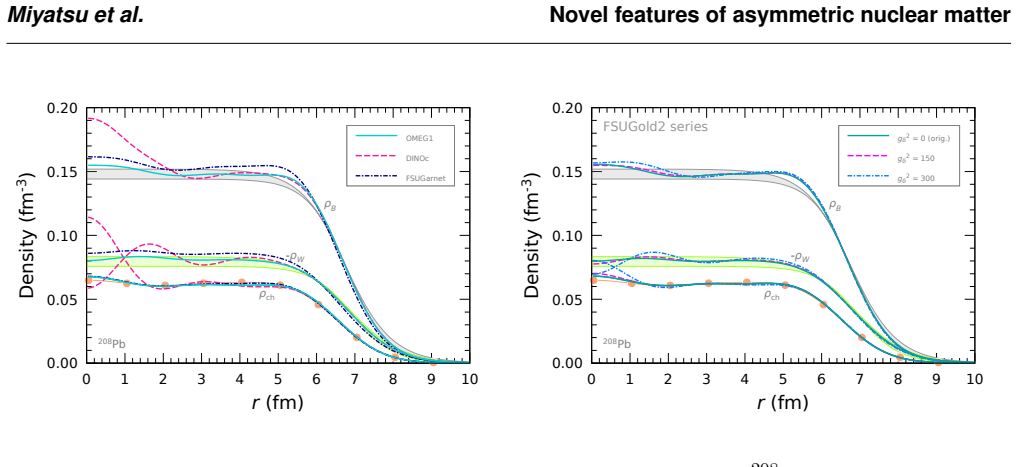
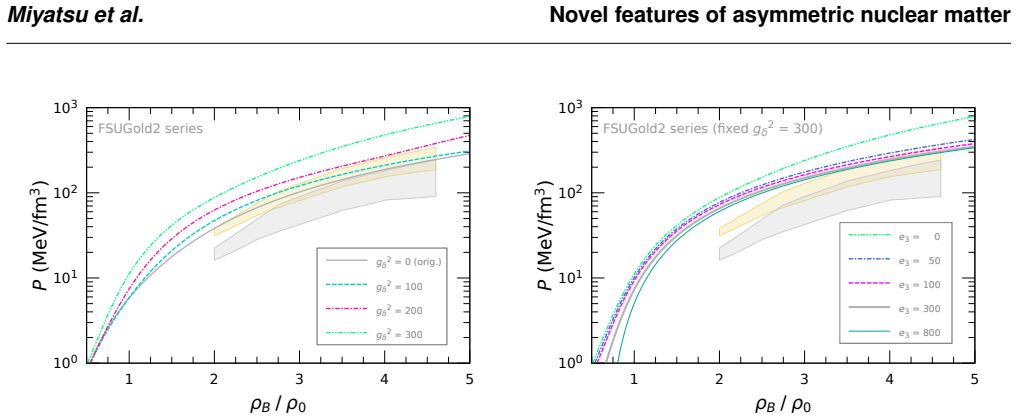
The central discovery is that adding an isoscalar–isovector scalar meson mixing term, specifically $\Lambda_{\sigma\delta}\,\sigma^2(\delta\cdot\delta)$, to a relativistic mean-field Lagrangian with δ-nucleon coupling forces the nuclear symmetry energy $E_{\rm sym}$ to drop sharply near $2\rho_0$ in pure neutron matter, while leaving the behavior below saturation nearly unchanged. This sudden softening makes the neutron-star equation of state soft in the density range probed by canonical 1.4 $M_\odot$ stars, so the same models that predict a PREX-2-like thick neutron skin in 208Pb ($R_{\rm skin}^{208}\simeq0.23$–$0.25$ fm) also give $R_{1.4}\simeq12.4$–$12.8$ km and $\Lambda_{1.4}\simeq460$–$520$, consistent with NICER's measurement of PSR J0437–4715 and GW170817. The authors show that the δ-nucleon coupling alone makes stars too large, and that the quartic ρ-meson self-interaction, while softening the equation of state, destabilizes neutron-star matter.
Load-bearing premise
The σ–δ mixing term in the Lagrangian is an assumed interaction whose strength is tuned to make the symmetry energy drop, so the reconciliation with neutron-star radii rests on that tuning rather than on measured data.
Editorial extensions
If this is right
- If the OMEG models are right, a 1.4 $M_\odot$ neutron star has a radius of 12.4–12.8 km and a dimensionless tidal deformability near 460–520, both testable with NICER-like observations and future gravitational-wave events.
- The symmetry energy is not monotonic in density, so the saturation-slope parameter $L$ alone cannot be extrapolated to neutron-star densities.
- The reconciliation of PREX-2 with astrophysics requires σ–δ mixing, not just the δ meson; models without the mixing (such as the FSUGold2 series) are inconsistent with GW170817 unless artificially softened.
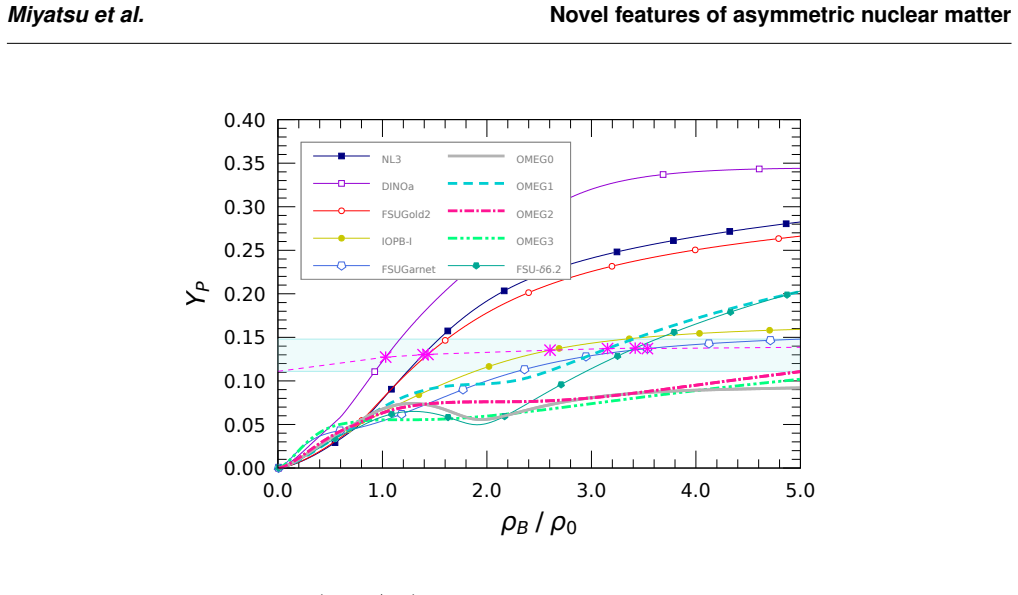
- The same softening suppresses the proton fraction and can turn off the direct URCA process, changing predicted neutron-star cooling behavior.
- The PREX-2/CREX tension is not fully resolved: among all models examined, only DINOc satisfies both parity-violating experiments.
Reading between the lines
- The fitted strength $\Lambda_{\sigma\delta}\simeq70$–$95$ is not derived from first principles; a microscopic or experimental determination of σ–δ mixing strength would directly test the mechanism.
- A precise radius measurement at a slightly different mass, or a tighter heavy-ion pion-ratio constraint near $1.5\rho_0$, could bracket where the softening must occur; current data likely cannot distinguish a dip at $2\rho_0$ from one at $2.5\rho_0$.
- The sudden softening resembles the cusp behavior discussed in other dense-matter approaches, suggesting a possible common physical origin beyond this particular mean-field parametrization.
- If future parity-violating experiments reduce the 208Pb skin uncertainty, the OMEG family's predicted range $R_{\rm skin}^{208}\sim0.23$–$0.25$ fm will be either confirmed or excluded.
Editorial analysis
A structured set of objections, weighed in public.
Referee Report
Summary. The manuscript develops a family of relativistic mean-field (RMF) models, called the OMEG family, that include the δ meson, σ–δ mixing, and the quartic ρ-meson self-interaction in order to reconcile the PREX-2 neutron-skin measurement with the small radii and tidal deformabilities implied by NICER and GW170817. The authors compute ground-state properties of closed-shell nuclei, the density dependence of the nuclear symmetry energy, neutron-star mass–radius relations, and tidal deformabilities, comparing against HIC flow data, PREX-2, CREX, NICER, and GW170817. The central claim is that, once these constraints are taken into account, the symmetry energy softens suddenly at about twice saturation density as a result of σ–δ mixing. The paper is transparent about the calibration procedure in Sec. 4, and it includes analytic formulas for the symmetry energy decomposition and thermodynamic stability conditions (Vμ > 0, VP > 0).
Significance. If the results are interpreted as a calibration study, the paper is a useful contribution: it shows that a particular RMF ansatz with σ–δ mixing can simultaneously accommodate the large PREX-2 skin thickness, the NICER radius of PSR J0437–4715, and the GW170817 tidal-deformability constraint, while maintaining thermodynamic stability and matching HIC flow data. The analytic decomposition of the symmetry energy and the explicit stability checks are valuable, and the prediction that the direct URCA process is suppressed in several OMEG models is testable. However, the headline claim that the symmetry energy 'undergoes a sudden softening' is not a model-independent empirical inference; it is a property produced by a fitted σ^2δ^2 mixing term. The paper's own control series demonstrate this, so the significance of the work lies in demonstrating consistency and a possible resolution, not in extracting a unique feature from the data.
major comments (2)
- [Abstract and §3.3] The abstract's statement that the symmetry energy 'undergoes a sudden softening at approximately twice the saturation density' is presented as an empirical finding, but the softening is generated by the σ^2δ^2 term in Eq. (3), whose coefficient Λσδ is a free parameter calibrated to the same astrophysical data (Table 1; Sec. 4). The manuscript's own controls show this explicitly: for the FSUGold2 series with gδ^2=300 and Λσδ=0, Table 6 gives R1.4=14.74 km and Λ1.4=1334, whereas OMEG1 with Λσδ=95 gives R1.4=12.76 km and Λ1.4=515. The reconciliation with NICER and GW170817 therefore disappears if the mixing term is removed. I recommend rewording the abstract and Sec. 3.3 to state that the softening is a property of a specific fitted ansatz, not a model-independent inference from PREX-2, NICER, and GW170817.
- [§4 and Table 5] The summary says the OMEG family is calibrated to 'the results from the PREX-2 and CREX experiments,' but no single OMEG parameter set satisfies both experiments simultaneously. OMEG0 and OMEG1 meet PREX-2 with R208skin=0.227 fm and 0.245 fm, respectively, yet their R48skin values of 0.201 fm and 0.209 fm lie above the CREX 1σ range of 0.121±0.035 fm. OMEG3, by contrast, gives R48skin=0.161 fm and is near CREX, but its R208skin=0.143 fm is below the PREX-2 1σ range of 0.283±0.071 fm. The text should explicitly say that the family brackets the two experiments collectively rather than implying that each member reconciles them.
minor comments (4)
- [Eqs. (20) and (21)] The quartic δ-meson self-interaction terms in Eqs. (20) and (21) appear to be missing the coefficient d3: the mean-field energy density should contain d3 δ̄^4/4, not δ̄^4/4, and the pressure should contain −d3 δ̄^4/4. This is likely a typographical issue since d3 appears in Eq. (13).
- [Table 6] The column header 'ρt (fm −1)' should be 'ρt (fm −3)', because the crust-core transition density has units of inverse cubic femtometers.
- [Throughout] There are several small typographical and grammatical issues, including 'iso-scalarδ meson' (missing space), 'the our results' in Sec. 3.4, and inconsistent use of 'Vp' and 'VP' in Fig. 9 and the surrounding text.
- [Fig. 1 and Sec. 3.2] The FSUGold2 series with gδ^2=300 shows large density fluctuations around the core of 208Pb (Fig. 2), and the authors note that wave functions do not converge for gδ^2>300. It would be helpful to state more prominently that Rskin values for the highest gδ^2 cases in Table 5 come from solutions with non-smooth central densities, since this weakens the quantitative significance of those points.
Circularity Check
Esym softening is a fitted consequence of the σ–δ mixing term; calibration is transparent, but the abstract's 'It is found' overstates it.
-
fitted input called prediction
[Abstract; Sec. 4 'Summary and Conclusion'; Eq. (3) and Table 1]
"It is found that the nuclear symmetry energy undergoes a sudden softening at approximately twice the saturation density of nuclear matter, taking into account the PREX-2 result, the recent NICER observation of PSR J0437–4715, and the binary neutron star merger, GW170817. ..."
The softening is generated by the term −Λσδ σ²(δ·δ) in Eq. (3); Table 1 sets Λσδ = 70–95 for the OMEG models, and Sec. 4 states that the OMEG parameters were calibrated to satisfy the PREX-2, CREX, HIC, J0740, and GW170817 constraints. The abstract's 'taking into account' therefore reports the behavior of a free parameter fitted to those same data, not an inference from the data. The paper's control series make the reduction explicit: FSUGold2 with gδ²=300 and Λσδ=0 gives R1.4=14.74 km and Λ1.4=1334 (Table 6), while OMEG1 with Λσδ=95 gives R1.4=12.76 km and Λ1.4=515. Set Λσδ=0 and the small-radius/tidal-compatibility mechanism disappears; hence the headline 'sudden softening' is the fitted ansatz renamed as a discovered feature.
full rationale
The paper is a calibration study: the OMEG parameters, including Λσδ, are chosen to satisfy HIC flow, PSR J0740+6620, GW170817 tidal deformability, and PREX-2/CREX skins (Sec. 4). Within that declared scope the calculations are internally consistent, and the J0437-4715 radius comparison is a legitimate, non-fitted check. The circularity is confined to the framing of the headline result: the 'sudden softening' of Esym near 2ρ0 is not discovered from 'taking into account' PREX-2/NICER/GW170817, but is generated by the fitted σ²δ² coupling. The paper itself shows the mechanism is necessary: without Λσδ the FSUGold2-type models with large gδ² produce R1.4 ≈ 14.7 km and Λ1.4 ≈ 1334, far outside the NICER/GW170817 bands. Hence the feature is an attribute of the chosen ansatz after calibration, not an independent prediction. Citations to the authors' earlier work introduce the OMEG family, but the present paper re-derives the equations and gives the parameter tables, so self-citation is not the load-bearing element. The central issue is the fitted-input-called-prediction pattern in the abstract and summary, giving a partial circularity score of 6 rather than 8 or 10.
Assumptions & free parameters
free parameters (4)
- g_delta^2 (delta-nucleon coupling) =
OMEG0-3: 37.7, 30.0, 20.0, 15.0; FSUGold2 series up to 300
- Lambda_sigma_delta (sigma-delta mixing) =
OMEG0-3: 87, 95, 85, 70
- e3 (quartic rho self-interaction) =
0 to 800
- Lambda_omega_rho (vector meson mixing) =
Table 1 values, e.g., OMEG0: 102.6
assumptions (4)
- domain assumption Mean-field approximation: meson fields are replaced by classical expectation values, neglecting Fock terms and vacuum polarization.
- domain assumption The delta meson (a0(980)) is treated as a pointlike isovector-scalar mean-field degree of freedom.
- ad hoc to paper The sigma-delta mixing terms (Gamma_sigma_delta sigma delta^2 and Lambda_sigma_delta sigma^2 delta^2) are physically meaningful and can be large.
- domain assumption The crust EoS (MYN13) can be matched to the uniform core EoS at the crust-core transition.
invented entities (2)
-
sigma-delta meson mixing interaction (Gamma_sigma_delta sigma delta^2 and Lambda_sigma_delta sigma^2 delta^2)
-
quartic rho-meson self-interaction (e3 (rho_mu · rho_mu)^2)
Cite this review
Pith. "Pith review of Novel features of asymmetric nuclear matter from terrestrial experiments and astrophysical observations of neutron stars." pith.science (2026). https://pith.science/paper/MRSVUCNU
@misc{pith2026241113210,
  author       = {Pith},
  title        = {Pith review of: Novel features of asymmetric nuclear matter from terrestrial experiments and astrophysical observations of neutron stars},
  year         = {2026},
  howpublished = {\url{https://pith.science/paper/MRSVUCNU}},
  note         = {Machine review of arXiv:2411.13210}
}
abstract
The accurate measurement of neutron skin thickness of $^{208}$Pb by the PREX Collaboration suggests a large value of the nuclear symmetry energy slope parameter, $L$, whereas the smaller $L$ is preferred to account for the small neutron-star radii from NICER observations. To resolve this discrepancy between nuclear experiments and astrophysical observations, new effective interactions have been developed using relativistic mean-field models with the isoscalar- and isovector-meson mixing. We investigate the effects of $\delta$-nucleon coupling and $\sigma$--$\delta$ mixing on the ground-state properties of finite nuclei, as well as the characteristics of isospin-asymmetric nuclear matter and neutron stars. Additionally, we explore the role of the quartic $\rho$-meson self-interaction in dense nuclear matter to mitigate the stiff equation of state for neutron stars resulting from the large $\delta$-nucleon coupling. It is found that the nuclear symmetry energy undergoes a sudden softening at approximately twice the saturation density of nuclear matter, taking into account the PREX-2 result, the recent NICER observation of PSR J0437$-$4715, and the binary neutron star merger, GW170817.
Figures


Figures from the paper (9 more)






Forward citations
Cited by 1 Pith paper
-
Quarkyonic Quark-Meson Coupling Model for Nuclear and Neutron Matter
A quark-based nuclear matter model combining quarkyonic Pauli blocking with quark-meson coupling can be tuned to reproduce neutron-star and heavy-ion constraints.
Reference graph
Works this paper leans on
-
[1]
, " * write output.state after.block = add.period write newline
ENTRY address annote author booktitle chapter doi edition editor eid howpublished institution journal key language month note number organization pages publisher school series title type volume year label extra.label sort.label short.list INTEGERS output.state before.all mid.sentence after.sentence after.block FUNCTION init.state.consts #0 'before.all := ...
-
[2]
write newline
" write newline "" before.all 'output.state := FUNCTION n.dashify 't := "" t empty not t #1 #1 substring "-" = t #1 #2 substring "--" = not "--" * t #2 global.max substring 't := t #1 #1 substring "-" = "-" * t #2 global.max substring 't := while if t #1 #1 substring * t #2 global.max substring 't := if while FUNCTION word.in bbl.in capitalize " " * FUNCT...
-
[3]
Abbott, B. P., Abbott, R., Abbott, T. D., et al. (2017). GW170817: Observation of Gravitational Waves from a Binary Neutron Star Inspiral . Phys. Rev. Lett. 119, 161101. doi:10.1103/PhysRevLett.119.161101 LIGOScientific:2017vwq
-
[4]
Abbott, B. P., Abbott, R., Abbott, T. D., et al. (2018). GW170817: Measurements of neutron star radii and equation of state . Phys. Rev. Lett. 121, 161101. doi:10.1103/PhysRevLett.121.161101 LIGOScientific:2018cki
-
[5]
Abbott, B. P., Abbott, R., Abbott, T. D., et al. (2019). Properties of the binary neutron star merger GW170817 . Phys. Rev. X 9, 011001. doi:10.1103/PhysRevX.9.011001 LIGOScientific:2018hze
-
[6]
Abbott, R., Abbott, T. D., Abraham, S., et al. (2020). GW190814: Gravitational Waves from the Coalescence of a 23 Solar Mass Black Hole with a 2.6 Solar Mass Compact Object . Astrophys. J. Lett. 896, L44. doi:10.3847/2041-8213/ab960f LIGOScientific:2020zkf
-
[7]
Adhikari, D. et al. (2021). Accurate Determination of the Neutron Skin Thickness of ^ 208 Pb through Parity-Violation in Electron Scattering . Phys. Rev. Lett. 126, 172502. doi:10.1103/PhysRevLett.126.172502 PREX:2021umo
-
[8]
Adhikari, D. et al. (2022). Precision Determination of the Neutral Weak Form Factor of ^ 48 Ca . Phys. Rev. Lett. 129, 042501. doi:10.1103/PhysRevLett.129.042501 CREX:2022kgg
Show all 150 references
-
[9]
K., Fortin, M., Pais, H., Provid\^encia, C., Raduta, A
Alam, N., Agrawal, B. K., Fortin, M., Pais, H., Provid\^encia, C., Raduta, A. R., et al. (2016). Strong correlations of neutron star radii with the slopes of nuclear matter incompressibility and symmetry energy at saturation . Phys. Rev. C 94, 052801. doi:10.1103/PhysRevC.94.0...
2016 doi
-
[10]
G., Brodie, L., Haber, A., and Tews, I
Alford, M. G., Brodie, L., Haber, A., and Tews, I. (2022). Relativistic mean-field theories for neutron-star physics based on chiral effective field theory . Phys. Rev. C 106, 055804. doi:10.1103/PhysRevC.106.055804 Alford:2022bpp
2022 doi
-
[11]
Annala, E., Gorda, T., Kurkela, A., and Vuorinen, A. (2018). Gravitational-wave constraints on the neutron-star-matter Equation of State . Phys. Rev. Lett. 120, 172703. doi:10.1103/PhysRevLett.120.172703 Annala:2017llu
2018 doi
-
[12]
Arzoumanian, Z., Brazier, A., Burke-Spolaor, S., et al. (2018). The NANOGrav 11-year Data Set: High-precision timing of 45 Millisecond Pulsars . Astrophys. J. Suppl. 235, 37. doi:10.3847/1538-4365/aab5b0 NANOGrav:2017wvv
2018 doi
-
[13]
A., and Pethick, C
Baym, G., Bethe, H. A., and Pethick, C. (1971). Neutron star matter . Nucl. Phys. A 175, 225--271. doi:10.1016/0375-9474(71)90281-8 Baym:1971ax
1971 doi
-
[14]
A., Brown, G
Bethe, H. A., Brown, G. E., Applegate, J., and Lattimer, J. M. (1979). Equation of state in the gravitational collapse of stars . Nucl. Phys. A 324, 487--533. doi:10.1016/0375-9474(79)90596-7 Bethe:1979zd
1979 doi
-
[15]
Birkhan, J. et al. (2017). Electric dipole polarizability of ^ 48 Ca and implications for the neutron skin . Phys. Rev. Lett. 118, 252501. doi:10.1103/PhysRevLett.118.252501 Birkhan:2016qkr
2017 doi
-
[16]
and Bodmer, A
Boguta, J. and Bodmer, A. R. (1977). Relativistic Calculation of Nuclear Matter and the Nuclear Surface . Nucl. Phys. A 292, 413--428. doi:10.1016/0375-9474(77)90626-1 Boguta:1977xi
1977 doi
-
[17]
and Chen, L.-W
Cai, B.-J. and Chen, L.-W. (2012). Lorentz covariant nucleon self-energy decomposition of the nuclear symmetry energy . Phys. Lett. B 711, 104--108. doi:10.1016/j.physletb.2012.03.058 Cai:2012en
2012 doi
-
[18]
Centelles, M., Roca-Maza, X., Vinas, X., and Warda, M. (2009). Nuclear symmetry energy probed by neutron skin thickness of nuclei . Phys. Rev. Lett. 102, 122502. doi:10.1103/PhysRevLett.102.122502 Centelles:2008vu
2009 doi
-
[19]
Chen, L.-W. (2015). Symmetry energy systematics and its high density behavior . EPJ Web Conf. 88, 00017. doi:10.1051/epjconf/20158800017 Chen:2015gba
2015
-
[20]
M., Li, B.-A., Shen, C., and Xu, J
Chen, L.-W., Cai, B.-J., Ko, C. M., Li, B.-A., Shen, C., and Xu, J. (2009). High-order effects on the incompressibility of isospin asymmetric nuclear matter . Phys. Rev. C 80, 014322. doi:10.1103/PhysRevC.80.014322 Chen:2009wv
2009 doi
-
[21]
M., and Li, B.-A
Chen, L.-W., Ko, C. M., and Li, B.-A. (2005 a ). Determination of the stiffness of the nuclear symmetry energy from isospin diffusion . Phys. Rev. Lett. 94, 032701. doi:10.1103/PhysRevLett.94.032701 Chen:2004si
2005 doi
-
[22]
M., and Li, B.-A
Chen, L.-W., Ko, C. M., and Li, B.-A. (2005 b ). Nuclear matter symmetry energy and the neutron skin thickness of heavy nuclei . Phys. Rev. C 72, 064309. doi:10.1103/PhysRevC.72.064309 Chen:2005ti
2005 doi
-
[23]
M., and Li, B.-A
Chen, L.-W., Ko, C. M., and Li, B.-A. (2007). Isospin-dependent properties of asymmetric nuclear matter in relativistic mean-field models . Phys. Rev. C 76, 054316. doi:10.1103/PhysRevC.76.054316 Chen:2007ih
2007 doi
-
[24]
and Piekarewicz, J
Chen, W.-C. and Piekarewicz, J. (2014). Building relativistic mean field models for finite nuclei and neutron stars . Phys. Rev. C 90, 044305. doi:10.1103/PhysRevC.90.044305 Chen:2014sca
2014 doi
-
[25]
and Piekarewicz, J
Chen, W.-C. and Piekarewicz, J. (2015). Searching for isovector signatures in the neutron-rich oxygen and calcium isotopes . Phys. Lett. B 748, 284--288. doi:10.1016/j.physletb.2015.07.020 Chen:2014mza
2015 doi
-
[26]
Choudhury, D. et al. (2024). A NICER View of the Nearest and Brightest Millisecond Pulsar: PSR J0437 4715 . Astrophys. J. Lett. 971, L20. doi:10.3847/2041-8213/ad5a6f Choudhury:2024xbk
2024 doi
-
[27]
Cromartie, H. T. et al. (2019). Relativistic Shapiro delay measurements of an extremely massive millisecond pulsar . Nature Astron. 4, 72--76. doi:10.1038/s41550-019-0880-2 NANOGrav:2019jur
2019 doi
-
[28]
Czerski, P., De Pace , A., and Molinari, A. (2002). Revisiting the Hugenholtz-Van Hove theorem in nuclear matter . Phys. Rev. C 65, 044317. doi:10.1103/PhysRevC.65.044317 Czerski:2002pz
2002 doi
-
[29]
Danielewicz, P., Lacey, R., and Lynch, W. G. (2002). Determination of the equation of state of dense matter . Science 298, 1592--1596. doi:10.1126/science.1078070 Danielewicz:2002pu
2002 doi
-
[30]
W., and De Vries , C
De Vries , H., De Jager , C. W., and De Vries , C. (1987). Nuclear charge and magnetization density distribution parameters from elastic electron scattering . Atom. Data Nucl. Data Tabl. 36, 495--536. doi:10.1016/0092-640X(87)90013-1 DeVries:1987atn
1987 doi
-
[31]
Demorest, P., Pennucci, T., Ransom, S., Roberts, M., and Hessels, J. (2010). Shapiro Delay Measurement of A Two Solar Mass Neutron Star . Nature 467, 1081--1083. doi:10.1038/nature09466 Demorest:2010bx
2010 doi
-
[32]
S., Carlson, B
Dutra, M., Louren c o, O., Avancini, S. S., Carlson, B. V., Delfino, A., Menezes, D. P., et al. (2014). Relativistic Mean-Field Hadronic Models under Nuclear Matter Constraints . Phys. Rev. C 90, 055203. doi:10.1103/PhysRevC.90.055203 Dutra:2014qga
2014 doi
-
[33]
Estee, J. et al. (2021). Probing the Symmetry Energy with the Spectral Pion Ratio . Phys. Rev. Lett. 126, 162701. doi:10.1103/PhysRevLett.126.162701 SpiRIT:2021gtq
2021 doi
-
[34]
J., Horowitz, C
Fattoyev, F. J., Horowitz, C. J., Piekarewicz, J., and Reed, B. (2020). GW190814: Impact of a 2.6 solar mass neutron star on the nucleonic equations of state . Phys. Rev. C 102, 065805. doi:10.1103/PhysRevC.102.065805 Fattoyev:2020cws
2020 doi
-
[35]
J., Horowitz, C
Fattoyev, F. J., Horowitz, C. J., Piekarewicz, J., and Shen, G. (2010). Relativistic effective interaction for nuclei, giant resonances, and neutron stars . Phys. Rev. C 82, 055803. doi:10.1103/PhysRevC.82.055803 Fattoyev:2010mx
2010 doi
-
[36]
Fattoyev, F. J. and Piekarewicz, J. (2010). Sensitivity of the Moment of Inertia of Neutron Stars to the Equation of State of Neutron-Rich Matter . Phys. Rev. C 82, 025810. doi:10.1103/PhysRevC.82.025810 Fattoyev:2010tb
2010 doi
-
[37]
Fattoyev, F. J. and Piekarewicz, J. (2013). Has a thick neutron skin in ^ 208 Pb been ruled out? Phys. Rev. Lett. 111, 162501. doi:10.1103/PhysRevLett.111.162501 Fattoyev:2013yaa
2013 doi
-
[38]
Fonseca, E. et al. (2021). Refined Mass and Geometric Measurements of the High-mass PSR J0740+6620 . Astrophys. J. Lett. 915, L12. doi:10.3847/2041-8213/ac03b8 Fonseca:2021wxt
2021 doi
-
[39]
Fuchs, C. (2006). Kaon production in heavy ion reactions at intermediate energies . Prog. Part. Nucl. Phys. 56, 1--103. doi:10.1016/j.ppnp.2005.07.004 Fuchs:2005zg
2006 doi
-
[40]
Glendenning, N. K. (1997). Compact stars: Nuclear physics, particle physics, and general relativity Glendenning:1997wn
1997
-
[41]
Glendenning, N. K. and Moszkowski, S. A. (1991). Reconciliation of neutron star masses and binding of the lambda in hypernuclei . Phys. Rev. Lett. 67, 2414--2417. doi:10.1103/PhysRevLett.67.2414 Glendenning:1991es
1991 doi
-
[42]
Guichon, P. A. M. (1988). A Possible Quark Mechanism for the Saturation of Nuclear Matter . Phys. Lett. B 200, 235--240. doi:10.1016/0370-2693(88)90762-9 Guichon:1987jp
1988 doi
-
[43]
Haidari, M. M. and Sharma, M. M. (2008). Sigma-omega meson coupling and properties of nuclei and nuclear matter . Nucl. Phys. A 803, 159--172. doi:10.1016/j.nuclphysa.2008.02.296 Haidari:2007cg
2008 doi
-
[44]
Hinderer, T. (2008). Tidal Love numbers of neutron stars . Astrophys. J. 677, 1216--1220. doi:10.1086/533487. [Erratum: Astrophys.J. 697, 964 (2009)] Hinderer:2007mb
2008 doi
-
[45]
D., Lang, R
Hinderer, T., Lackey, B. D., Lang, R. N., and Read, J. S. (2010). Tidal deformability of neutron stars with realistic equations of state and their gravitational wave signatures in binary inspiral . Phys. Rev. D 81, 123016. doi:10.1103/PhysRevD.81.123016 Hinderer:2009ca
2010 doi
-
[46]
Horowitz, C. J. and Piekarewicz, J. (2001 a ). Neutron star structure and the neutron radius of Pb-208 . Phys. Rev. Lett. 86, 5647. doi:10.1103/PhysRevLett.86.5647 Horowitz:2000xj
2001 doi
-
[47]
Horowitz, C. J. and Piekarewicz, J. (2001 b ). The Neutron radii of Pb-208 and neutron stars . Phys. Rev. C 64, 062802. doi:10.1103/PhysRevC.64.062802 Horowitz:2001ya
2001 doi
-
[48]
Horowitz, C. J. and Piekarewicz, J. (2002). Constraining URCA cooling of neutron stars from the neutron radius of Pb-208 . Phys. Rev. C 66, 055803. doi:10.1103/PhysRevC.66.055803 Horowitz:2002mb
2002 doi
-
[49]
J., Pollock, S
Horowitz, C. J., Pollock, S. J., Souder, P. A., and Michaels, R. (2001). Parity violating measurements of neutron densities . Phys. Rev. C 63, 025501. doi:10.1103/PhysRevC.63.025501 Horowitz:1999fk
2001 doi
-
[50]
Horowitz, C. J. et al. (2012). Weak charge form factor and radius of 208Pb through parity violation in electron scattering . Phys. Rev. C 85, 032501. doi:10.1103/PhysRevC.85.032501 Horowitz:2012tj
2012 doi
-
[51]
Hu, J., Bao, S., Zhang, Y., Nakazato, K., Sumiyoshi, K., and Shen, H. (2020). Effects of symmetry energy on the radius and tidal deformability of neutron stars in the relativistic mean-field model . PTEP 2020, 043D01. doi:10.1093/ptep/ptaa016 Hu:2020ujf
2020 doi
-
[52]
Katayama, T., Miyatsu, T., and Saito, K. (2012). EoS for massive neutron stars . Astrophys. J. Suppl. 203, 22. doi:10.1088/0067-0049/203/2/22 Katayama:2012ge
2012 doi
-
[53]
Kubis, S. (2007). The nuclear symmetry energy and stability of matter in neutron star . Phys. Rev. C 76, 025801. doi:10.1103/PhysRevC.76.025801 Kubis:2006kb
2007 doi
-
[54]
A., and Zabari, N
Kubis, S., W \'o jcik, W., Castillo, D. A., and Zabari, N. (2023). Relativistic mean-field model for the ultracompact low-mass neutron star HESS J1731-347 . Phys. Rev. C 108, 045803. doi:10.1103/PhysRevC.108.045803 Kubis:2023gxa
2023 doi
-
[55]
Kubis, S., W \'o jcik, W., and Zabari, N. (2020). Multilayer neutron stars with scalar mesons crossing term . Phys. Rev. C 102, 065803. doi:10.1103/PhysRevC.102.065803 Kubis:2020ysv
2020 doi
-
[56]
K., and Patra, S
Kumar, B., Agrawal, B. K., and Patra, S. K. (2018). New relativistic effective interaction for finite nuclei, infinite nuclear matter and neutron stars . Phys. Rev. C 97, 045806. doi:10.1103/PhysRevC.97.045806 Kumar:2017wqp
2018 doi
-
[57]
Kumar, S., Kumar, M., Kumar, R., and Dhiman, S. K. (2023). Implications of isoscalar and isovector scalar meson mixed interaction on nuclear and neutron star properties . Phys. Rev. C 108, 055802. doi:10.1103/PhysRevC.108.055802 PhysRevC.108.055802
2023 doi
-
[58]
A., Konig, J., and Ring, P
Lalazissis, G. A., Konig, J., and Ring, P. (1997). A New parametrization for the Lagrangian density of relativistic mean field theory . Phys. Rev. C 55, 540--543. doi:10.1103/PhysRevC.55.540 Lalazissis:1996rd
1997 doi
-
[59]
Lattimer, J. M. (2014). Symmetry energy in nuclei and neutron stars . Nucl. Phys. A 928, 276--295. doi:10.1016/j.nuclphysa.2014.04.008 Lattimer:2014scr
2014 doi
-
[60]
Lattimer, J. M. (2023). Constraints on Nuclear Symmetry Energy Parameters . Particles 6, 30--56. doi:10.3390/particles6010003 Lattimer:2023rpe
2023 doi
-
[61]
Lattimer, J. M. and Prakash, M. (2007). Neutron Star Observations: Prognosis for Equation of State Constraints . Phys. Rept. 442, 109--165. doi:10.1016/j.physrep.2007.02.003 Lattimer:2006xb
2007 doi
-
[62]
M., Prakash, M., Pethick, C
Lattimer, J. M., Prakash, M., Pethick, C. J., and Haensel, P. (1991). Direct URCA process in neutron stars . Phys. Rev. Lett. 66, 2701--2704. doi:10.1103/PhysRevLett.66.2701 Lattimer:1991ib
1991 doi
-
[63]
Lattimer, J. M. and Swesty, F. D. (1991). A Generalized equation of state for hot, dense matter . Nucl. Phys. A 535, 331--376. doi:10.1016/0375-9474(91)90452-C Lattimer:1991nc
1991 doi
-
[64]
K., Ma, Y.-L., Paeng, W.-G., and Rho, M
Lee, H. K., Ma, Y.-L., Paeng, W.-G., and Rho, M. (2022). Cusp in the symmetry energy, speed of sound in neutron stars and emergent pseudo-conformal symmetry . Mod. Phys. Lett. A 37, 2230003. doi:10.1142/S0217732322300038 Lee:2021hrw
2022 doi
-
[65]
Li, B.-A., Cai, B.-J., Xie, W.-J., and Zhang, N.-B. (2021). Progress in Constraining Nuclear Symmetry Energy Using Neutron Star Observables Since GW170817 . Universe 7, 182. doi:10.3390/universe7060182 Li:2021thg
2021 doi
-
[66]
and Chen, L.-W
Li, B.-A. and Chen, L.-W. (2005). Nucleon-nucleon cross sections in neutron-rich matter and isospin transport in heavy-ion reactions at intermediate energies . Phys. Rev. C 72, 064611. doi:10.1103/PhysRevC.72.064611 Li:2005jy
2005 doi
-
[67]
Li, B.-A., Chen, L.-W., and Ko, C. M. (2008). Recent Progress and New Challenges in Isospin Physics with Heavy-Ion Reactions . Phys. Rept. 464, 113--281. doi:10.1016/j.physrep.2008.04.005 Li:2008gp
2008 doi
-
[68]
G., Wen, D.-H., and Zhang, N.-B
Li, B.-A., Krastev, P. G., Wen, D.-H., and Zhang, N.-B. (2019). Towards Understanding Astrophysical Effects of Nuclear Symmetry Energy . Eur. Phys. J. A 55, 117. doi:10.1140/epja/i2019-12780-8 Li:2019xxz
2019 doi
-
[69]
and Magno, M
Li, B.-A. and Magno, M. (2020). Curvature-slope correlation of nuclear symmetry energy and its imprints on the crust-core transition, radius and tidal deformability of canonical neutron stars . Phys. Rev. C 102, 045807. doi:10.1103/PhysRevC.102.045807 Li:2020ass
2020 doi
-
[70]
Li, F., Cai, B.-J., Zhou, Y., Jiang, W.-Z., and Chen, L.-W. (2022). Effects of Isoscalar- and Isovector-scalar Meson Mixing on Neutron Star Structure . Astrophys. J. 929, 183. doi:10.3847/1538-4357/ac5e2a Li:2022okx
2022 doi
-
[71]
P., and Sulaksono, A
Liliani, N., Diningrum, J. P., and Sulaksono, A. (2021). Tensor and Coulomb-exchange terms in the relativistic mean-field model with -meson and isoscalar-isovector coupling . Phys. Rev. C 104, 015804. doi:10.1103/PhysRevC.104.015804 Liliani:2021jne
2021 doi
-
[72]
M., Diningrum, J
Liliani, N., Nugraha, A. M., Diningrum, J. P., and Sulaksono, A. (2024). Tensor and isovector isoscalar terms of relativistic mean field model: Impacts on neutron-skin thickness, charge radius, and nuclear matter . Nucl. Phys. A 1042, 122812. doi:10.1016/j.nuclphysa.2023.12281...
2024
-
[73]
and Holt, J
Lim, Y. and Holt, J. W. (2018). Neutron star tidal deformabilities constrained by nuclear theory and experiment . Phys. Rev. Lett. 121, 062701. doi:10.1103/PhysRevLett.121.062701 Lim:2018bkq
2018 doi
-
[74]
and Schwenk, A
Lim, Y. and Schwenk, A. (2024). Symmetry energy and neutron star properties constrained by chiral effective field theory calculations . Phys. Rev. C 109, 035801. doi:10.1103/PhysRevC.109.035801 Lim:2023dbk
2024 doi
-
[75]
Lopes, L. L. (2024). Role of the symmetry energy slope in neutron stars: Exploring the model dependency . Phys. Rev. C 110, 015805. doi:10.1103/PhysRevC.110.015805 Lopes:2024bvz
2024 doi
-
[76]
Lynch, W. G. and Tsang, M. B. (2022). Decoding the density dependence of the nuclear symmetry energy . Phys. Lett. B 830, 137098. doi:10.1016/j.physletb.2022.137098 Lynch:2021xkq
2022
-
[77]
G., Tsang, M
Lynch, W. G., Tsang, M. B., Zhang, Y., Danielewicz, P., Famiano, M., Li, Z., et al. (2009). Probing the Symmetry Energy with Heavy Ions . Prog. Part. Nucl. Phys. 62, 427. doi:10.1016/j.ppnp.2009.01.001 Lynch:2009vc
2009 doi
-
[78]
and Rho, M
Ma, Y.-L. and Rho, M. (2021). Topology change, emergent symmetries and compact star matter . AAPPS Bull. 31, 16. doi:10.1007/s43673-021-00016-1 Ma:2021nuf
2021 doi
-
[79]
Machleidt, R. (1989). The Meson theory of nuclear forces and nuclear structure . Adv. Nucl. Phys. 19, 189--376 Machleidt:1989tm
1989
-
[80]
Machleidt, R., Holinde, K., and Elster, C. (1987). The Bonn Meson Exchange Model for the Nucleon Nucleon Interaction . Phys. Rept. 149, 1--89. doi:10.1016/S0370-1573(87)80002-9 Machleidt:1987hj
1987 doi
-
[81]
Malik, T., Dexheimer, V., and Provid\^encia, C. (2024). Astrophysics and nuclear physics informed interactions in dense matter: Inclusion of PSR J0437-4715 . Phys. Rev. D 110, 043042. doi:10.1103/PhysRevD.110.043042 Malik:2024qjw
2024 doi
-
[82]
B., Cheoun, M.-K., Kajino, T., Kusakabe, M., and Mathews, G
Maruyama, T., Balantekin, A. B., Cheoun, M.-K., Kajino, T., Kusakabe, M., and Mathews, G. J. (2022). A relativistic quantum approach to neutrino and antineutrino emission via the direct Urca process in strongly magnetized neutron-star matter . Phys. Lett. B 824, 136813. doi:10...
2022
-
[83]
and Chiba, S
Maruyama, T. and Chiba, S. (1999). Equation of state of neutron star matter and the isovector nucleon optical model potential . J. Phys. G 25, 2361--2369. doi:10.1088/0954-3899/25/12/306 Maruyama:1999td
1999 doi
-
[84]
C., Lamb, F
Miller, M. C., Lamb, F. K., Dittmann, A. J., et al. (2021). The Radius of PSR J0740+6620 from NICER and XMM-Newton Data . Astrophys. J. Lett. 918, L28. doi:10.3847/2041-8213/ac089b Miller:2021qha
2021 doi
-
[85]
Miller, M. C. et al. (2019). PSR J0030+0451 Mass and Radius from NICER Data and Implications for the Properties of Neutron Star Matter . Astrophys. J. Lett. 887, L24. doi:10.3847/2041-8213/ab50c5 Miller:2019cac
2019 doi
-
[86]
S., Maruyama, T., and Saito, K
Miyatsu, T., Cheoun, M.-K., Ishizuka, C., Kim, K. S., Maruyama, T., and Saito, K. (2020). Decomposition of nuclear symmetry energy based on Lorentz-covariant nucleon self-energies in relativistic Hartree-Fock approximation . Phys. Lett. B 803, 135282. doi:10.1016/j.physletb.20...
2020
- [87]
-
[88]
Miyatsu, T., Cheoun, M.-K., Kim, K., and Saito, K. (2023). Can the PREX-2 and CREX results be understood by relativistic mean-field models with the astrophysical constraints? Phys. Lett. B 843, 138013. doi:10.1016/j.physletb.2023.138013 Miyatsu:2023lki
2023
-
[89]
(2013 a )
Miyatsu, T., Cheoun, M.-K., and Saito, K. (2013 a ). Equation of state for neutron stars in SU(3) flavor symmetry . Phys. Rev. C 88, 015802. doi:10.1103/PhysRevC.88.015802 Miyatsu:2013yta
2013 doi
-
[90]
Miyatsu, T., Cheoun, M.-K., and Saito, K. (2015). Equation of State for Neutron Stars With Hyperons and Quarks in the Relativistic Hartree fock Approximation . Astrophys. J. 813, 135. doi:10.1088/0004-637X/813/2/135 Miyatsu:2015kwa
2015 doi
-
[91]
(2022 b )
Miyatsu, T., Cheoun, M.-K., and Saito, K. (2022 b ). Asymmetric Nuclear Matter in Relativistic Mean-field Models with Isoscalar- and Isovector-meson Mixing . Astrophys. J. 929, 82. doi:10.3847/1538-4357/ac5f40 Miyatsu:2022wuy
2022 doi
-
[92]
Miyatsu, T., Katayama, T., and Saito, K. (2012). Effects of Fock term, tensor coupling and baryon structure variation on a neutron star . Phys. Lett. B 709, 242--246. doi:10.1016/j.physletb.2012.02.009 Miyatsu:2011bc
2012 doi
-
[93]
(2013 b )
Miyatsu, T., Yamamuro, S., and Nakazato, K. (2013 b ). A new equation of state for neutron star matter with nuclei in the crust and hyperons in the core . Astrophys. J. 777, 4. doi:10.1088/0004-637X/777/1/4 Miyatsu:2013hea
2013 doi
-
[94]
R., Weih, L
Most, E. R., Weih, L. R., Rezzolla, L., and Schaffner-Bielich, J. (2018). New constraints on radii and tidal deformabilities of neutron stars from GW170817 . Phys. Rev. Lett. 120, 261103. doi:10.1103/PhysRevLett.120.261103 Most:2018hfd
2018 doi
-
[95]
C., Niksic, T., Lalazissis, G
Moustakidis, C. C., Niksic, T., Lalazissis, G. A., Vretenar, D., and Ring, P. (2010). Constraints on the inner edge of neutron star crusts from relativistic nuclear energy density functionals . Phys. Rev. C 81, 065803. doi:10.1103/PhysRevC.81.065803 Moustakidis:2010zx
2010 doi
-
[96]
and Serot, B
Mueller, H. and Serot, B. D. (1996). Relativistic mean field theory and the high density nuclear equation of state . Nucl. Phys. A 606, 508--537. doi:10.1016/0375-9474(96)00187-X Mueller:1996pm
1996 doi
-
[97]
Nagai, S., Miyatsu, T., Saito, K., and Tsushima, K. (2008). Quark-meson coupling model with the cloudy bag . Phys. Lett. B 666, 239--244. doi:10.1016/j.physletb.2008.07.065 Nagai:2008ai
2008 doi
-
[98]
Negele, J. W. and Vautherin, D. (1973). Neutron star matter at subnuclear densities . Nucl. Phys. A 207, 298--320. doi:10.1016/0375-9474(73)90349-7 Negele:1971vb
1973 doi
-
[99]
Niksic, T., Vretenar, D., Finelli, P., and Ring, P. (2002). Relativistic Hartree-Bogolyubov model with density dependent meson nucleon couplings . Phys. Rev. C 66, 024306. doi:10.1103/PhysRevC.66.024306 Niksic:2002yp
2002 doi
-
[100]
Oertel, M., Hempel, M., Kl \"a hn, T., and Typel, S. (2017). Equations of state for supernovae and compact stars . Rev. Mod. Phys. 89, 015007. doi:10.1103/RevModPhys.89.015007 Oertel:2016bki
2017 doi
-
[101]
Oliinychenko, D., Sorensen, A., Koch, V., and McLerran, L. (2023). Sensitivity of Au+Au collisions to the symmetric nuclear matter equation of state at 2 5 nuclear saturation densities . Phys. Rev. C 108, 034908. doi:10.1103/PhysRevC.108.034908 Oliinychenko:2022uvy
2023 doi
-
[102]
Oppenheimer, J. R. and Volkoff, G. M. (1939). On massive neutron cores . Phys. Rev. 55, 374--381. doi:10.1103/PhysRev.55.374 Oppenheimer:1939ne
1939 doi
-
[103]
Page, D., Geppert, U., and Weber, F. (2006). The Cooling of compact stars . Nucl. Phys. A 777, 497--530. doi:10.1016/j.nuclphysa.2005.09.019 Page:2005fq
2006 doi
-
[104]
K., Venneti, A., Imam, S
Patra, N. K., Venneti, A., Imam, S. M. A., Mukherjee, A., and Agrawal, B. K. (2023). Systematic analysis of the impacts of symmetry energy parameters on neutron star properties . Phys. Rev. C 107, 055804. doi:10.1103/PhysRevC.107.055804 Patra:2023jvv
2023 doi
-
[105]
Piekarewicz, J. (2014). Symmetry Energy Constraints from Giant Resonances: A Theoretical Overview . Eur. Phys. J. A 50, 25. doi:10.1140/epja/i2014-14025-x Piekarewicz:2013bea
2014 doi
-
[106]
K., Chatterjee, D., Gandhi, R., and Schaffner-Bielich, J
Pradhan, B. K., Chatterjee, D., Gandhi, R., and Schaffner-Bielich, J. (2023). Role of vector self-interaction in neutron star properties . Nucl. Phys. A 1030, 122578. doi:10.1016/j.nuclphysa.2022.122578 Pradhan:2022txg
2023
-
[107]
S., Cavagnoli, R., Chiacchiera, S., Ducoin, C., Grill, F., et al
Provid\^encia, C., Avancini, S. S., Cavagnoli, R., Chiacchiera, S., Ducoin, C., Grill, F., et al. (2014). Imprint of the symmetry energy on the inner crust and strangeness content of neutron stars . Eur. Phys. J. A 50, 44. doi:10.1140/epja/i2014-14044-7 Providencia:2013dsa
2014 doi
-
[108]
P., Moustakidis, C
Psonis, V. P., Moustakidis, C. C., and Massen, S. E. (2007). Nuclear symmetry energy effects on neutron stars properties . Mod. Phys. Lett. A 22, 1233--1254. doi:10.1142/S0217732307023572 Psonis:2006kz
2007 doi
-
[109]
Raithel, C., \"O zel, F., and Psaltis, D. (2018). Tidal deformability from GW170817 as a direct probe of the neutron star radius . Astrophys. J. Lett. 857, L23. doi:10.3847/2041-8213/aabcbf Raithel:2018ncd
2018 doi
-
[110]
T., Fattoyev, F
Reed, B. T., Fattoyev, F. J., Horowitz, C. J., and Piekarewicz, J. (2021). Implications of PREX-2 on the Equation of State of Neutron-Rich Matter . Phys. Rev. Lett. 126, 172503. doi:10.1103/PhysRevLett.126.172503 Reed:2021nqk
2021 doi
-
[111]
T., Fattoyev, F
Reed, B. T., Fattoyev, F. J., Horowitz, C. J., and Piekarewicz, J. (2024). Density dependence of the symmetry energy in the post PREX-CREX era . Phys. Rev. C 109, 035803. doi:10.1103/PhysRevC.109.035803 Reed:2023cap
2024 doi
-
[112]
Reinhard, P.-G., Roca-Maza, X., and Nazarewicz, W. (2021). Information Content of the Parity-Violating Asymmetry in Pb208 . Phys. Rev. Lett. 127, 232501. doi:10.1103/PhysRevLett.127.232501 Reinhard:2021utv
2021 doi
-
[113]
G., Rufa, M., Maruhn, J., Greiner, W., and Friedrich, J
Reinhard, P. G., Rufa, M., Maruhn, J., Greiner, W., and Friedrich, J. (1986). Nuclear Ground State Properties in a Relativistic Meson Field Theory . Z. Phys. A 323, 13--25 Reinhard:1986qq
1986
-
[114]
and Li, B.-A
Richter, J. and Li, B.-A. (2023). Empirical radius formulas for canonical neutron stars from bidirectionally selecting features of equations of state in extended Bayesian analyses of observational data . Phys. Rev. C 108, 055803. doi:10.1103/PhysRevC.108.055803 Richter:2023zec
2023 doi
-
[115]
Riley, T. E. et al. (2019). A NICER View of PSR J0030+0451: Millisecond Pulsar Parameter Estimation . Astrophys. J. Lett. 887, L21. doi:10.3847/2041-8213/ab481c Riley:2019yda
2019 doi
-
[116]
Riley, T. E. et al. (2021). A NICER View of the Massive Pulsar PSR J0740+6620 Informed by Radio Timing and XMM-Newton Spectroscopy . Astrophys. J. Lett. 918, L27. doi:10.3847/2041-8213/ac0a81 Riley:2021pdl
2021 doi
-
[117]
Ring, P. (1996). Relativistic mean field in finite nuclei . Prog. Part. Nucl. Phys. 37, 193--263. doi:10.1016/0146-6410(96)00054-3 Ring:1996qi
1996 doi
-
[118]
R., Vi\ nas, X., Basu, D
Routray, T. R., Vi\ nas, X., Basu, D. N., Pattnaik, S. P., Centelles, M., Robledo, L., et al. (2016). Exact versus Taylor-expanded energy density in the study of the neutron star crust core transition . J. Phys. G 43, 105101. doi:10.1088/0954-3899/43/10/105101 Routray:2016yvp
2016 doi
-
[119]
Rutherford, N. et al. (2024). Constraining the Dense Matter Equation of State with New NICER Mass Radius Measurements and New Chiral Effective Field Theory Inputs . Astrophys. J. Lett. 971, L19. doi:10.3847/2041-8213/ad5f02 Rutherford:2024srk
2024 doi
-
[120]
Saito, K., Miyatsu, T., and Cheoun, M.-K. (2024). Effect of isoscalar and isovector scalar fields on baryon semileptonic decays in nuclear matter . Phys. Rev. D 110, 113001. doi:10.1103/PhysRevD.110.113001 Saito:2024qth
2024 doi
-
[121]
and Thomas, A
Saito, K. and Thomas, A. W. (1994 a ). A Quark - meson coupling model for nuclear and neutron matter . Phys. Lett. B 327, 9--16. doi:10.1016/0370-2693(94)91520-2 Saito:1994ki
1994 doi
-
[122]
and Thomas, A
Saito, K. and Thomas, A. W. (1994 b ). The Nolen-Schiffer anomaly and isospin symmetry breaking in nuclear matter . Phys. Lett. B 335, 17--23. doi:10.1016/0370-2693(94)91551-2 Saito:1994tq
1994 doi
-
[123]
Saito, K., Tsushima, K., and Thomas, A. W. (2007). Nucleon and hadron structure changes in the nuclear medium and impact on observables . Prog. Part. Nucl. Phys. 58, 1--167. doi:10.1016/j.ppnp.2005.07.003 Saito:2005rv
2007 doi
-
[124]
and Piekarewicz, J
Salinas, M. and Piekarewicz, J. (2023 a ). Bayesian refinement of covariant energy density functionals . Phys. Rev. C 107, 045802. doi:10.1103/PhysRevC.107.045802 Salinas:2023nci
2023 doi
-
[125]
and Piekarewicz, J
Salinas, M. and Piekarewicz, J. (2023 b ). Building an Equation of State Density Ladder . Symmetry 15, 994. doi:10.3390/sym15050994 Salinas:2023epr
2023 doi
-
[126]
Serot, B. D. and Walecka, J. D. (1986). The Relativistic Nuclear Many Body Problem . Adv. Nucl. Phys. 16, 1--327 Serot:1984ey
1986
-
[127]
Sharma, M. M. (2008). Scalar-vector Lagrangian without nonlinear self-interactions of bosonic fields in the relativistic mean-field theory . Phys. Lett. B 666, 140--144. doi:10.1016/j.physletb.2008.07.005 Sharma:2008jza
2008 doi
-
[128]
and Ota, S
Sotani, H. and Ota, S. (2022). Neutron star mass formula with nuclear saturation parameters for asymmetric nuclear matter . Phys. Rev. D 106, 103005. doi:10.1103/PhysRevD.106.103005 Sotani:2022zvu
2022 doi
-
[129]
Stone, J. R. (2021). Nuclear Physics and Astrophysics Constraints on the High Density Matter Equation of State . Universe 7, 257. doi:10.3390/universe7080257 Stone:2021uju
2021 doi
-
[130]
Stone, J. R. (2024). Nuclear Symmetry Energy in Strongly Interacting Matter: Past, Present and Future . Symmetry 16, 1038. doi:10.3390/sym16081038 Stone:2024inj
2024 doi
-
[131]
and Toki, H
Sugahara, Y. and Toki, H. (1994). Relativistic mean field theory for unstable nuclei with nonlinear sigma and omega terms . Nucl. Phys. A 579, 557--572. doi:10.1016/0375-9474(94)90923-7 Sugahara:1993wz
1994 doi
-
[132]
Sulaksono, A., Alam, N., and Agrawal, B. K. (2014). Core crust transition properties of neutron stars within systematically varied extended relativistic mean-field model . Int. J. Mod. Phys. E 23, 1450072. doi:10.1142/S0218301314500724 Sulaksono:2014bja
2014 doi
-
[133]
Sun, B., Bhattiprolu, S., and Lattimer, J. M. (2024). Compiled properties of nucleonic matter and nuclear and neutron star models from nonrelativistic and relativistic interactions . Phys. Rev. C 109, 055801. doi:10.1103/PhysRevC.109.055801 Sun:2023xkg
2024 doi
-
[134]
Tamii, A. et al. (2011). Complete electric dipole response and the neutron skin in 208Pb . Phys. Rev. Lett. 107, 062502. doi:10.1103/PhysRevLett.107.062502 Tamii:2011pv
2011 doi
-
[135]
Tarbert, C. M. et al. (2014). Neutron skin of ^ 208 Pb from Coherent Pion Photoproduction . Phys. Rev. Lett. 112, 242502. doi:10.1103/PhysRevLett.112.242502 Tarbert:2013jze
2014 doi
-
[136]
Todd-Rutel, B. G. and Piekarewicz, J. (2005). Neutron-Rich Nuclei and Neutron Stars: A New Accurately Calibrated Interaction for the Study of Neutron-Rich Matter . Phys. Rev. Lett. 95, 122501. doi:10.1103/PhysRevLett.95.122501 Todd-Rutel:2005yzo
2005 doi
-
[137]
Tolman, R. C. (1939). Static solutions of Einstein's field equations for spheres of fluid . Phys. Rev. 55, 364--373. doi:10.1103/PhysRev.55.364 Tolman:1939jz
1939 doi
-
[138]
J., Schmidt, R., von Egidy, T., et al
Trzcinska, A., Jastrzebski, J., Lubinski, P., Hartmann, F. J., Schmidt, R., von Egidy, T., et al. (2001). Neutron density distributions deduced from anti-protonic atoms . Phys. Rev. Lett. 87, 082501. doi:10.1103/PhysRevLett.87.082501 Trzcinska:2001sy
2001 doi
-
[139]
Y., Tsang, M
Tsang, C. Y., Tsang, M. B., Lynch, W. G., Kumar, R., and Horowitz, C. J. (2024). Determination of the equation of state from nuclear experiments and neutron star observations . Nature Astron. 8, 328--336. doi:10.1038/s41550-023-02161-z Tsang:2023vhh
2024 doi
-
[140]
B., Zhang, Y., Danielewicz, P., Famiano, M., Li, Z., Lynch, W
Tsang, M. B., Zhang, Y., Danielewicz, P., Famiano, M., Li, Z., Lynch, W. G., et al. (2009). Constraints on the density dependence of the symmetry energy . Phys. Rev. Lett. 102, 122701. doi:10.1103/PhysRevLett.102.122701 Tsang:2008fd
2009 doi
-
[141]
Tsang, M. B. et al. (2012). Constraints on the symmetry energy and neutron skins from experiments and theory . Phys. Rev. C 86, 015803. doi:10.1103/PhysRevC.86.015803 Tsang:2012se
2012 doi
-
[142]
and Brown, B
Typel, S. and Brown, B. A. (2001). Neutron radii and the neutron equation of state in relativistic models . Phys. Rev. C 64, 027302. doi:10.1103/PhysRevC.64.027302 Typel:2001lcw
2001 doi
-
[143]
and Li, B.-A
Xie, W.-J. and Li, B.-A. (2019). Bayesian Inference of High-density Nuclear Symmetry Energy from Radii of Canonical Neutron Stars . Astrophys. J. 883, 174. doi:10.3847/1538-4357/ab3f37 Xie:2019sqb
2019 doi
-
[144]
Xie, W.-J., Li, B.-A., and Zhang, N.-B. (2024). Impact of the newly revised gravitational redshift of x-ray burster GS 1826-24 on the equation of state of supradense neutron-rich matter . Phys. Rev. D 110, 043025. doi:10.1103/PhysRevD.110.043025 Xie:2024mxu
2024 doi
-
[145]
Xu, J., Chen, L.-W., Li, B.-A., and Ma, H.-R. (2009). Nuclear constraints on properties of neutron star crusts . Astrophys. J. 697, 1549--1568. doi:10.1088/0004-637X/697/2/1549 Xu:2009vi
2009 doi
-
[146]
Zabari, N., Kubis, S., and W \'o jcik, W. (2019). Influence of the interactions of scalar mesons on the behavior of the symmetry energy . Phys. Rev. C 99, 035209. doi:10.1103/PhysRevC.99.035209 Zabari:2018tjk
2019 doi
-
[147]
Zenihiro, J. et al. (2010). Neutron density distributions of Pb-204, Pb-206, Pb-208 deduced via proton elastic scattering at Ep=295 MeV . Phys. Rev. C 82, 044611. doi:10.1103/PhysRevC.82.044611 Zenihiro:2010zz
2010 doi
-
[148]
and Li, B.-A
Zhang, N.-B. and Li, B.-A. (2021). Impact of NICER s Radius Measurement of PSR J0740+6620 on Nuclear Symmetry Energy at Suprasaturation Densities . Astrophys. J. 921, 111. doi:10.3847/1538-4357/ac1e8c Zhang:2021xdt
2021 doi
-
[149]
Zhang, N.-B., Li, B.-A., and Xu, J. (2018). Combined Constraints on the Equation of State of Dense Neutron-rich Matter from Terrestrial Nuclear Experiments and Observations of Neutron Stars . Astrophys. J. 859, 90. doi:10.3847/1538-4357/aac027 Zhang:2018vrx
2018 doi
-
[150]
Zhou, J., Xu, J., and Papakonstantinou, P. (2023). Bayesian inference of neutron-star observables based on effective nuclear interactions . Phys. Rev. C 107, 055803. doi:10.1103/PhysRevC.107.055803 Zhou:2023hzu
2023 doi
Reviewed August 12, 2026 · model on record in the stance chip above.
Discussion (0). Continue with ORCID to comment.