REVIEW 3 major objections 3 minor 86 references
This paper builds a unified quark-based model of nuclear matter, the quarkyonic quark-meson coupling (QQMC) model, and claims it reproduces the sound velocity inferred from neutron-star observations and the pressure extracted from heavy-ion
Reviewed by Pith at T0; open to challenge. T0 means a machine referee read the full paper against a public rubric. the ladder, T0–T4 →
T0 review · deepseek-v4-flash
2026-08-03 18:34 UTC pith:Y2QRMDJL
load-bearing objection A serious but partly self-fulfilling quarkyonic-QMC model: real analytic machinery, headline agreement achieved by tuning, not prediction. the 3 major comments →
Quarkyonic Quark-Meson Coupling Model for Nuclear and Neutron Matter
The pith
A machine-rendered reading of the paper's core claim, the machinery that carries it, and where it could break.
Core claim
The central claim is that a relativistic gaussian quark wavefunction, already used in the quark-meson coupling (QMC) model to describe nucleon structure, can be consistently built into a dual quarkyonic description of dense matter. In the combined QQMC model, the quark momentum distribution in a nucleon is generated by the same gaussian wavefunction, and the matter is described either as nucleons or quarks via a momentum-space sum rule. Below the quark saturation density the matter is ordinary Fermi gas; above it, quark Pauli blocking creates a depleted bulk Fermi sea and a nucleon shell, which stiffens the equation of state. The authors show that the naive gaussian quarkyonic model has disc
What carries the argument
The load-bearing object is the momentum-space duality relation between the nucleon distribution f_N(k) and the quark distribution f_Q(q), where each quark momentum is the nucleon momentum divided by N_c plus the internal quark momentum drawn from a relativistic gaussian wavefunction. The gaussian form is the key because it makes the sums analytically tractable while including the relativistic lower component that shifts the quark saturation density upward. The second piece of machinery is the boundary condition that fixes the two characteristic momenta in the quarkyonic phase: the bulk Fermi-sea momentum k_b and the shell upper bound k_s, chosen so that the quark distribution reaches unity a
Load-bearing premise
The momentum-space construction of the dual quarkyonic model with a gaussian quark wavefunction is assumed rather than derived; the paper states that no explicit theoretical method has been established, and the boundary condition fixing the two quarkyonic momenta is imposed intuitively, with the singular behavior at saturation ultimately to be resolved by QCD.
What would settle it
A first-principles computation of the quark momentum distribution in a nucleon from lattice QCD could be compared to the gaussian form assumed here; if the true distribution is non-gaussian in a way that changes the saturation condition g_Q(k_sat)=1 significantly, the quark saturation density and hence the sound-velocity peak would move. Alternatively, a direct inference of the equation of state from neutron-star observations at densities ρ/ρ0 ≈ 4 that rules out the peak in sound velocity between 0.5 and 0.8 would falsify the claimed consistency.
If this is right
- If the QQMC model is correct, a single quark-based equation of state can describe matter from ordinary nuclear densities through the quarkyonic crossover, removing the need to match separate hadronic and quark-matter descriptions.
- The model predicts the quark saturation density in symmetric nuclear matter to be about 1.5–3.6 times ρ0 depending on the proton radius, so the quarkyonic phase could set in around 2–3 times saturation density for realistic nucleon sizes.
- The sound velocity in neutron-star matter acquires a characteristic peak and subsequent decrease, which distinguishes quarkyonic stiffening from purely hadronic equations of state that rise monotonically.
- The pressure in both symmetric and pure neutron matter is predicted to satisfy the high-density constraints from heavy-ion collision experiments, providing a testable link between microscopic quark structure and macroscopic astrophysics.
- The regulator parameters (ν=2.0, w=0.4 GeV) that reproduce neutron-star and heavy-ion data imply that the singular behavior in the ideal gaussian model is an artifact of a sharp Fermi surface, not a physical barrier, so the crossover is smooth.
Where Pith is reading between the lines
- The paper's regulator is effectively a two-parameter smearing of the quarkyonic boundary; a testable extension is to derive these parameters from a microscopic momentum-dependent interaction instead of fitting to the same data the model is judged against.
- If the quark saturation density is as low as about 1.5 ρ0 for r_p=0.8 fm, then nuclear matter at densities already probed by heavy-ion collisions may be in the quarkyonic phase, which would have consequences for neutron-star cooling and for the interpretation of the EMC effect.
- The same construction could be applied to hyperonic matter: because the d-quark sea is already filled, the onset of Λ and Σ hyperons would be pushed to higher density, offering a quarkyonic resolution of the hyperon puzzle that can be tested once neutron-star mass-radius data become precise enough.
- One could test the gaussian wavefunction assumption by comparing the predicted momentum distribution f_Q(q) with the one extracted from deep-inelastic scattering or Drell-Yan data on nuclei, where the quark distributions are experimentally accessible.
Editorial analysis
A structured set of objections, weighed in public.
Referee Report
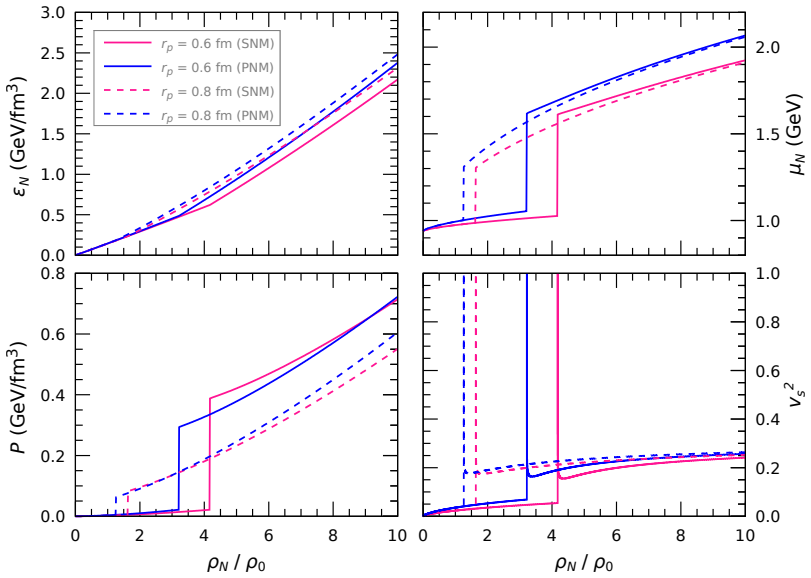
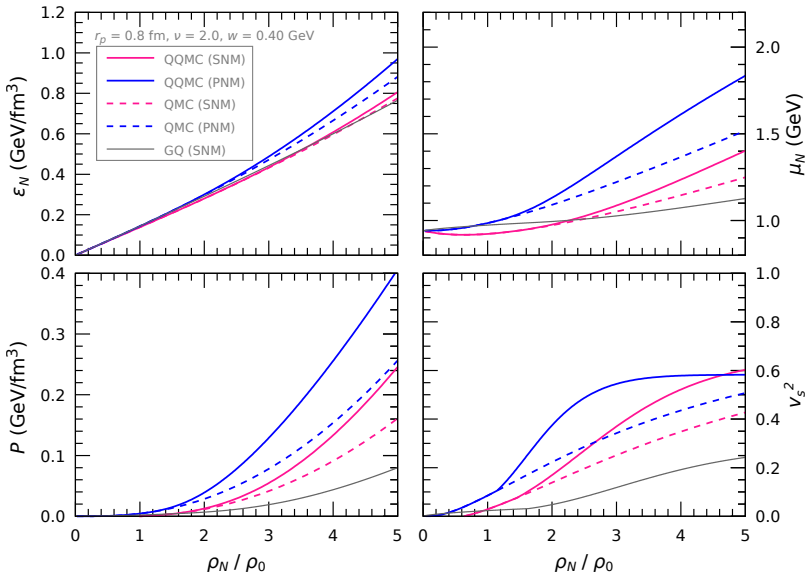
Summary. The paper constructs the 'QQMC' model by merging the dual quarkyonic (IdylliQ) picture with the quark-meson coupling (QMC) model, using a relativistic gaussian quark wavefunction. It first analyzes an ideal gaussian quarkyonic (GQ) gas, shows that energy density, chemical potential, pressure, and sound velocity are discontinuous or divergent at the quark saturation density, and introduces an infrared regulator alpha_nu(k_b)=1+(w/k_b)^nu to smooth the transition (Sec. II C). It then couples the regulated quarkyonic distributions to QMC mean fields of sigma, omega, and rho mesons, with parameters fitted to nuclear saturation properties, and computes EoS-related quantities for symmetric and pure neutron matter. The authors find that the quark saturation density depends strongly on r_p, and, after choosing nu=2.0, w=0.4 GeV, and r_p in the range 0.6-0.8 fm, claim that the resulting sound velocity is consistent with neutron-star inferences and that pressures match heavy-ion collision constraints.
Significance. The novelty is the unification of two quark-based frameworks and the analytic treatment of the gaussian wavefunction, including center-of-mass corrections, scalar polarizability, and quark Pauli blocking. The paper supplies extensive tables and formulas, and it explicitly admits its main limitations: the postsaturation construction is 'intuitive' (Sec. II A), the boundary condition's sufficiency is open (Sec. IV), and the regulator should ultimately be replaced by QCD. These admissions are scientifically honest. The central quantitative claim, however, is currently a calibration statement rather than a prediction: the regulator parameters and r_p are tuned to the same neutron-star and HIC data used as benchmarks (Sec. III B; Sec. IV). The model is a plausible phenomenological candidate, but the evidence presented does not yet establish the claimed consistency as an independent test.
major comments (3)
- [Sec. III B (after Eq. (80); Figs. 13-16)] The central validation is circular. The text states: 'we adjust the parameters in the regulator so as to reproduce the sound velocity inferred from the observed data of neutron stars and pressure determined by the experiment of heavy-ion collisions (HICs) at high energy, i.e. we take nu=2.0 and w=0.4 GeV.' The abstract then claims the model 'can produce the sound velocity which is consistent with that inferred from the observed data of several neutron stars' and that HIC pressure 'can be explained.' Because nu and w are calibrated to the very data sets used as benchmarks, the agreement in Figs. 13-16 is achieved by construction, not by independent prediction. Similarly, Sec. IV selects r_p in 0.6-0.8 fm after the fact based on matching the same sound-velocity inferences. To support the abstract's claim, the authors should either provide an out-of-sample test (e.g., mass-radius or tidal d
- [Sec. II A 4 and Sec. IV (Eqs. (23)-(26), (57)-(59))] The postsaturation momentum distribution and the boundary conditions are assumed rather than derived. The authors write in Sec. II A that for the gaussian wavefunction 'no explicit theoretical method has been established. Thus, in this paper, we shall consider a dual quarkyonic model with the gaussian quark wavefunction intuitively.' In Sec. IV they further state that the boundary condition determining k_b and k_s 'may not be sufficient' and that the singular behavior 'should instead be resolved by the fundamental dynamics, i.e. QCD.' Because the central results—especially the peak and decline of v_s^2 and the high-density pressure—depend on this construction and on the ad hoc regulator, the model is at present a phenomenological ansatz. A concrete test would be a variational minimization of the energy density with respect to f_N(k) subject to the quark Pauli constraints, even with a res
- [Sec. III B, Figs. 13-14] The comparison with neutron-star inferences is made for pure neutron matter (PNM) and symmetric nuclear matter (SNM), whereas the inferred v_s^2 constraints in Refs. [67] and [68] apply to beta-equilibrated, charge-neutral neutron-star matter. The paper states only that 'it can be expected that the maximum value of v_s^2 in neutron-star matter turns out to be slightly smaller than the value in PNM.' This is a qualitative expectation, not a calculation. To substantiate the abstract's claim of consistency with 'observed data of several neutron stars,' the QQMC EoS should be extended to beta equilibrium with leptons and, preferably, used to compute mass-radius relations or tidal deformabilities. Without this step, the comparison in Figs. 13-14 is not a direct test of the model against neutron-star constraints.
minor comments (3)
- [Throughout] The manuscript contains numerous typos and misspellings: 'nuclaer' (Sec. I, after Eq. (3)), 'neucleon' (Fig. 2 caption), 'qaurk' (Sec. II B 1), 'incomplessibility' (Sec. III A, near Eq. (77)), 'mean-feild' (Sec. III B), and 'bahaves' (Sec. III B). A careful proofreading pass is needed.
- [Abstract and Sec. III B] The phrase 'observed data of several neutron stars' is imprecise: Refs. [67] and [68] use neural-network and Bayesian inference methods to reconstruct v_s^2 from observations. Suggest consistently using 'inferred from observed data' to reflect the indirect nature of the comparison.
- [Sec. II C and Sec. III B] The choice nu=2.0, w=0.4 GeV is stated without a detailed discussion of how the allowed window 3/2 < nu < 3 and the w-dependence were navigated in the QQMC model. Figs. 6 and 7 show the sensitivity in the GQ model; a short explanation of why the final values were selected beyond 'to reproduce' the data would improve transparency.
Circularity Check
Central validation is circular: the regulator parameters ν and w (and the r_p range) are tuned to the very neutron-star sound-speed and HIC-pressure data used as confirmation.
specific steps
-
fitted input called prediction
[Sec. III B, after Eq. (80)]
"In the calculation of the QQCM model, as discussed in the end of this section, we adjust the parameters in the regulator so as to reproduce the sound velocity inferred from the observed data of neutron stars and pressure determined by the experiment of heavy-ion collisions (HICs) at high energy, i.e. we take ν=2.0 and w=0.4 GeV."
The two regulator parameters are free inputs in the modified boundary conditions Eqs. (57)–(59) and thereby control k_b, k_s and the entire post-saturation EoS. The abstract then presents as confirmations that the QQMC model 'can produce the sound velocity which is consistent with that inferred from the observed data of several neutron stars' and that HIC pressure 'can be explained by the QQMC model as well.' Since ν and w were chosen to reproduce those very data sets, the agreement is enforced by construction rather than predicted independently.
-
fitted input called prediction
[Sec. IV, summary item 4]
"From the consideration on the sound velocity, the choice ofrp = 0.6−0.8 fm seems most suitable for describing dense nuclear matter in the QQMC model."
The proton radius r_p is a free structural input scanned over 0.6–1.0 fm (Table I). After computing the sound velocity, the paper selects r_p = 0.6–0.8 fm because that range makes the QQMC sound velocity match the two competing inferences from neutron-star data. Using the same data both to select the parameter and to validate the model means the 'consistent with observed neutron-star data' statement is partially a fit of r_p to the validation target, not an out-of-sample prediction.
full rationale
The paper's headline quantitative claims of agreement with neutron-star sound-speed inferences and HIC pressures are partly circular: the regulator parameters ν=2.0 and w=0.4 GeV are explicitly adjusted to reproduce those quantities, and the preferred r_p=0.6–0.8 fm range is selected by matching the same sound-velocity inferences. The abstract's 'consistent' and 'explained' language therefore overstates what is a parameter fit. This is partial circularity (score 6), not full circularity, because the quarkyonic construction, the QMC mean-field machinery, and the low-density saturation properties are not fitted to these validation data. The paper's admitted weaknesses—the gaussian dual quarkyonic model is adopted 'intuitively', and the boundary condition may not be sufficient—are assumptions rather than circular steps, so they lower confidence but do not raise the circularity score. No load-bearing self-citation chain was found: the QMC framework is an established, externally anchored approach, and the IdylliQ boundary condition is imported from independent work by Fujimoto et al., with the paper explicitly flagging it as an open question rather than a proved uniqueness result.
Axiom & Free-Parameter Ledger
free parameters (7)
- ν (regulator power) =
2.0 (explored 1.6–2.0)
- w (regulator width) =
0.40 GeV (explored 0.1–0.4 GeV)
- r_p (proton RMS charge radius input) =
0.6–1.0 fm; '0.6–0.8 fm seems most suitable'
- g_σ, g_ω =
≈9.6–11.0 and 7.47–7.81 (case 2)
- g_ρ =
≈4.34–4.36
- g_2 =
≈22.8–25.8 fm^{-1}
- quark mass m =
300 MeV (case 2; 250/350 variants)
axioms (6)
- domain assumption The dual sum rule f_Q(q) = ∫_k φ(q−k/N_c) f_N(k) (Eq. 2) exactly relates nucleon and quark momentum distributions, and its inversion is the correct way to impose quark Pauli blocking.
- domain assumption Quark saturation occurs when f_Q(0)=1 (Eqs. 21, 79).
- ad hoc to paper Postsaturation nucleon distributions are the step functions Eq. (23)/(24) with occupancy 1/N_c^3 and 3/(2N_c^3).
- ad hoc to paper The infrared regulator α_ν(k_b)=1+(w/k_b)^ν modifies the boundary conditions (Eqs. 58–59) and smooths the singularity.
- domain assumption The Dirac equation with scalar-vector harmonic oscillator potential U(r)=c/2(1+γ0)r^2 describes confined quarks (Eqs. 4–7).
- domain assumption Mean-field approximation for σ, ω, ρ mesons and constant spin-correlation energy E_spin^N in matter.
read the original abstract
We unite the dual quarkyonic model with the quark-meson coupling (QMC) model to construct a novel nuclear model based on the quark degrees of freedom, which can cover a wide range of nuclear densities, from low density to the crossover region. In the model, the relativistic, gaussian quark wavefunction is used to describe the nucleon structure. We first evaluate the energy density, chemical potential, pressure and sound velocity within the ideal Fermi gas picture. In this case, those physical quantities are discontinuous or divergent at the quark saturation density, where the quarkyonic phase emerges. To remove such singular behavior, we next introduce an infrared regulator, and combine the dual quarkyonic model and the QMC model to include the nuclear interaction -- we call it the quarkyonic quark-meson coupling (QQMC) model. In this model, the quark saturation density depends strongly on the nucleon size. For example, when $r_p = 0.6\, (0.8)$ fm, where $r_p$ is the root-mean-square radius of the proton, the quark saturation density is about $3.6\,(1.5) \times \rho_0$ in symmetric nuclear matter, where $\rho_0$ is the nuclear saturation density. Furthermore, the nuclear interaction plays an important role in considering physical quantities quantitatively. In fact, the QQMC model can produce the sound velocity which is consistent with that inferred from the observed data of several neutron stars. Furthermore, pressure in symmetric or pure neutron matter deduced from the experiments of heavy-ion collisions at high energy can be explained by the QQMC model as well. We discuss in detail the formulation for the QQMC model and the physical quantities calculated by the model.
Figures






Reference graph
Works this paper leans on
-
[1]
The nuclear density is also described in terms of the quark momentum distributionf Q as in Eq.(12)
Nuclear density The nuclear density,ρ N(n) , in SNM (PNM) is expressed by ρN = 2 π2 Z dk k2fN (k),(14) ρn = 1 π2 Z dk k2fn(k).(15) Here, we definef N (k)≡f p(k) =f n(k) for SNM, wheref p(n) (k) is the momentum distri- bution for protons (neutrons). The nuclear density is also described in terms of the quark momentum distributionf Q as in Eq.(12)
-
[2]
(14) and (15) are simply given by the usual Fermi distribution fN (k) =f n(k) =θ(k s −k),(16) wherek s =k F (kF the Fermi momentum)
Presaturation region Because, below the quark saturation density, the nuclear matter is normal, the two mo- mentum distributions in Eqs. (14) and (15) are simply given by the usual Fermi distribution fN (k) =f n(k) =θ(k s −k),(16) wherek s =k F (kF the Fermi momentum). In SNM, the dual momentum-space distribution for iso-symmetric light quarks with a give...
-
[3]
At quark saturation density At quark saturation density, the quark momentum distribution reaches unity atq= 0. In SNM, the nucleon momentumk sat atρ sat is given by the saturation condition gQ(ksat) = N 3 c√π √π−2Er( ¯ksat)−2 ¯ksat 1 + 2¯k2 sat 2¯λ2 + 3 e−¯k2 sat = 1,(21) where we defineg Q(k)≡f Q(0, k). Similarly, in PNM, the neutron momentumk sat atρ sa...
-
[4]
Such region is denoted by 0≤q≤q b, and we positf <qb Q(d) (q) =θ(q b −q) for SNM (PNM)
Postsaturation region Above the quark saturation density, the low momentum levels of quarks are fully occu- pied, where the quarks behave like Fermi gas but still feel the confinement force, i.e.soft deconfinement. Such region is denoted by 0≤q≤q b, and we positf <qb Q(d) (q) =θ(q b −q) for SNM (PNM). Correspondingly, because the dual nucleon momentum dis...
-
[5]
k2 b EN (kb) ∂2kb ∂k 2 s + 2kbEN (kb) + k3 b EN (kb) ∂kb ∂ks 2 # ,(51) B′ = 2ks −β
Symmetric nuclear matter First, the nuclear density, Eq. (14), reads ρbelow N = 2 3π2 k3 s (ks =k F ),(27) ρabove N = 2 3π2 (k3 s −βk 3 b ),(28) where the superscripts (below, above) indicate (ρN < ρsat,ρ N > ρsat), respectively. Because, in the limitρ N →ρ sat,k b approaches zero, the density is continuous atρ sat. The derivative of the density with resp...
-
[6]
Then, replacingN 3 c with 2 3 N 3 c , we can calculateµ n,P, andv 2 s as in case of SNM
Pure neutron matter For PNM, the neutron density reads ρbelow n = 1 3π2 k3 s (ks =k F ),(53) ρabove n = 1 3π2 (k3 s −β ′k3 b ),(54) and the energy density is ϵbelow n = 1 π2 Z ks 0 dk k2En(k) = 1 π2 I(M N , ks),(55) ϵabove n = 1 π2 Z ks 0 −β′ Z kb 0 dk k2En(k) = 1 π2 [I(M N , ks)−β ′I(M N , kb)],(56) withE n(k) = p M 2 N +k 2. Then, replacingN 3 c with 2 ...
-
[7]
The quark saturation density,ρ sat, is very sensitive to the quark wavefunction. In the present calculation, we have chosen the relativistic gaussian wavefunction, and, due to the lower component of the wavefunction, the value ofρ sat turns out to be higher than that in the NR case. Furthermore, it is also important to consider the c.m. correction to the ...
-
[8]
In the present paper, to determine those two momenta, we have used the same boundary condition as in the IdylliQ model
The quarkyonic phase is characterized by two momenta,k b andk s, where the former defines the under-occupied bulk part at low density and the latter gives the upper bound of the shell structure at high density. In the present paper, to determine those two momenta, we have used the same boundary condition as in the IdylliQ model. Then, using the gaussian q...
-
[9]
We have next combined the GQ model and the QMC model in order to introduce the nuclear interaction – it is called the QQMC model. The QQMC model is a nuclear model based on the quark degrees of freedom, and it is available to use over a wide range of nuclear density from low density to a crossover region where the transition from baryonic to quark matter ...
-
[10]
It is notable that the inclusion of nuclear interaction in the quarkyonic model is quite important to consider the physical quantities quantitatively. In fact, the QQMC model can provide the sound velocity which is consistent with that inferred from the observed neutron-star data by using the neural network model or Bayesian inference analysis. Furthermor...
2025
-
[11]
B. P. Abbottet al.(LIGO Scientific, Virgo), Phys. Rev. Lett.119, 161101 (2017), arXiv:1710.05832 [gr-qc]
Pith/arXiv arXiv 2017
-
[12]
B. P. Abbottet al.(LIGO Scientific, Virgo), Phys. Rev. X9, 011001 (2019), arXiv:1805.11579 [gr-qc]
Pith/arXiv arXiv 2019
-
[13]
B. P. Abbottet al.(LIGO Scientific, Virgo), Phys. Rev. Lett.121, 161101 (2018), arXiv:1805.11581 [gr-qc]
Pith/arXiv arXiv 2018
-
[14]
Arzoumanianet al.(NANOGrav), Astrophys
Z. Arzoumanianet al.(NANOGrav), Astrophys. J. Suppl.235, 37 (2018), arXiv:1801.01837 [astro-ph.HE]
Pith/arXiv arXiv 2018
-
[15]
P. Demorest, T. Pennucci, S. Ransom, M. Roberts, and J. Hessels, Nature467, 1081 (2010), arXiv:1010.5788 [astro-ph.HE]
Pith/arXiv arXiv 2010
-
[16]
Antoniadiset al., Science340, 6131 (2013), arXiv:1304.6875 [astro-ph.HE]
J. Antoniadiset al., Science340, 6131 (2013), arXiv:1304.6875 [astro-ph.HE]. 43
Pith/arXiv arXiv 2013
-
[17]
E. Fonsecaet al., Astrophys. J. Lett.915, L12 (2021), arXiv:2104.00880 [astro-ph.HE]
Pith/arXiv arXiv 2021
-
[18]
R. W. Romani, D. Kandel, A. V. Filippenko, T. G. Brink, and W. Zheng, Astrophys. J. Lett. 934, L17 (2022), arXiv:2207.05124 [astro-ph.HE]
Pith/arXiv arXiv 2022
-
[19]
S. Vinciguerraet al., Astrophys. J.961, 62 (2024), arXiv:2308.09469 [astro-ph.HE]
Pith/arXiv arXiv 2024
-
[20]
D. Choudhuryet al., Astrophys. J. Lett.971, L20 (2024), arXiv:2407.06789 [astro-ph.HE]
Pith/arXiv arXiv 2024
-
[21]
T. Salmiet al., Astrophys. J.974, 294 (2024), arXiv:2406.14466 [astro-ph.HE]
Pith/arXiv arXiv 2024
-
[22]
T. Salmiet al., Astrophys. J.976, 58 (2024), arXiv:2409.14923 [astro-ph.HE]
Pith/arXiv arXiv 2024
-
[23]
Mauviardet al., arXiv:2506.14883 [astro-ph.HE]
L. Mauviardet al., arXiv:2506.14883 [astro-ph.HE]
-
[24]
A. Liet al., Sci. China Phys. Mech. Astron.68, 119503 (2025), arXiv:2506.08104 [astro-ph.HE]
arXiv 2025
-
[25]
T. Miyatsu, M.-K. Cheoun, K. Kim, and K. Saito, Front. in Phys.12, 1531475 (2024), arXiv:2411.13210 [nucl-th]
Pith/arXiv arXiv 2024
-
[26]
L. Brandes and W. Weise, Symmetry16, 111 (2024), arXiv:2312.11937 [nucl-th]
Pith/arXiv arXiv 2024
-
[27]
T. Miyatsu, M.-K. Cheoun, K. Kim, and K. Saito, Symmetry17, 1872 (2025), arXiv:2509.16559 [nucl-th]
arXiv 2025
-
[28]
L. McLerran and R. D. Pisarski, Nucl. Phys. A796, 83 (2007), arXiv:0706.2191 [hep-ph]
Pith/arXiv arXiv 2007
-
[29]
G. Baym, T. Hatsuda, T. Kojo, P. D. Powell, Y. Song, and T. Takatsuka, Rept. Prog. Phys. 81, 056902 (2018), arXiv:1707.04966 [astro-ph.HE]
Pith/arXiv arXiv 2018
-
[30]
K. Fukushima, T. Kojo, and W. Weise, Phys. Rev. D102, 096017 (2020), arXiv:2008.08436 [hep-ph]
Pith/arXiv arXiv 2020
-
[31]
T. Kojo, J. Subatomic Part. Cosmol.4, 100088 (2025), arXiv:2412.20442 [nucl-th]
Pith/arXiv arXiv 2025
-
[32]
O. Ivanytskyi, Phys. Rev. D112, 034001 (2025), arXiv:2505.07076 [nucl-th]
Pith/arXiv arXiv 2025
-
[33]
C. G¨ artlein, O. Ivanytskyi, V. Sagun, and I. Lopes, arXiv:2509.03517 [nucl-th]
-
[34]
Y. Fujimoto, T. Kojo, and L. D. McLerran, Phys. Rev. Lett.132, 112701 (2024), arXiv:2306.04304 [nucl-th]
Pith/arXiv arXiv 2024
- [35]
-
[36]
Koch and V
V. Koch and V. Vovchenko, J. Subatomic Part. Cosmol.3, 100025 (2025)
2025
-
[37]
V. Koch, L. McLerran, G. A. Miller, and V. Vovchenko, Phys. Rev. C110, 025201 (2024), arXiv:2403.15375 [nucl-th]
Pith/arXiv arXiv 2024
-
[38]
L. McLerran and G. A. Miller, Phys. Rev. C110, 045203 (2024), arXiv:2405.11074 [nucl-th]
Pith/arXiv arXiv 2024
-
[39]
D. F. Geesaman, K. Saito, and A. W. Thomas, Ann. Rev. Nucl. Part. Sci.45, 337 (1995)
1995
-
[40]
Arneodo, Phys
M. Arneodo, Phys. Rept.240, 301 (1994). 44
1994
-
[41]
A. Nikolakopoulos and G. A. Miller, arXiv:2506.22670 [nucl-th]
- [42]
-
[43]
P. A. M. Guichon, J. R. Stone, and A. W. Thomas, Prog. Part. Nucl. Phys.100, 262 (2018), arXiv:1802.08368 [nucl-th]
Pith/arXiv arXiv 2018
-
[44]
G. Krein, A. W. Thomas, and K. Tsushima, Prog. Part. Nucl. Phys.100, 161 (2018), arXiv:1706.02688 [hep-ph]
Pith/arXiv arXiv 2018
-
[45]
P. A. M. Guichon, Phys. Lett. B200, 235 (1988)
1988
-
[46]
K. Saito and A. W. Thomas, Phys. Lett. B327, 9 (1994), arXiv:nucl-th/9403015
Pith/arXiv arXiv 1994
-
[47]
P. A. M. Guichon, K. Saito, E. N. Rodionov, and A. W. Thomas, Nucl. Phys. A601, 349 (1996), arXiv:nucl-th/9509034
Pith/arXiv arXiv 1996
-
[48]
K. Saito and K. Tsushima, Prog. Theor. Phys.105, 373 (2001), arXiv:nucl-th/0012090
Pith/arXiv arXiv 2001
- [49]
-
[50]
K. Tsushima, K. Saito, and A. W. Thomas, Phys. Lett. B411, 9 (1997), [Erratum: Phys.Lett.B 421, 413 (1998)], arXiv:nucl-th/9701047
Pith/arXiv arXiv 1997
-
[51]
P. A. M. Guichon, A. W. Thomas, and K. Tsushima, Nucl. Phys. A814, 66 (2008), arXiv:0712.1925 [nucl-th]
Pith/arXiv arXiv 2008
-
[52]
D.-H. Lu, A. W. Thomas, K. Tsushima, A. G. Williams, and K. Saito, Phys. Lett. B417, 217 (1998), arXiv:nucl-th/9706043
Pith/arXiv arXiv 1998
-
[53]
D.-H. Lu, K. Tsushima, A. W. Thomas, A. G. Williams, and K. Saito, Phys. Rev. C60, 068201 (1999), arXiv:nucl-th/9807074
Pith/arXiv arXiv 1999
-
[54]
T. Kolaret al.(A1), Phys. Rev. C110, L061302 (2024), arXiv:2311.01935 [nucl-ex]
Pith/arXiv arXiv 2024
-
[55]
Saito and A
K. Saito and A. W. Thomas, Nucl. Phys. A574, 659 (1994)
1994
-
[56]
I. C. Cloet, W. Bentz, and A. W. Thomas, Phys. Lett. B642, 210 (2006), arXiv:nucl- th/0605061
arXiv 2006
-
[57]
A. W. Thomas, P. A. M. Guichon, D. B. Leinweber, and R. D. Young, Prog. Theor. Phys. Suppl.156, 124 (2004), arXiv:nucl-th/0411014
Pith/arXiv arXiv 2004
-
[58]
E. Chang, Z. Davoudi, W. Detmold, A. S. Gambhir, K. Orginos, M. J. Savage, P. E. Shana- han, M. L. Wagman, and F. Winter (NPLQCD), Phys. Rev. Lett.120, 152002 (2018), arXiv:1712.03221 [hep-lat]. 45
Pith/arXiv arXiv 2018
-
[59]
T. Katayama, T. Miyatsu, and K. Saito, Astrophys. J. Suppl.203, 22 (2012), arXiv:1207.1554 [astro-ph.SR]
Pith/arXiv arXiv 2012
-
[60]
T. Miyatsu, T. Katayama, and K. Saito, Phys. Lett. B709, 242 (2012), arXiv:1110.3868 [nucl-th]
Pith/arXiv arXiv 2012
-
[61]
T. Miyatsu, M.-K. Cheoun, and K. Saito, Astrophys. J.813, 135 (2015), arXiv:1506.05552 [nucl-th]
Pith/arXiv arXiv 2015
-
[62]
D. H. Rischke, M. I. Gorenstein, H. Stoecker, and W. Greiner, Z. Phys. C51, 485 (1991)
1991
-
[63]
J. Leong, A. W. Thomas, and P. A. M. Guichon, Nucl. Phys. A1050, 122928 (2024), arXiv:2308.08987 [nucl-th]
Pith/arXiv arXiv 2024
-
[64]
W. Bentz and I. C. Clo¨ et, Symmetry17, 505 (2025), arXiv:2503.20564 [nucl-th]
Pith/arXiv arXiv 2025
-
[65]
H. Toki, U. Meyer, A. Faessler, and R. Brockmann, Phys. Rev. C58, 3749 (1998)
1998
-
[66]
H. Shen and H. Toki, Phys. Rev. C61, 045205 (2000), arXiv:nucl-th/9911046
Pith/arXiv arXiv 2000
-
[67]
N. Barik, R. N. Mishra, D. K. Mohanty, P. K. Panda, and T. Frederico, Phys. Rev. C88, 015206 (2013), arXiv:1307.0934 [nucl-th]
Pith/arXiv arXiv 2013
-
[68]
K. Saito, T. Miyatsu, and M.-K. Cheoun, Phys. Rev. D110, 113001 (2024), arXiv:2409.14764 [hep-ph]
Pith/arXiv arXiv 2024
-
[69]
Leal Ferreira, Lett
P. Leal Ferreira, Lett. Nuovo Cim.20, 157 (1977)
1977
-
[70]
Leal Ferreira and N
P. Leal Ferreira and N. Zagury, Lett. Nuovo Cim.20, 511 (1977)
1977
-
[71]
Barik and B
N. Barik and B. K. Dash, Phys. Rev. D33, 1925 (1986)
1925
-
[72]
Z. Zhu, A. Li, J. Hu, and H. Shen, Phys. Rev. C108, 025809 (2023), arXiv:2305.16058 [nucl- th]
Pith/arXiv arXiv 2023
-
[73]
Navaset al.(Particle Data Group), Phys
S. Navaset al.(Particle Data Group), Phys. Rev. D110, 030001 (2024)
2024
-
[74]
T. Kojo, Phys. Rev. D104, 074005 (2021), arXiv:2106.06687 [nucl-th]
Pith/arXiv arXiv 2021
-
[75]
T. Miyatsu, M.-K. Cheoun, and K. Saito, Astrophys. J.929, 82 (2022), arXiv:2202.06468 [nucl-th]
Pith/arXiv arXiv 2022
-
[76]
T. Miyatsu, M.-K. Cheoun, K. Kim, and K. Saito, Phys. Lett. B843, 138013 (2023), arXiv:2303.14763 [nucl-th]
Pith/arXiv arXiv 2023
-
[77]
Y. Fujimoto, K. Fukushima, and K. Murase, Phys. Rev. D101, 054016 (2020), arXiv:1903.03400 [nucl-th]
Pith/arXiv arXiv 2020
-
[78]
L. Brandes and W. Weise, Phys. Rev. D111, 034005 (2025), arXiv:2412.05923 [nucl-th]
Pith/arXiv arXiv 2025
-
[79]
P. Danielewicz, R. Lacey, and W. G. Lynch, Science298, 1592 (2002), arXiv:nucl-th/0208016. 46
Pith/arXiv arXiv 2002
-
[80]
D. Oliinychenko, A. Sorensen, V. Koch, and L. McLerran, Phys. Rev. C108, 034908 (2023), arXiv:2208.11996 [nucl-th]
Pith/arXiv arXiv 2023
discussion (0)
Sign in with ORCID, Apple, or X to comment. Anyone can read and Pith papers without signing in.