REVIEW 4 major objections 6 minor 1 cited by
Quantum Attention for Vision Transformers in High Energy Physics
T0 review · 4 major / 6 minor · reviewed 2026-08-12 · deepseek-v4-flash
Pith's one-line read A quantum-enhanced vision transformer with orthogonal attention layers matches the classical model on quark-gluon jet classification (test AUC 0.7369 vs 0.7385).
desk verdict A clean benchmark undermined by a sign inconsistency in the unary loader that likely invalidates the claimed quantum attention computation; worth a real referee only if code and error bars are supplied. read the letter →
The pith
A machine-rendered reading of the paper's core claim, the machinery that carries it, and where it could break.
The reading
What carries the argument
The object that carries the argument is the QONN layer: a pyramid-shaped circuit of RBS gates that implements an $n \times n$ orthogonal matrix using $n(n-1)/2$ tunable angles. A unary amplitude loader encodes each normalized input vector into a superposition with only $n-1$ RBS gates, and each attention coefficient is produced by a circuit that loads the key vector, applies the orthogonal weight matrix $W$, and overlaps the result with the query vector, with the measured first-qubit probability supplying the attention score. The orthogonality of $W$ is what the paper credits for stable gradients and efficient parameterization in high-dimensional spaces.
What would settle it
Run a statevector simulation of the trained QViT, record the attention coefficients actually produced from a batch of test jet images, and compare them with the classical formula $x_i^T W x_j$ evaluated on the same embeddings; any disagreement—expected if embeddings contain negative components—would show the quantum and classical attention mechanisms are not computing the same quantity.
Extended reading notes
Core claim
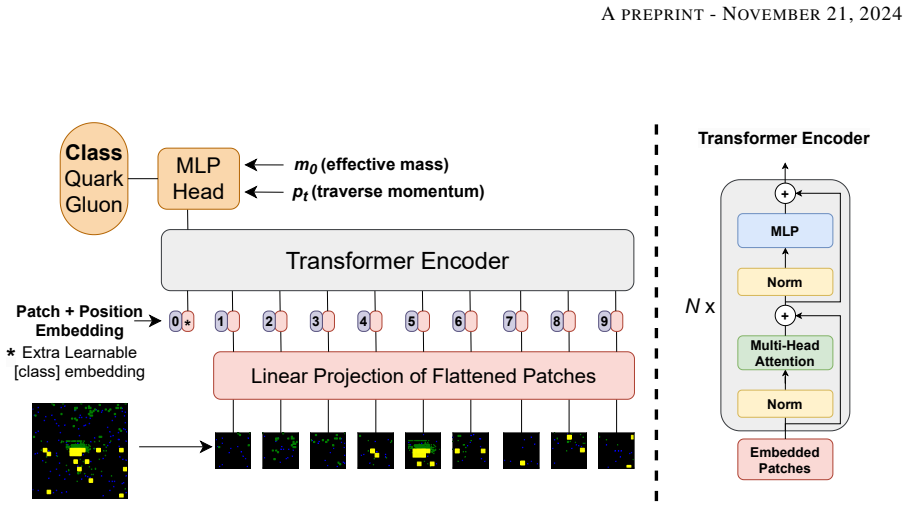
The central claim of the paper is that replacing the linear projection layers that generate queries, keys, and values in a vision transformer with quantum orthogonal layers yields a model that is as effective as the classical ViT. The QViT uses pyramidal circuits of reconfigurable beam splitter gates to implement orthogonal weight matrices, and a quantum circuit to compute each attention coefficient from loaded query and key states. On quark-gluon jet classification, the authors report test accuracy 0.6755, test AUC 0.7369, and validation AUC converging to roughly 0.675, against 0.6788, 0.7385, and roughly 0.675 for the classical model. They conclude that the quantum attention mechanism matches the classical one and that orthogonal quantum layers offer a scalable alternative for the data demands of the HL-LHC.
Load-bearing premise
The load-bearing premise is that the circuit that turns data into quantum states can exactly represent any patch embedding produced by the network; the circuit's angle formula requires every entry to be nonnegative and no intermediate factor to vanish, but the embeddings are unconstrained real numbers, so this premise is not guaranteed by the architecture.
Editorial extensions
If this is right
- If quantum attention is as effective as classical attention, QONN-based vision transformers become a candidate architecture for HL-LHC-era jet classification, where the orthogonal layers' parameter efficiency could reduce training cost.
- The reported numbers—test AUC 0.7369 versus 0.7385, accuracy 0.6755 versus 0.6788—provide a concrete benchmark that future quantum transformer proposals can be compared against on the same CMS Open Data task.
- The architecture's linear-depth data loading and $n(n-1)/2$-parameter orthogonal layers imply that the quantum resources per image grow with the square of the number of patches (25 patches require 26×26 attention circuits), so the scalability argument is architectural rather than a demonstrated speedup on current simulators.
- Replacing generic variational circuits with orthogonal quantum layers should improve gradient behaviour during training, which is the main practical motivation the authors offer for preferring QONNs over other quantum attention designs.
Reading between the lines
- The attention circuit's output is naturally $|x_i^T W x_j|^2$, a squared, sign-free kernel, while classical softmax attention uses signed dot products; the parity result therefore shows that a network with this squared kernel can match the classical AUC, not that the two models compute the same attention function.
- A clean ablation would replace the quantum orthogonal layer with a classical orthogonal layer (for example, a weight matrix constrained by QR decomposition) while keeping the same nonnegative unary-loading constraint; if that model also matches the classical ViT, the quantum hardware is not essential to the observed parity.
- Repeating the 15-epoch training with several random seeds would show whether the 0.0016 test-AUC gap is within run-to-run variance; the paper reports a single run for each model.
- Inspecting the distribution of learned patch embeddings would settle whether the loader's nonnegativity requirement clips or distorts the features; if it does, the reported comparison is between classical attention and a quantum circuit acting on a constrained, altered representation.
Editorial analysis
A structured set of objections, weighed in public.
Referee Report
Summary. The manuscript proposes a hybrid quantum-classical vision transformer (QViT) in which the query–key attention coefficients are computed by a quantum circuit built from reconfigurable beam-splitter (RBS) gates, forming a quantum orthogonal neural network (QONN). The model is trained and evaluated on 50,000 CMS Open Data jet images for quark–gluon classification, with the class token and two jet-level features passed to a classical multilayer perceptron head. The central empirical claim is that the QViT matches a classical ViT in performance, with test AUC 0.7369 vs 0.7385 and test accuracy 0.6755 vs 0.6788 (Table 1). The paper also claims that the quantum attention mechanism is as effective as the classical mechanism and that the approach offers promising scalability.
Significance. If the implementation is correct and reproducible, the paper would provide a useful benchmark for hybrid quantum attention in HEP jet classification, with the virtue of using a public dataset and an independently implemented classical baseline. The claimed AUC parity is a concrete, falsifiable result. The paper, however, does not ship code, does not report statistical uncertainties, and contains an internal inconsistency in the unary loader/RBS sign convention that prevents verification of the central claim. The strengths are the use of public CMS Open Data, the explicit classical baseline comparison, and the clear identification of the orthogonal-layer parameter count.
major comments (4)
- [Section 2.2, RBS gate matrix and vector loading circuit] The stated RBS matrix in Section 2.2 maps the basis state |10> to cos(theta)|10> - sin(theta)|01>. Starting from the initialized state X|0...> = |10...>, the cascade of RBS gates therefore produces a negative amplitude on the second unary basis state. With the recursive angle formula alpha_0 = arccos(x_0), a valid nonnegative input such as x = (1/sqrt(2), 1/sqrt(2)) is loaded as (1/sqrt(2), -1/sqrt(2)) rather than x itself. Unless the implemented circuit uses the opposite RBS sign convention, every attention coefficient computed by the circuit in Figure 5 is a function of a sign-corrupted embedding, so the AUC comparison in Table 1 does not test the proposed quantum attention mechanism. The manuscript gives no procedure for handling negative components or for choosing an alternative RBS orientation.
- [Section 2.2, 'Attention Coefficient Circuit' and Figure 5] The circuit is claimed to compute |x_i^T W x_j|^2, but no derivation links the measurement probability of the first qubit in state |1> to this quantity, nor is it explained how loading |x_j>, applying W, and loading <x_i| implements the transpose operation. Additionally, the attention mechanism in Section 2.1 uses softmax(QK^T / sqrt(d_k)), a linear inner product, whereas the quantum circuit outputs a squared absolute value. Without an explicit mapping from the circuit output to the attention weights and a specification of how the softmax and scaling are applied, the forward pass of the model is undefined, and the comparison with the classical ViT is not a like-for-like test.
- [Table 1 and Section 4] The central claim that the QViT is 'as effective' as the classical ViT rests on test AUC 0.7369 vs 0.7385 and test accuracy 0.6755 vs 0.6788. No error bars, multiple seeds, or significance tests are reported, and no code is provided to reproduce the single run. Given that the differences are well within typical stochastic variation for a 15-epoch training run, the evidence as presented does not support the claim beyond an anecdotal single-run observation.
- [Section 2.2, vector loading circuit applicability] The unary amplitude loader requires the input vector to be normalized and to have nonnegative components, as the recursive angles are defined through arccos of quotients of the vector entries. Patch embeddings are outputs of a learned linear projection E and are not constrained to be nonnegative or within [0,1]. The paper states that normalization does not degrade performance but does not address the sign restriction or provide a procedure for out-of-range values. Consequently, the loader as written cannot be applied to general patch embeddings, which is load-bearing because the attention coefficients in Figure 5 are computed from those embeddings.
minor comments (6)
- [Section 6] The heading 'Aknowledgments' should be spelled 'Acknowledgments'.
- [Author line and footnote] The author name appears inconsistently as 'Alessandro Tesi' in the author list and 'Alessandro Tessi' in the acknowledgment footnote.
- [Figure 2] The figure shows a decomposition of the RBS gate using Hadamard, controlled-Z, and Ry rotations, but the text does not verify that this decomposition realizes the matrix given in Section 2.2; a short algebraic check would help.
- [Section 2.1 and Section 3.2] The classical attention formula uses a scaling by sqrt(d_k), but the quantum attention coefficient circuit does not mention any such scaling; the relationship between the two should be clarified.
- [Section 3.2] The statement that 'the simulation requires 26 x 26 attention circuits per self-attention block' is not explicit about whether this is per image and per epoch; please clarify the counting.
- [References] Reference [1] is a webpage without a stable identifier; please provide a persistent DOI, CERN document number, or accession date and URL.
Circularity Check
No significant circularity: the central claim is a benchmark result against an independent classical ViT on external CMS Open Data; self-citations are descriptive, not load-bearing.
full rationale
The paper's central claim—that QONN-based quantum attention performs comparably to classical attention for quark/gluon jet classification—is an empirical benchmark, not a derived prediction. The QViT is trained on CMS Open Data and compared in Table 1 with a classical ViT; the reported test AUC values are external measurements obtained on a held-out test set, not outputs of a fitted parameter renamed as a prediction. The RBS pyramid and unary loader implement QONN-style orthogonal transformations cited from [11,12], and the QViT line of work cites the authors' own prior papers [5,6], but those citations only situate the architecture and do not supply a uniqueness theorem or force the numerical outcome. While there is an internal consistency question about the unary loader's sign convention and the squared-modulus description of the attention circuit, that is a correctness concern, not circularity: the comparison with the classical ViT does not reduce by construction to any fitted input. The evaluation is self-contained against an independent baseline on external data, so any self-citation is minor and non-load-bearing.
Assumptions & free parameters
assumptions (4)
- domain assumption The recursive arccos construction loads any normalized input vector into the unary quantum state.
- domain assumption The probability of measuring |1> on the first qubit yields |x_i^T W x_j|^2 and can be used as the attention score.
- domain assumption The classical ViT with identical hyperparameters is an appropriate baseline for asserting comparable performance.
- standard math RBS gates and pyramid circuits parameterize orthogonal matrices with n(n-1)/2 angles.
Cite this review
Pith. "Pith review of Quantum Attention for Vision Transformers in High Energy Physics." pith.science (2026). https://pith.science/paper/TVN3EN44
@misc{pith2026241113520,
  author       = {Pith},
  title        = {Pith review of: Quantum Attention for Vision Transformers in High Energy Physics},
  year         = {2026},
  howpublished = {\url{https://pith.science/paper/TVN3EN44}},
  note         = {Machine review of arXiv:2411.13520}
}
read the original abstract
We present a novel hybrid quantum-classical vision transformer architecture incorporating quantum orthogonal neural networks (QONNs) to enhance performance and computational efficiency in high-energy physics applications. Building on advancements in quantum vision transformers, our approach addresses limitations of prior models by leveraging the inherent advantages of QONNs, including stability and efficient parameterization in high-dimensional spaces. We evaluate the proposed architecture using multi-detector jet images from CMS Open Data, focusing on the task of distinguishing quark-initiated from gluon-initiated jets. The results indicate that embedding quantum orthogonal transformations within the attention mechanism can provide robust performance while offering promising scalability for machine learning challenges associated with the upcoming High Luminosity Large Hadron Collider. This work highlights the potential of quantum-enhanced models to address the computational demands of next-generation particle physics experiments.
Figures


Figures from the paper (4 more)


Forward citations
Cited by 1 Pith paper
-
Lie-Equivariant Quantum Graph Neural Networks
A Lorentz-equivariant quantum graph neural network matches the classical LorentzNet on quark-gluon jet discrimination in noiseless simulations.
Reference graph
Works this paper leans on
-
[1]
The high-luminosity large hadron collider (hl-lhc) project, 2024
CERN HL-LHC Project. The high-luminosity large hadron collider (hl-lhc) project, 2024. Accessed: 2024-10-30
work page 2024
-
[2]
Quantum machine learning
Jacob Biamonte, Peter Wittek, Nicola Pancotti, Patrick Rebentrost, Nathan Wiebe, and Seth Lloyd. Quantum machine learning. Nature, 549(7671):195–202, September 2017
2017
-
[3]
S. Mangini, F. Tacchino, D. Gerace, D. Bajoni, and C. Macchiavello. Quantum computing models for artificial neural networks. Europhysics Letters, 134(1):10002, may 2021
work page 2021
-
[4]
Quantum linear algebra is all you need for transformer architectures, 2024
Naixu Guo, Zhan Yu, Matthew Choi, Aman Agrawal, Kouhei Nakaji, Alán Aspuru-Guzik, and Patrick Rebentrost. Quantum linear algebra is all you need for transformer architectures, 2024
work page 2024
-
[5]
Unlu, Marçal Comajoan Cara, Gopal Ramesh Dahale, Zhongtian Dong, Roy T
Eyup B. Unlu, Marçal Comajoan Cara, Gopal Ramesh Dahale, Zhongtian Dong, Roy T. Forestano, Sergei Gleyzer, Daniel Justice, Kyoungchul Kong, Tom Magorsch, Konstantin T. Matchev, and Katia Matcheva. Hybrid quantum vision transformers for event classification in high energy physics. Axioms, 13(3), 2024
work page 2024
-
[6]
Forestano, Sergei Gleyzer, Daniel Justice, Kyoungchul Kong, Tom Magorsch, Konstantin T
Marçal Comajoan Cara, Gopal Ramesh Dahale, Zhongtian Dong, Roy T. Forestano, Sergei Gleyzer, Daniel Justice, Kyoungchul Kong, Tom Magorsch, Konstantin T. Matchev, Katia Matcheva, and Eyup B. Unlu. Quantum vision transformers for quark–gluon classification. Axioms, 13(5):323, May 2024
work page 2024
-
[7]
El Amine Cherrat, Iordanis Kerenidis, Natansh Mathur, Jonas Landman, Martin Strahm, and Yun Yvonna Li. Quantum vision transformers. Quantum, 8:1265, February 2024
work page 2024
-
[8]
An image is worth 16x16 words: Transformers for image recognition at scale, 2021
Alexey Dosovitskiy, Lucas Beyer, Alexander Kolesnikov, Dirk Weissenborn, Xiaohua Zhai, Thomas Unterthiner, Mostafa Dehghani, Matthias Minderer, Georg Heigold, Sylvain Gelly, Jakob Uszkoreit, and Neil Houlsby. An image is worth 16x16 words: Transformers for image recognition at scale, 2021
2021
Show all 14 references
-
[9]
Gomez, Lukasz Kaiser, and Illia Polosukhin
Ashish Vaswani, Noam Shazeer, Niki Parmar, Jakob Uszkoreit, Llion Jones, Aidan N. Gomez, Lukasz Kaiser, and Illia Polosukhin. Attention is all you need, 2023
2023
-
[10]
Multilayer perceptron and neural networks
Marius-Constantin Popescu, Valentina Balas, Liliana Perescu-Popescu, and Nikos Mastorakis. Multilayer perceptron and neural networks. WSEAS Transactions on Circuits and Systems , 8, 07 2009
2009
-
[11]
Classical and quantum algorithms for orthogonal neural networks, 2022
Iordanis Kerenidis, Jonas Landman, and Natansh Mathur. Classical and quantum algorithms for orthogonal neural networks, 2022
2022
-
[12]
Quantum methods for neural networks and application to medical image classification
Jonas Landman, Natansh Mathur, Yun Yvonna Li, Martin Strahm, Skander Kazdaghli, Anupam Prakash, and Iordanis Kerenidis. Quantum methods for neural networks and application to medical image classification. Quantum, 6:881, December 2022. 8 A PREPRINT - NOVEMBER 21, 2024
2022
-
[13]
About the CMS Experiment, 2024
CERN Open Data Portal. About the CMS Experiment, 2024. Accessed: 2024-10-30
2024
-
[14]
Andrews, B
M. Andrews, B. Burkle, Y . Chen, D. DiCroce, S. Gleyzer, U. Heintz, M. Narain, M. Paulini, N. Pervan, Y . Shafi, W. Sun, E. Usai, and K. Yang. End-to-end jet classification of boosted top quarks with the cms open data.Physical Review D, 105(5), March 2022. 9
2022
Reviewed August 12, 2026 · model on record in the stance chip above.
Discussion (0). Continue with ORCID to comment.