REVIEW 2 major objections 4 minor 63 references
Identity Preserving 3D Head Stylization with Multiview Score Distillation
T0 review · 2 major / 4 minor · reviewed 2026-08-12 · deepseek-v4-flash
Pith's one-line read This paper claims that PanoHead can be fine-tuned, using likelihood distillation and three gradient modifications, to stylize heads across 360 degrees while preserving each person's identity.
desk verdict Plausible identity-preserving 3D head stylization with a genuinely neat rank-weighting trick, but the stylization-quality numbers are not cross-method comparable because each method is measured against its own diffusion teacher. read the letter →
The pith
A machine-rendered reading of the paper's core claim, the machinery that carries it, and where it could break.
The reading
What carries the argument
The central object is the distillation gradient used to fine-tune the PanoHead generator. LD replaces the SDS gradient, which subtracts the sampled noise epsilon, with the pure score estimate, so the update direction seeks higher likelihood rather than mode collapse. The SVD rank weighting decomposes the 4-channel score tensor and reweights its singular values with W = diag(1, 0.75, 0.5, 0.25) to keep the dominant stylization rank while suppressing the lower-rank color tint. Mirror gradients reuse the same score for yaw-symmetric poses and flip the backpropagated gradient, exploiting the head symmetry prior. Grid distillation forms a 2×2 grid of four render poses, denoises the grid jointly with a depth-conditioned ControlNet, and backpropagates the grid gradient before the SR network.
What would settle it
Recompute FID/CLIP with a reference distribution generated independently of the distillation teacher, such as a second diffusion model or a fixed human-rated set of stylized portraits; if the margin over DiffusionGAN3D and StyleGANFusion shrinks or reverses, the quality gains rest on the benchmark's circularity. Separately, replace ArcFace with a different face-recognition embedding and re-measure identity similarity; if the gap disappears, the identity claim is ArcFace-specific.
Extended reading notes
Core claim
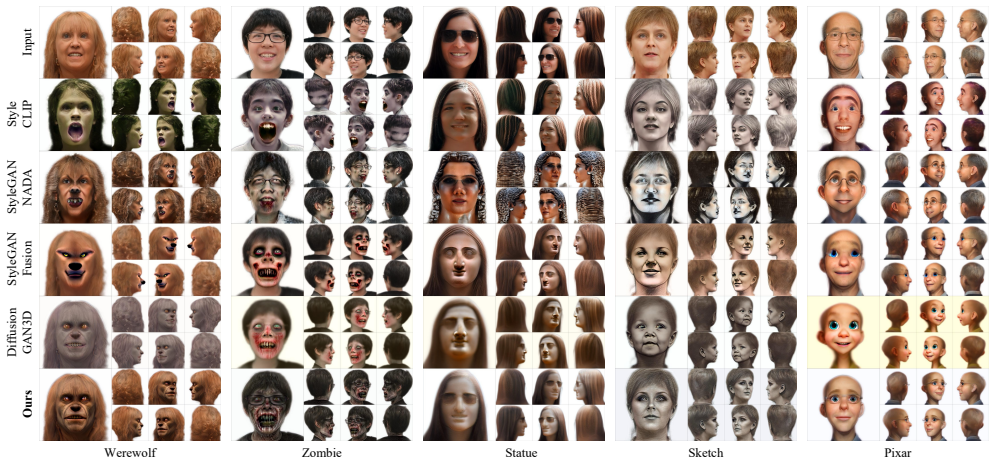
The central claim is that a 3D-aware GAN like PanoHead can be adapted to a text-prompted style while preserving the input subject's identity by swapping SDS for LD, which is diversity-seeking rather than mode-seeking, and by adding three gradient-level modifications: re-weighting the SVD of the score tensor along the VAE channel dimension to suppress color artifacts, forcing cross-view consistency through mirrored gradients for symmetric poses and a 2×2 grid of renders passed to a depth-conditioned ControlNet, and routing grid gradients before the super-resolution network to avoid a resolution mismatch. The paper asserts that this recipe lets different input identities remain distinguishable after stylization, whereas prior methods such as DiffusionGAN3D, StyleGANFusion, StyleCLIP, and StyleGAN-NADA tend to produce similar outputs for different people.
Load-bearing premise
The claim that the method's stylization quality beats the baselines assumes that the FID and CLIP reference distribution produced by adding noise at timestep 25 to real images and denoising with each baseline's own diffusion checkpoint is a fair, method-neutral benchmark.
Editorial extensions
If this is right
- The same distillation recipe can be transferred to other 3D-aware GANs with a symmetric pose pair and a super-resolution stage, without per-prompt identity losses.
- Identity preservation becomes a property of the objective, so less per-prompt tuning and fewer hand-crafted regularizers are needed compared with SDS-based baselines.
- The rank-weighted score tensors provide a user-controllable dial for how much of the style's low-rank structure is applied, trading stylization strength against identity fidelity.
- Distillation from diffusion models to one-step generators is improved by modeling cross-view dependencies instead of treating each render as independent, which the paper demonstrates through mirror and grid gradients.
Reading between the lines
- The FID/CLIP gains should be re-checked against a reference set not produced by the same diffusion teacher; if the margin over baselines disappears, the stylization-quality advantage may be an artifact of a benchmark that favors the teacher's own outputs.
- The mirror-gradient trick suggests a general recipe for any pose pair with a known equivariance map, so a rotation operator could extend the method to non-symmetric views and to full 3D objects beyond heads.
- Because the diffusion model is frozen and only the GAN is adapted, the approach should port directly to newer, stronger 3D generators and diffusion teachers, provided the score tensor's channel dimension remains accessible for SVD weighting.
Editorial analysis
A structured set of objections, weighed in public.
Referee Report
Summary. This paper proposes a 3D head stylization method built on PanoHead that fine-tunes the generator using a negative log-likelihood distillation (LD) objective instead of SDS, together with rank-weighted SVD of score tensors, mirror-pose gradients, and multi-view grid denoising with a depth-conditioned ControlNet. The authors claim improved identity preservation (ArcFace ID, depth difference ΔD, and a user study) and improved stylization quality (FID, CLIP, KID) relative to several 3D domain-adaptation and 2D-3D editing baselines, on five style prompts. The central technical claims are that LD avoids the identity-collapse and over-smoothing observed with SDS, and that the mirror and grid extensions improve multi-view consistency without sacrificing identity.
Significance. If the identity-preservation claims hold, the paper makes a useful contribution: it demonstrates that an LD-style objective can be used for GAN domain adaptation with better identity retention than SDS, and the rank-weighting and multi-view distillation extensions are practical and well-ablated. The qualitative results, 360-degree visualizations, and user study are encouraging, and the method is described in enough detail to be reproducible. The main weakness is that the quantitative stylization-quality metrics are self-referential and are therefore not comparable across methods as presented; this issue must be corrected before the comparative conclusions can be fully accepted. The identity-related metrics (ID, ΔD) and the user study are not affected by this circularity.
major comments (2)
- [Supplementary, 'Quantitative scores'; Table 1] The ground-truth edited distribution used for FID and CLIP is generated separately for each method by denoising with that method's own diffusion checkpoint, as stated in the Supplementary ('we take images, add noise with t = 25, and denoise with the style prompt using each baseline’s diffusion checkpoints for 50 steps'). Since the proposed method uses Realistic Vision v5.1 while StyleGANFusion, DiffusionGAN3D, and other baselines use their original SD1.5/SD2 checkpoints, Table 1's FID/CLIP values compare each method's outputs against a reference generated by that method's own teacher. A method that simply imitates its teacher would score well, and the numbers are not comparable across rows. This directly undermines the abstract's claim of 'substantial quantitative improvements' in stylization quality. The KID table in the Supplementary inherits the same problem. Please recompute the stylization metrics against a single fixed reference distribution (e.g., using one SD checkpoint for all methods) or, at minimum, restrict the cross-method claim to the identity metrics, which are not affected by this issue.
- [Table 2; Supplementary B (Implementation details)] The ablation in Table 2 does not hold the diffusion teacher fixed. The row '[29]' uses SDS with DiffusionGAN3D's original checkpoint, while the rows 'LD + [63]' and onward use Realistic Vision v5.1, as stated in the Supplementary ('As the conditional denoiser for our method and the ablation study for showing the improvements upon [29], we employ RV v5.1'). The large ID improvement from 0.35 to 0.46 and the FID decrease from 147.19 to 116.88 are therefore not attributable solely to the change from SDS to LD; they may reflect the stronger teacher. Please re-run the [29] baseline with the same teacher (RV v5.1) used for the LD ablation rows, and re-report the deltas, so that the effect of the distillation objective is isolated.
minor comments (4)
- [Supplementary Eq. (5)] The change-of-variables expression p(x_0) = p(x_t)|∂x_t/∂x_0|^{-1} = p(x_t)√ᾱ_t is dimensionally incorrect; the determinant should be ᾱ_t^{d/2} for a d-dimensional latent. The subsequent gradient formula is unaffected because the constant drops out under differentiation, but the equality as written is misleading.
- [§3.2, Eqs. (13)-(14)] In the mirror-gradient derivation, the score ∇_{x_t} log p(x_t^π|y) appears in both terms of Eq. (13) even though the second term involves x_t^{π′}. Please state explicitly that, by the assumed symmetry, the score for the mirrored pose is evaluated on the mirrored tensor, or rewrite the indices so that the two terms are unambiguous.
- [§3.2, 'Rank weighted score tensors'] The rank-weighting matrix W = diag(1, 0.75, 0.5, 0.25) is said to be set 'based on our empirical analysis' and used for all prompts. A short sensitivity study (e.g., different decay schedules) or a clearer justification for why these exact coefficients are robust would strengthen the generality claim.
- [§3.2, 'SDS vs LD on GANs'] The statement that SDS is 'inherently mode-seeking' because of the subtraction of the ground-truth noise ϵ is stated without formal support. If retained, it should be presented as an empirical observation or supported by a reference, rather than as a derived property.
Circularity Check
Quantitative stylization claims are measured against a reference generated by the same diffusion teacher used to train the method, making the FID/CLIP improvements partly self-referential.
-
self definitional
[Main text Sec. 4 Metrics; Supplementary 'Quantitative scores'; Supplementary B Implementation details]
"the images are edited with a Stable Diffusion pipeline in the 2D image domain (ground-truth distribution)... For the first distribution, we take images, add noise with t = 25, and denoise with the style prompt using each baseline's diffusion checkpoints for 50 steps, resulting in edited images... As the conditional denoiser for our method and the ablation study for showing the improvements upon [29], we employ RV v5.1. For qualitative and quantitative comparison among other methods, we employ the methods' suggested diffusion checkpoints in their papers and repositories."
The 'ground-truth' stylized distribution used for FID and CLIP is generated by the same Stable Diffusion checkpoint that supplies the score gradients for the method's LD objective (RV v5.1). Equation (11) updates the generator toward higher density under that teacher's conditional distribution, so the FID/CLIP evaluation measures how closely the 3D generator imitates its own distillation teacher rather than an independent stylization target. Because each baseline's reference distribution is created with that baseline's own diffusion checkpoint, the reference changes across methods; a method that simply copied its teacher would trivially score near-perfect FID against that self-generated reference.
full rationale
The method's own equations are not circular: LD in Eq. (11) is a standard likelihood distillation, and the mirror/grid extensions are heuristic additions with no hidden dependence on the conclusions. The self-citations in the paper are not load-bearing; prior inversion and editing methods are cited as related work, not as the justification for the core claim. The main circularity is in the quantitative evaluation: the 'ground-truth' edited distribution for each method is produced by that method's own diffusion teacher, and the training objective is to match that same teacher. Thus FID/CLIP stylization numbers are not cross-method comparable and partially reduce to teacher similarity. A secondary confound is that the ablation table may combine the switch to RV v5.1 with the switch from SDS to LD, although the supplementary text is ambiguous about whether the [29] rows in the ablation also use RV v5.1. The identity-preservation results (ArcFace ID, delta-D, user study) are external to this circularity and support the paper's identity claim.
Assumptions & free parameters
free parameters (4)
- Rank weighting matrix W =
diag(1, 0.75, 0.5, 0.25)
- Distillation noise timestep ranges =
mirror: (0.70, 0.96); grid: (0.30, 0.80)
- CFG weight and ControlNet guidance weight =
7.5 and 1.0
- Ground-truth noise level t=25 =
25
assumptions (5)
- domain assumption Renders across poses are independent (Eq. 7)
- domain assumption Yaw-symmetric poses satisfy exact mirror relation x_t^pi = M(x_t^{pi'}) (Eq. 13-14)
- domain assumption PanoHead provides 360-degree consistent renders and an invertible W+ space
- standard math Score function estimated by the denoising UNet approximates the true gradient of log density (Eq. 5)
- domain assumption Depth-conditioned ControlNet preserves geometry in grid denoising
Cite this review
Pith. "Pith review of Identity Preserving 3D Head Stylization with Multiview Score Distillation." pith.science (2026). https://pith.science/paper/RERYFHER
@misc{pith2026241113536,
  author       = {Pith},
  title        = {Pith review of: Identity Preserving 3D Head Stylization with Multiview Score Distillation},
  year         = {2026},
  howpublished = {\url{https://pith.science/paper/RERYFHER}},
  note         = {Machine review of arXiv:2411.13536}
}
read the original abstract
3D head stylization transforms realistic facial features into artistic representations, enhancing user engagement across gaming and virtual reality applications. While 3D-aware generators have made significant advancements, many 3D stylization methods primarily provide near-frontal views and struggle to preserve the unique identities of original subjects, often resulting in outputs that lack diversity and individuality. This paper addresses these challenges by leveraging the PanoHead model, synthesizing images from a comprehensive 360-degree perspective. We propose a novel framework that employs negative log-likelihood distillation (LD) to enhance identity preservation and improve stylization quality. By integrating multi-view grid score and mirror gradients within the 3D GAN architecture and introducing a score rank weighing technique, our approach achieves substantial qualitative and quantitative improvements. Our findings not only advance the state of 3D head stylization but also provide valuable insights into effective distillation processes between diffusion models and GANs, focusing on the critical issue of identity preservation. Please visit the https://three-bee.github.io/head_stylization for more visuals.
Figures


Figures from the paper (15 more)




Reference graph
Works this paper leans on
-
[29]
Biwen Lei, Kai Yu, Mengyang Feng, Miaomiao Cui, and Xuansong Xie. DiffusionGAN3D: Boosting text-guided 3D generation and domain adaptation by combining 3D GANs and diffusion priors. In Proceedings of the IEEE/CVF Con- ference on Computer Vision and Pattern Recognition, CVPR, pages 10487–10497, 2024. 2, 3, 4, 6, 7, 8
work page 2024
-
[63]
Adding conditional control to text-to-image diffusion models
Lvmin Zhang, Anyi Rao, and Maneesh Agrawala. Adding conditional control to text-to-image diffusion models. In Proceedings of the IEEE/CVF International Conference on Computer Vision, ICCV , pages 3836–3847, 2023. 5, 7, 8, 2 9
work page 2023
-
[1]
3davatargan: Bridging domains for personalized editable avatars
Rameen Abdal, Hsin-Ying Lee, Peihao Zhu, Menglei Chai, Aliaksandr Siarohin, Peter Wonka, and Sergey Tulyakov. 3davatargan: Bridging domains for personalized editable avatars. In Proceedings of the IEEE/CVF Conference on Computer Vision and Pattern Recognition , CVPR, pages 4552–4562, 2023. 2
work page 2023
-
[2]
Rameen Abdal, Yipeng Qin, and Peter Wonka. Im- age2stylegan: How to embed images into the stylegan la- tent space? In Proceedings of the IEEE/CVF International Conference on Computer Vision, CVPR, pages 4432–4441,
-
[3]
HyperStyle: StyleGAN inversion with hypernetworks for real image editing
Yuval Alaluf, Omer Tov, Ron Mokady, Rinon Gal, and Amit Bermano. HyperStyle: StyleGAN inversion with hypernetworks for real image editing. In Proceedings of the IEEE/CVF Conference on Computer Vision and Pattern Recognition, CVPR, pages 18511–18521, 2022. 2
work page 2022
-
[4]
Sizhe An, Hongyi Xu, Yichun Shi, Guoxian Song, Umit Y . Ogras, and Linjie Luo. PanoHead: Geometry-aware 3D full-head synthesis in 360 degrees. In Proceedings of the IEEE/CVF Conference on Computer Vision and Pattern Recognition, CVPR, pages 20950–20959, 2023. 2, 3, 5
work page 2023
-
[5]
Real-time 3d-aware portrait editing from a single image
Qingyan Bai, Zifan Shi, Yinghao Xu, Hao Ouyang, Qiuyu Wang, Ceyuan Yang, Xuan Wang, Gordon Wetzstein, Yujun Shen, and Qifeng Chen. Real-time 3d-aware portrait editing from a single image. In Proceedings of the European Con- ference on Computer Vision, ECCV , 2024. 2
work page 2024
-
[6]
Triplanenet: An encoder for eg3d inversion
Ananta R Bhattarai, Matthias Nießner, and Artem Sev- astopolsky. Triplanenet: An encoder for eg3d inversion. In Proceedings of the IEEE/CVF Winter Conference on Appli- cations of Computer Vision, W ACV , pages 3055–3065, 2024. 2
work page 2024
Show all 63 references
-
[7]
Dual encoder gan inversion for high-fidelity 3d head reconstruction from single images
Bahri Batuhan Bilecen, Ahmet Berke Gokmen, and Aysegul Dundar. Dual encoder gan inversion for high-fidelity 3d head reconstruction from single images. In Advances in Neural Information Processing Systems, NeurIPS, 2024. 2
2024
-
[8]
Tim Brooks, Aleksander Holynski, and Alexei A. Efros. In- structPix2Pix: Learning to follow image editing instructions. In Proceedings of the IEEE/CVF Conference on Computer Vision and Pattern Recognition, CVPR, pages 18392–18402,
-
[9]
Efficient geometry-aware 3d generative adversarial networks
Eric R Chan, Connor Z Lin, Matthew A Chan, Koki Nagano, Boxiao Pan, Shalini De Mello, Orazio Gallo, Leonidas J Guibas, Jonathan Tremblay, Sameh Khamis, et al. Efficient geometry-aware 3d generative adversarial networks. In Pro- ceedings of the IEEE/CVF Conference on Computer V...
2022
-
[10]
pi-gan: Periodic implicit generative adversarial networks for 3d-aware image synthesis
Eric R Chan, Marco Monteiro, Petr Kellnhofer, Jiajun Wu, and Gordon Wetzstein. pi-gan: Periodic implicit generative adversarial networks for 3d-aware image synthesis. In Pro- ceedings of the IEEE/CVF Conference on Computer Vision and Pattern Recognition, CVPR, pages 5799–5809, 2021. 2
2021
-
[11]
Arcface: Additive angular margin loss for deep face recognition
Jiankang Deng, Jia Guo, Niannan Xue, and Stefanos Zafeiriou. Arcface: Additive angular margin loss for deep face recognition. In Proceedings of the IEEE/CVF Confer- ence on Computer Vision and Pattern Recognition , CVPR, pages 4690–4699, 2019. 6
2019
-
[12]
Fine detailed texture learning for 3d meshes with gen- erative models
Aysegul Dundar, Jun Gao, Andrew Tao, and Bryan Catan- zaro. Fine detailed texture learning for 3d meshes with gen- erative models. IEEE Transactions on Pattern Analysis and Machine Intelligence, 2023. 2
2023
-
[13]
Progressive learning of 3d reconstruction network from 2d gan data
Aysegul Dundar, Jun Gao, Andrew Tao, and Bryan Catan- zaro. Progressive learning of 3d reconstruction network from 2d gan data. IEEE Transactions on Pattern Analysis and Ma- chine Intelligence, 2023. 2
2023
-
[14]
Bermano, Gal Chechik, and Daniel Cohen-Or
Rinon Gal, Or Patashnik, Haggai Maron, Amit H. Bermano, Gal Chechik, and Daniel Cohen-Or. StyleGAN-NADA: CLIP-guided domain adaptation of image generators. ACM Transactions on Graphics, 41(4):1–13, 2022. 1, 5, 2
2022
-
[15]
StyleNeRF: A style-based 3D-aware generator for high- resolution image synthesis
Jiatao Gu, Lingjie Liu, Peng Wang, and Christian Theobalt. StyleNeRF: A style-based 3D-aware generator for high- resolution image synthesis. In International Conference on Learning Representations, ICLR, 2022. 2
2022
-
[16]
Efros, Aleksander Holynski, and Angjoo Kanazawa
Ayaan Haque, Matthew Tancik, Alexei A. Efros, Aleksander Holynski, and Angjoo Kanazawa. Instruct-NeRF2NeRF: Editing 3D scenes with instructions. In Proceedings of the International Conference on Computer Vision, ICCV , pages 19740–19750, 2023. 6, 7
2023
-
[17]
Leveraging 2d data to learn textured 3d mesh gener- ation
Paul Henderson, Vagia Tsiminaki, and Christoph H Lam- pert. Leveraging 2d data to learn textured 3d mesh gener- ation. In Proceedings of the IEEE/CVF conference on com- puter vision and pattern recognition , CVPR, pages 7498– 7507, 2020. 2
2020
-
[18]
Gans trained by a two time-scale update rule converge to a local nash equilib- rium
Martin Heusel, Hubert Ramsauer, Thomas Unterthiner, Bernhard Nessler, and Sepp Hochreiter. Gans trained by a two time-scale update rule converge to a local nash equilib- rium. In Advances in Neural Information Processing Sys- tems, volume 30 of NeurIPS, 2017. 6
2017
-
[19]
Denoising dif- fusion probabilistic models
Jonathan Ho, Ajay Jain, and Pieter Abbeel. Denoising dif- fusion probabilistic models. In Advances in Neural Informa- tion Processing Systems, NeurIPS, pages 6840 – 6851, 2020. 3
2020
-
[20]
Classifier-free diffusion guidance, 2021
Jonathan Ho and Tim Salimans. Classifier-free diffusion guidance, 2021. 4, 5, 2
2021
-
[21]
Avatarclip: zero-shot text- driven generation and animation of 3d avatars
Fangzhou Hong, Mingyuan Zhang, Liang Pan, Zhongang Cai, Lei Yang, and Ziwei Liu. Avatarclip: zero-shot text- driven generation and animation of 3d avatars. ACM Trans. Graph., 41(4), July 2022. 3
2022
-
[22]
PlacidDreamer: Advancing harmony in text-to-3D gen- eration, 2024
Shuo Huang, Shikun Sun, Zixuan Wang, Xiaoyu Qin, Yan- min Xiong, Yuan Zhang, Pengfei Wan, Di Zhang, and Jia Jia. PlacidDreamer: Advancing harmony in text-to-3D gen- eration, 2024. 2, 3, 4
2024
-
[23]
Rehg, and Pinar Yanardag
Ozgur Kara, Bariscan Kurtkaya, Hidir Yesiltepe, James M. Rehg, and Pinar Yanardag. Rave: Randomized noise shuf- fling for fast and consistent video editing with diffusion mod- els. In Proceedings of the IEEE/CVF Conference on Com- puter Vision and Pattern Recognition, CVPR, 2024. 5
2024
-
[24]
A style-based generator architecture for generative adversarial networks
Tero Karras, Samuli Laine, and Timo Aila. A style-based generator architecture for generative adversarial networks. In Proceedings of the IEEE/CVF Conference on Computer Vision and Pattern Recognition , CVPR, pages 4401–4410,
-
[25]
Analyzing and improv- ing the image quality of stylegan
Tero Karras, Samuli Laine, Miika Aittala, Janne Hellsten, Jaakko Lehtinen, and Timo Aila. Analyzing and improv- ing the image quality of stylegan. In Proceedings of the IEEE/CVF Conference on Computer Vision and Pattern 7 Recognition, CVPR, pages 8110–8119, 2020. 1, 2
2020
-
[26]
Datid-3d: Diversity- preserved domain adaptation using text-to-image diffusion for 3d generative model
Gwanghyun Kim and Se Young Chun. Datid-3d: Diversity- preserved domain adaptation using text-to-image diffusion for 3d generative model. In Proceedings of the IEEE/CVF Conference on Computer Vision and Pattern Recognition , CVPR, pages 14203–14213, 2023. 2
2023
-
[27]
Podia- 3d: Domain adaptation of 3d generative model across large domain gap using pose-preserved text-to-image diffusion
Gwanghyun Kim, Ji Ha Jang, and Se Young Chun. Podia- 3d: Domain adaptation of 3d generative model across large domain gap using pose-preserved text-to-image diffusion. In Proceedings of the IEEE/CVF International Conference on Computer Vision, ICCV , pages 22603–22612, 2023. 2
2023
-
[28]
Grid diffusion models for text-to-video generation
Taegyeong Lee, Soyeong Kwon, and Taehwan Kim. Grid diffusion models for text-to-video generation. In Proceed- ings of the IEEE/CVF Conference on Computer Vision and Pattern Recognition, CVPR, pages 8734–8743, 2024. 5
2024
-
[30]
Generalizable one-shot 3d neural head avatar
Xueting Li, Shalini De Mello, Sifei Liu, Koki Nagano, Umar Iqbal, and Jan Kautz. Generalizable one-shot 3d neural head avatar. In Advances in Neural Information Processing Sys- tems, volume 36 of NeurIPS, 2024. 2
2024
-
[31]
Towards faster and stabilized gan training for high- fidelity few-shot image synthesis
Bingchen Liu, Yizhe Zhu, Kunpeng Song, and Ahmed El- gammal. Towards faster and stabilized gan training for high- fidelity few-shot image synthesis. In International Confer- ence on Learning Representations, ICLR, 2020. 2
2020
-
[32]
Zero-1-to-3: Zero-shot one image to 3d object
Ruoshi Liu, Rundi Wu, Basile Van Hoorick, Pavel Tok- makov, Sergey Zakharov, and Carl V ondrick. Zero-1-to-3: Zero-shot one image to 3d object. In Proceedings of the IEEE/CVF International Conference on Computer Vision , ICCV , pages 9298–9309, 2023. 5
2023
-
[33]
SyncDreamer: Gen- erating multiview-consistent images from a single-view im- age
Yuan Liu, Cheng Lin, Zijiao Zeng, Xiaoxiao Long, Lingjie Liu, Taku Komura, and Wenping Wang. SyncDreamer: Gen- erating multiview-consistent images from a single-view im- age. In International Conference on Learning Representa- tions, ICLR, 2024. 5
2024
-
[34]
Srinivasan, Matthew Tancik, Jonathan T
Ben Mildenhall, Pratul P. Srinivasan, Matthew Tancik, Jonathan T. Barron, Ravi Ramamoorthi, and Ren Ng. NeRF: Representing scenes as neural radiance fields for view syn- thesis. In Proceedings of the European Conference on Com- puter Vision, ECCV , pages 405–421, 2020. 2
2020
-
[35]
Clip-mesh: Generating textured meshes from text using pretrained image-text models
Nasir Mohammad Khalid, Tianhao Xie, Eugene Belilovsky, and Tiberiu Popa. Clip-mesh: Generating textured meshes from text using pretrained image-text models. InSIGGRAPH Asia 2022 Conference Papers, 2022. 3
2022
-
[36]
Giraffe: Represent- ing scenes as compositional generative neural feature fields
Michael Niemeyer and Andreas Geiger. Giraffe: Represent- ing scenes as compositional generative neural feature fields. In Proceedings of the IEEE/CVF Conference on Computer Vision and Pattern Recognition, CVPR, pages 11453–11464,
-
[37]
Few-shot image generation via cross-domain correspondence
Utkarsh Ojha, Yijun Li, Jingwan Lu, Alexei A Efros, Yong Jae Lee, Eli Shechtman, and Richard Zhang. Few-shot image generation via cross-domain correspondence. In Pro- ceedings of the IEEE/CVF conference on computer vision and pattern recognition, CVPR, pages 10743–10752, 2021. 2
2021
-
[38]
Dall-e 3: A system for generating images from text prompts, 2023
OpenAI. Dall-e 3: A system for generating images from text prompts, 2023. 2
2023
-
[39]
Stylesdf: High-resolution 3d-consistent image and geome- try generation
Roy Or-El, Xuan Luo, Mengyi Shan, Eli Shecht- man, Jeong Joon Park, and Ira Kemelmacher-Shlizerman. Stylesdf: High-resolution 3d-consistent image and geome- try generation. In Proceedings of the IEEE/CVF Conference on Computer Vision and Pattern Recognition, CVPR, pages 13503–...
2022
-
[40]
StyleCLIP: Text-driven manipulation of StyleGAN imagery
Or Patashnik, Zongze Wu, Eli Shechtman, Daniel Cohen-Or, and Dani Lischinski. StyleCLIP: Text-driven manipulation of StyleGAN imagery. In Proceedings of the International Conference on Computer Vision , ICCV , pages 2065–2074,
-
[41]
Convolutional gener- ation of textured 3d meshes.Advances in Neural Information Processing Systems, 33:870–882, 2020
Dario Pavllo, Graham Spinks, Thomas Hofmann, Marie- Francine Moens, and Aurelien Lucchi. Convolutional gener- ation of textured 3d meshes.Advances in Neural Information Processing Systems, 33:870–882, 2020. 2
2020
-
[42]
Styleres: Transforming the residuals for real image editing with stylegan
Hamza Pehlivan, Yusuf Dalva, and Aysegul Dundar. Styleres: Transforming the residuals for real image editing with stylegan. In Proceedings of the IEEE/CVF Conference on Computer Vision and Pattern Recognition, CVPR, pages 1828–1837, 2023. 2
2023
-
[43]
SDXL: Improving latent diffusion models for high-resolution image synthesis
Dustin Podell, Zion English, Kyle Lacey, Andreas Blattmann, Tim Dockhorn, Jonas M ¨uller, Joe Penna, and Robin Rombach. SDXL: Improving latent diffusion models for high-resolution image synthesis. In International Con- ference on Learning Representations, ICLR, 2024. 2
2024
-
[44]
Barron, and Ben Milden- hall
Ben Poole, Ajay Jain, Jonathan T. Barron, and Ben Milden- hall. DreamFusion: Text-to-3D using 2D diffusion. In In- ternational Conference on Learning Representations, ICLR,
-
[45]
Bermano, and Daniel Cohen-Or
Daniel Roich, Ron Mokady, Amit H. Bermano, and Daniel Cohen-Or. Pivotal tuning for latent-based editing of real im- ages. ACM Transactions on Graphics, 42(1):1 – 13, 2022. 2
2022
-
[46]
High-resolution image synthesis with latent diffusion models
Robin Rombach, Andreas Blattmann, Dominik Lorenz, Patrick Esser, and Bj ¨orn Ommer. High-resolution image synthesis with latent diffusion models. In Proceedings of the IEEE/CVF Conference on Computer Vision and Pattern Recognition, CVPR, pages 10684–10695, 2022. 3, 5
2022
-
[47]
Photorealistic text-to-image diffusion models with deep language understanding
Chitwan Saharia, William Chan, Saurabh Saxena, Lala Li, Jay Whang, Emily L Denton, Kamyar Ghasemipour, Raphael Gontijo Lopes, Burcu Karagol Ayan, Tim Salimans, et al. Photorealistic text-to-image diffusion models with deep language understanding. In Advances in Neural Informat...
2022
-
[48]
Clip-forge: Towards zero-shot text-to-shape genera- tion
Aditya Sanghi, Hang Chu, Joseph G Lambourne, Ye Wang, Chin-Yi Cheng, Marco Fumero, and Kamal Rahimi Malek- shan. Clip-forge: Towards zero-shot text-to-shape genera- tion. In Proceedings of the IEEE/CVF Conference on Com- puter Vision and Pattern Recognition, CVPR, pages 18603–...
2022
-
[49]
Agilegan3d: Few-shot 3d portrait styl- ization by augmented transfer learning
Guoxian Song, Hongyi Xu, Jing Liu, Tiancheng Zhi, Yichun Shi, Jianfeng Zhang, Zihang Jiang, Jiashi Feng, Shen Sang, and Linjie Luo. Agilegan3d: Few-shot 3d portrait styl- ization by augmented transfer learning. In Proceedings of the IEEE/CVF Conference on Computer Vision and P...
2024
-
[50]
StyleGAN-Fusion: Dif- fusion guided domain adaptation of image generators
Kunpeng Song, Ligong Han, Bingchen Liu, Dimitris 8 Metaxas, and Ahmed Elgammal. StyleGAN-Fusion: Dif- fusion guided domain adaptation of image generators. In Proceedings of the IEEE/CVF Winter Conference on Appli- cations of Computer Vision, W ACV , pages 5441–5451, 2024. 2, 3...
2024
-
[51]
Score-based generative modeling through stochastic differential equa- tions
Yang Song, Jascha Sohl-Dickstein, Diederik P Kingma, Ab- hishek Kumar, Stefano Ermon, and Ben Poole. Score-based generative modeling through stochastic differential equa- tions. In International Conference on Learning Represen- tations, ICLR, 2021. 3
2021
-
[52]
Explaining the SDXL latent space: A complete demonstration
Timothy Alexis Vass. Explaining the SDXL latent space: A complete demonstration. Available at https: //huggingface.co/blog/TimothyAlexisVass/ explaining-the-sdxl-latent-space , 2024. 4
2024
-
[53]
Instantid: Zero-shot identity-preserving gener- ation in seconds
Qixun Wang, Xu Bai, Haofan Wang, Zekui Qin, and An- thony Chen. Instantid: Zero-shot identity-preserving gener- ation in seconds. arXiv preprint arXiv:2401.07519, 2024. 6, 8
2024 arXiv
-
[54]
Prolificdreamer: High-fidelity and diverse text-to-3d generation with variational score distilla- tion
Zhengyi Wang, Cheng Lu, Yikai Wang, Fan Bao, Chongxuan Li, Hang Su, and Jun Zhu. Prolificdreamer: High-fidelity and diverse text-to-3d generation with variational score distilla- tion. In Advances in Neural Information Processing Systems, NeurIPS, 2023. 4
2023
-
[55]
High-fidelity 3d gan inversion by pseudo- multi-view optimization
Jiaxin Xie, Hao Ouyang, Jingtan Piao, Chenyang Lei, and Qifeng Chen. High-fidelity 3d gan inversion by pseudo- multi-view optimization. In Proceedings of the IEEE/CVF Conference on Computer Vision and Pattern Recognition , CVPR, pages 321–331, 2023. 2
2023
-
[56]
Depth any- thing v2
Lihe Yang, Bingyi Kang, Zilong Huang, Zhen Zhao, Xiao- gang Xu, Jiashi Feng, and Hengshuang Zhao. Depth any- thing v2. In Advances in Neural Information Processing Sys- tems, NeurIPS, 2024. 6, 2
2024
-
[57]
Pastiche master: Exemplar-based high-resolution por- trait style transfer
Shuai Yang, Liming Jiang, Ziwei Liu, and Chen Change Loy. Pastiche master: Exemplar-based high-resolution por- trait style transfer. In Proceedings of the IEEE/CVF Confer- ence on Computer Vision and Pattern Recognition , CVPR, pages 7693–7702, 2022. 1
2022
-
[58]
DreamComposer: Controllable 3D object gen- eration via multi-view conditions
Yunhan Yang, Yukun Huang, Xiaoyang Wu, Yuan-Chen Guo, Song-Hai Zhang, Hengshuang Zhao, Tong He, and Xihui Liu. DreamComposer: Controllable 3D object gen- eration via multi-view conditions. In Proceedings of the IEEE/CVF Conference on Computer Vision and Pattern Recognition, CV...
2024
-
[59]
Diverse inpainting and edit- ing with gan inversion
Ahmet Burak Yildirim, Hamza Pehlivan, Bahri Batuhan Bilecen, and Aysegul Dundar. Diverse inpainting and edit- ing with gan inversion. In Proceedings of the IEEE/CVF International Conference on Computer Vision, ICCV , pages 23120–23130, 2023. 2
2023
-
[60]
Warping the residuals for image editing with stylegan
Ahmet Burak Yildirim, Hamza Pehlivan, and Aysegul Dun- dar. Warping the residuals for image editing with stylegan. International Journal of Computer Vision, pages 1–16, 2024. 2
2024
-
[61]
Make encoder great again in 3d gan inversion through geometry and occlusion-aware encoding
Ziyang Yuan, Yiming Zhu, Yu Li, Hongyu Liu, and Chun Yuan. Make encoder great again in 3d gan inversion through geometry and occlusion-aware encoding. In Proceedings of the IEEE/CVF International Conference on Computer Vi- sion, ICCV , 2023. 2
2023
-
[62]
Deformtoon3d: Deformable neural radiance fields for 3d toonification
Junzhe Zhang, Yushi Lan, Shuai Yang, Fangzhou Hong, Quan Wang, Chai Kiat Yeo, Ziwei Liu, and Chen Change Loy. Deformtoon3d: Deformable neural radiance fields for 3d toonification. In Proceedings of the IEEE/CVF Interna- tional Conference on Computer Vision , ICCV , pages 9144–...
2023
Reviewed August 12, 2026 · model on record in the stance chip above.
Discussion (0). Continue with ORCID to comment.