REVIEW 2 major objections 5 minor 119 references
Robust Detection of Watermarks for Large Language Models Under Human Edits
T0 review · 2 major / 5 minor · reviewed 2026-08-12 · deepseek-v4-flash
Pith's one-line read The paper proves that a truncated goodness-of-fit test reaches the information-theoretic detection boundary for Gumbel-max watermarks under human edits, without knowing the edit level or the token distributions.
desk verdict A real phase-transition result for robust watermark detection, with a clean adaptive test, once you accept the mixture model—but the edit model is narrower than the title suggests. read the letter →
The pith
A machine-rendered reading of the paper's core claim, the machinery that carries it, and where it could break.
The reading
What carries the argument
The central object is the truncated goodness-of-fit statistic $S^+_n(s) = \sup_{r\in[p^+,1)} K^+_s(F_n(r),r)$, where $F_n$ is the empirical CDF of the p-values $p_t=1-Y_t$, $Y_t$ is the pivotal statistic attached to token $t$, and $K_s$ is the $\phi_s$-divergence between two Bernoulli distributions. The truncations exclude the smallest p-values and keep only the region where the empirical CDF exceeds the null CDF, removing the heavy-tail outliers that would otherwise dominate the statistic. At $s=2$ the statistic is exactly Higher Criticism, and the paper shows it grows like $n^{1/2-p-q/2}$ under the alternative while only reaching $\log\log n$ under the null, which is what pins the boundary $q+2p=1$.
What would settle it
Take a watermarked text, delete or replace a contiguous 5% block of tokens rather than editing tokens at random, and keep replacements semantically close; at parameter values near the boundary such as $p=0.3$, $q=0.4$, observe whether Tr-GoF's Type I plus Type II error still tends to zero as $n$ grows. Under the paper's Bernoulli-mixture model it must; if the block-edit alternative is the true one, the stated boundary need not hold.
Extended reading notes
Core claim
On its own terms, the discovery is that robust watermark detection reduces to a sparse-mixture detection problem on pivotal statistics, and that the optimal boundary is reached by comparing the empirical CDF of the p-values against the uniform null CDF instead of accumulating scores. Theorem 4.3 states that when $q+2p<1$, the Tr-GoF statistic with any truncation constant $c^+_n \le 1/n$ and $s \in [-1,2]$ drives both Type I and Type II error to zero without knowledge of $p$, $q$, $\epsilon_n$, or the next-token distributions. Theorem 4.4 states that any sum-based rule built from a parameter-free non-decreasing score function has detection boundary only $q+p=1/2$. Theorem 4.5 states that in the constant-edit regime Tr-GoF attains the optimal $\mathcal{P}_\Delta$-efficiency $D_{\mathrm{KL}}(\mu_0, (1-\epsilon)\mu_0 + \epsilon \mu_{1,P^\star_\Delta})$, again without knowing $\epsilon$ or $\Delta$.
Load-bearing premise
The load-bearing premise is that each edited token is pure noise and each unedited token keeps its watermark independently with the same probability $\epsilon_n$; if human edits arrive in blocks or leave contextual traces in the pseudorandom statistics, the data are no longer the Bernoulli mixture the theorems assume.
Editorial extensions
If this is right
- Below the boundary $q+2p=1$, Tr-GoF separates watermarked from human-written text with both error probabilities tending to zero, and it does so without tuning to the problem.
- Separating at the optimal boundary requires abandoning sum-based statistics: every parameter-free non-decreasing score rule is confined to $q+p=1/2$ in the sparse regime.
- When the edit fraction and token-distribution regularity are constant, Tr-GoF reaches the optimal exponential decay rate of Type II error, matching the least-favorable benchmark without knowing $\epsilon$ or $\Delta$.
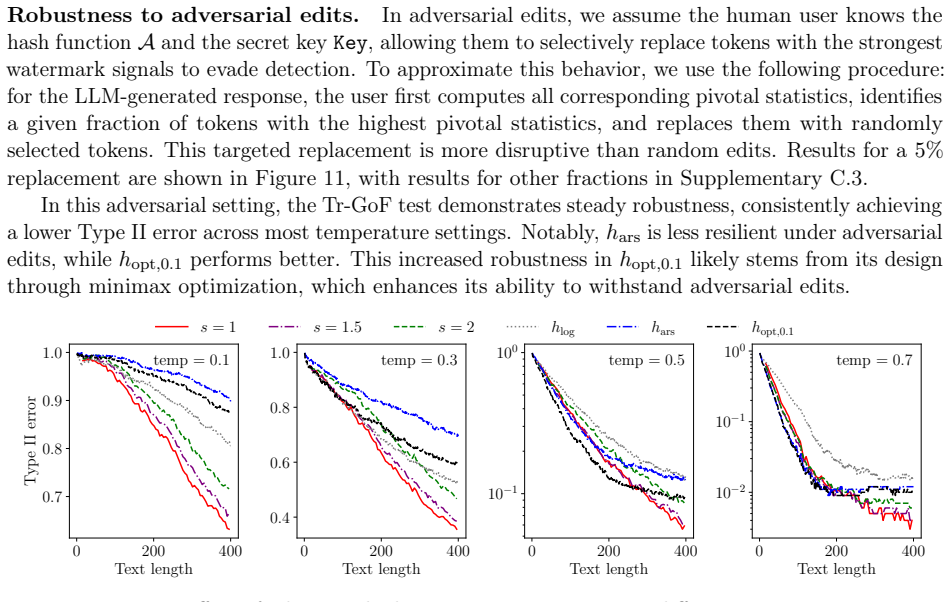
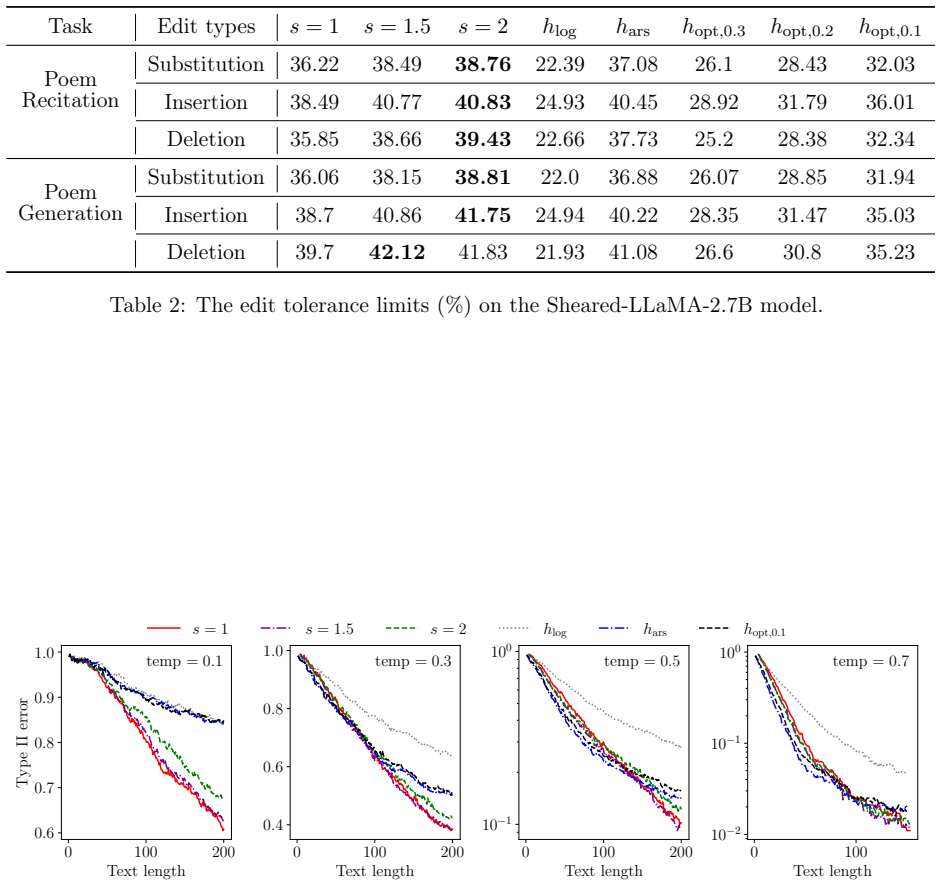
- Empirically, on open-source LLMs, Tr-GoF keeps Type I error controlled and achieves lower Type II error than baselines at low temperature, with the largest edit-tolerance limits in substitution, insertion, and deletion experiments.
Reading between the lines
- The truncation strategy should transfer to other watermark decoders whose pivotal statistics have a known null distribution, since the CDF comparison treats the decoder as a black box once pivots are defined.
- If real edits are clustered rather than per-token independent, the true alternative is autocorrelated and the boundary $q+2p=1$ may no longer be the right description; estimating the watermark fraction or exploiting spatial edit structure could recover some of the loss.
- Because the impossibility direction of Theorem 4.2 is an upper bound over all tests, the boundary $q+2p=1$ is plausibly information-theoretic for the Gumbel-max watermark, not just a property of p-value-based methods.
- In deployment, the tuning-free form suggests setting $s=2$ (Higher Criticism) with a Monte-Carlo threshold as a drop-in robust detector; the main cost is computing the pseudorandom pivots, which the detector already needs.
Editorial analysis
A structured set of objections, weighed in public.
Referee Report
Summary. The paper studies detection of the Gumbel-max watermark when LLM-generated text may have been edited by humans. It models edits as a per-token Bernoulli mixture: with probability εn a token retains its watermark signal, and otherwise it behaves as pure noise with pivot statistic drawn from µ0. Under an asymptotic regime with watermark fraction εn ≍ n^{-p} and NTP singularity Δn ≍ n^{-q}, the paper proves that the optimal detection boundary is q+2p=1, that the proposed truncated goodness-of-fit test (Tr-GoF) attains this boundary adaptively without knowing p, q, εn, or the NTP distributions, and that sum-based detection rules are limited to the suboptimal boundary q+p=1/2. In the constant-edit regime, the paper further claims that Tr-GoF achieves the optimal P∆-efficiency rate. The theoretical results are supplemented by simulations and experiments on OPT-1.3B and Sheared-LLaMA-2.7B, including random, adversarial, and roundtrip-translation edits.
Significance. If the results hold as stated, this is a substantial contribution to the statistical theory of LLM watermark detection. The paper gives a concrete phase transition, a parameter-free test that provably reaches it, and a rigorous explanation of why additive scoring rules are fragile under edits. The proofs are theorem-driven rather than fit to simulations, the simulation boundaries in Figures 6 and 7 align with the theory, and the source code is publicly available. The main value is the demonstration that a goodness-of-fit statistic can be adaptively optimal in a sparse mixture setting with autoregressive, time-varying signal distributions. The scope of these guarantees, however, depends on the mixture assumption for human edits, and that assumption is the main point of concern.
major comments (2)
- [Assumption 4.1(b) / Eq. (4) / Lemma A.2] The load-bearing assumption is that each edited token is independent of the pseudorandom vector ζt, so its pivot is exactly µ0. This is contradicted by the paper's own WordNet synonym-substitution protocol in Supplementary C.1. When the m-token context preceding position t is unedited, the verifier's recomputed ζt equals the original pseudorandom vector used to generate the token, and a replacement chosen as a synonym of the watermarked token is a function of that vector. For |W|=2 with P=(1/2,1/2), swapping the observed token to the other one yields P(Yt≤r | edited)=2r−r² rather than r. Consequently the mixture in Eq. (4) does not describe the actual edited-token distribution under content-dependent edits, and the clean conditional-mixture identity in Lemma A.2, on which Theorems 4.1–4.5 rely, is misspecified. The q+2p=1 boundary and the optimality of Tr-GoF are therefore proved for an edit process that is independent of the visible watermarked text, not for the editing process featured in the title and experiments. The authors should either prove that the stated results are insensitive to this dependence, add a misspecification analysis, or explicitly restrict the theoretical claims.
- [Remark 4.2 / Appendix Theorem 4.2] The relaxed-assumption statement in Remark 4.2 is inverted relative to the appendix. The main text says merging follows from q+2p>1 with P1:n⊂P∆n and separation from q+2p<1 with P1:n⊂Pc∆n, while the appendix's restated Theorem 4.2 and the proof in Section A.2 use the opposite inclusions: merging is proved for P1:n⊂Pc∆n and separation for P1:n⊂P∆n. Since P∆n is the class with Δ(Pt)≥Δn, the appendix version is the correct one for a signal that strengthens with Δn. Please correct Remark 4.2 so that the main text and appendix agree.
minor comments (5)
- [Section 6.3] In the paragraph on edit tolerance limits, 'reported in Figure 1' should read 'reported in Table 1'.
- [Section 5.3 / footnote 4] The formula in footnote 4 is garbled; the displayed lower bound on q should be written cleanly as q ≥ log(|W|/(|W|-1)) / log n to be readable.
- [Theorem 4.5] The optimal-efficiency result is stated for s∈(0,1) and c+_n=0, but the surrounding text and Figure 4 present it as a property of Tr-GoF generally; please state these restrictions wherever the result is summarized.
- [Section 6.1] The sentence beginning 'Among ∆ ∈ 0.1, 0.2, 0.3' is grammatically incomplete; please revise.
- [Algorithm 2] The notation 'ew' in the pseudocode should be 'w'; the current typesetting appears to come from an unresolved LaTeX macro.
Circularity Check
No significant circularity: Tr-GoF's optimality is derived from explicit assumptions via Hellinger and empirical-process arguments; self-citations to the authors' companion framework are not used as fitted inputs.
full rationale
The paper's derivation chain is theorem-driven rather than fit-driven. The alternative hypothesis is defined by Assumption 4.1(b) as a per-token Bernoulli mixture, and the detection boundary q+2p=1 is obtained from explicit Hellinger computations (Lemmas A.3-A.5) and empirical-process bounds (Lemmas A.8, A.11, A.12), not from any calibrated parameter. Tr-GoF's rejection rule uses only the sample size through (1+delta)loglog n and permits any 0 <= c+_n <= 1/n and any s in [-1,2], so the method does not use p, q, epsilon_n, or the NTP distributions in its construction. Theorem 4.5's optimal P-Delta-efficiency is proven via large-deviation results for Kolmogorov-Smirnov-type statistics [55, 64] and does not insert the claimed DKL value as an input. Self-citations to [47] supply the P-Delta-efficiency definition and the 'Working Hypothesis' of pseudorandomness, but these are stated assumptions or formal definitions with independent content, not unverified results that force the conclusions. The strongest skeptical concern, that real content-dependent edits violate Assumption 4.1(b), is a model-misspecification/correctness risk rather than a circularity: the mathematical claims are conditional on that assumption and are not equivalent to it by construction. Overall, no circular step was found.
Assumptions & free parameters
free parameters (2)
- s (phi-divergence index) =
1, 1.5, 2 in main LLM experiments; theorem allows any s in [-1,2]
- c+_n (truncation threshold) =
1/n in most experiments, 10^-3 in edit tolerance; theorem allows 0 <= c+_n <= 1/n
assumptions (5)
- domain assumption Perfect pseudorandomness: the pseudorandom values ζt are i.i.d. and independent of the past (Assumption 4.1a).
- domain assumption Per-token edit mixture: each token is watermarked with probability εn and otherwise is pure noise independent of ζt (Assumption 4.1b).
- domain assumption Identical singularity: every NTP distribution has max probability 1-Δn with Δn ≍ n^{-q} (Assumption 4.2).
- domain assumption Known null distribution for pivots: under H0 the pivots Yt are i.i.d. µ0 (uniform for Gumbel-max).
- standard math External large-deviation and empirical-process results, including the extreme value of the uniform empirical process, Theorem 2 in [55], and the lower bound in [64].
Cite this review
Pith. "Pith review of Robust Detection of Watermarks for Large Language Models Under Human Edits." pith.science (2026). https://pith.science/paper/OCFDUJSV
@misc{pith2026241113868,
  author       = {Pith},
  title        = {Pith review of: Robust Detection of Watermarks for Large Language Models Under Human Edits},
  year         = {2026},
  howpublished = {\url{https://pith.science/paper/OCFDUJSV}},
  note         = {Machine review of arXiv:2411.13868}
}
read the original abstract
Watermarking has offered an effective approach to distinguishing text generated by large language models (LLMs) from human-written text. However, the pervasive presence of human edits on LLM-generated text dilutes watermark signals, thereby significantly degrading detection performance of existing methods. In this paper, by modeling human edits through mixture model detection, we introduce a new method in the form of a truncated goodness-of-fit test for detecting watermarked text under human edits, which we refer to as Tr-GoF. We prove that the Tr-GoF test achieves optimality in robust detection of the Gumbel-max watermark in a certain asymptotic regime of substantial text modifications and vanishing watermark signals. Importantly, Tr-GoF achieves this optimality \textit{adaptively} as it does not require precise knowledge of human edit levels or probabilistic specifications of the LLMs, in contrast to the optimal but impractical (Neyman--Pearson) likelihood ratio test. Moreover, we establish that the Tr-GoF test attains the highest detection efficiency rate in a certain regime of moderate text modifications. In stark contrast, we show that sum-based detection rules, as employed by existing methods, fail to achieve optimal robustness in both regimes because the additive nature of their statistics is less resilient to edit-induced noise. Finally, we demonstrate the competitive and sometimes superior empirical performance of the Tr-GoF test on both synthetic data and open-source LLMs in the OPT and LLaMA families.
Figures


Figures from the paper (17 more)








Reference graph
Works this paper leans on
-
[1]
Watermarking of large language models, August 2023
Scott Aaronson. Watermarking of large language models, August 2023. URLhttps://simons. berkeley.edu/talks/scott-aaronson-ut-austin-openai-2023-08-17
2023
-
[2]
Josh Achiam, Steven Adler, Sandhini Agarwal, Lama Ahmad, Ilge Akkaya, Florencia Leoni Aleman, Diogo Almeida, Janko Altenschmidt, Sam Altman, Shyamal Anadkat, et al. GPT-4 technical report. arXiv preprint arXiv:2303.08774, 2023. 24
arXiv 2023
-
[3]
A learning algorithm for Boltzmann machines.Cognitive science, 9(1):147–169, 1985
David H Ackley, Geoffrey E Hinton, and Terrence J Sejnowski. A learning algorithm for Boltzmann machines.Cognitive science, 9(1):147–169, 1985
1985
-
[4]
Distribution-free tests for sparse heterogeneous mixtures
Ery Arias-Castro and Meng Wang. Distribution-free tests for sparse heterogeneous mixtures. Test, 26:71–94, 2017
2017
-
[5]
An intensive introduction to cryptography, lectures notes for Harvard CS 127
Boaz Barak. An intensive introduction to cryptography, lectures notes for Harvard CS 127. https://intensecrypto.org/public/index.html, Fall 2021
2021
-
[6]
On asymptotically optimal non-parametric criteria.Theory of Probability & Its Applications, 13(3):359–393, 1968
AA Borokov and NM Sycheva. On asymptotically optimal non-parametric criteria.Theory of Probability & Its Applications, 13(3):359–393, 1968
1968
-
[7]
Boundary-value problems for random walks and large deviations in function spaces
Aleksandr A Borovkov. Boundary-value problems for random walks and large deviations in function spaces. Theory of Probability & Its Applications, 12(4):575–595, 1967
1967
-
[8]
Language models are few-shot learners
Tom Brown, Benjamin Mann, Nick Ryder, Melanie Subbiah, Jared D Kaplan, Prafulla Dhariwal, Arvind Neelakantan, Pranav Shyam, Girish Sastry, Amanda Askell, et al. Language models are few-shot learners. InAdvances in Neural Information Processing Systems, volume 33, pages 1877–1901, 2020
1901
Show all 119 references
-
[9]
Optimal detection of sparse mixtures against a given null distribution
T Tony Cai and Yihong Wu. Optimal detection of sparse mixtures against a given null distribution. IEEE Transactions on Information Theory, 60(4):2217–2232, 2014
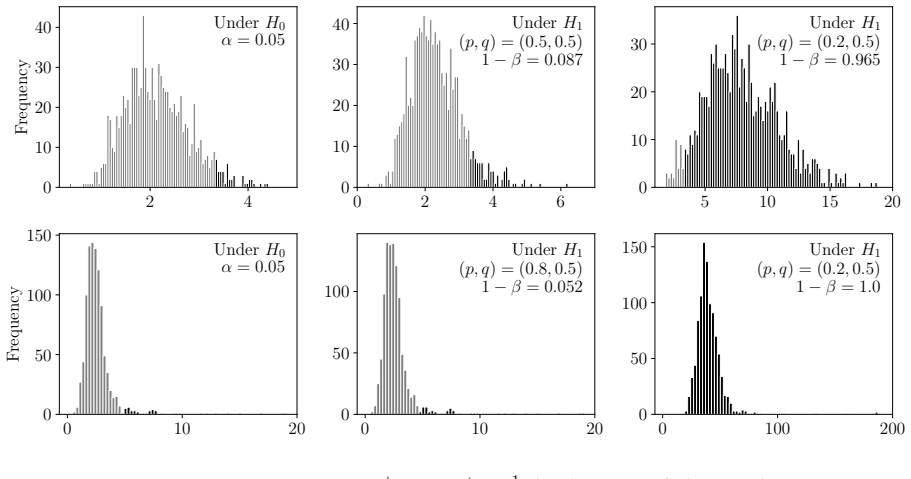
2014
-
[10]
Optimal detection of heterogeneous and het- eroscedastic mixtures
T Tony Cai, X Jessie Jeng, and Jiashun Jin. Optimal detection of heterogeneous and het- eroscedastic mixtures. Journal of the Royal Statistical Society Series B: Statistical Methodology, 73(5):629–662, 2011
2011
-
[11]
Towards better statistical understanding of watermarking LLMs.arXiv preprint arXiv:2403.13027, 2024
Zhongze Cai, Shang Liu, Hanzhao Wang, Huaiyang Zhong, and Xiaocheng Li. Towards better statistical understanding of watermarking LLMs.arXiv preprint arXiv:2403.13027, 2024
2024 arXiv
-
[12]
Pseudorandom error-correcting codes
Miranda Christ and Sam Gunn. Pseudorandom error-correcting codes. InAnnual International Cryptology Conference, pages 325–347. Springer, 2024
2024
-
[13]
Undetectable watermarks for language models
Miranda Christ, Sam Gunn, and Or Zamir. Undetectable watermarks for language models. In Conference on Learning Theory, pages 1125–1139. PMLR, 2024
2024
-
[14]
Routledge, 2017
Ralph B D’Agostino.Goodness-of-fit-techniques. Routledge, 2017
2017
-
[15]
Scalable watermarking for identifying large language model outputs
Sumanth Dathathri, Abigail See, Sumedh Ghaisas, Po-Sen Huang, Rob McAdam, Johannes Welbl, Vandana Bachani, Alex Kaskasoli, Robert Stanforth, Tatiana Matejovicova, Jamie Hayes, Nidhi Vyas, Majd Al Merey, Jonah Brown-Cohen, Rudy Bunel, Borja Balle, Taylan Cemgil, Zahra Ahmed, Ki...
2024
-
[16]
Cambridge university press, 2023
Ilias Diakonikolas and Daniel M Kane.Algorithmic high-dimensional robust statistics. Cambridge university press, 2023
2023
-
[17]
RL Dobrusin. A statistical problem arising in the theory of detection of signals in the presence of noise in a multi-channel system and leading to stable distribution laws.Theory of Probability & Its Applications, 3(2):161–173, 1958. 25
1958
-
[18]
Higher criticism for detecting sparse heterogeneous mixtures
David Donoho and Jiashun Jin. Higher criticism for detecting sparse heterogeneous mixtures. The Annals of Statistics, 32(3):962–994, 2004
2004
-
[19]
Higher criticism for large-scale inference, especially for rare and weak effects.Statistical science, 30(1):1–25, 2015
David Donoho and Jiashun Jin. Higher criticism for large-scale inference, especially for rare and weak effects.Statistical science, 30(1):1–25, 2015
2015
-
[20]
AI watermarking must be watertight to be effective.Nature, 634:753, 2024
Nature editorial. AI watermarking must be watertight to be effective.Nature, 634:753, 2024. URL https://www.nature.com/articles/d41586-024-03418-x
2024
-
[21]
M. R. Farhangdoost and M. Kargar Dolatabadi. New inequalities for Gamma and Digamma functions. Journal of Applied Mathematics, 2014, 2014
2014
-
[22]
Three bricks to consolidate watermarks for large language models
Pierre Fernandez, Antoine Chaffin, Karim Tit, Vivien Chappelier, and Teddy Furon. Three bricks to consolidate watermarks for large language models. In 2023 IEEE International Workshop on Information Forensics and Security (WIFS), pages 1–6. IEEE, 2023
2023
-
[23]
GumbelSoft: Diversified language model watermarking via the GumbelMax-trick.arXiv preprint arXiv:2402.12948, 2024
Jiayi Fu, Xuandong Zhao, Ruihan Yang, Yuansen Zhang, Jiangjie Chen, and Yanghua Xiao. GumbelSoft: Diversified language model watermarking via the GumbelMax-trick.arXiv preprint arXiv:2402.12948, 2024
2024 arXiv
-
[24]
WaterMax: Breaking the LLM watermark detectability- robustness-quality trade-off
Eva Giboulot and Furon Teddy. WaterMax: Breaking the LLM watermark detectability- robustness-quality trade-off. arXiv preprint arXiv:2403.04808, 2024
2024 arXiv
-
[25]
Edit distance robust watermarks for language models.arXiv preprint arXiv:2406.02633, 2024
Noah Golowich and Ankur Moitra. Edit distance robust watermarks for language models.arXiv preprint arXiv:2406.02633, 2024
2024 arXiv
-
[26]
The intermediates take it all: Asymptotics of higher criticism statistics and a powerful alternative based on equal local levels
Veronika Gontscharuk, Sandra Landwehr, and Helmut Finner. The intermediates take it all: Asymptotics of higher criticism statistics and a powerful alternative based on equal local levels. Biometrical Journal, 57(1):159–180, 2015
2015
-
[27]
US Government Printing Office, 1948
Emil Julius Gumbel.Statistical theory of extreme values and some practical applications: A series of lectures, volume 33. US Government Printing Office, 1948
1948
-
[28]
Properties of higher criticism under strong dependence.The Annals of Statistics, pages 381–402, 2008
Peter Hall and Jiashun Jin. Properties of higher criticism under strong dependence.The Annals of Statistics, pages 381–402, 2008
2008
-
[29]
Innovated higher criticism for detecting sparse signals in correlated noise
Peter Hall and Jiashun Jin. Innovated higher criticism for detecting sparse signals in correlated noise. The Annals of Statistics, 38(3):1686–1732, 2010
2010
-
[30]
Convex analysis and minimization algorithms I: Fundamentals, volume 305
Jean-Baptiste Hiriart-Urruty and Claude Lemaréchal. Convex analysis and minimization algorithms I: Fundamentals, volume 305. Springer science & business media, 1996
1996
-
[31]
SemStamp: A semantic watermark with paraphrastic robustness for text generation
Abe Hou, Jingyu Zhang, Tianxing He, Yichen Wang, Yung-Sung Chuang, Hongwei Wang, Lingfeng Shen, Benjamin Van Durme, Daniel Khashabi, and Yulia Tsvetkov. SemStamp: A semantic watermark with paraphrastic robustness for text generation. InNorth American Chapter of the Association...
2024
-
[32]
Unbiased watermark for large language models
Zhengmian Hu, Lichang Chen, Xidong Wu, Yihan Wu, Hongyang Zhang, and Heng Huang. Unbiased watermark for large language models. In International Conference on Learning Representations, 2024. URL https://openreview.net/forum?id=uWVC5FVidc. 26
2024
-
[33]
Towards optimal statistical watermarking.arXiv preprint arXiv:2312.07930, 2023
Baihe Huang, Hanlin Zhu, Banghua Zhu, Kannan Ramchandran, Michael I Jordan, Jason D Lee, and Jiantao Jiao. Towards optimal statistical watermarking.arXiv preprint arXiv:2312.07930, 2023
2023 arXiv
-
[34]
Robust estimation of a location parameter
Peter J Huber. Robust estimation of a location parameter. InBreakthroughs in statistics: Methodology and distribution, pages 492–518. Springer, 1992
1992
-
[35]
John Wiley & Sons, 2011
Peter J Huber and Elvezio M Ronchetti.Robust statistics. John Wiley & Sons, 2011
2011
-
[36]
Some problems of hypothesis testing leading to infinitely divisible distributions
Yuri I Ingster. Some problems of hypothesis testing leading to infinitely divisible distributions. Mathematical Methods of Statistics, 6(1):47–69, 1997
1997
-
[37]
Goodness-of-fit tests via phi-divergences.Annals of Statistics, 35(5):2018–2053, 2007
Leah Jager and Jon A Wellner. Goodness-of-fit tests via phi-divergences.Annals of Statistics, 35(5):2018–2053, 2007
2018
-
[38]
Categorical reparameterization with Gumbel-Softmax
Eric Jang, Shixiang Gu, and Ben Poole. Categorical reparameterization with Gumbel-Softmax. In International Conference on Learning Representations, 2016
2016
-
[39]
Rare and weak effects in large-scale inference: Methods and phase diagrams
Jiashun Jin and Zheng Tracy Ke. Rare and weak effects in large-scale inference: Methods and phase diagrams. Statistica Sinica, pages 1–34, 2016
2016
-
[40]
Optimal adaptivity of signed-polygon statistics for network testing.The Annals of Statistics, 49(6):3408–3433, 2021
Jiashun Jin, Zheng Tracy Ke, and Shengming Luo. Optimal adaptivity of signed-polygon statistics for network testing.The Annals of Statistics, 49(6):3408–3433, 2021
2021
-
[41]
Covariance assisted screening and estimation.Annals of statistics, 42(6):2202, 2014
Tracy Ke, Jiashun Jin, and Jianqing Fan. Covariance assisted screening and estimation.Annals of statistics, 42(6):2202, 2014
2014
-
[42]
Martingale approach in the theory of goodness-of-fit tests.Theory of Probability & Its Applications, 26(2):240–257, 1982
Estate V Khmaladze. Martingale approach in the theory of goodness-of-fit tests.Theory of Probability & Its Applications, 26(2):240–257, 1982
1982
-
[43]
A watermark for large language models
John Kirchenbauer, Jonas Geiping, Yuxin Wen, Jonathan Katz, Ian Miers, and Tom Goldstein. A watermark for large language models. InInternational Conference on Machine Learning, volume 202, pages 17061–17084, 2023
2023
-
[44]
On the reliability of watermarks for large language models
John Kirchenbauer, Jonas Geiping, Yuxin Wen, Manli Shu, Khalid Saifullah, Kezhi Kong, Kasun Fernando, Aniruddha Saha, Micah Goldblum, and Tom Goldstein. On the reliability of watermarks for large language models. InInternational Conference on Learning Representations,
-
[45]
Robust distortion- free watermarks for language models.Transactions on Machine Learning Research, 2024
Rohith Kuditipudi, John Thickstun, Tatsunori Hashimoto, and Percy Liang. Robust distortion- free watermarks for language models.Transactions on Machine Learning Research, 2024. ISSN 2835-8856. URL https://openreview.net/forum?id=FpaCL1MO2C
2024
-
[46]
Higher criticism: p-values and criticism.The Annals of Statistics, 43(3):1323–1350, 2015
Jian Li and David Siegmund. Higher criticism: p-values and criticism.The Annals of Statistics, 43(3):1323–1350, 2015
2015
-
[47]
Xiang Li, Feng Ruan, Huiyuan Wang, Qi Long, and Weijie J. Su. A statistical framework of watermarks for large language models: Pivot, detection efficiency and optimal rules.The Annals of Statistics (to appear), 2024. 27
2024
-
[48]
A semantic invariant robust watermark for large language models
Aiwei Liu, Leyi Pan, Xuming Hu, Shiao Meng, and Lijie Wen. A semantic invariant robust watermark for large language models. InInternational Conference on Learning Representations,
-
[49]
Adaptive text watermark for large language models
Yepeng Liu and Yuheng Bu. Adaptive text watermark for large language models. InInter- national Conference on Machine Learning, 2024. URLhttps://openreview.net/forum?id= 7emOSb5UfX
2024
-
[50]
URL https://openreview.net/forum?id=6p8lpe4MNf
-
[51]
Large language models challenge the future of higher education.Nature Machine Intelligence, 5(4):333–334, 2023
Silvia Milano, Joshua A McGrane, and Sabina Leonelli. Large language models challenge the future of higher education.Nature Machine Intelligence, 5(4):333–334, 2023
2023
-
[52]
A* sampling
Chris J Maddison, Daniel Tarlow, and Tom Minka. A* sampling. InAdvances in Neural Information Processing Systems, volume 27, 2014
2014
-
[53]
Fast calculation of p-values for one-sided Kolmogorov-Smirnov type statistics
Amit Moscovich. Fast calculation of p-values for one-sided Kolmogorov-Smirnov type statistics. Computational Statistics & Data Analysis, 185:107769, 2023
2023
-
[54]
WordNet: A lexical database for English.Communications of the ACM, 38 (11):39–41, 1995
George A Miller. WordNet: A lexical database for English.Communications of the ACM, 38 (11):39–41, 1995
1995
-
[55]
Hodges-Lehmann asymptotic efficiency of the Kolmogorov and Smirnov goodness- of-fit tests
Ya Yu Nikitin. Hodges-Lehmann asymptotic efficiency of the Kolmogorov and Smirnov goodness- of-fit tests. Journal of Soviet Mathematics, 36:517–520, 1987
1987
-
[56]
Cambridge University Press, 1995
ÍÀkov ÍÙr’evich Nikitin.Asymptotic efficiency of nonparametric tests. Cambridge University Press, 1995
1995
-
[57]
Understanding the source of what we see and hear online, May 2024
OpenAI. Understanding the source of what we see and hear online, May 2024. URL https://https://openai.com/index/understanding-the-source-of-what-we-see- and-hear-online/
2024
-
[58]
ChatGPT: Optimizing language models for dialogue, Jan 2023
OpenAI. ChatGPT: Optimizing language models for dialogue, Jan 2023. URLhttp://web. archive.org/web/20230109000707/https://openai.com/blog/chatgpt/
2023
-
[59]
Mark my words: Analyzing and evaluating language model watermarks.arXiv preprint arXiv:2312.00273, 2023
Julien Piet, Chawin Sitawarin, Vivian Fang, Norman Mu, and David Wagner. Mark my words: Analyzing and evaluating language model watermarks.arXiv preprint arXiv:2312.00273, 2023
2023 arXiv
-
[60]
Perturb-and-map random fields: Using discrete opti- mization to learn and sample from energy models
George Papandreou and Alan L Yuille. Perturb-and-map random fields: Using discrete opti- mization to learn and sample from energy models. InInternational Conference on Computer Vision, pages 193–200. IEEE, 2011
2011
-
[61]
Language models are unsupervised multitask learners.OpenAI blog, 1(8):9, 2019
Alec Radford, Jeffrey Wu, Rewon Child, David Luan, Dario Amodei, Ilya Sutskever, et al. Language models are unsupervised multitask learners.OpenAI blog, 1(8):9, 2019
2019
-
[62]
Large deviations and bahadur efficiency of the Khmaladze-Aki statistic
OA Podkorytova. Large deviations and bahadur efficiency of the Khmaladze-Aki statistic. Journal of Mathematical Sciences, 68:560–565, 1994
1994
-
[63]
Exploring the limits of transfer learning with a unified text-to-text transformer
Colin Raffel, Noam Shazeer, Adam Roberts, Katherine Lee, Sharan Narang, Michael Matena, Yanqi Zhou, Wei Li, and Peter J Liu. Exploring the limits of transfer learning with a unified text-to-text transformer. Journal of Machine Learning Research, 21(1):5485–5551, 2020
2020
-
[64]
Robust speech recognition via large-scale weak supervision
Alec Radford, Jong Wook Kim, Tao Xu, Greg Brockman, Christine McLeavey, and Ilya Sutskever. Robust speech recognition via large-scale weak supervision. InInternational Conference on Machine Learning, pages 28492–28518. PMLR, 2023. 28
2023
-
[65]
A robust semantics-based watermark for large language model against paraphrasing
Jie Ren, Han Xu, Yiding Liu, Yingqian Cui, Shuaiqiang Wang, Dawei Yin, and Jiliang Tang. A robust semantics-based watermark for large language model against paraphrasing. InFindings of the Association for Computational Linguistics, pages 613–625, 2024
2024
-
[66]
Efficient estimates and optimum inference procedures in large samples
C Radhakrishna Rao. Efficient estimates and optimum inference procedures in large samples. Journal of the Royal Statistical Society: Series B (Methodological), 24(1):46–63, 1962
1962
-
[67]
The curse of recursion: Training on generated data makes models forget
Ilia Shumailov, Zakhar Shumaylov, Yiren Zhao, Yarin Gal, Nicolas Papernot, and Ross Anderson. The curse of recursion: Training on generated data makes models forget. arXiv preprint arXiv:2305.17493, 2023
2023 arXiv
-
[68]
Applied Cryptography
Bruce Schneier. Applied Cryptography. John Wiley & Sons, 1996
1996
-
[69]
AI bot ChatGPT writes smart essays—Should professors worry?Nature News, 2022
C Stokel-Walker. AI bot ChatGPT writes smart essays—Should professors worry?Nature News, 2022
2022
-
[70]
Disinformation’s spread: Bots, trolls and all of us.Nature, 571(7766):449–450, 2019
Kate Starbird. Disinformation’s spread: Bots, trolls and all of us.Nature, 571(7766):449–450, 2019
2019
-
[71]
Ethical and social risks of harm from language models.arXiv preprint arXiv:2112.04359, 2021
Laura Weidinger, John Mellor, Maribeth Rauh, Conor Griffin, Jonathan Uesato, Po-Sen Huang, Myra Cheng, Mia Glaese, Borja Balle, Atoosa Kasirzadeh, et al. Ethical and social risks of harm from language models.arXiv preprint arXiv:2112.04359, 2021
2021 arXiv
-
[72]
LLaMA: Open and efficient foundation language models.arXiv preprint arXiv:2302.13971, 2023
Hugo Touvron, Thibaut Lavril, Gautier Izacard, Xavier Martinet, Marie-Anne Lachaux, Timo- thée Lacroix, Baptiste Rozière, Naman Goyal, Eric Hambro, Faisal Azhar, et al. LLaMA: Open and efficient foundation language models.arXiv preprint arXiv:2302.13971, 2023
2023 arXiv
-
[73]
DiPmark: A stealthy, efficient and resilient watermark for large language models.arXiv preprint arXiv:2310.07710, 2023
Yihan Wu, Zhengmian Hu, Hongyang Zhang, and Heng Huang. DiPmark: A stealthy, efficient and resilient watermark for large language models.arXiv preprint arXiv:2310.07710, 2023
2023 arXiv
-
[74]
A note on the asymptotic distribution of Berk—Jones type statistics under the null hypothesis
Jon A Wellner and Vladimir Koltchinskii. A note on the asymptotic distribution of Berk—Jones type statistics under the null hypothesis. InHigh Dimensional Probability III, pages 321–332. Springer, 2003
2003
-
[75]
Su, and Ruixun Zhang
Yangxinyu Xie, Xiang Li, Tanwi Mallick, Weijie J. Su, and Ruixun Zhang. Debiasing watermarks for large language models via maximal coupling.arXiv preprint arXiv:2411.11203, 2024
2024 arXiv
-
[76]
Sheared LLaMA: Accelerating language model pre-training via structured pruning
Mengzhou Xia, Tianyu Gao, Zhiyuan Zeng, and Danqi Chen. Sheared LLaMA: Accelerating language model pre-training via structured pruning. InInternational Conference on Learning Representations, 2023
2023
-
[77]
Defending against neural fake news
Rowan Zellers, Ari Holtzman, Hannah Rashkin, Yonatan Bisk, Ali Farhadi, Franziska Roesner, and Yejin Choi. Defending against neural fake news. In Advances in Neural Information Processing Systems, volume 32, 2019
2019
-
[78]
Robust multi-bit natural lan- guage watermarking through invariant features
KiYoon Yoo, Wonhyuk Ahn, Jiho Jang, and Nojun Kwak. Robust multi-bit natural lan- guage watermarking through invariant features. InAnnual Meeting Of The Association For Computational Linguistics, 2023. 29
2023
-
[79]
Provable robust watermarking for AI-generated text
Xuandong Zhao, Prabhanjan Vijendra Ananth, Lei Li, and Yu-Xiang Wang. Provable robust watermarking for AI-generated text. InInternational Conference on Learning Representations,
-
[80]
OPT: Open pre-trained transformer language models.arXiv preprint arXiv:2205.01068, 2022
Susan Zhang, Stephen Roller, Naman Goyal, Mikel Artetxe, Moya Chen, Shuohui Chen, Christopher Dewan, Mona Diab, Xian Li, Xi Victoria Lin, et al. OPT: Open pre-trained transformer language models.arXiv preprint arXiv:2205.01068, 2022
2022 arXiv
-
[81]
Duwak: Dual watermarks in large language models
Chaoyi Zhu, Jeroen Galjaard, Pin-Yu Chen, and Lydia Y Chen. Duwak: Dual watermarks in large language models. InFindings of the Association for Computational Linguistics, 2024
2024
-
[82]
URL https://openreview.net/forum?id=SsmT8aO45L
-
[83]
Permute-and-Flip: An optimally robust and watermarkable decoder for LLMs.arXiv preprint arXiv:2402.05864, 2024
Xuandong Zhao, Lei Li, and Yu-Xiang Wang. Permute-and-Flip: An optimally robust and watermarkable decoder for LLMs.arXiv preprint arXiv:2402.05864, 2024
2024 arXiv
-
[85]
Human behavior and the principle of least effort: An introduction to human ecology
George Kingsley Zipf. Human behavior and the principle of least effort: An introduction to human ecology. Ravenio books, 2016. 30 Supplementary Material This Supplementary Material includes the remaining proofs and technical details. Section A presents the proofs, while Sectio...
2016
-
[86]
If n · supPt∈P H 2(µ0, (1 − εn)µ0 + εnµ1,Pt) = o(1), then TV(ρ0, ρ1) → 0 as n → ∞
-
[87]
, Yt−1] be the conditional version ofµ1,Pt given the history information Y1,
Let µ1,t = E1[µ1,Pt|Y1, . . . , Yt−1] be the conditional version ofµ1,Pt given the history information Y1, . . . , Yt−1. If there exists a positive non-random sequencecn satisfying ncn → ∞such that mint∈[n] inf Pt∈P H 2(µ0, (1 − εn)µ0 + εnµ1,t) ≥ cn holds almost surely for eac...
-
[88]
By the last inequality, (14), and (13), it follows that H 2(ρ0, ρ1) ≤ 1 − nY t=1 1 − sup Pt∈P H 2(µ0, (1 − εn)µ0 + εnµ1,Pt)
By conditional Jensen’s inequality, it follows that EYn∼µ0 q (1 − εn) + εnf 1,n(Yn) ≥ EYn∼µ0 E1 q (1 − εn) + εnf1,Pn(Yn) Gn−1 ≥ inf Pn∈P EYn∼µ0 q (1 − εn) + εnf1,Pn(Yn) = 1 − sup Pn∈P H 2(µ0, (1 − εn)µ0 + εnµ1,Pn). By the last inequality, (14), and (13), it follows that H 2(ρ0...
-
[89]
E1 " nY t=1 1Yt∈At|Gn−1 ## = E1
By the condition, it follows that EYn∼µ0 q (1 − εn) + εnf 1,n(Yn) = 1 − H 2(µ0, (1 − εn)µ0 + εnµ1,n) ≤ 1 − cn. By the last inequality, (14), and (13), it follows that H 2(ρ0, ρ1) ≥ 1 − (1 − cn)n ≥ 1 − e−ncn → 1. Proof of (14). To prove equation(14), we require an important lem...
-
[90]
Hence, for any test, the sum of Type I and Type II errors tends to 1 asn → ∞
If q + 2p >1 and P1:n ⊂ Pc ∆n, H0 and H mix 1 merge asymptotically. Hence, for any test, the sum of Type I and Type II errors tends to 1 asn → ∞
-
[91]
Furthermore, for the likelihood-ratio test that rejectsH0 if the log-likelihood ratio is positive, the sum of Type I and Type II errors tends to 0 asn → ∞
If q + 2p <1 and P1:n ⊂ P∆n, H0 and H mix 1 separate asymptotically. Furthermore, for the likelihood-ratio test that rejectsH0 if the log-likelihood ratio is positive, the sum of Type I and Type II errors tends to 0 asn → ∞. Proof of Theorem 4.2.We prove this theorem with the ...
-
[92]
Then, H 2(µ0, 1 − εn + εnµ1,Pt) = Θ(1) · ε2 n · E0(f1,Pt(Y ) − 1)2
Let f1,Pt(r) = P w∈W r1/Pt,w−1 be the PDF ofµ1,Pt. Then, H 2(µ0, 1 − εn + εnµ1,Pt) = Θ(1) · ε2 n · E0(f1,Pt(Y ) − 1)2
-
[93]
Let Gn = σ({Yt}n t=1) is the σ-field generated by allY1, . . . , Yn. We define the conditioned PDF and probability measure:f 1,t(y) = E1[f1,Pt(y)|Gt−1] and µ1,t = E1[µ1,Pt|Gt−1]. It follows that H 2(µ0, 1 − εn + εnµ1,t) = Θ(1) · ε2 n · E0(f 1,t(Y ) − 1)2. Here Θ(1) in the abov...
-
[94]
By Lemma A.1, it suffices to show nX t=1 sup Pt∈P c ∆n H 2(µ0, (1 − εn)µ0 + εnµ1,Pt) → 0
To prove the first point, we could use a similar argument in the proof of Theorem 4.1. By Lemma A.1, it suffices to show nX t=1 sup Pt∈P c ∆n H 2(µ0, (1 − εn)µ0 + εnµ1,Pt) → 0. (19) Lemma A.4. Fix Pt. Let f1,Pt(r) = P w∈W r1/Pt,w−1 be the PDF ofµ1,Pt. Then, E0(f1,Pt(Y ) − 1)2 ...
-
[95]
Lemma A.5
To prove the second point, by Lemma A.1, we only have to show that there exists a positive non-random sequence cn satisfying ncn → ∞and H 2(µ0, (1 − εn)µ0 + εnµ1,t) ≥ cn almost surely for ∀n ≥ 1. Lemma A.5. If Pt ∈ P∆n holds almost surely andn is sufficiently large so that∆n <...
-
[96]
For eacht ∈ [n], we obtain a p-value by pt := P0(Y ≥ Yt|Yt) = 1 − Yt
-
[97]
Sort the p-values to p(1) < p(2) < . . . <p(n). We make a convention that p(n+1) = 1
-
[98]
(22) 38 For any givenδ >0, we would rejectH0 if HC+ n ≥ p 2(1 + δ) log logn
Define the HC statistic as HC+ n = sup t:p(t+1)≥c+ n HCn,t, HCn,t = √n t/n −p(t)q p(t)(1 −p(t)) . (22) 38 For any givenδ >0, we would rejectH0 if HC+ n ≥ p 2(1 + δ) log logn. (23) Remark A.1. We mention that except for the expression in(22), there are other variants or general...
-
[99]
As a result, Tr-GoF can asymptotically distinguish between H0 and H mix 1
These results imply that by rejecting H0 whenever nS+ n (s) ≥ (1 + δ) log logn for any givenδ >0, both Type I and Type II errors converge to zero asymptotically. As a result, Tr-GoF can asymptotically distinguish between H0 and H mix 1 . To prove Theorem 4.3, we start by intro...
-
[100]
Proof of Lemma A.11.If u < v, K+ s (u, v) = 0; thus, all the inequalities follow directly
For s = 1, it follows that K+ 1 (u, v) ≥ K+ 2 (u, v) · v u . Proof of Lemma A.11.If u < v, K+ s (u, v) = 0; thus, all the inequalities follow directly. We then assume 0 < v≤ u <1. Note that by definition,K2(u, v) = 1 2 (u−v)2 v(1−v) is always non-negative
-
[101]
(31) Given v ≤ u and s ≤ 2, it follows that −(1 − v) 1 − v u 2−s ≤ v(1 − v)Ds(u⋆, v) − 1 ≤ v " 1 − v 1 − u 2−s − 1 #
If s ̸= 1, from the proof of Lemma 7.2 (ii) in [37], it follows that Ks(u, v) = K2(u, v) [1 +v(1 − v)Ds(u⋆, v) − 1] , where u⋆ ∈ [v, u] is determined by the mean value theorem andDs(u⋆, v) is given by Ds(u, v) = v u 2−s 1 v + 1 − v 1 − u 2−s 1 1 − v . (31) Given v ≤ u and s ≤ ...
-
[102]
We then complete the proof by noting thatK+ s (u, v) = Ks(u, v) if v ≤ u
If s = 1, from the proof of Theorem 1.1 in [72], we similarly have K1(u, v) = K2(u, v) [1 +v(1 − v)D1(u⋆, v) − 1] , where u⋆ ∈ [v, u]is determined by the mean value theorem and the quantityD1(u⋆, v), according to (31), is given by D1(u⋆, v) = 1 u⋆(1 − u⋆) By the inequalityu⋆ ∈...
-
[103]
For hars, E1,P hars(Y ) − E0 hars(Y ) = Θ(1) · Ent(P ) = Θ ∆ log 1 ∆
-
[104]
For hlog, E1,P hlog(Y ) − E0 hlog(Y ) = 1 − P w∈W P 2 w = Θ(∆)
-
[105]
For hind,δ with δ ∈ (0, 1), E1,P hind,δ(Y ) − E0 hind,δ(Y ) = δ − FP (δ) = Θ(∆)
-
[106]
5This inequality deviates slightly from the original version (see Theorem 2(a) in [21])
For hopt,∆0 with ∆0 ∈ (0, 1), E1,P hopt,∆0(Y ) − E0 hopt,∆0(Y ) = Θ(∆). 5This inequality deviates slightly from the original version (see Theorem 2(a) in [21]). It can be established using the same methodology they employed, with the alteration being the adjustment of the doma...
-
[107]
It is easy to find the lower bound holds:Ent(P ) ≥ (1 − Pmax) log 1 1−Pmax = ∆ log 1 ∆
We first note that Ent(P ) = Pmax log 1 Pmax + (1 − Pmax) log 1 1 − Pmax + (1 − Pmax) X w:Pw̸=Pmax Pw 1 − Pmax log 1 − Pmax Pw . It is easy to find the lower bound holds:Ent(P ) ≥ (1 − Pmax) log 1 1−Pmax = ∆ log 1 ∆. For the upper bound, we note that ifPmax ≥ 1 − c (due to ∆ ≤...
-
[108]
It follows that1 − Pmax ≤ 1 − P w∈W P 2 w ≤ 1 − P 2 max ≤ 2(1 − Pmax)
-
[109]
Given Pmax is smaller than a constant, sayc, we have that−g′(θ) is a positive constant that depends only onδ and c, which implies the above equation(∗)
Due toPmaxδ1/Pmax ≤ FP (δ) ≤ δ1/Pmax, once we setg(x) = δx, the mean value theorem implies that g(1) − g 1 Pw = g′(θ) 1 − 1 Pw (∗) = Θ(1 − Pmax) where θ ∈ [1, 1/Pmax]. Given Pmax is smaller than a constant, sayc, we have that−g′(θ) is a positive constant that depends only onδ ...
-
[110]
We first consider the simplest case where∆0 ∈ (0, 0.5), hopt,∆0(y) = log y ∆0 1−∆0 + y 1 ∆0 −1 = ∆0 1 − ∆0 log y + log 1 + y 1−∆0 ∆0 − ∆0 1−∆0 . We note that by integration by parts, it follows that E1,P hopt,∆0(Y ) − E0 hopt,∆0(Y ) = ∆0 1 − ∆0 [E1,P hlog(Y ) − E0 hlog(Y )] + ...
-
[111]
If q + p <1 2 and P1:n ⊂ P∆n, the sum of Type I and Type II errors tends to 0
-
[112]
If q + p >1 2 and P1:n ⊂ Pc ∆n, the sum of Type I and Type II errors tends to 1. Proof of Theorem 4.4.Recall that the considered detection rule has the following form: Th(Y1:n) = ( 1 if Pn t=1 h(Yt) ≥ n · E0 h(Y ) + C · n 1 2 an, 0 if Pn t=1 h(Yt) < n· E0 h(Y ) + C · n 1 2 an,...
-
[113]
By condition an n1/2−p−q → 0, we haveX n√n → −∞as n → ∞
If p + q <1 2 and P1:n ⊂ P∆n, we then have that X n ≤ −Θ(n · εn · ∆n). By condition an n1/2−p−q → 0, we haveX n√n → −∞as n → ∞. Hence, by Chebyshev’s inequality, it follows that as long asn is sufficiently large, P1(Th(Y1:n) = 0) ≤ P1 Xn√n ≥ X n√n − Can ≤ O(1) n 1 2 −p−q → 0
-
[114]
Hence, by Chebyshev’s inequality, it follows that as long as n is sufficiently large, P1(Th(Y1:n) = 1) ≤ P1 Xn√n ≥ Can − X n√n ≤ O(1) a2n → 0
If p + q >1 2 and P1:n ⊂ Pc ∆n, we then have that 0 ≥ X n ≥ −Θ(n · εn · ∆n), which implies that X n√n → 0 as n → ∞. Hence, by Chebyshev’s inequality, it follows that as long as n is sufficiently large, P1(Th(Y1:n) = 1) ≤ P1 Xn√n ≥ Can − X n√n ≤ O(1) a2n → 0. The case forhars w...
-
[115]
Draw n = 104 samples from U (0, 1) to represent H0 and then calculateHC+ n or HC⋆ n
-
[116]
Replace ⌈nεn⌉ of the previous samples by the same number of samples fromF1,Pt where Pt is generated according to theM3 method in which the top probability is forced to be1 − ∆n
-
[117]
heavy tails
Repeat Steps 1 and 2 overN = 103 times and make histograms of the simulatedHC+ n or HC⋆ n. See Figure 14 for the distribution ofHC+ n (top) and HC⋆ n (bottom) under interesting(p, q) pairs. Let’s first focus on the top row. UnderH0, the distribution ofHC+ n values is primarily...
2000
-
[118]
Helsinki-NLP/opus-mt-tc-big-en-fr for English to French translation,
-
[119]
This method leverages the subtle nuances of translation to detect inconsistencies or vulnerabilities in language models
Helsinki-NLP/opus-mt-tc-big-fr-en for French to English translation. This method leverages the subtle nuances of translation to detect inconsistencies or vulnerabilities in language models. Since the text length may change after roundtrip translation, we use the last 200 token...
-
[2024]
URL https://openreview.net/forum?id=DEJIDCmWOz
Reviewed August 12, 2026 · model on record in the stance chip above.
Discussion (0). Continue with ORCID to comment.