REVIEW 3 major objections 8 minor 37 references
LLaSA: Large Language and Structured Data Assistant
T0 review · 3 major / 8 minor · reviewed 2026-08-12 · deepseek-v4-flash
Pith's one-line read One hypergraph encoder lifts four LLMs on structured data.
desk verdict LLaSA's unified hypergraph adapter is a solid engineering contribution with real frozen-LLM gains; the SOTA claim is thin and per-domain graph transfer is never directly ablated. read the letter →
The pith
A machine-rendered reading of the paper's core claim, the machinery that carries it, and where it could break.
The reading
What carries the argument
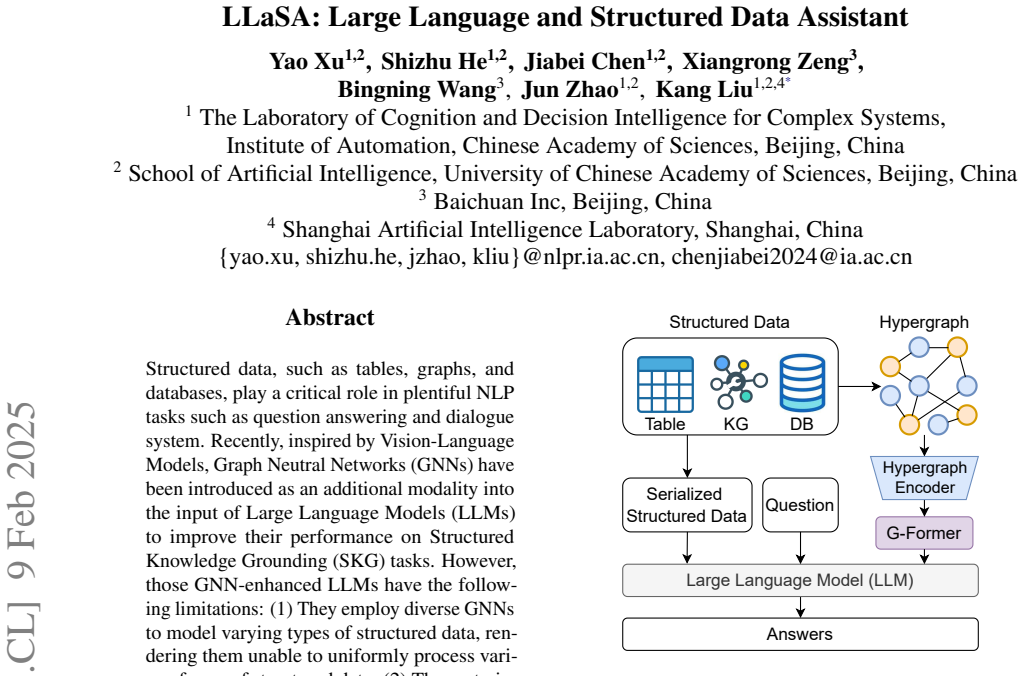
The unifying object is the hypergraph built from any structured input, together with the two-stage encoder-compressor that reads it. HyperTrans alternates Node2Hyperedge and Hyperedge2Node set-attention layers with a hyperedge fusion MLP, producing representations of every cell or entity; G-Former then uses a fixed set of learnable query tokens, cross-attending to these representations and compressing them into a handful of soft tokens. The two self-supervised objectives, answer generation conditioned on the graph and a graph-text matching score, make the query tokens carry textual meaning before any LLM is attached. Because the pretraining is LLM-free, the same encoder and G-Former can be frozen or lightly tuned and plugged into a new language model, with the soft tokens placed in front of the serialized input.
What would settle it
Take the knowledge-graph tasks CompWebQ, KVRet, and DART and ablate the hypergraph soft prompts entirely, leaving the same serialized input and LoRA training: the central claim predicts a clear accuracy drop; if scores stay flat, the reported gains come from text and tuning rather than from the structured-data modality. A second check is to pretrain the encoder on tables only and evaluate on graphs: if graph accuracy matches a text-only baseline, the claimed cross-type transfer has failed.
Extended reading notes
Core claim
The paper's central claim is that a single hypergraph encoder, pretrained once with self-supervised objectives and decoupled from any particular language model, can serve as a universal structured-data interface for LLMs. Tables become hypergraphs by treating cells as nodes and rows and columns as hyperedges; knowledge graphs become hypergraphs by treating entities as nodes and relations as hyperedges, with reverse-relation nodes preserving direction. A structure-aware transformer called HyperTrans encodes each hypergraph, and a G-Former, modeled on the Q-Former design from vision-language pretraining, compresses the node representations into a fixed number of query tokens that are appended to the LLM's text embeddings as soft prompts. Two pretraining tasks, graph-dependent answer generation and graph-text matching, align the encoder with text without involving any LLM. Across ten benchmark tasks and four base models, the framework improves results over text-only prompting, and in the LoRA-tuned setting with Mistral-7B it reaches an average of 66.9 versus 66.7 for a full-parameter-tuned generalist baseline, with only about 400 million trainable parameters. The authors conclude that the pretrained encoder transfers across tables, knowledge graphs, and databases even though pretraining saw only tables.
Load-bearing premise
The load-bearing premise is that pretraining on 25 million tables alone teaches the encoder and G-Former to represent knowledge-graph and database hypergraphs well enough to improve answers, even though no graph or database example is seen during pretraining.
Editorial extensions
If this is right
- If the central claim is right, a single structured-data encoder can be reused across many LLMs, removing the need to re-pretrain a GNN for each new base model.
- Freezing the LLM still gives large gains, roughly ten points on average, so the hypergraph path can be used even when the LLM cannot be fine-tuned.
- LoRA fine-tuning yields small improvements on held-in tasks but consistently larger improvements on held-out datasets, suggesting the contribution is genuine structure understanding rather than memorization.
- With about 400 million trainable parameters and LoRA, the framework edges past a full-parameter-tuned generalist baseline, so parameter-efficient tuning suffices for this modality.
Reading between the lines
- Directly pretraining on knowledge-graph and database hypergraphs, not just tables, would test and likely strengthen the claimed universality; the current results only show that table pretraining transfers.
- The fixed number of query tokens, which the authors flag as a limitation, makes the approach a candidate for adaptive query budgets: graphs with hundreds of nodes may need more than the current ten tokens.
- The soft-prompt design suggests a practical recipe for any new LLM: append the same pretrained hypergraph interface rather than distilling graph structure into the model's weights.
- A clean controlled experiment, removing the soft prompts or replacing the pretrained encoder with a random one, would quantify how much of the gain is due to the structured modality rather than the extra trainable parameters.
Editorial analysis
A structured set of objections, weighed in public.
Referee Report
Summary. The paper proposes LLaSA, a framework that converts structured data (tables, knowledge graphs, databases) into a unified hypergraph representation, encodes it with a HyTrel-style hypergraph transformer, compresses the encoded nodes into fixed-length query tokens with a Q-Former-like G-Former, and feeds those tokens as soft prompts to a frozen or LoRA-tuned LLM. The hypergraph encoder and G-Former are pretrained with two self-supervised objectives, graph-dependent answer generation and graph-text matching, on 25 million web tables from TaBERT. The authors evaluate LLaSA on ten held-in SKG tasks (seven table-related and three knowledge-graph tasks) and three held-out table tasks, across four base LLMs and two tuning strategies. They report consistent gains over the base LLMs in the frozen-LLM setting, smaller gains under LoRA tuning, and claim that LLaSA with LoRA surpasses the prior full-parameter-tuning state of the art, StructLM.
Significance. If the central claims hold, the paper would make a useful contribution: a single pretrained hypergraph encoder and G-Former that can be plugged into different LLMs as a structured-data adapter, avoiding LLM-coupled GNN pretraining. The idea of unifying tables, graphs, and databases as hypergraphs is appealing, and the paper provides initial evidence across several base models. The ablation study in Table 3 supports the importance of pretraining, the GNN, and the G-Former, and the authors are transparent about the known weakness of the answer-generation objective, which they mitigate with graph-text matching. However, the headline state-of-the-art claim rests on a very small average margin, and the transfer of table-only pretraining to knowledge-graph hypergraphs is not isolated in the ablations. The significance of the work is thus conditional on additional experiments that separate per-domain effects and quantify uncertainty.
major comments (3)
- [Abstract, Section 4.4, Table 1] The headline claim that LLaSA 'outperforms previous SOTA method using full parameters tuning' rests on an average held-in score of 66.9 versus StructLM's 66.7, a difference of 0.2 points. No standard deviations, number of seeds, or significance tests are reported, and on the held-out tasks LLaSA's average (27.2) is actually lower than StructLM's (27.7). Several individual task margins are also very small (e.g., HybridQA 62.9 vs 62.6, WikiSQL 87.1 vs 87.0, KVRet 72.3 vs 72.2). The paper uses the word 'significantly' in Section 4.4 without statistical support. As it stands, the SOTA claim is not supported by the reported evidence.
- [Section 3.1, Section 4.3, Table 3] The universal structured-data claim depends on the assumption that pretraining exclusively on 25 million web tables transfers to knowledge-graph hypergraphs. Table 3 reports only Avg-I and Avg-O, which aggregate seven table tasks (WikiTQ, HybridQA, FeTaQA, TabMWP, WikiSQL, TabFact, ToTTo) and three graph tasks (KVRet, CWQ, DART), so the marginal contribution of pretraining on the graph subset is not identifiable. Table 2's frozen-LLM rows show per-dataset gains on KVRet, CWQ, and DART, but those comparisons add the full LLaSA machinery (400M-parameter encoder plus G-Former plus soft prompts) and do not isolate the pretrained initialization. This concern is reinforced by Section 3.1, where graph conversion introduces relation and reverse-relation hyperedges that have no direct counterpart in table rows or columns. Please report the ablation per task or at least per domain, and consider including a graph-only pretraining comparison.
- [Section 3.3.2, Eq. (7)] The manuscript never explicitly states whether the hypergraph encoder and G-Former are frozen or updated during task-specific instruction tuning. The sentence 'we only use the graph transformer module pretrained in the pretraining stage' is ambiguous: it could mean that the text transformer is discarded while the graph transformer remains frozen, or that the graph transformer is initialized from pretraining and further trained. Equations (8)-(9) define p_theta only over LLM parameters theta, but Eq. (7) includes the G-Former and the fully connected layer without specifying their trainable status. The reusable-adapter claim depends on this distinction: if the 400M-parameter encoder and G-Former are retrained for each base LLM, then Table 2 demonstrates per-LLM fine-tuning rather than a single frozen structured-data adapter. Please state the exact trainable parameter sets for each finetuning strategy and, if these modules are frozen, confirm this explicitly.
minor comments (8)
- [Abstract] The abstract contains a typo: 'Graph Neutral Networks' should be 'Graph Neural Networks'.
- [Eq. (6)] Equation (6) appears to have a misplaced parenthesis: the intended form is likely Softmax(omega(X W_K)^T)(X W_V), not Softmax(omega(X W_K)^T (X W_V)), since the softmax should operate on the attention scores rather than on the product with the values.
- [Section 3.1, Figure 3] The graph-to-hypergraph construction is underspecified: after introducing a reverse-relation node, the text does not state whether the reverse-relation hyperedge connects to the head entity, the tail entity, or both, nor how directionality is encoded in the attention mechanism. Please clarify.
- [Section 4.2, Table 1] The HGT 7B-M and G-Retriever 7B-M results are described as re-implemented 'under our framework,' but no hyperparameters, training schedules, or validation checks are reported. Since these baselines are used to argue that projector-based GNN-LLM strategies underperform, the comparison needs more detail to be convincing.
- [Section 3.3.1, Appendix A] The Graph-Text Matching objective is central to the alignment claim, but the negative sampling procedure is not described. Please specify how negative (graph, text) pairs are constructed and how many negatives are used per positive example.
- [Table 1, Table 3] There are inconsistent model names: Table 1 lists 'LlaSA 7B-M' while the text and Table 3 use 'LLaSA'; Table 3 says 'LLaSA Llama-7B' but the accompanying text refers to Llama2-7B. Please standardize.
- [Section 4.4] The statement that LLaSA 'only requiring 400M trainable parameters' is imprecise because the LoRA adapters in the base LLM are also trainable; the paper should distinguish between the pretrained modules' parameter count and the total number of trainable parameters under each strategy.
- [Tables 1 and 2] The tables would be easier to interpret if the datasets were explicitly grouped by structured-data type (table, knowledge graph, database), since the paper's universal-encoder claim is per-type.
Circularity Check
No circularity: the pretraining is self-supervised on external web tables, downstream evaluation uses separate SKG benchmarks, and the main skeptical concern is a generalization/validity question, not a definitional reduction.
full rationale
The paper's load-bearing derivation chain is self-contained rather than circular. The hypergraph encoder and G-Former are pretrained on 25M tables taken from TaBERT (Section 4.3 and Appendix A) using self-supervised objectives, template question answering and Graph-Text Matching, none of which involve labels or inputs from the downstream SKG test sets. The downstream claim, that the pretrained encoder adapts to different LLMs, is tested by appending the same frozen pretrained components to Phi-3B, Llama2-7B, Mistral-7B, and Llama3-8B and measuring held-in and held-out performance (Table 2). The ablation study (Table 3) directly tests the contribution of pretraining by comparing randomly initialized versus pretrained GNN/G-Former, and the contribution of the graph modality by removing GNN or G-Former; these are empirical comparisons, not quantities that are equal by construction. The skeptical concern that table-only pretraining may not transfer to knowledge-graph and database hypergraphs is a legitimate generalization risk, but it is not circularity: the KG tasks are not used to define the pretraining objective, and no equation reduces a reported prediction to a fitted input. The paper explicitly acknowledges one related weakness, that some pretraining answers can be deduced from node names alone, and it introduces Graph-Text Matching to mitigate it; this is a leakage/validity consideration, not a circular step. There are no load-bearing self-citations: HyTrel, Q-Former, and TaBERT are external prior works, and no uniqueness theorem or ansatz is imported from the authors' own prior papers. The limitation section concerns fixed query-token counts and context length, neither of which creates a circular argument. Overall, no quoted passage exhibits self-definition, fitted-input-called-prediction, or citation-imported circularity.
Assumptions & free parameters
free parameters (3)
- Number of G-Former query tokens =
10
- Pretraining question template set =
3 templates, 10 questions per table
- LoRA rank =
32
assumptions (4)
- domain assumption A hypergraph with rows, columns, and cell nodes (tables) and entities, relation nodes, reverse-relation nodes (graphs) preserves enough structure for SKG tasks.
- domain assumption Pretraining on 25M web tables transfers to knowledge-graph and database hypergraphs.
- domain assumption RoBERTa or Sentence-BERT initial embeddings of cell and entity text carry enough semantics for the hypergraph encoder.
- ad hoc to paper The two pretraining objectives align hypergraph representations with text sufficiently despite the answer-generation task being solvable from serialized text alone.
Cite this review
Pith. "Pith review of LLaSA: Large Language and Structured Data Assistant." pith.science (2026). https://pith.science/paper/424ZM6LY
@misc{pith2026241114460,
  author       = {Pith},
  title        = {Pith review of: LLaSA: Large Language and Structured Data Assistant},
  year         = {2026},
  howpublished = {\url{https://pith.science/paper/424ZM6LY}},
  note         = {Machine review of arXiv:2411.14460}
}
read the original abstract
Structured data, such as tables, graphs, and databases, play a critical role in plentiful NLP tasks such as question answering and dialogue system. Recently, inspired by Vision-Language Models, Graph Neutral Networks (GNNs) have been introduced as an additional modality into the input of Large Language Models (LLMs) to improve their performance on Structured Knowledge Grounding (SKG) tasks. However, those GNN-enhanced LLMs have the following limitations: (1) They employ diverse GNNs to model varying types of structured data, rendering them unable to uniformly process various forms of structured data. (2) The pretraining of GNNs is coupled with specific LLMs, which prevents GNNs from fully aligning with the textual space and limits their adaptability to other LLMs. To address these issues, we propose \textbf{L}arge \textbf{L}anguage and \textbf{S}tructured Data \textbf{A}ssistant (LLaSA), a general framework for enhancing LLMs' ability to handle structured data. Specifically, we represent various types of structured data in a unified hypergraph format, and use self-supervised learning to pretrain a hypergraph encoder, and a G-Former compressing encoded hypergraph representations with cross-attention. The compressed hypergraph representations are appended to the serialized inputs during training and inference stages of LLMs. Experimental results on multiple SKG tasks show that our pretrained hypergraph encoder can adapt to various LLMs and enhance their ability to process different types of structured data. Besides, LLaSA, with LoRA fine-tuning, outperforms previous SOTA method using full parameters tuning.
Figures


Figures from the paper (2 more)


Reference graph
Works this paper leans on
-
[1]
online" 'onlinestring :=
ENTRY address archivePrefix author booktitle chapter edition editor eid eprint eprinttype howpublished institution journal key month note number organization pages publisher school series title type volume year doi pubmed url lastchecked label extra.label sort.label short.list INTEGERS output.state before.all mid.sentence after.sentence after.block STRING...
-
[2]
write newline
" write newline "" before.all 'output.state := FUNCTION n.dashify 't := "" t empty not t #1 #1 substring "-" = t #1 #2 substring "--" = not "--" * t #2 global.max substring 't := t #1 #1 substring "-" = "-" * t #2 global.max substring 't := while if t #1 #1 substring * t #2 global.max substring 't := if while FUNCTION word.in bbl.in capitalize " " * FUNCT...
-
[3]
Abhimanyu Dubey, Abhinav Jauhri
Abhinav Pandey Abhishek Kadian Ahmad Al-Dahle Aiesha Letman et al. Abhimanyu Dubey, Abhinav Jauhri. 2024. https://arxiv.org/abs/2407.21783 The llama 3 herd of models . Preprint, arXiv:2407.21783
arXiv 2024
-
[4]
Reza Yazdani Aminabadi, Samyam Rajbhandari, Minjia Zhang, Ammar Ahmad Awan, Cheng Li, Du Li, Elton Zheng, Jeff Rasley, Shaden Smith, Olatunji Ruwase, and Yuxiong He. 2022. https://arxiv.org/abs/2207.00032 Deepspeed inference: Enabling efficient inference of transformer models at unprecedented scale . Preprint, arXiv:2207.00032
arXiv 2022
-
[5]
Yejin Bang, Samuel Cahyawijaya, Nayeon Lee, Wenliang Dai, Dan Su, Bryan Wilie, Holy Lovenia, Ziwei Ji, Tiezheng Yu, Willy Chung, Quyet V. Do, Yan Xu, and Pascale Fung. 2023. https://doi.org/10.48550/arXiv.2302.04023 A Multitask , Multilingual , Multimodal Evaluation of ChatGPT on Reasoning , Hallucination , and Interactivity . arXiv preprint. ArXiv:2302.0...
-
[6]
Junwei Bao, Duyu Tang, Nan Duan, Zhao Yan, Yuanhua Lv, Ming Zhou, and Tiejun Zhao. 2018. Table-to-text: Describing table region with natural language. In Proceedings of the AAAI conference on artificial intelligence, volume 32
work page 2018
-
[7]
Pei Chen, Soumajyoti Sarkar, Leonard Lausen, Balasubramaniam Srinivasan, Sheng Zha, Ruihong Huang, and George Karypis. 2023 a . http://arxiv.org/abs/2307.08623 HYTREL : Hypergraph -enhanced Tabular Data Representation Learning . arXiv preprint. ArXiv:2307.08623 [cs]
work page Pith review arXiv 2023
-
[8]
Wenhu Chen, Hongmin Wang, Jianshu Chen, Yunkai Zhang, Hong Wang, Shiyang Li, Xiyou Zhou, and William Yang Wang. 2019. Tabfact: A large-scale dataset for table-based fact verification. arXiv preprint arXiv:1909.02164
arXiv 2019
Show all 37 references
-
[9]
Yukang Chen, Shengju Qian, Haotian Tang, Xin Lai, Zhijian Liu, Song Han, and Jiaya Jia. 2023 b . Longlora: Efficient fine-tuning of long-context large language models. arXiv preprint arXiv:2309.12307
2023 arXiv
-
[10]
Zhiyu Chen, Wenhu Chen, Charese Smiley, Sameena Shah, Iana Borova, Dylan Langdon, Reema Moussa, Matt Beane, Ting-Hao Huang, Bryan Routledge, et al. 2021. Finqa: A dataset of numerical reasoning over financial data. arXiv preprint arXiv:2109.00122
2021 arXiv
-
[11]
Jacob Devlin, Ming-Wei Chang, Kenton Lee, and Kristina Toutanova. 2019. http://arxiv.org/abs/1810.04805 BERT : Pre -training of Deep Bidirectional Transformers for Language Understanding . arXiv:1810.04805 [cs]. ArXiv: 1810.04805
2019 arXiv
-
[12]
Ning Ding, Yujia Qin, Guang Yang, Fuchao Wei, Zonghan Yang, Yusheng Su, Shengding Hu, Yulin Chen, Chi-Min Chan, Weize Chen, et al. 2023. Parameter-efficient fine-tuning of large-scale pre-trained language models. Nature Machine Intelligence, 5(3):220--235
2023
-
[13]
Chawla, Thomas Laurent, Yann LeCun, Xavier Bresson, and Bryan Hooi
Xiaoxin He, Yijun Tian, Yifei Sun, Nitesh V. Chawla, Thomas Laurent, Yann LeCun, Xavier Bresson, and Bryan Hooi. 2024. http://arxiv.org/abs/2402.07630 G- Retriever : Retrieval - Augmented Generation for Textual Graph Understanding and Question Answering . arXiv preprint. ArXiv...
2024 arXiv
-
[14]
Jonathan Herzig, Pawel Krzysztof Nowak, Thomas Müller, Francesco Piccinno, and Julian Eisenschlos. 2020. https://doi.org/10.18653/v1/2020.acl-main.398 TaPas : Weakly Supervised Table Parsing via Pre -training . In Proceedings of the 58th Annual Meeting of the Association for C...
2020 doi
-
[15]
Hugo Touvron, Louis Martin
Kevin Stone Peter Albert Amjad Almahairi-Yasmine Babaei Nikolay Bashlykov et al. Hugo Touvron, Louis Martin. 2023. https://arxiv.org/abs/2307.09288 Llama 2: Open foundation and fine-tuned chat models . Preprint, arXiv:2307.09288
2023 arXiv
-
[16]
Mohit Iyyer, Wen-tau Yih, and Ming-Wei Chang. 2017. Search-based neural structured learning for sequential question answering. In Proceedings of the 55th Annual Meeting of the Association for Computational Linguistics (Volume 1: Long Papers), pages 1821--1831
2017
-
[17]
Albert Q. Jiang, Alexandre Sablayrolles, Arthur Mensch, Chris Bamford, Devendra Singh Chaplot, Diego de las Casas, Florian Bressand, Gianna Lengyel, Guillaume Lample, Lucile Saulnier, Lélio Renard Lavaud, Marie-Anne Lachaux, Pierre Stock, Teven Le Scao, Thibaut Lavril, Thomas ...
2023 arXiv
- [18]
- [19]
-
[20]
Pan Lu, Liang Qiu, Kai-Wei Chang, Ying Nian Wu, Song-Chun Zhu, Tanmay Rajpurohit, Peter Clark, and Ashwin Kalyan. 2022. Dynamic prompt learning via policy gradient for semi-structured mathematical reasoning. arXiv preprint arXiv:2209.14610
2022 arXiv
-
[21]
Marah Abdin, Jyoti Aneja
Hany Awadalla Ahmed Awadallah Ammar Ahmad Awan Nguyen Bach et al. Marah Abdin, Jyoti Aneja. 2024. https://arxiv.org/abs/2404.14219 Phi-3 technical report: A highly capable language model locally on your phone . Preprint, arXiv:2404.14219
2024 arXiv
-
[22]
Linyong Nan, Chiachun Hsieh, Ziming Mao, Xi Victoria Lin, Neha Verma, Rui Zhang, Wojciech Kry \'s ci \'n ski, Hailey Schoelkopf, Riley Kong, Xiangru Tang, et al. 2022. Fetaqa: Free-form table question answering. Transactions of the Association for Computational Linguistics, 10:35--49
2022
-
[23]
Linyong Nan, Dragomir Radev, Rui Zhang, Amrit Rau, Abhinand Sivaprasad, Chiachun Hsieh, Xiangru Tang, Aadit Vyas, Neha Verma, Pranav Krishna, et al. 2020. Dart: Open-domain structured data record to text generation. arXiv preprint arXiv:2007.02871
2020 arXiv
-
[24]
Ankur P Parikh, Xuezhi Wang, Sebastian Gehrmann, Manaal Faruqui, Bhuwan Dhingra, Diyi Yang, and Dipanjan Das. 2020. Totto: A controlled table-to-text generation dataset. arXiv preprint arXiv:2004.14373
2020 arXiv
-
[25]
Panupong Pasupat and Percy Liang. 2015. Compositional semantic parsing on semi-structured tables. arXiv preprint arXiv:1508.00305
2015 arXiv
-
[26]
N Reimers. 2019. Sentence-bert: Sentence embeddings using siamese bert-networks. arXiv preprint arXiv:1908.10084
2019 arXiv
-
[27]
Chang Shu, Yusen Zhang, Xiangyu Dong, Peng Shi, Tao Yu, and Rui Zhang. 2021. Logic-consistency text generation from semantic parses. arXiv preprint arXiv:2108.00577
2021 arXiv
-
[28]
Alon Talmor and Jonathan Berant. 2018. The web as a knowledge-base for answering complex questions. arXiv preprint arXiv:1803.06643
2018 arXiv
-
[29]
Jiabin Tang, Yuhao Yang, Wei Wei, Lei Shi, Lixin Su, Suqi Cheng, Dawei Yin, and Chao Huang. 2023. http://arxiv.org/abs/2310.13023 GraphGPT : Graph Instruction Tuning for Large Language Models . arXiv. ArXiv:2310.13023 [cs]
2023 arXiv
- [30]
-
[31]
Petar Veli c kovi \'c , Guillem Cucurull, Arantxa Casanova, Adriana Romero, Pietro Lio, and Yoshua Bengio. 2017. Graph attention networks. arXiv preprint arXiv:1710.10903
2017 arXiv
-
[32]
Wang, Victor Zhong, Bailin Wang, Chengzu Li, Connor Boyle, Ansong Ni, Ziyu Yao, Dragomir Radev, Caiming Xiong, Lingpeng Kong, Rui Zhang, Noah A
Tianbao Xie, Chen Henry Wu, Peng Shi, Ruiqi Zhong, Torsten Scholak, Michihiro Yasunaga, Chien-Sheng Wu, Ming Zhong, Pengcheng Yin, Sida I. Wang, Victor Zhong, Bailin Wang, Chengzu Li, Connor Boyle, Ansong Ni, Ziyu Yao, Dragomir Radev, Caiming Xiong, Lingpeng Kong, Rui Zhang, N...
2022 arXiv
-
[33]
Pengcheng Yin, Graham Neubig, Wen-tau Yih, and Sebastian Riedel. 2020. http://arxiv.org/abs/2005.08314 TaBERT : Pretraining for Joint Understanding of Textual and Tabular Data . ACL 2020. ArXiv: 2005.08314
2020 arXiv
-
[34]
Jingyi Zhang, Jiaxing Huang, Sheng Jin, and Shijian Lu. 2024 a . Vision-language models for vision tasks: A survey. IEEE Transactions on Pattern Analysis and Machine Intelligence
2024
-
[35]
Tianshu Zhang, Xiang Yue, Yifei Li, and Huan Sun. 2024 b . http://arxiv.org/abs/2311.09206 TableLlama : Towards Open Large Generalist Models for Tables . arXiv preprint. ArXiv:2311.09206 [cs]
2024 arXiv
-
[36]
Wayne Xin Zhao, Kun Zhou, Junyi Li, Tianyi Tang, Xiaolei Wang, Yupeng Hou, Yingqian Min, Beichen Zhang, Junjie Zhang, Zican Dong, et al. 2023. A survey of large language models. arXiv preprint arXiv:2303.18223
2023 arXiv
-
[37]
Huang, Jie Fu, Xiang Yue, and Wenhu Chen
Alex Zhuang, Ge Zhang, Tianyu Zheng, Xinrun Du, Junjie Wang, Weiming Ren, Stephen W. Huang, Jie Fu, Xiang Yue, and Wenhu Chen. 2024. https://doi.org/10.48550/arXiv.2402.16671 StructLM : Towards Building Generalist Models for Structured Knowledge Grounding . arXiv preprint. ArX...
Reviewed August 12, 2026 · model on record in the stance chip above.
Discussion (0). Continue with ORCID to comment.