REVIEW 4 major objections 6 minor 4 references
Multi-agent reinforcement learning strategy to maximize the lifetime of Wireless Rechargeable
T0 review · 4 major / 6 minor · reviewed 2026-08-12 · deepseek-v4-flash
Pith's one-line read A multi-agent reinforcement learning charging policy extends wireless sensor network lifetime by more than 3x on 50-target maps and 2.15x on average, transferring to unseen layouts.
desk verdict A plausible new combination of ideas for WRSN charging that is let down by thin empirical support and an unvalidated surrogate reward. read the letter →
The pith
A machine-rendered reading of the paper's core claim, the machinery that carries it, and where it could break.
The reading
What carries the argument
Two mechanisms carry the argument. First, Algorithm 1 computes, for every sensor, an estimated remaining connection time to the base station by treating each node's weight $(e_j - e_{th})/p_j$ as a bottleneck value; the estimated remaining network lifetime is the minimum over targets of the maximum connection time among the sensors monitoring that target (Equation 3.10), and every reward is the improvement of this estimate between the start and end of a macro action. Second, the actor is a U-Net that turns a 4x100x100 observation stack into a charging probability map; instead of regressing a continuous destination, the algorithm samples a peak from a Gaussian-perturbed map and then solves a small bound-constrained optimization with L-BFGS-B to choose the charging point, with charging time set proportional to the peak probability. The asynchronous sampling mechanism, in which each charger commits a new macro action the moment its previous one ends, makes this Dec-POSMDP compatible with PPO-style training.
What would settle it
Run AMAPPO on a test instance while logging both the estimated remaining lifetime and the true network death time $F_0$ from the simulator, and check whether episodes with higher reward also have longer $F_0$; a single episode where the reward rises while $F_0$ falls would show the surrogate decouples from the objective. A second check is to construct a small network where a subpath of a maximum-weight path is not maximum-weight and verify that Algorithm 1 still returns the exact connection time.
Extended reading notes
Core claim
The paper's central claim is that asynchronous coordination is what makes multi-agent PPO work for charging. Each mobile charger acts on its own clock: when it finishes its current macro action (travel to a point, charge for c seconds), it draws a new action from its own policy network, and all agents' sampled transitions are pooled to train one joint critic. The action output is not a raw destination; a U-Net produces a probability map over the field, and the final location is chosen by maximizing the weighted charging rate inside the highest-probability cell, with charging time proportional to the peak probability. Observations are four Gaussian-kernel heat maps encoding sensor energy criticality, self-location, other chargers' current charging status, and other chargers' movement targets. The reward is the change in an estimated remaining-lifetime value $\hat{F}_t$ computed from a widest-path sweep of the sensor graph, plus an individual term that rewards charging sensors with short estimated lifetimes. The experimental chapter reports that this policy, trained only on hanoi_50, achieves network lifetime improvements of 3.13, 2.35, 1.69, and 1.43 on instances with 50, 100, 150, and 200 targets, and beats the Q-learning baseline DTCM even when DTCM is retrained on each test instance for one million frames.
Load-bearing premise
The load-bearing premise is that the estimated remaining lifetime $\hat{F}_t$ computed by Algorithm 1 faithfully predicts the true network lifetime $F_0$, because every reward is the change in $\hat{F}_t$; the paper's proof of Algorithm 1 includes a false assertion about subpaths of maximum-weight paths, so the correctness of this estimate is not rigorously established.
Editorial extensions
If this is right
- Trained on one 50-target map, the AMAPPO policy can be applied to 100-, 150-, and 200-target instances without retraining, and the paper reports lifetime improvements of 2.35, 1.69, and 1.43 respectively.
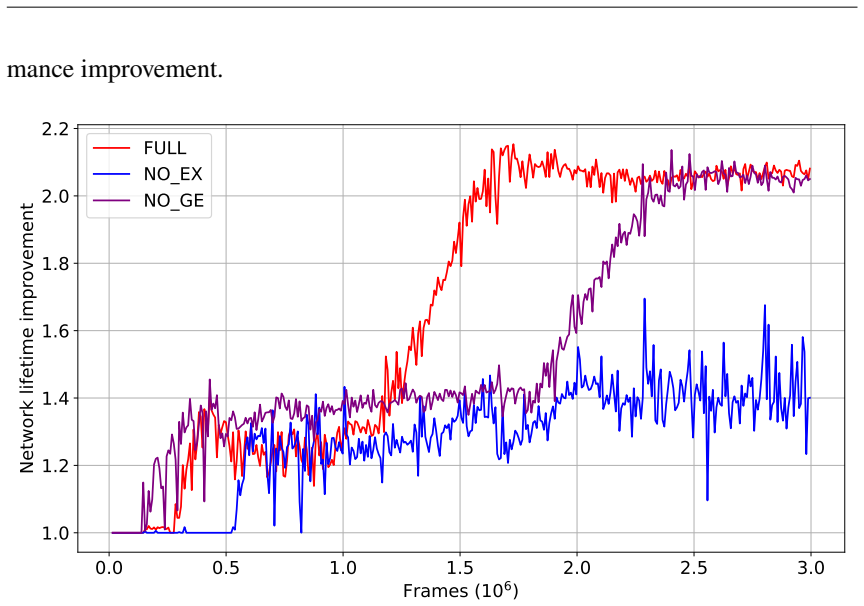
- A U-Net probability map plus local optimization avoids the huge continuous action space of raw charging coordinates, which the paper shows is otherwise hard to explore (the NO_PM ablation stalls near lifetime improvement 1.0).
- The combination of a shared general reward and an individual reward term prevents the credit-assignment failure, called lazy agents, that appears when only a joint reward is used.
- The asynchronous sampling mechanism extends PPO and IPPO to environments where agents finish actions at different times, so standard MARL algorithms can be applied without clipping steps to a fixed interval.
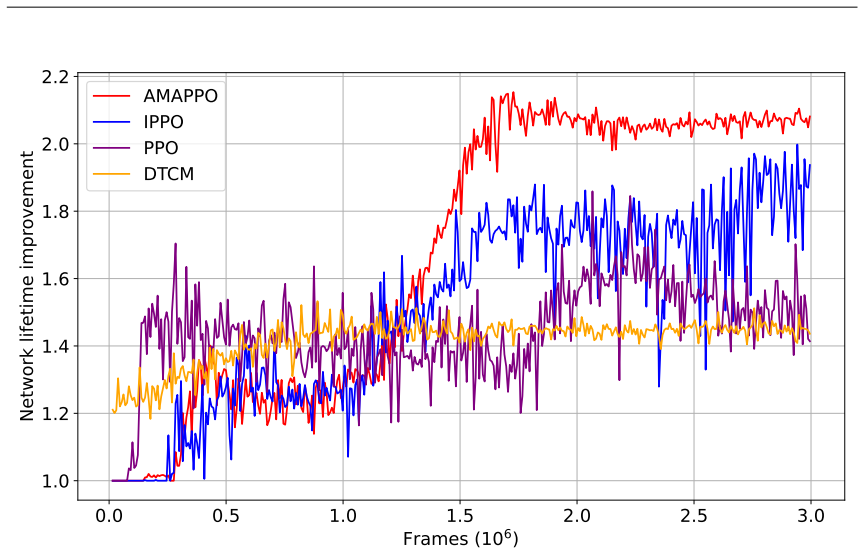
- The reported performance metric, network lifetime improvement over a no-charger baseline, makes results comparable across maps with different geometry, and the paper reports AMAPPO as 2.15 overall versus IPPO's 1.85 and PPO's lower value.
Reading between the lines
- The lifetime estimate in Algorithm 1 is a widest-path computation; if the proof gap in Proposition 3.2.3 is repaired, the same surrogate could serve as a cheap real-time health certificate for other WRSN scheduling problems.
- The reported gain declines as target count grows (from 3.13 at 50 targets to 1.43 at 200), which suggests the policy's advantage is largest in sparse networks; testing beyond 200 targets would locate the breaking point.
- The thesis itself lists two unexplored regimes: changing the number of mobile chargers dynamically and introducing environmental randomness; these are the natural first tests of the generalization claim.
- A direct way to separate the reward-shaping effect from the architecture would be to retrain AMAPPO with rewards based on true simulated lifetime rather than the estimate and compare the two test curves.
Editorial analysis
A structured set of objections, weighed in public.
Referee Report
Summary. The manuscript proposes a multi-agent reinforcement learning framework for maximizing the lifetime of wireless rechargeable sensor networks under target-coverage and connectivity constraints. It formulates the charging problem as a decentralized partially observable semi-Markov decision process (Dec-POSMDP), introduces an asynchronous multi-agent PPO algorithm (AMAPPO), and represents observations and actions through Gaussian-kernel heatmaps and a U-Net probability map. The authors evaluate AMAPPO against PPO, IPPO, and DTCM on a small set of instances based on Vietnamese geographic data, reporting network lifetime improvements up to 3.13x for 50-target instances and 2.15x overall, and claim the learned policies generalize across network maps without retraining.
Significance. If the empirical claims are correct, the Dec-POSMDP formulation and the asynchronous training mechanism would be a useful step toward scalable, reusable controllers for multi-mobile-charger WRSNs. The paper has several strengths: the ablation study isolates the contribution of observation layers, reward terms, and the U-Net action decoder; the testing protocol evaluates pre-trained policies on distinct geographic instances; and the authors explicitly acknowledge limitations regarding dynamic charger counts and environmental uncertainty. However, the central claim of superiority is currently supported by a validation chain whose weakest link is the surrogate lifetime estimate used as the training reward, and by experimental reporting that lacks repeated-seed statistics. The correctness proof of the lifetime-estimation algorithm also contains a false step, so the rigor of the supporting derivations is not yet at the level required for the main claim.
major comments (4)
- [Section 3.2, Equations (3.10)–(3.11), Algorithm 1] The training reward R_GE is defined as the improvement of the estimated remaining lifetime F_hat_t, but F_hat_t is a heuristic snapshot that assumes current consumption rates persist and ignores future charging. The paper never validates that F_hat_t tracks the true remaining lifetime F0 defined in Equation (3.3). A policy that maximizes R_GE may therefore improve the surrogate without improving actual network lifetime. The authors should report a direct diagnostic of this alignment — for example, Spearman correlation between F_hat_t and the true residual lifetime under the executing policy, or a comparison of final F0 for policies trained with and without the surrogate. This is load-bearing because the headline improvements are measured on true F0, while training optimizes F_hat_t.
- [Section 3.2, Proposition 3.2.3] The proof of Proposition 3.2.3 contains a false statement: 'subpaths of a path with maximum weight are also paths with maximum weight' is not true for the max-min path-weight objective used in Algorithm 1. The proof also uses undefined notation 's' and 'CT(s,z)' instead of 'CT(x0,z)'. Even though Algorithm 1 resembles a standard widest-path procedure and may be correct, the correctness proof as written is invalid. The authors should either provide a correct proof (e.g., the standard exchange argument for widest paths) or replace the proposition with a citation to a known result.
- [Section 5.3, Table 5.3, Figures 5.6 and 5.8] The experimental reporting is insufficient to support the claimed margins of superiority. Training is performed on a single map (hanoi_50), and no information is given about the number of random seeds, standard deviations, confidence intervals, or statistical significance of the differences. In stochastic deep RL, the reported differences between AMAPPO (2.15 overall) and IPPO (1.85 overall) could be within run-to-run noise. Additionally, Table 5.3 is captioned as 'training maps' but its FULL row shows exactly the same numbers as the testing-phase results in Section 5.5.2 (3.13, 2.35, 1.69, 1.43, 2.15), which is internally inconsistent and must be clarified. The authors should provide multi-seed results with error bars and significance tests, and correct the table caption or the underlying data provenance.
- [Conclusion, Limitation paragraph; Section 1.5] The claim that the framework is 'generalized' and applicable 'to different networks without requiring extensive retraining' is broader than what the experiments demonstrate. The evaluation fixes the number of mobile chargers at 3, uses a single training map, and only varies target counts and geographic locations within Vietnam. The Limitation paragraph explicitly acknowledges that dynamic increases or decreases in the number of mobile chargers are unexplored, yet this is precisely a dimension that a 'generalized' multi-agent formulation should address. The authors should either narrow the generalization claim to the tested setting or add experiments varying the number of MCs, charger parameters, and sensor deployment characteristics.
minor comments (6)
- [Equation (3.5)] The notation in the Gaussian kernel is unclear: 'X ∥x − x′∥2^2' should presumably be a norm squared divided by h^2, such as exp(−∥x−x′∥_2^2 / (2h^2)). Please rewrite the expression unambiguously.
- [Equation (4.2)] The critic loss is described as Mean Squared Error, but the displayed formula does not contain a square. Add the square, i.e., E[(r + γ V_ϕ(o') − V_ϕ(o))^2], or explain why the squared term is omitted.
- [Section 3.2, Proposition 3.2.3 proof] The proof contains several typographical issues, including the undefined 's' in 'CT(s,z)' and the variable name 'Preposition' in the title. These should be corrected as part of the proof revision.
- [Section 5.2 and Section 5.5.2] The baselines are limited to PPO, IPPO, and DTCM. At least one non-RL heuristic or an optimization-based baseline from the WRSN literature would help calibrate whether the reported lifetime improvements reflect the contribution of the RL formulation or simply the choice of the comparison set.
- [Conclusion, first paragraph] The acronym NTM-CTC appears in the Conclusion, whereas the rest of the paper uses NLM-CTC. This inconsistency should be fixed.
- [References] Reference [4] contains the typo 'I Fakilidz et al.' and should be corrected to the standard author name for the well-known WSN survey.
Circularity Check
No significant circularity; the headline lifetime results are evaluated against the true simulated network lifetime, not the reward surrogate.
full rationale
The paper's central claim—that AMAPPO extends network lifetime by 3.13x on 50-target instances and 2.15x overall—is measured with the actual network lifetime F0 defined in Eq. (3.3) via simulation; it is not a restatement of the fitted reward. The reward (Eq. 3.11) and the observation maps use the estimated remaining lifetime F_hat_t from Eq. (3.10), but the reported metric (Eq. 5.1) uses F0/FB, so improving the surrogate is not definitionally identical to the reported result. The actor's charging-location optimization and the exclusive reward R_EX share the same heuristic objective, but this is reward shaping/action decoding, not a derivation of the lifetime improvement; the comparison to PPO, IPPO, and DTCM and the cross-instance generalization test (training on hanoi_50, testing on other maps) provide independent evidence. The self-citations in the Publication section disclose inherited models and motivating techniques; they are not used as a load-bearing justification for the numerical superiority claim. The proof flaw in Proposition 3.2.3 (false statement about subpaths of maximum-weight paths) and the unvalidated alignment between F_hat_t and F0 are correctness/robustness risks, not circularity. The Limitation section similarly acknowledges unexplored flexibility and uncertainty; that does not make the derivation circular.
Assumptions & free parameters
free parameters (2)
- Gaussian kernel width h
- Grid resolution T =
100
assumptions (4)
- standard math Algorithm 1 correctly computes the widest-path connection time CT(x0,xj) for every sensor.
- domain assumption The estimated remaining lifetime F_hat_t (Eq. 3.10) is a faithful proxy for the actual network lifetime F0.
- domain assumption The wireless charging model (Eq. 3.4) and energy consumption model (Eqs. 3.1-3.2) from prior work accurately represent hardware behavior.
- domain assumption The four-layer Gaussian heat map observation preserves enough information for a policy trained on one network to generalize to other networks.
Cite this review
Pith. "Pith review of Multi-agent reinforcement learning strategy to maximize the lifetime of Wireless Rechargeable." pith.science (2026). https://pith.science/paper/6ZGBZJAA
@misc{pith2026241114496,
  author       = {Pith},
  title        = {Pith review of: Multi-agent reinforcement learning strategy to maximize the lifetime of Wireless Rechargeable},
  year         = {2026},
  howpublished = {\url{https://pith.science/paper/6ZGBZJAA}},
  note         = {Machine review of arXiv:2411.14496}
}
read the original abstract
The thesis proposes a generalized charging framework for multiple mobile chargers to maximize the network lifetime and ensure target coverage and connectivity in large scale WRSNs. Moreover, a multi-point charging model is leveraged to enhance charging efficiency, where the MC can charge multiple sensors simultaneously at each charging location. The thesis proposes an effective Decentralized Partially Observable Semi-Markov Decision Process (Dec POSMDP) model that promotes Mobile Chargers (MCs) cooperation and detects optimal charging locations based on realtime network information. Furthermore, the proposal allows reinforcement algorithms to be applied to different networks without requiring extensive retraining. To solve the Dec POSMDP model, the thesis proposes an Asynchronous Multi Agent Reinforcement Learning algorithm (AMAPPO) based on the Proximal Policy Optimization algorithm (PPO).
Figures


Figures from the paper (23 more)





Reference graph
Works this paper leans on
-
[92]
Introduction to discrete-event simulation and the simpy lan- guage,
N. Matloff, “Introduction to discrete-event simulation and the simpy lan- guage,” Davis, CA. Dept of Computer Science. University of California at Davis. Retrieved on August, vol. 2, no. 2009, pp. 1–33, 2008
work page 2009
-
[93]
Proximal policy optimization algorithms,
J. Schulman, F. Wolski, P . Dhariwal, A. Radford, and O. Klimov, “Proximal policy optimization algorithms,” arXiv preprint arXiv:1707.06347, 2017
arXiv 2017
-
[94]
The surprising effectiveness of ppo in cooperative multi-agent games,
C. Yu, A. Velu, E. Vinitsky, et al. , “The surprising effectiveness of ppo in cooperative multi-agent games,” Advances in Neural Information Processing Systems, vol. 35, pp. 24 611–24 624, 2022
work page 2022
-
[95]
N. T. Hanh, H. T. T. Binh, V . Q. Truong, N. P . Tan, and H. C. Phap, “Node placement optimization under q-coverage and q-connectivity constraints in wireless sensor networks,” Journal of Network and Computer Applications , vol. 212, p. 103 578, 2023, ISSN : 1084-8045. DOI : https://doi.org/ 10.1016/j.jnca.2022.103578. 69
arXiv 2023
Reviewed August 12, 2026 · model on record in the stance chip above.
Discussion (0). Continue with ORCID to comment.