REVIEW 4 major objections 6 minor 47 references
Entropic tug of war: Topological constraints spontaneously rectify the dynamics of a polymer with heterogeneous fluctuations
T0 review · 4 major / 6 minor · reviewed 2026-08-12 · deepseek-v4-flash
Pith's one-line read This paper establishes that a polymer with a hotter block and a colder block, entangled with other chains, spontaneously drifts along its own path toward the hot block, with velocity set by the temperature difference divided by the…
desk verdict New mechanism for persistence from isotropic fluctuations, with a credible scaling argument and careful simulations; the main missing control is varying the cold temperature. read the letter →
The pith
A machine-rendered reading of the paper's core claim, the machinery that carries it, and where it could break.
The reading
What carries the argument
The primitive-path/tube picture of entangled polymers: the chain is confined to a tube of diameter a by uncrossable neighbors, and the free energy cost of stretching the primitive path to length L is balanced by a topological entropic force f = −dF/dL ~ kBT/a pulling at both ends. The paper evaluates this force at the two local thermostats and subtracts, obtaining Eq. (2), Δf ~ kBΔT/a, and then uses it as a drift term in the tube dynamics. The static cubic obstacle lattice with spacing a is the simulation realization of the tube, and the contour displacement of monomers along the surviving tube segments gives the measured velocity.
What would settle it
Simulate a two-temperature diblock in a genuine melt with mobile chains rather than a static obstacle lattice and measure the mean curvilinear velocity of the chain along its primitive path as a function of ΔT and the entanglement length N_e; if the drift is absent or does not scale as ΔT/N_e, the local-entropy subtraction fails once tubes can renew. A cheaper check is to place the hot block in the chain interior and see whether the predicted active-loop motion appears, or to increase the obstacle spacing a beyond the chain gyration radius and confirm that the velocity, as the paper predicts with its fitted amax ≈ 18.2, extrapolates to zero.
Extended reading notes
Core claim
The paper's central assertion is that broken translational symmetry—the fact that a chain in an entangled melt is confined to a tube and cannot pass through neighboring chains—converts an isotropic temperature contrast into a persistent curvilinear drift. In the tube picture, the chain's primitive path is stretched by an entropic end force f ~ kBT/a, where a is the tube diameter. For a diblock with hot and cold blocks, the two ends experience the same geometric entropic force but at different local temperatures, producing an imbalance Δf ~ kBΔT/a. Because the hot end pulls harder, the whole chain drifts along its contour toward the hot segment with velocity v ~ kBΔT/(Γa). The simulations confirm the linear scaling of v with ΔT and with 1/a, and independently verify the drift through the long-time diffusion coefficient D ~ v N_e $b^{2}$.
Load-bearing premise
The argument assumes that an out-of-equilibrium two-temperature chain can still be described by two local equilibrium entropies, one per thermostat, so the topological end forces f ~ kBT/a at the hot and cold ends can be evaluated independently and subtracted; the paper itself flags that the definition of entropy is problematic in this driven system.
Editorial extensions
If this is right
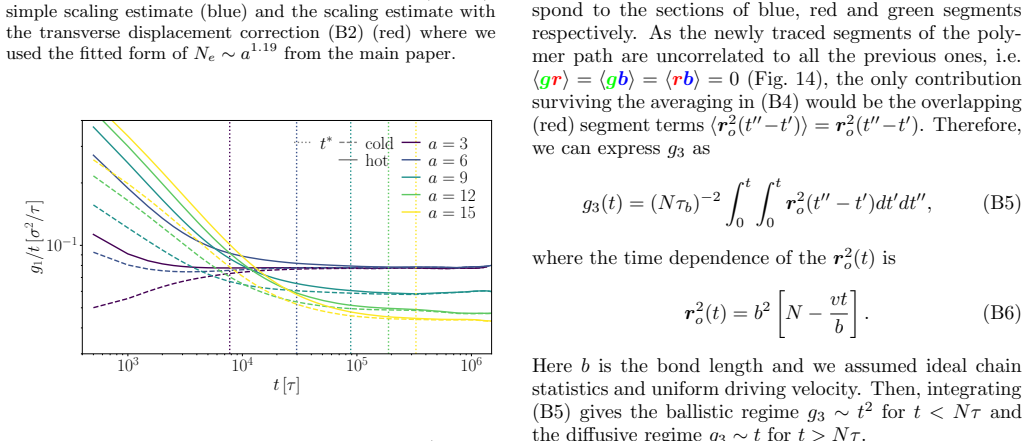
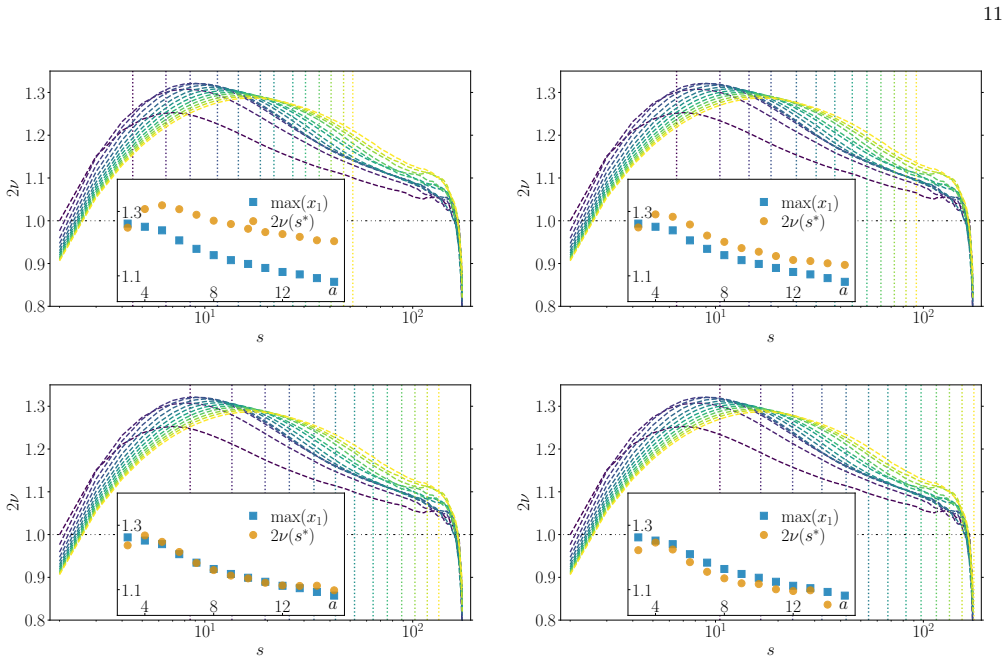
- Below the chain relaxation time, a monomer in the cold segment moves superdiffusively, with g1(t) ~ t^{x1}, and x1 approaches twice the conformational exponent 2ν of the primitive path, with the strongest superdiffusion for tight meshes (small a).
- The chain's center of mass performs a transient ballistic motion (g3 ~ t^{x3} with x3 between 1 and 2) whose duration is set by the number of cells the chain spans, then crosses over to ordinary diffusion with D ~ v N_e b^2.
- The drift exists for any positive temperature contrast ΔT > 0, even with a single hot monomer, as long as the chain is larger than the mesh spacing; this distinguishes the mechanism from active topological glass and active-passive phase separation, which require a threshold ΔT.
- A hot segment in the middle of the chain should act as an entropic puller that moves the chain and can drive looping and effective attraction of flanking regions, a scenario relevant to active chromatin models.
- The viscosity of a two-temperature copolymer melt is expected to scale as η ~ N^2, like tangentially driven polymers, but for a different reason: the relaxation time grows as τ_relax ~ N^2/v while the elastic modulus stays length-independent unless the hot block grows with N.
Reading between the lines
- The mechanism suggests that isotropic 'thermal noise asymmetry' can serve as a generic rectification engine in any crowded environment where a polymer is topologically confined, not only in melts, so similar entropic tug-of-war effects might appear in other strongly confined soft-matter systems.
- For living chromatin, the model predicts that the local entanglement mesh size a controls whether active genes show superdiffusive or purely diffusive motion; this could be tested with single-locus tracking data binned by local chromatin compaction, since the paper predicts a large variability in scaling exponents with a.
- A testable extension: in a melt with mobile, renewable entanglements, the drift velocity should be suppressed when the tube renewal time becomes comparable to a/v; if no such suppression is observed, the static-lattice representation may be hiding an essential many-body effect.
- The amax ≈ R_g result implies that nanoscale self-propulsion by this mechanism fails for chains smaller than the entanglement mesh, so an experimental realization would need long polymers in a well-entangled environment with a sharp temperature contrast along the contour.
Editorial analysis
A structured set of objections, weighed in public.
Referee Report
Summary. The manuscript proposes a mechanism for spontaneous directional motion of a two-temperature ('active-passive') diblock copolymer in a topologically constraining environment. In a static cubic obstacle lattice, the authors argue that the equilibrium entropic end force f ∼ k_B T/a, derived from the primitive-path entropy of a chain in an obstacle lattice, evaluated separately at the hot and cold ends, gives an imbalance Δf ∼ k_B ΔT/a, causing the chain to reptate along its tube toward the hot end. Molecular dynamics simulations with Kremer-Grest chains in a cubic mesh confirm the predicted linear dependence on ΔT and approximately inverse dependence on lattice spacing a, with a finite-size cutoff a_max. A consistency check using the long-time diffusion coefficient D vs v b^2 N_e is presented without fitted parameters. The paper then analyzes segmental and center-of-mass mean-squared displacements, showing superdiffusive regimes and scale-dependent exponents, and discusses implications for active topological glass, chromatin dynamics, and viscosity.
Significance. If the central law holds, the paper is significant because it shows that an isotropic, temporally uncorrelated temperature difference alone can rectify polymer motion through topological constraints, without any explicit directional force. This is a minimal and elegant route to self-propulsion in heterogeneous active polymers and could matter for chromatin and active copolymer melts. The paper's strengths are that the force imbalance is derived from a known equilibrium primitive-path entropy result (Helfand-Pearson) rather than introduced ad hoc; the simulations directly test the predicted scalings; the diffusion-coefficient check is parameter-free; and the finite-size and exponent analyses are extensive and carefully documented. The main weakness is that the key two-temperature entropy split is an unvalidated local-equilibrium ansatz, acknowledged by the authors, and the current simulations do not isolate ΔT from T_c.
major comments (4)
- [Topological entropy imbalance generates polymer drift, Eq. (2)] The central scaling is derived by evaluating the equilibrium entropic end force f ∼ k_B T/a at T_h and T_c and subtracting; the text itself concedes that 'the definition of entropy is problematic' in this out-of-equilibrium situation. The supporting simulation in Fig. 1(b) varies T_h at fixed T_c = 1, so it explores only the line T_h = T_c + ΔT in the two-temperature parameter plane. A steady-state force imbalance that depends on the average temperature or on the ratio T_h/T_c, rather than only on the difference, would be indistinguishable from Eq. (2) on this data set. Since v ∼ ΔT/a is the paper's load-bearing quantitative claim, the authors should test the entropy split by repeating the measurement at, say, T_c = 0.5 and T_c = 2.0 with the same ΔT; without such a test, the extracted linear scaling cannot validate the proposed mechanism.
- [Results and Methods (N_h = 24 in all simulations)] The end-force picture implies that the drift velocity v is independent of the hot-block length N_h as long as the hot block is longer than the mesh size a, because the driving force arises at the chain ends. The simulations always use N_h = 24, even though a ranges from 3 to 15, so this prediction is not tested. The Discussion's claim that the mechanism operates 'as long as the chain possesses at least one hot monomer' makes the N_h dependence non-trivial, and the effective-temperature argument for a hot segment smaller than a predicts a reduced driving. Varying N_h at fixed a (for example N_h = 12, 24, 48) would confirm that the measured v is indeed an end effect and would strengthen the connection between the lattice model and the diblock-copolymer picture.
- [Fig. 2 and the diffusion-coefficient paragraph] The agreement D ≈ v b^2 N_e without fitted parameters is presented as an independent verification of Eq. (2), but it is not independent with respect to the entropy-split hypothesis. Both D and v are extracted from the same non-equilibrium trajectories, and the relation follows from the tube/primitive-path model once v is given; any systematic error in v, for example from the tube-construction algorithm or from the local-temperature assumption, would propagate directly into the predicted D. The check is a valuable consistency test of the tube model, but it does not validate the two-temperature entropy balance, and the text should say so.
- [Abstract and Discussion] The manuscript claims consequences for 'concentrated' chains, melts, and chromatin, but the simulations use a static cubic obstacle lattice that permanently fixes the tube. In a real entangled melt, topological constraints are transient: tube renewal, constraint release, and activity-induced changes of the local entanglement density could weaken or eliminate the rectification. The authors list these as higher-order effects they intentionally omit, which is reasonable for a proof-of-principle, but then the scope claims should be calibrated accordingly, or a melt simulation should be added to show the drift survives dynamic constraints. As written, the external validity of Eq. (2) for real melts is an extrapolation.
minor comments (6)
- [Throughout] There are numerous typos, including 'distict', 'theflexible', 'occurence', 'neccessary', and 'stadard'; a careful language pass would improve the manuscript.
- [Fig. 2 caption] The notation v b^2 N_e is not defined in the caption; please state that v is in lattice cells per τ, b = σ is the monomer size, and N_e is the number of monomers per cell from the inset.
- [SI Sec. B.2, Eq. (B7)] The derivation of the criterion a^2(1 − a/a_max) < R^2 T_c/ΔT is too compressed; the definitions of τ_a and τ_e and the approximations leading to this inequality should be given explicitly.
- [Fig. 4 and SI Fig. 12] The k^2 = 3 panel appears identically in the main text and in the SI; please label clearly which value of k^2 is used in the main text and avoid repeating the panel.
- [Introduction] The phrase 'scalar activity' is not standard; define it at first use, e.g., by stating that the only difference from equilibrium is the magnitude of delta-correlated thermal-like noise.
- [References] Reference [8] is an arXiv preprint while most others are published; please update it if a journal version is available and unify the reference formatting.
Circularity Check
No significant circularity: the central scaling result is derived from an external equilibrium primitive-path entropy result and tested against direct simulation, not reduced to a fit or a self-citation chain.
full rationale
The paper's key prediction v ~ kB Delta T / (Gamma a) is obtained by evaluating the equilibrium entropic end force f ~ kB T / a, citing Rubinstein-Colby [31] and Helfand-Pearson [34], separately at the two thermostat temperatures and subtracting. This is a model assumption, not a circular definition: the force imbalance is not an input fitted to the measured v, and the simulations then test it by measuring contour velocities and finding the predicted linear scalings in Delta T and 1/a. The active-topological-glass and phase-separation self-citations [10,11,40] provide context, not the derivation. The 'independent check' involving D = v b^2 Ne is a consistency cross-check using measured v and Ne from the same simulation, not a fit of a theory parameter, so it does not constitute a fitted input renamed as a prediction; at most it is a weaker check than the text claims. The admitted difficulty that 'the definition of entropy is problematic' is an unvalidated assumption about applying equilibrium entropic forces locally to a non-equilibrium chain, but that is a correctness or external-validity concern, not circularity: the derivation does not assume its conclusion. No equation is equivalent to its input by construction, and no load-bearing argument reduces to a self-citation chain.
Assumptions & free parameters
free parameters (5)
- a_max, cutoff in velocity scaling =
18.2 (in sigma units)
- k^2, matching scale in d2(s*) = (k a)^2 =
k^2 = 3
- A and a_max in max(x3) fits =
a_max about 42 from fit 1; A not quoted
- N_e(a) power-law prefactor and exponent =
0.85 and 1.19
- B in transverse-correction fit (SI) =
not quoted
assumptions (5)
- domain assumption Primitive-path free energy: F_s ~ k_B T L^2 / (2 N b^2) plus topological entropy F_t ~ -k_B T L / a gives an end force f ~ k_B T / a.
- ad hoc to paper A non-equilibrium two-temperature chain can be treated by assigning each chain end a local temperature, giving Delta-f ~ k_B Delta-T / a.
- domain assumption A static cubic mesh of immobile obstacles with spacing a is a faithful proxy for the topological constraints of a polymer melt.
- domain assumption Langevin thermostats with delta-correlated white noise and no hydrodynamic interactions represent the relevant activity of chromatin and active polymer materials.
- domain assumption Mesh size a and primitive path length L are independent of the active driving.
Cite this review
Pith. "Pith review of Entropic tug of war: Topological constraints spontaneously rectify the dynamics of a polymer with heterogeneous fluctuations." pith.science (2026). https://pith.science/paper/M77RBFN7
@misc{pith2026241114778,
  author       = {Pith},
  title        = {Pith review of: Entropic tug of war: Topological constraints spontaneously rectify the dynamics of a polymer with heterogeneous fluctuations},
  year         = {2026},
  howpublished = {\url{https://pith.science/paper/M77RBFN7}},
  note         = {Machine review of arXiv:2411.14778}
}
read the original abstract
Polymers with active segments constitute prospective future materials and are used as a model for some biological systems such as chromatin. The directions of the active forces are typically introduced with temporal or spatial correlations to establish directional motion of the chain and corresponding active dynamics. Instead, here we consider an active-passive copolymer, where the two segments differ only by the magnitude of their fluctuations and feature no artificial correlations. Here we show that although the model itself does not possess directional dynamics, if the chains are concentrated, directional persistent motion spontaneously arises as a consequence of the broken translational symmetry owing to the topological constraints. Using scaling arguments and simulations, we explain the phenomenon and describe the ensuing dynamics. Our work has thus far-reaching consequences for the mechanical properties of all dense active polymeric systems with heterogeneous fluctuations and in particular for chromatin conformation and dynamics that are crucial for biological functionality.
Figures


Figures from the paper (12 more)




Reference graph
Works this paper leans on
-
[1]
Drift/diffusion dominated relaxation and transverse displacements As mentioned in the main paper the diffusion coeffi- cient, as calculated from the drift-diffusion equation [41], for a tangentially driven polymer is in a dimensionless form given by D = c 6 coth cZ 2Dc , (B1) where Z is the number of lattice sites occupied by the chain. The dimensionless ...
-
[2]
More details on g3 calculation On time scales shorter than the relaxation time t < τrelax, the lattice prevents rotational relaxation of the chain on the scale above the mesh size. Therefore, as the entropic pulling is at play, the mean squared dis- placement of the center of mass g3(t) is similar to that of the tangentially driven polymers [42] exhibitin...
-
[3]
V. P. Patil, H. Tuazon, E. Kaufman, T. Chakrabortty, D. Qin, J. Dunkel, and M. S. Bhamla, Ultrafast reversible self-assembly of liv- ing tangled matter, Science 380, 392 (2023), https://www.science.org/doi/pdf/10.1126/science.ade7759
- [4]
-
[5]
S. F¨ urthauer, B. Lemma, P. J. Foster, S. C. Ems- McClung, C.-H. Yu, C. E. Walczak, Z. Dogic, D. J. Needleman, and M. J. Shelley, Self-straining of actively crosslinked microtubule networks, Nature Physics 15, 1295 (2019)
work page 2019
-
[6]
R. G. Winkler, J. Elgeti, and G. Gompper, Active poly- mers —emergent conformational and dynamical proper- 13 FIG. 15. The polymer between times t0 and t3 mostly follows the delineated path, but because of the transverse modes the overlapping (red) region is no longer perfectly correlated but can decorrelate. ties: A brief review, J. Phys. Soc. Jpn. 86, 1...
work page 2017
-
[7]
Ramaswamy, The mechanics and statistics of active matter, Annual Review of Condensed Matter Physics 1, 323 (2010)
S. Ramaswamy, The mechanics and statistics of active matter, Annual Review of Condensed Matter Physics 1, 323 (2010)
2010
-
[8]
M. C. Marchetti, J. F. Joanny, S. Ramaswamy, T. B. Liverpool, J. Prost, M. Rao, and R. A. Simha, Hydrody- namics of soft active matter, Rev. Mod. Phys. 85, 1143 (2013)
2013
Show all 47 references
-
[9]
A. R. Tejedor, R. Carracedo, and J. Ram ´ ırez, Molecu- lar dynamics simulations of active entangled polymers reptating through a passive mesh, Polymer 268, 125677 (2023)
2023
-
[10]
Humphrey, C
D. Humphrey, C. Duggan, D. Saha, D. Smith, and J. K¨ as, Active fluidization of polymer networks through molecu- lar motors, Nature 416, 413 (2002)
2002
-
[11]
Breoni, C
D. Breoni, C. Kurzthaler, B. Liebchen, H. L¨ owen, and S. Mandal, Giant activity-induced stress plateau in entangled polymer solutions (2023), arXiv:2310.02929 [cond-mat.soft]
2023 arXiv
-
[12]
Micheletti, I
C. Micheletti, I. Chubak, E. Orlandini, and J. Sm- rek, Topology-based detection and tracking of deadlocks reveal aging of active ring melts, ACS Macro Letters 13, 124 (2024), pMID: 38198592, https://doi.org/10.1021/acsmacrolett.3c00567
2024 doi
-
[13]
Smrek, I
J. Smrek, I. Chubak, C. N. Likos, and K. Kremer, Active topological glass, Nat. Commun. 11, 26 (2020)
2020
-
[14]
Chubak, C
I. Chubak, C. N. Likos, K. Kremer, and J. Smrek, Emer- gence of active topological glass through directed chain dynamics and nonequilibrium phase segregation, Phys. Rev. Research 2, 043249 (2020)
2020
-
[15]
M. A. Ubertini, E. Locatelli, and A. Rosa, Universal time and length scales of polar active polymer melts, ACS Macro Letters 13, 1204 (2024), pMID: 39213658, https://doi.org/10.1021/acsmacrolett.4c00423
2024 doi
-
[16]
Bianco, E
V. Bianco, E. Locatelli, and P. Malgaretti, Globulelike conformation and enhanced diffusion of active polymers, Phys. Rev. Lett. 121, 217802 (2018)
2018
-
[17]
Lamura, Excluded volume effects on tangentially driven active ring polymers, Phys
A. Lamura, Excluded volume effects on tangentially driven active ring polymers, Phys. Rev. E 109, 054611 (2024)
2024
-
[18]
Natali, L
L. Natali, L. Caprini, and F. Cecconi, How a local active force modifies the structural properties of polymers, Soft Matter 16, 2594 (2020)
2020
-
[19]
A. R. Tejedor and J. Ram ´ ırez, Reptation of active entangled polymers, Macromolecules 52, 8788 (2019), https://doi.org/10.1021/acs.macromol.9b01994
2019 doi
-
[20]
Eisenstecken, G
T. Eisenstecken, G. Gompper, and R. G. Winkler, Con- formational properties of active semiflexible polymers, Polymers 8, 304 (2016)
2016
-
[21]
Bruinsma, A
R. Bruinsma, A. Grosberg, Y. Rabin, and A. Zidovska, Chromatin hydrodynamics, Biophys. J.106, 1871 (2014)
2014
-
[22]
Cavalli and T
G. Cavalli and T. Misteli, Functional implications of genome topology, Nat Struct Mol Biol 20, 290 (2013)
2013
-
[23]
Zidovska, D
A. Zidovska, D. A. Weitz, and T. J. Mitchi- son, Micron-scale coherence in interphase chromatin dynamics, Proceedings of the Na- tional Academy of Sciences 110, 15555 (2013), https://www.pnas.org/doi/pdf/10.1073/pnas.1220313110
2013 doi
-
[24]
Goychuk, D
A. Goychuk, D. Kannan, A. K. Chakraborty, and M. Kar- dar, Polymer folding through active processes recreates features of genome organization, Proceedings of the National Academy of Sciences 120, e2221726120 (2023), https://www.pnas.org/doi/pdf/10.1073/pnas.2221726120
2023 doi
-
[25]
F.-Y. Chu, A. S. Clavijo, S. Lee, and A. Zidovska, Transcription-dependent mobility of single genes and genome-wide motions in live human cells, Nature Com- munications 15, 8879 (2024)
2024
-
[26]
S. S. Ashwin, T. Nozaki, K. Maeshima, and M. Sa- sai, Organization of fast and slow chromatin revealed by single-nucleosome dynamics, Proceedings of the National Academy of Sciences 116, 19939 (2019), https://www.pnas.org/doi/pdf/10.1073/pnas.1907342116
2019 doi
-
[27]
Halverson, J
J. Halverson, J. Smrek, K. Kremer, and A. Grosberg, From a melt of rings to chromosome territories: The role of topological constraints in genome folding, Rep. Prog. Phys. 77, 022601 (2014)
2014
-
[28]
Chan and M
B. Chan and M. Rubinstein, Activity-driven chromatin organization during interphase: Compaction, segrega- tion, and entanglement suppression, Proceedings of the National Academy of Sciences 121, e2401494121 (2024), https://www.pnas.org/doi/pdf/10.1073/pnas.2401494121
2024 doi
-
[29]
Chan and M
B. Chan and M. Rubinstein, Theory of chro- matin organization maintained by active loop extrusion, Proceedings of the National Academy of Sciences 120, e2222078120 (2023), https://www.pnas.org/doi/pdf/10.1073/pnas.2222078120
2023 doi
-
[30]
Doi and S
M. Doi and S. F. Edwards, The Theory of Polymer Dy- namics (Oxford University Press, New York, 1986)
1986
-
[31]
Baule, K
A. Baule, K. V. Kumar, and S. Ramaswamy, Exact solu- tion of a brownian inchworm model for self-propulsion, Journal of Statistical Mechanics: Theory and Experi- ment 2008, P11008 (2008)
2008
-
[32]
S. F. Edwards, The theory of rubber elasticity, Br. Polym. J. 9, 140 (1977)
1977
-
[33]
Everaers, H
R. Everaers, H. A. Karimi-Varzaneh, F. Fleck, N. Hojdis, and C. Svaneborg, Kremer–grest models for commodity polymer melts: Linking theory, experiment, and simula- tion at the kuhn scale, Macromolecules 53, 1901 (2020), https://doi.org/10.1021/acs.macromol.9b02428
2020 doi
-
[34]
Rubinstein and R
M. Rubinstein and R. Colby, Polymer Physics (OUP Ox- ford, 2003)
2003
-
[35]
Uchida, G
N. Uchida, G. S. Grest, and R. Everaers, Vis- coelasticity and primitive path analysis of entan- gled polymer liquids: From F-actin to polyethy- lene, The Journal of Chemical Physics 128, 044902 (2008), https://pubs.aip.org/aip/jcp/article- pdf/doi/10.1063/1.2825597/13474945/0...
2008 doi
-
[36]
A. Y. Grosberg and J.-F. Joanny, Nonequilibrium statis- tical mechanics of mixtures of particles in contact with different thermostats, Phys. Rev. E 92, 032118 (2015)
2015
-
[37]
Helfand and D
E. Helfand and D. S. Pearson, Statistics of the entanglement of polymers: Unentangled loops and primitive paths, The Journal of Chemical Physics 79, 2054 (1983), https://pubs.aip.org/aip/jcp/article- pdf/79/4/2054/18943854/2054 1 online.pdf
1983
-
[38]
Kremer and G
K. Kremer and G. S. Grest, Dynamics of entangled lin- ear polymer melts: A molecular-dynamics simulation, J. Chem. Phys. 92, 5057 (1990). 14
1990
-
[39]
S. N. Weber, C. A. Weber, and E. Frey, Binary mixtures of particles with different diffusivities demix, Phys. Rev. Lett. 116, 058301 (2016)
2016
-
[40]
Ganai, S
N. Ganai, S. Sengupta, and G. I. Menon, Chromo- some positioning from activity-based segregation, Nucleic Acids Res 42, 4145 (2014)
2014
-
[41]
Awazu, Segregation and phase inversion of strongly and weakly fluctuating brownian particle mixtures and a chain of such particle mixtures in spherical containers, Phys
A. Awazu, Segregation and phase inversion of strongly and weakly fluctuating brownian particle mixtures and a chain of such particle mixtures in spherical containers, Phys. Rev. E 90, 042308 (2014)
2014
-
[42]
The center of mass position vector rcm(t) = N −1 PN i=1 ri(t), with the monomer i position vector ri
and show where our system differs. The center of mass position vector rcm(t) = N −1 PN i=1 ri(t), with the monomer i position vector ri. As the polymer moves along its contour path, the dis- placement ∆rcm(t) = rcm(t) − rcm(0) can be expressed as the sum of the end-to-end vect...
-
[43]
Smrek and K
J. Smrek and K. Kremer, Small activity differences drive phase separation in active-passive polymer mixtures, Phys. Rev. Lett. 118, 098002 (2017)
2017
-
[44]
A. R. Tejedor and J. Ram ´ ırez, Dynamics of entangled polymers subjected to reptation and drift, Soft Matter 16, 3154 (2020)
2020
-
[45]
J.-X. Li, S. Wu, L.-L. Hao, Q.-L. Lei, and Y.-Q. Ma, Nonequilibrium structural and dynamic behaviors of po- lar active polymer controlled by head activity, Phys. Rev. Res. 5, 043064 (2023)
2023
-
[46]
J. Li, B. Zhang, and Z.-Y. Wang, Activity-induced stiff- ness, entanglement network and dynamic slowdown in unentangled semidilute polymer solutions, Soft Matter 20, 5174 (2024)
2024
-
[47]
Plimpton, Fast parallel algorithms for short-range molecular dynamics, J
S. Plimpton, Fast parallel algorithms for short-range molecular dynamics, J. Comput. Phys. 117, 1 (1995), http://lammps.sandia.gov
1995
Reviewed August 12, 2026 · model on record in the stance chip above.
Discussion (0). Continue with ORCID to comment.