REVIEW 4 major objections 4 minor 55 references
Omni-IML: Towards Unified Image Manipulation Localization
T0 review · 4 major / 4 minor · reviewed 2026-08-12 · deepseek-v4-flash
Pith's one-line read Omni-IML claims that one generalist model can localize tampering in natural images, documents, faces, and scene text at state-of-the-art level, without task-specific fine-tuning, and can describe what looks wrong.
desk verdict Solid generalist IML system and a useful new dataset, but the state-of-the-art claim is overstated: it is average SOTA, not per-benchmark SOTA, and the interpretation evaluation is partly circular. read the letter →
The pith
A machine-rendered reading of the paper's core claim, the machinery that carries it, and where it could break.
The reading
What carries the argument
The argument is carried by three sample-adaptive components plus an annotation pipeline. The Modal Gate Encoder computes both RGB and fused RGB-frequency features, produces two coarse predictions, and runs a small binary classifier that picks the more reliable encoding modality for each image, so noisy frequency features can be discarded when they hurt. The Dynamic Weight Decoder replaces a fixed filter stack with Dynamic Weight Filters: each filter averages the input feature into a global representation, combines it with an image-level vector through a fully connected layer, and computes a weighted sum of four base filters to produce sample-specific depthwise convolution kernels. The Anomaly Enhancement module adds a Faster R-CNN-style detection head, consisting of two feature pyramid networks, a region proposal network, and a box head, on top of two encoder feature levels, and these detection branches exist only during training; after training their enhanced features are added back to the segmentation features, so inference cost is nearly unchanged. For interpretation, the paper builds Omni-273k through a chain-of-thoughts pipeline that recognizes tampered instances one by one, generates focused artifact descriptions per instance, and then has the annotator self-examine the response; the annotations are stored as structured JSON with content, absolute position, relative position, and artifact fields. The Interpretation Module forms a reference prompt $I_{\mathrm{ref}} = (I_{\mathrm{input}} + I_{\mathrm{mask}})/2$ by averaging the input image with the predicted mask, concatenates it along the longest side with the original image, and feeds both to a multimodal LLM, which draws the LLM's attention to suspect regions without changing the LLM architecture.
What would settle it
Run the strongest per-task baselines and Omni-IML on all four tasks under identical training data, backbone weights, optimizer, input size, and iteration count, as Table 5 does but for the full baseline set; if any baseline matches or exceeds Omni-IML's average IoU of 0.714 in this controlled setup, the central claim of a generalist advantage is refuted rather than confirmed.
Extended reading notes
Core claim
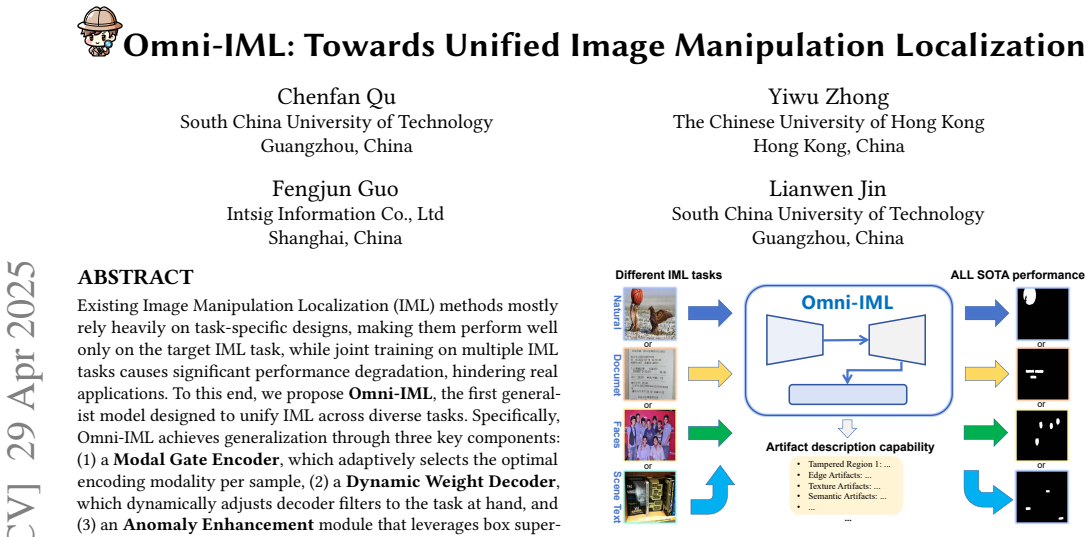
The paper's central claim is that a single model, Omni-IML, can localize manipulated regions in natural images, document images, face images, and scene text images at once, with no task-specific or benchmark-specific fine-tuning, and that it reaches state-of-the-art results on all four in the reported comparisons. The authors attribute prior failures to unify these tasks to task-dependent architecture choices, such as edge enhancement for natural objects, frequency fusion for documents, and texture filters for faces, and to the absence of per-sample adaptation. Omni-IML instead routes each sample: a Modal Gate decides whether to feed the encoder frequency-plus-vision features or pure RGB features, a Dynamic Weight Decoder generates sample-specific convolutional filters, and an Anomaly Enhancement module, supervised with bounding boxes that exist only during training, sharpens tampered-region features. The paper also introduces Omni-273k, a 273,776-image dataset with structured natural-language artifact descriptions produced by a chain-of-thoughts annotation pipeline, and an interpretation module that feeds the LLM a reference image with the predicted mask highlighted, improving artifact description accuracy. On the paper's own controlled comparison, joint training degrades Omni-IML's document IoU by only 1.6 points, versus 6.9 points for a document specialist, supporting the claim that the model suffers less from multi-task confusion.
Load-bearing premise
The load-bearing premise is that Omni-IML outperforms the specialized baselines because of its proposed modules, not because it is trained on more data with a stronger initialization; if the advantage comes mainly from the extra training data or the ADE20k-pretrained backbone, the 'state of the art across all four tasks' claim would be overstated.
Editorial extensions
If this is right
- A single Omni-IML checkpoint can be deployed in place of four separate specialists on natural, document, face, and scene-text forgery localization, with no task-specific fine-tuning.
- Joint training, which currently makes specialized forensic models unreliable, no longer needs to be avoided if the model adapts per sample; Omni-IML's degradation under joint training is reported as much smaller than that of prior models.
- Frequency-domain evidence can be used selectively: the gate lets document images keep the benefit of frequency fusion while natural images are protected from the noise that always-on frequency features introduce.
- The Omni-273k dataset, with structured JSON artifact annotations across four image types, allows fine-grained evaluation of exactly what a forensic explanation model gets right, such as content, position, and artifact type, rather than a coarse string match.
- The reference visual prompt improves artifact description on multi-target and low-obviousness cases such as documents, and the method transfers across several multimodal LLMs.
Reading between the lines
- Because the headline comparisons use published numbers from differently trained baselines, the cleanest test of the claim is a full four-way matched comparison; Table 5 is only a step in that direction.
- The sample-adaptive gate could be read as a learned routing policy; a testable prediction is that the gate's binary choices will cluster by image type, choosing fused features on documents and pure RGB on most natural images, and that these choices correlate with where frequency features help.
- The chain-of-thoughts annotation format, with per-instance recognition and self-examination, could be reused to build explanation datasets for other dense prediction tasks with many small targets, such as medical or satellite imagery, and its structured JSON keys enable typed evaluation.
- The interpretation module's simple averaging of mask and image creates a visual reference that could be applied to any segmentation-augmented vision-language model; it is not specific to image manipulation localization.
Editorial analysis
A structured set of objections, weighed in public.
Referee Report
Summary. The paper proposes Omni-IML, a single image-manipulation-localization model intended to work across natural, document, face, and scene-text images without task-specific fine-tuning. The method combines a Modal Gate Encoder that chooses between RGB and RGB+frequency features, an Anomaly Enhancement module trained with box supervision, and a Dynamic Weight Decoder that selects decoder filters per sample. The authors also introduce Omni-273k, a large dataset of GPT-4o-generated artifact descriptions, and an interpretation module that feeds the input image together with a highlight overlay of the predicted mask into a multimodal LLM. Experiments evaluate localization on four tasks and interpretation on the new dataset, with ablations showing that each proposed module contributes to the reported averages and that the proposed model degrades less than several baselines under joint training.
Significance. If the claims are supported, the paper would be a valuable step toward a generalist IML system: it addresses a real practical limitation of task-specific forgery detectors, provides a large new interpretability dataset, and introduces a controlled joint-training comparison that is rarely reported in this area. The localized ablation study and the consistency of the per-module gains are strengths. However, the paper's central value proposition is currently overstated: the reported per-dataset numbers do not support the abstract's and Section 5.2's claim that a single model achieves state-of-the-art performance across all four tasks. In addition, the interpretation experiments evaluate models against the same GPT-4o-generated references used for training, so the quantitative interpretation results are partly circular. The contribution is still publishable after the claims are qualified and the evaluation is strengthened.
major comments (4)
- [Abstract and §5.2, Tables 2–4] The claim that Omni-IML 'achieves state-of-the-art performance across all four major IML tasks' and 'can simultaneously outperform existing specialized methods on each individual task' is contradicted by the paper's own per-dataset results. In Table 2, APSC-Net has higher IoU on CASIAv1 (0.810 vs 0.796), NIST16 (0.525 vs 0.522), and IMD20 (0.679 vs 0.662). In Table 3, DTD has higher IoU on DocTamper-SCD (0.691 vs 0.664). In Table 4, SegFormer and Swin-UPer have higher IoU on T-IC13 (0.778 and 0.773 vs 0.741) and also higher F1 (0.875 and 0.872 vs 0.851). The 'state-of-the-art' statement therefore holds only if one averages over datasets within each task, a qualification that is never stated. Since the paper's central value proposition is that a generalist can replace per-task specialists, this overstatement is load-bearing and should be corrected in the abstract, introduction, and Section 5.2.
- [§5.2, Table 5] The controlled comparison in Table 5 does not fully resolve the SOTA concern. It reports only per-task aggregate IoU, includes only a subset of the strongest baselines from Tables 2–4 (notably omitting SegFormer, DiffForensics, UnionFormer, and CAT-Netv2), and provides no per-dataset breakdown. Furthermore, the comparisons in Tables 2–4 use baselines with different training data, iteration counts, and backbone initializations; Omni-IML trains for 400k iterations with an ADE20k-pretrained ConvNeXt-Base and additional COCO data. The paper should either restrict the SOTA claim to the controlled setting, or extend Table 5 with per-dataset results and the missing strong baselines so that the reader can separate the effect of the proposed modules from the effect of more training data and a stronger backbone. The lack of error bars or significance tests is also a concern, since several reported margins are smaller than 0.01 IoU.
- [§4.1 and §5.4, Tables 7–8] The interpretation evaluation is partly circular. The Omni-273k annotations are generated by GPT-4o, Step 3 of the chain-of-thought pipeline uses GPT-4o to correct and rewrite GPT-4o's own previous responses, and Tables 7 and 8 then measure the fine-tuned models against those same GPT-4o-generated references. High ROUGE/BLEU/cosine-similarity scores in this setting can reflect successful mimicry of GPT-4o rather than accurate forensic interpretation. The paper also states that the final annotations are 'very closed to human annotation' without reporting any human agreement study. I recommend adding a human evaluation on a sampled subset, or at least an independent set of human-written references, before claiming high-quality interpretation.
- [§3.1] The training signal for the Modal Gate is not specified in the submitted text. The gate is described as a binary classifier that decides whether to use the fused RGB+frequency features or the RGB-only features, but there is no statement of what supervises this decision or how a hard selection is made differentiable during end-to-end training. The main text refers to the appendix for details, but no appendix is included in the version under review. Since the Modal Gate is one of the three core contributions, the paper needs to specify the gate supervision and the differentiable relaxation (or provide the appendix). This is a reproducibility issue, not merely a presentation issue.
minor comments (4)
- [Figure 5] The caption of Figure 5 reads 'The proposed Chain-of-Thoughts Pipeline,' but the figure appears to show qualitative localization results; the caption should match the figure content.
- [§4.3 and §5.2] There are several typos and inconsistencies: 'OSFT' should be 'OSTF' in Section 4.3, 'datatset' and 'isthe' appear in Section 4.4, 'Singe target' appears in Table 1, and the text alternately uses 'DWF' and 'DW' in Table 6 and the associated ablation discussion.
- [§3.3] The DWF dilation schedule and the number of dynamic filters are not reported in the main text; since the decoder's behavior depends on these hyperparameters, they should be stated explicitly or the appendix should be made available.
- [§5.4] The interpretation experiments compare fine-tuned models with and without the reference visual prompt, but they do not compare against prior interpretable-IML systems such as SIDA or FakeShield. Adding such a comparison would clarify the contribution relative to existing methods.
Circularity Check
Interpretation claim is self-referential: GPT-4o generates the Omni-273k annotations, GPT-4o self-corrects them, and Table 8 evaluates models against those same GPT-4o-generated references; the 'very closed to human annotation' claim has no independent human ground truth.
-
self definitional
[Section 4.1 (Step 3) and Section 5.4 (Table 8)]
"The final response has a significantly improved quality, is very closed to human annotation and is used as the final annotation. ... The experiments on interpretation task are conducted on our Omni-273k dataset. In Table 8, we directly evaluate models with their whole output string for each sample using word-vectors cosine similarity [30], ROUGE and BLEU, following the previous works [14, 44]."
The reference annotations in Omni-273k are produced by GPT-4o: Step 3 asks GPT-4o to examine and clean its own previous response, and the result is declared 'very closed to human annotation' without any human comparison. Table 8 then evaluates all fine-tuned models against these same GPT-4o-generated references. Thus the reported interpretation scores measure agreement with GPT-4o's self-corrected output, and the quality claim is validated by the same model that produced the labels. The claim that the reference visual prompt improves interpretation is also measured only against these GPT-4o labels, so the target is defined by the annotation source and cannot independently confirm 'human-like' quality.
full rationale
The localization claims are externally benchmarked: Tables 2-5 compare against published baselines on standard datasets with independent ground-truth masks, and Table 5 provides a controlled same-training-data comparison. Those claims are not circular. The circularity is confined to the interpretation and dataset-quality claim: Omni-273k annotations are generated by GPT-4o, refined by GPT-4o self-examination, and then used as the reference labels for evaluating the interpretation module and all compared models. The assertion that the final annotations are 'very closed to human annotation' is supported only by GPT-4o's own self-assessment, with no human annotation study. This is a partial, supporting circularity rather than a circularity of the central localization benchmark, so the overall score is 4 rather than 6 or higher.
Assumptions & free parameters
free parameters (4)
- DWF dilation schedule =
3, 2, 6, 2, 2, 2
- Binary mask threshold =
0.5
- Anomaly Enhancement loss weights =
not reported
- LoRA rank =
64
assumptions (4)
- domain assumption Ground-truth masks in all benchmark datasets are accurate enough to serve as supervision and evaluation labels.
- domain assumption Frequency artifacts computed by the DTD-style perception head are a meaningful representation of tampering.
- domain assumption GPT-4o can produce accurate artifact descriptions after the chain-of-thought procedure.
- domain assumption Each connected component of the binary tamper mask corresponds to exactly one tampered instance.
Cite this review
Pith. "Pith review of Omni-IML: Towards Unified Image Manipulation Localization." pith.science (2026). https://pith.science/paper/IMKZWY4Q
@misc{pith2026241114823,
  author       = {Pith},
  title        = {Pith review of: Omni-IML: Towards Unified Image Manipulation Localization},
  year         = {2026},
  howpublished = {\url{https://pith.science/paper/IMKZWY4Q}},
  note         = {Machine review of arXiv:2411.14823}
}
read the original abstract
Existing Image Manipulation Localization (IML) methods mostly rely heavily on task-specific designs, making them perform well only on the target IML task, while joint training on multiple IML tasks causes significant performance degradation, hindering real applications. To this end, we propose Omni-IML, the first generalist model designed to unify IML across diverse tasks. Specifically, Omni-IML achieves generalization through three key components: (1) a Modal Gate Encoder, which adaptively selects the optimal encoding modality per sample, (2) a Dynamic Weight Decoder, which dynamically adjusts decoder filters to the task at hand, and (3) an Anomaly Enhancement module that leverages box supervision to highlight the tampered regions and facilitate the learning of task-agnostic features. Beyond localization, to support interpretation of the tampered images, we construct Omni-273k, a large high-quality dataset that includes natural language descriptions of tampered artifact. It is annotated through our automatic, chain-of-thoughts annotation technique. We also design a simple-yet-effective interpretation module to better utilize these descriptive annotations. Our extensive experiments show that our single Omni-IML model achieves state-of-the-art performance across all four major IML tasks, providing a valuable solution for practical deployment and a promising direction of generalist models in image forensics. Our code and dataset will be publicly available.
Figures


Figures from the paper (2 more)


Reference graph
Works this paper leans on
-
[1]
Alibaba Security. 2020. Security AI Challenger Program. https://tianchi.aliyun. com/competition/entrance/531812/introduction
work page 2020
-
[2]
Shuai Bai, Keqin Chen, Xuejing Liu, Jialin Wang, Wenbin Ge, Sibo Song, Kai Dang, Peng Wang, Shijie Wang, Jun Tang, et al . 2025. Qwen2. 5-vl technical report. arXiv preprint arXiv:2502.13923 (2025)
arXiv 2025
-
[3]
Bilal Bataineh, Siti Norul Huda Sheikh Abdullah, and Khairudin Omar. 2011. A statistical global feature extraction method for optical font recognition. In Intelligent Information and Database Systems: Third International Conference, ACIIDS 2011, Daegu, Korea, April 20-22, 2011, Proceedings, Part I 3 . Springer, 257– 267
work page 2011
-
[4]
Xiuli Bi, Yang Wei, Bin Xiao, and Weisheng Li. 2019. RRU-Net: The ringed residual U-Net for image splicing forgery detection. InProceedings of the IEEE/CVF Conference on Computer Vision and Pattern Recognition Workshops . 0–0
work page 2019
-
[5]
Zhe Chen, Jiannan Wu, Wenhai Wang, Weijie Su, Guo Chen, Sen Xing, Muyan Zhong, Qinglong Zhang, Xizhou Zhu, Lewei Lu, et al . 2024. Internvl: Scaling up vision foundation models and aligning for generic visual-linguistic tasks. In Proceedings of the IEEE/CVF conference on computer vision and pattern recognition . 24185–24198
2024
-
[6]
Chengbo Dong, Xinru Chen, Ruohan Hu, Juan Cao, and Xirong Li. 2022. Mvss-net: Multi-view multi-scale supervised networks for image manipulation detection. IEEE Transactions on Pattern Analysis and Machine Intelligence 45, 3 (2022), 3539– 3553
2022
-
[7]
Jing Dong, Wei Wang, and Tieniu Tan. 2013. CASIA Image Tampering Detection Evaluation Database. In 2013 IEEE China Summit and International Conference on Signal and Information Processing . 422–426. https://doi.org/10.1109/ChinaSIP. 2013.6625374
arXiv 2013
-
[8]
Renshuai Liu Dong, Li, Bowen Ma, Wei Zhang, Zhipeng Hu, Changjie Fan, Tangjie Lv, Yu Ding, and Xuan Cheng. 2024. Robust Text Image Tampering Localization via Forgery Traces Enhancement and Multiscale Attention. IEEE Transactions on Consumer Electronics (2024)
work page 2024
Show all 55 references
-
[9]
Haiying Guan, Mark Kozak, Eric Robertson, Yooyoung Lee, Amy N Yates, Andrew Delgado, Daniel Zhou, Timothee Kheyrkhah, Jeff Smith, and Jonathan Fiscus
-
[10]
Fabrizio Guillaro, Davide Cozzolino, Avneesh Sud, Nicholas Dufour, and Luisa Verdoliva. 2023. TruFor: Leveraging all-round clues for trustworthy image forgery detection and localization. In Proceedings of the IEEE/CVF Conference on Computer Vision and Pattern Recognition . 20606–20615
2023
-
[11]
Xiao Guo, Xiaohong Liu, Zhiyuan Ren, Steven Grosz, Iacopo Masi, and Xiaoming Liu. 2023. Hierarchical Fine-Grained Image Forgery Detection and Localization. In CVPR
2023
-
[12]
Falk Heuer, Sven Mantowsky, Saqib Bukhari, and Georg Schneider. 2021. Multitask-centernet (mcn): Efficient and diverse multitask learning using an anchor free approach. In Proceedings of the IEEE/CVF International conference on computer vision. 997–1005
2021
-
[13]
Edward J Hu, Yelong Shen, Phillip Wallis, Zeyuan Allen-Zhu, Yuanzhi Li, Shean Wang, Lu Wang, Weizhu Chen, et al. 2022. Lora: Low-rank adaptation of large language models. ICLR 1, 2 (2022), 3
2022
-
[14]
Zhenglin Huang, Jinwei Hu, Xiangtai Li, Yiwei He, Xingyu Zhao, Bei Peng, Baoyuan Wu, Xiaowei Huang, and Guangliang Cheng. 2024. SIDA: Social Media Image Deepfake Detection, Localization and Explanation with Large Multimodal Model. arXiv preprint arXiv:2412.04292 (2024)
2024 arXiv
-
[15]
Zhengchao Huang, Bin Xia, Zicheng Lin, Zhun Mou, Wenming Yang, and Jiaya Jia. 2024. Ffaa: Multimodal large language model based explainable open-world face forgery analysis assistant. arXiv preprint arXiv:2408.10072 (2024)
2024 arXiv
-
[16]
Shan Jia, Mingzhen Huang, Zhou Zhou, Yan Ju, Jialing Cai, and Siwei Lyu. 2023. AutoSplice: A Text-Prompt Manipulated Image Dataset for Media Forensics. In Proceedings of the IEEE/CVF Conference on Computer Vision and Pattern Recognition (CVPR) Workshops. 893–903
2023
-
[17]
Myung-Joon Kwon, Seung-Hun Nam, In-Jae Yu, Heung-Kyu Lee, and Changick Kim. 2022. Learning JPEG compression artifacts for image manipulation detection and localization. International Journal of Computer Vision 130, 8 (2022), 1875– 1895
2022
-
[18]
Xin Lai, Zhuotao Tian, Yukang Chen, Yanwei Li, Yuhui Yuan, Shu Liu, and Jiaya Jia
-
[19]
Trung-Nghia Le, Huy H Nguyen, Junichi Yamagishi, and Isao Echizen. 2021. Open- forensics: Large-scale challenging dataset for multi-face forgery detection and segmentation in-the-wild. In Proceedings of the IEEE/CVF international conference on computer vision. 10117–10127
2021
-
[20]
Shuaibo Li, Wei Ma, Jianwei Guo, Shibiao Xu, Benchong Li, and Xiaopeng Zhang
-
[21]
Tsung-Yi Lin, Piotr Dollár, Ross Girshick, Kaiming He, Bharath Hariharan, and Serge Belongie. 2017. Feature pyramid networks for object detection. In Proceed- ings of the IEEE conference on computer vision and pattern recognition . 2117–2125
2017
-
[22]
Tsung-Yi Lin, Michael Maire, Serge Belongie, James Hays, Pietro Perona, Deva Ramanan, Piotr Dollár, and C Lawrence Zitnick. 2014. Microsoft coco: Common objects in context. In Computer Vision–ECCV 2014: 13th European Conference, Zurich, Switzerland, September 6-12, 2014, Proce...
2014
-
[23]
In Proceedings of the IEEE/CVF Conference on Computer Vision and Pattern Recognition (CVPR)
UnionFormer: Unified-Learning Transformer with Multi-View Represen- tation for Image Manipulation Detection and Localization. In Proceedings of the IEEE/CVF Conference on Computer Vision and Pattern Recognition (CVPR) . 12523–12533
-
[24]
Xiaohong Liu, Yaojie Liu, Jun Chen, and Xiaoming Liu. 2022. PSCC-Net: Progres- sive spatio-channel correlation network for image manipulation detection and localization. IEEE Transactions on Circuits and Systems for Video Technology 32, 11 (2022), 7505–7517
2022
-
[25]
Yang Liu, Xiaofei Li, Jun Zhang, Shengze Hu, and Jun Lei. 2024. DA-HFNet: Progressive Fine-Grained Forgery Image Detection and Localization Based on Dual Attention. arXiv preprint arXiv:2406.01489 (2024)
2024 arXiv
-
[26]
Weihuang Liu, Xi Shen, Chi-Man Pun, and Xiaodong Cun. 2023. Explicit visual prompting for low-level structure segmentations. In Proceedings of the IEEE/CVF Conference on Computer Vision and Pattern Recognition . 19434–19445
2023
-
[27]
Ilya Loshchilov and Frank Hutter. 2017. Decoupled weight decay regularization. arXiv preprint arXiv:1711.05101 (2017)
2017 arXiv
-
[28]
Haoyu Lu, Wen Liu, Bo Zhang, Bingxuan Wang, Kai Dong, Bo Liu, Jingxiang Sun, Tongzheng Ren, Zhuoshu Li, Hao Yang, et al. 2024. Deepseek-vl: towards real- world vision-language understanding. arXiv preprint arXiv:2403.05525 (2024)
2024 arXiv
-
[29]
Zhuang Liu, Hanzi Mao, Chao-Yuan Wu, Christoph Feichtenhofer, Trevor Darrell, and Saining Xie. 2022. A convnet for the 2020s. In Proceedings of the IEEE/CVF conference on computer vision and pattern recognition . 11976–11986
2022
-
[30]
Tomas Mikolov, Edouard Grave, Piotr Bojanowski, Christian Puhrsch, and Ar- mand Joulin. 2017. Advances in pre-training distributed word representations. arXiv preprint arXiv:1712.09405 (2017)
2017 arXiv
-
[31]
Adam Novozamsky, Babak Mahdian, and Stanislav Saic. 2020. IMD2020: A Large-Scale Annotated Dataset Tailored for Detecting Manipulated Images. In Proceedings of the IEEE/CVF Winter Conference on Applications of Computer Vision (W ACV) Workshops
2020
-
[32]
Xiaochen Ma, Xuekang Zhu, Lei Su, Bo Du, Zhuohang Jiang, Bingkui Tong, Zeyu Lei, Xinyu Yang, Chi-Man Pun, Jiancheng Lv, et al . 2024. Imdl-benco: A comprehensive benchmark and codebase for image manipulation detection & localization. Advances in Neural Information Processing S...
2024
-
[33]
Chenfan Qu, Yiwu Zhong, Fengjun Guo, and Lianwen Jin. 2025. Revisiting Tampered Scene Text Detection in the Era of Generative AI. In AAAI Conference on Artificial Intelligence. AAAI, 568–584
2025
-
[34]
Chenfan Qu, Yiwu Zhong, Chongyu Liu, Guitao Xu, Dezhi Peng, Fengjun Guo, and Lianwen Jin. 2024. Towards Modern Image Manipulation Localization: A Large-Scale Dataset and Novel Methods. InProceedings of the IEEE/CVF Conference on Computer Vision and Pattern Recognition (CVPR) ....
2024
-
[35]
Chenfan Qu, Chongyu Liu, Yuliang Liu, Xinhong Chen, Dezhi Peng, Fengjun Guo, and Lianwen Jin. 2023. Towards robust tampered text detection in document image: new dataset and new solution. In Proceedings of the IEEE/CVF Conference on Computer Vision and Pattern Recognition . 5937–5946
2023
-
[36]
Zhihao Sun, Haoran Jiang, Danding Wang, Xirong Li, and Juan Cao. 2023. SAFL- Net: Semantic-Agnostic Feature Learning Network with Auxiliary Plugins for Image Manipulation Detection. In Proceedings of the IEEE/CVF International Con- ference on Computer Vision . 22424–22433
2023
-
[37]
Joost Van Beusekom, Faisal Shafait, and Thomas M Breuel. 2013. Text-line examination for document forgery detection. International Journal on Document Analysis and Recognition (IJDAR) 16 (2013), 189–207
2013
-
[38]
Shaoqing Ren, Kaiming He, Ross Girshick, and Jian Sun. 2015. Faster r-cnn: Towards real-time object detection with region proposal networks. Advances in ACM MM, 2025, Dublin, Ireland Chenfan Qu, Yiwu Zhong, Fengjun Guo, and Lianwen Jin neural information processing systems 28 (2015)
2015
-
[39]
Yuxin Wang, Hongtao Xie, Mengting Xing, Jing Wang, Shenggao Zhu, and Yong- dong Zhang. 2022. Detecting tampered scene text in the wild. In European Conference on Computer Vision . Springer, 215–232
2022
-
[40]
Bihan Wen, Ye Zhu, Ramanathan Subramanian, Tian-Tsong Ng, Xuanjing Shen, and Stefan Winkler. 2016. COVERAGE — A novel database for copy-move forgery detection. In 2016 IEEE International Conference on Image Processing (ICIP) . 161–
2016
-
[41]
Junke Wang, Zuxuan Wu, Jingjing Chen, Xintong Han, Abhinav Shrivastava, Ser-Nam Lim, and Yu-Gang Jiang. 2022. Objectformer for image manipulation detection and localization. In Proceedings of the IEEE/CVF Conference on Computer Vision and Pattern Recognition . 2364–2373
2022
-
[42]
Yue Wu, Zuxuan Wu, Jingjing Chen, Xintong Han, Abhinav Shrivastava, Ser- Nam Lim, and Yu-Gang Jiang. 2019. Mantra-net: Manipulation tracing network for detection and localization of image forgeries with anomalous features. In Proceedings of the IEEE/CVF Conference on Computer ...
2019
-
[43]
Zhuofan Xia, Dongchen Han, Yizeng Han, Xuran Pan, Shiji Song, and Gao Huang
-
[44]
Zhipei Xu, Xuanyu Zhang, Runyi Li, Zecheng Tang, Qing Huang, and Jian Zhang
-
[45]
Haiwei Wu, Jiantao Zhou, Jinyu Tian, and Jun Liu. 2022. Robust image forgery detection over online social network shared images. InProceedings of the IEEE/CVF Conference on Computer Vision and Pattern Recognition . 13440–13449
2022
-
[46]
Zeqin Yu, Jiangqun Ni, Yuzhen Lin, Haoyi Deng, and Bin Li. 2024. DiffForensics: Leveraging Diffusion Prior to Image Forgery Detection and Localization. In Proceedings of the IEEE/CVF Conference on Computer Vision and Pattern Recognition (CVPR). 12765–12774
2024
-
[47]
Rui Zhang, Yongsheng Zhou, Qianyi Jiang, Qi Song, Nan Li, Kai Zhou, Lei Wang, Dong Wang, Minghui Liao, Mingkun Yang, et al. 2019. Icdar 2019 robust reading challenge on reading chinese text on signboard. In 2019 international conference on document analysis and recognition (IC...
2019
-
[48]
In Proceedings of the IEEE/CVF Conference on Computer Vision and Pattern Recognition
Gsva: Generalized segmentation via multimodal large language models. In Proceedings of the IEEE/CVF Conference on Computer Vision and Pattern Recognition. 3858–3869
-
[49]
Bolei Zhou, Hang Zhao, Xavier Puig, Sanja Fidler, Adela Barriuso, and Antonio Torralba. 2017. Scene parsing through ade20k dataset. In Proceedings of the IEEE conference on computer vision and pattern recognition . 633–641
2017
-
[50]
arXiv preprint arXiv:2410.02761 (2024)
Fakeshield: Explainable image forgery detection and localization via multi- modal large language models. arXiv preprint arXiv:2410.02761 (2024)
2024 arXiv
-
[51]
Yuan Yao, Tianyu Yu, Ao Zhang, Chongyi Wang, Junbo Cui, Hongji Zhu, Tianchi Cai, Haoyu Li, Weilin Zhao, Zhihui He, et al. 2024. Minicpm-v: A gpt-4v level mllm on your phone. arXiv preprint arXiv:2408.01800 (2024)
2024 arXiv
-
[54]
Hengshuang Zhao, Jianping Shi, Xiaojuan Qi, Xiaogang Wang, and Jiaya Jia. 2017. Pyramid scene parsing network. InProceedings of the IEEE conference on computer vision and pattern recognition . 2881–2890
2017
-
[165]
https://doi.org/10.1109/ICIP.2016.7532339
2016
-
[2019]
In 2019 IEEE Winter Applications of Computer Vision Workshops (W ACVW)
MFC datasets: Large-scale benchmark datasets for media forensic chal- lenge evaluation. In 2019 IEEE Winter Applications of Computer Vision Workshops (W ACVW). IEEE, 63–72
2019
-
[2024]
In Proceedings of the IEEE/CVF Conference on Computer Vision and Pattern Recognition
Lisa: Reasoning segmentation via large language model. In Proceedings of the IEEE/CVF Conference on Computer Vision and Pattern Recognition . 9579–9589
Reviewed August 12, 2026 · model on record in the stance chip above.
Discussion (0). Continue with ORCID to comment.