REVIEW 3 major objections 4 minor 39 references
Latent Schrodinger Bridge: Prompting Latent Diffusion for Fast Unpaired Image-to-Image Translation
T0 review · 3 major / 4 minor · reviewed 2026-08-12 · deepseek-v4-flash
Pith's one-line read This paper derives a Schrodinger-bridge ODE whose velocity splits into source, target, and noise predictors, and shows that one pretrained Stable Diffusion model can supply all three for fast unpaired image-to-image translation.
desk verdict Fast unpaired I2I via pretrained SD is real; the SB theory is an overclaim, not a proof. read the letter →
The pith
A machine-rendered reading of the paper's core claim, the machinery that carries it, and where it could break.
The reading
What carries the argument
The central object is the decomposed Schrodinger-bridge ODE velocity v(xt,t) = ((1/2-t) $\sqrt$(tau) / $\sqrt$(t(1-t))) epsilon_hat(xt) + xhat_1(xt) - xhat_0(xt), where each term is a conditional expectation: the source predictor xhat_0, the target predictor xhat_1, and the noise predictor epsilon_hat. Proposition 1 provides the load-bearing justification that any coupling between P0 and P1 yields a valid probability-flow ODE between the marginals. The SNR-matching map ys = xt / $\sqrt$($sigma_t^{2}$ + 1) aligns the bridge state with what the VP diffusion denoiser saw during training, and prompt optimization via textual inversion turns one Stable Diffusion model into both the source and target predictors.
What would settle it
Construct a synthetic pair of distributions P0 and P1 where the posterior means E[x0|xt], E[x1|xt], and E[epsilon|xt] can be computed in closed form, then integrate the LSB ODE with the exact predictors and compare the terminal distribution with P1; a mismatch would invalidate the general-predictor claim. Separately, to test the SNR-matching premise, draw xt from the bridge construction with known x0, x1, and epsilon, and compare the VP denoiser output with the empirical conditional average over many samples: large systematic disagreement means the approximation fails.
Extended reading notes
Core claim
The central claim is that the Schrodinger-bridge probability-flow ODE velocity has the form v(xt,t) = ((1/2-t) $\sqrt$(tau) / $\sqrt$(t(1-t))) epsilon_hat(xt) + xhat_1(xt) - xhat_0(xt), and that this ODE still transports samples between P0 and P1 even if the three predictors are not the true Schrodinger-bridge posteriors. The source predictor xhat_0 repels from the source domain, the target predictor xhat_1 attracts toward the target domain, and the noise predictor epsilon_hat adds or removes noise depending on whether t < 0.5 or t > 0.5. The paper asserts that a variance-preserving diffusion denoiser trained on source images, after rescaling the bridge state by ys = xt / $\sqrt$($sigma_t^{2}$ + 1), provides valid estimates for x0 and epsilon, and the same trick with target-domain prompts provides x1. Prompt-optimized text embeddings let one Stable Diffusion model act as both domain predictors, and the result is claimed to be competitive unpaired translation with as few as 8 NFEs.
Load-bearing premise
The method assumes that a denoiser trained on source images can, after the SNR-matching rescaling, return an accurate estimate of the original source image from the bridge state, and that the same holds for target images; the paper does not prove this.
Editorial extensions
If this is right
- Unpaired image-to-image translation can run with as few as 8 neural function evaluations using a single pretrained diffusion model, avoiding the separate inversion stage that slows down dual-diffusion baselines.
- The source-repelling term addresses a failure mode of SDEdit, where incomplete translation leaves source structure intact because there is no force pushing away from the source domain.
- Because any coupling between the source and target distributions suffices, expensive Schrodinger-bridge training is not needed to obtain a valid transport ODE.
- Textual inversion with fewer than a thousand domain images is enough to create usable source and target predictors in Stable Diffusion.
- The same ODE can translate in reverse by integrating from t = 1 to t = 0, giving bidirectional translation from one model and one set of optimized prompts.
Reading between the lines
- The three-predictor decomposition is not tied to Stable Diffusion specifically: any score-based or flow-based denoiser could in principle supply the predictors, so the architecture may extend to faster distilled models or other latent diffusion backbones.
- The SNR-matching argument aligns only the marginal noise level, not the full posterior distribution, so the reliability of the method on new domains should be tested by comparing denoiser outputs with exact posterior means on controlled data.
- The dependence on textual inversion implies that domains far outside the pretrained model's prior may require finetuning or more than 1k images, a regime the paper does not explore.
- Combining the LSB ODE with fast ODE solvers or learned step-size schedules might push the NFE count below 8 without the quality loss the paper reports at 4 NFEs.
Editorial analysis
A structured set of objections, weighed in public.
Referee Report
Summary. The paper proposes Latent Schrödinger Bridge (LSB), a method for fast unpaired image-to-image translation that leverages a pre-trained Stable Diffusion model. The authors decompose the SB probability flow ODE velocity into three terms—source predictor, target predictor, and noise predictor—and approximate each using a single text-conditioned VP diffusion denoiser, with domain-specific text embeddings obtained via textual inversion. They introduce an SNR-matching change of variables, a time-dependent noise predictor, CFG scaling, and a final denoising step. Experiments on Cat→Dog, Horse→Zebra, and Dog→Wild show improved FID/DINOv2 FD at 8 NFEs compared to DDIB and SDEdit, with additional ablations and examples across several domains.
Significance. If the theoretical grounding held, the paper would be a valuable practical contribution: it demonstrates that a single pre-trained diffusion model, without training an SB, can produce competitive unpaired translation in very few NFEs, and the component analysis (source/target/noise predictors) is intuitive. The empirical study is extensive and the code release is promised. However, the central theoretical claim—that VP diffusion denoisers compute the required SB posterior means after SNR matching—is not established and is in fact questionable. The paper itself concedes in Appendix G that no global OT map is constructed, so the proposed ODE is not a Schrödinger bridge in the strict sense. Thus the significance as a principled SB-based method is weakened; it may still be a useful empirical heuristic, but the current framing overstates the theoretical contribution.
major comments (3)
- [Section 4.2, Eq. (20)] The SNR-matching change of variables does not imply that a VP denoiser trained on P0 computes the SB conditional expectation E[x0|xt] required by Eq. (14). Under the LSB forward model, the rescaled input y_s = sqrt(alpha_s) x_t = sqrt(alpha_s)[(1-t)x0 + t x1] + sqrt(1-alpha_s) epsilon contains a structured signal from the target domain (the term t sqrt(alpha_s) x1), which is not present in the VP training distribution y_s = sqrt(alpha_s) x0 + sqrt(1-alpha_s) epsilon with x0 ~ P0. Matching only the scalar SNR does not align the conditional posteriors. For instance, with zero-mean isotropic Gaussian data and independent coupling, the true posterior E[x0|xt] differs from the Tweedie estimate produced by a VP denoiser for all t in (0,1). This undermines the premise of Proposition 1, which requires the predictors to be posterior means under a coupling with marginals P0 and P1. The Appendix G admission that the global OT map P^tau_01 is not constructed means the ODE's final marginal is not guaranteed to be P1. The authors should either provide a rigorous justification for why the VP denoiser approximation is valid (e.g., under additional assumptions or with a correction term), or reframe the method as an empirical approximation and validate the approximation directly (e.g., by measuring the discrepancy between the predictors and the true posterior means on synthetic data).
- [Algorithm 1, line 8] The pseudo-code writes y_{s_i} <- x_{t_i} / sqrt(alpha_{s_i}), which is the inverse of the formula y_s = sqrt(alpha_s) x_t given in Eq. (20). Since alpha_{s_i} = 1/(sigma_{t_i}^2 + 1), the line as written scales the input by sqrt(sigma_{t_i}^2+1), increasing the noise component rather than decreasing it. This is not a harmless typo: it directly contradicts the derivation in Section 4.2 and, if actually executed, would likely degrade performance substantially. The authors must correct this line (it should be y_{s_i} <- sqrt(alpha_{s_i}) x_{t_i}) and clarify whether the reported experiments used the corrected formula.
- [Section 5.1 and Appendix C.5] The hyperparameters t0, tau, and the CFG scale omega are selected by grid search on the same tasks and metrics (FID) that are reported in the main results (Table 1 and Figure 3). This makes the reported improvements partly a product of tuning rather than a general property of the algorithm. To support the claim of broad applicability, the authors should either report results with a fixed, task-independent hyperparameter setting, or show sensitivity curves and report the performance on held-out tasks or with a validation split that is not used for tuning. Otherwise, the reader cannot assess how much of the advantage is due to the method versus the grid search.
minor comments (4)
- [Appendix G] The limitations paragraph states that the method is not a true Schrödinger bridge because the global OT map is not constructed. This admission is in tension with the title and abstract, which present LSB as a Schrödinger bridge method. The authors should either soften the claim or rename the method to avoid overclaiming.
- [Section 4.1, Eq. (12)] The derivation of Eq. (12) from Eq. (11) uses sigma_t = sqrt(t(1-t) tau), but the expression has a typo: the factor in the noise term should read (1/2-t) sqrt(tau) / sqrt(t(1-t)), not (1/2-t) sqrt(tau) / sqrt(t(1-t)) with the square root misplaced. Please correct the formula and re-check the subsequent equations.
- [Section 4.3, 'Prompt optimization'] The text says 'we can improve the reflectance of text prompt'—likely intended as 'reflectance' or 'relevance'? Please clarify the wording.
- [References] Some references appear incomplete or have incorrect page numbers (e.g., [12] is cited as 'arXiv preprint' without a year, and [30] has an extra '2' at the end). Please ensure all references are accurately formatted.
Circularity Check
No significant circularity: the LSB ODE is a flow-matching construction with an explicitly approximate VP-denoiser substitution, validated against external baselines.
full rationale
The paper's derivation chain is not circular. The SB ODE velocity decomposition (Eqs. 7-12) is a direct application of linearity of expectation and the reparametrization trick, and Proposition 1 is proven by invoking Theorem 3.1 of an external flow-matching reference ([32]); the marginals P0/P1 at t=0/1 follow from the construction of Pt in Eq. (13) using a coupling Γ01 with those marginals. This is a standard flow-matching construction, not a conclusion assumed in its own premises. The later use of a pretrained Stable Diffusion VP denoiser (Sec. 4.2) is explicitly an approximation: the paper states that xt and ys have different formulations, matches only their SNRs, and does not claim the VP posterior equals the SB posterior. Appendix G honestly concedes that the global OT map Pτ_01 is not constructed, so the method is not literally a Schrödinger bridge and no uniqueness/self-citation chain is used to force the choice. The only self-citations ([12], [13]) appear in a sanity-check proof and related-work discussion, respectively, and are not load-bearing for the central I2I claim. The hyperparameters τ, t0, and ω are disclosed as grid-searched in Appendix C.5 on the same tasks; this is standard tuning, not a fitted parameter renamed as a prediction. The headline empirical claims are benchmarked against external baselines (DDIB, PnP, SDEdit) with reported FID/KD/DINOv2 FD scores, so the empirical content is self-contained. One non-circular caveat is that Algorithm 1 line 8 writes y_s ← x_t / sqrt(α_s), which inverts Eq. (20); this is an implementation typo or inconsistency rather than a circular reduction, and a correctness risk only.
Assumptions & free parameters
free parameters (4)
- tau (SB variance) =
sqrt(tau) = 2.5 for main 8-NFE runs; 1.5, 2.3, 3.0, 3.5 for other NFE settings
- initial SB time t0 =
0.2
- CFG scale omega =
11.0 in main experiments; grid-searched values 3.0, 5.0, 11.0 for different settings
- final denoising step =
always applied
assumptions (5)
- standard math Thm 3.1 of Tong et al. (2023): for any coupling Gamma_01 and any conditional path P_{t|01}, the regression objective yields the marginal probability-flow ODE.
- ad hoc to paper Text-conditioned Stable Diffusion VP denoisers, after textual inversion on roughly 1k images, compute the posterior means in Eq. (14) for the source and target domains.
- ad hoc to paper Matching the SNR between xt and ys is sufficient to make a VP score model a valid predictor for SB variables, even though the clean signal in xt is mu_t = (1-t)x0 + t x1 rather than a draw from P0.
- domain assumption Stable Diffusion's latent space has enough capacity and semantic prior for all tested domain shifts.
- domain assumption Euler integration of the LSB ODE with N=8 steps, plus a final denoising step, accurately approximates the intended SB-like probability path.
Cite this review
Pith. "Pith review of Latent Schrodinger Bridge: Prompting Latent Diffusion for Fast Unpaired Image-to-Image Translation." pith.science (2026). https://pith.science/paper/YLUFRCQY
@misc{pith2026241114863,
  author       = {Pith},
  title        = {Pith review of: Latent Schrodinger Bridge: Prompting Latent Diffusion for Fast Unpaired Image-to-Image Translation},
  year         = {2026},
  howpublished = {\url{https://pith.science/paper/YLUFRCQY}},
  note         = {Machine review of arXiv:2411.14863}
}
read the original abstract
Diffusion models (DMs), which enable both image generation from noise and inversion from data, have inspired powerful unpaired image-to-image (I2I) translation algorithms. However, they often require a larger number of neural function evaluations (NFEs), limiting their practical applicability. In this paper, we tackle this problem with Schrodinger Bridges (SBs), which are stochastic differential equations (SDEs) between distributions with minimal transport cost. We analyze the probability flow ordinary differential equation (ODE) formulation of SBs, and observe that we can decompose its vector field into a linear combination of source predictor, target predictor, and noise predictor. Inspired by this observation, we propose Latent Schrodinger Bridges (LSBs) that approximate the SB ODE via pre-trained Stable Diffusion, and develop appropriate prompt optimization and change of variables formula to match the training and inference between distributions. We demonstrate that our algorithm successfully conduct competitive I2I translation in unsupervised setting with only a fraction of computation cost required by previous DM-based I2I methods.
Figures


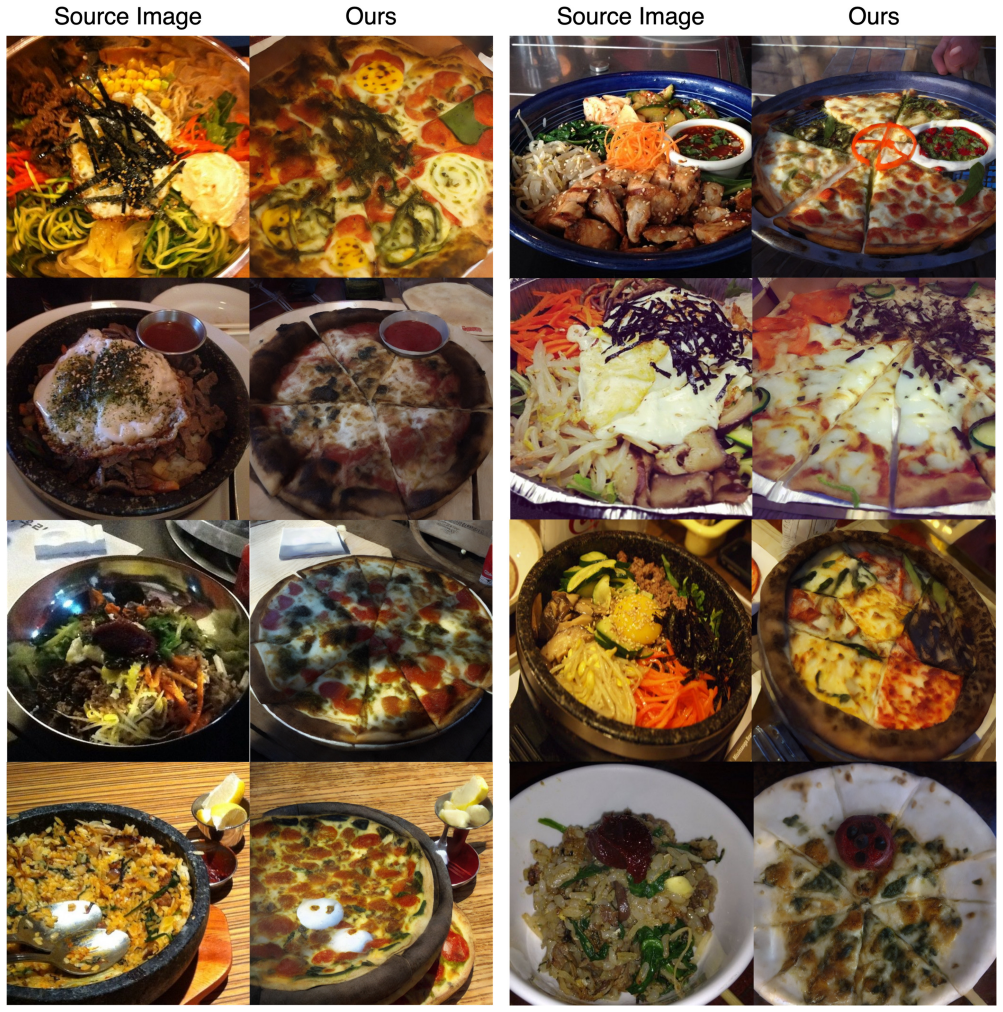
Figures from the paper (10 more)




Reference graph
Works this paper leans on
-
[1]
Mikołaj Bi ´nkowski, Danica J Sutherland, Michael Arbel, and Arthur Gretton. Demystifying mmd gans. arXiv preprint arXiv:1801.01401, 2018. 7, 2
arXiv 2018
-
[2]
Diffusion Schr ¨odinger Bridge with Appli- cations to Score-Based Generative Modeling
Valentin De Bortoli, James Thornton, Jeremy Heng, and Ar- naud Doucet. Diffusion Schr ¨odinger Bridge with Appli- cations to Score-Based Generative Modeling. In NeurIPS,
-
[3]
Hyungjin Chung, Jeongsol Kim, Michael T. Mccann, Marc L. Klasky, and Jong Chul Ye. Diffusion Posterior Sam- pling for General Noisy Inverse Problems. In ICLR, 2023. 1
work page 2023
-
[4]
Diffusion Models Beat GANs on Image Synthesis
Prafulla Dhariwal and Alex Nichol. Diffusion Models Beat GANs on Image Synthesis. In NeurIPS, 2021. 1
work page 2021
-
[5]
Bermano, Gal Chechik, and Daniel Cohen-Or
Rinon Gal, Yuval Alaluf, Yuval Atzmon, Or Patashnik, Amit H. Bermano, Gal Chechik, and Daniel Cohen-Or. An image is worth one word: Personalizing text-to-image gen- eration using textual inversion, 2022. 6, 2
work page 2022
-
[6]
Ian J. Goodfellow, Jean Pouget-Abadie, Mehdi Mirza, Bing Xu, David Warde-Farley, Sherjil Ozair, Aaron Courville, and Yoshua Bengio. Generative Adversarial Nets. In NeurIPS,
-
[7]
Adversarial Schr¨odinger Bridge Matching
Nikita Gushchin, Daniil Selikhanovych, Sergei Kholkin, Evgeny Burnaev, and Alexander Korotin. Adversarial Schr¨odinger Bridge Matching. In NeurIPS, 2024. 3
work page 2024
-
[8]
GANs Trained by a Two Time-Scale Update Rule Converge to a Local Nash Equilibrium
Martin Heusel, Hubert Ramsauer, Thomas Unterthiner, and Bernhard Nessler. GANs Trained by a Two Time-Scale Update Rule Converge to a Local Nash Equilibrium. In NeurIPS, 2017. 7, 2
work page 2017
Show all 39 references
-
[9]
Denoising Dif- fusion Probabilistic Models
Jonathan Ho, Ajay Jain, and Pieter Abbeel. Denoising Dif- fusion Probabilistic Models. In NeurIPS, 2020. 1
2020
-
[10]
Phillip Isola, Jun-Yan Zhu, Tinghui Zhou, and Alexei A. Efros. Image-to-Image Translation with Conditional Adver- sarial Networks. In CVPR, 2017. 2
2017
-
[11]
Multi-Task Learning Using Uncertainty to Weigh Losses for Scene Ge- ometry and Semantics
Alex Kendall, Yarin Gal, and Roberto Cipolla. Multi-Task Learning Using Uncertainty to Weigh Losses for Scene Ge- ometry and Semantics. In CVPR, 2018. 7, 2
2018
-
[12]
Sim- ple reflow: Improved techniques for fast flow models
Beomsu Kim, Yu-Guan Hsieh, Michal Klein, Marco Cuturi, Jong Chul Ye, Bahjat Kawar, and James Thornton. Sim- ple reflow: Improved techniques for fast flow models. arXiv preprint arXiv:2410.07815, 2024. 1
2024 arXiv
-
[13]
Unpaired Image-to-Image Translation via Neural Schr¨odinger Bridge
Beomsu Kim, Gihyun Kwon, Kwanyoung Kim, and Jong Chul Ye. Unpaired Image-to-Image Translation via Neural Schr¨odinger Bridge. In ICLR, 2024. 3, 4
2024
-
[14]
Noise2Score: Tweedie’s Approach to Self-Supervised Image Denoising without Clean Images
Kwanyoung Kim and Jong Chul Ye. Noise2Score: Tweedie’s Approach to Self-Supervised Image Denoising without Clean Images. In NeurIPS, 2021. 5
2021
-
[15]
Kingma and Max Welling
Diederik P. Kingma and Max Welling. Auto-Encoding Vari- ational Bayes. In ICLR, 2014. 4
2014
-
[16]
Yaron Lipman, Ricky T. Q. Chen, Heli Ben-Hamu, Maximil- ian Nickel, and Matthew Le. Flow Matching for Generative Modeling. In ICLR, 2023. 3
2023
-
[17]
Theodorou, and Ricky T
Guan-Horng Liu, Yaron Lipman, Maximilian Nickel, Brian Karrer, Evangelos A. Theodorou, and Ricky T. Q. Chen. Generalized Schr ¨odinger Bridge Matching. In ICLR, 2024. 3
2024
-
[18]
Flow Straight and Fast: Learning to Generate and Transfer Data with Rectified Flow
Xingchao Liu, Chengyue Gong, and Qiang Liu. Flow Straight and Fast: Learning to Generate and Transfer Data with Rectified Flow. arXiv preprint arXiv:2209.03003 ,
-
[19]
DPM-Solver: A Fast ODE Solver for Dif- fusion Probabilistic Model Sampling in Around 10 Steps
Cheng Lu, Yuhao Zhou, Fan Bao, Jianfei Chen, Chongxuan Li, and Jun Zhu. DPM-Solver: A Fast ODE Solver for Dif- fusion Probabilistic Model Sampling in Around 10 Steps. In NeurIPS, 2022. 2, 3
2022
-
[20]
SDEdit: Guided Im- age Synthesis and Editing with Stochastic Differential Equa- tions
Chenlin Meng, Yutong He, Yang Song, Jiaming Song, Jiajun Wu, Jun-Yan Zhu, and Stefano Ermon. SDEdit: Guided Im- age Synthesis and Editing with Stochastic Differential Equa- tions. In ICLR, 2022. 2, 6
2022
-
[21]
Efros, Richard Zhang, and Jun- Yan Zhu
Taesung Park, Alexei A. Efros, Richard Zhang, and Jun- Yan Zhu. Contrastive Learning for Unpaired Image-to-Image Translation. In ECCV, 2020. 2
2020
-
[22]
Learning transferable visual models from natural language supervi- sion
Alec Radford, Jong Wook Kim, Chris Hallacy, Aditya Ramesh, Gabriel Goh, Sandhini Agarwal, Girish Sastry, Amanda Askell, Pamela Mishkin, Jack Clark, et al. Learning transferable visual models from natural language supervi- sion. In International conference on machine learning, ...
2021
-
[23]
High-Resolution Image Synthesis with Latent Diffusion Models
Robin Rombach, Andreas Blattmann, Dominik Lorenz, Patrick Esser, and Bj ¨orn Ommer. High-Resolution Image Synthesis with Latent Diffusion Models. In CVPR, 2022. 1
2022
-
[24]
Progressive Distillation for Fast Sampling of Diffusion Models
Tim Salimans and Jonathan Ho. Progressive Distillation for Fast Sampling of Diffusion Models. In ICLR, 2022. 3
2022
-
[25]
Diffusion Schr ¨odinger Bridge Matching
Yuyang Shi, Valentin De Bortoli, Andrew Campbell, and Ar- naud Doucet. Diffusion Schr ¨odinger Bridge Matching. In NeurIPS, 2023. 2, 3
2023
-
[26]
Denois- ing Diffusion Implicit Models
Jiaming Song, Chenlin Meng, and Stefano Ermon. Denois- ing Diffusion Implicit Models. In ICLR, 2021. 1, 2, 3
2021
-
[27]
Improved Techniques for Training Consistency Models
Yang Song and Prafulla Dhariwal. Improved Techniques for Training Consistency Models. In ICLR, 2024. 2, 3
2024
-
[28]
Kingma, Ab- hishek Kumar, Stefano Ermon, and Ben Poole
Yang Song, Jascha Sohl-Dickstein, Diederik P. Kingma, Ab- hishek Kumar, Stefano Ermon, and Ben Poole. Score-Based Generative Modeling through Stochastic Differential Equa- tions. In ICLR, 2021. 1, 2, 3
2021
-
[29]
Consistency Models
Yang Song, Prafulla Dhariwal, Mark Chen, and Ilya Sutskever. Consistency Models. In ICML, 2023. 2, 3
2023
-
[30]
Exposing flaws of generative model evaluation metrics and their un- fair treatment of diffusion models
George Stein, Jesse Cresswell, Rasa Hosseinzadeh, Yi Sui, Brendan Ross, Valentin Villecroze, Zhaoyan Liu, Anthony L Caterini, Eric Taylor, and Gabriel Loaiza-Ganem. Exposing flaws of generative model evaluation metrics and their un- fair treatment of diffusion models. In Advan...
2023
-
[31]
Dual Diffusion Implicit Bridges for Image-to-Image Trans- lation
Xuan Su, Jiaming Song, Chenlin Meng, and Stefano Ermon. Dual Diffusion Implicit Bridges for Image-to-Image Trans- lation. In ICLR, 2023. 2, 6
2023
-
[32]
Improving and generalizing flow-based generative models with minibatch optimal transport
Alexander Tong, Kilian Fatras, Nikolay Malkin, Guillaume Huguet, Yanlei Zhang, Jarrid Rector-Brooks, Guy Wolf, and Yoshua Bengio. Improving and generalizing flow-based generative models with minibatch optimal transport. arXiv preprint arXiv:2302.00482, 2023. 3, 1
2023 arXiv
-
[33]
Splicing vit features for semantic appearance transfer
Narek Tumanyan, Omer Bar-Tal, Shai Bagon, and Tali Dekel. Splicing vit features for semantic appearance transfer. In Proceedings of the IEEE/CVF Conference on Computer Vision and Pattern Recognition, pages 10748–10757, 2022. 7, 2 9
2022
-
[34]
Plug-and-Play Diffusion Features for Text-Driven Image-to-Image Translation
Narek Tumanyan, Michal Geyer, Shai Bagon, and Tali Dekel. Plug-and-Play Diffusion Features for Text-Driven Image-to-Image Translation. In CVPR, 2023. 2, 6
2023
-
[35]
Deep Generative Learning via Schr¨odinger Bridge
Gefei Wang, Yuling Jiao, Qian Xu, Yang Wang, and Can Yang. Deep Generative Learning via Schr¨odinger Bridge. In ICML, 2021. 2
2021
-
[36]
Imagere- ward: Learning and evaluating human preferences for text- to-image generation
Jiazheng Xu, Xiao Liu, Yuchen Wu, Yuxuan Tong, Qinkai Li, Ming Ding, Jie Tang, and Yuxiao Dong. Imagere- ward: Learning and evaluating human preferences for text- to-image generation. Advances in Neural Information Pro- cessing Systems, 36, 2024. 7, 2
2024
-
[37]
Fast Sampling of Dif- fusion Models with Exponential Integrator
Qinsheng Zhang and Yongxin Chen. Fast Sampling of Dif- fusion Models with Exponential Integrator. In ICLR, 2023. 2, 3
2023
-
[38]
Fast ODE-based Sampling for Diffusion Models in Around 5 Steps
Zhenyu Zhou, Defang Chen, Can Wang, and Chun Chen. Fast ODE-based Sampling for Diffusion Models in Around 5 Steps. In CVPR, 2024. 2, 3
2024
-
[39]
!” to represent the source domain and “*
Jun-Yan Zhu, Taesung Park, Phillip Isola, and Alexei A. Efros. Unpaired Image-to-Image Translation using Cycle- Consistent Adversarial Networks. In ICCV, 2017. 2 10 Latent Schr¨odinger Bridge: Prompting Latent Diffusion for Fast Unpaired Image-to-Image Translation Supplementar...
2017
Reviewed August 12, 2026 · model on record in the stance chip above.
Discussion (0). Continue with ORCID to comment.