REVIEW 5 major objections 5 minor 37 references
CODE-CL: Conceptor-Based Gradient Projection for Deep Continual Learning
T0 review · 5 major / 5 minor · reviewed 2026-08-12 · deepseek-v4-flash
Pith's one-line read CODE-CL claims that selectively releasing shared old-task directions, while projecting gradients into the pseudo-orthogonal complement, yields both low forgetting and high forward transfer.
desk verdict Solid incremental CL method with public code and consistent accuracy gains, but the forgetting claims overreach and there is a hyperparameter inconsistency that must be fixed. read the letter →
The pith
A machine-rendered reading of the paper's core claim, the machinery that carries it, and where it could break.
The reading
What carries the argument
The carrying object is the conceptor matrix, a regularized reconstruction matrix for a batch of activation vectors: $C(X,\alpha)=\arg\min_C \frac{1}{b}\|X-XC\|_F^2 + \alpha^{-2}\|C\|_F^2$, with closed form $\frac{X^\top X}{b}(\frac{X^\top X}{b}+\alpha^{-2}I)^{-1}$. Reading $C$ through its SVD, $C = U S U^\top$, the singular values $S_{ii}\in(0,1)$ encode the importance of the directions $U_{:,i}$, so $C$ acts as a soft projection onto the layer's activation subspace. Conceptors form a Boolean algebra: $\neg C = I-C$, $C\wedge B = (C^{-1}+B^{-1}-I)^{-1}$ (with a pseudo-inverse variant for rank-deficient matrices), and $C\vee B = \neg(\neg C \wedge \neg B)$. CODE-CL uses $\wedge$ to locate directions shared by the old and new tasks, uses the top-$K$ singular vectors of that intersection to define the learnable subspace via $W^{\mathrm{eff}} = W + W U M U^\top$, and uses $\neg C_{t-1}$ to enforce pseudo-orthogonal gradient updates, then $\vee$ to merge old and new knowledge. This gives a single mechanism that decides, per direction, whether to freeze, project away, or actively reuse.
What would settle it
Train a sequence of two tasks with input subspaces whose overlap is known by construction (e.g., synthetic Gaussian features spanning chosen subspaces). Compute $C_{t,\mathrm{and}}$ and compare its top-$K$ directions against the true shared subspace. Then flip the released directions: replace $U$ in $W^{\mathrm{eff}} = W + W U M U^\top$ with a random orthonormal set of the same dimension while keeping the projection and training otherwise identical. If accuracy on the new task stays high, the mechanism is not actually transferring learned structure; if backward transfer worsens, the intersection estimate is releasing unsafe directions. Either outcome would undermine the central claim.
Extended reading notes
Core claim
On the paper's own terms, the central claim is that catastrophic forgetting and forward knowledge transfer are not in conflict once the update direction is chosen per direction rather than per task. A conceptor matrix $C$ is a soft projection built from the layer's input activations; its singular values in $(0,1)$ mark how much each direction matters to the tasks seen so far. Before learning task $t$, CODE-CL forms $C_{t,\mathrm{and}} = C_{t,\mathrm{pre}} \wedge C_{t-1}$, the conceptor intersection of the new task and all previous tasks. If the capacity ratio $\Theta(C_{t,\mathrm{and}})/\Theta(C_{t-1})$ exceeds a threshold $\epsilon$, the top-$K$ directions of that intersection are released for learning by setting $W^{\mathrm{eff}} = W + W U M U^\top$, with $M$ a learned $K\times K$ matrix, while gradients are constrained to $(I - C_{t-1})\nabla_W L$. After training, the knowledge is consolidated by the union $C_t = C_{t,\mathrm{post}} \vee C_{t-1}$. The paper's experiments conclude that this recipe yields state-of-the-art accuracy, near-zero backward transfer, and the highest forward transfer among compared projection methods.
Load-bearing premise
The load-bearing premise is that the intersection between the current task's activation directions and the stored summary of previous tasks, estimated from a finite batch with a threshold, reliably flags which directions are both shared and safe to release for learning.
Editorial extensions
If this is right
- If the main results are right, gradient projection methods can be improved without extra data replay or network expansion: the gains come from selectively freeing shared directions.
- CODE-CL's reported accuracy on Split MiniImageNet and 5-Datasets exceeds the multitask upper bound, so sequential learning with controlled transfer can beat joint training in these settings.
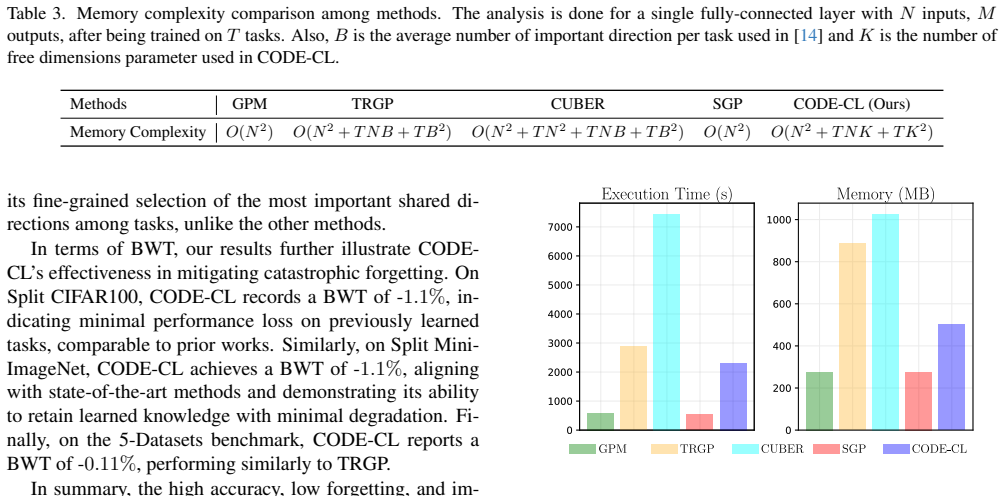
- The added state per task is $O(TNK+TK^2)$ on top of the $O(N^2)$ conceptors, so the method remains practical for larger layers compared to per-task-gradient methods like CUBER.
- Low backward transfer (-1.1%, -1.1%, -0.11% BWT on the three main benchmarks) means the released directions do not, as measured, harm old tasks, supporting the safety of the intersection estimate.
- On the overlapping-class benchmark OL-CIFAR100, CODE-CL also leads (76.89% ACC with 6.02% relative FWT), suggesting the mechanism transfers beyond strictly disjoint class splits.
Reading between the lines
- The threshold $\epsilon$ and the count of free dimensions $K$ are chosen globally, but the paper's own ablations show accuracy climbs with $K$ and falls with larger $\epsilon$; an editor's inference is that per-layer or per-task adaptive selection of $K$ and $\epsilon$ could improve the stability-plasticity balance further, a direction the paper does not explore.
- The reported forward-transfer metric is relative to GPM as baseline, so the magnitude of the FWT advantage is baseline-dependent; comparing CODE-CL against a common non-projection baseline (e.g., plain SGD or a regularization method) would be an informative test of how much of the gain is due to the released directions versus the projection itself.
- Because conceptors are computed from a finite batch of activations, the intersection estimate carries sampling noise; a natural stress test is to compare the method's behavior on identical task pairs when the conceptor is estimated from increasingly small batches, predicting that BWT should degrade or FWT should drop once the intersection becomes unreliable.
- The paper's task-incremental multi-head setup means task identity is provided at test time; whether the same direction-release mechanism helps in class-incremental or single-head settings, where the classifier suffers cross-task interference, is a plausible extension the paper does not address.
Editorial analysis
A structured set of objections, weighed in public.
Referee Report
Summary. The paper proposes CODE-CL, a continual learning method that uses conceptor matrices to estimate the importance of input-activation directions per layer for previous tasks. For each new task, it computes the intersection between the previous task conceptor and a pre-conceptor of the new task; if the overlap is large enough, it allows gradient updates along the top-K shared directions through a learnable matrix M_t, while projecting the base-weight gradient onto the pseudo-orthogonal complement I-C^{t-1}. The authors claim that this balances stability and plasticity, mitigates catastrophic forgetting, and improves forward knowledge transfer. Experiments on Split CIFAR100, Split MiniImageNet, 5-Datasets, and OL-CIFAR100 report state-of-the-art average accuracy and improved relative FWT over GPM-based baselines, with memory complexity comparable to GPM and TRGP.
Significance. If the reported results hold, CODE-CL is a competitive addition to gradient-projection continual learning, achieving the best average accuracy on three standard benchmarks (77.21%, 71.16%, 93.51%) and substantially higher relative FWT than TRGP, CUBER, and SGP. The method is reproducible in principle because the code is provided, and the conceptor formulation is a clean way to parameterize subspace overlap. However, the paper's own BWT numbers show that CODE-CL forgets more than TRGP, CUBER, and GPM on Split CIFAR100 and Split MiniImageNet, which conflicts with the abstract's 'minimal forgetting' claim. The main contribution is algorithmic and heuristic; there is no theoretical guarantee that the unconstrained M_t updates preserve old-task performance.
major comments (5)
- [Abstract and Table 1] The claim of 'minimal forgetting' is not supported by the reported BWT values. On Split CIFAR100, CODE-CL has BWT of -1.1±0.28, which is worse than GPM (-0.2±0.19), TRGP (-0.1±0.18), and CUBER (+0.1±0.11); on Split MiniImageNet, BWT -1.1±0.3 is worse than GPM, TRGP, and CUBER. The text should soften this claim or explicitly discuss that the improved ACC/FWT come at the cost of slightly more forgetting than some prior methods.
- [Algorithm 1 and Section 3.2.1] The shared-direction subspace U_t,and is computed from a single forward pass over a batch of 125 samples before any training on task t, then frozen for the entire epoch loop (lines 3-8 and 15-19). Since W and M_t both change during training, the input activations of task t will shift, so the intersection may no longer represent the true shared directions. The paper does not test this stationarity assumption; the epsilon ablation (Table 7) varies only the threshold, not the timing or sample size. Please provide evidence of subspace stability (e.g., cosine similarity of top directions before/after training) or an ablation that recomputes C_t,and periodically.
- [Section 3.2.2, Eq. (8), Algorithm 1 lines 16-19] The gradient constraint in Eq. (8) is applied only to the base weight W. The effective weights W_eff = W + W U_t M_t U_t^T are also updated through the unconstrained M_t gradient. Because the columns of U_t lie in the C_t-1 subspace (they come from the intersection C_t,and = C_t,pre ∧ C_t-1), the M_t update directly modifies directions deemed important for previous tasks. Thus Eq. (8) does not guarantee forgetting protection as claimed. The paper should analyze this effect or empirically test the impact of the M_t update on old-task performance (e.g., freezing M_t during training and measuring BWT).
- [Section 4.1.2 and Supplementary Table 9] The aperture values are inconsistent between the main text and the supplementary material. The main text states α=16 for Split miniImageNet and α=8 for 5-Datasets, but Supplementary Table 9 reports α=8 and α=4, respectively. Since α is a key hyperparameter and the ablation in Figure 4 shows sensitivity, this inconsistency prevents exact reproduction of the reported results. Please correct the discrepancy and state the exact values used for Table 1.
- [Section 4.1.3 and Section 4.2.1 (evaluation protocol)] The paper does not explain how task-level accuracy is computed after all tasks are learned. Training on task t uses the effective weights W_eff,t = W + W U_t M_t U_t^T, and W continues to change during later tasks. For evaluation on task i after the full sequence, the model must either re-apply the stored (U_i, M_i) to reconstruct the effective feature extractor or use the final W alone; these two protocols yield different numbers. The memory analysis (Table 3) suggests per-task storage of U_i and M_i, but the evaluation protocol is never stated, which affects the interpretation of every ACC and BWT number. Please clarify the exact evaluation procedure.
minor comments (5)
- [Section 2.1 and Algorithm 2] Algorithm 2 uses a threshold β to determine the effective rank of conceptors, but β is not listed in Table 9 or defined in the main text. Please specify its value and how it is chosen.
- [Algorithm 1, line 6] The condition 'if Θ(C_t,and)/Θ(C_t-1) > ε then for each layer l ∈ L' is ambiguous: it should be stated explicitly that the capacity ratio and the SVD are computed per layer, and that the learnable M_t is defined per layer as well.
- [Table 1] Several BWT entries from prior works are reported without standard deviations (e.g., DFGP on Split CIFAR100). Please add the missing values or state that they are unavailable.
- [Eq. (10) and Table 2] The FWT metric as defined is a relative FWT against a GPM baseline. This should be stated more prominently in the main text to avoid readers interpreting it as an absolute measure of forward transfer.
- [Title and affiliations] There are typographical errors in the title ('De ep'), the affiliation ('West Lafayete'), and some citation formatting. These should be corrected in the final version.
Circularity Check
No circularity: CODE-CL is an externally benchmarked algorithmic heuristic; its conceptor operations come from external prior work and its reported gains are empirical, not forced by construction.
full rationale
The derivation chain in Algorithm 1 couples Eqs. (2), (4), (7), and (8), but no quantity is defined in terms of the metric it is claimed to predict. C_t,and = C_t,pre ∧ C_t−1 is computed from data and prior conceptors; the top-K singular vectors are released through the learnable matrix M_t in Eq. (7), and old-task protection comes from the fixed projection I − C^{t−1} in Eq. (8). These are independent design mechanisms, not identities, and no equation reduces to a fitted prediction. The reported FWT is measured as A_i,i − B_i,i relative to GPM as an external baseline, not optimized directly; the same holds for ACC and BWT on standard external benchmarks. Hyperparameters α, ε, and K are tuned via ablations (Tables 5–7 and Figs. 4–5), which is standard practice and does not make the benchmark results fitted predictions. Self-citations to GPM [23] and SGP [22] are present, but they serve as baselines, dataloader sources, and comparison points; the load-bearing conceptor algebra comes from Jaeger [8], and competing results are reproduced from official implementations. The reviewer-flagged stationarity concern — that U_t,and is computed once from a 125-sample pre-training batch and frozen while W and M_t change — is a legitimate correctness risk about an untested assumption, not a circularity, because the released directions are not definitionally guaranteed to improve transfer or prevent forgetting.
Assumptions & free parameters
free parameters (3)
- Aperture α =
6 (Split CIFAR100), 16 (Split miniImageNet), 8 (5-Datasets)
- Threshold ε =
0.5
- Number of free dimensions K =
80
assumptions (3)
- domain assumption Conceptor matrix theory from Jaeger (2014): C = argmin (1/b)||X - XC||_F^2 + α^-2||C||_F^2, with Boolean-like operations AND, OR, NOT.
- domain assumption Gradients of a layer lie in the span of that layer's input activations (Zhang et al. 2017).
- ad hoc to paper The intersection conceptor computed from sampled activations and the pseudo-inverse approximation (Eq. 11) faithfully represents the true subspace overlap.
Cite this review
Pith. "Pith review of CODE-CL: Conceptor-Based Gradient Projection for Deep Continual Learning." pith.science (2026). https://pith.science/paper/OHOEAZNI
@misc{pith2026241115235,
  author       = {Pith},
  title        = {Pith review of: CODE-CL: Conceptor-Based Gradient Projection for Deep Continual Learning},
  year         = {2026},
  howpublished = {\url{https://pith.science/paper/OHOEAZNI}},
  note         = {Machine review of arXiv:2411.15235}
}
read the original abstract
Continual learning (CL) - the ability to progressively acquire and integrate new concepts - is essential to intelligent systems to adapt to dynamic environments. However, deep neural networks struggle with catastrophic forgetting (CF) when learning tasks sequentially, as training for new tasks often overwrites previously learned knowledge. To address this, recent approaches constrain updates to orthogonal subspaces using gradient projection, effectively preserving important gradient directions for previous tasks. While effective in reducing forgetting, these approaches inadvertently hinder forward knowledge transfer (FWT), particularly when tasks are highly correlated. In this work, we propose Conceptor-based gradient projection for Deep Continual Learning (CODE-CL), a novel method that leverages conceptor matrix representations, a form of regularized reconstruction, to adaptively handle highly correlated tasks. CODE-CL mitigates CF by projecting gradients onto pseudo-orthogonal subspaces of previous task feature spaces while simultaneously promoting FWT. It achieves this by learning a linear combination of shared basis directions, allowing efficient balance between stability and plasticity and transfer of knowledge between overlapping input feature representations. Extensive experiments on continual learning benchmarks validate CODE-CL's efficacy, demonstrating superior performance, reduced forgetting, and improved FWT as compared to state-of-the-art methods.
Figures


Figures from the paper (2 more)


Reference graph
Works this paper leans on
-
[1]
Avalanche: A PyTorch Library for Deep Continual Learning
Antonio Carta, Lorenzo Pellegrini, Andrea Cossu, Hamed Hemati, and Vincenzo Lomonaco. Avalanche: A PyTorch Library for Deep Continual Learning. Journal of Machine Learning Research, 24(363):1–6, 2023. 5
work page 2023
-
[2]
On Tiny Episodic Memories in Continual Learning
Arslan Chaudhry, Marcus Rohrbach Facebook, A I Re- search, Mohamed Elhoseiny, Thalaiyasingam Ajanthan, Puneet K Dokania, Philip H S Torr, and Marc ’ Aurelio Ran- zato. On Tiny Episodic Memories in Continual Learning. arXiv:1902.10486, 2019. 1, 3, 6
arXiv 1902
-
[3]
Efficient Lifelong Learning with A-GEM
Arslan Chaudhry, Marc’Aurelio Ranzato, Marcus Rohrbach, and Mohamed Elhoseiny. Efficient Lifelong Learning with A-GEM. International Conference on Learning Representa- tions, 2019. 1, 3, 6
work page 2019
-
[4]
Adversarial Continual Learn- ing
Sayna Ebrahimi, Franziska Meier, Roberto Calandra, Trevor Darrell, and Marcus Rohrbach. Adversarial Continual Learn- ing. In Computer Vision – ECCV 2020: 16th European Con- ference, Glasgow, UK, August 23–28, 2020, Proceedings, Part XI, pages 386–402, Berlin, Heidelberg, 2020. Springer- Verlag. 5
work page 2020
-
[5]
Orthogonal Gradient Descent for Continual Learning
Mehrdad Farajtabar, Navid Azizan, Alex Mott, Ang Li, Deepmind Caltech, and Deepmind Deepmind. Orthogonal Gradient Descent for Continual Learning. In Proceedings of the Twenty Third International Conference on Artificial In- telligence and Statistics, pages 3762–3773. PMLR, 2020. 1
work page 2020
-
[6]
Raia Hadsell, Dushyant Rao, Andrei A. Rusu, and Razvan Pascanu. Embracing Change: Continual Learning in Deep Neural Networks. Trends in Cognitive Sciences , 24(12): 1028–1040, 2020. 1
work page 2020
-
[7]
Xu He and H. Jaeger. Overcoming Catastrophic Interfer- ence using Conceptor-Aided Backpropagation.International Conference on Learning Representations, 2018. 3
work page 2018
-
[8]
Controlling Recurrent Neural Networks by Conceptors
Herbert Jaeger. Controlling Recurrent Neural Networks by Conceptors. arXiv:1403.3369, 2014. 1, 2, 3
arXiv 2014
Show all 37 references
-
[9]
Achieving forgetting prevention and knowledge transfer in continual learning
Zixuan Ke, Bing Liu, Nianzu Ma, Hu Xu, and Lei Shu. Achieving forgetting prevention and knowledge transfer in continual learning. In Proceedings of the 35th International Conference on Neural Information Processing Systems, Red Hook, NY , USA, 2021. Curran Associates Inc. 1
2021
-
[10]
Rusu, Kieran Milan, John Quan, Tiago Ramalho, Agnieszka Grabska- Barwinska, Demis Hassabis, Claudia Clopath, Dharshan Ku- maran, and Raia Hadsell
James Kirkpatrick, Razvan Pascanu, Neil Rabinowitz, Joel Veness, Guillaume Desjardins, Andrei A. Rusu, Kieran Milan, John Quan, Tiago Ramalho, Agnieszka Grabska- Barwinska, Demis Hassabis, Claudia Clopath, Dharshan Ku- maran, and Raia Hadsell. Overcoming catastrophic for- gett...
2017
-
[11]
Learning Multiple Layers of Features from Tiny Images
Alex Krizhevsky. Learning Multiple Layers of Features from Tiny Images. 2009. 5
2009
-
[12]
Brna, Suraj Chakravarthi Raja, Nick Ch- eney, Jeff Clune, Anurag Daram, Stefano Fusi, Peter Helfer, Leslie Kay, Nicholas Ketz, Zsolt Kira, Soheil Kolouri, Jef- frey L
Dhireesha Kudithipudi, Mario Aguilar-Simon, Jonathan Babb, Maxim Bazhenov, Douglas Blackiston, Josh Bon- gard, Andrew P. Brna, Suraj Chakravarthi Raja, Nick Ch- eney, Jeff Clune, Anurag Daram, Stefano Fusi, Peter Helfer, Leslie Kay, Nicholas Ketz, Zsolt Kira, Soheil Kolouri, J...
2022
-
[13]
Adaptive plasticity im- provement for continual learning
Yan-Shuo Liang and Wu-Jun Li. Adaptive plasticity im- provement for continual learning. In 2023 IEEE/CVF Conference on Computer Vision and Pattern Recognition (CVPR), pages 7816–7825, 2023. 6
2023
-
[14]
TRGP: Trust Region Gradient Projection for Continual Learning.In- ternational Conference on Learning Representations , 2022
Sen Lin, Li Yang, Deliang Fan, and Junshan Zhang. TRGP: Trust Region Gradient Projection for Continual Learning.In- ternational Conference on Learning Representations , 2022. 1, 3, 5, 6, 7, 8, 2
2022
-
[15]
Beyond not-forgetting: continual learning with backward knowledge transfer
Sen Lin, Li Yang, Deliang Fan, and Junshan Zhang. Beyond not-forgetting: continual learning with backward knowledge transfer. In Proceedings of the 36th International Conference on Neural Information Processing Systems , Red Hook, NY , USA, 2022. Curran Associates Inc. 1, 3, 6, 8
2022
-
[16]
Gradient Episodic Memory for Continual Learning
David Lopez-Paz and Marc ’ Aurelio Ranzato. Gradient Episodic Memory for Continual Learning. In Proceedings of the 31st International Conference on Neural Information Processing Systems, 2017. 1, 3, 5, 2
2017
-
[17]
PackNet: Adding Multiple Tasks to a Single Network by Iterative Pruning
Arun Mallya and Svetlana Lazebnik. PackNet: Adding Multiple Tasks to a Single Network by Iterative Pruning. 2018 IEEE/CVF Conference on Computer Vision and Pat- tern Recognition, pages 7765–7773, 2017. 1, 3
2018
-
[18]
BNS: Building Network Structures Dynamically for Continual Learning
Qi Qin, Wenpeng Hu, Han Peng, Dongyan Zhao, and Bing Liu. BNS: Building Network Structures Dynamically for Continual Learning. Advances in Neural Information Pro- cessing Systems, 34:20608–20620, 2021. 1, 3
2021
-
[19]
Sylvestre Alvise Rebuffi, Alexander Kolesnikov, Georg Sperl, and Christoph H. Lampert. iCaRL: Incremental Clas- sifier and Representation Learning. 2017 IEEE Conference on Computer Vision and Pattern Recognition (CVPR), 2017- January:5533–5542, 2017. 1, 3
2017
-
[20]
Ritter, Aleksandar Botev, and D
H. Ritter, Aleksandar Botev, and D. Barber. Online Struc- tured Laplace Approximations For Overcoming Catastrophic Forgetting. Neural Information Processing Systems, 2018. 3
2018
-
[21]
Rusu, Neil C
Andrei A. Rusu, Neil C. Rabinowitz, Guillaume Desjardins, Hubert Soyer, James Kirkpatrick, Koray Kavukcuoglu, Raz- van Pascanu, and Raia Hadsell. Progressive Neural Net- works. arXiv preprint arXiv:1606.04671, 2016. 1, 3
2016 arXiv
-
[22]
Continual Learning with Scaled Gradient Projection
Gobinda Saha and Kaushik Roy. Continual Learning with Scaled Gradient Projection. Proceedings of the 37th AAAI Conference on Artificial Intelligence, AAAI 2023 , 37:9677– 9685, 2023. 1, 2, 3, 5, 6, 8 9
2023
-
[23]
Gobinda Saha, Isha Garg, and K. Roy. Gradient Projection Memory for Continual Learning. International Conference on Learning Representations, 2021. 1, 2, 3, 5, 6, 8
2021
-
[24]
Czarnecki, Jelena Luketina, A
Jonathan Schwarz, Wojciech M. Czarnecki, Jelena Luketina, A. Grabska-Barwinska, Y . Teh, Razvan Pascanu, and R. Hadsell. Progress & Compress: A scalable framework for continual learning. International Conference on Machine Learning, 2018. 3
2018
-
[25]
Serr `a, D ´ıdac Sur ´ıs, M
J. Serr `a, D ´ıdac Sur ´ıs, M. Miron, and Alexandros Karat- zoglou. Overcoming catastrophic forgetting with hard at- tention to the task. International Conference on Machine Learning, 2018. 1, 3, 6, 2
2018
-
[26]
Con- tinual Learning via Bit-Level Information Preserving
Yujun Shi, Li Yuan, Yunpeng Chen, and Jiashi Feng. Con- tinual Learning via Bit-Level Information Preserving. 2021 IEEE/CVF Conference on Computer Vision and Pattern Recognition (CVPR), pages 16669–16678, 2021. 1
2021
-
[27]
Vinyals, C
O. Vinyals, C. Blundell, T. Lillicrap, K. Kavukcuoglu, and Daan Wierstra. Matching Networks for One Shot Learning. Neural Information Processing Systems, 2016. 5
2016
-
[28]
A Comprehensive Survey of Continual Learning: The- ory, Method and Application
Liyuan Wang, Xingxing Zhang, Hang Su, and Jun Zhu. A Comprehensive Survey of Continual Learning: The- ory, Method and Application. IEEE Transactions on Pat- tern Analysis and Machine Intelligence , 46(08):5362–5383,
-
[29]
Training Networks in Null Space of Feature Covariance for Continual Learning
Shipeng Wang, Xiaorong Li, Jian Sun, and Zongben Xu. Training Networks in Null Space of Feature Covariance for Continual Learning. 2021 IEEE/CVF Conference on Com- puter Vision and Pattern Recognition (CVPR) , pages 184– 193, 2021. 1
2021
-
[30]
Reinforced Continual Learning
Ju Xu and Zhanxing Zhu. Reinforced Continual Learning. In Proceedings of the 32nd International Conference on Neural Information Processing Systems, pages 907–916, 2018. 1, 3
2018
-
[31]
Data augmented flatness- aware gradient projection for continual learning
Enneng Yang, Li Shen, Zhenyi Wang, Shiwei Liu, Guib- ing Guo, and Xingwei Wang. Data augmented flatness- aware gradient projection for continual learning. In 2023 IEEE/CVF International Conference on Computer Vision (ICCV), pages 5607–5616, 2023. 3, 6
2023
-
[32]
Lifelong Learning with Dynamically Expandable Networks
Jaehong Yoon, Eunho Yang, Jeongtae Lee, and Sung Ju Hwang. Lifelong Learning with Dynamically Expandable Networks. International Conference on Learning Represen- tations, 2018. 1, 3
2018
-
[33]
Scalable and Order-robust Continual Learning with Additive Parameter Decomposition
Jaehong Yoon, Saehoon Kim, Eunho Yang, and Sung Ju Hwang. Scalable and Order-robust Continual Learning with Additive Parameter Decomposition. International Confer- ence on Learning Representations, 2020. 1
2020
-
[34]
Contin- ual learning of context-dependent processing in neural net- works
Guanxiong Zeng, Yang Chen, Bo Cui, and Shan Yu. Contin- ual learning of context-dependent processing in neural net- works. Nature Machine Intelligence 2019 1:8, 1(8):364–372,
2019
-
[35]
Contin- ual Learning Through Synaptic Intelligence
Friedemann Zenke, Ben Poole, and Surya Ganguli. Contin- ual Learning Through Synaptic Intelligence. Proceedings of machine learning research, 70:3987, 2017. 1, 3
2017
-
[36]
Understanding deep learning re- quires rethinking generalization
Chiyuan Zhang, Samy Bengio, Moritz Hardt, Benjamin Recht, and Oriol Vinyals. Understanding deep learning re- quires rethinking generalization. In International Confer- ence on Learning Representations, 2017. 2, 3
2017
-
[37]
Rethinking gradient projection continual learning: Stability/plasticity feature space decou- pling
Zhen Zhao, Zhizhong Zhang, Xin Tan, Jun Liu, Yanyun Qu, Yuan Xie, and Lizhuang Ma. Rethinking gradient projection continual learning: Stability/plasticity feature space decou- pling. In 2023 IEEE/CVF Conference on Computer Vision and Pattern Recognition (CVPR) , pages 3718–372...
2023
Reviewed August 12, 2026 · model on record in the stance chip above.
Discussion (0). Continue with ORCID to comment.