REVIEW 4 major objections 6 minor 52 references
Efficient and Private: Memorisation under differentially private parameter-efficient fine-tuning in language models
T0 review · 4 major / 6 minor · reviewed 2026-08-12 · deepseek-v4-flash
Pith's one-line read Parameter-efficient fine-tuning with LoRA and adapters reduces membership-inference leakage and memorisation of mislabelled data compared with full-parameter fine-tuning, while matching task accuracy.
desk verdict Plausible and clearly written, but the headline privacy gains are built on single-seed AUC differences that may be sampling noise. read the letter →
The pith
A machine-rendered reading of the paper's core claim, the machinery that carries it, and where it could break.
The reading
What carries the argument
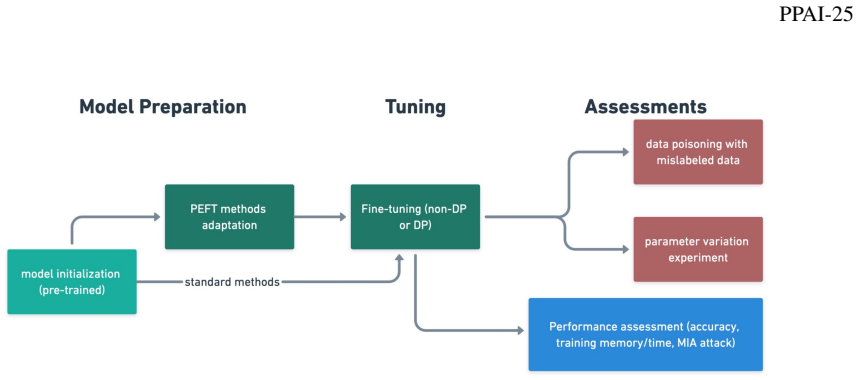
The load-bearing object is the loss-based membership inference attack, scored with AUC: a model that has memorised a training point assigns it unusually low loss, so the AUC measures how cleanly an attacker can separate training from non-training examples. The second mechanism is the canary test, where 30 examples from each of the training and test sets are mislabelled to create atypical feature-label pairs that a high-capacity model tends to memorise; high accuracy or high AUC on that poisoned subset is read as evidence of memorisation. The third piece is the parameter-scaling design, which varies Adapter bottleneck sizes from 32 to 512 and LoRA ranks from 8 to 480 to test whether any privacy advantage can be explained away by parameter count.
What would settle it
Run the same IMDb and QNLI protocol across at least five random seeds and compare per-seed distributions of membership-inference AUC: if the LoRA and Adapter values around 0.52 and 0.53 overlap with DistilBERT's 0.59, the claimed privacy advantage is not supported. Separately, replace the mislabelled canaries with correctly labelled rare sensitive strings; if PEFT models extract those as readily as full fine-tuning, the reduced-memorisation claim would be an artefact of the poisoning setup rather than a general property.
Extended reading notes
Core claim
The central claim, stated on the paper's own terms, is that PEFT methods memorise less of the fine-tuning data than standard full-parameter fine-tuning, and that this reduced memorisation is directly visible in two measurements: lower loss-based membership-inference AUC and lower accuracy on deliberately mislabelled canary examples. On IMDb without DP, DistilBERT's attack AUC is 0.59, while LoRA and Adapter sit at 0.52 and 0.53; on the poisoned subset, fully fine-tuned DistilBERT's training accuracy climbs from 0.20 to over 0.45 across epochs, while LoRA and Adapter stay low. Under DP, all methods show less leakage, but PEFT methods show smaller absolute reductions than standard fine-tuning, so at epsilon 8 LoRA and Adapter can end up slightly above DistilBERT; the paper interprets this as DP noise being concentrated on a smaller parameter set. Scaling experiments show that larger Adapter bottlenecks can raise AUC on QNLI from 0.58 to 0.71, whereas larger LoRA ranks leave AUC nearly flat, leading the authors to conclude that PEFT's privacy behaviour depends on where and how the adaptation modules are placed, not merely on their parameter count.
Load-bearing premise
The load-bearing assumption is that a score measuring how easily a model's per-example losses reveal training set membership, computed on a set of only 30 deliberately mislabelled examples, is a reliable and statistically meaningful proxy for privacy leakage, since the central comparison rests on small AUC differences reported without error bars or repeated-seed variance.
Editorial extensions
If this is right
- If the result holds, privacy-conscious teams can adopt LoRA or adapters as a cheap first defence against membership inference, without paying the memory and training-time costs of DP-SGD.
- The accuracy results imply that PEFT under DP is not a utility sacrifice: LoRA at epsilon 4.0 reaches 85.3 percent on IMDb, above DistilBERT's 84.3 percent and BERT-base's 81.1 percent.
- Because larger LoRA ranks did not raise leakage, deployers can scale LoRA capacity without obviously trading away the memorisation advantage, at least within the studied range.
- The weaker DP effect on PEFT suggests that privacy accounting and noise schedules designed for full fine-tuning may not transfer directly; applying DP to PEFT needs its own recipe.
- The canary results imply that PEFT models are less likely to lock in atypical label associations, which matters for datasets where rare or sensitive examples are exactly the ones an attacker targets.
Reading between the lines
- The paper reports single runs without error bars or repeated-seed variance; until the 0.59 versus 0.52 AUC gap is shown to exceed run-to-run noise, the ranking should be treated as directional, and multi-seed repetition is the natural next check.
- The canary test uses mislabelled examples; an extension the authors do not run would insert correctly labelled rare strings such as IDs or email addresses and ask whether PEFT still memorises less, which is closer to real data-extraction risk.
- The architecture-placement hypothesis is testable: fix LoRA's rank and attach it to query, key, value, or output projections separately, then measure whether membership-inference AUC shifts, isolating where memorisation happens.
- All experiments use BERT-style encoders; the transfer to decoder-only generative models is untested, and the memorisation economics of generation could differ.
Editorial analysis
A structured set of objections, weighed in public.
Referee Report
Summary. This paper empirically evaluates whether parameter-efficient fine-tuning (PEFT) methods—Adapters, LoRA, and (IA)^3—reduce memorisation and privacy leakage relative to standard fine-tuning, both with and without differentially private (DP) training. Using DistilBERT and BERT-base on IMDb and QNLI, the authors measure task accuracy, training cost, membership-inference AUC (loss-based black-box), and AUC/accuracy on a small set of intentionally mislabelled canary samples. They report that PEFT methods, especially LoRA, achieve competitive accuracy while substantially lowering MIA AUC in non-DP settings, that DP reduces leakage across all methods, and that increasing PEFT parameter counts does not erase the privacy advantage. The paper positions PEFT as a complementary privacy-preserving alternative to DP fine-tuning.
Significance. If the empirical findings hold, the paper makes a useful practical contribution: it provides evidence on a question of active interest—whether PEFT methods inherently reduce memorisation relative to full fine-tuning, and how they interact with DP-SGD. The study covers three PEFT variants, two datasets, multiple DP budgets, and a canary-based memorisation audit, which is a reasonable breadth for a first investigation. The central claims are falsifiable and the evaluation protocol is standard (accuracy, MIA AUC, training cost), so the results could inform deployment decisions for privacy-sensitive fine-tuning. However, the statistical support for the headline privacy claim is currently weak: all AUC comparisons are single-run point estimates with no error bars, and the canary subset is very small. The paper also overstates the performance parity of PEFT under DP, as Adapter on QNLI is 13 points below standard fine-tuning. These issues need to be addressed before the central claims can be accepted.
major comments (4)
- [Section 4, 'Privacy Leakage: Membership Inference' (Figure 2)] The central claim that PEFT methods reduce privacy leakage rests on AUC differences such as 0.52 (LoRA) and 0.53 (Adapter) versus 0.59 (DistilBERT) on non-DP IMDb. No error bars, confidence intervals, or multi-seed results are reported anywhere in Section 4, and no significance test is applied. Given that each configuration appears to be a single run, training stochasticity and hyperparameter sensitivity cannot be ruled out as the source of these differences. The canary experiment described in Section 3 uses only 30 flipped training and 30 flipped test points; for an AUC computed on that subset, the standard error under the null is roughly sqrt(61/(12*30*30)) ≈ 0.075, so a gap of 0.07 is within one standard error. Please report per-seed AUC values, confidence intervals or bootstrap estimates, and explicitly state whether the AUC in Figure 3 is computed on the full dataset or only the 60-point poisoned subset. Without this, the headline 'significantly reducing privacy leakage' is not statistically supported.
- [Section 4, Table 4 (Performance comparison)] The abstract and Section 4 claim that PEFT methods achieve 'comparable performance' to standard fine-tuning, but Table 4 shows Adapter under DP on QNLI at 63.6% versus DistilBERT at 76.4% (ε=4.0), and on IMDb at 73.8% versus 83.6% (ε=1.0). These are substantial accuracy gaps, not comparability. The claim 'PEFT methods matched or exceeded the accuracy of standard fine-tuning' is only true for LoRA in some settings and for non-DP IMDb. Please qualify the performance conclusion to name the configurations where PEFT is competitive and where it is not, and adjust the abstract accordingly if these gaps are not addressed.
- [Section 4, 'Privacy Leakage: Auditing using canaries' (Figures 3 and 4)] The canary experiment is a key piece of evidence for the memorisation claim, but the methodology is under-specified. Section 3 states that the authors 'conducted a loss-based MIA on the entire dataset and then focused on the AUC scores of this poisoned subset'—it is unclear whether the AUC is computed only on the 30 mislabelled training points versus 30 mislabelled test points, or on the full dataset with membership labels restricted to those 60 points. The text reports large differences (e.g., 'elevated AUC values' for DistilBERT) but gives no numeric values in the text and no variance estimate for the 30-point estimate. With such a small subset, the AUC estimate is highly unstable; the claim of 'significantly lower AUC scores' for PEFT cannot be evaluated. Please provide the exact computation, the numerical AUC values, and a confidence interval or a permutation test.
- [Section 4, 'PEFT Parameter Variation' (Figure 5)] The parameter-variation experiment is used to argue that PEFT robustness is not simply due to fewer parameters, but the evidence is presented as point estimates without variance. On QNLI, Adapter AUC rises from 0.58 to 0.71 as the bottleneck size increases, which is a substantial change; on IMDb the AUC 'fluctuates'—both patterns are difficult to interpret without confidence intervals. For LoRA, the text says 'minimal AUC variation' but no numerical threshold is given. This claim feeds directly into the Section 5 discussion about architectural placement, so it needs quantitative support. Please report the AUC values for each configuration, the number of seeds, and a statistical comparison (e.g., overlapping confidence intervals) before concluding that robustness is independent of parameter count.
minor comments (6)
- [Section 1] Reference [1] is listed as 'Emergent abilities of large language models' but is cited in support of the EU AI Act; this appears to be a citation error.
- [Section 2] There are several typos, including 'excells' for 'excels' and 'adressing' for 'addressing'; Section 4 has 'umber' for 'number'.
- [Section 3] The DP implementation is described as 'implemented at a sample level' but the privacy accounting method is not specified; please state which accountant (e.g., Rényi DP) and whether Poisson sampling or another subsampling scheme was used to compute the reported ε values.
- [Section 4] Figure 2 and Figure 3 are heatmaps that are difficult to read in print; the exact AUC values should also be given in a table in the text.
- [Section 4] The reason (IA)^3 is excluded from DP experiments appears in Section 3, but Table 4's N/A entries are not explained there; a brief pointer in the table caption would help.
- [Section 5] The statement that 'DP-SGD can often act as a natural regulariser' is speculative and not tested; please either support it with the data or soften the language.
Circularity Check
No significant circularity: the paper's privacy-leakage claims are empirical measurements (MIA AUC and canary accuracy), not outputs derived from fitted parameters or self-citations; the cited self-work is background and future-direction material only.
full rationale
This paper is an empirical evaluation, not a formal derivation. The central claims—that PEFT methods such as LoRA and Adapter exhibit lower membership-inference AUC and lower memorisation of mislabelled canary samples than standard fine-tuning—are read directly from measured training outcomes (Figures 2-5, Tables 4-5). No equation in the paper defines the conclusion in terms of the inputs, and no fitted parameter is later renamed as a prediction. The canary experiment is an operationalisation of memorisation: the paper intentionally mislabels 30 training and 30 test instances and then measures the model's loss-based AUC and accuracy on that subset. This is a measurement protocol, not a circular definition, because the reported values are empirical outputs that could have come out differently. The self-citations by the authors, [35] and [50], are cited for background on white-box membership inference and as a suggested direction for future architectural adaptation research; neither is load-bearing for the empirical privacy-leakage comparisons. There is no imported uniqueness theorem, no ansatz smuggled in via citation, and no renaming of a known result as a new contribution. The strongest legitimate concern is statistical robustness: the reported AUC differences are small and the paper gives no confidence intervals, multiple seeds, or significance tests. That concern, however, concerns the evidentiary weight of the measurements and belongs under correctness risk, not circularity. No load-bearing step reduces to its own inputs, so the circularity score is 0.
Assumptions & free parameters
free parameters (3)
- Per-method learning rates (DP and non-DP) =
Non-DP: Adapter 5e-4, LoRA 5e-4, (IA)3 7e-3; DP: Adapter 1e-3, LoRA 8e-4
- Number of mislabelled canary samples per split =
30
- DP clipping norm C and delta =
C=1.5, delta=10^-5
assumptions (4)
- standard math DP-SGD as implemented in Opacus/dp-transformers provides the stated (epsilon, delta)-DP guarantee.
- domain assumption Loss-based membership inference AUC is a valid proxy for privacy leakage and memorisation.
- domain assumption Mislabelled canary samples represent worst-case memorisation.
- domain assumption Results on BERT-family encoder models generalize to other LLM architectures.
Cite this review
Pith. "Pith review of Efficient and Private: Memorisation under differentially private parameter-efficient fine-tuning in language models." pith.science (2026). https://pith.science/paper/MWSCWHWQ
@misc{pith2026241115831,
  author       = {Pith},
  title        = {Pith review of: Efficient and Private: Memorisation under differentially private parameter-efficient fine-tuning in language models},
  year         = {2026},
  howpublished = {\url{https://pith.science/paper/MWSCWHWQ}},
  note         = {Machine review of arXiv:2411.15831}
}
read the original abstract
Fine-tuning large language models (LLMs) for specific tasks introduces privacy risks, as models may inadvertently memorise and leak sensitive training data. While Differential Privacy (DP) offers a solution to mitigate these risks, it introduces significant computational and performance trade-offs, particularly with standard fine-tuning approaches. Previous work has primarily focused on full-parameter updates, which are computationally intensive and may not fully leverage DPs potential in large models. In this work, we address these shortcomings by investigating Parameter-Efficient Fine-Tuning (PEFT) methods under DP constraints. We show that PEFT methods achieve comparable performance to standard fine-tuning while requiring fewer parameters and significantly reducing privacy leakage. Furthermore, we incorporate a data poisoning experiment involving intentional mislabelling to assess model memorisation and directly measure privacy risks. Our findings indicate that PEFT methods not only provide a promising alternative but also serve as a complementary approach for privacy-preserving, resource-efficient fine-tuning of LLMs.
Figures


Figures from the paper (2 more)


Reference graph
Works this paper leans on
-
[1]
Chi, Tatsunori Hashimoto, Oriol Vinyals, Percy Liang, Jeff Dean, and William Fedus
Jason Wei, Yi Tay, Rishi Bommasani, Colin Raffel, Barret Zoph, Sebastian Borgeaud, Dani Yogatama, Maarten Bosma, Denny Zhou, Donald Metzler, Ed H. Chi, Tatsunori Hashimoto, Oriol Vinyals, Percy Liang, Jeff Dean, and William Fedus. Emergent abilities of large language models. Transactions on Machine Learning Research,
-
[2]
European Commission. Proposal for a regulation of the european parliament and of the coun- cil laying down harmonised rules on artificial intelligence (artificial intelligence act) and amend- ing certain union legislative acts. https://eur-lex.europa.eu/resource.html?uri=cellar: e0649735-a372-11eb-9585-01aa75ed71a1.0001.02/DOC_1&format=PDF ; https://eur-l...
work page 2021
-
[3]
Badhan Chandra Das, M. Hadi Amini, and Yanzhao Wu. Security and privacy challenges of large language models: A survey. arXiv preprint arXiv:2402.00888, 2024. Available at https://arxiv.org/abs/2402.00888
arXiv 2024
-
[4]
Auditing Data Provenance in Text-Generation Models
Congzheng Song and Vitaly Shmatikov. Auditing data provenance in text-generation models. arXiv preprint arXiv:1811.00513, 2019
work page Pith review arXiv 2019
-
[5]
Extracting training data from large language models
Nicholas Carlini, Florian Tramèr, Eric Wallace, Matthew Jagielski, Ariel Herbert-V oss, Katherine Lee, Adam Roberts, Tom Brown, Dawn Song, Úlfar Erlingsson, Alina Oprea, and Colin Raffel. Extracting training data from large language models. In 30th USENIX Security Symposium (USENIX Security 21) , pages 2633–2650. USENIX Association, aug 2021
work page 2021
-
[6]
Quantifying privacy risks of masked language models using membership inference attacks
Fatemehsadat Mireshghallah, Kartik Goyal, Archit Uniyal, Taylor Berg-Kirkpatrick, and Reza Shokri. Quantifying privacy risks of masked language models using membership inference attacks. In Yoav Goldberg, Zornitsa Kozareva, and Yue Zhang, editors, Proceedings of the 2022 Conference on Empirical Methods in Natural Language Processing, pages 8332–8347, Abu ...
work page 2022
-
[7]
Exploring memorization in fine-tuned language models
Shenglai Zeng, Yaxin Li, Jie Ren, Yiding Liu, Han Xu, Pengfei He, Yue Xing, Shuaiqiang Wang, Jiliang Tang, and Dawei Yin. Exploring memorization in fine-tuned language models. arXiv preprint arXiv:2310.06714, 2023
arXiv 2023
-
[8]
Deep learning with differential privacy
Martin Abadi, Andy Chu, Ian Goodfellow, H Brendan McMahan, Ilya Mironov, Kunal Talwar, and Li Zhang. Deep learning with differential privacy. In Proceedings of the 2016 ACM SIGSAC Conference on Computer and Communications Security, pages 308–318. ACM, 2016
work page 2016
Show all 52 references
-
[9]
The Algorithmic F oundations of Differential Privacy
Cynthia Dwork and Aaron Roth. The Algorithmic F oundations of Differential Privacy. Now Publishers Inc., Hanover, MA, USA, 2014. Available at https://www.cis.upenn.edu/~aaroth/Papers/privacybook. pdf
2014
-
[10]
Training text-to-text transformers with privacy guarantees
Natalia Ponomareva, Jasmijn Bastings, and Sergei Vassilvitskii. Training text-to-text transformers with privacy guarantees. In Findings of the Association for Computational Linguistics: ACL 2022 , pages 2182–2193, 2022
2022
-
[11]
Differential privacy has disparate impact on model accuracy
Eugene Bagdasaryan, Omid Poursaeed, and Vitaly Shmatikov. Differential privacy has disparate impact on model accuracy. Advances in neural information processing systems , 32, 2019
2019
-
[12]
Differentially private fine-tuning of language models
Da Yu, Saurabh Naik, Arturs Backurs, Sivakanth Gopi, Huseyin A Inan, Gautam Kamath, Janardhan Kulkarni, Yin Tat Lee, Andre Manoel, Lukas Wutschitz, et al. Differentially private fine-tuning of language models. In International Conference on Learning Representations (ICLR) , 2022
2022
-
[13]
Differentially private bias-term only fine-tuning of foundation models
Zhiqi Bu, Yu-Xiang Wang, Sheng Zha, and George Karypis. Differentially private bias-term only fine-tuning of foundation models. arXiv preprint arXiv:2210.00036, 2022
2022 arXiv
-
[14]
Hashimoto
Xuechen Li, Florian Tramèr, Percy Liang, and Tatsunori B. Hashimoto. Large language models can be strong differentially private learners. arXiv preprint arXiv:2110.05679, 2021. 10 The 6th AAAI Workshop on Privacy-Preserving Artificial Intelligence PPAI-25
2021 arXiv
-
[15]
Parameter-efficient fine-tuning for large models: A comprehensive survey
Zeyu Han, Chao Gao, Jinyang Liu, Jeff Zhang, and Sai Qian Zhang. Parameter-efficient fine-tuning for large models: A comprehensive survey. arXiv preprint arXiv:2403.14608, 2024. 25 pages, 12 figures
2024 arXiv
-
[16]
Parameter efficient fine tuning: A comprehensive analysis across applications, April 2024
Charith Chandra, Sai Balne, Sreyoshi Bhaduri, Tamoghna Roy, Vinija Jain, and Aman Chadha. Parameter efficient fine tuning: A comprehensive analysis across applications, April 2024. ResearchGate preprint
2024
-
[17]
Lora learns less and forgets less
Dan Biderman, Jose Ortiz, Jacob Portes, Mansheej Paul, Philip Greengard, Connor Jennings, Daniel King, Sam Havens, Vitaliy Chiley, Jonathan Frankle, Cody Blakeney, and John Cunningham. Lora learns less and forgets less. ArXiv, May 2024
2024
-
[18]
Calibrating noise to sensitivity in private data analysis
Cynthia Dwork, Frank McSherry, Kobbi Nissim, and Adam Smith. Calibrating noise to sensitivity in private data analysis. In Theory of Cryptography, Third Theory of Cryptography Conference, TCC 2006 , volume 3876 of Lecture Notes in Computer Science , pages 265–284. Springer, 2006
2006
-
[19]
Tianqing Zhu, Gang Li, Wanlei Zhou, and Philip S. Yu. Differentially private deep learning. In Differential Privacy and Applications, volume 69 of Advances in Information Security , pages 67–82. Springer, 2017. First Online: 23 August 2017
2017
-
[20]
Opacus: User-friendly differential privacy library in pytorch
Ashkan Yousefpour, Igor Shilov, Alexandre Sablayrolles, Karthik Prasad, Mani Malek Esmaeili, John Nguyen, Sayan Ghosh, Akash Bharadwaj, Jessica Zhao, Graham Cormode, and Ilya Mironov. Opacus: User-friendly differential privacy library in pytorch. In NeurIPS, 2021
2021
-
[21]
Parameter-efficient transfer learning for nlp
Neil Houlsby, Andrei Giurgiu, Stanislaw Jastrzebski, Bruna Morrone, Quentin de Laroussilhe, Andrea Gesmundo, Mona Attariyan, and Sylvain Gelly. Parameter-efficient transfer learning for nlp. In International Conference on Machine Learning, pages 2790–2799. PMLR, 2019
2019
-
[22]
Hu, Yelong Shen, Phillip Wallis, Zeyuan Allen-Zhu, Zhize Li, Lei Wang, and Weizhu Chen
Edward J. Hu, Yelong Shen, Phillip Wallis, Zeyuan Allen-Zhu, Zhize Li, Lei Wang, and Weizhu Chen. Lora: Low-rank adaptation of large language models. arXiv preprint arXiv:2106.09685, 2021
2021 arXiv
-
[23]
Few-shot parameter-efficient fine-tuning is better and cheaper than in-context learning
Haokun Liu, Derek Tam, Muqeeth Mohammed, Jay Mohta, Tenghao Huang, Mohit Bansal, and Colin Raffel. Few-shot parameter-efficient fine-tuning is better and cheaper than in-context learning. In Advances in Neural Information Processing Systems, 2022
2022
-
[24]
G-adapter: Towards structure-aware parameter-efficient transfer learning for graph transformer networks
Anchun Gui, Jinqiang Ye, and Han Xiao. G-adapter: Towards structure-aware parameter-efficient transfer learning for graph transformer networks. ArXiv, abs/2305.10329, 2023
2023 arXiv
-
[25]
Narayanan
Tiantian Feng and Shrikanth S. Narayanan. Peft-ser: On the use of parameter efficient transfer learning approaches for speech emotion recognition using pre-trained speech models. ArXiv, abs/2306.05350, 2023
2023 arXiv
-
[26]
Adamix: Mixture-of- adaptations for parameter-efficient model tuning
Yaqing Wang, Subhabrata Mukherjee, Xiaodong Liu, Jing Gao, and Jianfeng Gao. Adamix: Mixture-of- adaptations for parameter-efficient model tuning. ArXiv, abs/2210.17451, 2022
2022 arXiv
-
[27]
Pruning meets low-rank parameter-efficient fine-tuning
Mingyang Zhang, Hao Chen, Chunhua Shen, Zhen Yang, Linlin Ou, Xinyi Yu, and Bohan Zhuang. Pruning meets low-rank parameter-efficient fine-tuning. ArXiv, abs/2305.18403, 2023
2023 arXiv
-
[28]
Minxin Du, Xiang Yue, Sherman S. M. Chow, Tianhao Wang, Chenyu Huang, and Huan Sun. Dp-forward: Fine-tuning and inference on language models with differential privacy in forward pass. In Proceedings of the 2023 ACM SIGSAC Conference on Computer and Communications Security (CCS...
2023
-
[29]
Sasi Kumar Murakonda and R. Shokri. Ml privacy meter: Aiding regulatory compliance by quantifying the privacy risks of machine learning. arXiv preprint arXiv:2007.09339, 2020
2007 arXiv
-
[30]
Introducing a new privacy testing library in tensorflow, 2020
Shuang Song and David Marn. Introducing a new privacy testing library in tensorflow, 2020. Available on TensorFlow blog or documentation
2020
-
[31]
Membership inference attacks against machine learning models
Reza Shokri, Marco Stronati, Congzheng Song, and Vitaly Shmatikov. Membership inference attacks against machine learning models. Proceedings of the IEEE Symposium on Security and Privacy (SP) , pages 3–18, 2017
2017
-
[32]
Practical membership inference attacks against fine-tuned large language models via self-prompt calibration
Wenjie Fu, Huandong Wang, Chen Gao, Guanghua Liu, Yong Li, and Tao Jiang. Practical membership inference attacks against fine-tuned large language models via self-prompt calibration. arXiv preprint arXiv:2311.06062, abs/2311.06062, 2023
2023 arXiv
-
[33]
An empirical analysis of memorization in fine-tuned autoregressive language models
Fatemehsadat Mireshghallah, Archit Uniyal, Tianhao Wang, David Evans, and Taylor Berg-Kirkpatrick. An empirical analysis of memorization in fine-tuned autoregressive language models. Proceedings of the 2022 Conference on Empirical Methods in Natural Language Processing (EMNLP)...
2022
-
[34]
Effects of differential privacy and data skewness on membership inference vulnerability
Sherri Truex, Ling Liu, Mehmet Gursoy, Wenqi Wei, and Lei Yu. Effects of differential privacy and data skewness on membership inference vulnerability. In 2019 First IEEE International Conference on Trust, Privacy and Security in Intelligent Systems and Applications (TPS-ISA) ,...
2019
-
[35]
Sok: Memorisation in machine learning
Dmitrii Usynin, Moritz Knolle, and Georgios Kaissis. Sok: Memorisation in machine learning. arXiv preprint arXiv:2311.03075, 2023
2023 arXiv
-
[36]
Sok: Membership inference is harder than previously thought
Antreas Dionysiou and Elias Athanasopoulos. Sok: Membership inference is harder than previously thought. Proceedings on Privacy Enhancing Technologies, 3:286–306, 2023
2023
-
[37]
Low-cost high-power membership inference by boosting relativity
Sajjad Zarifzadeh, Philippe Cheng-Jie Marc Liu, and Reza Shokri. Low-cost high-power membership inference by boosting relativity. 2023
2023
-
[38]
Targeted backdoor attacks on deep learning systems using data poisoning
Xinyun Chen, Chang Liu, Bo Li, Kimberly Lu, and Dawn Song. Targeted backdoor attacks on deep learning systems using data poisoning. arXiv preprint arXiv:1712.05526, 2017
2017 arXiv
-
[39]
Learning to poison large language models during instruction tuning
Yao Qiang, Xiangyu Zhou, Saleh Zare Zade, Mohammad Amin Roshani, Prashant Khanduri, Douglas Zytko, and Dongxiao Zhu. Learning to poison large language models during instruction tuning. arXiv preprint arXiv:2402.13459, 2024
2024 arXiv
-
[40]
Amplifying membership exposure via data poisoning
Yufei Chen, Chao Shen, Yun Shen, Cong Wang, and Yang Zhang. Amplifying membership exposure via data poisoning. In Proceedings of the 36th International Conference on Neural Information Processing Systems , NIPS ’22, Red Hook, NY , USA, 2024. Curran Associates Inc
2024
-
[41]
The secret sharer: Evaluating and testing unintended memorization in neural networks
Nicholas Carlini, Chang Liu, Úlfar Erlingsson, Jernej Kos, and Dawn Song. The secret sharer: Evaluating and testing unintended memorization in neural networks. In 28th USENIX security symposium (USENIX security 19) , pages 267–284, 2019
2019
-
[42]
Evaluating differentially private machine learning in practice
Bargav Jayaraman and David Evans. Evaluating differentially private machine learning in practice. In 28th USENIX Security Symposium (USENIX Security 19) , pages 1895–1912, Santa Clara, CA, aug 2019. USENIX Association
1912
-
[43]
Membership inference attacks against language models via neighbourhood comparison
Justus Mattern, Fatemehsadat Mireshghallah, Zhijing Jin, Bernhard Schoelkopf, Mrinmaya Sachan, and Taylor Berg-Kirkpatrick. Membership inference attacks against language models via neighbourhood comparison. In Anna Rogers, Jordan Boyd-Graber, and Naoaki Okazaki, editors, Findi...
2023
-
[44]
Distilbert, a distilled version of bert: smaller, faster, cheaper and lighter
Victor Sanh, Lysandre Debut, Julien Chaumond, and Thomas Wolf. Distilbert, a distilled version of bert: smaller, faster, cheaper and lighter. arXiv preprint arXiv:1910.01108, 2019
1910 arXiv
-
[45]
Bert: Pre-training of deep bidirectional transformers for language understanding
Jacob Devlin, Ming-Wei Chang, Kenton Lee, and Kristina Toutanova. Bert: Pre-training of deep bidirectional transformers for language understanding. In Proceedings of the 2019 Conference of the North American Chapter of the Association for Computational Linguistics: Human Langu...
2019
-
[46]
Peft: State-of-the-art parameter-efficient fine-tuning methods
Sourab Mangrulkar, Sylvain Gugger, Lysandre Debut, Younes Belkada, Sayak Paul, and Benjamin Bossan. Peft: State-of-the-art parameter-efficient fine-tuning methods. https://github.com/huggingface/peft, 2022
2022
-
[47]
Mind the privacy unit! user-level differential privacy for language model fine-tuning
Lynn Chua, Badih Ghazi, Yangsibo Huang, Pritish Kamath, Ravi Kumar, Daogao Liu, Pasin Manurangsi, Amer Sinha, and Chiyuan Zhang. Mind the privacy unit! user-level differential privacy for language model fine-tuning. arXiv preprint arXiv:2406.14322, 2024
2024 arXiv
-
[48]
Inan, and Andre Manoel
Lukas Wutschitz, Huseyin A. Inan, and Andre Manoel. dp-transformers: Training transformer models with dif- ferential privacy. https://www.microsoft.com/en-us/research/project/dp-transformers , August 2022
2022
-
[49]
Thomas Wolf, Lysandre Debut, Victor Sanh, Julien Chaumond, Clement Delangue, Anthony Moi, Pierric Cistac, Tim Rault, Rémi Louf, Morgan Funtowicz, Joe Davison, Sam Shleifer, Patrick von Platen, Clara Ma, Yacine Jernite, Julien Plu, Canwen Xu, Teven Le Scao, Sylvain Gugger, Mari...
2020
-
[50]
Zen and the art of model adaptation: Low-utility-cost attack mitigations in collaborative machine learning
Dmitrii Usynin, Daniel Rueckert, Jonathan Passerat-Palmbach, and Georgios Kaissis. Zen and the art of model adaptation: Low-utility-cost attack mitigations in collaborative machine learning. Proceedings on Privacy Enhancing Technologies, 2022
2022
-
[51]
Reconstructing training data from trained neural networks
Niv Haim, Gal Vardi, Gilad Yehudai, Ohad Shamir, and Michal Irani. Reconstructing training data from trained neural networks. Advances in Neural Information Processing Systems , 35:22911–22924, 2022. 12 The 6th AAAI Workshop on Privacy-Preserving Artificial Intelligence
2022
-
[2022]
Survey Certification
Reviewed August 12, 2026 · model on record in the stance chip above.
Discussion (0). Continue with ORCID to comment.