REVIEW 3 major objections 6 minor 4 references
Boosting 3D Object Generation through PBR Materials
T0 review · 3 major / 6 minor · reviewed 2026-08-12 · deepseek-v4-flash
Pith's one-line read The paper claims a plug-and-play post-processing pipeline converts RGB-textured meshes from any single-image-to-3D generator into relightable PBR assets with refined normals, boosting realism and geometry.
desk verdict A practical plug-and-play PBR-material pipeline for image-to-3D, with an honest but real circularity problem in the normal-refinement validation. read the letter →
The pith
A machine-rendered reading of the paper's core claim, the machinery that carries it, and where it could break.
The reading
What carries the argument
The load-bearing machinery is a pair of fine-tuned Stable Diffusion models: an image-to-albedo model and an image-to-normal model, obtained by concatenating the input image latent with the noisy latent and fine-tuning the U-Net on HyperSim and, for albedo, additionally on Objaverse. Their jobs are to strip lighting from the input into a clean albedo map and to predict target normals from albedo. The other central object is the iterative normal-refinement step, in which an MLP with hash-grid positional encoding outputs a bump map $n_b(\theta)$, combined with the original normal $n_o$ via normal integration to give $n_f(\theta)=n_o \oplus n_b(\theta)$, and optimized against diffusion-produced target normals $n_{\text{tgt}}$ with the MSE loss $\|n_f(\theta)-n_{\text{tgt}}\|_2^2$.
What would settle it
Render a smooth monochromatic object, for example a matte white sphere, through the full pipeline and compare the refined normal map with the known analytic normals under a fixed light; if the diffusion-produced target normals stay flat or add spurious structure, the core refinement claim fails precisely on the class of objects the paper identifies as problematic.
Extended reading notes
Core claim
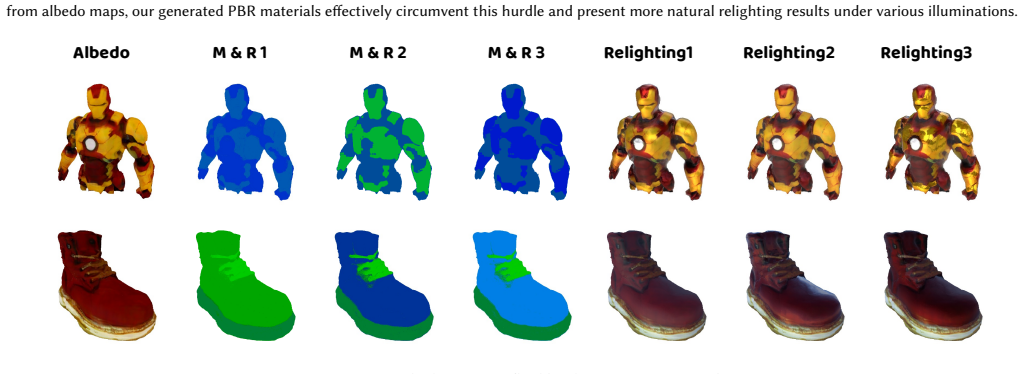
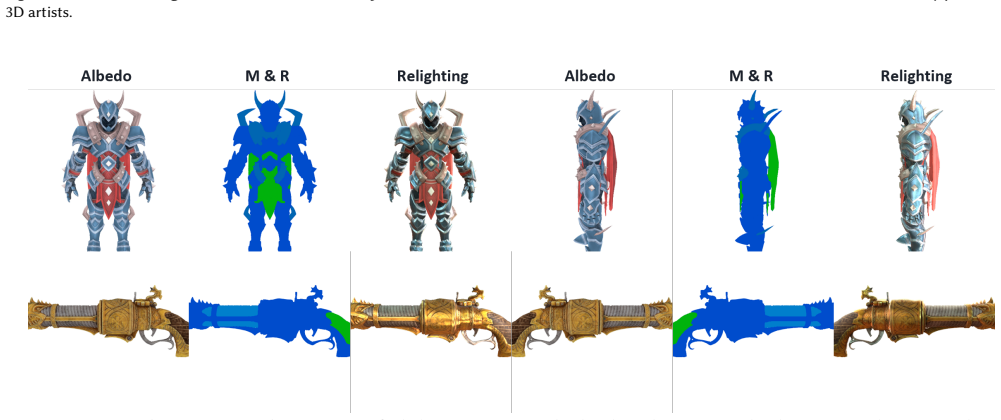
The paper's central claim is that a plug-and-play pipeline can upgrade any single-image-to-3D generator by replacing RGB-only textures with complete PBR material maps and by refining the mesh normals. The key procedural move is to estimate an albedo map from the input RGB image first and then feed that albedo into the base generator, yielding multi-view albedo maps that fuse into a consistent albedo UV. Roughness and metalness are assigned per semantic part using a 3D mask from SAM and value recommendations from a vision-language model, with manual adjustment left open. Geometry is improved by iteratively optimizing a bump map: for each view, the bumped normals and the albedo are fed into a fine-tuned image-to-normal diffusion model, whose output serves as pseudo-ground truth in an MSE loss. The paper reports that this boosts CRM, Wonder3D, TripoSR, InstantMesh, DreamCraft3D, and Era3D, yielding natural relighting and substantially improved geometry.
Load-bearing premise
The refining stage assumes the fine-tuned image-to-normal diffusion model, fed only with albedo maps, provides trustworthy pseudo-ground-truth normals; on monochromatic objects the albedo is a flat color block with no geometric information, and the paper concedes the prediction fails there.
Editorial extensions
If this is right
- Any existing reconstruction-based or optimization-based image-to-3D generator can be upgraded without retraining by running this post-processor on its output.
- Generated assets become relightable: albedo, roughness, metalness, and bump maps support rendering under novel illuminations instead of baked RGB lighting.
- Geometry and texture become better aligned because the bump-map optimization recovers high-frequency surface detail that the base mesh missed.
- Material editing becomes possible at the semantic-part level, since metalness and roughness values are tied to a 3D semantic mask and can be adjusted interactively.
Reading between the lines
- One implication the authors do not develop: because the pipeline feeds albedo rather than raw RGB into the multi-view generator, it may also improve multi-view consistency for base models beyond the tested ones, since lighting and highlights are removed before novel-view synthesis; this is a testable extension rather than a paper claim.
- The method's own limitation suggests a boundary: on monochromatic or textureless objects the albedo-to-normal link carries no information, so the normal-refinement stage should be expected to underperform there, and a natural fix would be conditioning the diffusion model on shading cues or on the original RGB-based normal estimates.
- The semi-automatic metalness and roughness stage could be fully automated by prompting the vision-language model with per-part albedo crops, which would remove the SAM interaction and speed up the pipeline.
- The same post-processing recipe should apply to text-to-3D generators that output textured meshes, since the inputs to the pipeline are a mesh and an albedo UV rather than the original conditioning image.
Editorial analysis
A structured set of objections, weighed in public.
Referee Report
Summary. The paper proposes a plug-and-play post-processing pipeline for single-image-to-3D generation that adds PBR materials and refines normals. Albedo maps are predicted by a Stable Diffusion model fine-tuned on HyperSim and Objaverse; roughness and metalness maps are produced semi-automatically using SAM-based 3D semantic masks and VLM recommendations with optional manual adjustment; bump maps are optimized iteratively against target normals generated by the authors' own image-to-normal diffusion model. The method is applied on top of CRM, Wonder3D, TripoSR, InstantMesh, and DreamCraft3D, with qualitative comparisons, a user study, and ablations.
Significance. If the claims are fully validated, this is a useful contribution: it provides a drop-in relighting and material layer for several existing image-to-3D methods and demonstrates a practical way to use diffusion priors for intrinsic decomposition. The paper's strengths include the plug-and-play design across four reconstruction-based methods plus DreamCraft3D, the fine-tuned albedo and normal diffusion models, and the consideration of a realistic artist-in-the-loop workflow for roughness and metalness. However, the central claim of substantially improved geometry rests on circular validation: the refinement targets are produced by the authors' own normal-diffusion model, and no independent ground-truth geometry is used. The user study also lacks statistical support. With additional external evaluation, the contribution would be solid; as presented, the evidence is suggestive rather than conclusive.
major comments (3)
- [Section 4.3, Eqs. (5)-(6) and Section 5.2] The claim of substantially improved geometry is validated circularly. The target normal maps n_tgt are generated by the authors' own fine-tuned image-to-normal diffusion model conditioned on albedo maps, and the MSE loss in Eq. (6) optimizes the bump map to match these targets. Visual comparisons and the user study only compare against the base methods' normals; they cannot distinguish recovering true surface geometry from imposing diffusion-plausible normal detail. The paper's own Section 6.2 concedes that the albedo-to-normal prediction is not wholly logical for monochromatic objects. To support the geometry claim, add quantitative evaluation on held-out meshes with known ground truth (e.g., Objaverse/Objaverse-XL) using metrics such as Chamfer distance, normal angular error, and F-score, and show that the refinement improves fidelity to the actual surface rather than only agreement with the diffusion prior.
- [Section 5.4, Table 1] The user study reports preference ratios but no significance tests, confidence intervals, or inter-rater agreement. The text says 60 participants and 80 pairwise comparisons were collected, but it does not state whether participants were blind to method identity, how the 20 objects were selected, or whether the same participants rated all base models. Without statistical support, the overall 83.51% preference for the boosting method cannot be taken as strong evidence. Add per-method and overall significance tests (e.g., binomial tests), report confidence intervals, and ideally separate perceptual ratings for geometric fidelity versus material/relighting quality.
- [Sections 5.2-5.3 and 5.1.1] Albedo and normal estimation are evaluated only qualitatively, even though the fine-tuning data (HyperSim and Objaverse) contain ground-truth albedo and normal maps. No quantitative intrinsic-image metrics such as PSNR, SSIM, or angular error are reported, and the comparisons to Sang and Chandraker, Wang et al. 2023c, Fantasia3D, and RichDreamer are visual only. Add quantitative comparisons on a held-out subset and include an ablation of the initial timestep t0 in Eq. (5), since t0 is a free parameter that directly controls how much the diffusion prior influences the refinement target.
minor comments (6)
- [Section 4.3, Eq. (4)] The symbol ⊕ for the 'special operation for normal integration' is never defined. Please specify how the bump normal is composed with the base normal and how the hash-grid positional encoding is normalized across different mesh scales.
- [Section 4.3, Eq. (5)] The initial timestep t0 is introduced but no ablation or selection criterion is provided, and the distribution of the added noise ε is not specified. Clarify the schedule and justify the chosen value.
- [Section 4.2] The 6 orthographic views for SAM projection and the voting strategy for the 3D semantic mask are described only briefly. Please provide details on view selection, alignment between views, and how inconsistencies in overlapping regions are resolved.
- [Section 5.5] The usability study reports 'general agreement' among two artists and eight non-experts without giving the questionnaire items or response scales. Include the actual questions and a summary of responses per participant or group.
- [Sections 1, 2, and 6.1] There are minor typographical and capitalization issues, e.g., 'we empirically found this leads' in Section 1 and 'we aim to boost all of them' in Section 2. More substantively, the conclusion in Section 6.1 should be tempered to reflect the limitations acknowledged in Section 6.2, especially the monochromatic-object failure mode.
- [Section 5.7] The text refers to 'Figure 3 and Figure 4 of the supplementary material,' but the arXiv version does not include the supplementary material. Either include it or describe those results directly in the main text.
Circularity Check
Normal-refinement 'geometry boosting' reduces to matching the authors' own image-to-normal diffusion model output; no independent geometry validation.
-
fitted input called prediction
[Section 4.3, Equations (5) and (6)]
"we leverage our fine-tuned image-to-normal diffusion model to derive the target normal maps n_tgt from the albedo maps with fine details. ... Regarding the target normal map n_tgt as the pseudo-ground truth, we optimize the bump map n_b(θ) via a pixel-wise MSE loss: L_MSE =∥n_f(θ)− n_tgt∥2_2"
The refined normal n_f(θ) is optimized by minimizing the distance to n_tgt, and n_tgt is the output of the same fine-tuned image-to-normal diffusion model the authors trained (Eq. 5). By construction, the 'boosted' normal map is therefore a bump-map-compatible projection of that model's own prediction; the claim that geometry is substantially improved is validated only against the model that generated the target. The paper's Section 6.2 concession that albedo-to-normal prediction fails for monochromatic objects confirms that the self-generated target can be geometrically meaningless, and the refinement then inherits that failure. No independent ground-truth geometry is used to support the general 'substantially improved geometry' claim.
full rationale
The PBR-material part of the paper is not circular: the image-to-albedo model is fine-tuned on HyperSim/Objaverse ground truth, the roughness/metalness values come from VLMs or manual adjustment, and relighting demonstrations provide external visual evidence. The circularity is concentrated in the normal-boosting pillar: Equation (6) fits the bump map to n_tgt produced by the authors' own image-to-normal diffusion model in Equation (5), so the refined normals are, by construction, an approximation of that model's output. The paper explicitly calls n_tgt a pseudo-ground-truth and even concedes in Section 6.2 that the albedo-to-normal route is 'not wholly logical' for monochromatic objects, which shows the target itself can be non-geometric. Because no external ground-truth geometry is used to evaluate the 'substantially improved geometry' part of the central claim, that sub-claim reduces to self-consistency with the authors' own model rather than independent verification. This is a partial circularity: one of the two central pillars is self-referential, while the material-generation contribution retains independent content.
Assumptions & free parameters
free parameters (2)
- initial timestep t0 =
not reported
- number of orthographic views for SAM projection =
6
assumptions (5)
- domain assumption Albedo maps are clean images without much noise and can serve as input to multi-view 3D generation without losing geometric information.
- domain assumption Surface areas with similar semantic characteristics tend to have consistent PBR material values.
- domain assumption A vision-language model (Gemini) can recommend plausible metalness and roughness values for segmented object parts.
- ad hoc to paper The fine-tuned image-to-normal diffusion model produces reliable target normals from albedo maps.
- domain assumption Stable Diffusion fine-tuning on synthetic data (HyperSim, Objaverse) transfers to in-the-wild object images.
Cite this review
Pith. "Pith review of Boosting 3D Object Generation through PBR Materials." pith.science (2026). https://pith.science/paper/RDGLO6OK
@misc{pith2026241116080,
  author       = {Pith},
  title        = {Pith review of: Boosting 3D Object Generation through PBR Materials},
  year         = {2026},
  howpublished = {\url{https://pith.science/paper/RDGLO6OK}},
  note         = {Machine review of arXiv:2411.16080}
}
read the original abstract
Automatic 3D content creation has gained increasing attention recently, due to its potential in various applications such as video games, film industry, and AR/VR. Recent advancements in diffusion models and multimodal models have notably improved the quality and efficiency of 3D object generation given a single RGB image. However, 3D objects generated even by state-of-the-art methods are still unsatisfactory compared to human-created assets. Considering only textures instead of materials makes these methods encounter challenges in photo-realistic rendering, relighting, and flexible appearance editing. And they also suffer from severe misalignment between geometry and high-frequency texture details. In this work, we propose a novel approach to boost the quality of generated 3D objects from the perspective of Physics-Based Rendering (PBR) materials. By analyzing the components of PBR materials, we choose to consider albedo, roughness, metalness, and bump maps. For albedo and bump maps, we leverage Stable Diffusion fine-tuned on synthetic data to extract these values, with novel usages of these fine-tuned models to obtain 3D consistent albedo UV and bump UV for generated objects. In terms of roughness and metalness maps, we adopt a semi-automatic process to provide room for interactive adjustment, which we believe is more practical. Extensive experiments demonstrate that our model is generally beneficial for various state-of-the-art generation methods, significantly boosting the quality and realism of their generated 3D objects, with natural relighting effects and substantially improved geometry.
Figures


Figures from the paper (9 more)




Reference graph
Works this paper leans on
-
[3]
Consistent123: One Image to Highly Consistent 3D Asset Using Case-Aware Diffusion Priors. In ACM Multimedia 2024 . https://openreview.net/forum?id= dAAy8no18G Haotian Liu, Chunyuan Li, Qingyang Wu, and Yong Jae Lee. 2023c. Visual Instruction Tuning. InThirty-seventh Conference on Neural Information Processing Systems. https: //openreview.net/forum?id=w0H2...
arXiv 2023
-
[4]
arXiv preprint arXiv:2312.11805 (2023)
Gemini: a family of highly capable multimodal models. arXiv preprint arXiv:2312.11805 (2023). Dmitry Tochilkin, David Pankratz, Zexiang Liu, Zixuan Huang, Adam Letts, Yangguang Li, Ding Liang, Christian Laforte, Varun Jampani, and Yan-Pei Cao. 2024. Triposr: Fast 3d object reconstruction from a single image. arXiv preprint arXiv:2403.02151 (2024). Shimon ...
arXiv 2023
-
[2023]
In Proceedings of the IEEE/CVF International Conference on Computer Vision
Segment anything. In Proceedings of the IEEE/CVF International Conference on Computer Vision. 4015–4026. Peter Kocsis, Julien Philip, Kalyan Sunkavalli, Matthias Nießner, and Yannick Hold- Geoffroy. 2024a. LightIt: Illumination Modeling and Control for Diffusion Models. In CVPR. Peter Kocsis, Vincent Sitzmann, and Matthias Nießner. 2024b. Intrinsic Image ...
arXiv 2024
-
[2024]
In Proceedings of the IEEE/CVF Conference on Computer Vision and Pattern Recognition
Luciddreamer: Towards high-fidelity text-to-3d generation via interval score matching. In Proceedings of the IEEE/CVF Conference on Computer Vision and Pattern Recognition. 6517–6526. Yukang Lin, Haonan Han, Chaoqun Gong, Zunnan Xu, Yachao Zhang, and Xiu Li
Reviewed August 12, 2026 · model on record in the stance chip above.
Discussion (0). Continue with ORCID to comment.