REVIEW 3 major objections 5 minor 12 references
Improved Leakage Currents and Polarity Control through Oxygen Incorporation in Ferroelectric Al0.73Sc0.27N Thin Films
T0 review · 3 major / 5 minor · reviewed 2026-08-12 · deepseek-v4-flash
Pith's one-line read Oxygen doping of ferroelectric Al0.73Sc0.27N cuts leakage by up to an order of magnitude and flips as-grown polarity.
desk verdict Useful incremental AlScN study: systematic O-doping lowers leakage and flips as-grown polarity, but the bulk-substitution mechanism and the headline numbers need tougher evidence before I'd trust them quantitatively. read the letter →
The pith
A machine-rendered reading of the paper's core claim, the machinery that carries it, and where it could break.
The reading
What carries the argument
The load-bearing mechanism is substitutional oxygen on nitrogen sites (O_N) in the wurtzite lattice. Oxygen replaces nitrogen first in scandium-coordinated tetrahedra (favored by bond-energy arguments) and, at higher concentrations, in aluminum tetrahedra, forming deep-level DX-center-like traps that capture electrons and reduce leakage; the accompanying local lattice distortion and change in film stress are proposed to drive the N-polar to M-polar inversion above Nmix ≈ 8–10 sccm.
What would settle it
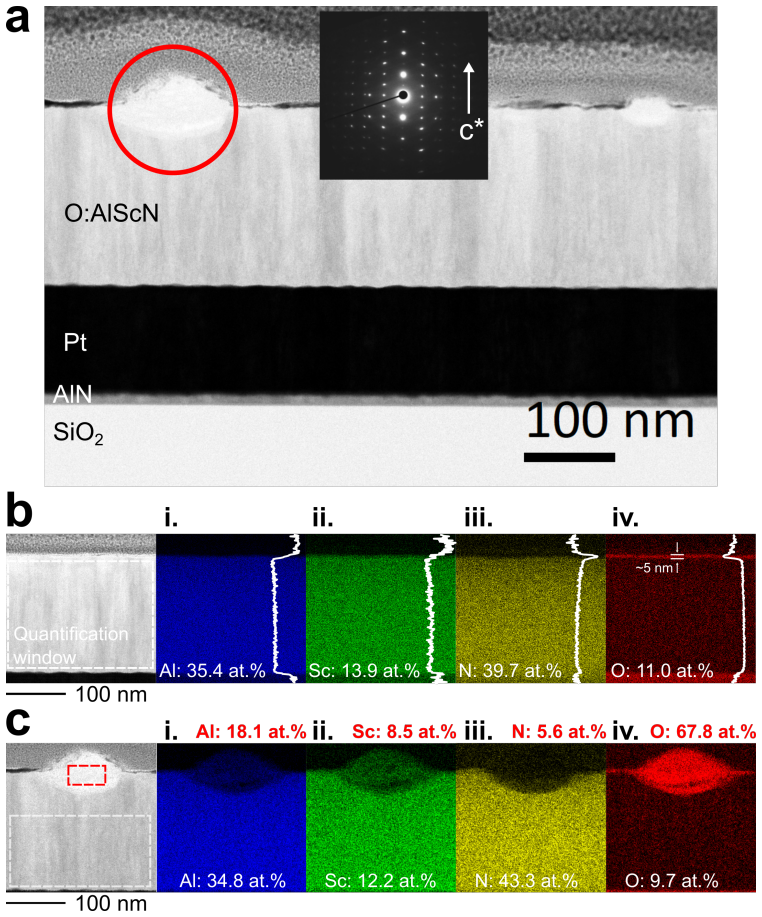
A decisive check would be atom-column-resolved STEM-EELS across grain boundaries in the Nmix = 15 film: if most of the oxygen signal is confined to grain boundaries, surface protrusions, or the interface rather than the bulk lattice, the proposed O_N substitution and DX-center mechanism would not be the operative cause of the leakage drop.
Extended reading notes
Core claim
The central discovery is that intentional oxygen incorporation, achieved by mixing a N2 with 2% O2 gas source into the reactive sputter gas, is a viable doping route for w-Al0.73Sc0.27N: it cuts switching-related leakage near the coercive field by almost fourfold and steady-state leakage at low fields by about one order of magnitude, and it reverses the as-grown film polarity from N-polar to M-polar as the Nmix flow rises from 8 to 15 sccm. XRD and STEM show the 0002 rocking-curve width increases by only about 20% at the highest doping, with no chemical segregation or Al2O3 interface layer, so the leakage and polarity improvements are not bought at the price of destroying the wurtzite texture. The authors attribute the initial leakage drop to filling of nitrogen vacancies by oxygen and the formation of deep DX-center-like acceptor states, and the later polarity reversal to lattice strain and changes in local bonding that destabilize the N-polar growth mode.
Load-bearing premise
The paper's claims assume that the oxygen counted by SEM-EDS and ToF-SIMS is electrically active oxygen sitting on nitrogen sites inside the wurtzite lattice, and that the Nmix gas-flow setting reliably tracks that bulk doping level.
Editorial extensions
If this is right
- O-doped Al0.73Sc0.27N capacitors can be switched with a smaller leakage tail, which directly improves the margin for reading and writing ferroelectric memory cells.
- Setting the oxygen flow during sputtering selects the as-deposited polarity, so devices could be built with the preferred initial polarization orientation without a post-growth poling step.
- Because bulk crystallinity and c-axis texture are largely preserved, the doping route is compatible with existing sputter-based fabrication flows.
- The same gas-phase doping approach may reduce leakage in other wurtzite ferroelectrics such as Al1-xBxN and Al1-xYxN, which the paper argues share the relevant structural features.
Reading between the lines
- Editorial inference: if the leakage reduction really comes from O_N deep traps, then combining oxygen doping with other intentional dopants could allow independent tuning of leakage and polarity, a combination not explored in this paper.
- Editorial inference: because the O quantification is qualitative, a quantitative calibration (for instance Rutherford backscattering) would be needed before the Nmix values could be transferred to another deposition tool.
- Editorial inference: the polarity reversal near Nmix = 8–10 sccm is reported for as-deposited films; whether the mixed-polar domain state at the boundary is stable under cycling is not tested, so a natural follow-up is an endurance measurement on Nmix = 8 and 10 films.
Editorial analysis
A structured set of objections, weighed in public.
Referee Report
Summary. The manuscript reports a systematic study of oxygen incorporation during reactive sputtering of ferroelectric Al0.73Sc0.27N thin films, achieved by mixing a N2/O2 source into the nitrogen gas flow. The claims are that O-doped films show an almost fourfold leakage-current reduction near the coercive field, roughly an order-of-magnitude reduction of steady-state leakage at sub-coercive fields, a polarity transition from nitrogen-polar to metal-polar as-deposited films with increasing O content, and only minor structural degradation (a <20% increase in XRD rocking-curve width). These claims are supported by P-E and J-E hysteresis measurements, quasi-static leakage measurements, unipolar J-V polarity tests, PFM phase/amplitude mapping, HRXRD, SEM/STEM imaging, and STEM-EDS elemental mapping. The authors attribute the leakage improvement to O filling N vacancies and forming deep-level DX centers, and attribute the polarity flip to O-driven destabilization of the N-polar growth mode.
Significance. If the claims hold, the paper provides a practically relevant and seemingly simple gas-phase doping route to reduce leakage and engineer the as-deposited polarity of ferroelectric AlScN, which is a key obstacle for memory and MEMS applications. The strengths of the paper include direct electrical measurements of leakage and switching behavior, independent PFM confirmation of the polarity transition, multi-technique structural characterization, and an unusually candid discussion of the quantitative limitations of the O-content measurements. The central weakness is that the bulk-substitutional mechanism is not uniquely established: the electrical changes occur at the same doping range in which pronounced surface protrusions and a native oxide appear, and the O quantification is explicitly qualitative. The significance is therefore conditional on separating bulk from surface/interface contributions.
major comments (3)
- [Results and discussion: Determination of O-content; Effects of O-doping on the surface and bulk microstructure] The manuscript attributes the leakage reduction and polarity flip to oxygen incorporated on nitrogen sites in the bulk wurtzite lattice, but the data do not exclude an alternative explanation in which the electrical changes are caused or strongly modified by the O-rich surface protrusions, the ~5 nm native oxide, or interfacial layers. The surface protrusions first appear at Nmix = 8 sccm and cover the surface by Nmix = 12 sccm (Figure 3e-h), which is exactly the doping range where the mixed-polarity state and the second-stage leakage drop are observed (Figures 5 and 6). The authors themselves note that SEM-EDS carries a ~1.2 at% O background from buried SiO2, that ToF-SIMS is only relative, and that FIB and surface oxidation can inflate the bulk O signal. Without atomic-scale evidence such as EELS or atom-probe tomography showing O on nitrogen sites in grain interiors, the central claim that gas-phase O doping of the bulk reduces leakage and sets polarity is not uniquely demonstrated. I recommend adding a control experiment (e.g., a film with the surface protrusions removed or an interface-engineered stack) or direct site-specific chemical analysis to separate bulk from surface/interface effects.
- [Figure 5 and accompanying text] The headline claim of 'almost a fourfold reduction of the leakage current near the coercive field' is not supported by a single quantitative measurement: the text states a 'four-fold drop (2x at the positive side and 2x at the negative side)', which is a product of two separate branchwise factors rather than a directly observed fourfold ratio in the same device or polarity state. In addition, Figure 5c-d reports leakage current densities without error bars, device-to-device statistics, or a statement of how many capacitors were measured per composition; the experimental section mentions 100 averages but not the number of devices. The authors should report the extracted leakage values for each polarity branch, with uncertainties and sample counts, and revise the abstract/conclusion wording if the fourfold factor is a combined metric.
- [Results and discussion: As-deposited polarization reversal via O-doping] The polarity assignment in Figure 6 is based on unipolar J-V responses from two pristine pads per composition, and PFM phase maps are shown for only three of the eight compositions (Nmix = 0, 8, 15 sccm). Given the substantial surface roughness and protrusions at Nmix ≥ 12 sccm, which the authors acknowledge can affect PFM contrast and electrode contact, the conclusion that the films are 'entirely M-polar' at Nmix = 12 and 15 sccm would be strengthened by additional pads per sample, a statistical measure of the switching-peak asymmetry, and PFM data for the 12 sccm sample. As written, the evidence supports a qualitative polarity trend but not the quantitative strength of the claim.
minor comments (5)
- [Abstract and Introduction] The phrase 'changing from nitrogen- to metal-polar orientation' is clear, but the abstract does not mention the mixed-polarity intermediate region reported in the main text; consider adding a qualifier such as 'via intermediate mixed-polar states' for consistency.
- [Figure 2] The error bars in Figure 2b for the in-plane a lattice parameter are large and asymmetric, but this is not explained in the caption; the text mentions the larger error only in passing. Please add the uncertainty source to the caption.
- [Results and discussion: Effects of O-doping on the surface and bulk microstructure] The statement 'It can be assumed that O atoms are likely to replace an N atom (ON) in a Sc-coordinated tetrahedra first' would be better phrased as a hypothesis, because the authors later note that calculations for Sc-tetrahedra distortions are missing; the current wording overstates the structural evidence.
- [Experimental section] The sentence 'The use of this separate sample set on sapphire was necessary to conduct as the sample has to be transparent for transmission measurements' contains a grammatical error ('to conduct as'); it should read 'was necessary because the sample has to be transparent'.
- [Figure 6] The PFM sub-figures are labeled (i), (ii), (iii) within each panel but the caption refers to 'sub-figures i-l', which is inconsistent with the figure layout showing (a-h) electrical data and (i-k) PFM data; please align the labels.
Circularity Check
No circularity: leakage and polarity results are direct measurements, and the interpretive mechanisms are not load-bearing.
full rationale
The paper's headline claims — a roughly fourfold reduction in leakage current near the coercive field, about an order-of-magnitude reduction in steady-state sub-coercive leakage, and a transition from N-polar to M-polar as-deposited films with increasing oxygen flow — are all direct measurements of J-E, P-E, unipolar J-V, and PFM phase on a series of films grown with different Nmix settings. No parameter is fitted to the electrical data to produce these results, and no equation in the paper defines the output in terms of the input. The oxygen doping level is an independently set process variable (Nmix = 0–15 sccm), corroborated by monotonic SEM-EDS and ToF-SIMS trends; the authors explicitly label the absolute O quantification as qualitative, but that affects interpretation rather than making the result circular. The DFT/DX-center discussion (refs 31–32) is used only as a post-hoc speculative mechanism for the observed leakage improvement, and it is not needed to establish the measured leakage reduction or the polarity flip. Self-citations (e.g., refs 7, 16, 17, 20, 22, 25) support background statements about AlScN growth, microstructure, and typical leakage behavior, but the present conclusions do not reduce to those citations; the electrical and PFM data are independently reported here. The competing surface-oxide/protrusion explanation raised in the skeptical summary is a causal-interpretation risk and a validity concern, but it does not constitute a circular derivation, because the correlation between Nmix and electrical response is empirical rather than constructed. No circular step can be exhibited from the paper's own equations or definitions.
Assumptions & free parameters
assumptions (4)
- domain assumption Oxygen atoms substitute on nitrogen sites (ON) in the wurtzite lattice and act as deep-level traps.
- domain assumption As-grown polarity can be read reliably from unipolar J-V switching peaks and PFM phase contrast.
- domain assumption SEM-EDS and ToF-SIMS O intensities are monotonic proxies for bulk O content.
- domain assumption Bandgap trends from sapphire-grown epitaxial samples transfer to Pt/Si device samples.
Cite this review
Pith. "Pith review of Improved Leakage Currents and Polarity Control through Oxygen Incorporation in Ferroelectric Al0.73Sc0.27N Thin Films." pith.science (2026). https://pith.science/paper/5LXW65G6
@misc{pith2026241117360,
  author       = {Pith},
  title        = {Pith review of: Improved Leakage Currents and Polarity Control through Oxygen Incorporation in Ferroelectric Al0.73Sc0.27N Thin Films},
  year         = {2026},
  howpublished = {\url{https://pith.science/paper/5LXW65G6}},
  note         = {Machine review of arXiv:2411.17360}
}
read the original abstract
This article examines systematic oxygen (O)-incorporation to reduce total leakage currents in sputtered wurtzite-type ferroelectric Al0.73Sc0.27N thin films, along with its impact on the material structure and the polarity of the as-grown films. The O in the bulk Al0.73Sc0.27N was introduced through an external gas source during the reactive sputter process. In comparison to samples without doping, O-doped films showed almost a fourfold reduction of the leakage current near the coercive field. In addition, doping resulted in the reduction of the steady-state leakage currents by roughly one order of magnitude sub-coercive fields. Microstructure analysis using X-ray diffraction 1and scanning transmission electron microscopy (STEM) revealed no significant structural degradation of the bulk Al0.73Sc0.27N. In case of the maximum O-doped film, the c-axis out-of-plane texture increased by only 20% from 1.8{\deg} and chemical mapping revealed a uniform distribution of oxygen incorporation into the bulk. Our results further demonstrate the ability to control the as-deposited polarity of Al0.73Sc0.27N via the O-concentration, changing from nitrogen- to metal-polar orientation. Thus, this article presents a promising approach to mitigate the leakage current in wurtzite-type Al0.73Sc0.27N without incurring any significant structural degradation of the bulk thin film quality, thereby making ferroelectric nitrides more suitable for microelectronic applications.
Figures


Figures from the paper (3 more)


Reference graph
Works this paper leans on
-
[3]
(8) Wang, P.; Wang, D.; Mondal, S.; Hu, M.; Wu, Y.; Ma, T.; Mi, Z. Ferroelectric nitride heterostructures on CMOS compatible molybdenum for synaptic memristors.ACS Ap- plied Materials & Interfaces2023, 15, 18022–18031. (9) Drury, D.; Yazawa, K.; Zakutayev, A.; Hanrahan, B.; Brennecka, G. High-temperature ferroelectric behavior of Al0. 7Sc0. 3N.Micromachin...
work page 2022
-
[10]
V.; Grotjohn, T.; Hardy, A.; Muehle, M.; Wilson, R
(38) Guzman, E.; Kargar, F.; Angeles, F.; Meidanshahi, R. V.; Grotjohn, T.; Hardy, A.; Muehle, M.; Wilson, R. B.; Goodnick, S. M.; Balandin, A. A. Effects of boron doping on the bulk and surface acoustic phonons in single-crystal diamond.ACS Applied Materials & Interfaces 2022, 14, 42223–42231. 26 (39) Anggraini, S. A.; Uehara, M.; Hirata, K.; Yamada, H.;...
work page 2022
-
[93]
(45) Chen, Z.; Jaramillo, T. F. The Use of UV-Visible Spectroscopy to Measure the Band Gap of a Semiconductor.2017, (46) Vachhani, P. S.; Bhatnagar, A. K. Oxygen pressure-dependent band gap in Cu-doped and -undoped ZnO films.Physica Scripta 2013,
work page 2017
-
[95]
(25) Schönweger, G.; Islam, M. R.; Fichtner, S. Structural and ferroelectric properties of Al1- xScxN. 2023, (26) Geng, W.; Chen, X.; Pan, L.; Qiao, X.; He, J.; Mu, J.; Hou, X.; Chou, X. Improved crystallization, domain, and ferroelectricity by controlling lead/oxygen vacancies in Mn-doped PZT thin films.Materials Characterization 2021, 176, 111131. (27) ...
work page 2023
-
[104]
(41) Schaffer, M.; Schaffer, B.; Ramasse, Q. Sample preparation for atomic-resolution STEM at low voltages by FIB.Ultramicroscopy 2012, 114, 62–71. (42) Van de Walle, C. G.; Neugebauer, J.; Stampfl, C.; McCluskey, M.; Johnson, N. Defects and defect reactions in semiconductor nitrides. Acta Physica Polonica A 1999, 96, 613–627. (43) Sebastian, M. T.; Silva...
work page 2012
-
[116]
R.; Gremmel, M.; Petraru, A.; Kienle, L.; Kohlst- edt, H.; Fichtner, S
24 (22) Schönweger, G.; Wolff, N.; Islam, M. R.; Gremmel, M.; Petraru, A.; Kienle, L.; Kohlst- edt, H.; Fichtner, S. In-grain ferroelectric switching in sub-5 nm thin Al0. 74Sc0. 26N films at 1 V.Advanced Science2023, 10, 2302296. (23) Akiyama, M.; Kamohara, T.; Kano, K.; Teshigahara, A.; Takeuchi, Y.; Kawahara, N. Enhancement of piezoelectric response in...
work page 2009
-
[118]
(4) Kim, K.-H.; Oh, S.; Fiagbenu, M. M. A.; Zheng, J.; Musavigharavi, P.; Kumar, P.; Trainor, N.; Aljarb, A.; Wan, Y.; Kim, H. M.; others Scalable CMOS back-end-of-line- compatible AlScN/two-dimensional channel ferroelectric field-effect transistors.Nature nanotechnology 2023, 18, 1044–1050. (5) Mikolajick, T.; Slesazeck, S.; Mulaosmanovic, H.; Park, M.; ...
work page 2023
-
[119]
(15) Wang, D.; Mondal, S.; Liu, J.; Hu, M.; Wang, P.; Yang, S.; Wang, D.; Xiao, Y.; Wu, Y.; Ma, T.; others Ferroelectric YAlN grown by molecular beam epitaxy.Applied Physics Letters 2023,
work page 2023
Show all 12 references
-
[123]
R.; Schoönweger, G.; Wolff, N.; Petraru, A.; Kohlstedt, H.; Fichtner, S.; Kienle, L
(16) Islam, M. R.; Schoönweger, G.; Wolff, N.; Petraru, A.; Kohlstedt, H.; Fichtner, S.; Kienle, L. A Comparative Study of Pt/Al0. 72Sc0. 28N/Pt-Based Thin-Film Metal- Ferroelectric-Metal Capacitors on GaN and Si Substrates.ACS Applied Materials & Interfaces 2023, 15, 41606–41...
2023
-
[125]
(3) Wang, P.; Wang, D.; Vu, N
(2) Leone, S.; Ligl, J.; Manz, C.; Kirste, L.; Fuchs, T.; Menner, H.; Prescher, M.; Wiegert, J.; Žukauskait˙ e, A.; Quay, R.; others Metal-organic chemical vapor deposi- tion of aluminum scandium nitride.physica status solidi (RRL)–Rapid Research Letters 2020, 14, 1900535. (3)...
2020
-
[135]
Y.; Kakushima, K
(28) Chen, S.-M.; Nishida, H.; Tsai, S.-L.; Hoshii, T.; Tsutsui, K.; Wakabayashi, H.; Chang, E. Y.; Kakushima, K. Oxygen-atom Incorporated Ferroelectric AIScN Capaci- tors for Multi-level Operation.IEEE Electron Device Letters2024, (29) Zhu, X.; Liu, K.; Lu, Z.; Xu, Y.; Qi, S....
2020
-
[3204]
U.; Brennecka, G
(31) Lee, C.-W.; Din, N. U.; Brennecka, G. L.; Gorai, P. Defects and oxygen impurities in ferroelectric wurtzite Al1-xScxN alloys.Applied Physics Letters2024, 125, 022901. (32) Gordon, L.; Lyons, J.; Janotti, A.; Van de Walle, C. Hybrid functional calculations of DX centers in...
2008
Reviewed August 12, 2026 · model on record in the stance chip above.
Discussion (0). Continue with ORCID to comment.