REVIEW 4 major objections 5 minor 30 references
Learning New Concepts, Remembering the Old: Continual Learning for Multimodal Concept Bottleneck Models
T0 review · 4 major / 5 minor · reviewed 2026-08-12 · deepseek-v4-flash
Pith's one-line read A Concept Bottleneck Model whose concept and classifier layers are updated by recursive ridge regression can learn new concepts and classes without forgetting old ones, because each update provably matches the solution trained on all data…
desk verdict A useful new task definition wrapped around an overclaimed memory guarantee: the recursive least-squares update can't deliver 'absolute knowledge memory' because the classifier's input features change across phases. read the letter →
The pith
A machine-rendered reading of the paper's core claim, the machinery that carries it, and where it could break.
The reading
What carries the argument
The carrying object is the recursive regularized least-squares update. For the concept layer, with expanded features $Z_t^*$ and cumulative concepts $C_{\le t}$, the paper maintains $R_c^{(t)} = (\sum_{i=0}^t Z_i^{*\top} Z_i^* + \lambda_1 I)^{-1}$ and updates it by $R_c^{(t)} = R_c^{(t-1)} - R_c^{(t-1)} Z_t^{*\top}(I + Z_t^* R_c^{(t-1)} Z_t^{*\top})^{-1} Z_t^* R_c^{(t-1)}$; the weight update $W_c^{(t)}$ then concatenates a correction for old concepts with a newly fitted block for new concepts. The classifier layer runs the identical mechanism on the expanded predicted concepts $\hat{C}_t^*$ with its own matrix $R_y^{(t)}$. Two random, fixed feature-expansion maps $\sigma(z W_{fe})$ and $\sigma(\hat{c} W'_{fe})$, 25,000 dimensions in the experiments, give the linear layers enough capacity. This machinery matters because it replaces gradient-based fine-tuning with matrix multiplications and small inversions whose cost depends on feature dimension rather than accumulated data size.
What would settle it
Run CONCIL on a small CBM and, after the final phase, solve the exact ridge-regression weights on the full accumulated dataset in one batch; compare the classifier weights and old-task predictions. Any mismatch, or any drop in old-task class accuracy when the concept layer is updated, shows the claimed equivalence to centralized training does not hold exactly.
Extended reading notes
Core claim
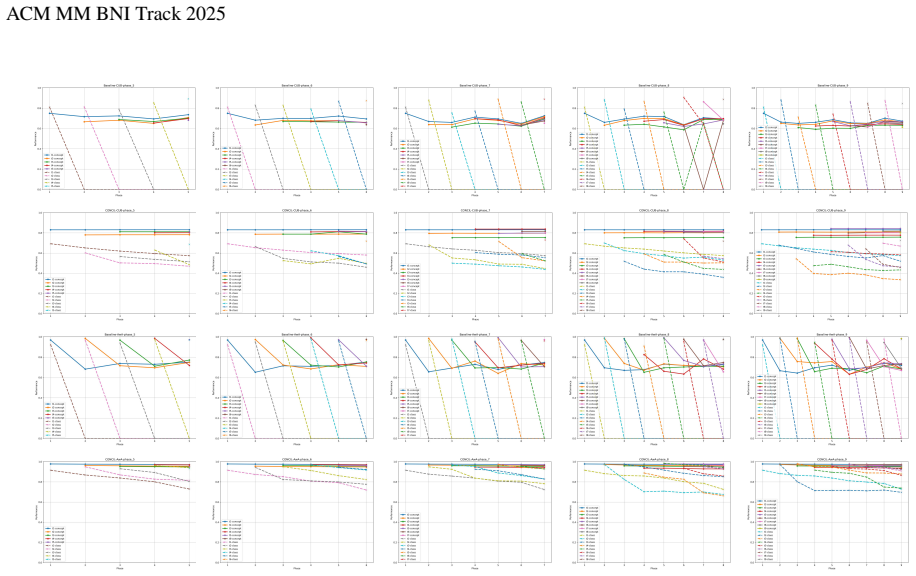
The central claim is that the hard part of continual learning for CBMs can be moved out of optimization and into linear algebra. After the backbone is frozen, the concept layer is a ridge regression from expanded visual features $z^*$ to an ever-growing concept set, and the classifier is a ridge regression from expanded predicted concepts $\hat{c}^*$ to an ever-growing class set. Both have closed-form solutions whose sufficient statistics are the regularized inverse correlation matrices $R_c^{(t)}$ and $R_y^{(t)}$; the Sherman-Morrison-Woodbury formula turns the cumulative solutions into recursive updates that use only the current phase's data and the previous matrices. On its own terms, the paper proves that these recursive updates reproduce the batch solution, and its experiments show near-flat concept accuracy and class accuracy across up to nine phases on CUB and AwA, while the fine-tuned CBM baseline's class accuracy collapses from roughly 0.61 to 0.15 on CUB.
Load-bearing premise
The no-forgetting guarantee rests on the assumption that each analytic layer's input features stay fixed across all phases and that base weights already solve the same least-squares problem; the classifier input actually changes whenever the concept layer is updated, and base training is gradient-based rather than closed-form.
Editorial extensions
If this is right
- Each incremental phase becomes a single-pass matrix update, so adding a task costs no gradient steps and no replay buffer; the computation scales with feature dimensionality rather than total data size.
- Because only the inverse correlation matrices are carried forward and raw samples are discarded, the scheme is naturally compatible with privacy and storage constraints in continual multimodal deployments.
- If the no-forgetting guarantee holds, a CBM could be updated indefinitely on streams of new classes and attributes while its interpretability bottleneck remains intact, since the concept space itself keeps growing.
- On the paper's experiments the gap in class accuracy between CONCIL and the baseline widens with each phase, so the method is most valuable exactly when the number of incremental tasks is large.
- The same recursive scheme could be applied to any CBM variant with a concept bottleneck, including post-hoc or label-free CBMs, whenever concept annotations are available per phase.
Reading between the lines
- The paper's proof of absolute memory treats each analytic layer as if its input features were fixed. But updating $W_c^{(t)}$ recomputes the predicted concepts that feed the classifier, so old tasks' classifier features change after every concept update; a strict reading of the guarantee covers the concept layer fully and the classifier only to the extent the concept layer stops moving.
- A direct way to test that boundary is to freeze the concept layer after base training, update only the classifier, and compare old-task class accuracy; if forgetting remains nonzero, the remaining source is concept-layer drift rather than classifier update error.
- The random 25,000-dimensional feature expansions carry much of the representational load, so their width, activation, and initialization are likely decisive; the paper does not report how sensitive the results are to these choices.
- The authors' own limitation section notes that linear layers may miss nonlinear concept-class relations and that inverse-matrix overhead grows with the concept and class vocabulary, so the approach's ceiling is an empirical question for larger, more granular concept sets.
Editorial analysis
A structured set of objections, weighed in public.
Referee Report
Summary. The paper defines a new continual learning setting for Concept Bottleneck Models (CBMs), called Concept-Incremental and Class-Incremental Continual Learning (CICIL), in which both the concept vocabulary and the class set grow over time. The authors propose CONCIL, a framework that first trains a standard CBM by backpropagation on a base task and then updates the concept layer and classifier through recursive ridge-regression updates, using only current-task data and summary matrices. The central claim is that these recursive updates achieve 'absolute knowledge memory': the model behaves as though it had been trained on all data seen so far, thereby eliminating catastrophic forgetting. The paper reports experiments on CUB and AwA showing higher concept and class accuracy and lower forgetting than a naive fine-tuned CBM baseline. The claimed theoretical guarantee is the main contribution, but it is not established by the presented derivation.
Significance. If the 'absolute knowledge memory' guarantee were correct, the paper would make a useful contribution by providing a computationally efficient, privacy-preserving continual learning method for CBMs, with a new task formulation that reflects realistic dynamic multimodal settings. The recursive matrix updates are an appealing idea, and the paper correctly identifies a gap in the CBM literature. However, the central theoretical claim is invalid as stated: the classifier's input features depend on the continually updated concept layer, so the recursive updates are not equivalent to batch ridge regression over a fixed feature representation. The nonzero class forgetting reported in Table 1 also directly contradicts the 'eliminating catastrophic forgetting' claim. The task definition and empirical comparison to a naive baseline remain of interest, but the paper's headline contribution is not supported.
major comments (4)
- [§5.3, Eq. (5)] The objective in Eq. (4) is described as minimizing loss 'over the current task's data,' but Eq. (5) is the closed-form solution of a cumulative loss summed over all tasks i = 0..t. These two statements are inconsistent. The recursive updates in Sections 5.6 and 5.7 are derived from the cumulative objective, so the paper never actually solves the stated per-phase regression problem. The derivation of the claimed memory property therefore lacks a well-defined starting point and needs to be re-stated as an explicit cumulative-loss objective.
- [§5.7, Eq. (13)] The update for W_y(t) assumes that the classifier input features C*_i are fixed across phases. However, Eq. (6) defines C*_t = σ(C_hat_t W'_fe) with C_hat_t = Z*_t W_c(t), and W_c(t) is updated at every phase via Eq. (12). For i < t, the features used to build R_y(t-1) are computed with W_c(i), not with the current W_c(t). At test time, the model applies the final W_c(t) to all inputs, so the deployed feature representation differs from the one used to accumulate the summaries. Consequently, Eq. (13) is not equivalent to batch ridge regression over any common feature matrix, and the 'absolute knowledge memory' assertion in Section 5.8(i) is not supported for the classifier.
- [§5.2, §5.6] The recursive update formulas are exact only if the base weights W_c(0) and W_y(0) already minimize the corresponding ridge objectives (Eq. (4) and Eq. (8)) on the base data. The paper obtains these weights by backpropagation in Section 5.2 and provides no argument that they satisfy the normal equations. Without this condition, even the concept-layer recursion does not recover the cumulative ridge solution, so the claimed equivalence to centralized training fails at the first update.
- [Table 1, §6.5] The CONCIL class forget rates are 0.0919 on CUB and 0.1029 on AwA, which are non-negligible and directly contradict the statement in Section 5.8(i) that catastrophic forgetting is eliminated. The sentence in Section 6.5 that these results 'empirically validate our theoretical claim of absolute knowledge memory' is therefore an overinterpretation; at best the results show low forgetting relative to the naive baseline, not absolute retention.
minor comments (5)
- [§7, §10] Sections 7 and 10 are verbatim duplicates of the same 'Limitations and Future Work' text; one should be removed.
- [Eq. (7)] The phrase 'if the updated concepts set is an empty set' is unclear; the condition appears to concern the current concept-set dimension being smaller than L_max and should be rewritten.
- [§5.4] The notation L_max is used in Eq. (7) before it is defined; please define it at first use.
- [§6.2] The experimental section states that p ranges from 2 to 9, but Table 1 reports phases 2 through 9; it should be clarified whether all reported results correspond to p = 9 and how the phase-1 base training is incorporated into the metrics.
- [§6.5] The empirical comparison includes only a naive fine-tuned baseline; comparing against an exemplar-free continual learning method adapted to CBMs (e.g., EWC or LwF) would substantially strengthen the claim that CONCIL is a superior continual learning approach.
Circularity Check
No significant circularity: the memory guarantee is a self-contained algebraic identity of the recursive ridge updates; the classifier gap is an unsupported proof, not a circular fit.
full rationale
The paper's central 'absolute knowledge memory' claim is an algebraic consequence of the recursive least-squares construction, not a circular derivation from its own output. For the concept layer, Eq. 12 is the Sherman-Morrison-Woodbury factorization of Eq. 5, so given fixed expanded features Z* and a base weight that already solves Eq. 4, the recursion exactly reproduces the cumulative ridge solution; this is a mathematical identity, not an input fitted to a reported result. The concept-forgetting numbers in Table 1 therefore illustrate a by-construction property rather than independently test it, but no parameter is fitted to the reported accuracies, and no load-bearing conclusion is imported from the authors' own prior work. The classifier update in Eq. 13 is more problematic: Eq. 9's batch solution would require fixed classifier features, whereas Eq. 6 defines C*_t using phase-specific concept weights W_c^(t), which Eq. 12 changes; the accumulated summary therefore cannot equal the batch ridge solution over any single common representation. That is a failure of the proof's assumptions, not circularity: the claim is not reduced to its own conclusion, it is simply not established for the classifier. Likewise, starting from backpropagation-trained base weights without verifying the analytic normal equations is a correctness gap but not a circular step. Overall, no fitted-input-renamed-as-prediction, no self-citation chain, and no definitional equivalence is present, so the circularity score is zero.
Assumptions & free parameters
free parameters (5)
- lambda_1 =
500
- lambda_2 =
1
- dz* =
25000
- dC* =
25000
- concept_loss_weight =
0.5
assumptions (5)
- standard math Sherman-Morrison-Woodbury matrix inversion lemma
- domain assumption The backbone is frozen after base training, so the expanded features z* are fixed across phases
- domain assumption Concept labels for old concepts in new tasks are either available or correctly set to zero for absent concepts
- domain assumption The random feature expansion matrices W_fe and W'_fe are fixed after initialization and not updated
- ad hoc to paper Backpropagation-trained base weights are used as the starting point for the recursive updates without establishing they solve the same ridge objective
Cite this review
Pith. "Pith review of Learning New Concepts, Remembering the Old: Continual Learning for Multimodal Concept Bottleneck Models." pith.science (2026). https://pith.science/paper/VPLBX7MO
@misc{pith2026241117471,
  author       = {Pith},
  title        = {Pith review of: Learning New Concepts, Remembering the Old: Continual Learning for Multimodal Concept Bottleneck Models},
  year         = {2026},
  howpublished = {\url{https://pith.science/paper/VPLBX7MO}},
  note         = {Machine review of arXiv:2411.17471}
}
read the original abstract
Concept Bottleneck Models (CBMs) enhance the interpretability of AI systems, particularly by bridging visual input with human-understandable concepts, effectively acting as a form of multimodal interpretability model. However, existing CBMs typically assume static datasets, which fundamentally limits their adaptability to real-world, continuously evolving multimodal data streams. To address this, we define a novel continual learning task for CBMs: simultaneously handling concept-incremental and class-incremental learning. This task requires models to continuously acquire new concepts (often representing cross-modal attributes) and classes while robustly preserving previously learned knowledge. To tackle this challenging problem, we propose CONceptual Continual Incremental Learning (CONCIL), a novel framework that fundamentally re-imagines concept and decision layer updates as linear regression problems. This reformulation eliminates the need for gradient-based optimization, thereby effectively preventing catastrophic forgetting. Crucially, CONCIL relies solely on recursive matrix operations, rendering it highly computationally efficient and well-suited for real-time and large-scale multimodal data applications. Experimental results compellingly demonstrate that CONCIL achieves "absolute knowledge memory" and significantly surpasses the performance of traditional CBM methods in both concept- and class-incremental settings, thus establishing a new paradigm for continual learning in CBMs, particularly valuable for dynamic multimodal understanding.
Figures


Figures from the paper (1 more)
Reference graph
Works this paper leans on
-
[1]
Deep learning
Yann LeCun, Yoshua Bengio, and Geoffrey Hinton. Deep learning. Nature, 521(7553):436–444, May 2015
2015
-
[2]
Anders, and Klaus-Robert Muller
Wojciech Samek, Gregoire Montavon, Sebastian Lapuschkin, Christopher J. Anders, and Klaus-Robert Muller. Explaining deep neural networks and beyond: A review of methods and applications. Proceedings of the IEEE, 109(3):247–278, March 2021
work page 2021
-
[3]
Human-in-the-loop extraction of interpretable concepts in deep learning models
Zhenge Zhao, Panpan Xu, Carlos Scheidegger, and Liu Ren. Human-in-the-loop extraction of interpretable concepts in deep learning models. IEEE Transactions on Visualization and Computer Graphics, 28(1):780–790, 2022
work page 2022
-
[4]
Luca Longo, Mario Brcic, Federico Cabitza, Jaesik Choi, Roberto Confalonieri, Javier Del Ser, Riccardo Guidotti, Yoichi Hayashi, Francisco Herrera, Andreas Holzinger, Richard Jiang, Hassan Khosravi, Freddy Lecue, Gianclaudio Malgieri, Andrés Páez, Wojciech Samek, Johannes Schneider, Timo Speith, and Simone Stumpf. Explainable artificial intelligence (xai)...
work page 2024
-
[5]
Continual learning for large language models: A survey, 2024
Tongtong Wu, Linhao Luo, Yuan-Fang Li, Shirui Pan, Thuy-Trang Vu, and Gholamreza Haffari. Continual learning for large language models: A survey, 2024
work page 2024
-
[6]
A comprehensive survey of continual learning: Theory, method and application, 2024
Liyuan Wang, Xingxing Zhang, Hang Su, and Jun Zhu. A comprehensive survey of continual learning: Theory, method and application, 2024. 16 ACM MM BNI Track 2025
work page 2024
-
[7]
Michael McCloskey and Neal J. Cohen. Catastrophic interference in connectionist networks: The sequential learning problem. volume 24 of Psychology of Learning and Motivation, pages 109–165. Academic Press, 1989
work page 1989
-
[8]
James L. McClelland, Bruce L. McNaughton, and Randall C. O’Reilly. Why there are complementary learning systems in the hippocampus and neocortex: insights from the successes and failures of connectionist models of learning and memory. Psychological review, 102 3:419–457, 1995
work page 1995
Show all 30 references
-
[9]
Rusu, Kieran Milan, John Quan, Tiago Ramalho, Agnieszka Grabska-Barwinska, Demis Hassabis, Claudia Clopath, Dharshan Kumaran, and Raia Hadsell
James Kirkpatrick, Razvan Pascanu, Neil Rabinowitz, Joel Veness, Guillaume Desjardins, Andrei A. Rusu, Kieran Milan, John Quan, Tiago Ramalho, Agnieszka Grabska-Barwinska, Demis Hassabis, Claudia Clopath, Dharshan Kumaran, and Raia Hadsell. Overcoming catastrophic forgetting i...
2017
-
[10]
van de Ven, Tinne Tuytelaars, and Andreas S
Gido M. van de Ven, Tinne Tuytelaars, and Andreas S. Tolias. Three types of incremental learning. Nature Machine Intelligence, 4(12):1185–1197, December 2022
2022
-
[11]
Mitigating the alignment tax of rlhf, 2024
Yong Lin, Hangyu Lin, Wei Xiong, Shizhe Diao, Jianmeng Liu, Jipeng Zhang, Rui Pan, Haoxiang Wang, Wenbin Hu, Hanning Zhang, Hanze Dong, Renjie Pi, Han Zhao, Nan Jiang, Heng Ji, Yuan Yao, and Tong Zhang. Mitigating the alignment tax of rlhf, 2024
2024
-
[12]
An empirical study of catastrophic forgetting in large language models during continual fine-tuning, 2024
Yun Luo, Zhen Yang, Fandong Meng, Yafu Li, Jie Zhou, and Yue Zhang. An empirical study of catastrophic forgetting in large language models during continual fine-tuning, 2024
2024
-
[13]
Analytic Learning, pages 237–241
Aytac Gogus. Analytic Learning, pages 237–241. Springer US, Boston, MA, 2012
2012
-
[14]
Concept bottleneck models
Pang Wei Koh, Thao Nguyen, Yew Siang Tang, Stephen Mussmann, Emma Pierson, Been Kim, and Percy Liang. Concept bottleneck models. In International conference on machine learning, pages 5338–5348. PMLR, 2020
2020
-
[15]
Interactive concept bottleneck models
Kushal Chauhan, Rishabh Tiwari, Jan Freyberg, Pradeep Shenoy, and Krishnamurthy Dvijotham. Interactive concept bottleneck models. In Proceedings of the AAAI Conference on Artificial Intelligence, volume 37, pages 5948–5955, 2023
2023
-
[16]
Post-hoc concept bottleneck models
Mert Yuksekgonul, Maggie Wang, and James Zou. Post-hoc concept bottleneck models. arXiv preprint arXiv:2205.15480, 2022
2022 arXiv
-
[17]
Label-free concept bottleneck models
Tuomas Oikarinen, Subhro Das, Lam M Nguyen, and Tsui-Wei Weng. Label-free concept bottleneck models. arXiv preprint arXiv:2304.06129, 2023
2023 arXiv
-
[18]
A comprehensive survey of continual learning: Theory, method and application
Liyuan Wang, Xingxing Zhang, Hang Su, and Jun Zhu. A comprehensive survey of continual learning: Theory, method and application. IEEE Transactions on Pattern Analysis and Machine Intelligence, 46(8):5362–5383, 2024
2024
-
[19]
Learning without forgetting
Zhizhong Li and Derek Hoiem. Learning without forgetting. IEEE transactions on pattern analysis and machine intelligence, 40(12):2935–2947, 2017
2017
-
[20]
Fasticarl: Fast incremental classifier and representation learning with efficient budget allocation in audio sensing applications
Young D Kwon, Jagmohan Chauhan, and Cecilia Mascolo. Fasticarl: Fast incremental classifier and representation learning with efficient budget allocation in audio sensing applications. arXiv preprint arXiv:2106.07268, 2021
2021 arXiv
-
[21]
icarl: Incremental classifier and representation learning
Sylvestre-Alvise Rebuffi, Alexander Kolesnikov, Georg Sperl, and Christoph H Lampert. icarl: Incremental classifier and representation learning. In Proceedings of the IEEE conference on Computer Vision and Pattern Recognition, pages 2001–2010, 2017
2001
-
[22]
Experience replay for continual learning
David Rolnick, Arun Ahuja, Jonathan Schwarz, Timothy Lillicrap, and Gregory Wayne. Experience replay for continual learning. Advances in neural information processing systems, 32, 2019
2019
-
[23]
Memory aware synapses: Learning what (not) to forget
Rahaf Aljundi, Francesca Babiloni, Mohamed Elhoseiny, Marcus Rohrbach, and Tinne Tuytelaars. Memory aware synapses: Learning what (not) to forget. In Proceedings of the European conference on computer vision (ECCV), pages 139–154, 2018
2018
-
[24]
Class-incremental learning on multivariate time series via shape-aligned temporal distillation
Zhongzheng Qiao, Minghui Hu, Xudong Jiang, Ponnuthurai Nagaratnam Suganthan, and Ramasamy Savitha. Class-incremental learning on multivariate time series via shape-aligned temporal distillation. In ICASSP 2023- 2023 IEEE International Conference on Acoustics, Speech and Signal...
2023
-
[25]
Learning the pseudoinverse solution to network weights.Neural Networks, 45:94–100, 2013
Jonathan Tapson and André van Schaik. Learning the pseudoinverse solution to network weights.Neural Networks, 45:94–100, 2013
2013
-
[26]
Pseudoinverse learning algorithm for feedforward neural networks
Ping Guo, Michael R Lyu, and NE Mastorakis. Pseudoinverse learning algorithm for feedforward neural networks. Advances in Neural Networks and Applications, 1(321-326), 2001
2001
-
[27]
Universal approximation using radial-basis-function networks
Jooyoung Park and Irwin W Sandberg. Universal approximation using radial-basis-function networks. Neural computation, 3(2):246–257, 1991. 17 ACM MM BNI Track 2025
1991
-
[28]
Noniterative deep learning: Incorporating restricted boltzmann machine into multilayer random weight neural networks
Xi-Zhao Wang, Tianlun Zhang, and Ran Wang. Noniterative deep learning: Incorporating restricted boltzmann machine into multilayer random weight neural networks. IEEE Transactions on Systems, Man, and Cybernetics: Systems, 49(7):1299–1308, 2019
2019
-
[29]
The caltech-ucsd birds-200- 2011 dataset
Catherine Wah, Steve Branson, Peter Welinder, Pietro Perona, and Serge Belongie. The caltech-ucsd birds-200- 2011 dataset. 2011
2011
-
[30]
Zero-shot learning—a comprehensive evaluation of the good, the bad and the ugly
Yongqin Xian, Christoph H Lampert, Bernt Schiele, and Zeynep Akata. Zero-shot learning—a comprehensive evaluation of the good, the bad and the ugly. IEEE transactions on pattern analysis and machine intelligence, 41(9):2251–2265, 2018. 18
2018
Reviewed August 12, 2026 · model on record in the stance chip above.
Discussion (0). Continue with ORCID to comment.