REVIEW 3 major objections 6 minor 1 cited by
From quantum-enhanced to quantum-inspired Monte Carlo
T0 review · 3 major / 6 minor · reviewed 2026-08-12 · deepseek-v4-flash
Pith's one-line read Quantum-enhanced Monte Carlo may not need a quantum computer: approximate tensor-network proposals can preserve its scaling advantage over classical samplers.
desk verdict The MPS quantum-inspired proposal is a genuinely new idea, but the scaling advantage rests on small-system fits with no error bars and deserves a conditional refereeing, not a desk reject. read the letter →
The pith
A machine-rendered reading of the paper's core claim, the machinery that carries it, and where it could break.
The reading
What carries the argument
The load-bearing mechanism is the proposal matrix $Q(s|s_0)=|\langle s|U|s_0\rangle|^2$ generated by time evolution under $H=(1-\gamma)\alpha H_c+\gamma H_{\mathrm{mix}}$, with a symmetric $U$ so that detailed balance reduces to the classical Metropolis rule. The paper replaces the exact unitary with a Trotterized time evolution (at step $dt\approx0.8$) implemented on a matrix product state—a compressed tensor-network representation of a quantum state—via time-evolving block decimation, truncating to bond dimension $\chi$. The central quantity is the spectral gap $\delta$ of the full transition matrix $P(s_0\to s)=Q(s|s_0)A(s|s_0)$; its exponential closing rate $k$ is the figure of merit that lets a small-$\chi$ approximate state match the quantum proposal's scaling.
What would settle it
Run the quantum-inspired proposal with a heavily compressed tensor network (a compression level that is exact only up to five spins) for $n=10$ to $14$ and measure the spectral-gap or autocorrelation exponent; if the exponent rises from roughly 0.23 toward 0.96–1.0, or if the time to reach a fixed gap grows faster than linearly, the claimed advantage is refuted.
Extended reading notes
Core claim
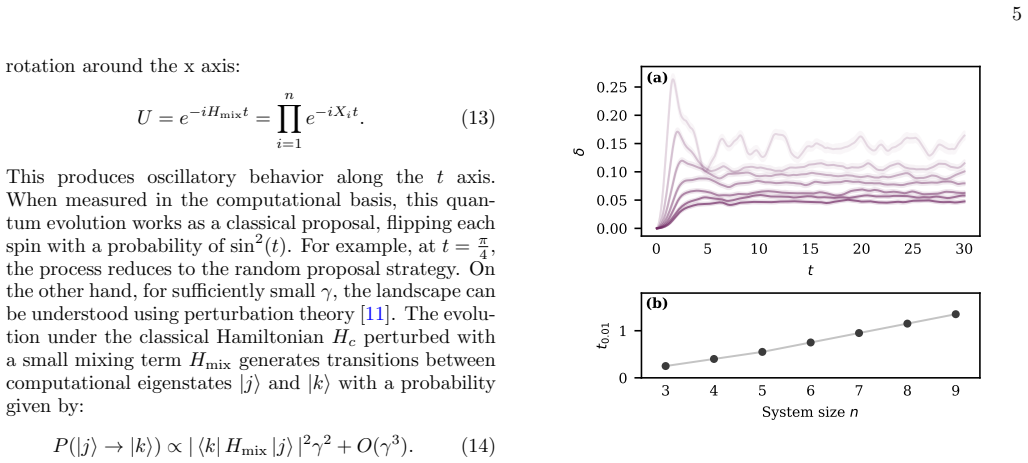
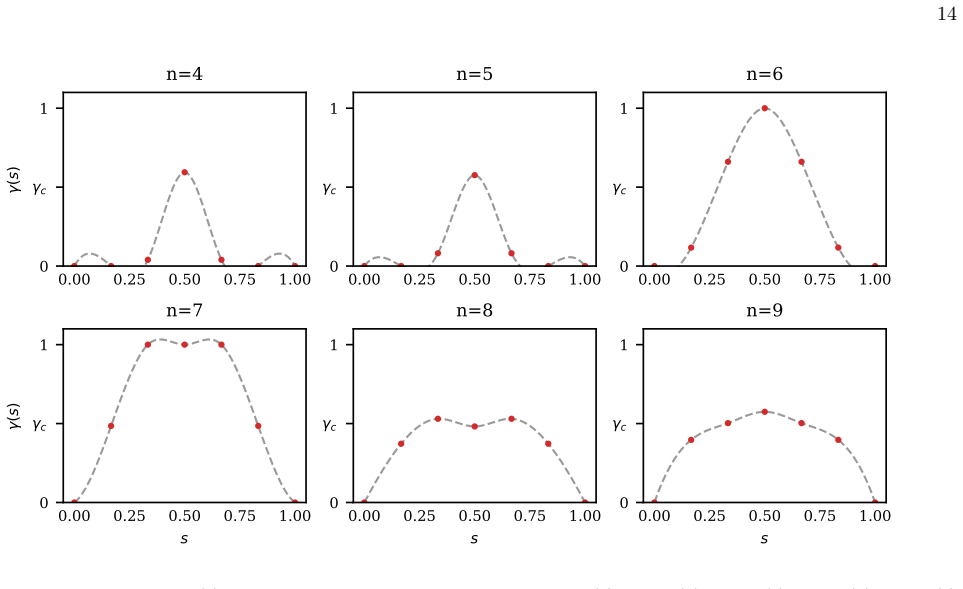
On the paper's own terms, the central discovery is that the efficiency of QEMC survives approximate classical emulation of its proposal dynamics. It shows that the spectral gap $\delta$ of the resulting Markov chain closes as $\delta \propto 2^{-kn}$ with $k\approx0.23$ for a matrix-product-state proposal at bond dimension $\chi=4$ (and $\chi=8$), statistically indistinguishable from the exact continuous-time quantum proposal ($k=0.24$), while uniform and local classical proposals close much faster ($k\approx0.96$-$1.0$). Because the acceptance step is classical and exact, approximation errors alter only the proposal quality, never the equilibrium distribution. The paper also finds a clear optimal proposal regime: a fixed mixing weight $\gamma\approx0.45$, slightly below the finite-size critical value $\gamma_c\approx0.50$, with total evolution time $t=12$, slightly outperforms the original randomized parameter choice, and the time to reach a fixed gap $\delta=0.01$ grows roughly linearly with $n$, suggesting circuit depth is not an exponential bottleneck.
Load-bearing premise
The whole argument rests on the assumption that scaling trends measured for systems of 3 to 9 spins—especially the linear growth of the needed evolution time and the preserved speedup of a heavily compressed tensor-network proposal—continue to hold at larger sizes.
Editorial extensions
If this is right
- A fixed working point ($\gamma\approx0.45$, $t=12$) is at least as good as the original randomized proposal, so the method may not require instance-by-instance fine-tuning.
- The roughly linear growth of $t_{0.01}$ with $n$ means the total evolution time—and hence circuit depth—does not erase the polynomial speedup.
- The optimal Trotter step coincides with $dt=0.8$, the value used in the original hardware experiment, so the hardware-friendly setting is also computationally near-optimal.
- Approximation in the proposal step cannot corrupt the sampler: because acceptance is exact, the equilibrium distribution is protected, and only mixing efficiency can degrade.
- A bond dimension $\chi=4$ matrix product state, despite being inexact for $n>5$, preserves the quantum scaling exponent $k\approx0.23$ up to $n=9$, implying the speedup may be reproducible classically.
Reading between the lines
- If the $\chi=4$ scaling survives at larger $n$, the practical race shifts from building noisy quantum hardware to engineering a classical tensor-network or neural-network proposal with a competitive prefactor.
- The same robustness argument suggests other cheap approximate quantum dynamics—e.g., neural quantum states or tree tensor networks with sublinear connectivity—could also preserve part of the speedup, which the paper lists but does not test.
- A direct test would be to run the matrix-product-state proposal with $\chi=4$ on systems $n=10$-$14$ using Markov-chain autocorrelation estimates rather than exact diagonalization; the paper's exponential matrix construction limits this regime.
- The optimal $\gamma$ sitting just below $\gamma_c$ hints that the proposal's power comes from enhanced fluctuations near the spin-glass transition; if so, temperature or field schedules tuned to that critical region could further improve scaling.
Editorial analysis
A structured set of objections, weighed in public.
Referee Report
Summary. This paper revisits the quantum-enhanced Markov chain Monte Carlo (QEMC) algorithm of Layden et al. (Nature 619, 282) and investigates three questions: the optimal choice of the mixing Hamiltonian strength and total evolution time; alternative proposal circuits (time-dependent schedules and a symmetric QAOA ansatz); and a classical quantum-inspired version in which the proposal step is approximately generated by a matrix product state (MPS) simulation. The central claim is that an MPS with small bond dimension (chi = 4), below the value required for exact state representation, reproduces the quantum spectral-gap scaling exponent k = 0.23 up to n = 9, matching the exact Trotterized quantum proposal (k = 0.24) and giving a large advantage over classical local (k ~ 1.0) and uniform (k ~ 0.96) updates. The authors also report an optimal gamma near the quantum phase transition, a linear growth of the time-to-target t_0.01 with n, and an optimal Trotter step dt = 0.8, and they provide cost estimates for the MPS proposal.
Significance. If the scaling claims hold, the paper would be significant in two ways: it identifies favorable operating regimes for QEMC, and it suggests that the QEMC scaling advantage does not require exact quantum evolution, opening the door to quantum-inspired classical samplers. The paper is also careful in several respects: it uses exact spectral-gap diagonalization for all reported gaps (the gold standard for mixing-time comparisons at the sizes considered), it reports averages over 100 disorder instances, and it includes a transparent cost model for the MPS proposal in Appendix F and Table I, with an explicit threshold formula. The work is framed as a proof of principle, and the authors repeatedly acknowledge the small-system limitation.
major comments (3)
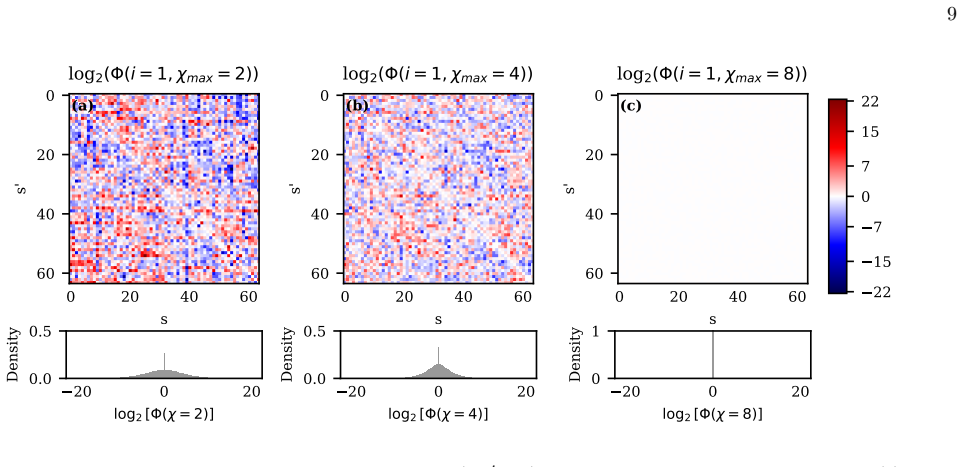
- [Sec. V.B.2, Fig. 9] The load-bearing claim that an MPS with chi = 4 maintains the quantum scaling exponent k = 0.23 rests on an exponential fit over n = 3 to 9, but chi = 4 is exact for n <= 5 (the maximum bond dimension is 2^{floor(n/2)} = 4 for n <= 5). Only n = 6, 7, 8, 9 actually probe the approximate, truncated regime, and the fit includes no confidence intervals or error bars. With four approximate points, the fitted exponent cannot robustly distinguish k = 0.23 from substantially larger values, especially because Fig. 8 shows that the symmetry-breaking ratio Phi deviates more strongly with n for fixed chi. Please report fit uncertainties, refit excluding the n <= 5 exact points, and, if possible, extend to n = 10-12 using the sampling-based or iterative methods mentioned in the outlook.
- [Sec. V.B.1 and V.B.2] The role of the symmetry-breaking ratio Phi in the spectral-gap calculation of Fig. 9 is ambiguous. The text in Sec. V.B.1 states that for chi < 2^{n/2} one must include the ratio Q(s|s')/Q(s'|s) explicitly in the acceptance step, doubling the computation. However, Fig. 9 and its caption do not state whether the reported spectral gaps were obtained with this corrected acceptance rule or with the naive symmetric acceptance of Eq. (8). If the naive rule was used, the Markov chain does not satisfy detailed balance with respect to pi, and the computed 'spectral gap' is not the convergence rate to the target distribution. If the corrected rule was used, the authors should state this explicitly and explain how Phi was evaluated for the full transition matrix, since the proposal matrix is then no longer symmetric and the cost of constructing P changes.
- [Sec. III.A/B, Figs. 1-3, Eq. (12)] The parameters gamma = 0.45 and t = 12 are selected by a grid search on the same n = 3 to 9 instances used to evaluate performance, so the comparison with the randomized strategy in Fig. 3 is in-sample. The monotonic decrease of gamma_opt with n in Fig. 1(c) means there is no evidence that a fixed gamma = 0.45 remains optimal at larger sizes; the flattening at n = 9 is only three points. Similarly, the linear scaling of t_0.01 in Fig. 2(b) is based on seven points with no error bars, and this linearity is used in Sec. II.D to argue that the circuit depth does not spoil the asymptotic scaling advantage. Please provide out-of-sample tests (e.g., hold out instances or re-optimize on one half and test on the other) and report fit statistics, or at least explicitly quantify the sensitivity of the scaling conclusions to the parameter-choice procedure.
minor comments (6)
- [Appendix C, Eq. (C1)] The displayed equality e^{-2iH_Z dt} [U_2nd]^T e^{+2iH_Z dt} = [U_2nd]^T is not generally correct, since H_Z is a non-trivial diagonal matrix and does not commute with the full second-order Trotterized unitary. The symmetry of the second-order Trotterized proposal follows from each Trotter factor being symmetric; please correct the derivation or remove the misleading intermediate expression.
- [Sec. V.B.1] There is a typo in the sentence 'Q(s'|s) ≠ Q(s'|s) for chi < 2^{n/2}'; the two quantities should be Q(s'|s) and Q(s|s').
- [Sec. II] The phrase 'requirements fo practical quantum advantage' should be 'requirements for practical quantum advantage'.
- [Fig. 1] The labels 'avg' and 'opt' in the inset of panels (b) and (c) are not defined in the caption; please add a definition or use a legend.
- [Sec. IV.A, Appendix B] The number of free parameters in the Bayesian optimization schedule (five equidistant interpolation points) appears only in Appendix B; stating this in the main text would help the reader assess the expressiveness of the optimized schedules in Fig. 12.
- [Table I] The memory and time estimates assume a local spin dimension d = 2; this assumption is implicit and should be stated in the table caption or in the text around Eq. (20).
Circularity Check
No significant circularity: the spectral-gap scalings are computed from first principles and the MPS results are independent numerical simulations, not reductions to input parameters.
full rationale
The paper's central numerical results are obtained by directly constructing the proposal matrix Q from the Born rule (Eq. 7), building the full transition matrix P, and diagonalizing it to obtain the spectral gap delta (Eq. 5) for n <= 9. The scaling exponents k are then exponential fits to these independently computed gaps; they are descriptive fits of the computed data, not predictions forced by construction. The fixed working point gamma = 0.45, t = 12 is selected by grid search on the same benchmark systems, and the paper explicitly labels the resulting comparison empirical ('While these observations cannot be considered conclusive'), so this is in-sample hyperparameter selection rather than a fitted input renamed as a prediction. The MPS-QIMC scaling claim (Fig. 9) is likewise an independent TEBD simulation; the paper explicitly notes that chi = 4 is not exact for n > 5 and relies on the n = 6..9 approximate points for the 'unconverged' claim, so the result does not reduce to an identity. The paper's self-citations (Refs. 10, 11) are background and benchmark sources; the current QEMC exponents are recomputed (e.g., randomized quantum k = 0.27 vs. Ref. 11's kq = 0.264), and no load-bearing conclusion is imported from a self-citation chain. The authors also acknowledge that larger-scale verification is required for the t0.01 scaling and the quantum-inspired advantage, which is an honest limitation, not a circularity. No equation in the paper is equivalent to its inputs by construction.
Assumptions & free parameters
free parameters (6)
- gamma (mixing Hamiltonian weight) =
0.45 fixed; gamma_opt ~0.42 (n=9)
- t (total evolution time) =
12
- dt (Trotter time step) =
0.8
- QAOA angle theta (single shared angle) =
optimized per n, depth p=5..50
- BO schedule parameters (5 interpolation points for gamma(s)) =
optimized per n=4..9
- gamma_c (critical field) =
0.50 +/- 0.02
assumptions (6)
- standard math Detailed balance and Metropolis-Hastings acceptance rule (Eq. 4) guarantee convergence to the target Boltzmann distribution.
- standard math The spectral gap delta (Eq. 5) is the correct scalar metric for comparing MCMC mixing times.
- domain assumption The fully connected Sherrington-Kirkpatrick spin glass with random couplings and fields is a representative hard testbed.
- ad hoc to paper Observed trends (gamma_opt flattening, linear t0.01 scaling, MPS chi=4 scaling) continue to larger system sizes.
- domain assumption The MPS proposal matrix can be evaluated for all 2^n transitions at n<=9 by repeated TEBD evolution, allowing exact construction of the full transition matrix.
- ad hoc to paper The phase transition at gamma_c=0.50 determined by Binder cumulants is related to optimal QEMC performance.
Cite this review
Pith. "Pith review of From quantum-enhanced to quantum-inspired Monte Carlo." pith.science (2026). https://pith.science/paper/7X3ZXJAN
@misc{pith2026241117821,
  author       = {Pith},
  title        = {Pith review of: From quantum-enhanced to quantum-inspired Monte Carlo},
  year         = {2026},
  howpublished = {\url{https://pith.science/paper/7X3ZXJAN}},
  note         = {Machine review of arXiv:2411.17821}
}
read the original abstract
We perform a comprehensive analysis of the quantum-enhanced Monte Carlo method [Nature, 619, 282-287 (2023)], aimed at identifying the optimal working point of the algorithm. We observe an optimal mixing Hamiltonian strength and analyze the scaling of the total evolution time with the size of the system. We also explore extensions of the circuit, including the use of time-dependent Hamiltonians and reverse digitized annealing. Additionally, we propose that classical, approximate quantum simulators can be used for the proposal step instead of the original real-hardware implementation. We observe that tensor-network simulators, even with unconverged settings, can maintain a scaling advantage over standard classical samplers. This may extend the utility of quantum-enhanced Monte Carlo as a quantum-inspired algorithm, even before the deployment of large-scale quantum hardware.
Figures


Figures from the paper (7 more)





Forward citations
Cited by 1 Pith paper
-
Quantum Annealing Enhanced Markov-Chain Monte Carlo
QAEMCMC uses quantum annealing outputs as Metropolis-Hastings proposals and claims faster mixing for the N=10 Sherrington-Kirkpatrick model, but the reported advantage rests on oracle-tuning tau and one scaling table ...
Reference graph
Works this paper leans on
-
[1]
We define the ratio Φ(s, s′, n, t, χ) = Q(s|s′; n, t, χ) Q(s′|s; n, t, χ) , (19) which quantifies the impact of the bond dimension on the symmetry condition
Symmetry error The first thing to check is whether the approximation error disrupts the symmetry of the proposal. We define the ratio Φ(s, s′, n, t, χ) = Q(s|s′; n, t, χ) Q(s′|s; n, t, χ) , (19) which quantifies the impact of the bond dimension on the symmetry condition. In principle, Q(s|s′; n, t, χ) ∈ [0, 1], which implies that Φ( s, s′, n, t, χ) ∈ [0, ...
-
[2]
To do so, we perform the usual gap scaling analysis
Scaling of the approximate MPS-QEMC We now analyze whether this quantum-inspired strat- egy has the potential to be advantageous compared to traditional classical updates. To do so, we perform the usual gap scaling analysis. We apply Trotter evolution with the MPS, using three different choices of bond di- mensions. For simplicity, we use the optimal time...
-
[3]
Threshold for practical quantum inspired advantage In the preceding section, we showed that the quantum- inspired Monte Carlo (QIMC) can in principle replicate the spectral gap scaling of the QEMC using bond di- mensions much smaller than what is needed for an ex- act simulation ( χ ≪ 2n/2). However, as mentioned in Sec. II D, the spectral gap scaling doe...
-
[4]
Binder, Monte Carlo Methods in Statistical Physics, Vol
K. Binder, Monte Carlo Methods in Statistical Physics, Vol. 7 (Springer, 2012)
work page 2012
-
[5]
C. M. Bishop and H. Bishop, Deep Learning: Founda- tions and Concepts(Springer, 2023)
work page 2023
-
[6]
Kirkpatrick, C
S. Kirkpatrick, C. D. Gelatt Jr, and M. P. Vecchi, Opti- mization by simulated annealing, science220, 671 (1983)
1983
-
[7]
M. P. Allen and D. J. Tildesley, Computer simulation of liquids (Oxford university press, 2017)
2017
-
[8]
M. A. Nielsen and I. L. Chuang, Quantum Computation and Quantum Information: 10th Anniversary Edition (Cambridge University Press, 2010)
2010
Show all 82 references
-
[9]
Mazzola, Quantum computing for chemistry and physics applications from a monte carlo perspective, The Journal of Chemical Physics 160, 010901 (2024)
G. Mazzola, Quantum computing for chemistry and physics applications from a monte carlo perspective, The Journal of Chemical Physics 160, 010901 (2024). 16
2024
-
[10]
S. E. Venegas-Andraca, Quantum walks: a comprehen- sive review, Quantum Information Processing 11, 1015 (2012)
2012
-
[11]
Lemieux, B
J. Lemieux, B. Heim, D. Poulin, K. Svore, and M. Troyer, Efficient quantum walk circuits for metropolis-hastings algorithm, Quantum 4, 287 (2020)
2020
-
[12]
Babbush, J
R. Babbush, J. R. McClean, M. Newman, C. Gid- ney, S. Boixo, and H. Neven, Focus beyond quadratic speedups for error-corrected quantum advantage, PRX Quantum 2, 010103 (2021)
2021
-
[13]
Mazzola, Sampling, rates, and reaction currents through reverse stochastic quantization on quantum com- puters, Physical Review A 104, 022431 (2021)
G. Mazzola, Sampling, rates, and reaction currents through reverse stochastic quantization on quantum com- puters, Physical Review A 104, 022431 (2021)
2021
-
[14]
Layden, G
D. Layden, G. Mazzola, R. V. Mishmash, M. Motta, P. Wocjan, J.-S. Kim, and S. Sheldon, Quantum- enhanced markov chain monte carlo, Nature 619, 282 (2023)
2023
-
[15]
Orfi and D
A. Orfi and D. Sels, Bounding the speedup of the quantum-enhanced markov-chain monte carlo algorithm, Physical Review A 110, 052414 (2024)
2024
-
[16]
Orfi and D
A. Orfi and D. Sels, Quantum enhanced markov chains require fine-tuned quenches, arXiv preprint arXiv:2408.07881 (2024)
2024 arXiv
-
[17]
Nakano, H
Y. Nakano, H. Hakoshima, K. Mitarai, and K. Fujii, Markov-chain monte carlo method enhanced by a quan- tum alternating operator ansatz, Physical Review Re- search 6, 033105 (2024)
2024
-
[18]
Lockwood, P
O. Lockwood, P. Weiss, F. Aronshtein, and G. Verdon, Quantum dynamical hamiltonian monte carlo, Physical Review Research 6, 033142 (2024)
2024
-
[19]
Ferguson and P
S. Ferguson and P. Wallden, Quantum-enhanced markov chain monte carlo for systems larger than a quantum computer, Physical Review Research 7, 013231 (2025)
2025
-
[20]
G. E. Santoro, R. Martoˇ n´ ak, E. Tosatti, and R. Car, The- ory of quantum annealing of an ising spin glass, Science 295, 2427 (2002)
2002
-
[21]
Albash and D
T. Albash and D. A. Lidar, Adiabatic quantum compu- tation, Reviews of Modern Physics 90, 015002 (2018)
2018
-
[22]
B. Heim, T. F. Rønnow, S. V. Isakov, and M. Troyer, Quantum versus classical annealing of ising spin glasses, Science 348, 215 (2015)
2015
-
[23]
S. V. Isakov, G. Mazzola, V. N. Smelyanskiy, Z. Jiang, S. Boixo, H. Neven, and M. Troyer, Understanding quan- tum tunneling through quantum monte carlo simulations, Physical Review Letters 117, 180402 (2016)
2016
-
[24]
Mazzola, V
G. Mazzola, V. N. Smelyanskiy, and M. Troyer, Quantum monte carlo tunneling from quantum chemistry to quan- tum annealing, Physical Review B 96, 134305 (2017)
2017
-
[25]
M´ ezard, G
M. M´ ezard, G. Parisi, and M. A. Virasoro,Spin glass the- ory and beyond: An Introduction to the Replica Method and Its Applications, Vol. 9 (World Scientific Publishing Company, 1987)
1987
-
[26]
Lucas, Ising formulations of many np problems, Fron- tiers in physics 2, 5 (2014)
A. Lucas, Ising formulations of many np problems, Fron- tiers in physics 2, 5 (2014)
2014
-
[27]
S. F. Edwards and P. W. Anderson, Theory of spin glasses, Journal of Physics F: Metal Physics 5, 965 (1975)
1975
-
[28]
Barahona, On the computational complexity of ising spin glass models, Journal of Physics A: Mathematical and General 15, 3241 (1982)
F. Barahona, On the computational complexity of ising spin glass models, Journal of Physics A: Mathematical and General 15, 3241 (1982)
1982
-
[29]
Binder and A
K. Binder and A. P. Young, Spin glasses: Experimen- tal facts, theoretical concepts, and open questions, Rev. Mod. Phys. 58, 801 (1986)
1986
-
[30]
De las Cuevas and T
G. De las Cuevas and T. S. Cubitt, Simple universal mod- els capture all classical spin physics, Science 351, 1180 (2016)
2016
-
[31]
Z. Zhu, A. J. Ochoa, and H. G. Katzgraber, Efficient cluster algorithm for spin glasses in any space dimension, Physical review letters 115, 077201 (2015)
2015
-
[32]
Barzegar, C
A. Barzegar, C. Pattison, W. Wang, and H. G. Katz- graber, Optimization of population annealing Monte Carlo for large-scale spin-glass simulations, Phys. Rev. E 98, 053308 (2018)
2018
-
[33]
Houdayer, A cluster monte carlo algorithm for 2- dimensional spin glasses, The European Physical Jour- nal B-Condensed Matter and Complex Systems 22, 479 (2001)
J. Houdayer, A cluster monte carlo algorithm for 2- dimensional spin glasses, The European Physical Jour- nal B-Condensed Matter and Complex Systems 22, 479 (2001)
2001
-
[34]
M. W. Johnson, M. H. Amin, S. Gildert, T. Lanting, F. Hamze, N. Dickson, R. Harris, A. J. Berkley, J. Jo- hansson, P. Bunyk, et al., Quantum annealing with man- ufactured spins, Nature 473, 194 (2011)
2011
-
[35]
Boixo, T
S. Boixo, T. F. Rønnow, S. V. Isakov, Z. Wang, D. Wecker, D. A. Lidar, J. M. Martinis, and M. Troyer, Evidence for quantum annealing with more than one hun- dred qubits, Nature physics 10, 218 (2014)
2014
-
[36]
T. F. Rønnow, Z. Wang, J. Job, S. Boixo, S. V. Isakov, D. Wecker, J. M. Martinis, D. A. Lidar, and M. Troyer, Defining and detecting quantum speedup, science 345, 420 (2014)
2014
-
[37]
Baldassi and R
C. Baldassi and R. Zecchina, Efficiency of quantum vs. classical annealing in nonconvex learning problems, Pro- ceedings of the National Academy of Sciences 115, 1457 (2018)
2018
-
[38]
Pagano, A
G. Pagano, A. Bapat, P. Becker, K. S. Collins, A. De, P. W. Hess, H. B. Kaplan, A. Kyprianidis, W. L. Tan, C. Baldwin, et al., Quantum approximate optimization of the long-range ising model with a trapped-ion quan- tum simulator, Proceedings of the National Academy of Sciences...
2020
-
[39]
Robert and G
C. Robert and G. Casella, A short history of markov chain monte carlo: Subjective recollections from incom- plete data, Statistical Science , 102 (2011)
2011
-
[40]
Metropolis, A
N. Metropolis, A. W. Rosenbluth, M. N. Rosenbluth, A. H. Teller, and E. Teller, Equation of state calcula- tions by fast computing machines, The journal of chem- ical physics 21, 1087 (1953)
1953
-
[41]
D. A. Levin and Y. Peres, Markov chains and mixing times, Vol. 107 (American Mathematical Soc., 2017)
2017
-
[42]
Yamamoto and H
T. Yamamoto and H. Ishii, A perturbation expansion for the sherrington-kirkpatrick model with a transverse field, Journal of Physics C: Solid State Physics20, 6053 (1987)
1987
-
[43]
Young, Stability of the quantum sherrington- kirkpatrick spin glass model, Physical Review E 96, 032112 (2017)
A. Young, Stability of the quantum sherrington- kirkpatrick spin glass model, Physical Review E 96, 032112 (2017)
2017
-
[44]
M. Guo, R. N. Bhatt, and D. A. Huse, Quantum crit- ical behavior of a three-dimensional ising spin glass in a transverse magnetic field, Physical review letters 72, 4137 (1994)
1994
-
[45]
Gidney and A
C. Gidney and A. G. Fowler, Efficient magic state fac- tories with a catalyzed |ccz > to 2 |t > transformation, Quantum 3, 135 (2019)
2019
-
[46]
Baity-Jesi, R
M. Baity-Jesi, R. A. Banos, A. Cruz, L. A. Fer- nandez, J. M. Gil-Narvion, A. Gordillo-Guerrero, M. Guidetti, D. Iniguez, A. Maiorano, F. Mantovani, E. Marinari, V. Martin-Mayor, J. Monforte-Garcia, A. Munoz Sudupe, D. Navarro, G. Parisi, M. Pivanti, S. Perez-Gaviro, F. Ricci-...
2012
-
[47]
Orfi, Near-Term Quantum Algorithms for Classical Sampling, Master’s thesis, University of Waterloo (2023)
A. Orfi, Near-Term Quantum Algorithms for Classical Sampling, Master’s thesis, University of Waterloo (2023)
2023
-
[48]
Mukherjee, A
S. Mukherjee, A. Rajak, and B. K. Chakrabarti, Classical-to-quantum crossover in the critical behavior of the transverse-field sherrington-kirkpatrick spin glass model, Physical Review E 92, 042107 (2015)
2015
-
[49]
B. F. Schiffer, J. Tura, and J. I. Cirac, Adiabatic spec- troscopy and a variational quantum adiabatic algorithm, PRX Quantum 3, 020347 (2022)
2022
-
[50]
Matsuura, S
S. Matsuura, S. Buck, V. Senicourt, and A. Zaribafiyan, Variationally scheduled quantum simulation, Phys. Rev. A 103, 052435 (2021)
2021
-
[51]
Passarelli, R
G. Passarelli, R. Fazio, and P. Lucignano, Optimal quan- tum annealing: A variational shortcut-to-adiabaticity approach, Physical Review A 105, 022618 (2022)
2022
-
[52]
J. R. Finˇ zgar, M. J. Schuetz, J. K. Brubaker, H. Nishi- mori, and H. G. Katzgraber, Designing quantum anneal- ing schedules using bayesian optimization, Physical Re- view Research 6, 023063 (2024)
2024
-
[53]
Crosson and D
E. Crosson and D. Lidar, Prospects for quantum en- hancement with diabatic quantum annealing, Nature Re- views Physics 3, 466 (2021)
2021
-
[54]
J. Mockus, The bayesian approach to global optimiza- tion, in System Modeling and Optimization: Proceedings of the 10th IFIP Conference New York City, USA, Au- gust 31–September 4, 1981(Springer, 2005) pp. 473–481
1981
-
[55]
Zhou, S.-T
L. Zhou, S.-T. Wang, S. Choi, H. Pichler, and M. D. Lukin, Quantum approximate optimization algorithm: Performance, mechanism, and implementation on near- term devices, Physical Review X 10, 021067 (2020)
2020
-
[56]
Scriva, N
G. Scriva, N. Astrakhantsev, S. Pilati, and G. Mazzola, Challenges of variational quantum optimization with measurement shot noise, Physical Review A 109, 032408 (2024)
2024
-
[57]
Javadi-Abhari, M
A. Javadi-Abhari, M. Treinish, K. Krsulich, C. J. Wood, J. Lishman, J. Gacon, S. Martiel, P. D. Nation, L. S. Bishop, A. W. Cross, B. R. Johnson, and J. M. Gambetta, Quantum computing with Qiskit (2024), arXiv:2405.08810 [quant-ph]
2024 arXiv
-
[58]
G. C. Knee and W. J. Munro, Optimal trotterization in universal quantum simulators under faulty control, Phys- ical Review A 91, 052327 (2015)
2015
-
[59]
Miessen, D
A. Miessen, D. J. Egger, I. Tavernelli, and G. Mazzola, Benchmarking digital quantum simulations above hun- dreds of qubits using quantum critical dynamics, PRX Quantum 5, 040320 (2024)
2024
-
[60]
Earnest, C
N. Earnest, C. Tornow, and D. J. Egger, Pulse-efficient circuit transpilation for quantum applications on cross- resonance-based hardware, Physical Review Research 3, 043088 (2021)
2021
-
[61]
Bezanson, A
J. Bezanson, A. Edelman, S. Karpinski, and V. B. Shah, Julia: A fresh approach to numerical computing, SIAM Review 59, 65 (2017)
2017
-
[62]
Schollw¨ ock, The density-matrix renormalization group in the age of matrix product states, Annals of physics 326, 96 (2011)
U. Schollw¨ ock, The density-matrix renormalization group in the age of matrix product states, Annals of physics 326, 96 (2011)
2011
-
[63]
Or´ us, A practical introduction to tensor networks: Matrix product states and projected entangled pair states, Annals of physics 349, 117 (2014)
R. Or´ us, A practical introduction to tensor networks: Matrix product states and projected entangled pair states, Annals of physics 349, 117 (2014)
2014
-
[64]
Verstraete and J
F. Verstraete and J. I. Cirac, Renormalization algorithms for quantum-many body systems in two and higher di- mensions, arXiv preprint cond-mat/0407066 (2004)
2004 arXiv
-
[65]
V. Murg, F. Verstraete, ¨O. Legeza, and R. M. Noack, Simulating strongly correlated quantum systems with tree tensor networks, Physical Review B—Condensed Matter and Materials Physics 82, 205105 (2010)
2010
-
[66]
Donatella, Z
K. Donatella, Z. Denis, A. Le Boit´ e, and C. Ciuti, Dy- namics with autoregressive neural quantum states: Ap- plication to critical quench dynamics, Physical Review A 108, 022210 (2023)
2023
-
[67]
Sinibaldi, C
A. Sinibaldi, C. Giuliani, G. Carleo, and F. Vicentini, Un- biasing time-dependent variational monte carlo by pro- jected quantum evolution, Quantum 7, 1131 (2023)
2023
-
[68]
Carleo, F
G. Carleo, F. Becca, M. Schir´ o, and M. Fabrizio, Lo- calization and glassy dynamics of many-body quantum systems, Scientific reports 2, 243 (2012)
2012
-
[69]
Vidal, Efficient simulation of one-dimensional quan- tum many-body systems, Physical review letters 93, 040502 (2004)
G. Vidal, Efficient simulation of one-dimensional quan- tum many-body systems, Physical review letters 93, 040502 (2004)
2004
-
[70]
Paeckel, T
S. Paeckel, T. K¨ ohler, A. Swoboda, S. R. Manmana, U. Schollw¨ ock, and C. Hubig, Time-evolution methods for matrix-product states, Annals of Physics 411, 167998 (2019)
2019
-
[71]
Fishman, S
M. Fishman, S. White, and E. M. Stoudenmire, The iten- sor software library for tensor network calculations, Sci- Post Physics Codebases , 004 (2022)
2022
-
[72]
Han and J.-H
K.-H. Han and J.-H. Kim, Quantum-inspired evolution- ary algorithm for a class of combinatorial optimization, IEEE transactions on evolutionary computation 6, 580 (2002)
2002
-
[73]
Jarret and B
M. Jarret and B. Lackey, Substochastic monte carlo al- gorithms, arXiv preprint arXiv:1704.09014 (2017)
2017 arXiv
-
[74]
Tang, A quantum-inspired classical algorithm for rec- ommendation systems, in Proceedings of the 51st annual ACM SIGACT symposium on theory of computing(2019) pp
E. Tang, A quantum-inspired classical algorithm for rec- ommendation systems, in Proceedings of the 51st annual ACM SIGACT symposium on theory of computing(2019) pp. 217–228
2019
-
[75]
J. M. Arrazola, A. Delgado, B. R. Bardhan, and S. Lloyd, Quantum-inspired algorithms in practice, Quantum 4, 307 (2020)
2020
-
[76]
Shi, L.-M
Y.-Y. Shi, L.-M. Duan, and G. Vidal, Classical simulation of quantum many-body systems with a tree tensor net- work, Physical Review A—Atomic, Molecular, and Op- tical Physics 74, 022320 (2006)
2006
-
[77]
A. A. Gangat, Linear-time classical approximate op- timization of cubic-lattice classical spin glasses, arXiv preprint arXiv:2501.17267 (2025)
2025
-
[78]
Castellani and A
T. Castellani and A. Cavagna, Spin-glass theory for pedestrians, Journal of Statistical Mechanics: Theory and Experiment 2005, P05012 (2005)
2005
-
[79]
J. R. de Almeida and D. J. Thouless, Stability of the sherrington-kirkpatrick solution of a spin glass model, Journal of Physics A: Mathematical and General 11, 983 (1978)
1978
-
[80]
Parisi, Order parameter for spin-glasses, Phys
G. Parisi, Order parameter for spin-glasses, Phys. Rev. Lett. 50, 1946 (1983)
1983
-
[81]
Wilson, F
J. Wilson, F. Hutter, and M. Deisenroth, Maximizing acquisition functions for bayesian optimization, Advances in neural information processing systems 31 (2018)
2018
-
[82]
Tibaldi, D
S. Tibaldi, D. Vodola, E. Tignone, and E. Ercolessi, Bayesian optimization for qaoa, IEEE Transactions on Quantum Engineering (2023)
2023
Reviewed August 12, 2026 · model on record in the stance chip above.
Discussion (0). Continue with ORCID to comment.