REVIEW 3 major objections 4 minor 54 references
MatchDiffusion: Training-free Generation of Match-cuts
T0 review · 3 major / 4 minor · reviewed 2026-08-12 · deepseek-v4-flash
Pith's one-line read MatchDiffusion generates match-cut video pairs from two text prompts, training-free, by sharing early denoising steps.
desk verdict A genuinely new training-free match-cut recipe whose headline mechanism is plausible but not yet isolated from shared-initialization effects; deserves review, not a desk reject. read the letter →
The pith
A machine-rendered reading of the paper's core claim, the machinery that carries it, and where it could break.
The reading
What carries the argument
The machinery is the two-stage denoising schedule built on the noise-prediction network εθ. During Joint Diffusion, the noise estimate at each step is f(εθ(z_t,ρ′,t), εθ(z_t,ρ″,t)) with f chosen as the arithmetic mean (a+b)/2, so both prompts pull the same latent toward a compromise structure; after K steps the shared latent z_{T−K} is the object that must encode the match-cut's common structure. Disjoint Diffusion then feeds z_{T−K} into two independent denoising chains, one per prompt, for the remaining steps, so details diverge while the early layout persists. The number K is the control knob that trades prompt adherence against structural and motion coherence.
What would settle it
Record the latents z_{T−K} produced after K joint steps and denoise two copies from that same latent with each prompt alone; if the resulting videos show statistically no more layout or motion similarity than videos generated from independent noise, the persistence assumption is false. Concretely, one could measure LPIPS and motion tracklet correspondence between the pair for K=10, 20, 30 across many prompt pairs and check whether they remain above chance and whether the averaged latent's predictions are still aligned with both prompts.
Extended reading notes
Core claim
The central claim is that a match-cut can be synthesized from scratch, without training or fine-tuning, by breaking the denoising schedule of a text-to-video diffusion model into two stages. In Joint Diffusion, both prompts condition the same latent for K steps and their noise predictions are averaged, so the emerging layout, color palette, and motion pattern are shared. In Disjoint Diffusion, the remaining T−K steps run separately for each prompt, so each video develops its own semantic content while retaining the common structure established early. The result is a pair of videos x′ and x″ that can be concatenated into a seamless transition. The paper presents this as the first training-free generative method for match-cuts, with CogVideoX-5B as the backbone.
Load-bearing premise
The method assumes that the early denoising steps, run jointly on one shared latent, determine the layout, color, and motion that persist through the later prompt-specific steps, and that averaging the two prompts' noise estimates does not merge the two scenes into one.
Editorial extensions
If this is right
- Match-cut generation becomes a prompt-pairing task: any user can type two scene descriptions and get a transition video, without access to training data or GPUs for fine-tuning.
- The same backbone can produce both a standard video from one prompt and a match-cut pair from two prompts, so the method is compatible with existing text-to-video models.
- Varying K gives artistic control: small K yields more distinct scenes, large K yields stronger visual coupling, and K = T collapses to a single hybrid video.
- The optional user-intervention step lets editors inject color or background edits mid-diffusion, and the remaining denoising steps refine those edits so they stay realistic.
Reading between the lines
- The method could extend to image diffusion models; the paper's supplementary shows Stable Diffusion 1.5 yielding paired images with shared structure, which suggests match-cut style pairing is a general property of diffusion latents, not specific to video.
- A natural test is whether the same joint/disjoint schedule can align other attributes besides structure, such as camera motion or lighting, by changing the combination function f from averaging to a weighted or content-aware blend.
- If the early-latent persistence assumption holds broadly, the technique could transfer to longer multi-shot videos or to matching across different backbone models, though the paper only demonstrates one backbone.
- The tuned K per prompt pair hints at a future automatic K selection, perhaps predicted from prompt similarity.
Editorial analysis
A structured set of objections, weighed in public.
Referee Report
Summary. The paper introduces MatchDiffusion, a training-free method for generating match-cut video pairs from two text prompts using a pretrained text-to-video diffusion model (CogVideoX-5B). The method proceeds in two stages: Joint Diffusion, where the two videos share a common initial latent and their noise predictions are averaged for K steps (Eq. 4), and Disjoint Diffusion, where the remaining T-K denoising steps are run independently per prompt (Eq. 5). The authors argue that because early denoising steps determine broad structure and motion while later steps add semantic detail, the joint stage establishes shared layout and motion that persist through the disjoint stage, yielding visually coherent but semantically distinct videos. The paper evaluates against V2V, SMM, MOFT, and a lower-bound T2V baseline using CLIPScore, Motion Consistency, LPIPS, and a user study, reporting favorable qualitative and quantitative results.
Significance. If the central mechanism is sound, MatchDiffusion would be a valuable contribution: it is the first training-free generative approach to match-cut synthesis, requiring no fine-tuning of the backbone, and it addresses a task that is traditionally labor-intensive. The core idea of leveraging the coarse-to-fine structure of diffusion denoising is elegant, and the qualitative examples are compelling. The paper also contributes a formalization of match-cut generation as structural coherence with semantic divergence, plus baselines and metrics for this new task. The open-source code and supplementary videos are concrete assets. However, the empirical support for the claimed causal mechanism is currently incomplete, and the quantitative evaluation lacks the rigor needed to establish the method's advantage over baselines.
major comments (3)
- [§4.5 and §3.2] If the authors believe shared initialization alone is insufficient, naming this control and its result is essential to isolate the mechanism.
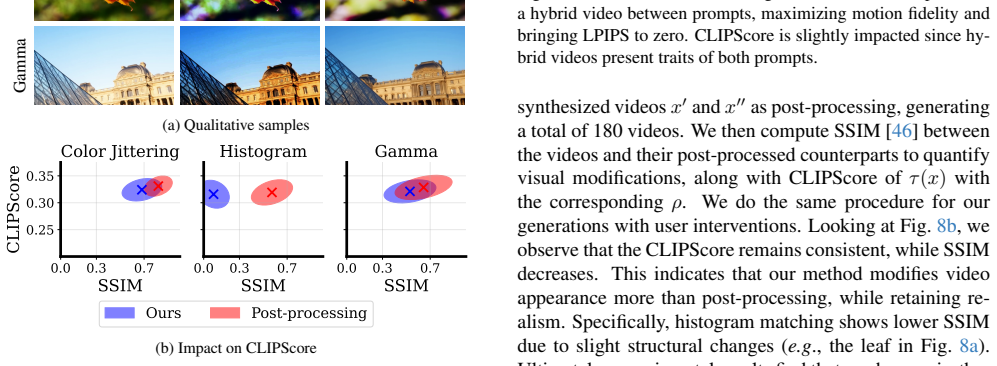
- [§4.1 and Table 1] The user study in Section 4.3 also has a small sample (35 users) and compares only against MOFT among motion-transfer methods; a significance test or confidence intervals would strengthen the conclusion that users significantly prefer MatchDiffusion.
- [§3.3 and §4.2] This issue is compounded by the fact that K is hand-tuned per prompt pair using the same qualitative and quantitative criteria that are used for evaluation, which risks selection on the evaluation metric.
minor comments (4)
- [§4.5] The sentence 'Increasing K to the maximum produces a hybrid video between prompts, maximizing motion fidelity and bringing LPIPS to zero' is trivially true because at K=T the two paths are identical; consider clarifying this degeneracy.
- [Supplementary B] The admitted limitation that 'prompts inspired by existing match-cuts... significantly improve the system's success rate, whereas randomly devised prompts frequently fail' is important for practical use and should be mentioned in the main paper, not only in the supplementary.
- [§3.2] The choice of f(a,b)=(a+b)/2 as the combination function is presented without discussion in the main text, but the supplementary comparison with a linear-decay f suggests that the choice is consequential; a brief justification or pointer to the supplementary results would improve readability.
- [Figure 1 and Section 2] There are a few typographical errors: 'Odissey' in Figure 1 should be 'Odyssey', and 'irregardless' in Section 2 should be 'regardless'.
Circularity Check
No derivation-level circularity: the joint/disjoint diffusion design is an independent heuristic. The only mild circularity is in-sample tuning of K (and CFG) using the same match-cut quality criteria that the evaluation then measures.
-
other
[Section 4.1 (MatchDiffusion settings) and Section 4.5 (Impact of K)]
"We tune K for each pair of prompts. ... Ultimately, we find that, for the purpose of match-cut generation, the user's needs play a central role, with K serving as a tunable parameter to adjust the results according to artistic preferences."
K is selected per prompt pair by the authors using the same qualitative and quantitative notions of match-cut quality (prompt adherence, motion coherence, structural similarity) that the subsequent evaluation and user study measure. Section 4.5 and Figure 9 further show that K directly trades CLIPScore against Motion and LPIPS. The headline numbers in Table 1 are therefore the best-case operating points of a tuned K sweep rather than a fixed-method result: the tuning objective is the evaluation objective, so the reported metrics cannot independently validate the claimed balance. This is an evaluation circularity rather than a derivation reduction, hence mild.
full rationale
The central method is not derived from its own outputs or from the authors' prior results. Equation (4) defines Joint Diffusion as averaging the two prompt-conditioned noise predictions for K steps, and Equation (5) defines Disjoint Diffusion as separate prompt-conditioned denoising from the shared latent; the pipeline is then compared against external baselines (SDEdit, SMM, MOFT) reimplemented on the same backbone. The load-bearing empirical premise that early denoising steps encode broad structure while later steps add detail is cited to [6], which includes two current authors, but also to external works [23,36] and is illustrated in Figure 2, so this is not a self-citation chain that forces the method. The supplementary limitation that randomly devised prompts frequently fail further contextualizes results as dependent on hand-crafted prompts, but again this is not derivation circularity. One correctness caveat, noted but not counted as circularity: Section 4.5's statement that 'K = 0 is equivalent to the lower bound' is inaccurate because the method still starts both paths from a shared initial latent at K=0, so the lower bound drawn with independent noises is not the same control; this is a confound affecting attribution of the effect to joint diffusion, not a circular derivation. Overall the method has independent content and the only circularity is the mild in-sample tuning of K and CFG, which limits the strength of the quantitative claims without making the approach itself circular.
Assumptions & free parameters
free parameters (3)
- K (number of joint diffusion steps) =
10 to 15 for main results, tuned per prompt pair
- CFG (classifier-free guidance scale) =
5 to 7 for most cases, sometimes 10
- Combination function f =
Arithmetic mean of the two noise predictions
assumptions (4)
- domain assumption Early denoising steps establish broad structure and motion, while later steps add prompt-specific semantics.
- domain assumption Averaging noise predictions from two prompts for K steps yields a shared latent that can seed two separate, semantically distinct videos.
- domain assumption CogVideoX-5B, used frozen, provides sufficient prompt adherence and diversity for both divergent paths.
- domain assumption CLIPScore, motion consistency, and LPIPS are adequate proxies for match-cut quality.
Cite this review
Pith. "Pith review of MatchDiffusion: Training-free Generation of Match-cuts." pith.science (2026). https://pith.science/paper/66FUQBWV
@misc{pith2026241118677,
  author       = {Pith},
  title        = {Pith review of: MatchDiffusion: Training-free Generation of Match-cuts},
  year         = {2026},
  howpublished = {\url{https://pith.science/paper/66FUQBWV}},
  note         = {Machine review of arXiv:2411.18677}
}
read the original abstract
Match-cuts are powerful cinematic tools that create seamless transitions between scenes, delivering strong visual and metaphorical connections. However, crafting match-cuts is a challenging, resource-intensive process requiring deliberate artistic planning. In MatchDiffusion, we present the first training-free method for match-cut generation using text-to-video diffusion models. MatchDiffusion leverages a key property of diffusion models: early denoising steps define the scene's broad structure, while later steps add details. Guided by this insight, MatchDiffusion employs "Joint Diffusion" to initialize generation for two prompts from shared noise, aligning structure and motion. It then applies "Disjoint Diffusion", allowing the videos to diverge and introduce unique details. This approach produces visually coherent videos suited for match-cuts. User studies and metrics demonstrate MatchDiffusion's effectiveness and potential to democratize match-cut creation.
Figures


Figures from the paper (6 more)


Reference graph
Works this paper leans on
-
[1]
Adobe Creative Cloud. What is a match cut?, n.d. Accessed: 2024-11-14. 2
work page 2024
-
[2]
Hritik Bansal, Yonatan Bitton, Michal Yarom, Idan Szpektor, Aditya Grover, and Kai-Wei Chang. Talc: Time-aligned cap- tions for multi-scene text-to-video generation.arXiv preprint arXiv:2405.04682, 2024. 2
arXiv 2024
-
[3]
Stable video diffusion: Scaling latent video diffusion models to large datasets
Andreas Blattmann, Tim Dockhorn, Sumith Kulal, Daniel Mendelevitch, Maciej Kilian, Dominik Lorenz, Yam Levi, Zion English, Vikram V oleti, Adam Letts, et al. Stable video diffusion: Scaling latent video diffusion models to large datasets. arXiv preprint arXiv:2311.15127, 2023. 2
arXiv 2023
-
[4]
Align your latents: High-resolution video synthesis with la- tent diffusion models
Andreas Blattmann, Robin Rombach, Huan Ling, Tim Dock- horn, Seung Wook Kim, Sanja Fidler, and Karsten Kreis. Align your latents: High-resolution video synthesis with la- tent diffusion models. In Proceedings of the IEEE/CVF Con- ference on Computer Vision and Pattern Recognition, pages 22563–22575, 2023. 2
2023
-
[5]
Diffusion illusions: Hiding images in plain sight
Ryan Burgert, Xiang Li, Abe Leite, Kanchana Ranasinghe, and Michael Ryoo. Diffusion illusions: Hiding images in plain sight. In ACM SIGGRAPH 2024 Conference Papers , pages 1–11, 2024. 3
work page 2024
-
[6]
Adaptive guidance: Training-free accel- eration of conditional diffusion models
Angela Castillo, Jonas Kohler, Juan C P ´erez, Juan Pablo P´erez, Albert Pumarola, Bernard Ghanem, Pablo Arbel ´aez, and Ali Thabet. Adaptive guidance: Training-free accel- eration of conditional diffusion models. arXiv preprint arXiv:2312.12487, 2023. 2, 3
arXiv 2023
-
[7]
Match cutting: Finding cuts with smooth visual transitions
Boris Chen, Amir Ziai, Rebecca S Tucker, and Yuchen Xie. Match cutting: Finding cuts with smooth visual transitions. In Proceedings of the IEEE/CVF Winter Conference on Ap- plications of Computer Vision, pages 2115–2125, 2023. 2
work page 2023
-
[8]
Ernie Chu, Tzuhsuan Huang, Shuo-Yen Lin, and Jun-Cheng Chen. Medm: Mediating image diffusion models for video- to-video translation with temporal correspondence guidance. In Proceedings of the AAAI Conference on Artificial Intelli- gence, pages 1353–1361, 2024. 2
work page 2024
Show all 54 references
-
[9]
Dragvideo: Interactive drag-style video editing
Yufan Deng, Ruida Wang, Yuhao Zhang, Yu-Wing Tai, and Chi-Keung Tang. Dragvideo: Interactive drag-style video editing. In European Conference on Computer Vision, pages 183–199. Springer, 2025. 2
2025
-
[10]
Audio match cutting: Finding and creating matching audio transitions in movies and videos
Dennis Fedorishin, Lie Lu, Srirangaraj Setlur, and Venu Govindaraju. Audio match cutting: Finding and creating matching audio transitions in movies and videos. In ICASSP 2024-2024 IEEE International Conference on Acoustics, Speech and Signal Processing (ICASSP), pages 6200–620...
2024
-
[11]
Factorized diffusion: Perceptual illusions by noise decomposition
Daniel Geng, Inbum Park, and Andrew Owens. Factorized diffusion: Perceptual illusions by noise decomposition. In ECCV, 2024. 3, 8
2024
-
[12]
Visual ana- grams: Generating multi-view optical illusions with diffu- sion models
Daniel Geng, Inbum Park, and Andrew Owens. Visual ana- grams: Generating multi-view optical illusions with diffu- sion models. In Proceedings of the IEEE/CVF Conference on Computer Vision and Pattern Recognition, pages 24154– 24163, 2024. 3
2024
-
[13]
Tokenflow: Consistent diffusion features for consistent video editing
Michal Geyer, Omer Bar-Tal, Shai Bagon, and Tali Dekel. Tokenflow: Consistent diffusion features for consistent video editing. In ICLR, 2023. 2
2023
-
[14]
Streamingt2v: Con- sistent, dynamic, and extendable long video generation from text
Roberto Henschel, Levon Khachatryan, Daniil Hayrapetyan, Hayk Poghosyan, Vahram Tadevosyan, Zhangyang Wang, Shant Navasardyan, and Humphrey Shi. Streamingt2v: Con- sistent, dynamic, and extendable long video generation from text. arXiv preprint arXiv:2403.14773, 2024. 2
2024 arXiv
-
[15]
Clipscore: A reference-free evaluation met- ric for image captioning
Jack Hessel, Ari Holtzman, Maxwell Forbes, Ronan Le Bras, and Yejin Choi. Clipscore: A reference-free evaluation met- ric for image captioning. In EMNLP, 2021. 5
2021
-
[16]
Denoising diffu- sion probabilistic models
Jonathan Ho, Ajay Jain, and Pieter Abbeel. Denoising diffu- sion probabilistic models. NeurIPS, 2020. 3
2020
-
[17]
Co- tracker: It is better to track together
Nikita Karaev, Ignacio Rocco, Benjamin Graham, Natalia Neverova, Andrea Vedaldi, and Christian Rupprecht. Co- tracker: It is better to track together. arXiv preprint arXiv:2307.07635, 2023. 5
2023 arXiv
-
[18]
Text2video-zero: Text- to-image diffusion models are zero-shot video generators
Levon Khachatryan, Andranik Movsisyan, Vahram Tade- vosyan, Roberto Henschel, Zhangyang Wang, Shant Navasardyan, and Humphrey Shi. Text2video-zero: Text- to-image diffusion models are zero-shot video generators. In Proceedings of the IEEE/CVF International Conference on Comput...
2023
-
[19]
Computational video editing for dialogue-driven scenes
Mackenzie Leake, Abe Davis, Anh Truong, and Maneesh Agrawala. Computational video editing for dialogue-driven scenes. ACM Trans. Graph., 36(4):130–1, 2017. 2
2017
-
[20]
Looking backward: Streaming video-to-video translation with feature banks
Feng Liang, Akio Kodaira, Chenfeng Xu, Masayoshi Tomizuka, Kurt Keutzer, and Diana Marculescu. Looking backward: Streaming video-to-video translation with feature banks. arXiv preprint arXiv:2405.15757, 2024. 2
2024 arXiv
-
[21]
A technique for the measurement of attitudes
Rensis Likert. A technique for the measurement of attitudes. Archives of psychology, 1932. 7
1932
-
[22]
Videodirectorgpt: Consistent multi-scene video generation via llm-guided planning
Han Lin, Abhay Zala, Jaemin Cho, and Mohit Bansal. Videodirectorgpt: Consistent multi-scene video generation via llm-guided planning. arXiv preprint arXiv:2309.15091,
-
[23]
Common diffusion noise schedules and sample steps are flawed
Shanchuan Lin, Bingchen Liu, Jiashi Li, and Xiao Yang. Common diffusion noise schedules and sample steps are flawed. In Proceedings of the IEEE/CVF winter conference on applications of computer vision, pages 5404–5411, 2024. 2, 3
2024
-
[24]
Microsoft coco: Common objects in context
Tsung-Yi Lin, Michael Maire, Serge Belongie, James Hays, Pietro Perona, Deva Ramanan, Piotr Doll´ar, and C Lawrence Zitnick. Microsoft coco: Common objects in context. In ECCV, 2014. 8
2014
-
[25]
Physgen: Rigid-body physics-grounded image- to-video generation
Shaowei Liu, Zhongzheng Ren, Saurabh Gupta, and Shen- long Wang. Physgen: Rigid-body physics-grounded image- to-video generation. In European Conference on Computer Vision, pages 360–378. Springer, 2025. 2 9
2025
-
[26]
Video- drafter: Content-consistent multi-scene video generation with llm
Fuchen Long, Zhaofan Qiu, Ting Yao, and Tao Mei. Video- drafter: Content-consistent multi-scene video generation with llm. arXiv preprint arXiv:2401.01256, 2024. 2
2024 arXiv
-
[27]
Snap video: Scaled spatiotemporal transformers for text-to-video synthesis
Willi Menapace, Aliaksandr Siarohin, Ivan Skorokhodov, Ekaterina Deyneka, Tsai-Shien Chen, Anil Kag, Yuwei Fang, Aleksei Stoliar, Elisa Ricci, Jian Ren, et al. Snap video: Scaled spatiotemporal transformers for text-to-video synthesis. In CVPR, 2024. 2
2024
-
[28]
Sdedit: Guided image synthesis and editing with stochastic differential equa- tions
Chenlin Meng, Yutong He, Yang Song, Jiaming Song, Jia- jun Wu, Jun-Yan Zhu, and Stefano Ermon. Sdedit: Guided image synthesis and editing with stochastic differential equa- tions. In ICLR, 2022. 2, 4, 5
2022
-
[29]
In the Blink of an Eye
Walter Murch. In the Blink of an Eye . Silman-James Press Los Angeles, 2001. 2
2001
-
[30]
Conditional image-to-video gener- ation with latent flow diffusion models
Haomiao Ni, Changhao Shi, Kai Li, Sharon X Huang, and Martin Renqiang Min. Conditional image-to-video gener- ation with latent flow diffusion models. In Proceedings of the IEEE/CVF conference on computer vision and pattern recognition, pages 18444–18455, 2023. 2
2023
-
[31]
How to use match cuts to tell stories, n.d
No Film School. How to use match cuts to tell stories, n.d. Accessed: 2024-11-14. 2
2024
-
[32]
Learning to cut by watch- ing movies
Alejandro Pardo, Fabian Caba, Juan Le ´on Alc ´azar, Ali K Thabet, and Bernard Ghanem. Learning to cut by watch- ing movies. In Proceedings of the IEEE/CVF International Conference on Computer Vision, pages 6858–6868, 2021. 2
2021
-
[33]
Moviecuts: A new dataset and benchmark for cut type recognition
Alejandro Pardo, Fabian Caba Heilbron, Juan Le ´on Alc´azar, Ali Thabet, and Bernard Ghanem. Moviecuts: A new dataset and benchmark for cut type recognition. In European Con- ference on Computer Vision, pages 668–685. Springer, 2022. 2
2022
-
[34]
Automatch: A large-scale audio beat matching benchmark for boost- ing deep learning assistant video editing
Sen Pei, Jingya Yu, Qi Chen, and Wozhou He. Automatch: A large-scale audio beat matching benchmark for boost- ing deep learning assistant video editing. arXiv preprint arXiv:2303.01884, 2023. 2
2023 arXiv
-
[35]
My favourite match cut, n.d
Alonso Perez. My favourite match cut, n.d. Accessed: 2024- 11-14. 2
2024
-
[36]
Boosting diffusion models with moving average sampling in frequency domain
Yurui Qian, Qi Cai, Yingwei Pan, Yehao Li, Ting Yao, Qibin Sun, and Tao Mei. Boosting diffusion models with moving average sampling in frequency domain. In Proceedings of the IEEE/CVF Conference on Computer Vision and Pattern Recognition, pages 8911–8920, 2024. 2, 3
2024
-
[37]
Contrastive sequential-diffusion learn- ing: An approach to multi-scene instructional video synthe- sis
Vasco Ramos, Yonatan Bitton, Michal Yarom, Idan Szpektor, and Joao Magalhaes. Contrastive sequential-diffusion learn- ing: An approach to multi-scene instructional video synthe- sis. arXiv preprint arXiv:2407.11814, 2024. 2
2024 arXiv
-
[38]
Consisti2v: Enhancing visual consistency for image-to-video generation
Weiming Ren, Huan Yang, Ge Zhang, Cong Wei, Xinrun Du, Wenhao Huang, and Wenhu Chen. Consisti2v: Enhancing visual consistency for image-to-video generation. Transac- tions on Machine Learning Research, 2024. 2
2024
-
[39]
High-resolution image synthesis with latent diffusion models
Robin Rombach, Andreas Blattmann, Dominik Lorenz, Patrick Esser, and Bj ¨orn Ommer. High-resolution image synthesis with latent diffusion models. In Proceedings of the IEEE/CVF Conference on Computer Vision and Pattern Recognition (CVPR), pages 10684–10695, 2022. 1
2022
-
[40]
High-resolution image syn- thesis with latent diffusion models
Robin Rombach, Andreas Blattmann, Dominik Lorenz, Patrick Esser, and Bj¨orn Ommer. High-resolution image syn- thesis with latent diffusion models. In CVPR, 2022. 3
2022
-
[41]
Autotran- sition: Learning to recommend video transition effects
Yaojie Shen, Libo Zhang, Kai Xu, and Xiaojie Jin. Autotran- sition: Learning to recommend video transition effects. In European Conference on Computer Vision, pages 285–300. Springer, 2022. 2
2022
-
[42]
Denoising diffusion implicit models
Jiaming Song, Chenlin Meng, and Stefano Ermon. Denoising diffusion implicit models. arXiv preprint arXiv:2010.02502, 2020. 3, 5
2010 arXiv
-
[43]
Match cuts: Creative transitions examples, n.d
StudioBinder. Match cuts: Creative transitions examples, n.d. Accessed: 2024-11-14. 2
2024
-
[44]
Types of match cuts, examples, and how to use them, n.d
VEGAS Creative Software. Types of match cuts, examples, and how to use them, n.d. Accessed: 2024-11-14. 2
2024
-
[45]
Modelscope text-to-video technical report
Jiuniu Wang, Hangjie Yuan, Dayou Chen, Yingya Zhang, Xiang Wang, and Shiwei Zhang. Modelscope text-to-video technical report. arXiv preprint arXiv:2308.06571, 2023. 2
2023 arXiv
-
[46]
Image quality assessment: from error visibility to structural similarity
Zhou Wang, Alan C Bovik, Hamid R Sheikh, and Eero P Simoncelli. Image quality assessment: from error visibility to structural similarity. T-IP, 2004. 8
2004
-
[47]
Video diffusion models are training-free motion interpreter and controller
Zeqi Xiao, Yifan Zhou, Shuai Yang, and Xingang Pan. Video diffusion models are training-free motion interpreter and controller. arXiv preprint arXiv:2405.14864, 2024. 2, 5
2024 arXiv
-
[48]
Dreamfactory: Pio- neering multi-scene long video generation with a multi-agent framework
Zhifei Xie, Daniel Tang, Dingwei Tan, Jacques Klein, Tegawend F Bissyand, and Saad Ezzini. Dreamfactory: Pio- neering multi-scene long video generation with a multi-agent framework. arXiv preprint arXiv:2408.11788, 2024. 2
2024 arXiv
-
[49]
Rerender a video: Zero-shot text-guided video-to-video translation
Shuai Yang, Yifan Zhou, Ziwei Liu, and Chen Change Loy. Rerender a video: Zero-shot text-guided video-to-video translation. In SIGGRAPH Asia 2023 Conference Papers , pages 1–11, 2023. 2
2023
-
[50]
Cogvideox: Text-to-video diffusion models with an expert transformer
Zhuoyi Yang, Jiayan Teng, Wendi Zheng, Ming Ding, Shiyu Huang, Jiazheng Xu, Yuanming Yang, Wenyi Hong, Xiao- han Zhang, Guanyu Feng, et al. Cogvideox: Text-to-video diffusion models with an expert transformer. arXiv preprint arXiv:2408.06072, 2024. 3, 5
2024 arXiv
-
[51]
Space-time diffusion features for zero-shot text-driven motion transfer
Danah Yatim, Rafail Fridman, Omer Bar-Tal, Yoni Kasten, and Tali Dekel. Space-time diffusion features for zero-shot text-driven motion transfer. In CVPR, 2024. 2, 5
2024
-
[52]
Dragnuwa: Fine-grained control in video generation by integrating text, image, and trajectory
Shengming Yin, Chenfei Wu, Jian Liang, Jie Shi, Houqiang Li, Gong Ming, and Nan Duan. Dragnuwa: Fine-grained control in video generation by integrating text, image, and trajectory. arXiv preprint arXiv:2308.08089, 2023. 2
2023 arXiv
-
[53]
The unreasonable effectiveness of deep features as a perceptual metric
Richard Zhang, Phillip Isola, Alexei A Efros, Eli Shechtman, and Oliver Wang. The unreasonable effectiveness of deep features as a perceptual metric. In CVPR, 2018. 5
2018
-
[54]
a bone-like fossil thrown to the sky
Rui Zhao, Yuchao Gu, Jay Zhangjie Wu, David Jun- hao Zhang, Jia-Wei Liu, Weijia Wu, Jussi Keppo, and Mike Zheng Shou. Motiondirector: Motion customization of text-to-video diffusion models. In ECCV. Springer, 2025. 2 10 MatchDiffusion: Training-free Generation of Match-Cuts Su...
2025
Reviewed August 12, 2026 · model on record in the stance chip above.
Discussion (0). Continue with ORCID to comment.