REVIEW 2 major objections 5 minor 18 references
Enhancing Neural Network Robustness Against Fault Injection Through Non-linear Weight Transformations
T0 review · 2 major / 5 minor · reviewed 2026-08-12 · deepseek-v4-flash
Pith's one-line read This paper claims that applying saturated activation functions to weights at inference confines bit-flip damage, letting an FP32 ResNet18 on ImageNet retain about 67% top-1 accuracy at a one-in-100,000 bit-error rate where an unprotected…
desk verdict Simple, cheap weight-saturation defense, but the reported fault model is under-specified to the point of being unverifiable. read the letter →
The pith
A machine-rendered reading of the paper's core claim, the machinery that carries it, and where it could break.
The reading
What carries the argument
The load-bearing object is a saturated activation function (SAF)—Tanh, Tanh0.5, Softsign, or Arctan—applied elementwise to weight matrices. During training the forward pass computes $\sigma(\tau(W_i)a_{i-1}+b_i)$, so the network learns weights compatible with the bounded mapping; at deployment the same $\tau$ is applied to weights read from fault-prone memory, so any bit-flip that would have produced a huge weight is compressed into a bounded interval. The mechanism exploits the contrast between FP32's large dynamic range, which makes stored weights fragile, and the bounded output range of $\tau$, which makes large outliers impossible.
What would settle it
A concrete test would be to inject bit flips only into the exponent bits of FP32 weights at a bit-error rate of $10^{-5}$; if the Tanh-protected ResNet18 drops toward random-guess accuracy, then the defense is specific to uniformly random flips rather than worst-case ones.
Extended reading notes
Core claim
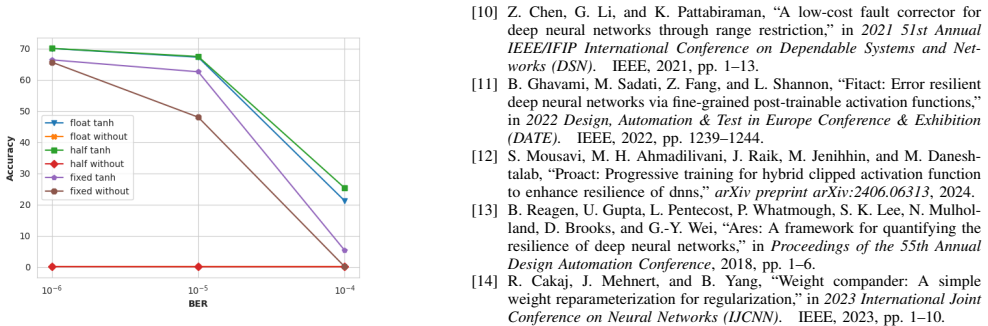
The central discovery is that constraining weights with saturated activation functions during training and re-applying them to the possibly corrupted weights before inference makes deep networks resilient to random bit flips in stored parameters. The paper reports that a fine-tuned ResNet18 with Tanh keeps 67.26 ± 1.01% top-1 accuracy on ImageNet 2012 after FP32 faults at a bit-error rate of one in 100,000, versus 0.10 ± 0.00% for the unprotected baseline; similar margins hold on CIFAR10 and CIFAR100 and for FP16 and Q2.5 formats. SAFs do not merely regularize: they cap the maximum magnitude a corrupted weight can take, which is what stops fault-induced outliers from propagating through the network.
Load-bearing premise
The load-bearing premise is that hardware faults behave like independent random bit flips at a fixed probability; if real faults cluster, target specific bit positions, or turn weights into NaN or infinity, bounding the weights cannot contain the damage.
Editorial extensions
If this is right
- FP32 and FP16 models can be deployed at a one-in-100,000 bit-error rate with only a few points of top-1 accuracy loss, provided they are trained or fine-tuned with a saturated activation function.
- The defense costs almost nothing at inference time because it transforms only weights, whose number is fixed, not activations, which scale with the number of inputs; this makes it cheaper than activation-clipping defenses in large-scale serving.
- Commonly available ImageNet pre-trained weights can be adapted to the defense in about five epochs, with a small top-1 accuracy gain rather than a loss, so the method does not require training from scratch.
- The same saturated-weight treatment also helps 8-bit fixed-point (Q2.5) models, though their unprotected accuracy is already more robust because of their limited range.
- At a bit-error rate of one in 10,000, the protection degrades: accuracy falls by more than half on ImageNet and the CIFAR models cannot operate, so the defense has a clear operating envelope.
Reading between the lines
- The paper does not test combining SAF weight bounds with activation clipping; since the two defenses act on different tensors, a natural extension is to check whether they stack under mixed fault models.
- Because saturation cannot contain non-finite values, the practical guarantee is probably limited to faults that produce large but finite weights; faults that create NaN or infinity would need a separate guard.
- The ordering among Tanh, Tanh0.5, Softsign, and Arctan hints that the speed of saturation is a tunable knob; per-layer or per-datatype choice of SAF may outperform the single global choice tested here, but no such tuning is reported.
Editorial analysis
A structured set of objections, weighed in public.
Referee Report
Summary. The paper proposes to improve DNN robustness against stored-weight bit-flips by applying saturated activation functions (SAFs) to the weights during both training and inference. During training the forward pass uses tau(W); at deployment, the raw weights are written to storage, read back with possible faults, and then passed through tau before being used in the affine operation. The authors evaluate Tanh, Arctan, Softsign, and a modified Tanh (c=0.5) on ResNet20 for CIFAR-10/100 and ResNet18 for ImageNet, under Monte Carlo bit-flip injection at BER=1e-5, for FP32, FP16, and Q2.5 datatypes. They report that SAFs reduce accuracy loss dramatically, e.g., ImageNet FP32 ResNet18 with Tanh retains 67.26% top-1 after faults compared to 0.10% for the unprotected baseline, and that ImageNet pretrained weights can be fine-tuned in 5 epochs.
Significance. If the reported results are reproducible, the method is an attractive low-overhead defense: it adds no per-input inference cost and works with off-the-shelf quantization. The 5-epoch adaptation of a pretrained ResNet18 is a practical strength. The paper, however, does not provide code, and the fault-injection protocol is not specified at the level of detail needed to assess whether the fault model is realistic. The proposed mechanism is plausible for bounded perturbations, but its headline claim depends entirely on the exact definition of the injected bit-flips, which the current text leaves ambiguous.
major comments (2)
- [Section IV (first paragraph); Eq. (3)] The fault-injection function f(W_i, BER) is never precisely defined. The text says only that bit-flips are 'randomly injecting bit-flips into weights with a probability of BER = 10^-5', which leaves open whether each bit is flipped independently with probability 1e-5 or whether a single bit per selected weight is flipped, and whether sign/exponent/mantissa bits are all eligible. This matters because a single exponent-field flip in an FP32 weight can produce NaN or Inf, for which tanh(.) is not bounded and the accuracy would collapse. Under independent per-bit flips, a ResNet18 with about 11.7M FP32 weights has ~3.7e3 flipped bits per round; the expected number of NaN/Inf-producing flips is on the order of tens. The reported ImageNet result in Table III (67.26 ± 1.01% over 10 rounds) is therefore impossible under the literal protocol. The authors must state the actual sampling rule, including any restriction to mantissa bits or any sanitization of non-finite values, and ideally repeat the evaluation with a protocol that includes exponent-bit flips, because physical faults are not limited to mantissa bits.
- [Section II; Section IV] The paper motivates the proposed weight-based SAF as an alternative to activation-restriction methods (e.g., clipped ReLU, Refs. [9]–[12]) and argues that it has a computational advantage. However, the experiments compare only against an unprotected baseline ('None'); no activation-restriction baseline is included. To support the claimed advantage over existing defenses, the authors should add a comparison, at least on CIFAR-10 and ImageNet, using the same fault protocol and reporting both accuracy and overhead. Without such a comparison, the paper's positioning relative to the prior work it cites is not empirically established.
minor comments (5)
- [Section III, Eqs. (2)-(4)] The paper should state whether the bias terms b_i are also subjected to bit-flips in the experiments and whether they are protected by the SAF; biases are usually stored in the same memory and are not transformed by tau in the present formulation.
- [Section IV, Table III] The notation 'operate at a BER of 1e-5' is ambiguous: the authors should clarify whether the BER applies to every stored bit of every parameter (including biases) or only to weight tensors.
- [Section IV-A] There is a typo: 'oppposite' should be 'opposite'; also in the Conclusion, 'The overheads of our method is minimal' should be 'are minimal'.
- [Section IV] The authors do not provide code or a detailed pseudocode for the fault-injection routine, which makes it difficult to verify the reported results; please include the Monte Carlo implementation or a reproducibility statement.
- [Section IV, Figs. 3 and 4] The figures would be easier to interpret if the error bars and the number of BER points were described in the captions or the text.
Circularity Check
No significant circularity: the SAF method is evaluated empirically under fault injection, and no prediction is defined in terms of the method's own fitted values.
full rationale
The paper makes an empirical robustness claim: after training with weights passed through a saturated activation function, faulty weights are passed through the same SAF at inference and top-1 accuracy is measured under Monte Carlo bit-flip injection. The only definitional component is that a SAF maps any input into a bounded range, so it cannot 'cause weights to become excessively large' by construction; however, the paper's actual claims—that accuracy loss remains small at BER 10^-5 and that baselines collapse—are measured outcomes, not consequences of the definition. No fitted parameter is used to define success, no central result is derived from a self-citation (references [8], [13], [14] are prior external work and are not invoked to justify the safety claim), and no uniqueness theorem or ansatz is smuggled in via citation. The reviewer's concern about the unspecified bit-position/NaN handling in the fault-injection protocol is a correctness and reproducibility issue about the experimental setup, not a circularity, because the protocol is not defined in terms of the results it is used to support. Accordingly, no circular step can be quoted and exhibited, and the score is 0.
Assumptions & free parameters
free parameters (1)
- c in modified Tanh (Tanh0.5) =
0.5
assumptions (3)
- domain assumption Random bit flips occur independently and uniformly across weight bits at a given BER.
- domain assumption Applying the SAF after reading faulty weights bounds the damage from faults; non-finite values such as NaN are not analyzed.
- domain assumption FP16 and Q2.5 experiments only convert stored weights; all arithmetic remains FP32.
Cite this review
Pith. "Pith review of Enhancing Neural Network Robustness Against Fault Injection Through Non-linear Weight Transformations." pith.science (2026). https://pith.science/paper/ZPH7BV5T
@misc{pith2026241119027,
  author       = {Pith},
  title        = {Pith review of: Enhancing Neural Network Robustness Against Fault Injection Through Non-linear Weight Transformations},
  year         = {2026},
  howpublished = {\url{https://pith.science/paper/ZPH7BV5T}},
  note         = {Machine review of arXiv:2411.19027}
}
read the original abstract
Deploying deep neural networks (DNNs) in real-world environments poses challenges due to faults that can manifest in physical hardware from radiation, aging, and temperature fluctuations. To address this, previous works have focused on protecting DNNs via activation range restriction using clipped ReLU and finding the optimal clipping threshold. However, this work instead focuses on constraining DNN weights by applying saturated activation functions (SAFs): Tanh, Arctan, and others. SAFs prevent faults from causing DNN weights to become excessively large, which can lead to model failure. These methods not only enhance the robustness of DNNs against fault injections but also improve DNN performance by a small margin. Before deployment, DNNs are trained with weights constrained by SAFs. During deployment, the weights without applied SAF are written to mediums with faults. When read, weights with faults are applied with SAFs and are used for inference. We demonstrate our proposed method across three datasets (CIFAR10, CIFAR100, ImageNet 2012) and across three datatypes (32-bit floating point (FP32), 16-bit floating point, and 8-bit fixed point). We show that our method enables FP32 ResNet18 with ImageNet 2012 to operate at a bit-error rate of 0.00001 with minor accuracy loss, while without the proposed method, the FP32 DNN only produces random guesses. Furthermore, to accelerate the training process, we demonstrate that an ImageNet 2012 pre-trained ResNet18 can be adapted to SAF by training for a few epochs with a slight improvement in Top-1 accuracy while still ensuring robustness against fault injection.
Figures


Figures from the paper (1 more)
Reference graph
Works this paper leans on
-
[14]
Weight compander: A simple weight reparameterization for regularization,
R. Cakaj, J. Mehnert, and B. Yang, “Weight compander: A simple weight reparameterization for regularization,” in 2023 International Joint Conference on Neural Networks (IJCNN) . IEEE, 2023, pp. 1–10
work page 2023
-
[9]
L.-H. Hoang, M. A. Hanif, and M. Shafique, “Ft-clipact: Resilience analysis of deep neural networks and improving their fault tolerance using clipped activation,” in 2020 Design, Automation & Test in Europe Conference & Exhibition (DATE) . IEEE, 2020, pp. 1241–1246
work page 2020
-
[12]
Proact: Progressive training for hybrid clipped activation function to enhance resilience of dnns,
S. Mousavi, M. H. Ahmadilivani, J. Raik, M. Jenihhin, and M. Danesh- talab, “Proact: Progressive training for hybrid clipped activation function to enhance resilience of dnns,” arXiv preprint arXiv:2406.06313 , 2024
-
[1]
Inceptionnext: When inception meets convnext,
W. Yu, P. Zhou, S. Yan, and X. Wang, “Inceptionnext: When inception meets convnext,” in Proceedings of the IEEE/CVF Conference on Com- puter Vision and Pattern Recognition , 2024, pp. 5672–5683
work page 2024
-
[2]
Llama: Open and efficient foundation language models,
H. Touvron, T. Lavril, G. Izacard, X. Martinet, M.-A. Lachaux, T. Lacroix, B. Rozi `ere, N. Goyal, E. Hambro, F. Azhar et al. , “Llama: Open and efficient foundation language models,” arXiv preprint arXiv:2302.13971, 2023
arXiv 2023
-
[3]
Yolov10: Real-time end-to-end object detection,
A. Wang, H. Chen, L. Liu, K. Chen, Z. Lin, J. Han, and G. Ding, “Yolov10: Real-time end-to-end object detection,” arXiv preprint arXiv:2405.14458, 2024
arXiv 2024
-
[4]
Language models are few-shot learners,
T. B. Brown, “Language models are few-shot learners,” arXiv preprint arXiv:2005.14165, 2020
arXiv 2005
-
[5]
Defect analysis and cost- effective resilience architecture for future dram devices,
S. Cha, O. Seongil, H. Shin, S. Hwang, K. Park, S. J. Jang, J. S. Choi, G. Y . Jin, Y . H. Son, H. Cho et al. , “Defect analysis and cost- effective resilience architecture for future dram devices,” in 2017 IEEE International Symposium on High Performance Computer Architecture (HPCA). IEEE, 2017, pp. 61–72
work page 2017
Show all 18 references
-
[6]
Silent data corruptions at scale,
H. D. Dixit, S. Pendharkar, M. Beadon, C. Mason, T. Chakravarthy, B. Muthiah, and S. Sankar, “Silent data corruptions at scale,” arXiv preprint arXiv:2102.11245, 2021
2021 arXiv
-
[7]
Recent progress in the voltage-controlled magnetic anisotropy effect and the challenges faced in developing voltage-torque MRAM,
T. Nozaki, T. Yamamoto, S. Miwa, M. Tsujikawa, M. Shirai, S. Yuasa, and Y . Suzuki, “Recent progress in the voltage-controlled magnetic anisotropy effect and the challenges faced in developing voltage-torque MRAM,” Micromachines, vol. 10, no. 5, p. 327, 2019
2019
-
[8]
Terminal brain damage: Exposing the graceless degradation in deep neural networks under hardware fault attacks,
S. Hong, P. Frigo, Y . Kaya, C. Giuffrida, and T. Dumitras,, “Terminal brain damage: Exposing the graceless degradation in deep neural networks under hardware fault attacks,” in 28th USENIX Security Symposium (USENIX Security 19) , 2019, pp. 497–514
2019
-
[10]
A low-cost fault corrector for deep neural networks through range restriction,
Z. Chen, G. Li, and K. Pattabiraman, “A low-cost fault corrector for deep neural networks through range restriction,” in 2021 51st Annual IEEE/IFIP International Conference on Dependable Systems and Net- works (DSN) . IEEE, 2021, pp. 1–13
2021
-
[11]
Fitact: Error resilient deep neural networks via fine-grained post-trainable activation functions,
B. Ghavami, M. Sadati, Z. Fang, and L. Shannon, “Fitact: Error resilient deep neural networks via fine-grained post-trainable activation functions,” in 2022 Design, Automation & Test in Europe Conference & Exhibition (DATE). IEEE, 2022, pp. 1239–1244
2022
-
[13]
Ares: A framework for quantifying the resilience of deep neural networks,
B. Reagen, U. Gupta, L. Pentecost, P. Whatmough, S. K. Lee, N. Mulhol- land, D. Brooks, and G.-Y . Wei, “Ares: A framework for quantifying the resilience of deep neural networks,” in Proceedings of the 55th Annual Design Automation Conference , 2018, pp. 1–6
2018
-
[15]
Torchvision: Pytorch’s computer vision library,
T. maintainers and contributors, “Torchvision: Pytorch’s computer vision library,” https://github.com/pytorch/vision, 2016
2016
-
[16]
Imagenet: A large-scale hierarchical image database,
J. Deng, W. Dong, R. Socher, L.-J. Li, K. Li, and L. Fei-Fei, “Imagenet: A large-scale hierarchical image database,” in 2009 IEEE conference on computer vision and pattern recognition . Ieee, 2009, pp. 248–255
2009
-
[17]
Deep residual learning for image recognition,
K. He, X. Zhang, S. Ren, and J. Sun, “Deep residual learning for image recognition,” in Proceedings of the IEEE conference on computer vision and pattern recognition , 2016, pp. 770–778
2016
-
[18]
Decoupled weight decay regularization,
I. Loshchilov, “Decoupled weight decay regularization,” arXiv preprint arXiv:1711.05101, 2017
2017 arXiv
Reviewed August 12, 2026 · model on record in the stance chip above.
Discussion (0). Continue with ORCID to comment.