REVIEW 3 major objections 4 minor 44 references
GalaxAlign: Mimicking Citizen Scientists' Multimodal Guidance for Galaxy Morphology Analysis
T0 review · 3 major / 4 minor · reviewed 2026-08-12 · deepseek-v4-flash
Pith's one-line read Fine-tuning a general vision-language model on galaxy images, text labels, and the schematic symbols used to instruct citizen scientists claims to match a galaxy-specialist foundation model on classification and to beat it on similarity…
desk verdict GalaxAlign is a credible two-stage tri-modal fine-tune that matches Zoobot on classification, but the symbol modality's contribution is under-supported and the retrieval comparison omits CLIP itself. read the letter →
The pith
A machine-rendered reading of the paper's core claim, the machinery that carries it, and where it could break.
The reading
What carries the argument
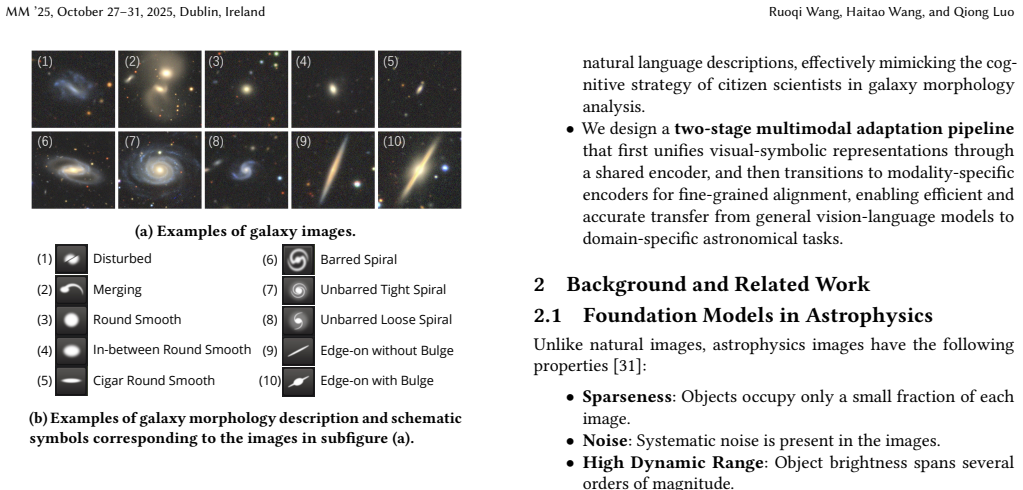
The load-bearing mechanism is a two-stage tri-modal alignment of CLIP-style encoders. Stage 1, a warm-up phase, runs a shared image encoder on photographs and schematic symbols paired with text through a contrastive loss, teaching a joint embedding space for visual and symbolic galaxy structure. Stage 2 copies the trained parameters into a dedicated symbol encoder and then fine-tunes image, symbol, and text encoders together with three pairwise contrastive losses (image-text, image-symbol, symbol-text). The parameter copy is what lets the symbol encoder start already aligned with images, so the encoders can specialize while remaining in a common embedding space. The schematic symbols themselves are simple line drawings from the Galaxy Zoo 2 decision tree, the same visual vocabulary used to instruct human volunteers.
What would settle it
Retrain GalaxAlign on Galaxy10 with the class-to-symbol mapping randomly permuted while keeping text and images intact; if accuracy and similarity-search mAP stay at the intact-symbol levels, the schematic modality is not carrying the claimed signal.
Extended reading notes
Core claim
The paper's central claim is that a tri-modal contrastive alignment of images, text, and schematic symbols lets a general pretrained vision-language model reach the level of a galaxy-specialist foundation model without large-scale astronomical pretraining. GalaxAlign fine-tunes CLIP in two stages: Stage 1 uses a shared image encoder on both galaxy photos and schematic symbols, paired with text descriptions through a contrastive loss, so the encoder learns a joint representation of photographic and symbolic galaxy structure; Stage 2 copies the shared encoder's parameters into a dedicated symbol encoder and fine-tunes image, symbol, and text encoders together using pairwise contrastive losses. On Galaxy10 the method reports 97.32% accuracy with a ViT backbone and 97.10% with ConvNeXT, compared with 96.00% for the stronger Zoobot baseline; on GalaxyMNIST it reports 92.72% and 93.72%, bracketing Zoobot's 93.60%. For similarity search, GalaxAlign reports mAP of 0.9645 and 0.9640 on Galaxy10, above Zoobot's 0.8492. The authors interpret these results as evidence that multimodal instructions can substitute for domain-specific pretraining in galaxy morphology tasks.
Load-bearing premise
The method's edge depends on schematic symbols adding morphological information beyond what the text labels already provide, so that tri-modal alignment is doing real work rather than acting as a regularizer on a two-tower image-text model.
Editorial extensions
If this is right
- Galaxy morphology classification becomes reachable by fine-tuning existing vision-language models, so groups without access to large annotated astronomical corpora can start from a smaller labeled set.
- On Galaxy10 and GalaxyMNIST the fine-tuned models match or slightly exceed the compared astronomical foundation model in accuracy, making the approach a plausible substitute for domain-specific pretraining in these benchmarks.
- Similarity search improves to 0.964 mAP on Galaxy10 from 0.849 for the best compared specialist model, strengthening the practical case for finding rare or structurally analogous galaxies from learned embeddings.
- Few-shot and reduced-data experiments show the method keeps the highest or nearly highest accuracy at every tested data size, indicating the multimodal recipe is data-efficient as well as annotation-light.
- The paper argues the same image-text-symbol recipe transfers to other sciences where schematic diagrams accompany imagery and descriptions, such as biology and geology.
Reading between the lines
- The authors do not report total training cost, but their central claim implies substantial savings: if the approach holds, the practical value is avoiding the multi-year, hundred-thousand-galaxy labeling campaigns that specialist pretraining requires, so a direct GPU-hour comparison would quantify that.
- Because the schematic symbols are simple and synthetic, a testable extension is replacing the exact Galaxy Zoo artwork with symbols generated on the fly from the textual class descriptions; if performance is unchanged, the information content of the decision tree, not the particular drawings, carries the effect.
- The same recipe should transfer to other science domains with decision-tree or atlas-style schematic guidance (radio galaxies, cell biology, mineralogy), where symbol-image-text triplets already exist; a positive result there would confirm that the mechanism is domain alignment rather than galaxy-specific tuning.
Editorial analysis
A structured set of objections, weighed in public.
Referee Report
Summary. The paper presents GalaxAlign, a tri-modal contrastive learning framework that fine-tunes CLIP for galaxy morphology classification and similarity search. The method aligns galaxy images, schematic symbols from the Galaxy Zoo 2 decision tree, and textual descriptions in two stages: first a shared image encoder processes images and symbols jointly with text, then three separate encoders are fine-tuned with pairwise contrastive losses. Experiments on Galaxy10 and GalaxyMNIST report classification accuracy/F1 comparable to Zoobot and better than several general-domain baselines, and higher mAP for similarity search. The paper also includes few-shot, data-size, and ablation studies, and releases code.
Significance. If the claims hold, GalaxAlign would offer a low-cost alternative to training domain-specific astronomical foundation models from scratch, by showing that multimodal guidance (text plus schematic symbols) can adapt generic vision-language models to a specialized scientific domain. The idea of mimicking citizen scientists' use of schematic symbols and text is well motivated, and the paper ships code, evaluates on two public datasets, and provides several baselines and ablations. However, the evidence is currently weakened by the absence of CLIP in the retrieval comparison, by non-uniform baseline training protocols, and by an unexplained ablation collapse in Table 5. These issues must be resolved before the central contribution can be firmly credited.
major comments (3)
- [Table 5, §3.3] The ConvNeXT row 'Loss w/o text-image' reports 0.5781 accuracy / 0.5503 F1 on Galaxy10 and 0.7390 / 0.7379 on GalaxyMNIST, while the corresponding ViT-16 row is nearly unchanged from the full model (0.9617 vs 0.9732 on Galaxy10). In the tri-modal loss defined in Eq. (2), removing the text-image contrastive term still leaves the symbol-image and symbol-text terms, so the image and text modalities remain aligned transitively through the symbol encoder; the dramatic, backbone-dependent degradation therefore has no stated mechanism in §3.3. The 'w/o Text' rows also drop sharply for both backbones (to 0.7965 for ViT and 0.7599 for ConvNeXT on Galaxy10) without discussion. Because Table 5 reports no standard deviations, these extreme drops read as training instabilities rather than meaningful ablation results. Please either provide a mechanistic explanation, re-run these ablations with multiple seeds and report variance, or remove the anomalous rows.
- [Table 3, §4.4] The similarity-search comparison in Table 3 omits the CLIP models entirely, even though GalaxAlign is initialized from CLIP and then fine-tuned. Without a CLIP retrieval baseline (either unfine-tuned or fine-tuned with only text-image alignment), the claim of 'superior performance over baseline methods' does not establish that the tri-modal alignment or the schematic-symbol stream improves retrieval over the starting backbone. Please add CLIP(ViT-16) and CLIP(ConvNeXT) rows to Table 3, and ideally report the zero-shot (unfine-tuned) CLIP embeddings as well.
- [A.2, Table 2] The baseline evaluation protocols are not uniform: Appendix A.2 states that MAE, DINOv2, MSN, and ViT-16 are evaluated with frozen encoders and a fine-tuned classification head following Lastufka et al., while ResNet-18/50, Zoobot, and GalaxAlign are fully fine-tuned. This makes the head-to-head numbers in Table 2, such as ViT-16 (0.7304) versus Ours (ViT-16, 0.9732) on Galaxy10, confound the training protocol with the method itself. The central claim that GalaxAlign 'outperform[s] all other methods' would be much more convincing if the key general-domain baselines were also evaluated under full fine-tuning (or, alternatively, under the same frozen-head protocol).
minor comments (4)
- [Section 3.2 / Appendix A.1] The main text states that 'just over 10 epochs' is sufficient for Stage 1, while Appendix A.1 reports training 50 epochs for the best results. Please reconcile this discrepancy and state the exact epoch count and any early-stopping criterion used for the reported numbers.
- [Table 1] The spelling of ConvNeXT is inconsistent: Table 1 and Table 2 use 'ConvNext' in some places and 'ConvNeXT' in others, and Table 1 labels the backbone 'ConvNext-Base'. Please unify the naming.
- [Figures 6 and 7] These figures show performance across data sizes and shot counts for many methods but contain no error bars or markers of statistical significance, making it difficult to judge whether the reported gaps are robust; adding variance would strengthen the few-shot and data-efficiency claims.
- [§4.6] The text describing the ablations refers to 'the results in Table 4' and then immediately discusses the CLIP comparison in Table 5; please clarify in the table captions the definitions of Ours_v1, Ours_v2, Ours_v3, and Ours_Scratch, and state clearly which table corresponds to which ablation.
Circularity Check
No circularity: GalaxAlign's claims rest on held-out evaluation and standard supervised fine-tuning, not on self-citation or fitted predictions.
full rationale
GalaxAlign is a standard supervised fine-tuning pipeline: it trains CLIP encoders with contrastive losses on a held-out training split of Galaxy10/GalaxyMNIST and evaluates accuracy/F1/mAP on a disjoint test split. No parameter is fitted to reproduce a test-set number, and no 'prediction' is renamed from a fit. The text and schematic-symbol modalities are constructed from the same class labels used for supervision, so they are label encodings rather than independent evidence; this is the standard CLIP zero-shot/few-shot protocol and does not make the evaluation circular, because the test labels are never used in training. There are no self-citations, no imported uniqueness theorems, and no ansatz smuggled via citations to the authors' own prior work. The empirical support for the symbol modality is weakened by the unexplained ConvNeXT 'Loss w/o text-image' collapse (0.5781 in Table 5) and by the omission of CLIP from the retrieval comparison in Table 3, but these are correctness and comparison concerns, not circularity. The derivation chain is therefore self-contained.
Assumptions & free parameters
free parameters (5)
- Learning rate (ViT) =
1e-4
- Learning rate (ConvNeXT) =
5e-6
- Weight decay (ViT) =
0.02
- Weight decay (ConvNeXT) =
0.0002
- Stage 1 epochs =
50 (Appendix A.1) or 10+ (Section 3.2)
assumptions (5)
- domain assumption Galaxy10 and GalaxyMNIST class labels are ground truth for morphology classification.
- domain assumption Schematic symbols from the Galaxy Zoo 2 decision tree adequately represent the morphology classes in Galaxy10 and GalaxyMNIST.
- ad hoc to paper The prompt 'A picture of a {class name}' is a sufficient textual description to convey galaxy morphology.
- ad hoc to paper The two-stage fine-tuning procedure (shared encoder then separate encoders) is an effective way to learn a shared embedding space.
- standard math Contrastive learning with the InfoNCE-style loss will align the three modalities as desired.
Cite this review
Pith. "Pith review of GalaxAlign: Mimicking Citizen Scientists' Multimodal Guidance for Galaxy Morphology Analysis." pith.science (2026). https://pith.science/paper/A6YRQTRC
@misc{pith2026241119475,
  author       = {Pith},
  title        = {Pith review of: GalaxAlign: Mimicking Citizen Scientists' Multimodal Guidance for Galaxy Morphology Analysis},
  year         = {2026},
  howpublished = {\url{https://pith.science/paper/A6YRQTRC}},
  note         = {Machine review of arXiv:2411.19475}
}
read the original abstract
Galaxy morphology analysis involves studying galaxies based on their shapes and structures. For such studies, fundamental tasks include identifying and classifying galaxies in astronomical images, as well as retrieving visually or structurally similar galaxies through similarity search. Existing methods either directly train domain-specific foundation models on large, annotated datasets or fine-tune vision foundation models on a smaller set of images. The former is effective but costly, while the latter is more resource-efficient but often yields lower accuracy. To address these challenges, we introduce GalaxAlign, a multimodal approach inspired by how citizen scientists identify galaxies in astronomical images by following textual descriptions and matching schematic symbols. Specifically, GalaxAlign employs a tri-modal alignment framework to align three types of data during fine-tuning: (1) schematic symbols representing galaxy shapes and structures, (2) textual labels for these symbols, and (3) galaxy images. By incorporating multimodal instructions, GalaxAlign eliminates the need for expensive pretraining and enhances the effectiveness of fine-tuning. Experiments on galaxy classification and similarity search demonstrate that our method effectively fine-tunes general pre-trained models for astronomical tasks by incorporating domain-specific multi-modal knowledge. Code is available at https://github.com/RapidsAtHKUST/GalaxAlign.
Figures


Figures from the paper (8 more)


Reference graph
Works this paper leans on
-
[1]
Mahmoud Assran, Mathilde Caron, Ishan Misra, Piotr Bojanowski, Florian Bordes, Pascal Vincent, Armand Joulin, Mike Rabbat, and Nicolas Ballas. 2022. Masked siamese networks for label-efficient learning. InEuropean Conference on Computer Vision. Springer, 456–473
work page 2022
-
[2]
Robert D Blum, Kaylan Burleigh, Arjun Dey, David J Schlegel, Aaron M Meis- ner, Michael Levi, Adam D Myers, Dustin Lang, John Moustakas, Anna Patej, et al. 2016. The decam legacy survey. In American Astronomical Society Meeting Abstracts# 228, Vol. 228. 317–01
work page 2016
-
[3]
Micah Bowles, Hongming Tang, Eleni Vardoulaki, Emma L Alexander, Yan Luo, Lawrence Rudnick, Mike Walmsley, Fiona Porter, Anna MM Scaife, Inigo Val Slijepcevic, et al. 2022. A New Task: Deriving Semantic Class Targets for the Physical Sciences. In NeurIPS 2022 Machine Learning and the Physical Sciences Workshop
work page 2022
-
[4]
Micah Bowles, Hongming Tang, Eleni Vardoulaki, Emma L Alexander, Yan Luo, Lawrence Rudnick, Mike Walmsley, Fiona Porter, Anna MM Scaife, Inigo Val Slijepcevic, et al. 2023. Radio galaxy zoo EMU: towards a semantic radio galaxy morphology taxonomy. Monthly Notices of the Royal Astronomical Society 522, 2 (2023), 2584–2600
work page 2023
-
[5]
Jia Deng, Wei Dong, Richard Socher, Li-Jia Li, Kai Li, and Li Fei-Fei. 2009. Imagenet: A large-scale hierarchical image database. In 2009 IEEE conference on computer vision and pattern recognition . Ieee, 248–255
2009
-
[6]
Arjun Dey, David J Schlegel, Dustin Lang, Robert Blum, Kaylan Burleigh, Xiaohui Fan, Joseph R Findlay, Doug Finkbeiner, David Herrera, Stéphanie Juneau, et al
-
[7]
Sander Dieleman, Kyle W Willett, and Joni Dambre. 2015. Rotation-invariant convolutional neural networks for galaxy morphology prediction.Monthly notices of the royal astronomical society 450, 2 (2015), 1441–1459
work page 2015
-
[8]
Alexey Dosovitskiy. 2020. An image is worth 16x16 words: Transformers for image recognition at scale. arXiv preprint arXiv:2010.11929 (2020)
arXiv 2020
Show all 44 references
-
[9]
Samir Yitzhak Gadre, Gabriel Ilharco, Alex Fang, Jonathan Hayase, Georgios Smyrnis, Thao Nguyen, Ryan Marten, Mitchell Wortsman, Dhruba Ghosh, Jieyu Zhang, et al. 2023. Datacomp: In search of the next generation of multimodal datasets. Advances in Neural Information Processing...
2023
-
[10]
Kaiming He, Xinlei Chen, Saining Xie, Yanghao Li, Piotr Dollár, and Ross Girshick
-
[11]
Kaiming He, Xiangyu Zhang, Shaoqing Ren, and Jian Sun. 2016. Deep residual learning for image recognition. In Proceedings of the IEEE conference on computer vision and pattern recognition . 770–778
2016
-
[12]
Leung Henry. 2021. Galaxy10 DECals Dataset. https://github.com/henrysky/Galaxy10
2021
-
[13]
Edward J Hu, Yelong Shen, Phillip Wallis, Zeyuan Allen-Zhu, Yuanzhi Li, Shean Wang, Lu Wang, Weizhu Chen, et al. 2022. Lora: Low-rank adaptation of large language models. ICLR 1, 2 (2022), 3
2022
-
[14]
Gabriel Ilharco, Mitchell Wortsman, Ross Wightman, Cade Gordon, Nicholas Carlini, Rohan Taori, Achal Dave, Vaishaal Shankar, Hongseok Namkoong, John Miller, Hannaneh Hajishirzi, Ali Farhadi, and Ludwig Schmidt. 2021. OpenCLIP. doi:10.5281/zenodo.5143773 If you use this softwar...
2021 doi
-
[15]
Raza Imam, Mohammed Talha Alam, Umaima Rahman, Mohsen Guizani, and Fakhri Karray. 2024. CosmoCLIP: Generalizing Large Vision-Language Models for Astronomical Imaging. arXiv preprint arXiv:2407.07315 (2024)
2024 arXiv
-
[16]
Manuel Jiménez, Emilio J Alfaro, Mercedes Torres Torres, and Isaac Triguero. 2023. CzSL: Learning from citizen science, experts, and unlabelled data in astronomical image classification. Monthly Notices of the Royal Astronomical Society 526, 2 (2023), 1742–1756
2023
-
[17]
Francois Lanusse, Liam Holden Parker, Siavash Golkar, Alberto Bietti, Miles Cranmer, Michael Eickenberg, Geraud Krawezik, Michael McCabe, Ruben Ohana, Mariel Pettee, et al. 2023. AstroCLIP: cross-modal pre-training for astronomical foundation models. In NeurIPS 2023 AI for Sci...
2023
-
[18]
Chris Lintott, Kevin Schawinski, Steven Bamford, Anže Slosar, Kate Land, Daniel Thomas, Edd Edmondson, Karen Masters, Robert C Nichol, M Jordan Raddick, et al. 2011. Galaxy Zoo 1: data release of morphological classifications for nearly 900 000 galaxies. Monthly Notices of the...
2011
-
[19]
Haotian Liu, Chunyuan Li, Qingyang Wu, and Yong Jae Lee. 2023. Visual in- struction tuning. Advances in neural information processing systems 36 (2023), 34892–34916
2023
-
[20]
Shengchao Liu, Yanjing Li, Zhuoxinran Li, Anthony Gitter, Yutao Zhu, Jiarui Lu, Zhao Xu, Weili Nie, Arvind Ramanathan, Chaowei Xiao, et al. 2023. A text-guided protein design framework. arXiv preprint arXiv:2302.04611 (2023)
2023 arXiv
-
[21]
Siddharth Mishra-Sharma, Yiding Song, and Jesse Thaler. 2024. PAPERCLIP: Associating Astronomical Observations and Natural Language with Multi-Modal Models. arXiv preprint arXiv:2403.08851 (2024)
2024 arXiv
-
[22]
Maxime Oquab, Timothée Darcet, Théo Moutakanni, Huy Vo, Marc Szafraniec, Vasil Khalidov, Pierre Fernandez, Daniel Haziza, Francisco Massa, Alaaeldin El- Nouby, et al. 2023. Dinov2: Learning robust visual features without supervision. arXiv preprint arXiv:2304.07193 (2023)
2023 arXiv
-
[23]
Alec Radford, Jong Wook Kim, Chris Hallacy, Aditya Ramesh, Gabriel Goh, Sandhini Agarwal, Girish Sastry, Amanda Askell, Pamela Mishkin, Jack Clark, et al. 2021. Learning transferable visual models from natural language supervision. In International conference on machine learni...
2021
-
[24]
Olga Russakovsky, Jia Deng, Hao Su, Jonathan Krause, Sanjeev Satheesh, Sean Ma, Zhiheng Huang, Andrej Karpathy, Aditya Khosla, Michael Bernstein, et al
-
[25]
Ana Sanchez-Fernandez, Elisabeth Rumetshofer, Sepp Hochreiter, and Günter Klambauer. 2023. CLOOME: contrastive learning unlocks bioimaging databases for queries with chemical structures. Nature Communications 14, 1 (2023), 7339
2023
-
[26]
Christoph Schuhmann, Romain Beaumont, Richard Vencu, Cade Gordon, Ross Wightman, Mehdi Cherti, Theo Coombes, Aarush Katta, Clayton Mullis, Mitchell Wortsman, et al. 2022. Laion-5b: An open large-scale dataset for training next generation image-text models. Advances in neural i...
2022
-
[27]
David R Silva, Robert D Blum, Lori Allen, Arjun Dey, David J Schlegel, Dustin Lang, John Moustakas, Aaron M Meisner, Francisco Valdes, Anna Patej, et al. 2016. The Mayall z-band Legacy Survey. In American Astronomical Society Meeting Abstracts# 228, Vol. 228. 317–02
2016
-
[28]
Inigo V Slijepcevic, Anna MM Scaife, Mike Walmsley, Micah Bowles, O Ivy Wong, Stanislav S Shabala, and Sarah V White. 2024. Radio galaxy zoo: towards building the first multipurpose foundation model for radio astronomy with self-supervised learning. RAS Techniques and Instrume...
2024
-
[29]
Laurens Van der Maaten and Geoffrey Hinton. 2008. Visualizing data using t-SNE. Journal of machine learning research 9, 11 (2008)
2008
-
[30]
Vicente Vivanco Cepeda, Gaurav Kumar Nayak, and Mubarak Shah. 2024. Geoclip: Clip-inspired alignment between locations and images for effective worldwide geo-localization. Advances in Neural Information Processing Systems 36 (2024)
2024
-
[31]
S Voloshynovskyy. 2024. Vision foundation models: can they be applied to astrophysics data? arXiv preprint arXiv:2409.11175 (2024)
2024
-
[32]
Mike Walmsley. 2022. Galaxy MNIST Dataset. https://github.com/mwalmsley/galaxy_mnist
2022
-
[33]
Mike Walmsley, Campbell Allen, Ben Aussel, Micah Bowles, Kasia Gregorow- icz, Inigo Val Slijepcevic, Chris J Lintott, Anna M Scaife, Maja Jabłońska, Kosio Karchev, et al. 2023. Zoobot: Adaptable Deep Learning Models for GalaxyMor- phology. Journal of Open Source Software 8, 85 (2023)
2023
-
[34]
Mike Walmsley, Tobias Géron, Sandor Kruk, Anna MM Scaife, Chris Lintott, Karen L Masters, James M Dawson, Hugh Dickinson, Lucy Fortson, Izzy L Garland, et al. 2023. Galaxy Zoo DESI: Detailed morphology measurements for 8.7 M galaxies in the DESI Legacy Imaging Surveys. Monthly...
2023
-
[35]
Mike Walmsley, Chris Lintott, Tobias Géron, Sandor Kruk, Coleman Krawczyk, Kyle W Willett, Steven Bamford, Lee S Kelvin, Lucy Fortson, Yarin Gal, et al. 2022. Galaxy Zoo DECaLS: Detailed visual morphology measurements from volunteers and deep learning for 314 000 galaxies. Mon...
2022
-
[36]
Mike Walmsley, Anna MM Scaife, Chris Lintott, Michelle Lochner, Verlon Et- sebeth, Tobias Géron, Hugh Dickinson, Lucy Fortson, Sandor Kruk, Karen L Masters, et al. 2022. Practical galaxy morphology tools from deep supervised representation learning. Monthly Notices of the Roya...
2022
-
[37]
Mike Walmsley, Lewis Smith, Chris Lintott, Yarin Gal, Steven Bamford, Hugh Dickinson, Lucy Fortson, Sandor Kruk, Karen Masters, Claudia Scarlata, et al
-
[38]
Kyle W Willett, Chris J Lintott, Steven P Bamford, Karen L Masters, Brooke D Simmons, Kevin RV Casteels, Edward M Edmondson, Lucy F Fortson, Sugata Kaviraj, William C Keel, et al . 2013. Galaxy Zoo 2: detailed morphological classifications for 304 122 galaxies from the Sloan D...
2013
-
[39]
The Galaxy Zoo. 2024. Galaxy Zoo Classification. https://www.zooniverse.org/projects/zookeeper/galaxy-zoo/classify. Nov. 2024
2024
-
[40]
Hu Zou, Xu Zhou, Xiaohui Fan, Tianmeng Zhang, Zhimin Zhou, Jundan Nie, Xiyan Peng, Ian McGreer, Linhua Jiang, Arjun Dey, et al. 2017. Project overview of the beijing–arizona sky survey. Publications of the Astronomical Society of the Pacific 129, 976 (2017), 064101. GalaxAlign...
2017
-
[2015]
International journal of computer vision 115 (2015), 211–252
Imagenet large scale visual recognition challenge. International journal of computer vision 115 (2015), 211–252
2015
-
[2019]
The Astronomical Journal 157, 5 (2019), 168
Overview of the DESI legacy imaging surveys. The Astronomical Journal 157, 5 (2019), 168
2019
-
[2020]
Monthly Notices of the Royal Astronomical Society 491, 2 (2020), 1554– 1574
Galaxy Zoo: probabilistic morphology through Bayesian CNNs and active learning. Monthly Notices of the Royal Astronomical Society 491, 2 (2020), 1554– 1574
2020
-
[2022]
In Proceedings of the IEEE/CVF conference on computer vision and pattern recognition
Masked autoencoders are scalable vision learners. In Proceedings of the IEEE/CVF conference on computer vision and pattern recognition . 16000–16009
Reviewed August 12, 2026 · model on record in the stance chip above.
Discussion (0). Continue with ORCID to comment.