REVIEW 4 major objections 5 minor 51 references
HiMoE: Heterogeneity-Informed Mixture-of-Experts for Fair Spatial-Temporal Forecasting
T0 review · 4 major / 5 minor · reviewed 2026-08-12 · deepseek-v4-flash
Pith's one-line read The paper claims existing forecasting losses are biased against low-activity nodes, and presents HiMoE plus a ratio-based fairness benchmark that beats the best baseline by at least 9.22% on every metric across four urban datasets.
desk verdict A credible architecture for fair ST forecasting whose fairness metric is a reweighted MAE, with an unfair head-to-head in the main table—but the accuracy gains are independent and the paper deserves peer review. read the letter →
The pith
A machine-rendered reading of the paper's core claim, the machinery that carries it, and where it could break.
The reading
What carries the argument
The load-bearing object is the weighted MAE of Eq. 10, $\mathrm{WMAE}_i = \frac{\mathrm{mean}(X)}{\mathrm{mean}(X_i)} \cdot \frac{1}{T'} \sum_j |X_i^j - \hat{X}_i^j|$, which rescales each node's absolute error by its own mean value so that low-cardinality and high-cardinality nodes are compared on the same relative footing; MWMAE is its mean across nodes and SWMAE its standard deviation, and the training loss $L = \mathrm{MWMAE} + \alpha\,\mathrm{SWMAE}$ is what presses the model toward consistency. The architecture that carries the accuracy side is HiGCN, which fuses a Gaussian-kernel static adjacency matrix with a dynamic trend-similarity adjacency matrix and applies a tanh edge gate before spectral graph convolution, and NMoE, which learns cardinality representations, routes nodes to experts through a temperature-controlled softmax over expert centers, and prunes inter-node edges inside each expert so that nodes of very different magnitudes are not forced to depend on each other.
What would settle it
Build a synthetic or real dataset where all nodes have identical means, train HiMoE with the STFairBench loss, and check whether SWMAE still drops substantially relative to MAE training; if it does, the cardinality-normalization story is not the source of the gain. Alternatively, replace WMAE with MAPE plus a small epsilon in the same loss; if the SWMAE improvements disappear, the specific WMAE ratio is load-bearing, and if they remain, the fairness contribution of the metric is weaker than claimed.
Extended reading notes
Core claim
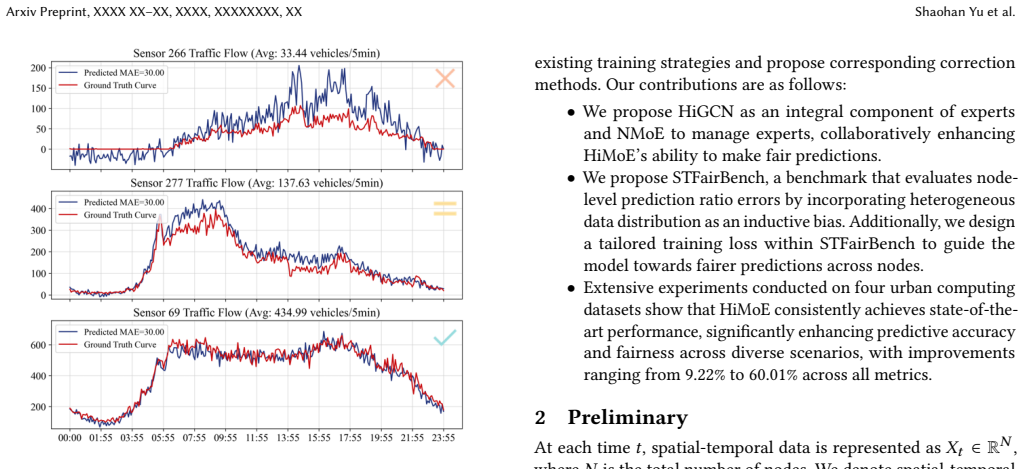
The paper's central claim is that node-level heterogeneity has two distinct forms and both must be addressed jointly to get accurate and fair spatial-temporal forecasts. Trend heterogeneity—different daily patterns across nodes—requires graph convolutions that fuse static distance graphs with dynamic trend-similarity graphs. Cardinality heterogeneity—different average magnitudes across nodes—requires assigning nodes to experts by magnitude so that low-volume nodes are not modeled together with high-volume nodes. The paper further claims that MAE and RMSE are unfair for this purpose, and that its WMAE metric, which normalizes each node's error by its own mean, gives an unbiased node-level fairness signal. It reports state-of-the-art results on the PeMS04, Beijing, Tongzhou, and KnowAir datasets, with improvements from 9.22% to 60.01% across MAE, RMSE, MAPE, MWMAE, and SWMAE, and it claims to be the first method to identify and correct node-level bias in spatial-temporal prediction.
Load-bearing premise
The claim rests on the assumption that WMAE, which divides each node's absolute error by its own mean value, is an unbiased measure of node-level prediction quality, so that reducing its cross-node spread is genuine fairness rather than just reshaping errors to fit a chosen ratio.
Editorial extensions
If this is right
- If the WMAE-based benchmark is accepted, future fairness results in spatial-temporal forecasting should report MWMAE and SWMAE alongside MAE, RMSE, and MAPE.
- If the fairness loss works as claimed, training with MWMAE plus alpha times SWMAE should reduce cross-node error spread without sacrificing average accuracy.
- If the empirical results hold, fine-grained mixture-of-experts with many small experts is a viable scaling path for spatial-temporal forecasting, not just for large language models.
- If the ablations reflect the true mechanism, both the trend-based dynamic graph fusion and the node-wise input gating are necessary for the reported gains.
Reading between the lines
- A natural extension is to test whether minimizing SWMAE also reduces worst-case error on low-activity nodes or merely shifts error toward medium-activity nodes, since the metric alone does not distinguish those outcomes.
- The gating is driven by cardinality embeddings, which suggests a testable transfer experiment: train expert centers on one city and route a second city's sensors without retraining, checking whether the learned cardinality ordering transfers.
- The WMAE construction is close to a relative error, so the benchmark could plausibly generalize beyond traffic and air quality to other spatiotemporal tasks with strong cardinality heterogeneity, such as energy load or mobility demand forecasting.
Signed reviews
Editorial analysis
A structured set of objections, weighed in public.
Referee Report
Summary. This paper proposes HiMoE, a spatial-temporal forecasting framework combining a Heterogeneity-Informed Graph Convolutional Network (HiGCN) for trend heterogeneity and a Node-wise Mixture-of-Experts (NMoE) for cardinality heterogeneity. It also introduces STFairBench, a fairness benchmark with a new node-level metric WMAE and a training loss. Experiments on PeMS04, Beijing, Tongzhou, and KnowAir report that HiMoE outperforms seven baselines by 9.22%-60.01% across MAE, RMSE, MAPE, MWMAE, and SWMAE, with ablations, parameter sensitivity, efficiency, and case studies.
Significance. If the claims hold, the architecture is a plausible contribution to balancing accuracy and consistency in multi-node forecasting, and STFairBench could be a reusable evaluation framework. The efficiency analysis and the attempt to control for the training loss in Table 3 are useful steps. However, the headline comparison is confounded by training loss, and the fairness metric is used both for training and evaluation, so the scientific claims require careful validation before the work can be considered a reliable state-of-the-art result.
major comments (4)
- [Section 4.2, Table 2] The state-of-the-art comparison is confounded by the training loss. HiMoE is trained with the STFairBench loss (Eq. 13) while each baseline uses its original loss. Since the loss directly controls the trade-off between accuracy and consistency, the improvements in MWMAE and SWMAE may be attributed to the loss function rather than the HiMoE architecture. Section 4.4 (Table 3) retrains baselines with the fairness loss, but only on PeMS04, so the abstract's claim of 'outperforming the best baseline by at least 9.22% across all evaluation metrics' is not supported by a like-for-like comparison on the other three datasets. Please provide controlled comparisons across all datasets, or restrict the claims appropriately.
- [Section 3.3, Eqs. (10)-(13)] The fairness metric WMAE is authored in this paper and is used both as the training objective (Eq. 13) and as the evaluation metric (MWMAE/SWMAE). This creates a circularity that makes the reported fairness gains partly self-confirming. The paper does not validate that WMAE is a meaningful fairness metric; it is a reweighted MAE with weights inverse to the node's mean, and the claim that MAE is 'inherently biased' is not formally justified. Please provide an external validation, for example by showing that SWMAE correlates with errors on low-volume nodes or by comparing against another fairness definition from the literature.
- [Section 4.2-4.6] The experiments report single runs with no error bars, seeds, or significance tests. Consequently, it is unclear whether the large margins over baselines are within run-to-run variance. The paper states that implementation details are in a code repository, but no repository link is provided. Please add code and detailed experimental settings (data splits, seeds, hyperparameters) and report standard deviations over at least three runs.
- [Introduction and Section 6] The paper claims that 'HiMoE is the first method to identify node-level bias in spatial-temporal predictions arising from existing training strategies.' This is contradicted by the paper's own related work (Section 5.1), which cites STMoE (Li et al., 2023) as mitigating performance bias across road segments and FairSTG (Lin et al., 2024) as targeting performance heterogeneity. Please revise the novelty claim to a precise statement and describe the specific differences from these methods.
minor comments (5)
- [Section 3.3] The definition of WMAE in Eq. (10) states that 'both X_i and X represent the entire time series,' but the next sentence says the training loss excludes test data. Please clarify which data splits are used to compute the scaling factors for the training loss versus the evaluation metric.
- [Section 3.2.2] The text says 'applying sparsity over the expert dimension' after Eq. (7), but the softmax does not zero out any expert probabilities. If sparsity is achieved by top-k selection or by the sigmoid output gating in Eq. (9), please state the explicit sparsification mechanism.
- [Section 4.5] Figure 5 and Figure 6 are informative, but the sensitivity analysis would be strengthened by reporting numerical values or error bars, especially for the claim that 'increasing k consistently improves prediction performance'.
- [Section 4.6] The statement 'HiMoE is the first to adopt a fine-grained expert mixture framework' is too strong without a formal definition of 'fine-grained' and given the existing MoE-based spatial-temporal models cited in the paper.
- [Section 4.1.4] The paper references a code repository for implementation details, but no URL is given in the text or footnotes.
Circularity Check
Fairness claim is partly self-confirming because the WMAE/SWMAE metric is both the training objective and the evaluation metric; the accuracy claim remains independent.
-
fitted input called prediction
[Section 3.3 (Eqs. 10-13) and Section 4.1.3 / Section 4.2]
"Based on the proposed MWMAE and SWMAE metrics, we construct a loss function that explicitly guides the model toward fair spatial-temporal prediction: L(X, X̂) = LMWMAE(X, X̂) + αLSWMAE(X, X̂). ... Additionally, we adopt STFairBench proposed in Section 3.3 for a fair evaluation of both accuracy and consistency."
The fairness criterion is defined by the paper's own Eq. 12 (SWMAE), and that same quantity is used as a training loss term in Eq. 13 and as the headline fairness evaluation metric in Section 4.1.3. HiMoE is therefore directly optimized to minimize the exact metric later reported as the fairness result, so the large SWMAE/MWMAE improvements claimed in Section 4.2 are partly guaranteed by construction rather than by an independent test of fairness. The MAE/RMSE/MAPE gains are not circular, but the paper's fairness conclusion reduces to the assertion that minimizing its self-defined WMAE spread is what fairness means.
full rationale
The accuracy derivation is largely self-contained: HiGCN and NMoE are trained with a WMAE-based loss but evaluated on standard MAE/RMSE/MAPE, and the reported gains on those independent metrics are not forced by the loss definition. Table 3 also retrains baselines with the proposed fairness loss, providing partial external grounding for STFairBench's transferability. The main circularity is restricted to the fairness claim: WMAE (Eq. 10) is an author-defined reweighted MAE, SWMAE (Eq. 12) is declared a measure of fairness, and the same quantities form both the training objective (Eq. 13) and the evaluation metrics (Section 4.1.3). Thus the fairness improvement is substantially self-confirming unless SWMAE is independently validated as a meaningful fairness criterion, which the paper does not provide. No load-bearing self-citations or imported uniqueness theorems were found; the few self-citations in the reference list are ordinary background citations. Overall circularity is moderate, not total, because the architecture's accuracy contribution stands independently while the fairness contribution is partly defined into existence.
Assumptions & free parameters
free parameters (5)
- Loss trade-off coefficient alpha =
0.5
- Number of experts k =
14
- Softmax temperature tau =
not reported
- Gaussian kernel scale sigma and distance threshold epsilon =
not reported
- HiGCN hidden dimensions =
MLP 8, GCN 64
assumptions (6)
- domain assumption Static adjacency built from a Gaussian kernel over physical distance is a valid spatial prior.
- domain assumption The dynamic adjacency matrix derived from node embedding similarity captures trend heterogeneity among nodes.
- ad hoc to paper WMAE, which normalizes absolute error by the node's mean value, is an unbiased evaluation metric.
- ad hoc to paper Minimizing the standard deviation of WMAE across nodes produces fair prediction.
- domain assumption The number of experts follows a scaling law similar to large language models.
- domain assumption Single-layer spectral GCN on the static graph is sufficient to represent node cardinality context.
invented entities (2)
-
Expert center vectors e_1 to e_k
-
Node cardinality embedding R and its z-scored version
Cite this review
Pith. "Pith review of HiMoE: Heterogeneity-Informed Mixture-of-Experts for Fair Spatial-Temporal Forecasting." pith.science (2026). https://pith.science/paper/7CX4ANIK
@misc{pith2026241200316,
  author       = {Pith},
  title        = {Pith review of: HiMoE: Heterogeneity-Informed Mixture-of-Experts for Fair Spatial-Temporal Forecasting},
  year         = {2026},
  howpublished = {\url{https://pith.science/paper/7CX4ANIK}},
  note         = {Machine review of arXiv:2412.00316}
}
read the original abstract
Achieving both accurate and consistent predictive performance across spatial nodes is crucial for ensuring the validity and reliability of outcomes in fair spatial-temporal forecasting tasks. However, existing training methods treat heterogeneous nodes with a fully averaged perspective, resulting in inherently biased prediction targets. Balancing accuracy and consistency is particularly challenging due to the multi-objective nature of spatial-temporal forecasting. To address this issue, we propose a novel Heterogeneity-Informed Mixture-of-Experts (HiMoE) framework that delivers both uniform and precise spatial-temporal predictions. From a model architecture perspective, we design the Heterogeneity-Informed Graph Convolutional Network (HiGCN) to address trend heterogeneity, and we introduce the Node-wise Mixture-of-Experts (NMoE) module to handle cardinality heterogeneity across nodes. From an evaluation perspective, we propose STFairBench, a benchmark that handles fairness in spatial-temporal prediction from both training and evaluation stages. Extensive experiments on four real-world datasets demonstrate that HiMoE achieves state-of-the-art performance, outperforming the best baseline by at least 9.22% across all evaluation metrics.
Figures


Figures from the paper (4 more)


Reference graph
Works this paper leans on
-
[1]
Mikel Artetxe, Shruti Bhosale, Naman Goyal, Todor Mihaylov, Myle Ott, Sam Shleifer, Xi Victoria Lin, Jingfei Du, Srinivasan Iyer, Ramakanth Pasunuru, et al
-
[2]
Lei Bai, Lina Yao, Can Li, Xianzhi Wang, and Can Wang. 2020. Adaptive graph convolutional recurrent network for traffic forecasting. Advances in neural information processing systems 33 (2020), 17804–17815
2020
-
[3]
Weilin Cai, Juyong Jiang, Fan Wang, Jing Tang, Sunghun Kim, and Jiayi Huang
-
[4]
Xu Chen, Junshan Wang, and Kunqing Xie. 2021. Trafficstream: A streaming traffic flow forecasting framework based on graph neural networks and continual learning. Proceedings of the Thirtieth International Joint Conference on Artificial Intelligence (2021)
work page 2021
-
[5]
Jeongwhan Choi, Hwangyong Choi, Jeehyun Hwang, and Noseong Park. 2022. Graph neural controlled differential equations for traffic forecasting. In Proceed- ings of the AAAI conference on artificial intelligence , Vol. 36. 6367–6374
work page 2022
-
[6]
Pan Deng, Yu Zhao, Junting Liu, Xiaofeng Jia, and Mulan Wang. 2023. Spatio- Temporal Neural Structural Causal Models for Bike Flow Prediction. Proceedings of the AAAI Conference on Artificial Intelligence 37, 4 (Jun. 2023), 4242–4249. doi:10.1609/aaai.v37i4.25542
-
[7]
Zheng Dong, Renhe Jiang, Haotian Gao, Hangchen Liu, Jinliang Deng, Qingsong Wen, and Xuan Song. 2024. Heterogeneity-Informed Meta-Parameter Learning for Spatiotemporal Time Series Forecasting. In Proceedings of the 30th ACM SIGKDD Conference on Knowledge Discovery and Data Mining . 631–641
work page 2024
-
[8]
Nan Du, Yanping Huang, Andrew M Dai, Simon Tong, Dmitry Lepikhin, Yuanzhong Xu, Maxim Krikun, Yanqi Zhou, Adams Wei Yu, Orhan Firat, et al
Show all 51 references
-
[9]
Zhiwen Fan, Rishov Sarkar, Ziyu Jiang, Tianlong Chen, Kai Zou, Yu Cheng, Cong Hao, Zhangyang Wang, et al. 2022. M 3vit: Mixture-of-experts vision transformer for efficient multi-task learning with model-accelerator co-design. Advances in Neural Information Processing Systems 3...
2022
-
[10]
Haotian Gao, Renhe Jiang, Zheng Dong, Jinliang Deng, Yuxin Ma, and Xuan Song. 2024. Spatial-Temporal-Decoupled Masked Pre-training for Spatiotemporal Forecasting. In Proceedings of the Thirty-Third International Joint Conference on Artificial Intelligence, IJCAI-24, Kate Larso...
2024 doi
-
[11]
In International Conference on Machine Learning
Glam: Efficient scaling of language models with mixture-of-experts. In International Conference on Machine Learning . PMLR, 5547–5569
-
[12]
Jindong Han, Hao Liu, Haoyi Xiong, and Jing Yang. 2022. Semi-supervised air quality forecasting via self-supervised hierarchical graph neural network. IEEE Transactions on Knowledge and Data Engineering 35, 5 (2022), 5230–5243
2022
-
[13]
Jindong Han, Hao Liu, Hengshu Zhu, Hui Xiong, and Dejing Dou. 2021. Joint air quality and weather prediction based on multi-adversarial spatiotemporal networks. In Proceedings of the AAAI Conference on Artificial Intelligence , Vol. 35. 4081–4089
2021
-
[14]
Shengnan Guo, Youfang Lin, Ning Feng, Chao Song, and Huaiyu Wan. 2019. Attention based spatial-temporal graph convolutional networks for traffic flow forecasting. In Proceedings of the AAAI conference on artificial intelligence , Vol. 33. 922–929
2019
-
[15]
Liangzhe Han, Bowen Du, Leilei Sun, Yanjie Fu, Yisheng Lv, and Hui Xiong
-
[16]
Hui He, Qi Zhang, Shoujin Wang, Kun Yi, Zhendong Niu, and Longbing Cao
-
[17]
Jindong Han, Weijia Zhang, Hao Liu, Tao Tao, Naiqiang Tan, and Hui Xiong
-
[18]
BigST: Linear Complexity Spatio-Temporal Graph Neural Network for Traffic Forecasting on Large-Scale Road Networks. Proc. VLDB Endow. 17, 5 (May 2024), 1081–1090. doi:10.14778/3641204.3641217
2024
-
[19]
Wenzhao Jiang, Jindong Han, Hao Liu, Tao Tao, Naiqiang Tan, and Hui Xiong
-
[20]
Guangyin Jin, Yuxuan Liang, Yuchen Fang, Zezhi Shao, Jincai Huang, Junbo Zhang, and Yu Zheng. 2023. Spatio-Temporal Graph Neural Networks for Predic- tive Learning in Urban Computing: A Survey. IEEE Trans. on Knowl. and Data Eng. 36, 10 (Nov. 2023), 5388–5408. doi:10.1109/TKDE...
2023
-
[21]
Xue-Bo Jin, Zhong-Yao Wang, Jian-Lei Kong, Yu-Ting Bai, Ting-Li Su, Hui-Jun Ma, and Prasun Chakrabarti. 2023. Deep spatio-temporal graph network with self-optimization for air quality prediction. Entropy 25, 2 (2023), 247
2023
-
[22]
IEEE Transactions on Knowledge and Data Engineering 36, 6 (2024), 2504–2516
Learning Informative Representation for Fairness-Aware Multivariate Time- Series Forecasting: A Group-Based Perspective. IEEE Transactions on Knowledge and Data Engineering 36, 6 (2024), 2504–2516. doi:10.1109/TKDE.2023.3323956
2024
-
[23]
Jiahao Ji, Jingyuan Wang, Chao Huang, Junjie Wu, Boren Xu, Zhenhe Wu, Junbo Zhang, and Yu Zheng. 2023. Spatio-temporal self-supervised learning for traffic flow prediction. In Proceedings of the AAAI conference on artificial intelligence , Vol. 37. 4356–4364
2023
-
[24]
Renhe Jiang, Zhaonan Wang, Jiawei Yong, Puneet Jeph, Quanjun Chen, Ya- sumasa Kobayashi, Xuan Song, Shintaro Fukushima, and Toyotaro Suzumura
-
[25]
Gengyu Lin, Zhengyang Zhou, Qihe Huang, Kuo Yang, Shifen Cheng, and Yang Wang. 2024. FairSTG: Countering performance heterogeneity via collaborative sample-level optimization. IEEE Transactions on Mobile Computing (2024)
2024
-
[26]
Aixin Liu, Bei Feng, Bing Xue, Bingxuan Wang, Bochao Wu, Chengda Lu, Cheng- gang Zhao, Chengqi Deng, Chenyu Zhang, Chong Ruan, et al. 2024. Deepseek-v3 technical report. arXiv preprint arXiv:2412.19437 (2024)
2024 arXiv
-
[27]
In Proceedings of the 30th ACM SIGKDD Conference on Knowledge Discovery and Data Mining
Interpretable cascading mixture-of-experts for urban traffic congestion prediction. In Proceedings of the 30th ACM SIGKDD Conference on Knowledge Discovery and Data Mining . 5206–5217
-
[28]
Yanlin Qi, Qi Li, Hamed Karimian, and Di Liu. 2019. A hybrid model for spa- tiotemporal forecasting of PM2.5 based on graph convolutional neural network and long short-term memory. Science of The Total Environment 664 (2019), 1–10. doi:10.1016/j.scitotenv.2019.01.333
2019 doi
-
[29]
Carlos Riquelme, Joan Puigcerver, Basil Mustafa, Maxim Neumann, Rodolphe Jenatton, André Susano Pinto, Daniel Keysers, and Neil Houlsby. 2021. Scaling vision with sparse mixture of experts. Advances in Neural Information Processing Systems 34 (2021), 8583–8595
2021
-
[30]
Jared Kaplan, Sam McCandlish, Tom Henighan, Tom B Brown, Benjamin Chess, Rewon Child, Scott Gray, Alec Radford, Jeffrey Wu, and Dario Amodei. 2020. Scaling laws for neural language models. arXiv preprint arXiv:2001.08361 (2020)
2020 arXiv
-
[31]
Hyunwook Lee and Sungahn Ko. 2024. TESTAM: A Time-Enhanced Spatio- Temporal Attention Model with Mixture of Experts. In The Twelfth Interna- tional Conference on Learning Representations . https://openreview.net/forum?id= N0nTk5BSvO
2024
-
[32]
Shuhao Li, Yue Cui, Yan Zhao, Weidong Yang, Ruiyuan Zhang, and Xiaofang Zhou. 2023. ST-MoE: Spatio-Temporal Mixture-of-Experts for Debiasing in Traffic Prediction. In Proceedings of the 32nd ACM International Conference on Information and Knowledge Management (Birmingham, Unit...
2023
-
[33]
Zixing Song, Yuji Zhang, and Irwin King. 2023. Towards fair financial services for all: A temporal GNN approach for individual fairness on transaction net- works. In Proceedings of the 32nd ACM international conference on information and knowledge management. 2331–2341
2023
-
[34]
Lucas Theis and Matthias Bethge. 2015. Generative image modeling using spatial lstms. Advances in neural information processing systems 28 (2015)
2015
-
[35]
Mingqi Lv, Zhaoxiong Hong, Ling Chen, Tieming Chen, Tiantian Zhu, and Shoul- ing Ji. 2020. Temporal multi-graph convolutional network for traffic flow pre- diction. IEEE Transactions on Intelligent Transportation Systems 22, 6 (2020), 3337–3348
2020
-
[36]
Ziyang Wu, Fan Liu, Jindong Han, Yuxuan Liang, and Hao Liu. 2024. Spatial- Temporal Mixture-of-Graph-Experts for Multi-Type Crime Prediction. arXiv preprint arXiv:2409.15764 (2024)
2024 arXiv
-
[37]
Zonghan Wu, Shirui Pan, Guodong Long, Jing Jiang, Xiaojun Chang, and Chengqi Zhang. 2020. Connecting the Dots: Multivariate Time Series Forecasting with Graph Neural Networks. In Proceedings of the 26th ACM SIGKDD International Conference on Knowledge Discovery & Data Mining (...
2020
-
[38]
Zezhi Shao, Zhao Zhang, Wei Wei, Fei Wang, Yongjun Xu, Xin Cao, and Chris- tian S. Jensen. 2022. Decoupled dynamic spatial-temporal graph neural net- work for traffic forecasting. Proc. VLDB Endow. 15, 11 (July 2022), 2733–2746. doi:10.14778/3551793.3551827
2022
-
[39]
Noam Shazeer, Azalia Mirhoseini, Krzysztof Maziarz, Andy Davis, Quoc Le, Geoffrey Hinton, and Jeff Dean. 2016. Outrageously Large Neural Networks: The Sparsely-Gated Mixture-of-Experts Layer. InInternational Conference on Learning Representations
2016
-
[40]
Chao Song, Youfang Lin, Shengnan Guo, and Huaiyu Wan. 2020. Spatial- temporal synchronous graph convolutional networks: A new framework for spatial-temporal network data forecasting. In Proceedings of the AAAI conference on artificial intelligence, Vol. 34. 914–921
2020
-
[41]
Yu Zhao, Pan Deng, Junting Liu, Xiaofeng Jia, and Mulan Wang. 2023. Causal Conditional Hidden Markov Model for Multimodal Traffic Prediction.Proceedings of the AAAI Conference on Artificial Intelligence 37, 4 (Jun. 2023), 4929–4936. doi:10.1609/aaai.v37i4.25619
2023 doi
-
[42]
Chuanpan Zheng, Xiaoliang Fan, Cheng Wang, and Jianzhong Qi. 2020. Gman: A graph multi-attention network for traffic prediction. In Proceedings of the AAAI conference on artificial intelligence , Vol. 34. 1234–1241. Received 20 February 2007; revised 12 March 2009; accepted 5 ...
2020
-
[43]
Shuo Wang, Yanran Li, Jiang Zhang, Qingye Meng, Lingwei Meng, and Fei Gao
-
[47]
Zonghan Wu, Shirui Pan, Guodong Long, Jing Jiang, and Chengqi Zhang. 2019. Graph wavenet for deep spatial-temporal graph modeling. In Proceedings of the 28th International Joint Conference on Artificial Intelligence (Macao, China) (IJCAI’19). AAAI Press, 1907–1913
2019
-
[48]
Fuzhao Xue, Zian Zheng, Yao Fu, Jinjie Ni, Zangwei Zheng, Wangchunshu Zhou, and Yang You. 2025. OpenMoE: an early effort on open mixture-of-experts language models. In Proceedings of the 41st International Conference on Machine HiMoE: Heterogeneity-Informed Mixture-of-Experts ...
2025
-
[49]
An Yan and Bill Howe. 2019. Fairst: Equitable spatial and temporal demand prediction for new mobility systems. In Proceedings of the 27th ACM SIGSPATIAL International Conference on Advances in Geographic Information Systems. 552–555
2019
-
[2020]
In Proceedings of the 28th International Conference on Advances in Geographic Information Systems (Seattle, WA, USA) (SIGSPATIAL ’20)
PM2.5-GNN: A Domain Knowledge Enhanced Graph Neural Network For PM2.5 Forecasting. In Proceedings of the 28th International Conference on Advances in Geographic Information Systems (Seattle, WA, USA) (SIGSPATIAL ’20). Association for Computing Machinery, New York, NY, USA, 163...
-
[2021]
In Proceedings of the 27th ACM SIGKDD conference on knowledge discovery & data mining
Dynamic and multi-faceted spatio-temporal deep learning for traffic speed forecasting. In Proceedings of the 27th ACM SIGKDD conference on knowledge discovery & data mining . 547–555
-
[2022]
In Proceedings of the 2022 Conference on Empirical Methods in Natural Language Processing
Efficient Large Scale Language Modeling with Mixtures of Experts. In Proceedings of the 2022 Conference on Empirical Methods in Natural Language Processing. 11699–11732
2022
-
[2023]
In Proceedings of the AAAI Conference on Artificial Intelligence , Vol
Spatio-temporal meta-graph learning for traffic forecasting. In Proceedings of the AAAI Conference on Artificial Intelligence , Vol. 37. 8078–8086
-
[2024]
arXiv preprint arXiv:2407.06204 (2024)
A survey on mixture of experts. arXiv preprint arXiv:2407.06204 (2024)
2024 arXiv
Reviewed August 12, 2026 · model on record in the stance chip above.
Discussion (0). Continue with ORCID to comment.