REVIEW 3 major objections 5 minor 70 references
A Cognac Shot To Forget Bad Memories: Corrective Unlearning for Graph Neural Networks
T0 review · 3 major / 5 minor · reviewed 2026-08-12 · deepseek-v4-flash
Pith's one-line read This paper introduces Cognac, which removes the effect of manipulated training data from a trained GNN using only 5% of the manipulated set, recovering near-oracle accuracy and beating retraining from scratch.
desk verdict A solid, novel empirical paper on corrective unlearning for GNNs whose weak theory and untested homophily boundary are real but don't undermine the main result. read the letter →
The pith
A machine-rendered reading of the paper's core claim, the machinery that carries it, and where it could break.
The reading
What carries the argument
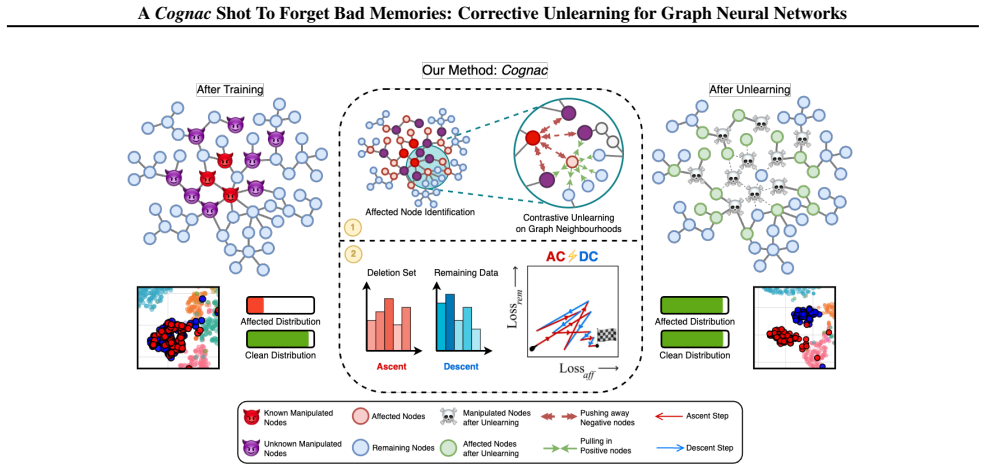
The machinery is the pairing of CoGN and AC/DC on top of the observation that manipulation damage is local. Lemma 3.2 gives the locality: in an $n$-layer GNN a node's representation can influence only nodes within its $n$-hop neighborhood, so affected nodes can be searched for cheaply. CoGN finds them by feature inversion—replacing each deletion node's features with $\mathbf{1} - X_v$, measuring the logit shift $\Delta_\chi = |M(\chi') - M(\chi)|$, and taking the top $k\%$ most shifted neighbors—and then optimizes the sigmoid contrastive loss $- \mathbb{E}[\log\sigma(z_v^\top z_p) + \log\sigma(-z_v^\top z_n)]$, which Theorem 3.3 shows monotonically increases the separation $\mathbb{E}[z_v^\top z_p - z_v^\top z_n]$ under convexity, differentiability, and bounded gradients. AC/DC then runs gradient ascent on the deletion set and gradient descent on the retain set with separate decoupled optimizers, so the wrong-label signal is weakened without reinforcing unidentified manipulations in the retain set. The two components are complementary: ablations show CoGN alone moves embeddings but does not raise affected-class accuracy, while AC/DC alone improves accuracy but falls far short of the oracle.
What would settle it
Run Cognac on a heterophilic benchmark (a graph where connected nodes mostly carry different labels) under the same label-flip and spurious-edge attacks; if it no longer beats retraining from scratch when only 5% of the manipulated set is known, the homophily assumption is doing the load-bearing work. A second check: corrupt a cluster of adjacent nodes so the identified 5% is not representative of the manipulation, and test whether affected-class accuracy still recovers.
Extended reading notes
Core claim
Cognac's central claim is that the two ways manipulation harms a GNN—propagation through the neighborhood and the learning of wrong labels—can be undone separately, and that this separation makes corrective unlearning work with almost no signal. On the propagation side, CoGN (Contrastive unlearning on Graph Neighborhoods) identifies the nodes most affected by the known deletion set by inverting the deletion nodes' features, running a forward pass, and ranking neighbors by the change in their output logits; it then applies a sigmoid contrastive loss that pushes these affected nodes' embeddings away from the manipulated nodes and toward their unaffected neighbors, restoring homophily. On the label side, AC/DC (Ascent DesCent de-coupled) performs gradient ascent on the deletion set's labels with one optimizer while a separate optimizer runs gradient descent on the remaining data, erasing the wrong learning signal without destroying the model. The paper grounds these choices in three results: manipulations only propagate within the n-hop receptive field of a poisoned node (Lemma 3.2), an Interclass Confusion attack provably entangles class embeddings (Theorem 3.1), and the contrastive objective strictly increases embedding separation at convergence under standard assumptions (Theorem 3.3). The empirical claim is that this combination beats retraining from scratch, occasionally surpasses a clean-data oracle, and performs consistently across ten datasets and three attack types with only 5% of the manipulated set known.
Load-bearing premise
The load-bearing premise is homophily: connected nodes tend to share labels, so the unaffected neighbors of a manipulated node carry a clean positive signal for the contrastive step; the paper itself (Section 7) concedes it has only been evaluated on homophilic graphs.
Editorial extensions
If this is right
- Existing graph unlearning methods (GNNDelete, GIF, MEGU, UtU, SCRUB) fail at corrective unlearning even with the complete manipulated set known, so this setting is genuinely harder than privacy-oriented deletion and needs dedicated methods.
- Retraining from scratch is not a gold standard for corrective unlearning: Cognac beats it on affected-class accuracy while being roughly 8x cheaper, so post-hoc repair can dominate full retraining.
- A small representative subset suffices: with 5% of the manipulated set identified, Cognac recovers most of the oracle's accuracy, because the neighborhood-based identification surfaces affected nodes beyond the identified set.
- The method scales: on OGB-Arxiv (~170k nodes, over 1M edges) Cognac keeps a lead of more than 10% over retraining while baselines show no gain over the poisoned model.
- Both components are load-bearing: CoGN alone yields no improvement in affected-class accuracy and AC/DC alone falls far short of the oracle, so corrective unlearning requires fixing neighborhood propagation and label fitting together.
Reading between the lines
- The paper's linked-versus-unlinked ablation (Appendix E.4) supports a design lesson the authors state only partially: for label manipulations, keeping the corrupted node in the graph and unlearning only its features and labels can beat full node deletion, because deleted nodes stop contributing clean graph context to their neighbors; structure-preserving unlearning may be the stronger default for
- Because the positive pairs in CoGN are drawn from the graph neighborhood, the method's reach depends on homophily; a natural extension would be to select positives by structural or feature similarity rather than adjacency, which would adapt the method to heterophilic graphs.
- The 5% result assumes the identified subset is representative of the whole manipulation; a stress test would corrupt a tight cluster of adjacent nodes so that the identified 5% samples only one region, and check whether affected-class accuracy still recovers.
- The efficiency claim (8x over retraining, and 8x faster affected-node sampling than MEGU's) makes corrective unlearning a practical companion to data-monitoring pipelines, but the paper's value depends on those detectors supplying a representative deletion set in the first place.
Editorial analysis
A structured set of objections, weighed in public.
Referee Report
Summary. The paper studies corrective unlearning for GNNs: removing the influence of manipulated training data (targeted label flips or spurious edges) from a trained model, using only a subset of the manipulated entities. It proposes Cognac, which alternates between two components: (i) CoGN, a contrastive loss that identifies nodes affected by the manipulation and pushes their embeddings away from the known deletion set while pulling them toward neighboring nodes, and (ii) AC/DC, which performs gradient ascent on the deletion set and gradient descent on the remaining data. The method is evaluated on ten benchmark graphs, two architectures (GCN and GAT), three manipulation types, and varying fractions of identified manipulated entities, reporting that Cognac outperforms existing graph unlearning baselines and retraining from scratch, recovering most of the oracle accuracy even when only 5% of the manipulation set is identified. The paper also presents theoretical claims about representation entanglement under interclass confusion and about contrastive-loss convergence.
Significance. If the empirical claims hold, this is a practically valuable contribution to graph unlearning. The evaluation is unusually thorough: ten datasets (including a 170k-node graph), a second architecture, a trigger-poisoning extension, large deletion-set stress tests, hyperparameter robustness searches, and a public code release. The finding that established graph unlearning methods fail even with the full manipulation set is important and likely to influence future benchmarking. The main positive result—that partial identification can recover most of the oracle performance—is well supported on homophilic datasets. However, the paper's theoretical apparatus is not sound as written, and the broadest claims are conditioned on an untested benign-neighborhood assumption; these issues limit the current strength of the paper but are addressable.
major comments (3)
- [§3.1.2 (Eq. 1–2) and §7] The central claim "Cognac ... can unlearn the effect of the manipulation set even when only 5% of it is identified" is not established for graphs in which the unidentified manipulated nodes appear in the positive set Vpos = N_{Vaff} \ Vf. Since CoGN explicitly pulls z_v toward the average of Vpos, any manipulated or mislabeled node in Vpos provides a poisoned pull; the method's success therefore depends on Vpos being clean and representative. The paper's Section 7 concedes reliance on homophily and excludes heterophilic graphs, but it does not address the more specific and more common failure mode that arises even in homophilic graphs when manipulation is locally concentrated or when the manipulation rate is high (Table 4 reports up to 38.96% of training nodes manipulated). The manuscript never reports the contamination rate of Vpos, never characterizes the spatial locality of the manipulated sets, and never varies this property. I ask the authors to (a) report Vpos purity for the existing experiments and (b) add at least one experiment with locally concentrated manipulation and one with a heterophilic dataset, or otherwise explicitly scope the 5% claim.
- [§3.1.2, Theorem 3.3 and Appendix A.2] Theorem 3.3 is not a valid proof of the claimed guarantee. The proof uses a first-order approximation ΔS ≈ −η⟨∇S, ∇L⟩ and then asserts ΔS ≥ 0 "for sufficiently small η" without a rigorous Lipschitz-based descent lemma; the later step "This equality holds only if σ(−a) → 0 and σ(b) → 0" is false as stated because equality of expectations does not force each integrand to vanish. Assumption A.2 (convexity of L) is not satisfied by trained GNNs, and the paper itself argues in Section 3.1.2 that the non-sigmoid objective has an "uneven optimization landscape" that motivates the log-sigmoid loss—so convexity is not a benign simplification. Moreover, because both L and S are defined in terms of the same dot products z_v^T z_p and z_v^T z_n, the claimed increase of S is essentially a restatement of the monotone effect of the sigmoid loss, rather than an independent convergence theorem. The sentence in Section 5 that Figure 5(b) is "validating our theoretical results" overstates the support. I recommend either replacing this with a rigorous statement under explicitly verifiable conditions or reclassifying it as an empirical observation.
- [§3, Theorem 3.1 and Appendix A.3] Theorem 3.1 is stated without specifying the probability space over which the expectations are taken, and its proof is heuristic. The proof assumes homophily-preserving message passing plus graph smoothness regularization in the training loss, but the experimental GCNs are not trained with a smoothness regularizer and the method is applied post-training. The derivation of the amplification factor η(1 − 1/L) and the final expression for Δ relies on asserted rather than derived propagation steps (Steps 4 and 5). Since the theorem is presented as a formal result and used to motivate the method, please either provide a proof under assumptions that match the experimental setup or explicitly downgrade it to an illustrative analysis.
minor comments (5)
- [Abstract and §F.2] The claim "8x more efficient" is ambiguous: in Table 7 the 8x refers to affected-node sampling time versus MEGU, while Figure 13 reports total unlearning time versus Retrain. Please state the baseline and the measurement condition clearly in the abstract and in the relevant section.
- [Figure 4 caption] The caption says "archives SOTA" and should read "achieves SOTA."
- [§3.1.2 (Eq. 2)] The variables z_v, z_p, and z_n are used in Eq. (2) without prior definition in the main text; please define them (they appear only later in the statement of Theorem 3.3 in Appendix A.2).
- [Lemma 3.2 proof (Appendix A.1)] The proof alternates between N^n(s) and N^l(v) notation without explaining that l indexes layers, and the base case statement "z_s = h_s^(0)" is confusing because z_s was defined as a final representation. Please use consistent notation.
- [Table 4] The heading "EDGES ADDED (%)" lists "-" for OGB-arXiv with no footnote; please specify whether no edges were added or the value is not applicable.
Circularity Check
No significant circularity: the central empirical claims are benchmarked directly against held-out test data and external baselines, and the convergence theorem is a post-hoc justification rather than an input that the predictions reduce to.
full rationale
Walking the derivation chain, the central claim that Cognac recovers most of the oracle's Accaff from only 5% of the manipulated set while beating retrain is not produced by fitting or by definitional equivalence. The positive and negative sets for CoGN are drawn from the graph neighborhood and the deletion set, not from the test-set Accaff numbers; hyperparameters are tuned on a validation objective (Appendix F.1); and the reported Accaff and Accrem are measured on held-out test splits against external baselines (GNNDelete, GIF, MEGU, UtU, SCRUB) and Retrain/Finetune/Oracle. The convergence guarantee in Theorem 3.3 relates the surrogate loss L to the separation measure S through the same dot products, and the proof is mathematically questionable, but this is a correctness risk rather than circularity because the method and its empirical evaluation do not depend on the theorem. The adoption of the corrective-unlearning formulation and metrics from Goel et al. (2024) is a self-citation by overlapping authors, but it frames the problem rather than carrying the new GNN-specific results, which are benchmarked directly. The stated reliance on homophily is an untested boundary condition, not a circular step. No prediction in the paper is equivalent to a fitted input by construction.
Assumptions & free parameters
free parameters (4)
- k (top-k% affected neighbors) =
varies (e.g., 4 for Cora)
- ascent learning rate =
lower than descent (tuned)
- descent learning rate =
tuned per dataset
- number of contrastive and ascent/descent epochs =
tuned per dataset
assumptions (4)
- domain assumption The graph is homophilic (edges connect similar nodes), so unaffected neighbors provide correct supervision for contrastive unlearning.
- domain assumption The known deletion set S_f is a representative sample of the full manipulation set S_m.
- ad hoc to paper The contrastive loss L is convex, differentiable, and has bounded gradients in the GNN parameters.
- ad hoc to paper The GNN uses homophily-preserving message passing, the graph is eta-homophilic, and training loss includes graph smoothness regularization.
Cite this review
Pith. "Pith review of A Cognac Shot To Forget Bad Memories: Corrective Unlearning for Graph Neural Networks." pith.science (2026). https://pith.science/paper/EBR4DY2Q
@misc{pith2026241200789,
  author       = {Pith},
  title        = {Pith review of: A Cognac Shot To Forget Bad Memories: Corrective Unlearning for Graph Neural Networks},
  year         = {2026},
  howpublished = {\url{https://pith.science/paper/EBR4DY2Q}},
  note         = {Machine review of arXiv:2412.00789}
}
read the original abstract
Graph Neural Networks (GNNs) are increasingly being used for a variety of ML applications on graph data. Because graph data does not follow the independently and identically distributed (i.i.d.) assumption, adversarial manipulations or incorrect data can propagate to other data points through message passing, which deteriorates the model's performance. To allow model developers to remove the adverse effects of manipulated entities from a trained GNN, we study the recently formulated problem of Corrective Unlearning. We find that current graph unlearning methods fail to unlearn the effect of manipulations even when the whole manipulated set is known. We introduce a new graph unlearning method, Cognac, which can unlearn the effect of the manipulation set even when only 5% of it is identified. It recovers most of the performance of a strong oracle with fully corrected training data, even beating retraining from scratch without the deletion set while being 8x more efficient. We hope our work assists GNN developers in mitigating harmful effects caused by issues in real-world data, post-training. Our code is publicly available at https://github.com/cognac-gnn-unlearning/corrective-unlearning-for-gnns
Figures


Figures from the paper (10 more)


Reference graph
Works this paper leans on
-
[1]
write newline
" write newline "" before.all 'output.state := FUNCTION n.dashify 't := "" t empty not t #1 #1 substring "-" = t #1 #2 substring "--" = not "--" * t #2 global.max substring 't := t #1 #1 substring "-" = "-" * t #2 global.max substring 't := while if t #1 #1 substring * t #2 global.max substring 't := if while FUNCTION format.date year duplicate empty "emp...
-
[2]
Optuna: A next-generation hyperparameter optimization framework
Takuya Akiba, Shotaro Sano, Toshihiko Yanase, Takeru Ohta, and Masanori Koyama. Optuna: A next-generation hyperparameter optimization framework. In Proceedings of the 25th ACM SIGKDD international conference on knowledge discovery & data mining, pp.\ 2623--2631, 2019
2019
-
[3]
LEACE : Perfect linear concept erasure in closed form
Nora Belrose, David Schneider-Joseph, Shauli Ravfogel, Ryan Cotterell, Edward Raff, and Stella Biderman. LEACE : Perfect linear concept erasure in closed form. In Thirty-seventh Conference on Neural Information Processing Systems, 2023. URL https://openreview.net/forum?id=awIpKpwTwF
2023
-
[4]
Deep gaussian embedding of graphs: Unsupervised inductive learning via ranking
Aleksandar Bojchevski and Stephan G \"u nnemann. Deep gaussian embedding of graphs: Unsupervised inductive learning via ranking. arXiv preprint arXiv:1707.03815, 2017
arXiv 2017
-
[5]
Adversarial attacks on node embeddings via graph poisoning
Aleksandar Bojchevski and Stephan G \"u nnemann. Adversarial attacks on node embeddings via graph poisoning. In International Conference on Machine Learning, pp.\ 695--704. PMLR, 2019 a
work page 2019
-
[6]
Certifiable robustness to graph perturbations
Aleksandar Bojchevski and Stephan G \"u nnemann. Certifiable robustness to graph perturbations. Advances in Neural Information Processing Systems, 32, 2019 b
work page 2019
-
[7]
Choquette-Choo, Hengrui Jia, Adelin Travers, Baiwu Zhang, David Lie, and Nicolas Papernot
Lucas Bourtoule, Varun Chandrasekaran, Christopher A. Choquette-Choo, Hengrui Jia, Adelin Travers, Baiwu Zhang, David Lie, and Nicolas Papernot. Machine unlearning. In IEEE S&P, 2021
work page 2021
-
[8]
Identifying mislabeled training data
Carla E Brodley and Mark A Friedl. Identifying mislabeled training data. Journal of artificial intelligence research, 11: 0 131--167, 1999
work page 1999
Show all 70 references
-
[9]
Recommendation unlearning
Chong Chen, Fei Sun, Min Zhang, and Bolin Ding. Recommendation unlearning. In Proceedings of the ACM Web Conference 2022, pp.\ 2768--2777, 2022 a
2022
-
[10]
Graph unlearning
Min Chen, Zhikun Zhang, Tianhao Wang, Michael Backes, Mathias Humbert, and Yang Zhang. Graph unlearning. In Proceedings of the 2022 ACM SIGSAC conference on computer and communications security, pp.\ 499--513, 2022 b
2022
-
[11]
Characterizing the influence of graph elements
Zizhang Chen, Peizhao Li, Hongfu Liu, and Pengyu Hong. Characterizing the influence of graph elements. In The Eleventh International Conference on Learning Representations, 2023. URL https://openreview.net/forum?id=51GXyzOKOp
2023
-
[12]
GNND elete: A general unlearning strategy for graph neural networks
Jiali Cheng, George Dasoulas, Huan He, Chirag Agarwal, and Marinka Zitnik. GNND elete: A general unlearning strategy for graph neural networks. In International Conference on Learning Representations, 2023. URL https://openreview.net/forum?id=X9yCkmT5Qrl
2023
-
[13]
Efficient model updates for approximate unlearning of graph-structured data
Eli Chien, Chao Pan, and Olgica Milenkovic. Efficient model updates for approximate unlearning of graph-structured data. In The Eleventh International Conference on Learning Representations, 2022
2022
-
[14]
Adversarial attack on graph structured data
Hanjun Dai, Hui Li, Tian Tian, Xin Huang, Lin Wang, Jun Zhu, and Le Song. Adversarial attack on graph structured data. In Jennifer Dy and Andreas Krause (eds.), Proceedings of the 35th International Conference on Machine Learning, volume 80 of Proceedings of Machine Learning R...
2018
-
[15]
When, why and how much? adaptive learning rate scheduling by refinement, 2023
Aaron Defazio, Ashok Cutkosky, Harsh Mehta, and Konstantin Mishchenko. When, why and how much? adaptive learning rate scheduling by refinement, 2023. URL https://arxiv.org/abs/2310.07831
2023 arXiv
-
[16]
The sybil attack
John R Douceur. The sybil attack. In International workshop on peer-to-peer systems, pp.\ 251--260. Springer, 2002
2002
-
[17]
Debiasing graph neural networks via learning disentangled causal substructure
Shaohua Fan, Xiao Wang, Yanhu Mo, Chuan Shi, and Jian Tang. Debiasing graph neural networks via learning disentangled causal substructure. In Proceedings of the 36th International Conference on Neural Information Processing Systems, NIPS '22, Red Hook, NY, USA, 2024. Curran As...
2024
-
[18]
u gner, Aleksandar Bojchevski, and Stephan G\
Simon Geisler, Tobias Schmidt, Hakan S irin, Daniel Z\" u gner, Aleksandar Bojchevski, and Stephan G\" u nnemann. Robustness of graph neural networks at scale. In Proceedings of the 35th International Conference on Neural Information Processing Systems, NIPS '21, Red Hook, NY,...
2024
-
[19]
Towards adversarial evaluations for inexact machine unlearning
Shashwat Goel, Ameya Prabhu, Amartya Sanyal, Ser-Nam Lim, Philip Torr, and Ponnurangam Kumaraguru. Towards adversarial evaluations for inexact machine unlearning. arXiv preprint arXiv:2201.06640, 2022
2022 arXiv
-
[20]
Corrective machine unlearning
Shashwat Goel, Ameya Prabhu, Philip Torr, Ponnurangam Kumaraguru, and Amartya Sanyal. Corrective machine unlearning. Data-centric Machine Learning Research (DMLR) Workshop, ICLR, 2024
2024
-
[21]
Graph neural networks: Adversarial robustness
Stephan G \"u nnemann. Graph neural networks: Adversarial robustness. Graph neural networks: foundations, frontiers, and applications, pp.\ 149--176, 2022
2022
-
[22]
Link spam alliances
Zoltan Gyongyi and Hector Garcia-Molina. Link spam alliances. Technical report, Stanford, 2005
2005
-
[23]
Inductive representation learning on large graphs
Will Hamilton, Zhitao Ying, and Jure Leskovec. Inductive representation learning on large graphs. Advances in neural information processing systems, 30, 2017
2017
-
[24]
Gans trained by a two time-scale update rule converge to a local nash equilibrium
Martin Heusel, Hubert Ramsauer, Thomas Unterthiner, Bernhard Nessler, and Sepp Hochreiter. Gans trained by a two time-scale update rule converge to a local nash equilibrium. Advances in neural information processing systems, 30, 2017
2017
-
[25]
Datamodels: Predicting predictions from training data
Andrew Ilyas, Sung Min Park, Logan Engstrom, Guillaume Leclerc, and Aleksander Madry. Datamodels: Predicting predictions from training data. arXiv preprint arXiv:2202.00622, 2022
2022 arXiv
-
[26]
Graph structure learning for robust graph neural networks
Wei Jin, Yao Ma, Xiaorui Liu, Xianfeng Tang, Suhang Wang, and Jiliang Tang. Graph structure learning for robust graph neural networks. In Proceedings of the 26th ACM SIGKDD international conference on knowledge discovery & data mining, pp.\ 66--74, 2020
2020
-
[27]
Kingma and Jimmy Ba
Diederik P. Kingma and Jimmy Ba. Adam: A method for stochastic optimization, 2017. URL https://arxiv.org/abs/1412.6980
2017 arXiv
-
[28]
Kipf and Max Welling
Thomas N. Kipf and Max Welling. Semi-supervised classification with graph convolutional networks, 2017
2017
-
[29]
Fairness-aware pac learning from corrupted data
Nikola H Konstantinov and Christoph Lampert. Fairness-aware pac learning from corrupted data. JMLR, 2022
2022
-
[30]
Towards unbounded machine unlearning
Meghdad Kurmanji, Peter Triantafillou, and Eleni Triantafillou. Towards unbounded machine unlearning. NeurIPS, 2023
2023
-
[31]
The wmdp benchmark: Measuring and reducing malicious use with unlearning
Nathaniel Li, Alexander Pan, Anjali Gopal, Summer Yue, Daniel Berrios, Alice Gatti, Justin D Li, Ann-Kathrin Dombrowski, Shashwat Goel, Long Phan, et al. The wmdp benchmark: Measuring and reducing malicious use with unlearning. arXiv preprint arXiv:2403.03218, 2024 a
2024 arXiv
-
[32]
Delta-influence: Unlearning poisons via influence functions, 2024 b
Wenjie Li, Jiawei Li, Christian Schroeder de Witt, Ameya Prabhu, and Amartya Sanyal. Delta-influence: Unlearning poisons via influence functions, 2024 b . URL https://arxiv.org/abs/2411.13731
2024
-
[33]
Towards effective and general graph unlearning via mutual evolution
Xunkai Li, Yulin Zhao, Zhengyu Wu, Wentao Zhang, Rong-Hua Li, and Guoren Wang. Towards effective and general graph unlearning via mutual evolution. In Proceedings of the AAAI Conference on Artificial Intelligence, volume 38, pp.\ 13682--13690, 2024 c
2024
-
[34]
Rethinking label poisoning for GNN s: Pitfalls and attacks
Vijay Lingam, Mohammad Sadegh Akhondzadeh, and Aleksandar Bojchevski. Rethinking label poisoning for GNN s: Pitfalls and attacks. In The Twelfth International Conference on Learning Representations, 2024. URL https://openreview.net/forum?id=J7ioefqDPw
2024
-
[35]
TOFU : A task of fictitious unlearning for LLM s
Pratyush Maini, Zhili Feng, Avi Schwarzschild, Zachary Chase Lipton, and J Zico Kolter. TOFU : A task of fictitious unlearning for LLM s. In First Conference on Language Modeling, 2024. URL https://openreview.net/forum?id=B41hNBoWLo
2024
-
[36]
Position: Graph foundation models are already here
Haitao Mao, Zhikai Chen, Wenzhuo Tang, Jianan Zhao, Yao Ma, Tong Zhao, Neil Shah, Mikhail Galkin, and Jiliang Tang. Position: Graph foundation models are already here. In Forty-first International Conference on Machine Learning, 2024
2024
-
[37]
Image-based recommendations on styles and substitutes, 2015
Julian McAuley, Christopher Targett, Qinfeng Shi, and Anton van den Hengel. Image-based recommendations on styles and substitutes, 2015. URL https://arxiv.org/abs/1506.04757
2015 arXiv
-
[38]
A survey of machine unlearning
Thanh Tam Nguyen, Thanh Trung Huynh, Phi Le Nguyen, Alan Wee-Chung Liew, Hongzhi Yin, and Quoc Viet Hung Nguyen. A survey of machine unlearning. arXiv preprint arXiv:2209.02299, 2022
2022 arXiv
-
[39]
Northcutt, Anish Athalye, and Jonas Mueller
Curtis G. Northcutt, Anish Athalye, and Jonas Mueller. Pervasive label errors in test sets destabilize machine learning benchmarks. In NeurIPS, 2021
2021
-
[40]
Training language models to follow instructions with human feedback
Long Ouyang, Jeffrey Wu, Xu Jiang, Diogo Almeida, Carroll Wainwright, Pamela Mishkin, Chong Zhang, Sandhini Agarwal, Katarina Slama, Alex Ray, et al. Training language models to follow instructions with human feedback. Advances in neural information processing systems, 35: 0 2...
2022
-
[41]
A law of adversarial risk, interpolation, and label noise
Daniel Paleka and Amartya Sanyal. A law of adversarial risk, interpolation, and label noise. In ICLR, 2023
2023
-
[42]
Machine unlearning fails to remove data poisoning attacks
Martin Pawelczyk, Jimmy Z Di, Yiwei Lu, Gautam Kamath, Ayush Sekhari, and Seth Neel. Machine unlearning fails to remove data poisoning attacks. arXiv preprint arXiv:2406.17216, 2024
2024
-
[43]
A survey of graph unlearning
Anwar Said, Tyler Derr, Mudassir Shabbir, Waseem Abbas, and Xenofon Koutsoukos. A survey of graph unlearning. arXiv preprint arXiv:2310.02164, 2023
2023
-
[44]
Dokania, Varun Kanade, and Philip Torr
Amartya Sanyal, Puneet K. Dokania, Varun Kanade, and Philip Torr. How benign is benign overfitting? In ICLR, 2021
2021
-
[45]
How unfair is private learning? In Uncertainty in Artificial Intelligence, 2022
Amartya Sanyal, Yaxi Hu, and Fanny Yang. How unfair is private learning? In Uncertainty in Artificial Intelligence, 2022
2022
-
[46]
Potion: Towards poison unlearning
Stefan Schoepf, Jack Foster, and Alexandra Brintrup. Potion: Towards poison unlearning. arXiv preprint arXiv:2406.09173, 2024
2024 arXiv
-
[47]
Pitfalls of graph neural network evaluation, 2019
Oleksandr Shchur, Maximilian Mumme, Aleksandar Bojchevski, and Stephan Günnemann. Pitfalls of graph neural network evaluation, 2019. URL https://arxiv.org/abs/1811.05868
2019 arXiv
-
[48]
Node injection attacks on graphs via reinforcement learning
Yiwei Sun, Suhang Wang, Xianfeng Tang, Tsung-Yu Hsieh, and Vasant Honavar. Node injection attacks on graphs via reinforcement learning. arXiv preprint arXiv:1909.06543, 2019
1909 arXiv
-
[49]
Unlink to unlearn: Simplifying edge unlearning in gnns
Jiajun Tan, Fei Sun, Ruichen Qiu, Du Su, and Huawei Shen. Unlink to unlearn: Simplifying edge unlearning in gnns. In Companion Proceedings of the ACM on Web Conference 2024, pp.\ 489--492, 2024
2024
-
[50]
Arnetminer: extraction and mining of academic social networks
Jie Tang, Jing Zhang, Limin Yao, Juanzi Li, Li Zhang, and Zhong Su. Arnetminer: extraction and mining of academic social networks. In Proceedings of the 14th ACM SIGKDD international conference on Knowledge discovery and data mining, pp.\ 990--998, 2008
2008
-
[51]
Graph attention networks, 2018
Petar Veličković, Guillem Cucurull, Arantxa Casanova, Adriana Romero, Pietro Liò, and Yoshua Bengio. Graph attention networks, 2018
2018
-
[52]
Microsoft academic graph: When experts are not enough
Kuansan Wang, Zhihong Shen, Chiyuan Huang, Chieh-Han Wu, Yuxiao Dong, and Anshul Kanakia. Microsoft academic graph: When experts are not enough. Quantitative Science Studies, 1 0 (1): 0 396--413, 2020
2020
-
[53]
The heterophilic snowflake hypothesis: Training and empowering gnns for heterophilic graphs, 2024
Kun Wang, Guibin Zhang, Xinnan Zhang, Junfeng Fang, Xun Wu, Guohao Li, Shirui Pan, Wei Huang, and Yuxuan Liang. The heterophilic snowflake hypothesis: Training and empowering gnns for heterophilic graphs, 2024. URL https://arxiv.org/abs/2406.12539
2024 arXiv
-
[54]
Machine unlearning of features and labels
Alexander Warnecke, Lukas Pirch, Christian Wressnegger, and Konrad Rieck. Machine unlearning of features and labels. In Proc. of the 30th Network and Distributed System Security (NDSS), 2023
2023
-
[55]
Baoning Wu and Brian D. Davison. Identifying link farm spam pages. In Special Interest Tracks and Posters of the 14th International Conference on World Wide Web, WWW '05, pp.\ 820–829, New York, NY, USA, 2005. Association for Computing Machinery. ISBN 1595930515. doi:10.1145/1...
2005
-
[56]
Gif: A general graph unlearning strategy via influence function
Jiancan Wu, Yi Yang, Yuchun Qian, Yongduo Sui, Xiang Wang, and Xiangnan He. Gif: A general graph unlearning strategy via influence function. In Proceedings of the ACM Web Conference 2023, pp.\ 651--661, 2023 a
2023
-
[57]
Certified edge unlearning for graph neural networks
Kun Wu, Jie Shen, Yue Ning, Ting Wang, and Wendy Hui Wang. Certified edge unlearning for graph neural networks. In Proceedings of the 29th ACM SIGKDD Conference on Knowledge Discovery and Data Mining, pp.\ 2606--2617, 2023 b
2023
-
[58]
Graph neural networks in recommender systems: A survey
Shiwen Wu, Fei Sun, Wentao Zhang, Xu Xie, and Bin Cui. Graph neural networks in recommender systems: A survey. ACM Comput. Surv., 55 0 (5), December 2022. ISSN 0360-0300. doi:10.1145/3535101. URL https://doi.org/10.1145/3535101
2022 doi
-
[59]
On the security risks of knowledge graph reasoning
Zhaohan Xi, Tianyu Du, Changjiang Li, Ren Pang, Shouling Ji, Xiapu Luo, Xusheng Xiao, Fenglong Ma, and Ting Wang. On the security risks of knowledge graph reasoning. In Proceedings of the 32nd USENIX Conference on Security Symposium, SEC '23, USA, 2023. USENIX Association. ISB...
2023
-
[60]
Large language model unlearning
Yuanshun Yao, Xiaojun Xu, and Yang Liu. Large language model unlearning. arXiv preprint arXiv:2310.10683, 2023
2023 arXiv
-
[61]
Mitigating emergent robustness degradation while scaling graph learning
Xiangchi Yuan, Chunhui Zhang, Yijun Tian, Yanfang Ye, and Chuxu Zhang. Mitigating emergent robustness degradation while scaling graph learning. In The Twelfth International Conference on Learning Representations, 2024. URL https://openreview.net/forum?id=Koh0i2u8qX
2024
-
[62]
Chasing all-round graph representation robustness: Model, training, and optimization
Chunhui Zhang, Yijun Tian, Mingxuan Ju, Zheyuan Liu, Yanfang Ye, Nitesh Chawla, and Chuxu Zhang. Chasing all-round graph representation robustness: Model, training, and optimization. In The Eleventh International Conference on Learning Representations, 2023. URL https://openre...
2023
-
[63]
Data poisoning attack against knowledge graph embedding
Hengtong Zhang, Tianhang Zheng, Jing Gao, Chenglin Miao, Lu Su, Yaliang Li, and Kui Ren. Data poisoning attack against knowledge graph embedding. In Proceedings of the Twenty-Eighth International Joint Conference on Artificial Intelligence, IJCAI-19 , pp.\ 4853--4859. Internat...
2019 doi
-
[64]
Graph neural network approaches for drug-target interactions
Zehong Zhang, Lifan Chen, Feisheng Zhong, Dingyan Wang, Jiaxin Jiang, Sulin Zhang, Hualiang Jiang, Mingyue Zheng, and Xutong Li. Graph neural network approaches for drug-target interactions. Current Opinion in Structural Biology, 73: 0 102327, 2022. ISSN 0959-440X. doi:https:/...
2022
-
[65]
Untargeted adversarial attack on knowledge graph embeddings, 2024
Tianzhe Zhao, Jiaoyan Chen, Yanchi Ru, Qika Lin, Yuxia Geng, and Jun Liu. Untargeted adversarial attack on knowledge graph embeddings, 2024. URL https://arxiv.org/abs/2405.10970
2024 arXiv
-
[66]
u gner and Stephan G \
Daniel Z \"u gner and Stephan G \"u nnemann. Adversarial attacks on graph neural networks via meta learning. In International Conference on Learning Representations (ICLR), 2019
2019
-
[67]
u gner, Amir Akbarnejad, and Stephan G\
Daniel Z\" u gner, Amir Akbarnejad, and Stephan G\" u nnemann. Adversarial attacks on neural networks for graph data. In Proceedings of the 24th ACM SIGKDD International Conference on Knowledge Discovery & Data Mining, KDD '18, pp.\ 2847–2856, New York, NY, USA, 2018. Associat...
2018
-
[68]
@esa (Ref
\@ifxundefined[1] #1\@undefined \@firstoftwo \@secondoftwo \@ifnum[1] #1 \@firstoftwo \@secondoftwo \@ifx[1] #1 \@firstoftwo \@secondoftwo [2] @ #1 \@temptokena #2 #1 @ \@temptokena \@ifclassloaded agu2001 natbib The agu2001 class already includes natbib coding, so you should ...
-
[69]
\@lbibitem[] @bibitem@first@sw\@secondoftwo \@lbibitem[#1]#2 \@extra@b@citeb \@ifundefined br@#2\@extra@b@citeb \@namedef br@#2 \@nameuse br@#2\@extra@b@citeb \@ifundefined b@#2\@extra@b@citeb @num @parse #2 @tmp #1 NAT@b@open@#2 NAT@b@shut@#2 \@ifnum @merge>\@ne @bibitem@firs...
-
[70]
@open @close @open @close and [1] URL: #1 \@ifundefined chapter * \@mkboth \@ifxundefined @sectionbib * \@mkboth * \@mkboth\@gobbletwo \@ifclassloaded amsart * \@ifclassloaded amsbook * \@ifxundefined @heading @heading NAT@ctr thebibliography [1] @ \@biblabel @NAT@ctr \@bibset...
Reviewed August 12, 2026 · model on record in the stance chip above.
Discussion (0). Continue with ORCID to comment.