REVIEW 3 major objections 5 minor 42 references
Epipolar Attention Field Transformers for Bird's Eye View Semantic Segmentation
T0 review · 3 major / 5 minor · reviewed 2026-08-12 · deepseek-v4-flash
Pith's one-line read This paper argues that a transformer-based bird's eye view (BEV) semantic segmentation network does not need to learn the geometric correspondence between cameras and the BEV grid.
desk verdict Useful empirical result and a genuinely new attention-weighting idea, but the epipolar geometry for the virtual BEV camera is under-derived and the paper needs code or a proper derivation before the mechanism claim is credible. read the letter →
The pith
A machine-rendered reading of the paper's core claim, the machinery that carries it, and where it could break.
The reading
What carries the argument
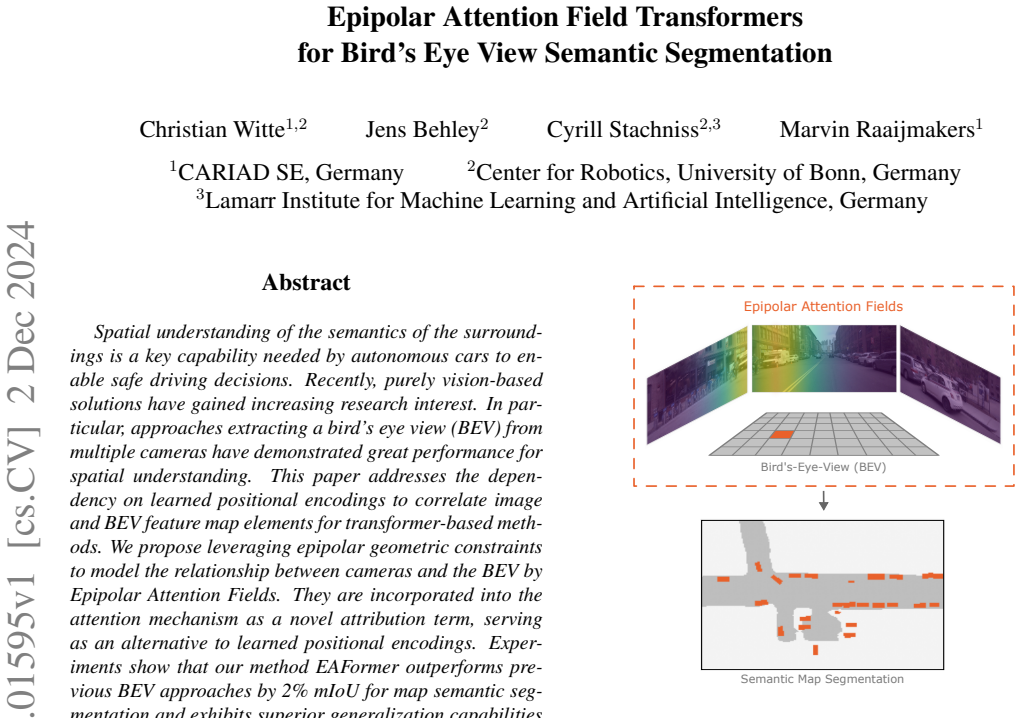
The load-bearing object is the Epipolar Attention Field, a Gaussian weight $W_{q,k} = \exp(-(\lambda \lambda_{q,i})^2 (x_i^\top \hat{l}_i)^2)$ attached to each BEV-query and image-key pair. Here $l_i = E_i x_0$ is the epipolar line in camera $i$ of the BEV cell $x_0$, $x_i$ is the image feature position, and $\lambda$ with $\lambda_{q,i}$ control the field width, with the latter scaling by the cell's distance from the camera. It is inserted into the attention function as $\text{Attention}(W,Q,K,V) = \text{softmax}(W \odot QK^\top / \sqrt{d_k}) V$, so the geometric prior multiplies the learned affinity rather than being added as a positional embedding. The mechanism turns the known fact that corresponding points must lie on epipolar lines into a soft attention prior, and the orthographic BEV assumption converts each BEV cell into a line in each camera view.
What would settle it
Measure, on a held-out camera rig, the distance between true image correspondences of known BEV points and the epipolar lines predicted by Eq. (1); if that mean distance is large compared with the BEV cell size and grows systematically with distance from the ego vehicle, the geometric weights are not computing the intended correspondence and the reported gains would have to come from another component.
Extended reading notes
Core claim
The central discovery is that the cross-attention between BEV grid queries and multi-view image features can be weighted by a closed-form geometric quantity instead of a learned positional encoding. Treating the BEV plane as a virtual perspective camera whose center lies infinitely far away, the paper uses the essential matrix $E_i$ to project each BEV query onto an epipolar line in each camera view. The attention weight for a query-key pair is then a Gaussian over the signed distance from the image key to that line, with a width scaled by the BEV cell's distance from the camera. The authors show, in a controlled ablation against a re-implemented CVT baseline, that adding this epipolar weighting improves segmentation and that subsequently removing the learned positional encoding improves it further. The same experiments indicate better zero-shot transfer to datasets with different camera intrinsics and extrinsics, which the authors attribute to the geometry being computed rather than memorized.
Load-bearing premise
The paper's load-bearing premise is that the bird's eye view grid can be treated as an orthographic camera with its center at infinity, so that the standard essential-matrix constraint $x_i^\top E_i x_0 = 0$ remains exactly valid; this limit is asserted rather than derived, and if it is not exact the epipolar lines feeding the attention weights are geometrically mis-specified.
Editorial extensions
If this is right
- Zero-shot transfer to an unseen camera rig becomes substantially cheaper: EAFormer reports 11.44 mIoU versus 2.70 for CVT when moving from Argoverse 2 to nuScenes, indicating that retraining per vehicle camera configuration may no longer be required.
- The gap between learned and geometric correspondence also narrows on the data-leakage-free split, with EAFormer dropping 19.98 mIoU versus CVT's 21.79, evidence that the explicit prior generalizes beyond memorized scene locations.
- Far-range vehicle segmentation improves, with EAFormer reaching 18.71 mIoU versus CVT's 15.44 at 40–50 m, a regime where learned positional encodings have little training signal.
- Because the positional encoding is gone, the cross-attention module itself becomes camera-parameter-aware through a fixed computation, which should make fine-tuning to a new vehicle model faster and more stable.
Reading between the lines
- Editorial inference: the same attention-weighting scheme should apply to other multi-view transformer tasks such as 3D object detection or motion forecasting, since any task that correlates a ground-plane query grid with perspective images admits an epipolar-line prior.
- Editorial inference: the current design fixes the BEV as an orthographic plane; loosening this to a ground plane with known roll or elevation, or learning $\lambda_{q,i}$ per region, is a natural extension that the paper only gestures at through the trainable distance-strength parameter.
- Editorial inference: EAFs need not replace positional encodings everywhere; using them as an additional regularization term alongside a learned encoding is a testable variant that could retain geometric transfer while recovering some of the flexibility of learned embeddings.
- Editorial inference: the ordering in the ablation table suggests the epipolar weighting and the removal of positional encoding are additive, but the paper does not isolate the configuration where both are present; that combination is the most direct missing experiment.
Editorial analysis
A structured set of objections, weighed in public.
Referee Report
Summary. The paper proposes Epipolar Attention Fields (EAFs) as an explicit geometric alternative to learned positional encodings in transformer-based multi-camera bird's-eye-view (BEV) semantic segmentation. The BEV grid is modeled as the image plane of a virtual orthographic camera with its center at infinity, and the epipolar constraint between a BEV query and an image feature is used to compute a multiplicative attention weight, defined as a Gaussian over the distance from the image feature to the epipolar line. The resulting architecture, EAFormer, is evaluated on nuScenes and Argoverse 2 for drivable-area and vehicle segmentation, including ablations, distance-stratified vehicle evaluation, a disjoint data split that avoids location-based leakage, and zero-shot transfer experiments across datasets and camera-rig changes. The central empirical claims are that EAFormer outperforms prior camera-only transformer-based BEV methods and that removing learned positional encodings improves both accuracy and generalization to unseen camera configurations.
Significance. If the geometric construction is made precise, replacing learned positional encodings with an explicit epipolar prior is a simple, falsifiable, and potentially useful idea for multi-camera BEV perception. The paper has notable empirical strengths: the ablation in Table 4 is a controlled progression from a CVT reimplementation, the use of the disjoint split of Yuan et al. addresses the known nuScenes data-leakage problem, and the cross-dataset and camera-swap experiments directly test the claimed generalization advantage. The distance-stratified evaluation in Table 5 is also informative. However, the core geometric mechanism is currently underspecified, and the zero-shot comparison rests on an under-documented baseline reimplementation. The significance of the paper is therefore conditional on the derivation of the epipolar construction and on the completeness of the experimental details.
major comments (3)
- [Sec. 3.1, Eq. (1)] The central geometric prior is stated as x_i^T E_i x_0 = 0, with l_i = E_i x_0, where the BEV grid is the image plane of a virtual camera whose center O0 is at infinity. The matrix E_i is neither defined nor derived. In standard calibrated multi-view geometry, the essential matrix is defined for two perspective cameras with finite centers, and its characterizing properties (rank 2, two equal nonzero singular values) follow from that assumption. For the mixed orthographic/perspective setup considered here, the correct object is an affine or mixed fundamental matrix, not a standard essential matrix, unless the infinite-center limit is derived explicitly. That limit is nontrivial: in normalized image coordinates, a perspective camera moved to infinity has image coordinates that collapse unless the focal length is scaled at the same rate. Since Eq. (3) computes every attention weight from the distance to l_i, an incorrect or non-derived E_i changes the geometric prior and prevents the reader from verifying that the reported gains are caused by the intended epipolar mechanism. Please derive E_i explicitly from the camera matrices (for example, P_0 for the virtual orthographic camera and P_i = K_i [R_i | t_i] for each view), give the resulting epipolar line, and state the algebraic properties of the matrix. If the implementation uses a standard essential-matrix routine, justify that it produces the correct epipolar lines for a camera at infinity.
- [Sec. 3.3, Eq. (3)] The attention weight in Eq. (3) is W_{q,k} = exp( - (λ λ_{q,i})^2 (x_i^T \hat{l}_i)^2 ). The text states that λ_{q,i} scales the width of the Gaussian depending on the distance of the BEV cell to the camera, the cell size, and the calibration, but it never gives the formula, default value, or units for λ_{q,i}. Without this, the method is not reproducible, and the ablation in Table 4 that attributes the gain to epipolar attention weighting cannot be separated from the particular choice of per-cell width. Please specify how λ_{q,i} is computed, for example as an explicit function of the BEV cell's position and the camera calibration, or state that λ_{q,i} = 1 in all reported experiments except the learnable-λ ablation. Also disambiguate the notation (λ λ_{q,i})^2, which currently reads as the square of a product without indicating the order of operations or the coordinate units in which the distance is measured.
- [Sec. 4.2, Table 2] The cross-dataset zero-shot results in Table 2 are the main evidence for the generalization claim, but the baseline is described only as "a re-implementation of CVT with our settings." The paper does not state the positional-encoding implementation, the exact training schedule, or whether this reimplementation was used for all rows of Table 2. If the CVT baseline is weaker than the original CVT on the target datasets, the large transfer margins (for example, 11.44 vs. 2.70 mIoU for A V2 → nuScenes) would overstate the advantage of explicit geometry. Please report the reimplementation details or release the code and configuration files; ideally, run the original CVT code under the same training protocol and report both.
minor comments (5)
- [Sec. 4.3, Table 5] The value "30.8" in the 30-40 m column of Table 5 should be written as "30.80" for consistency with the other entries in the table.
- [Sec. 3.3] The text calls λ "a hyperparameter" but later states that it can be trainable; please clarify that λ is a hyperparameter by default and can optionally be learned, and distinguish it from the per-cell λ_{q,i}.
- [Sec. 4.3] The phrases "approximately twice the performance" and "approximately four times the performance" describe ratios of mIoU values; it would be clearer to report relative gains in percentage terms and to state the baseline values to avoid overinterpreting absolute mIoU differences.
- [References] Reference [35] appears to have a malformed title with parentheses around the beginning of the title; please check the citation against the original publication.
- [Figure 3 caption] The phrase "the imaginary location of the vehicle" should be reworded to "the ego vehicle location" or "the ego vehicle's position" to avoid confusion.
Circularity Check
No significant circularity: the Epipolar Attention Fields are computed from external camera calibration and the reported gains are measured on public datasets against an independent CVT reimplementation.
full rationale
The paper's central derivation computes attention weights Wq,k from the epipolar line li = E_i x0, where E_i is taken from multi-view geometry and x0 is a BEV grid coordinate. These quantities depend only on camera calibration and grid geometry, not on the segmentation labels or on the mIoU numbers that are later reported. The claimed improvements are therefore not baked into the attention formula by construction. The experimental evaluation is self-contained: Table 1 reports mIoU on the nuScenes validation set, Table 2 reports zero-shot transfer between Argoverse 2 and nuScenes, and Table 3 evaluates on a disjoint split to address data leakage. In each case the target numbers are external benchmarks, and the comparison baseline is a reimplementation of CVT under the same training settings. The only trainable component beyond the network weights is the distance-strength parameter λ in one ablation; Table 7 shows that learning it yields only a minor change relative to λ=1.0, and the paper does not present that scalar as a prediction. The paper explicitly credits TransFusion [20] for the epipolar-field idea and Hartley and Zisserman [8] for the epipolar geometry, so there is no load-bearing self-citation chain. The potential concern that a standard essential matrix may not be the correct model for an orthographic BEV reference view at infinity is a correctness or technical-validity issue, not a circularity issue: if the geometric model were wrong, the method would still be empirically testable and would fail or succeed independently of whether the derivation is rigorous. No step in the paper reduces, by definition or by construction, to its own input. Therefore the circularity score is 0.
Assumptions & free parameters
free parameters (2)
- lambda (global distance-strength) =
1.0 (default); learnable in ablation
- lambda_{q,i} (per-cell width) =
unspecified
assumptions (4)
- standard math Standard epipolar geometry, including the essential matrix constraint, is applicable.
- ad hoc to paper The BEV grid can be treated as a virtual camera with center at infinity, and the standard essential matrix E_i remains valid for this setup.
- domain assumption Camera principal axes are approximately parallel to the BEV plane, so a BEV cell projects to a line with constant width.
- domain assumption Ground-truth vehicle masks from orthographic projection of 3D boxes with visibility greater than 40% are a valid evaluation target.
Cite this review
Pith. "Pith review of Epipolar Attention Field Transformers for Bird's Eye View Semantic Segmentation." pith.science (2026). https://pith.science/paper/B44SKKZ2
@misc{pith2026241201595,
  author       = {Pith},
  title        = {Pith review of: Epipolar Attention Field Transformers for Bird's Eye View Semantic Segmentation},
  year         = {2026},
  howpublished = {\url{https://pith.science/paper/B44SKKZ2}},
  note         = {Machine review of arXiv:2412.01595}
}
read the original abstract
Spatial understanding of the semantics of the surroundings is a key capability needed by autonomous cars to enable safe driving decisions. Recently, purely vision-based solutions have gained increasing research interest. In particular, approaches extracting a bird's eye view (BEV) from multiple cameras have demonstrated great performance for spatial understanding. This paper addresses the dependency on learned positional encodings to correlate image and BEV feature map elements for transformer-based methods. We propose leveraging epipolar geometric constraints to model the relationship between cameras and the BEV by Epipolar Attention Fields. They are incorporated into the attention mechanism as a novel attribution term, serving as an alternative to learned positional encodings. Experiments show that our method EAFormer outperforms previous BEV approaches by 2% mIoU for map semantic segmentation and exhibits superior generalization capabilities compared to implicitly learning the camera configuration.
Figures


Figures from the paper (2 more)


Reference graph
Works this paper leans on
-
[1]
Holger Caesar, Varun Bankiti, Alex H. Lang, Sourabh V ora, Venice E. Liong, Qiang Xu, Anush Krishnan, Yu Pan, Gian- carlo Baldan, and Oscar Beijbom. nuScenes: A Multimodal Dataset for Autonomous Driving. In Proc. of the IEEE/CVF Conf. on Computer Vision and Pattern Recognition (CVPR),
-
[2]
Liang-Chieh Chen, George Papandreou, Iasonas Kokki- nos, Kevin Murphy, and Alan L. Yuille. DeepLab: Se- mantic Image Segmentation withDeep Convolutional Nets, Atrous Convolution,and Fully Connected CRFs. IEEE Trans. on Pattern Analysis and Machine Intelligence (TPAMI), 40(4):834–848, 2018. 6
work page 2018
-
[3]
Residual Graph Convolu- tional Network for Bird’s-Eye-View Semantic Segmentation
Qiuxiao Chen and Xiaojun Qi. Residual Graph Convolu- tional Network for Bird’s-Eye-View Semantic Segmentation. In Proc. of the IEEE Winter Conf. on Applications of Com- puter Vision (WACV), 2024. 2
work page 2024
-
[4]
Efficient and robust 2d-to-bev representation learning via geometry-guided ker- nel transformer
Shaoyu Chen, Tianheng Cheng, Xinggang Wang, Wenming Meng, Qian Zhang, and Wenyu Liu. Efficient and robust 2d-to-bev representation learning via geometry-guided ker- nel transformer. arXiv preprint, arXiv:2206.04584, 2022. 1, 2, 6
arXiv 2022
-
[5]
MMDetection3D: Open- MMLab next-generation platform for general 3D object detection
MMDetection3D Contributors. MMDetection3D: Open- MMLab next-generation platform for general 3D object detection. https://github.com/open- mmlab/ mmdetection3d, 2020. 6
work page 2020
-
[6]
Exploring recurrent long-term temporal fusion for multi-view 3d perception
Chunrui Han, Jinrong Yang, Jianjian Sun, Zheng Ge, Run- pei Dong, Hongyu Zhou, Weixin Mao, Yuang Peng, and Xi- angyu Zhang. Exploring recurrent long-term temporal fusion for multi-view 3d perception. IEEE Robotics and Automa- tion Letters (RA-L), 9(7):6544–6551, 2024. 2
work page 2024
-
[7]
Simple-bev: What really mat- ters for multi-sensor bev perception? In Proc
Adam W Harley, Zhaoyuan Fang, Jie Li, Rares Ambrus, and Katerina Fragkiadaki. Simple-bev: What really mat- ters for multi-sensor bev perception? In Proc. of the IEEE Intl. Conf. on Robotics & Automation (ICRA), 2023. 1, 2
work page 2023
-
[8]
Multiple View Ge- ometry in Computer Vision
Richard Hartley and Andrew Zisserman. Multiple View Ge- ometry in Computer Vision . Cambridge University Press, second edition, 2004. 3
work page 2004
Show all 42 references
-
[9]
Epipolar transformers
Yihui He, Rui Yan, Katerina Fragkiadaki, and Shoou-I Yu. Epipolar transformers. In Proc. of the IEEE/CVF Conf. on Computer Vision and Pattern Recognition (CVPR), 2020. 2
2020
-
[10]
Fiery: Future instance prediction in bird’s- eye view from surround monocular cameras
Anthony Hu, Zak Murez, Nikhil Mohan, Sof ´ıa Dudas, Jef- frey Hawke, Vijay Badrinarayanan, Roberto Cipolla, and Alex Kendall. Fiery: Future instance prediction in bird’s- eye view from surround monocular cameras. In Proc. of the IEEE/CVF Intl. Conf. on Computer Vision (ICCV), ...
2021
-
[11]
Bevdet: High-performance multi-camera 3d object de- tection in bird-eye-view
Junjie Huang, Guan Huang, Zheng Zhu, Yun Ye, and Dalong Du. Bevdet: High-performance multi-camera 3d object de- tection in bird-eye-view. arXiv preprint, arXiv:2112.11790,
-
[12]
Kingma and Jimmy Ba
Diederik P. Kingma and Jimmy Ba. Adam: A Method for Stochastic Optimization. In Proc. of the Intl. Conf. on Learn- ing Representations (ICLR), 2015. 6
2015
-
[13]
Bevdepth: Acquisition of reliable depth for multi-view 3d object de- tection
Yinhao Li, Zheng Ge, Guanyi Yu, Jinrong Yang, Zengran Wang, Yukang Shi, Jianjian Sun, and Zeming Li. Bevdepth: Acquisition of reliable depth for multi-view 3d object de- tection. In Proc. of the Conf. on Advancements of Artificial Intelligence (AAAI), 2023. 2, 6
2023
-
[14]
Bevformer: Learning bird’s-eye-view representation from multi-camera images via spatiotemporal transformers
Zhiqi Li, Wenhai Wang, Hongyang Li, Enze Xie, Chong- hao Sima, Tong Lu, Yu Qiao, and Jifeng Dai. Bevformer: Learning bird’s-eye-view representation from multi-camera images via spatiotemporal transformers. In Proc. of the Eu- rop. Conf. on Computer Vision (ECCV), 2022. 2, 6
2022
-
[15]
Localization is all you evaluate: Data leakage in online mapping datasets and how to fix it
Adam Lilja, Junsheng Fu, Erik Stenborg, and Lars Ham- marstrand. Localization is all you evaluate: Data leakage in online mapping datasets and how to fix it. In Proc. of the IEEE/CVF Conf. on Computer Vision and Pattern Recogni- tion (CVPR), 2024. 6
2024
-
[16]
Focal Loss for Dense Object Detection
Tsung-Yi Lin, Priya Goyal, Ross Girshick, Kaiming He, and Piotr Doll ´ar. Focal Loss for Dense Object Detection. In Proc. of the IEEE Intl. Conf. on Computer Vision (ICCV) ,
-
[17]
Petr: Position embedding transformation for multi-view 3d object detection
Yingfei Liu, Tiancai Wang, Xiangyu Zhang, and Jian Sun. Petr: Position embedding transformation for multi-view 3d object detection. In Proc. of the Europ. Conf. on Computer Vision (ECCV), 2022. 2
2022
-
[18]
Petrv2: A unified framework for 3d perception from multi-camera images
Yingfei Liu, Junjie Yan, Fan Jia, Shuailin Li, Aqi Gao, Tian- cai Wang, and Xiangyu Zhang. Petrv2: A unified framework for 3d perception from multi-camera images. In Proc. of the IEEE/CVF Intl. Conf. on Computer Vision (ICCV), 2023. 2, 6
2023
-
[19]
Bevfusion: Multi- task multi-sensor fusion with unified bird’s-eye view repre- sentation
Zhijian Liu, Haotian Tang, Alexander Amini, Xinyu Yang, Huizi Mao, Daniela L Rus, and Song Han. Bevfusion: Multi- task multi-sensor fusion with unified bird’s-eye view repre- sentation. In Proc. of the IEEE Intl. Conf. on Robotics & Automation (ICRA), 2023. 2, 6
2023
-
[20]
Transfusion: Cross-view fusion with transformer for 3d human pose estimation
Haoyu Ma, Liangjian Chen, Deying Kong, Zhe Wang, Xing- wei Liu, Hao Tang, Xiangyi Yan, Yusheng Xie, Shih-Yao Lin, and Xiaohui Xie. Transfusion: Cross-view fusion with transformer for 3d human pose estimation. InProc. of British Machine Vision Conf. (BMVC), 2021. 3, 4
2021
-
[21]
BAEFormer: Bi-Directional and Early Interaction Transformers for Bird’s Eye View Seman- tic Segmentation
Cong Pan, Yonghao He, Junran Peng, Qian Zhang, Wei Sui, and Zhaoxiang Zhang. BAEFormer: Bi-Directional and Early Interaction Transformers for Bird’s Eye View Seman- tic Segmentation. In Proc. of the IEEE/CVF Conf. on Com- puter Vision and Pattern Recognition (CVPR), 2023. 2, 6
2023
-
[22]
BEVSegFormer: Bird’s Eye View Semantic Segmentation From Arbitrary Camera Rigs
Lang Peng, Zhirong Chen, Zhangjie Fu, Pengpeng Liang, and Erkang Cheng. BEVSegFormer: Bird’s Eye View Semantic Segmentation From Arbitrary Camera Rigs. In Proc. of the IEEE Winter Conf. on Applications of Computer Vision (WACV), 2023. 1
2023
-
[23]
Lift, splat, shoot: Encoding images from arbitrary camera rigs by implicitly unproject- ing to 3d
Jonah Philion and Sanja Fidler. Lift, splat, shoot: Encoding images from arbitrary camera rigs by implicitly unproject- ing to 3d. In Proc. of the Europ. Conf. on Computer Vision (ECCV), 2020. 1, 2, 5, 6
2020
-
[24]
UniFusion: Unified Multi-View Fusion Transformer for Spatial-Temporal Representation in Bird’s-Eye-View
Zequn Qin, Jingyu Chen, Chao Chen, Xiaozhi Chen, and Xi Li. UniFusion: Unified Multi-View Fusion Transformer for Spatial-Temporal Representation in Bird’s-Eye-View. In Proc. of the IEEE/CVF Conf. on Computer Vision and Pat- tern Recognition (CVPR), 2023. 2
2023
-
[25]
Ortho- graphic feature transform for monocular 3d object detection
Thomas Roddick, Alex Kendall, and Roberto Cipolla. Ortho- graphic feature transform for monocular 3d object detection. arXiv preprint, arXiv:1811.08188, 2018. 2 9
2018 arXiv
-
[26]
Translating images into maps
Avishkar Saha, Oscar Mendez, Chris Russell, and Richard Bowden. Translating images into maps. In Proc. of the IEEE Intl. Conf. on Robotics & Automation (ICRA), 2022. 2
2022
-
[27]
TLCFuse: Temporal Multi-Modality Fusion Towards Occlusion-Aware Semantic Segmentation-Aided Motion Planning
Gustavo Salazar-Gomez, Wenqian Liu, Manuel Diaz-Zapata, David Sierra-Gonzalez, and Christian Laugier. TLCFuse: Temporal Multi-Modality Fusion Towards Occlusion-Aware Semantic Segmentation-Aided Motion Planning. arXiv preprint, arXiv:2311.05319, 2023. 2
2023 arXiv
-
[28]
Super-convergence: Very fast training of neural networks using large learning rates
Leslie N Smith and Nicholay Topin. Super-convergence: Very fast training of neural networks using large learning rates. Artificial Intelligence and Machine Learning for Multi- Domain Operations Applications, 11006:369–386, 2019. 6
2019
-
[29]
Efficientnet: Rethinking model scaling for convolutional neural networks
Mingxing Tan and Quoc Le. Efficientnet: Rethinking model scaling for convolutional neural networks. In Proc. of the Intl. Conf. on Machine Learning (ICML), 2019. 6
2019
-
[30]
Gomez, Lukasz Kaiser, and Il- lia Polosukhin
Ashish Vaswani, Noam Shazeer, Niki Parmar, Jakob Uszko- reit, Llion Jones, Aidan N. Gomez, Lukasz Kaiser, and Il- lia Polosukhin. Attention Is All You Need. In Proc. of the Conf. on Neural Information Processing Systems (NeurIPS),
-
[31]
UniTR: A Unified and Efficient Multi-Modal Transformer for Bird’s-Eye-View Representation
Haiyang Wang, Hao Tang, Shaoshuai Shi, Aoxue Li, Zhen- guo Li, Bernt Schiele, and Liwei Wang. UniTR: A Unified and Efficient Multi-Modal Transformer for Bird’s-Eye-View Representation. In Proc. of the IEEE/CVF Intl. Conf. on Computer Vision (ICCV), 2023. 2
2023
-
[32]
Argoverse 2: Next Generation Datasets for Self-driving Perception and Forecasting
Benjamin Wilson, William Qi, Tanmay Agarwal, John Lam- bert, Jagjeet Singh, Siddhesh Khandelwal, Bowen Pan, Rat- nesh Kumar, Andrew Hartnett, Jhony Kaesemodel Pontes, Deva Ramanan, Peter Carr, and James Hays. Argoverse 2: Next Generation Datasets for Self-driving Perception an...
2021
-
[33]
M2BEV: Multi-Camera Joint 3D Detection and Segmenta- tion with Unified Birds-Eye View Representation
Enze Xie, Zhiding Yu, Daquan Zhou, Jonah Philion, Anima Anandkumar, Sanja Fidler, Ping Luo, and Jose M Alvarez. M2BEV: Multi-Camera Joint 3D Detection and Segmenta- tion with Unified Birds-Eye View Representation. arXiv preprint, arXiv:2204.05088, 2022. 1, 2, 6
2022 arXiv
-
[34]
CoBEVT: Cooperative bird’s eye view semantic segmentation with sparse transformers
Runsheng Xu, Zhengzhong Tu, Hao Xiang, Wei Shao, Bolei Zhou, and Jiaqi Ma. CoBEVT: Cooperative bird’s eye view semantic segmentation with sparse transformers. arXiv preprint, arXiv:2207.02202, 2022. 2
2022 arXiv
-
[35]
(cross modal trans- former: Towards fast and robust 3d object detection)
Junjie Yan, Yingfei Liu, Jianjian Sun, Fan Jia, Shuailin Li, Tiancai Wang, and Xiangyu Zhang. (cross modal trans- former: Towards fast and robust 3d object detection). In Proc. of the IEEE/CVF Intl. Conf. on Computer Vision (ICCV), 2023. 2
2023
-
[36]
BEVFormer v2: Adapting Modern Image Backbones to Bird’s-Eye-View Recognition via Perspective Supervision
Chenyu Yang, Yuntao Chen, Hao Tian, Chenxin Tao, Xizhou Zhu, Zhaoxiang Zhang, Gao Huang, Hongyang Li, Yu Qiao, Lewei Lu, et al. BEVFormer v2: Adapting Modern Image Backbones to Bird’s-Eye-View Recognition via Perspective Supervision. In Proc. of the IEEE/CVF Conf. on Computer ...
2023
-
[37]
Parametric Depth Based Feature Representation Learning for Object Detection and Segmentation in Bird’s-Eye View
Jiayu Yang, Enze Xie, Miaomiao Liu, and Jose M Alvarez. Parametric Depth Based Feature Representation Learning for Object Detection and Segmentation in Bird’s-Eye View. In Proc. of the IEEE/CVF Intl. Conf. on Computer Vision (ICCV), 2023. 1, 2
2023
-
[38]
Streammapnet: Streaming mapping network for vectorized online hd map construction
Tianyuan Yuan, Yicheng Liu, Yue Wang, Yilun Wang, and Hang Zhao. Streammapnet: Streaming mapping network for vectorized online hd map construction. In Proc. of the IEEE Winter Conf. on Applications of Computer Vision (WACV) ,
-
[39]
Beverse: Unified per- ception and prediction in birds-eye-view for vision-centric autonomous driving
Yunpeng Zhang, Zheng Zhu, Wenzhao Zheng, Junjie Huang, Guan Huang, Jie Zhou, and Jiwen Lu. Beverse: Unified per- ception and prediction in birds-eye-view for vision-centric autonomous driving. arXiv preprint , arXiv:2205.09743,
-
[40]
Cross-view trans- formers for real-time map-view semantic segmentation
Brady Zhou and Philipp Kr ¨ahenb¨uhl. Cross-view trans- formers for real-time map-view semantic segmentation. In Proc. of the IEEE/CVF Conf. on Computer Vision and Pat- tern Recognition (CVPR), 2022. 1, 2, 3, 4, 5, 6, 7, 8
2022
-
[41]
Matrixvt: Efficient multi-camera to bev transformation for 3d perception
Hongyu Zhou, Zheng Ge, Zeming Li, and Xiangyu Zhang. Matrixvt: Efficient multi-camera to bev transformation for 3d perception. In Proc. of the IEEE/CVF Intl. Conf. on Com- puter Vision (ICCV), 2023. 2
2023
-
[42]
UniM 2AE: Multi-modal Masked Autoen- coders with Unified 3D Representation for 3D Perception in Autonomous Driving
Jian Zou, Tianyu Huang, Guanglei Yang, Zhenhua Guo, and Wangmeng Zuo. UniM 2AE: Multi-modal Masked Autoen- coders with Unified 3D Representation for 3D Perception in Autonomous Driving. arXiv preprint, arXiv:2308.10421,
Reviewed August 12, 2026 · model on record in the stance chip above.
Discussion (0). Continue with ORCID to comment.