REVIEW 5 major objections 7 minor 61 references
Machine Learning Methods for Automated Interstellar Object Classification with LSST
T0 review · 5 major / 7 minor · reviewed 2026-08-11 · deepseek-v4-flash
Pith's one-line read A gradient boosting machine trained on simulated LSST tracklets distinguishes interstellar objects from other solar-system objects with near-perfect accuracy.
desk verdict Useful benchmark, but the near-perfect metrics are inflated by an orbit-level train/test leak; the real out-of-sample results are poor. read the letter →
The pith
A machine-rendered reading of the paper's core claim, the machinery that carries it, and where it could break.
The reading
What carries the argument
The central machinery is the tracklet-to-classifier pipeline: each night's observation sequence is reduced to a small feature vector consisting of astrometric observables (right ascension, declination, magnitude, sky-plane rate and direction) plus 26 Digest2 output scores, and that vector is fed to an ensemble classifier. The load-bearing component is Digest2, the short-arc orbit classifier whose raw and noid scores for 13 orbital classes turn out to dominate feature importance; the best model, a gradient boosting machine, builds sequential decision trees on this feature set. The assumption that tracklet linking is ideal and that only two detections per night are needed to form a tracklet is what makes the feature vector computable in the first place.
What would settle it
Run the trained GBM on the first year of real LSST tracklets once the survey is operational, and compare its ISO predictions to independently determined hyperbolic orbits reported to the Minor Planet Center: if real-data precision falls well below the simulated 0.998, or if any confirmed ISO appears in the classifier's false-negative set, the simulation-fidelity assumption is falsified. Before real data exist, upgrading the pseudo-survey with realistic astrometric noise and deliberately mislinked tracklets would be a concrete test — if the F1 score drops materially, the current near-perfect numbers would not survive realistic conditions.
Extended reading notes
Core claim
The paper claims that an automated classifier, specifically a gradient boosting machine, can identify interstellar-object tracklets in LSST-like data with accuracy high enough to act as a discovery trigger. Trained on a balanced set of simulated tracklets — LSST DP0.3 solar-system detections plus a custom pseudo-survey of hyperbolic orbits — the GBM achieves an overall accuracy of 0.9987 and per-class metrics above 0.997 for the ISO class, outperforming random forests, stochastic gradient descent, and neural networks. Feature-importance analysis shows that nine of the top ten features are Digest2 class scores, indicating that the orbital-shape information encoded in Digest2 is what carries the classification. On three held-out nights the GBM finds all synthetic ISOs with only one to nineteen false positives per night; on the real ISOs 1I/2017 U1 and 2I/2019 Q4 it does flag them, but with many false negatives, highlighting the gap between simulation and limited real observations.
Load-bearing premise
The central premise is that the simulated LSST tracklets — including the low-fidelity pseudo-survey generated from a simple one-hour, two-detection cadence with shuffled magnitudes — faithfully represent the tracklets LSST will actually produce for interstellar objects, with ideal linking and no false tracklets.
Editorial extensions
If this is right
- LSST's daily alert stream can be filtered by a GBM classifier to produce a short list of ISO candidates, with a false-positive rate of a few dozen per night, well within the capacity of follow-up telescopes.
- Digest2 scores should be computed as standard tracklet features in the LSST pipeline, because they carry the discriminating signal about orbital shape.
- The classifier must be retrained on real detections once LSST begins operations, since the simulation assumes perfect linking and no astrometric noise.
- For real ISOs with only a handful of observations, current models miss most cases, so collecting more observations of any new ISO is essential to make the classifier reliable.
Reading between the lines
- The near-perfect separation on clean simulated tracklets likely overstates real performance: the custom pseudo-survey uses a simplified one-hour, two-detection cadence, and ideal linking means mislinked or false tracklets are absent. Injecting realistic astrometric errors and false linkages into the training set would be a sharper test of the reported F1 scores.
- Because Digest2 class scores dominate the features, ISO recognition is essentially an orbital-shape problem; a dedicated hyperbolic-orbit score might compress the 26 Digest2 values into one feature and simplify the classifier.
- The same feature set and training recipe could be reused for other rare tracklet populations — interstellar meteors, or unusual high-eccentricity comets — by relabeling the training data, which could be tested immediately on existing surveys.
- If the classifier is deployed as an alert filter, its precision must be validated on real data before triggering follow-up, since a 0.998 precision still yields roughly 20 false positives per 10,000 tracklets on a typical night.
Signed reviews
Editorial analysis
A structured set of objections, weighed in public.
Referee Report
Summary. This paper presents a machine-learning pipeline for classifying interstellar object (ISO) tracklets in simulated LSST data. The authors construct a balanced dataset from the DP0.3 Solar System simulation, augmented with a custom low-fidelity pseudo-survey of hyperbolic orbits, and compute features from direct observables, derived sky-motion quantities, and Digest2 output scores. They train GBM, RF, SGD, and NN classifiers and report near-perfect performance (F1 ≈ 0.9987 for GBM) on a held-out subset, with additional validation on three synthetic nights and on tracklets of 1I/'Oumuamua and 2I/Borisov. The paper claims that the GBM model is the most effective approach for automated ISO identification.
Significance. The problem addressed is timely and important: LSST will generate millions of tracklets, and a fast, reliable ISO classifier would enable follow-up observations. The paper usefully demonstrates that ensemble tree methods outperform linear SGD and a simple NN on the synthetic dataset, and that Digest2-derived features dominate the feature-importance ranking. However, the headline quantitative results are not credible as reported because the train/test split is at the tracklet level rather than the orbit level, allowing the same synthetic orbits to appear in both partitions. The real-world transfer results (5/50 and 22/712 true positives for GBM on 'Oumuamua and Borisov) are far below the simulated performance, indicating substantial overfitting to the simulation and/or data leakage. The paper would be a valuable contribution if re-analyzed with a strict orbit-grouped split, a Digest2-only baseline, and substantially tempered claims.
major comments (5)
- [Section 4 (Model training and evaluation)] The train/test/validation split is performed at the tracklet (row) level using a fixed random seed, without grouping by object or orbit. Because the dataset contains multiple tracklets per orbit (Table 1: 800 ISO objects produce 3,306 tracklets; Table 2: 12,148 hyperbolic orbits produce 210,096 pseudo-survey tracklets), the same orbit appears in both training and test partitions. Since derived features and Digest2 scores are highly correlated across tracklets of the same orbit, a flexible model such as GBM can memorize orbit-level signatures, inflating the Table 4 metrics (F1, precision, recall ≈ 0.998). An orbit-grouped (or at least object-grouped) split is required to support the accuracy claim.
- [Section 4.3 (Validation on nightly datasets)] The nightly validation does not resolve the leakage concern. The text states that the three nights were 'excluded from the training, testing, and validation datasets,' but because the original split was row-level, tracklets from the same synthetic orbits may appear on other nights in the training set, allowing the model to have seen those orbits already. A valid evaluation must hold out entire orbits from training; the paper should also report the number of overlapping orbits, if any.
- [Section 4.4 (1I/'Oumuamua and 2I/Borisov) and Section 6 (Conclusion)] The transfer results to real ISOs are dramatically worse than the simulated metrics: GBM recovers only 5/50 'Oumuamua tracklets and 22/712 Borisov tracklets, and the SGD/RF models recover none of the Borisov tracklets. This large gap contradicts the abstract and Section 6 claim that the GBM model is 'the most effective approach for identifying these rare and elusive objects' near-perfectly. The claims should be scaled back to reflect the simulated, clean-tracklet regime, with the real-data performance presented as a preliminary, low-recall proof of concept.
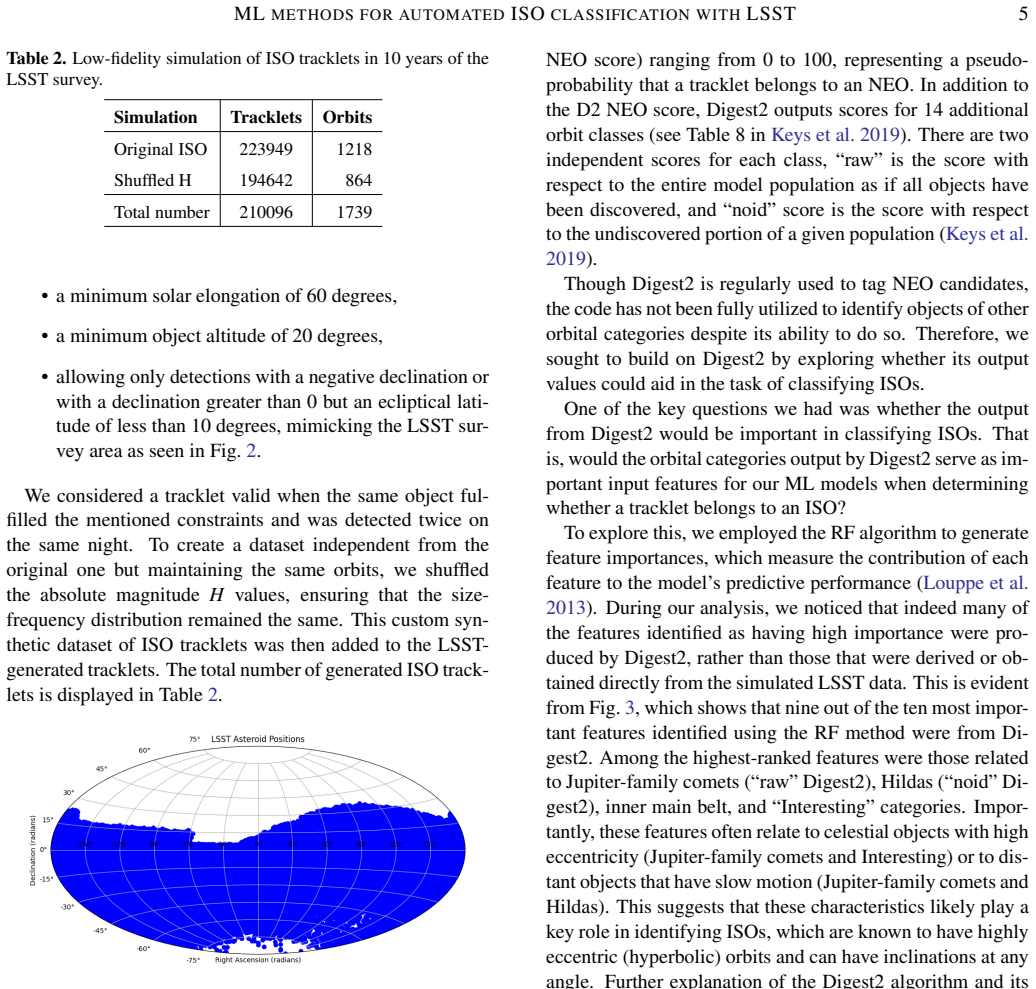
- [Sections 3.2 and 3.4 (Pseudo-survey and tracklet linking assumptions)] The synthetic ISO tracklets used for training and testing are generated by a 'low-fidelity' pseudo-survey with two detections separated by one hour, simplified visibility cuts, and H-shuffling, and the paper explicitly assumes ideal tracklet linking with no false tracklets. Real LSST inter-night linking for hyperbolic orbits is unproven (Section 3), so this assumption is load-bearing for the near-perfect separation. The paper should quantify sensitivity to these assumptions, for example by adding linking errors or using a more realistic cadence, before claiming operational readiness.
- [Section 3.3 (Digest2) and Section 5 (Discussion)] The feature-importance analysis shows that nine of the top ten features are Digest2 outputs, yet no baseline is reported for Digest2 alone (e.g., a threshold on the D2 scores or a simple logistic regression on the 26 Digest2 columns). Without such a baseline, it is unclear whether the ML models add value over the existing Digest2 classifier or are merely re-deriving its decisions. Adding this baseline is essential for assessing the practical contribution of the paper.
minor comments (7)
- [Throughout] The manuscript contains several typos and grammatical errors: 'theV era' and 'withV era' in the abstract; 'one our later' in Section 3.2; 'The results reveals' in Section 4.2; 'V alidation' in the Section 4.3 header; 'The LSST dataset is very differ from current surveys' in Section 4.4. These should be corrected.
- [Table 3] Table 3 lists 'orbtype' as an LSST column, but 'orbtype' is used as the target variable. Please clarify that it is the label, not a feature.
- [Section 4.1] The description of the neural network is too vague: no architecture, activation functions, number of layers/units, or training epochs are given. Similarly, the SGD model's loss function and regularization are not specified. These details are needed for reproducibility.
- [Figure 3] Figure 3 would benefit from error bars or a quantitative measure of feature-importance variability; as presented, the ranking alone is difficult to interpret.
- [Section 3.2] It is unclear whether the 210,096 pseudo-survey tracklets in Table 2 are merged with the original 14,151 ISO tracklets before balancing, and whether the H-shuffled subset is intended to be independent of the original LSST tracklets. Please clarify the exact composition of the final dataset.
- [Section 4.3] The phrase 'The selected data were excluded from the training, testing, and validation datasets' should be clarified to specify whether exclusion was at the tracklet or orbit level, and how this was implemented given the row-level split.
- [Section 4.2] The paper does not discuss the effect of training on a balanced class distribution versus the highly imbalanced real-world scenario; a discussion of expected precision at the true ISO incidence rate, or a cost-sensitive re-training, would strengthen the operational claims.
Circularity Check
No significant circularity: Digest2 feature use is legitimate feature engineering and the headline F1 is an empirical benchmark rather than a derivation; the main caveats are explicit simulation-fidelity limitations and a train/test non-independence risk.
full rationale
The paper does not contain a derivation-level circularity. The ISO labels come from the simulated LSST orbit classes, while Digest2 scores are used only as input features; ISOs are not one of Digest2's output classes, so the target is not defined through the features. Digest2 is an independent published short-arc classifier (Keys et al. 2019), and the self-citations in the paper (including Vereš & Chesley 2017 for false-tracklet discussion) are not load-bearing for the central comparison. The paper itself flags its key limitations: inter-night LSST linking for hyperbolic orbits is not proven (Section 3), and the analysis assumes ideal tracklet linking with no false tracklets (Section 3.4). A separate concern is that the fixed-seed row-level split in Section 4 does not group by object or orbit, while Section 3.2 generates many tracklets from the same 12,148 hyperbolic orbits; this may inflate Table 4's near-perfect metrics through orbit-level train/test leakage. That is a statistical non-independence and correctness risk, not a circular derivation, because the test labels are not constructed from the training labels or from the model predictions. The modest true-positive rates on real 1I/Oumuamua and 2I/Borisov tracklets in Table 6 further indicate that the simulated benchmark should be interpreted cautiously, but again as an external-validity limitation rather than circularity.
Assumptions & free parameters
free parameters (1)
- Balanced class ratio =
1:1 (ISO:non-ISO)
assumptions (3)
- domain assumption Simulated LSST DP0.3 data faithfully represents real LSST observations
- domain assumption Tracklet linking is ideal with no false or mislinked tracklets
- domain assumption The low-fidelity pseudo-survey generates ISO tracklets representative of LSST
Cite this review
Pith. "Pith review of Machine Learning Methods for Automated Interstellar Object Classification with LSST." pith.science (2026). https://pith.science/paper/T3GUD5NG
@misc{pith2026241202112,
  author       = {Pith},
  title        = {Pith review of: Machine Learning Methods for Automated Interstellar Object Classification with LSST},
  year         = {2026},
  howpublished = {\url{https://pith.science/paper/T3GUD5NG}},
  note         = {Machine review of arXiv:2412.02112}
}
read the original abstract
The Legacy Survey of Space and Time, to be conducted with the Vera C. Rubin Observatory, is poised to revolutionize our understanding of the Solar System by providing an unprecedented wealth of data on various objects, including the elusive interstellar objects (ISOs). Detecting and classifying ISOs is crucial for studying the composition and diversity of materials from other planetary systems. However, the rarity and brief observation windows of ISOs, coupled with the vast quantities of data to be generated by LSST, create significant challenges for their identification and classification. This study aims to address these challenges by exploring the application of machine learning algorithms to the automated classification of ISO tracklets in simulated LSST data. We employed various machine learning algorithms, including random forests (RFs), stochastic gradient descent (SGD), gradient boosting machines (GBMs), and neural networks (NNs), to classify ISO tracklets in simulated LSST data. We demonstrate that GBM and RF algorithms outperform SGD and NN algorithms in accurately distinguishing ISOs from other Solar System objects. RF analysis shows that many derived Digest2 values are more important than direct observables in classifying ISOs from the LSST tracklets. The GBM model achieves the highest precision, recall, and F1 score, with values of 0.9987, 0.9986, and 0.9987, respectively. These findings lay the foundation for the development of an efficient and robust automated system for ISO discovery using LSST data, paving the way for a deeper understanding of the materials and processes that shape planetary systems beyond our own. The integration of our proposed machine learning approach into the LSST data processing pipeline will optimize the survey's potential for identifying these rare and valuable objects, enabling timely follow-up observations and further characterization.
Figures


Figures from the paper (1 more)

Reference graph
Works this paper leans on
-
[1]
Bannister, M. T., Schwamb, M. E., Fraser, W. C., et al. 2017, ApJL, 851, L38
work page 2017
-
[2]
Bergner, J. B. & Seligman, D. Z. 2023, Nature, 615, 610
work page 2023
- [3]
-
[4]
Bolin, B. T., Lisse, C. M., Kasliwal, M. M., et al. 2020, The Astronomical Journal, 160, 26
work page 2020
-
[5]
Bolin, B. T., Weaver, H. A., Fernandez, Y . R., et al. 2018, ApJL, 852, L2
work page 2018
- [6]
-
[7]
Bottou, L. 2010, in Proceedings of COMPSTAT’2010: 19th International Conference on Computational StatisticsParis
work page 2010
-
[8]
France, August 22-27, 2010 Keynote, Invited and Contributed
work page 2010
Show all 61 references
-
[9]
2001, Machine learning, 45, 5
Breiman, L. 2001, Machine learning, 45, 5
2001
-
[10]
& Morbidelli, A
Charnoz, S. & Morbidelli, A. 2003, Icarus, 166, 141
2003
-
[11]
V ., Bowyer, K
Chawla, N. V ., Bowyer, K. W., Hall, L. O., & Kegelmeyer, W. P. 2002, Journal of artificial intelligence research, 16, 321
2002
-
[12]
V ., Ragozzine, D., Granvik, M., & Stephens, D
Cook, N. V ., Ragozzine, D., Granvik, M., & Stephens, D. C. 2016, ApJ, 825, 51 ML METHODS FOR AUTOMATED ISO CLASSIFICATION WITH LSST 11
2016
-
[13]
Curran, S. J. 2021, A&A, 649, L17
2021
-
[14]
2010, in American Astronomical Society Meeting Abstracts, V ol
Dailey, J., Bauer, J., Grav, T., et al. 2010, in American Astronomical Society Meeting Abstracts, V ol. 216, American Astronomical Society Meeting Abstracts #216, 409.04
2010
-
[15]
2013, Publications of the Astronomical Society of the Pacific, 125, 357
Denneau, L., Jedicke, R., Grav, T., et al. 2013, Publications of the Astronomical Society of the Pacific, 125, 357
2013
-
[16]
2013, PASP, 125, 357
Denneau, L., Jedicke, R., Grav, T., et al. 2013, PASP, 125, 357
2013
-
[17]
A., & Tonry, J
Do, A., Tucker, M. A., & Tonry, J. 2018, ApJL, 855, L10
2018
-
[18]
2017, The Astronomical Journal, 153, 133
Engelhardt, T., Jedicke, R., Vereš, P., et al. 2017, The Astronomical Journal, 153, 133
2017
-
[19]
2018, Nature Astronomy, 2, 133 Flekkøy, E
Fitzsimmons, A., Snodgrass, C., Rozitis, B., et al. 2018, Nature Astronomy, 2, 133 Flekkøy, E. G. & Brodin, J. F. 2022, ApJL, 925, L11 Flekkøy, E. G., Luu, J., & Toussaint, R. 2019, ApJL, 885, L41
2018
-
[20]
Francis, P. J. 2005, ApJ, 635, 1348
2005
-
[21]
C., Pravec, P., Fitzsimmons, A., et al
Fraser, W. C., Pravec, P., Fitzsimmons, A., et al. 2018, Nature Astronomy, 2, 383
2018
-
[22]
Friedman, J. H. 2001, Annals of statistics, 1189
2001
-
[23]
2011, PASP, 123, 423
Grav, T., Jedicke, R., Denneau, L., et al. 2011, PASP, 123, 423
2011
-
[24]
& Garcia, E
He, H. & Garcia, E. A. 2009, IEEE Transactions on knowledge and data engineering, 21, 1263
2009
-
[25]
2022, in AAS/Division for Planetary Sciences Meeting Abstracts, V ol
Heinze, A., Eggl, S., Juric, M., et al. 2022, in AAS/Division for Planetary Sciences Meeting Abstracts, V ol. 54, AAS/Division for Planetary Sciences Meeting Abstracts, 504.04
2022
-
[26]
& Loeb, A
Hoang, T. & Loeb, A. 2020, ApJL, 899, L23
2020
-
[27]
& Loeb, A
Hoang, T. & Loeb, A. 2023, ApJL, 951, L34
2023
-
[28]
2018, AJ, 156, 135
Kuindersma, S. 2018, AJ, 156, 135
2018
-
[29]
J., Seligman, D
Hoover, D. J., Seligman, D. Z., & Payne, M. J. 2022, The Planetary Science Journal, 3, 71 Ivezi´c, Ž., Kahn, S. M., Tyson, J. A., et al. 2019, The Astrophysical Journal, 873, 111
2022
-
[30]
Jackson, A. P. & Desch, S. J. 2021, Journal of Geophysical Research (Planets), 126, e06706
2021
-
[31]
& Stephen, S
Japkowicz, N. & Stephen, S. 2002, Intelligent data analysis, 6, 429
2002
-
[32]
2003, Earth Moon and Planets, 92, 465
Jewitt, D. 2003, Earth Moon and Planets, 92, 465
2003
-
[33]
2017, ApJL, 850, L36
Jewitt, D., Luu, J., Rajagopal, J., et al. 2017, ApJL, 850, L36
2017
-
[34]
& Seligman, D
Jewitt, D. & Seligman, D. Z. 2023, ARA&A, 61, 197
2023
-
[35]
2009, Earth, Moon, and Planets, 105, 101
Jones, R., Chesley, S., Connolly, A., et al. 2009, Earth, Moon, and Planets, 105, 101
2009
-
[36]
J., et al
Keys, S., Vereš, P., Payne, M. J., et al. 2019, Publications of the Astronomical Society of the Pacific, 131, 1
2019
-
[37]
M., Protopapa, S., Kelley, M
Knight, M. M., Protopapa, S., Kelley, M. S. P., et al. 2017, ApJL, 851, L31
2017
-
[38]
2015, nature, 521, 436
LeCun, Y ., Bengio, Y ., & Hinton, G. 2015, nature, 521, 436
2015
-
[39]
G., Cabot, S
Levine, W. G., Cabot, S. H. C., Seligman, D., & Laughlin, G. 2021, ApJ, 922, 39
2021
-
[40]
2022, Astrobiology, 22, 1392
Loeb, A. 2022, Astrobiology, 22, 1392
2022
-
[41]
2023, Research Notes of the American Astronomical Society, 7, 43
Loeb, A. 2023, Research Notes of the American Astronomical Society, 7, 43
2023
-
[42]
2013, Advances in neural information processing systems, 26 Marˇceta, D
Louppe, G., Wehenkel, L., Sutera, A., & Geurts, P. 2013, Advances in neural information processing systems, 26 Marˇceta, D. & Seligman, D. Z. 2023, The Planetary Science Journal, 4, 230
2013
-
[43]
J., Laher, R
Masci, F. J., Laher, R. R., Rusholme, B., et al. 2019, PASP, 131, 018003
2019
-
[44]
2019, MNRAS, 489, 3003
Mashchenko, S. 2019, MNRAS, 489, 3003
2019
-
[45]
2017, arXiv e-prints, arXiv:1710.09977
Masiero, J. 2017, arXiv e-prints, arXiv:1710.09977
2017 arXiv
-
[46]
McGlynn, T. A. & Chapman, R. D. 1989, ApJL, 346, L105
1989
-
[47]
J., Weryk, R., Micheli, M., et al
Meech, K. J., Weryk, R., Micheli, M., et al. 2017, Nature, 552, 378
2017
-
[48]
J., et al
Micheli, M., Farnocchia, D., Meech, K. J., et al. 2018, Nature, 559, 223
2018
-
[49]
N., et al
Miret-Roig, N., Bouy, H., Raymond, S. N., et al. 2022, Nature Astronomy, 6, 89 Moro-Martín, A., Turner, E. L., & Loeb, A. 2009, ApJ, 704, 733 Peña Ramírez, K., Béjar, V . J. S., Zapatero Osorio, M. R.,
2022
-
[50]
G., & Martín, E
Petr-Gotzens, M. G., & Martín, E. L. 2012, ApJ, 754, 30 Portegies Zwart, S., Torres, S., Pelupessy, I., Bédorf, J., & Cai, M. X. 2018, MNRAS, 479, L17
2012
-
[51]
Rafikov, R. R. 2018, ApJL, 867, L17
2018
-
[52]
N., Armitage, P
Raymond, S. N., Armitage, P. J., & Veras, D. 2018, ApJL, 856, L7
2018
-
[53]
N., Kaib, N
Raymond, S. N., Kaib, N. A., Armitage, P. J., & Fortney, J. J. 2020, ApJL, 904, L4
2020
-
[54]
2012, ApJ, 744, 6
Scholz, A., Muzic, K., Geers, V ., et al. 2012, ApJ, 744, 6
2012
-
[55]
E., Jones, R
Schwamb, M. E., Jones, R. L., Yoachim, P., et al. 2023, The Astrophysical Journal Supplement Series, 266, 22
2023
-
[56]
Sen, A. K. & Rana, N. C. 1993, A&A, 275, 298
1993
-
[57]
& Loeb, A
Siraj, A. & Loeb, A. 2022, NewA, 92, 101730
2022
-
[58]
K., & Kamel, M
Sun, Y ., Wong, A. K., & Kamel, M. S. 2009, International journal of pattern recognition and artificial intelligence, 23, 687
2009
-
[59]
Torbett, M. V . 1986, AJ, 92, 171
1986
-
[60]
E., Mommert, M., Hora, J
Trilling, D. E., Mommert, M., Hora, J. L., et al. 2018, AJ, 156, 261 Vereš, P. & Chesley, S. R. 2017, AJ, 154, 13
2018
-
[61]
Ye, Q.-Z., Zhang, Q., Kelley, M. S. P., & Brown, P. G. 2017, ApJL, 851, L5
2017
Reviewed August 11, 2026 · model on record in the stance chip above.
Discussion (0). Continue with ORCID to comment.