REVIEW 3 major objections 5 minor 76 references
Evaluating Single Event Upsets in Deep Neural Networks for Semantic Segmentation: an embedded system perspective
T0 review · 3 major / 5 minor · reviewed 2026-08-11 · deepseek-v4-flash
Pith's one-line read For ReLU-based segmentation networks, most single-event-upset errors come from bit flips that increase parameter values, with the exponent MSB being the dominant risk; the paper derives a formula predicting these error rates from bias…
desk verdict Solid, citable SEU study of segmentation U-Nets with a useful protection technique; the printed Equation 2 is mis-specified but the sign-aware calculation behind it is sound. read the letter →
The pith
A machine-rendered reading of the paper's core claim, the machinery that carries it, and where it could break.
The reading
What carries the argument
The load-bearing object is the binary representation of a trained parameter. In IEEE 754 single precision, a flip in bit 30—the MSB of the exponent—turns any value in $[1,2)$ into NaN or infinity, and a flip in a partially filled exponent (six of the seven lower exponent bits already set to one) pushes a sub-unity value above unity. The paper's central identity is the error-rate formula for the final-layer biases, $$\%\text{error}_{30} = \sum_{j=0}^{5} $P_j^{{\mathrm{fi}}$} $P_j^{{\mathrm{m}}$},$$ where $P_j^{\mathrm{fi}}$ is the probability that a bit-flip lands in bias $j$ (taken as $1/6$ in the experiment) and $P_j^{\mathrm{m}}$ is the faultless model's probability of predicting class $j$. This identity carries the argument because it converts a costly fault-injection campaign into an offline computation from two cheap quantities: bias signs and per-class prediction probabilities. The same representational reasoning motivates the proposed protection, which increments or decrements the exponent and compensates the mantissa so that no parameter sits one zero away from a filled exponent.
What would settle it
Take any trained ReLU segmentation FCN, compute the six output-bias signs and the faultless model's per-class prediction probabilities, then inject 1550 bit-30 flips into those biases; if the measured error rate disagrees with Equation 2 by more than the 2.5% margin allowed by the sample-size formula, the paper's predictive claim fails.
Extended reading notes
Core claim
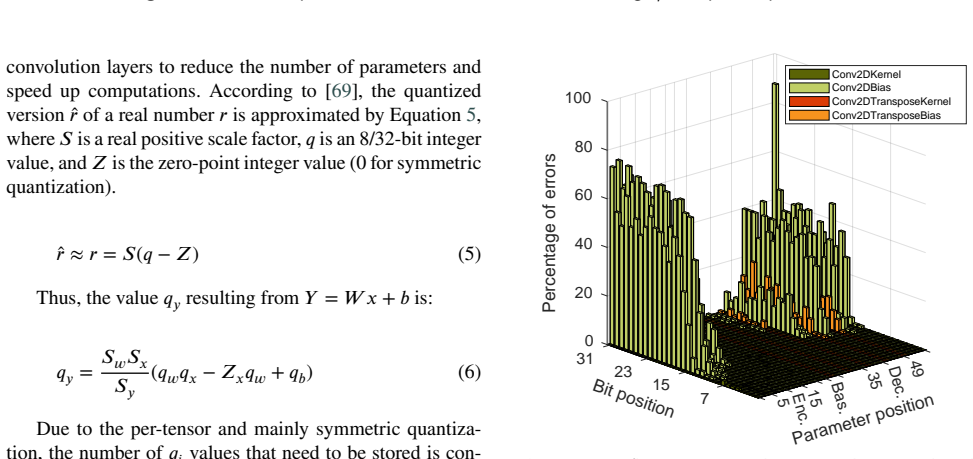
On the paper's own terms, the central discovery is that for ReLU-based encoder-decoder segmentation networks, SEU-induced failures are not spread uniformly across the parameter tensor: they concentrate in magnitude-increasing flips, with the exponent MSB (bit 30) as the dominant threat. In single-precision floating point, flipping bit 30 of any parameter in $[1,2)$ yields NaN or infinity; flipping a partially filled exponent (six lower exponent bits already set to one) pushes a sub-unity value above unity. Because ReLU outputs are nonnegative and the network's computation is largely monotonic, positive biases and positive gamma parameters in batch-normalization layers become the vulnerable points, and the final-layer bias error rate can be predicted with an equation that combines the probability of a flip in each bias and the probability the model predicts that class. The paper verifies this prediction experimentally (37.29% vs 34% for the unpruned model, 37.24% vs 32% for the pruned one), then shows that BN folding and quantization relocate rather than remove the risk, and concludes with a set of zero-overhead parameter-adjustment protections.
Load-bearing premise
The analysis assumes a streaming-like implementation with independent resources per layer, so a single event upset flips one stored parameter and never corrupts configuration memory, control logic, or shared buses (Section 3.2); if real-device errors are dominated by configuration upsets or multi-bit upsets, the per-layer error rates and SEU-per-hour estimates will not transfer.
Editorial extensions
If this is right
- Once a network is trained, its SEU error rate for the dominant bit-30 mechanism can be estimated from parameter sign, magnitude, and class frequencies, without running fault injections.
- Pruning removes the redundant slack that absorbs errors, so every remaining parameter is more critical; however, the pruned model's 100x smaller size drops the expected SEU encounter rate from about 5 to 0.05 SEUs per hour at 20 FIT/Mb.
- Integer quantization eliminates NaN and infinity states, making weights nearly immune; error protection can therefore be limited to the small bias subset, enabling low-cost redundancy.
- Batch-normalization folding eliminates the most sensitive parameters but increases conv-bias magnitudes, shifting vulnerability to lower exponent bits (24-29), so hardening must account for where the risk moves.
- The proposed exponent-adjustment protection reduces error rates at PT1-PT2 settings with no memory or computational overhead and only minor IoU changes.
Reading between the lines
- The same sign-and-representation analysis should transfer to other ReLU-based encoder-decoder networks; a direct test is to compute Equation 2 on a published segmentation model with different class frequencies and compare against a short bit-30 injection campaign.
- Because the upper word of an int8 bias only extends the sign, those redundant high bits could be repurposed as parity or error-detection storage with zero memory overhead—an idea the paper leaves implicit.
- The exponent-adjustment protection could be folded into training as a regularizer that keeps parameters away from filled-exponent states, potentially improving SEU robustness before deployment.
- The crossover point where pruning's smaller SEU encounter rate outweighs its higher per-bit sensitivity is a design variable the paper quantifies but does not optimize; finding that optimum for a given FIT rate and mission time would be a natural next step.
Signed reviews
Editorial analysis
A structured set of objections, weighed in public.
Referee Report
Summary. This manuscript presents a software fault-injection study of single-bit upsets (SBUs) in a U-Net-based semantic segmentation model, covering unpruned/pruned and FP32/INT8 variants. It reports layer-by-layer and bit-by-bit error rates, identifies sign- and exponent-related sensitivity patterns, and proposes zero-overhead parameter reconfiguration techniques to reduce risky exponent states. The central quantitative claim is that the error rate for bit-30 flips in the output biases can be predicted analytically from class frequencies (Equation 2), and that robustness can therefore be estimated without new fault injections.
Significance. The paper has clear strengths: the FI campaign is large (155,000 injections); the code for the FI tool and for the protection tool is publicly available; and the qualitative observations about positive biases, BN gamma sensitivity, partial-exponent filling, and BN folding are supported by calibration data and per-layer/per-bit statistics. If the analytic error-rate model were valid, the paper would offer a practical pre-deployment robustness estimator for encoder-decoder segmentation networks. However, the central analytic model is not valid as printed, and the SEU/hour extrapolation contains a unit error, so the paper currently overstates what is established. The qualitative vulnerability analysis remains a useful contribution.
major comments (3)
- [Sec. 4.1.1, Eq. (2)] Equation (2) is not a valid probability model as printed. The quantities P_j^m are described as probabilities that the faultless model predicts class j, but the substituted values (0, 55.09, 4.41, 73.05, 7.47, 83.73) are percentages summing to 223.75, not to 100. More importantly, the equation applies the same factor P_j^m to every bias regardless of sign, while the surrounding prose correctly states that a bit-30 flip in a negative bias makes that class never predicted (contribution P_j^m) and in a positive bias makes it always predicted (contribution 1 - P_j^m). With the listed values and the sign-aware rule, the prediction is (0 + 4.41 + 7.47 + 44.91 + 26.95 + 16.27)/6 = 16.67%, not the reported 37.29%; the claimed agreement with the experimental 34% is therefore not supported. The same invalid formula is reused in Sec. 4.1.2 (37.24%) and in Secs. 4.2.1 and 4.2.2 for the QNN (37.06% and 37.89%), so the quantitative half of the claim that robustness can be predicted without fault injection fails. Please correct the model and re-evaluate the agreement, or explicitly limit the claim to the qualitative sign/exponent mechanism.
- [Sec. 4.2.3 and Sec. 6] The SEU/hour estimates derived from a failure rate of 20 FIT/Mb are inconsistent with the standard definition of FIT (failures per 10^9 device-hours). With the model sizes in Table 2, 20 FIT/Mb corresponds to about 1.9e-5 SEU/h for the 118.77 MB FP32 unpruned model and about 4.8e-6 SEU/h for the 29.70 MB INT8 unpruned model, not the reported 5 SEU/h. The claimed 1000 upsets in 8.3 days and the corresponding pruned-model figure of about 2.3 years are therefore off by several orders of magnitude. Please correct the unit conversion or state the assumed FIT definition explicitly; the current numbers do not follow from the cited failure rate.
- [Sec. 5.1, paragraph after Table 17] The protection method is evaluated by injecting single bit-flips only in the risky bit positions of the parameters selected by the PT setting. Because the method is specifically designed to eliminate those risky exponents, this evaluation is partly circular and cannot quantify the method's effect on overall robustness under a realistic SEU distribution. The paper should also report the error rate of the protected models under the same random or exhaustive FI campaign used in Section 4, or at least under random bit positions across all parameters, together with the observed IoU changes. Without that, the claim that the proposed technique improves robustness with no memory or computational cost is demonstrated only for a targeted failure mode, not for general SBU exposure.
minor comments (5)
- [Abstract and Introduction] There are typos such as 'artifical intelligence' in the abstract and 'mayor concern' in the introduction; please correct them.
- [Sec. 4.2.1] The 'linear weighting approximation based on bit significance' used to obtain the experimental values 37.64% and 37.89% is not specified; the weights should be stated so that the aggregation is reproducible.
- [Sec. 5.1] The PT1-PT4 thresholds (1.999/1.001, 1.99/1.01, 1.95/1.05, 1.9/1.1) are introduced only in prose before Table 13; a compact definition in the table caption or in a short equation would improve readability.
- [Sec. 3.2, Sec. 4.2.3, Sec. 6] The streaming-like architecture assumption (independent per-layer resources, no configuration-memory or control-logic upsets) is stated early, but it should be recalled when the SEU/hour numbers are given, because those numbers are parameter-memory estimates, not device-level soft-error rates.
- [Sec. 6] The word 'prunning' appears in the conclusions; it should be 'pruning'.
Circularity Check
No significant circularity: the analytic error-rate estimate is checked against independent FI data, not fitted to it.
full rationale
This paper is an empirical fault-injection study whose central analytic estimate (Eq. 2) is computed from the faultless model's class frequencies and then compared against independently measured bit-flip error rates. The P_j^m inputs are not fitted to the experimental error rates; the comparison is a check rather than a tautology. The protection method is evaluated by flipping the specific bits it was designed to make safe, which tests the mechanism directly and does not rename the design target as a prediction. Self-citations ([20], [21], [66]) provide the public dataset and tooling used as experimental setup; they are not invoked as authority for the robustness conclusions. No step in the derivation chain reduces to its own inputs by construction. A separate correctness concern is that Eq. 2 as printed contains a normalization/sign inconsistency (the listed P_j^m values sum to 223.75, and the sign-dependent error rule in the text would require using 1-P_j^m for positive biases), but this is a modeling error, not circularity. The score reflects that the main derivation is self-contained against external fault-injection benchmarks.
Assumptions & free parameters
free parameters (1)
- Protection target mantissa thresholds (PT1-PT4) =
PT1 (1.999, 1.001), PT2 (1.99, 1.01), PT3 (1.95, 1.05), PT4 (1.9, 1.1)
assumptions (5)
- domain assumption Streaming-like implementation with independent resources per layer, so an SEU only affects one stored parameter and does not propagate to configuration memory or shared logic (Section 3.2, [68]).
- domain assumption Software-injected single bit-flips in stored weights/biases/BN parameters emulate hardware SEUs with uniform probability over bits and parameters (Section 4).
- standard math Statistical sample-size formula from Leveugle et al. [73] with p=0.5, e=0.025, t=1.96 yields n=1550 (Equation 1).
- domain assumption For Equation 2, the error rate from a bit-flip in bias j is P_j^m for negative biases and 1-P_j^m for positive biases, with each bias equally likely to be flipped (Section 4.1.1).
- domain assumption Numeric ranges observed in calibration passes (e.g., activations within [-6.77, 11.79], gamma in (0.1, 2)) are representative of the test distribution (Section 4.1.1).
Cite this review
Pith. "Pith review of Evaluating Single Event Upsets in Deep Neural Networks for Semantic Segmentation: an embedded system perspective." pith.science (2026). https://pith.science/paper/YFCBIRW2
@misc{pith2026241203630,
  author       = {Pith},
  title        = {Pith review of: Evaluating Single Event Upsets in Deep Neural Networks for Semantic Segmentation: an embedded system perspective},
  year         = {2026},
  howpublished = {\url{https://pith.science/paper/YFCBIRW2}},
  note         = {Machine review of arXiv:2412.03630}
}
read the original abstract
As the deployment of artifical intelligence (AI) algorithms at edge devices becomes increasingly prevalent, enhancing the robustness and reliability of autonomous AI-based perception and decision systems is becoming as relevant as precision and performance, especially in applications areas considered safety-critical such as autonomous driving and aerospace. This paper delves into the robustness assessment in embedded Deep Neural Networks (DNNs), particularly focusing on the impact of parameter perturbations produced by single event upsets (SEUs) on convolutional neural networks (CNN) for image semantic segmentation. By scrutinizing the layer-by-layer and bit-by-bit sensitivity of various encoder-decoder models to soft errors, this study thoroughly investigates the vulnerability of segmentation DNNs to SEUs and evaluates the consequences of techniques like model pruning and parameter quantization on the robustness of compressed models aimed at embedded implementations. The findings offer valuable insights into the mechanisms underlying SEU-induced failures that allow for evaluating the robustness of DNNs once trained in advance. Moreover, based on the collected data, we propose a set of practical lightweight error mitigation techniques with no memory or computational cost suitable for resource-constrained deployments. The code used to perform the fault injection (FI) campaign is available at https://github.com/jonGuti13/TensorFI2 , while the code to implement proposed techniques is available at https://github.com/jonGuti13/parameterProtection .
Figures


Figures from the paper (27 more)




Reference graph
Works this paper leans on
-
[1]
Soledad Le Clainche, Esteban Ferrer, Sam Gibson, Elisabeth Cross, Alessandro Parente, and Ricardo Vinuesa. Improving aircraft per- formance using machine learning: A review.Aerospace Science and Technology, page 108354, 2023
work page 2023
-
[2]
Guidelines for Development of Civil AircraftandSystems
SAE International Aerospace. Guidelines for Development of Civil AircraftandSystems. SAEARP4754A,2010. URL https://www.sae. org/standards/content/arp4754a/. Revision A
work page 2010
-
[3]
Road vehicles – Functional safety
International Organization for Standardization. Road vehicles – Functional safety. ISO 26262, 2018. URL https://www.iso.org/ standard/68383.html
work page 2018
-
[4]
Corinna Martinella, Rubén G Alía, Roger Stark, Andrea Coronetti, Carlo Cazzaniga, Maria Kastriotou, Yacine Kadi, Rémi Gaillard, Ulrike Grossner, and Arto Javanainen. Impact of terrestrial neutrons on the reliability of sic vd-mosfet technologies.IEEE Transactions on Nuclear Science, 68(5):634–641, 2021
work page 2021
-
[5]
Soft errors in advanced computer systems.IEEE design & test of computers, 22(3):258–266, 2005
Robert Baumann. Soft errors in advanced computer systems.IEEE design & test of computers, 22(3):258–266, 2005
work page 2005
-
[6]
Multiple sensitive volume based soft error rate estimation with machine learning
SoichiHirokawa,RyoHarada,KenshiroSakuta,YukinobuWatanabe, and Masanori Hashimoto. Multiple sensitive volume based soft error rate estimation with machine learning. In2016 16th European Conference on Radiation and Its Effects on Components and Systems (RADECS), pages 1–4. IEEE, 2016
work page 2016
-
[7]
When single event upset meets deep neural networks: Observations, explorations, and remedies
Zheyu Yan, Yiyu Shi, Wang Liao, Masanori Hashimoto, Xichuan Zhou, and Cheng Zhuo. When single event upset meets deep neural networks: Observations, explorations, and remedies. In2020 25th Asia and South Pacific Design Automation Conference (ASP-DAC), pages 163–168. IEEE, 2020
work page 2020
-
[8]
Wenxiao Wang, Song Gao, Yaqi Wang, Yang Li, Wenjing Yue, HongsenNiu,FeifeiYin,YunjianGuo,andGuozhenShen. Advances in emerging photonic memristive and memristive-like devices.Ad- vanced Science, 9(28):2105577, 2022
work page 2022
Show all 76 references
-
[9]
Wesco: Weight-encoded reliability and security co-design for in-memory computing systems
Jiangwei Zhang, Chong Wang, Yi Cai, Zhenhua Zhu, Donald Kline, Huazhong Yang, and Yu Wang. Wesco: Weight-encoded reliability and security co-design for in-memory computing systems. In2022 IEEE Computer Society Annual Symposium on VLSI (ISVLSI), pages 296–301. IEEE, 2022
2022
-
[10]
Flip- ping bits in memory without accessing them: An experimental study of dram disturbance errors.ACM SIGARCH Computer Architecture News, 42(3):361–372, 2014
Yoongu Kim, Ross Daly, Jeremie Kim, Chris Fallin, Ji Hye Lee, Donghyuk Lee, Chris Wilkerson, Konrad Lai, and Onur Mutlu. Flip- ping bits in memory without accessing them: An experimental study of dram disturbance errors.ACM SIGARCH Computer Architecture News, 42(3):361–372, 2014
2014
-
[11]
Variation-aware static and dynamic writability analysis for voltage-scaled bit-interleaved 8-t srams
Daeyeon Kim, Vikas Chandra, Robert Aitken, David Blaauw, and Dennis Sylvester. Variation-aware static and dynamic writability analysis for voltage-scaled bit-interleaved 8-t srams. InIEEE/ACM International Symposium on Low Power Electronics and Design, pages 145–150. IEEE, 2011
2011
-
[12]
Flip feng shui: Hammering a needle in the software stack
KavehRazavi,BenGras,ErikBosman,BartPreneel,CristianoGiuf- frida, and Herbert Bos. Flip feng shui: Hammering a needle in the software stack. In25th USENIX Security Symposium (USENIX Security 16), pages 1–18, 2016
2016
-
[13]
{DeepHammer}: Depleting the intelligence of deep neural networks through targeted chain of bit flips
Fan Yao, Adnan Siraj Rakin, and Deliang Fan. {DeepHammer}: Depleting the intelligence of deep neural networks through targeted chain of bit flips. In 29th USENIX Security Symposium (USENIX Security 20), pages 1463–1480, 2020
2020
-
[14]
Aegis: Mitigating targeted bit-flip attacks against deep neural networks
Jialai Wang, Ziyuan Zhang, Meiqi Wang, Han Qiu, Tianwei Zhang, Qi Li, Zongpeng Li, Tao Wei, and Chao Zhang. Aegis: Mitigating targeted bit-flip attacks against deep neural networks. In 32nd USENIX Security Symposium (USENIX Security 23), pages 2329– 2346, 2023
2023
-
[15]
Internimage: Exploring large-scale vision foundation models with deformable convolutions, 2023
Wenhai Wang, Jifeng Dai, Zhe Chen, Zhenhang Huang, Zhiqi Li, Xizhou Zhu, Xiaowei Hu, Tong Lu, Lewei Lu, Hongsheng Li, Xiao- gang Wang, and Yu Qiao. Internimage: Exploring large-scale vision foundation models with deformable convolutions, 2023
2023
-
[16]
Reorda,andA.Paccagnella
M.Violante,L.Sterpone,M.Ceschia,D.Bortolato,P.Bernardi,M.S. Reorda,andA.Paccagnella. Simulation-basedanalysisofseueffects in sram-based fpgas.IEEE Transactions on Nuclear Science, 51(6): 3354–3359, 2004. doi: 10.1109/TNS.2004.839516. Jon Gutiérrez-Zaballa et al.:Preprint submi...
2004
-
[17]
Selective hardening of critical neurons in deep neural networks
Annachiara Ruospo, Gabriele Gavarini, Ilaria Bragaglia, Marcello Traiola, Alberto Bosio, and Ernesto Sanchez. Selective hardening of critical neurons in deep neural networks. In2022 25th International Symposium on Design and Diagnostics of Electronic Circuits and Systems (DDEC...
2022
-
[18]
Explo- ration of activation fault reliability in quantized systolic array-based dnn accelerators, 2024
MahdiTaheri,NataliaCherezova,MohammadSaeedAnsari,Maksim Jenihhin, Ali Mahani, Masoud Daneshtalab, and Jaan Raik. Explo- ration of activation fault reliability in quantized systolic array-based dnn accelerators, 2024
2024
-
[19]
A survey of quantization methods for efficient neural network inference
Amir Gholami, Sehoon Kim, Zhen Dong, Zhewei Yao, Michael W Mahoney, and Kurt Keutzer. A survey of quantization methods for efficient neural network inference. InLow-Power Computer Vision, pages 291–326. Chapman and Hall/CRC, 2022
2022
-
[20]
parameterprotection, 2024
Jon Gutiérrez-Zaballa. parameterprotection, 2024. URL https: //github.com/jonGuti13/parameterProtection
2024
-
[21]
Tensorfi2, 2024
Jon Gutiérrez-Zaballa. Tensorfi2, 2024. URL https://github.com/ jonGuti13/TensorFI2
2024
-
[22]
Fault injection for ten- sorflow applications
Niranjhana Narayanan, Zitao Chen, Bo Fang, Guanpeng Li, Karthik Pattabiraman, and Nathan DeBardeleben. Fault injection for ten- sorflow applications. IEEE Transactions on Dependable and Se- cure Computing, 20(4):2677–2695, 2023. doi: 10.1109/TDSC.2022. 3175930
2023 doi
-
[23]
A systematic literature review onhardwarereliabilityassessmentmethodsfordeepneuralnetworks
Mohammad Hasan Ahmadilivani, Mahdi Taheri, Jaan Raik, Masoud Daneshtalab, and Maksim Jenihhin. A systematic literature review onhardwarereliabilityassessmentmethodsfordeepneuralnetworks. ACM Comput. Surv., dec 2023. ISSN 0360-0300. doi: 10.1145/ 3638242. URL https://doi.org/10...
2023 doi
-
[24]
The robustness of modern deep learning architectures against single event upset errors
Austin P Arechiga and Alan J Michaels. The robustness of modern deep learning architectures against single event upset errors. In2018 IEEE High Performance extreme Computing Conference (HPEC), pages 1–6. IEEE, 2018
2018
-
[25]
The impact of faults on dnns: A case study
Elaheh Malekzadeh, Nezam Rohbani, Zhonghai Lu, and Masoumeh Ebrahimi. The impact of faults on dnns: A case study. In2021 IEEE International Symposium on Defect and Fault Tolerance in VLSI and Nanotechnology Systems (DFT), pages 1–6. IEEE, 2021
2021
-
[26]
The effect of weight errors on neural networks
Austin P Arechiga and Alan J Michaels. The effect of weight errors on neural networks. In 2018 IEEE 8th Annual Computing and CommunicationWorkshopandConference(CCWC) ,pages190–196. IEEE, 2018
2018
-
[27]
Are cnns reliable enough for critical applications? an exploratory study
Mohamed A Neggaz, Ihsen Alouani, Smail Niar, and Fadi Kurdahi. Are cnns reliable enough for critical applications? an exploratory study. IEEE Design & Test, 37(2):76–83, 2019
2019
-
[28]
Eval- uating fault resiliency of compressed deep neural networks
Majid Sabbagh, Cheng Gongye, Yunsi Fei, and Yanzhi Wang. Eval- uating fault resiliency of compressed deep neural networks. In2019 IEEE International Conference on Embedded Software and Systems (ICESS), pages 1–7. IEEE, 2019
2019
-
[29]
Reliability evaluation of compresseddeeplearningmodels.In 2020IEEE11thLatinAmerican SymposiumonCircuits&Systems(LASCAS) ,pages1–5.IEEE,2020
Brunno F Goldstein, Sudarshan Srinivasan, Dipankar Das, Kunal Banerjee, Leandro Santiago, Victor C Ferreira, Alexandre S Nery, Sandip Kundu, and Felipe MG França. Reliability evaluation of compresseddeeplearningmodels.In 2020IEEE11thLatinAmerican SymposiumonCircuits&Systems(LA...
2020
-
[30]
IEEE, 2019
Alberto Bosio, Paolo Bernardi, Annachiara Ruospo, and Ernesto Sanchez.Areliabilityanalysisofadeepneuralnetwork.In 2019IEEE Latin American Test Symposium (LATS), pages 1–6. IEEE, 2019
2019
-
[31]
Assessing convolutional neural net- works reliability through statistical fault injections
Annachiara Ruospo, Gabriele Gavarini, Corrado De Sio, J Guerrero, LucaSterpone,MSonzaReorda,ErnestoSánchez,RiccardoMariani, J Aribido, and Jyotika Athavale. Assessing convolutional neural net- works reliability through statistical fault injections. In2023 Design, Automation&Te...
2023
-
[32]
Terminal brain damage: Exposing the graceless degradation in deep neural networks under hardware fault attacks
SanghyunHong,PietroFrigo,YiğitcanKaya,CristianoGiuffrida,and Tudor Dumitras,. Terminal brain damage: Exposing the graceless degradation in deep neural networks under hardware fault attacks. In 28thUSENIXSecuritySymposium(USENIXSecurity19) ,pages497– 514, 2019
2019
-
[33]
FaultinjectioninMachineLearningapplica- tions
NiranjhanaNarayanan. FaultinjectioninMachineLearningapplica- tions. PhD thesis, University of British Columbia, 2021
2021
-
[34]
Evaluating convolutional neural networks reliability de- pending on their data representation
Annachiara Ruospo, Alberto Bosio, Alessandro Ianne, and Ernesto Sanchez. Evaluating convolutional neural networks reliability de- pending on their data representation. In 2020 23rd Euromicro Conference on Digital System Design (DSD), pages 672–679. IEEE, 2020
2020
-
[35]
Investigating data representation for efficientandreliableconvolutionalneuralnetworks
Annachiara Ruospo, Ernesto Sanchez, Marcello Traiola, Ian O’connor, and Alberto Bosio. Investigating data representation for efficientandreliableconvolutionalneuralnetworks. Microprocessors and Microsystems, 86:104318, 2021
2021
-
[36]
In 2021 IEEE 32nd International Conference on Microelectronics (MIEL), pages 275–279
Rizwan Tariq Syed, Markus Ulbricht, Krzysztof Piotrowski, and Mi- losKrstic.Faultresilienceanalysisofquantizeddeepneuralnetworks. In 2021 IEEE 32nd International Conference on Microelectronics (MIEL), pages 275–279. IEEE, 2021
2021
-
[37]
Defending and harnessing the bit-flip based adversarial weight attack
Zhezhi He, Adnan Siraj Rakin, Jingtao Li, Chaitali Chakrabarti, and Deliang Fan. Defending and harnessing the bit-flip based adversarial weight attack. In Proceedings of the IEEE/CVF Conference on ComputerVisionandPatternRecognition ,pages14095–14103,2020
2020
-
[38]
Defending bit-flip attack through dnn weight reconstruction
JingtaoLi,AdnanSirajRakin,YanXiong,LiangliangChang,Zhezhi He, Deliang Fan, and Chaitali Chakrabarti. Defending bit-flip attack through dnn weight reconstruction. In2020 57th ACM/IEEE Design Automation Conference (DAC), pages 1–6. IEEE, 2020
2020
-
[39]
Bit-flip attack: Crushing neural network with progressive bit search
Adnan Siraj Rakin, Zhezhi He, and Deliang Fan. Bit-flip attack: Crushing neural network with progressive bit search. InProceedings of the IEEE/CVF International Conference on Computer Vision, pages 1211–1220, 2019
2019
-
[40]
On pixel- wise explanations for non-linear classifier decisions by layer-wise relevance propagation.PloS one, 10(7):e0130140, 2015
Sebastian Bach, Alexander Binder, Grégoire Montavon, Frederick Klauschen, Klaus-Robert Müller, and Wojciech Samek. On pixel- wise explanations for non-linear classifier decisions by layer-wise relevance propagation.PloS one, 10(7):e0130140, 2015
2015
-
[41]
Sensitivity based error resilient techniques for energy efficient deep neural network accelerators
Wonseok Choi, Dongyeob Shin, Jongsun Park, and Swaroop Ghosh. Sensitivity based error resilient techniques for energy efficient deep neural network accelerators. In Proceedings of the 56th Annual Design Automation Conference 2019, pages 1–6, 2019
2019
-
[42]
Estimating vulnerability of all model parameters in dnn with a small number of fault injections
Yangchao Zhang, Hiroaki Itsuji, Takumi Uezono, Tadanobu Toba, and Masanori Hashimoto. Estimating vulnerability of all model parameters in dnn with a small number of fault injections. In 2022 Design, Automation & Test in Europe Conference & Exhibition (DATE), pages 60–63. IEEE, 2022
2022
-
[43]
Binfi: An efficient fault injector for safety-critical machine learning systems
Zitao Chen, Guanpeng Li, Karthik Pattabiraman, and Nathan De- Bardeleben. Binfi: An efficient fault injector for safety-critical machine learning systems. In Proceedings of the International Conference for High Performance Computing, Networking, Storage and Analysis, pages 1–23, 2019
2019
-
[44]
Improving fault tolerance for reliable dnn using boundary-aware activation
Jinyu Zhan, Ruoxu Sun, Wei Jiang, Yucheng Jiang, Xunzhao Yin, and Cheng Zhuo. Improving fault tolerance for reliable dnn using boundary-aware activation. IEEE Transactions on Computer-Aided Design of Integrated Circuits and Systems, 41(10):3414–3425, 2021
2021
-
[45]
Improvingdnn fault tolerance in semantic segmentation applications
StéphaneBurelT,AdrianEvansT,andLorenaAnghel. Improvingdnn fault tolerance in semantic segmentation applications. In2022 IEEE International Symposium on Defect and Fault Tolerance in VLSI and Nanotechnology Systems (DFT), pages 1–6. IEEE, 2022
2022
-
[46]
ReliabilityEvaluationofSplitComputingNeural Networks
GiuseppeEsposito. ReliabilityEvaluationofSplitComputingNeural Networks. PhD thesis, Politecnico di Torino, 2023
2023
-
[47]
A fast reliability analysis of image segmentation neural networks exploiting statistical fault injections
G Govarini, Annachiara Ruospo, and E Sanchez. A fast reliability analysis of image segmentation neural networks exploiting statistical fault injections. In2023 IEEE 24th Latin American Test Symposium (LATS), pages 1–6. IEEE, 2023
2023
-
[48]
Ontheevaluationofsoft-errorsdetectiontechniquesfor gpgpus
Davide Sabena, M Sonza Reorda, Luca Sterpone, Paolo Rech, and LuigiCarro. Ontheevaluationofsoft-errorsdetectiontechniquesfor gpgpus. In 2013 8th IEEE Design and Test Symposium, pages 1–6. IEEE, 2013
2013
-
[49]
Modern gpus radiation sensitivity evaluation and mitigation through duplication with com- parison
Daniel AG Oliveira, Paolo Rech, Heather M Quinn, Thomas D Fairbanks, Laura Monroe, Sarah E Michalak, Christine Anderson- Cook, Philippe OA Navaux, and Luigi Carro. Modern gpus radiation sensitivity evaluation and mitigation through duplication with com- parison. IEEE Transacti...
2014
-
[50]
Kernel vulnerability factor and efficient hardening for his- togramoforientedgradients
Lucas Weigel, Fernando Fernandes, Philippe Navaux, and Paolo Rech. Kernel vulnerability factor and efficient hardening for his- togramoforientedgradients. In 2017IEEEInternationalSymposium on Defect and Fault Tolerance in VLSI and Nanotechnology Systems (DFT), pages 1–6. IEEE, 2017
2017
-
[51]
Selective hardeningforneuralnetworksinfpgas
Fabiano Libano, Brittany Wilson, J Anderson, Michael J Wirthlin, Carlo Cazzaniga, Christopher Frost, and Paolo Rech. Selective hardeningforneuralnetworksinfpgas. IEEETransactionsonNuclear Science, 66(1):216–222, 2018
2018
-
[52]
Selective hardening of cnns based on layer vulnerability estimation
Cristiana Bolchini, Luca Cassano, Antonio Miele, and Alessandro Nazzari. Selective hardening of cnns based on layer vulnerability estimation. In 2022 IEEE International Symposium on Defect and Fault Tolerance in VLSI and Nanotechnology Systems (DFT), pages 1–6. IEEE, 2022
2022
-
[53]
Analyzing and increasing the reliability of convolutional neural net- works on gpus
Fernando Fernandes dos Santos, Pedro Foletto Pimenta, Caio Lu- nardi, Lucas Draghetti, Luigi Carro, David Kaeli, and Paolo Rech. Analyzing and increasing the reliability of convolutional neural net- works on gpus. IEEE Transactions on Reliability, 68(2):663–677, 2018
2018
-
[54]
A methodology for selective protection of matrixmultiplications:Adiagnosticcoverageandperformancetrade- off for cnns executed on gpus
Javier Fernández, Irune Agirre, Jon Perez-Cerrolaza, Jaume Abella, and Francisco J Cazorla. A methodology for selective protection of matrixmultiplications:Adiagnosticcoverageandperformancetrade- off for cnns executed on gpus. In2022 6th International Conference on System Reli...
2022
-
[55]
Reduced precision dwc: An efficient hardening strategy for mixed- precisionarchitectures
Fernando F dos Santos, Marcelo Brandalero, Michael B Sullivan, Pedro M Basso, Michael Hübner, Luigi Carro, and Paolo Rech. Reduced precision dwc: An efficient hardening strategy for mixed- precisionarchitectures. IEEETransactionsonComputers ,71(3):573– 586, 2021
2021
-
[56]
Ft-clipact: Resilience analysis of deep neural networks and improving their fault tolerance using clipped activation
Le-Ha Hoang, Muhammad Abdullah Hanif, and Muhammad Shafique. Ft-clipact: Resilience analysis of deep neural networks and improving their fault tolerance using clipped activation. In 2020 Design, Automation & Test in Europe Conference & Exhibition (DATE), pages 1241–1246. IEEE, 2020
2020
-
[57]
Alow-costfault corrector for deep neural networks through range restriction
ZitaoChen,GuanpengLi,andKarthikPattabiraman. Alow-costfault corrector for deep neural networks through range restriction. In2021 51st Annual IEEE/IFIP International Conference on Dependable Systems and Networks (DSN), pages 1–13. IEEE, 2021
2021
-
[58]
Fitact: Error resilient deep neural networks via fine-grained post- trainable activation functions
BehnamGhavami,ManiSadati,ZhenmanFang,andLesleyShannon. Fitact: Error resilient deep neural networks via fine-grained post- trainable activation functions. In2022 Design, Automation & Test in Europe Conference & Exhibition (DATE), pages 1239–1244. IEEE, 2022
2022
-
[59]
An efficient bit-flip resilience optimization method for deep neural networks
Christoph Schorn, Andre Guntoro, and Gerd Ascheid. An efficient bit-flip resilience optimization method for deep neural networks. In 2019 Design, Automation & Test in Europe Conference & Exhibition (DATE), pages 1507–1512. IEEE, 2019
2019
-
[60]
Mate:Memory-andretraining- free error correction for convolutional neural network weights.Jour- nal of Information & Communication Convergence Engineering, 19 (1), 2021
MyeungjaeJangandJeongkyuHong. Mate:Memory-andretraining- free error correction for convolutional neural network weights.Jour- nal of Information & Communication Convergence Engineering, 19 (1), 2021
2021
-
[61]
Zero-overhead protection for cnn weights
Stéphane Burel, Adrian Evans, and Lorena Anghel. Zero-overhead protection for cnn weights. In2021 IEEE International Symposium on Defect and Fault Tolerance in VLSI and Nanotechnology Systems (DFT), pages 1–6. IEEE, 2021
2021
-
[62]
Bipolarvectorclassifier for fault-tolerant deep neural networks
SuyongLee,InsuChoi,andJoon-SungYang. Bipolarvectorclassifier for fault-tolerant deep neural networks. InProceedings of the 59th ACM/IEEE Design Automation Conference, pages 673–678, 2022
2022
-
[63]
Accelerated radiation test on quantized neural networks trained with fault aware training
Giulio Gambardella, Nicholas J Fraser, Ussama Zahid, Gianluca Furano, and Michaela Blott. Accelerated radiation test on quantized neural networks trained with fault aware training. In 2022 IEEE Aerospace Conference (AERO), pages 1–7. IEEE, 2022
2022
-
[64]
Detecting errors in convolutional neural networks using inter frame spatio-temporal correlation
Lucas Klein Draghetti, Fernando Fernandes dos Santos, Luigi Carro, and Paolo Rech. Detecting errors in convolutional neural networks using inter frame spatio-temporal correlation. In 2019 IEEE 25th International Symposium on On-Line Testing and Robust System Design (IOLTS), pa...
2019
-
[65]
Hashtag: Hash signatures foronlinedetectionoffault-injectionattacksondeepneuralnetworks
Mojan Javaheripi and Farinaz Koushanfar. Hashtag: Hash signatures foronlinedetectionoffault-injectionattacksondeepneuralnetworks. In 2021 IEEE/ACM International Conference On Computer Aided Design(ICCAD),pages1–9,2021. doi:10.1109/ICCAD51958.2021. 9643556
2021
-
[66]
Hsi-drivev2.0:Moredata fornewchallengesinsceneunderstandingforautonomousdriving
Jon Gutiérrez-Zaballa, Koldo Basterretxea, Javier Echanobe, M Vic- toriaMartínez,andUnaiMartinez-Corral. Hsi-drivev2.0:Moredata fornewchallengesinsceneunderstandingforautonomousdriving. In 2023 IEEE Symposium Series on Computational Intelligence (SSCI), pages 207–214. IEEE, 2023
2023
-
[67]
Device reliability report
AMD-Xilinx. Device reliability report. ug116 v10.17.https://docs. amd.com/r/en-US/ug116, 2023
2023
-
[68]
Comparative study: Autodpr-sem for enhancing cnn reliability in sram-based fpgas through au- tonomousreconfiguration
Haonan Tian, Younis Ibrahim, Rui Chen, Yixiu Wang, Chen Jin, George Belev, and Li Chen. Comparative study: Autodpr-sem for enhancing cnn reliability in sram-based fpgas through au- tonomousreconfiguration. MicroelectronicsReliability,157:115392,
-
[69]
Quantization and training of neural networks for efficient integer- arithmetic-only inference
BenoitJacob,SkirmantasKligys,BoChen,MenglongZhu,Matthew Tang, Andrew Howard, Hartwig Adam, and Dmitry Kalenichenko. Quantization and training of neural networks for efficient integer- arithmetic-only inference. InProceedings of the IEEE conference on computer vision and patter...
2018
-
[70]
Integer-only cnns with 4 bit weights and bit-shift quantization scales at full-precision accuracy.Electronics, 10(22):2823, 2021
Maarten Vandersteegen, Kristof Van Beeck, and Toon Goedemé. Integer-only cnns with 4 bit weights and bit-shift quantization scales at full-precision accuracy.Electronics, 10(22):2823, 2021
2021
-
[71]
Efficient post-training quantization with fp8 formats
Haihao Shen, Naveen Mellempudi, Xin He, Qun Gao, Chang Wang, and Mengni Wang. Efficient post-training quantization with fp8 formats. arXiv preprint arXiv:2309.14592, 2023
2023 arXiv
-
[72]
Integer quantization for deep learning inference: Prin- ciples and empirical evaluation
Hao Wu, Patrick Judd, Xiaojie Zhang, Mikhail Isaev, and Paulius Micikevicius. Integer quantization for deep learning inference: Prin- ciples and empirical evaluation. arXiv preprint arXiv:2004.09602, 2020
2004 arXiv
-
[73]
Leveugle, A
R. Leveugle, A. Calvez, P. Maistri, and P. Vanhauwaert. Statistical fault injection: Quantified error and confidence. In 2009 Design, Automation & Test in Europe Conference & Exhibition, pages 502– 506, 2009. doi: 10.1109/DATE.2009.5090716
2009
-
[74]
To prune, or not to prune: exploring the efficacy of pruning for model compression
Michael Zhu and Suyog Gupta. To prune, or not to prune: exploring the efficacy of pruning for model compression. arXiv preprint arXiv:1710.01878, 2017
2017 arXiv
-
[75]
Data-free quantization through weight equalization and bias correction
Markus Nagel, Mart van Baalen, Tijmen Blankevoort, and Max Welling. Data-free quantization through weight equalization and bias correction. In Proceedings of the IEEE/CVF International Conference on Computer Vision, pages 1325–1334, 2019. Jon Gutiérrez-Zaballa et al.:Preprint ...
2019
-
[2024]
doi:https://doi.org/10.1016/j.microrel.2024
ISSN0026-2714. doi:https://doi.org/10.1016/j.microrel.2024. 115392. URL https://www.sciencedirect.com/science/article/pii/ S0026271424000726
2024 doi
Reviewed August 11, 2026 · model on record in the stance chip above.
Discussion (0). Continue with ORCID to comment.