REVIEW 4 major objections 4 minor 1 cited by
Itinerant Ferromagnetism from One-Dimensional Mobility
T0 review · 4 major / 4 minor · reviewed 2026-08-11 · deepseek-v4-flash
Pith's one-line read One-dimensional mobility forces even-parity multi-electron exchanges, making a repulsive model a unique half-metallic ferromagnet at any doping.
desk verdict Genuinely new mechanism and a substantial proof effort, but the even-permutation ergodicity induction has a real gap; worth a careful referee. read the letter →
The pith
A machine-rendered reading of the paper's core claim, the machinery that carries it, and where it could break.
The reading
What carries the argument
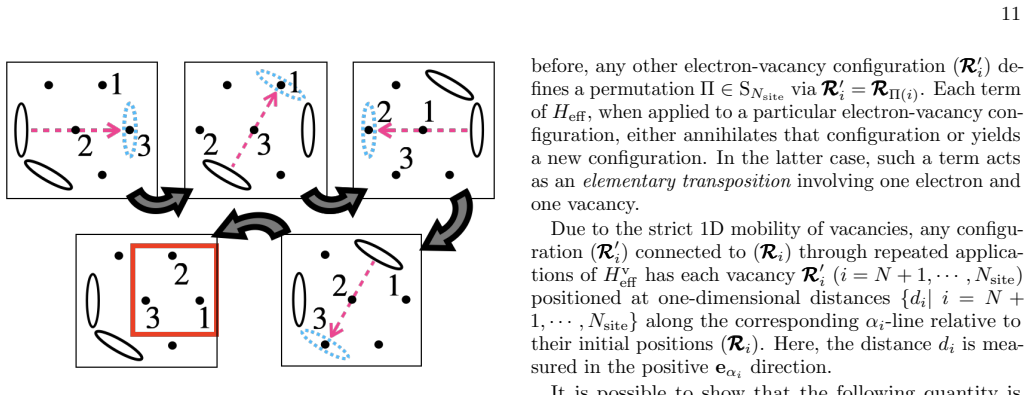
The load-bearing object is the elementary 3-cycle: a correlated move in which two p-electrons and the d-electron at a shared vertex permute among three neighboring sites. The central identity is that every hopping term of (3) acts as such a 3-cycle, and every 3-cycle is an even permutation; a gauge transformation makes all matrix elements non-positive. The proof then needs even-permutation ergodicity: for configurations satisfying the row/column condition, the 3-cycles generate the full alternating group on the $N$ electrons, established by induction using a graph-puzzle lemma. Non-positivity plus irreducibility in each sector forces the unique ferromagnetic ground state, and the ferromagnetic reduction to decoupled wires supplies the Fermi surface.
What would settle it
Enumerate all electron configurations satisfying the row/column condition on a small Lieb lattice with open boundaries, form the graph whose edges are the elementary 3-cycles, and check whether the induced permutations generate the full alternating group on the electrons; one counterexample would disprove even-permutation ergodicity and break the uniqueness theorem. The same exhaustive check on small periodic clusters would test the periodic-boundary version, which the paper states without a full proof.
Extended reading notes
Core claim
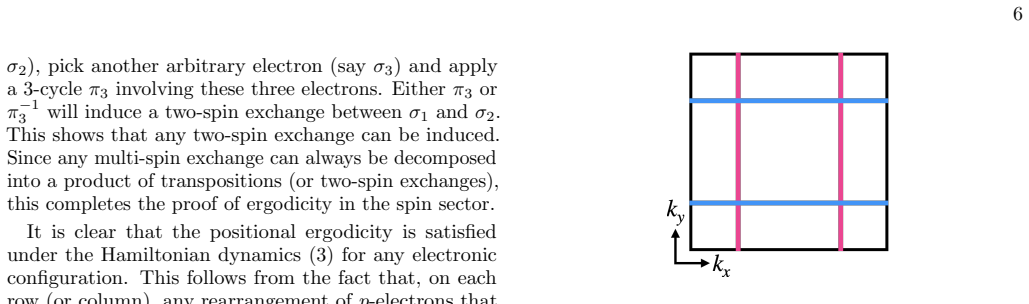
The paper's central result is Theorem II.5: on an $L\times L$ Lieb lattice (a square lattice with an extra site on each bond) with open boundaries and Hamiltonian (3), the infinite-repulsion model hosts a half-metallic ferromagnet as its unique ground state for every filling $0<\nu_p<2$, aside from the $(N+1)$-fold spin degeneracy from rotational symmetry and the $2L$-fold degeneracy of the gapless Fermi surface. The proof combines a gauge transformation that makes every off-diagonal matrix element negative, a proof that the allowed elementary 3-cycles generate the alternating group on the electrons, and an irreducibility argument that forces a unique fully polarized eigenstate in each symmetry sector. The metallic character is explicit: in the ferromagnetic sector the Hamiltonian reduces to $2L$ independent one-dimensional wires with spectrum $E_k=-2t\cos k$, so the ground state fills each wire uniformly and has straight-line Fermi surfaces. The authors state an analogous theorem for Wigner-crystal vacancies under conditions that guarantee even-permutation ergodicity, and they note the same results hold on other lattices in any dimension.
Load-bearing premise
The uniqueness proof assumes that from every allowed arrangement—with at least one mobile electron and two empty sites in every row and column—the allowed moves rearrange the electrons through every possible even permutation; if a single allowed arrangement fails this, the ferromagnetic ground state need not be unique.
Editorial extensions
If this is right
- Half-metallic ferromagnetism is a thermodynamic phase in a spin-independent model: it survives at fixed doping in the thermodynamic limit, not just at single-hole doping.
- The ground state is provably metallic, with straight-line Fermi surfaces obtained by uniformly filling $2L$ one-dimensional wires.
- In the strong-coupling Emery model, intermediate hole doping should show full spin polarization, while dilute and near-full doping favor a fully nematic, spin-degenerate state.
- In the Wigner-crystal vacancy model, sectors with equal vacancy numbers per line and at least two vacancy orientations have a unique ferromagnetic ground state with at least $3L$ low-energy excitations at the $2k_F$ wavevectors.
- The fermionic and hard-core bosonic versions of these models have identical spectra, so the bosonic system is a ferromagnetic Bose metal with the same Fermi surfaces.
Reading between the lines
- If the evenness argument is the whole story, any lattice or experimental realization of line-constrained, infinite-repulsion particles should develop full spin polarization; an optical-lattice implementation of correlated hopping could test this directly by measuring spin-resolved densities and compressibility.
- The periodic-boundary version of the ergodicity proposition is stated without a full proof; an exhaustive enumeration on small periodic clusters would settle whether the uniqueness claim is genuinely independent of boundary conditions.
- The boson-fermion equivalence suggests a sharp diagnostic for the Bose metal: in the hard-core bosonic system, the straight-line Fermi surfaces should persist under weak interactions and show up in momentum-resolved noise correlations.
- Because the parity argument is geometric, it likely extends to SU(N) spins and to three-dimensional lattices with line mobility; a natural next question is whether the nematic-to-isotropic transition in the two physical examples coincides with the onset of full spin polarization.
Editorial analysis
A structured set of objections, weighed in public.
Referee Report
Summary. This paper proposes a kinetic mechanism for half-metallic ferromagnetism in strongly interacting systems where doped particles have strictly one-dimensional mobility. The authors introduce a solvable U=∞ model on a Lieb lattice with correlated hopping, prove that all induced ring exchanges are even permutations (Prop. II.1), and show that the fully spin-polarized state is a ground state (Thm. II.2). They then claim uniqueness of the half-metallic ground state for any doping in the thermodynamic limit (Thm. II.5), based on an even-permutation ergodicity property (Props. II.3 and II.4) that is supposed to make the Hamiltonian matrix irreducible in each symmetry sector. The paper also discusses quasiparticles with approximate 1D mobility in the Emery model and Wigner-crystal vacancies, and proves an exact boson-fermion equivalence (Thm. V.1).
Significance. If Thm. II.5 is correct, it would provide a rare rigorous example of a metallic ferromagnetic ground state that is robust in the thermodynamic limit, going beyond the single-hole Nagaoka result. The proposed mechanism is physically appealing, and the model is exactly solvable in the ferromagnetic sector. The boson-fermion equivalence and the connection to Bose metals are interesting corollaries. The paper is clearly written, and the non-positivity/Perron-Frobenius strategy is standard and elegant. However, the central uniqueness theorem depends on the even-permutation ergodicity property, whose proof currently has significant gaps; these gaps are load-bearing and must be repaired before the main claim can be accepted.
major comments (4)
- [Appendix A, proof of Prop. II.3] The reduction to canonical charge configurations is not justified. The proof states that it is sufficient to prove transitivity for configurations in which all dangling bonds are vacant because positional ergodicity makes this possible. Positional ergodicity only provides a path from an arbitrary configuration to a canonical one; it does not imply that the group of electron permutations generated by closed loops at the arbitrary configuration is isomorphic to that at the canonical configuration. A path that changes the vacancy positions can mix electron and vacancy labels, and the available elementary 3-cycles at the two configurations can differ. Unless the generated group is shown to be invariant under such a path, the transitivity proof applies only to the canonical configuration, and the Perron-Frobenius irreducibility argument in Theorem II.5 may fail for non-canonical sectors.
- [Appendix A, induction step of Prop. II.3] The induction step on (Lx+1) × Ly splits the electrons into X1 (on and left of column x = Lx) and X2 (right of that column) and requires at least one px-electron on each row to the left of x = Lx. This condition is not implied by the hypothesis 0 < X(y) < Lx. If a row has its only x-bond electron on the bond x = Lx + 1/2 (which lies in X2), then after moving the leftmost vacancy to x = Lx + 1/2 the reduced Lx × Ly block has X_block(y) = 0, so the inductive hypothesis (condition (a)) does not apply. The same issue afflicts case (2) and case (3), which depend on filling the column x = Lx + 1/2 on every row. The proof does not explain how rows with no electrons in X1 (or columns with no electrons in the analogous column split) are handled, so the transitivity of the generated group on the full electron index set is not established.
- [Appendix A, Prop. II.4] The PBC version of even-permutation ergodicity is stated without proof ('The details are omitted here'). This is a load-bearing component of the PBC part of Theorem II.5, and the PBC proof has additional complications (the gauge transformation (10) changes the boundary condition, and matrix elements across the periodic boundary acquire phase factors that require the fermion parity condition (a)). A statement without proof is not sufficient for a central proposition on which a main theorem rests.
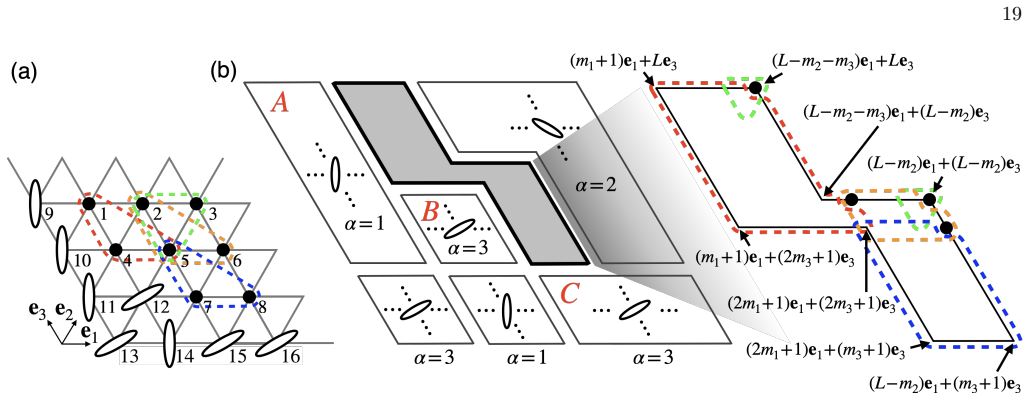
- [Appendix B, proof of Prop. IV.3] The proof of even-permutation ergodicity for the vacancy model is also insufficient. For the base case the four 3-cycles are listed, but their transitivity is merely asserted. For larger systems the proof says that correlated movements of vacancies in blocks A, B and C 'induce an overlapping set of 3-cycles' and that 'it is straightforward to see' that these generate a transitive group, without specifying the actual sequences or verifying that the conditions (c-d) guarantee the required room for all electrons. Because Theorem IV.4 relies entirely on this proposition, the uniqueness claim for the vacancy model is not rigorously established.
minor comments (4)
- [Prop. II.1, OBC case] The claim that under OBC 'the vacancies in the final configuration cannot be permuted from their initial configuration' is too strong and is not generally true: with three or more vacancies on a row, the dynamics can induce even permutations of vacancies while electrons return to their original positions. The argument only needs the vacancy permutation to be even, which follows from the evenness of the total electron-vacancy permutation; the proof should be revised accordingly.
- [Sec. II, notation for X(y)] The notation X(y) is defined in Eq. (4) for PBC as a sum over x = 1,...,Lx. For OBC there are Lx+1 x-bond sites per row, and the text says the conserved quantities are 'analogously defined,' but the condition 0 < X(y) < Lx in Proposition II.3 is only equivalent to 'two vacancies per row' if X(y) counts all Lx+1 bonds. Please clarify the OBC definition explicitly.
- [Sec. III, Eqs. (38-39)] In Eqs. (38-39), the energies of the nematic and isotropic phases are expanded in powers of x, but the definitions of E0, Δc, and Veff are not fully specified in the text; please provide the definitions or a reference for these quantities.
- [Fig. 3] Figure 3 is not described in detail in the text; it would be helpful to state in the caption how the Fermi surfaces are obtained from the single-particle dispersions of the 2L wires, particularly the relation between the wire index and the momentum perpendicular to the wire.
Circularity Check
No significant circularity: the exact ferromagnetism theorem is proved by explicit gauge choice, external group theory, and Perron-Frobenius arguments; the sole self-citation supplies a microscopic input model, not the target result.
full rationale
The derivation chain is self-contained and non-circular. The central result, Theorem II.5, is obtained from an explicit Perron-Frobenius irreducibility argument: the non-positive Hamiltonian matrix is constructed by the gauge transformation (10)-(13), and irreducibility is tied to positional ergodicity plus Proposition II.3's even-permutation ergodicity, whose proof in Appendix A is an induction over lattice size using Wilson's graph-puzzle lemma (Ref. [50]) as an external group-theoretic input. No parameter is fitted to the target quantity: the ferromagnetic trial state in Theorem II.2 is built from an arbitrary eigenstate via the Cauchy-Schwarz inequality, and the minimum-energy sector is identified by solving the non-interacting ferromagnetic spectrum (23)-(24). The only self-citation, Ref. [15], motivates the microscopic t11 vacancy dynamics in the illustrative Wigner-crystal section; that cited work supplies a physically derived Hamiltonian, not the ferromagnetism uniqueness theorem derived here, so it is not load-bearing in a circularity sense. The paper also flags its own limitations, e.g., Footnote [33] for the Emery model and Footnote [38] for vacancy sectors beyond condition (a), and the PBC analogue Proposition II.4 is stated with proof omitted; these are completeness or correctness caveats, not circular reductions. Possible gaps in the inductive proof of Proposition II.3, such as whether arbitrary configurations reduce to canonical ones while preserving the generated permutation group, would be proof-gap issues rather than evidence that a prediction is equivalent to its input by construction.
Assumptions & free parameters
assumptions (6)
- standard math Perron-Frobenius theorem for irreducible non-positive matrices (used in proof of Theorem II.5).
- standard math Wilson's lemma on graph puzzles (Lemma A.1): a transitive set of 3-cycles generates the alternating group.
- standard math Thouless rule: multi-spin ring exchanges with even parity mediate ferromagnetism, odd parity antiferromagnetism.
- domain assumption Normal-ordering convention for multi-particle hopping terms to define a unique Boltzmannian dynamics.
- domain assumption Condition (a) of Proposition II.3: each row and column contains at least one p-electron and two vacancies.
- domain assumption In the Wigner-crystal section, the assumption of 1D vacancy mobility in the semi-classical rs -> infinity limit from prior work.
Cite this review
Pith. "Pith review of Itinerant Ferromagnetism from One-Dimensional Mobility." pith.science (2026). https://pith.science/paper/L22GDWKI
@misc{pith2026241203638,
  author       = {Pith},
  title        = {Pith review of: Itinerant Ferromagnetism from One-Dimensional Mobility},
  year         = {2026},
  howpublished = {\url{https://pith.science/paper/L22GDWKI}},
  note         = {Machine review of arXiv:2412.03638}
}
read the original abstract
We propose a universal kinetic mechanism for a half-metallic ferromagnet -- a metallic state with full spin polarization -- arising from strong on-site Coulomb repulsions between particles that exhibit constrained one-dimensional (1D) dynamics. We illustrate the mechanism in the context of a solvable model on a Lieb lattice in which doped electrons have 1D mobility. Such 1D motion is shown to induce only multi-spin ring exchanges of even parity, which mediate ferromagnetism and result in a unique half-metallic ground state. In contrast to the Nagaoka mechanism of ferromagnetism, this result pertains to any doped electron density in the {\it thermodynamic} limit. We explore various microscopic routes to such (approximate) 1D dynamics, highlighting two examples: doped holes in the strong-coupling limit of the Emery model and vacancies in a two-dimensional Wigner crystal. Finally, we demonstrate an intriguing exact equivalence between the bosonic and fermionic versions of these models, which implies a novel mechanism for the conjectured Bose metallic phase.
Figures


Figures from the paper (8 more)




Forward citations
Cited by 1 Pith paper
-
Magnetism from multiparticle ring exchange in moir\'e Wigner crystals
For two-dimensional Wigner crystals in moiré potentials, increasing potential strength makes two-particle antiferromagnetic ring exchange win over three-particle ferromagnetic exchange, with triangular critical streng...
Reference graph
Works this paper leans on
-
[1]
Hubbard, Electron correlations in narrow energy bands, Proceedings of the Royal Society of London
J. Hubbard, Electron correlations in narrow energy bands, Proceedings of the Royal Society of London. Series A. Mathematical and Physical Sciences 276, 238 (1963)
1963
-
[2]
M. C. Gutzwiller, Effect of correlation on the ferromag- netism of transition metals, Physical Review Letters 10, 159 (1963)
work page 1963
-
[3]
J. Kanamori, Electron correlation and ferromagnetism of transition metals, Progress of Theoretical Physics 30, 275 (1963)
work page 1963
-
[4]
D. P. Arovas, E. Berg, S. A. Kivelson, and S. Raghu, The Hubbard model, Annual Review of Condensed Matter Physics 13, 239 (2022)
work page 2022
-
[5]
Nagaoka, Ferromagnetism in a narrow, almost half- filled s band, Physical Review 147, 392 (1966)
Y. Nagaoka, Ferromagnetism in a narrow, almost half- filled s band, Physical Review 147, 392 (1966). 20
work page 1966
-
[6]
+ V0n0 P, where P is the operator that projects out any state with doubly occupied sites
This Hamiltonian is often written as Hring = P −t X σ=↑,↓ NX i=0 c† i,σci+1,σ + H.c. + V0n0 P, where P is the operator that projects out any state with doubly occupied sites
-
[7]
M. Takahashi, Half-filled Hubbard model at low tempera- ture, Journal of Physics C: Solid State Physics 10, 1289 (1977)
work page 1977
-
[8]
Thouless invoked such a rule in trying to understand the nature of magnetic interactions in quantum crystals such as those appear in 3He and the two-dimensional electron gas [45]. See also Refs. [15, 51–57]
Show all 79 references
-
[9]
The hole motion around the smallest tri- angular loops generates two-spin exchanges that mediate antiferromagnetism
Kinetic antiferromagnetism on non-bipartite lattices, such as those explored in [ 58–60], similarly follows from the Thouless rule. The hole motion around the smallest tri- angular loops generates two-spin exchanges that mediate antiferromagnetism
-
[10]
Daul and R
S. Daul and R. Noack, Ferromagnetic transition and phase diagram of the one-dimensional Hubbard model with next- nearest-neighbor hopping, Physical Review B 58, 2635 (1998)
1998
-
[11]
Emery, S
V. Emery, S. Kivelson, and H. Lin, Phase separation in the t − J model, Physical Review Letters 64, 475 (1990)
1990
-
[12]
L. Liu, H. Yao, E. Berg, S. R. White, and S. A. Kivelson, Phases of the infinite U Hubbard model on square lattices, Physical Review Letters 108, 126406 (2012)
2012
-
[13]
Shastry, H
B. Shastry, H. Krishnamurthy, and P. Anderson, Insta- bility of the Nagaoka ferromagnetic state of the U = ∞ Hubbard model, Physical Review B 41, 2375 (1990)
1990
-
[14]
S. A. Kivelson, E. Fradkin, and T. H. Geballe, Quasi- one-dimensional dynamics and nematic phases in the two-dimensional Emery model, Physical Review B 69, 144505 (2004)
2004
-
[15]
K.-S. Kim, I. Esterlis, C. Murthy, and S. A. Kivelson, Dynamical defects in a two-dimensional Wigner crystal: self-doping and kinetic magnetism, Physical Review B 109, 235130 (2024)
2024
-
[16]
This half-filling constraint can be relaxed to allow some vacant d orbitals without much affecting the conclusions of Proposition II.1 and Theorem II.2. [As noted later in Footnote [21], the fermion parity condition (a) of Propo- sition II.1 can also be relaxed.] Consequently,...
-
[17]
In this paper, the symmetry is defined on each straight line of the lattice
Subsystem symmetry in a d-dimensional system refers to symmetry associated with subsystems of dimension 1 ≤ ds < d[61–63]. In this paper, the symmetry is defined on each straight line of the lattice. The subsystem symmetries [(4-5) and (42-44)] can also be understood as arisin...
-
[18]
This process can be viewed as a boundary contribution to the spin correlations and can be disregarded in the thermodynamic limit
Under the periodic boundary condition (PBC), the spin degeneracy is partially lifted by the motion of the p- electron across the periodic boundary. This process can be viewed as a boundary contribution to the spin correlations and can be disregarded in the thermodynamic limit
-
[19]
This ambiguity can be resolved by assigning each ‘normal-ordered’ operator a unique dy- namical process involving Boltzmannian particles
Interpreting a Hamiltonian for identical particles as one for distinguishable particles may seem ambiguous, particu- larly when the terms in the Hamiltonian involve more than two particles as in (3). This ambiguity can be resolved by assigning each ‘normal-ordered’ operator a ...
-
[20]
This fact can be proven using the path-integral for- mulation, as shown in Ref
The fact that the evenness of ring-exchange permutations entails ferromagnetism was first recognized by Thouless [45]. This fact can be proven using the path-integral for- mulation, as shown in Ref. [64]
-
[21]
For the PBC, the fermion parity condition (a) can be further relaxed for rows and columns that contain a vacant d site
As noted in Footnote [ 16], relaxing the half-filling condi- tion for d orbitals does not affect the conclusion for the OBC since the argument regarding the ‘invariant’ (7) re- mains valid. For the PBC, the fermion parity condition (a) can be further relaxed for rows and colum...
-
[22]
(1) The first involves the gauge transformation (10), which introduces a phase fac- tor (−1)Lx [or (−1)Ly ] to the hopping terms across the periodic boundary in (11)
There are two subtleties in the proof for the periodic boundary condition (PBC). (1) The first involves the gauge transformation (10), which introduces a phase fac- tor (−1)Lx [or (−1)Ly ] to the hopping terms across the periodic boundary in (11). (2) The second involves the r...
-
[23]
See Footnote
For the PBC, the transformed Hamiltonian (11) obeys a modified periodic boundary condition pR+ ˆδ 2 +Lδ ˆδ,σ = (−1)Lδ pR+ ˆδ 2 ,σ, instead of the usual PBC, where δ = x, y. See Footnote
-
[24]
See Footnotes [ 22] and [ 23] for more detail
For the PBC, the negativity of the matrix element that moves a p-electron across the periodic boundary follows from the assumption that the fermion parity on each row and column is odd, as specified in condition (a) of Proposition II.1. See Footnotes [ 22] and [ 23] for more detail
-
[25]
This problem was completely characterized by Wilson [50]
The question of whether or not the even-permutation ergodicity or full permutation ergodicity is satisfied for the single-hole problem in the U = ∞ Hubbard model on a given graph is equivalent to the ‘graph puzzle’ (a generalization of the 15-puzzle) problem on the same graph....
-
[26]
for a detailed discussion
-
[27]
The third term in (34) has a prefactor Vpd/4 that is 21 different by a factor of 1 /2 from the expression (A5) of Ref. [14]. We believe that this is a typo
-
[28]
Binder and D
K. Binder and D. Landau, Phase diagrams and critical behavior in Ising square lattices with nearest-and next- nearest-neighbor interactions, Physical Review B 21, 1941 (1980)
1980
-
[29]
Emery, Theory of high- Tc superconductivity in oxides, Physical Review Letters 58, 2794 (1987)
V. Emery, Theory of high- Tc superconductivity in oxides, Physical Review Letters 58, 2794 (1987)
1987
-
[30]
R. J. Baxter, I. Enting, and S. Tsang, Hard-square lattice gas, Journal of Statistical Physics 22, 465 (1980)
1980
-
[31]
Blote and X.-N
H. Blote and X.-N. Wu, Accurate determination of the critical line of the square Ising antiferromagnet in a field, Journal of Physics A: Mathematical and General 23, L627 (1990)
1990
-
[32]
R. J. Baxter, Exactly solved models in statistical mechan- ics, Elsevier (2008)
2008
-
[33]
Although Proposition II.1 and Theorem II.2 remain valid for Heff (37), the results of Propositions II.3-II.4 and The- orem II.5 may not directly apply due to the additional interaction [Vpp = ∞] beyond T (3). While it seems un- likely, it is possible that the isotropic ground ...
-
[34]
Cockayne and V
E. Cockayne and V. Elser, Energetics of point defects in the two-dimensional Wigner crystal, Physical Review B 43, 623 (1991)
1991
-
[35]
[ 14] incorrectly claimed that, in addition to the isotropic and nematic phases, a region of two-phase co- existence exists at low temperature (see their Fig
Ref. [ 14] incorrectly claimed that, in addition to the isotropic and nematic phases, a region of two-phase co- existence exists at low temperature (see their Fig. 4). Instead, the nematic-isotropic (or in Ising model terms, antiferromagnetic-paramagnetic) transition is always...
-
[36]
This invariant is reminiscent of the invariant used in proving the unsolvability of the 15-puzzle
-
[37]
The condition that each L − N v α(i) is odd is essential for preserving the PBC in (51)
For the PBC case, the transformed Hamiltonian (51) maintains the usual periodic boundary condition cie1+ke3+Le1,1 = (−1)L−N v 1 (k)−1cie1+ke3,1 = cie1+ke3,1, and similarly cie1+je2+Le2,2 = cie1+je2,2, cie1+ke3+Le3,3 = cie1+ke3,3. The condition that each L − N v α(i) is odd is ...
-
[38]
For further discussion on the regime of such 1D mobility, see Footnote [27] in Ref. [ 15]. Achieving such a regime of rs experimentally may be challenging; exploring more experimentally relevant platforms that host such ‘lineonic’ defect originating from polaronic effects is a...
-
[39]
At T = 0, this phase becomes fully nematic, leading to complete spin degeneracy as in the case of the strong- coupling and semi-classical limit of the Emery model (37)
suggests that in the dilute vacancy concentration (νv < νv c ), the system favors a quantum nematic phase. At T = 0, this phase becomes fully nematic, leading to complete spin degeneracy as in the case of the strong- coupling and semi-classical limit of the Emery model (37). B...
-
[40]
Yamanaka, M
M. Yamanaka, M. Oshikawa, and I. Affleck, Nonpertur- bative approach to Luttinger’s theorem in one dimension, Physical Review Letters 79, 1110 (1997)
1997
-
[41]
As discussed in Sec
As in the strong-coupling limit of the Emery model (37), determining the global ground state for a given filling νv requires comparing the ground state energies across different sectors of (42-44). As discussed in Sec. III, strong on-site interactions between different vacancy...
-
[42]
R. B. Laughlin, Quantized Hall conductivity in two di- mensions, Physical Review B 23, 5632 (1981)
1981
-
[43]
More precisely, the sum is O(N v 1 (k)); however, assum- ing a finite vacancy density in the thermodynamic limit, N v 1 (k)/L = O(1)
-
[44]
Oshikawa, Commensurability, excitation gap, and topology in quantum many-particle systems on a periodic lattice, Physical Review Letters 84, 1535 (2000)
M. Oshikawa, Commensurability, excitation gap, and topology in quantum many-particle systems on a periodic lattice, Physical Review Letters 84, 1535 (2000)
2000
-
[45]
Oshikawa, Topological approach to Luttinger’s theo- rem and the Fermi surface of a Kondo lattice, Physical Review Letters 84, 3370 (2000)
M. Oshikawa, Topological approach to Luttinger’s theo- rem and the Fermi surface of a Kondo lattice, Physical Review Letters 84, 3370 (2000)
2000
-
[46]
Eisenberg and E
E. Eisenberg and E. H. Lieb, Polarization of interacting bosons with spin, Physical Review Letters 89, 220403 (2002)
2002
-
[47]
This is a formal restatement of a fact articulated by Thouless in Ref. [45]
-
[48]
Thouless, Exchange in solid 3He and the Heisenberg Hamiltonian, Proceedings of the Physical Society (1958-
D. Thouless, Exchange in solid 3He and the Heisenberg Hamiltonian, Proceedings of the Physical Society (1958-
1958
-
[49]
Although Li et al. [ 73] established the existence of a half-metallic ground state in the thermodynamic limit, their ferromagnetism is driven fundamentally by on- site ferromagnetic Hund’s coupling rather than by spin- independent Coulomb interactions. In their model, all spin...
-
[50]
Yang and Y.-Q
K. Yang and Y.-Q. Li, Rigorous proof of pseudospin ferromagnetism in two-component bosonic systems with component-independent interactions, International Jour- nal of Modern Physics B 17, 1027 (2003)
2003
-
[51]
In such models, ferro- magnetism arises as a weak-coupling phenomenon, occur- ring for any small U >0 due to singular band structures
Ferromagnetic ground states in flat-band and related mod- els typically exhibit a charge gap and therefore do not constitute metallic ferromagnetism. In such models, ferro- magnetism arises as a weak-coupling phenomenon, occur- ring for any small U >0 due to singular band stru...
-
[52]
Roger, Multiple exchange in 3He and in the Wigner solid, Physical Review B 30, 6432 (1984)
M. Roger, Multiple exchange in 3He and in the Wigner solid, Physical Review B 30, 6432 (1984)
1984
-
[53]
Chakravarty, S
S. Chakravarty, S. Kivelson, C. Nayak, and K. Voelker, Wigner glass, spin liquids and the metal-insulator transi- tion, Philosophical Magazine B 79, 859 (1999)
1999
-
[54]
Voelker and S
K. Voelker and S. Chakravarty, Multiparticle ring ex- change in the Wigner glass and its possible relevance to strongly interacting two-dimensional electron systems in the presence of disorder, Physical Review B 64, 235125 (2001)
2001
-
[55]
R. M. Wilson, Graph puzzles, homotopy, and the alter- nating group, Journal of Combinatorial Theory, Series B 16, 86 (1974)
1974
-
[56]
Roger, J
M. Roger, J. Hetherington, and J. Delrieu, Magnetism in 22 solid 3He, Reviews of Modern Physics 55, 1 (1983)
1983
-
[57]
K.-S. Kim, C. Murthy, A. Pandey, and S. A. Kivelson, Interstitial-induced ferromagnetism in a two-dimensional Wigner crystal, Physical Review Letters 129, 227202 (2022)
2022
-
[58]
J. O. Haerter and B. S. Shastry, Kinetic antiferromag- netism in the triangular lattice, Physical Review Letters 95, 087202 (2005)
2005
-
[59]
Kim, Exact hole-induced resonating-valence-bond ground state in certain U = ∞ Hubbard models, Physical Review B 107, L140401 (2023)
K.-S. Kim, Exact hole-induced resonating-valence-bond ground state in certain U = ∞ Hubbard models, Physical Review B 107, L140401 (2023)
2023
-
[60]
Katano and D
M. Katano and D. S. Hirashima, Multiple-spin exchange in a two-dimensional Wigner crystal, Physical Review B 62, 2573 (2000)
2000
-
[61]
Kim and S
K.-S. Kim and S. A. Kivelson, Discovery of an insulat- ing ferromagnetic phase of electrons in two dimensions, Proceedings of the National Academy of Sciences 118, e2023964118 (2021)
2021
-
[62]
[see also Fig. 8]. Proof of Proposition IV.3. The proof of this proposition is analogous to that of Proposition II.3 given in Appendix A. We will show that a certain set of elementary 3-cycles generates a transitive group action on the electrons’ index set. By Lemma A.1, this ...
-
[63]
Gromov and L
A. Gromov and L. Radzihovsky, Colloquium: Fracton matter, Reviews of Modern Physics 96, 011001 (2024)
2024
-
[64]
Aizenman and E
M. Aizenman and E. H. Lieb, Magnetic properties of some itinerant-electron systems at T >0, Physical Review Letters 65, 1470 (1990)
1990
-
[65]
Kim and H
K.-S. Kim and H. Katsura, Exact hole-induced SU (N ) flavor singlets in certain U = ∞ SU (N ) Hubbard models, Physical Review Research 6, 013307 (2024)
2024
-
[66]
Vijay, J
S. Vijay, J. Haah, and L. Fu, Fracton topological order, generalized lattice gauge theory, and duality, Physical Review B 94, 235157 (2016)
2016
-
[67]
Pretko, X
M. Pretko, X. Chen, and Y. You, Fracton phases of matter, International Journal of Modern Physics A 35, 2030003 (2020)
2020
-
[68]
H. Tasaki, From Nagaoka’s ferromagnetism to flat-band ferromagnetism and beyond: An introduction to ferro- magnetism in the Hubbard model, Progress of theoretical physics 99, 489 (1998)
1998
-
[69]
Tasaki, Ferromagnetism in the Hubbard model: a constructive approach, Communications in Mathematical Physics 242, 445 (2003)
H. Tasaki, Ferromagnetism in the Hubbard model: a constructive approach, Communications in Mathematical Physics 242, 445 (2003)
2003
-
[70]
M¨ uller-Hartmann and J
E. M¨ uller-Hartmann and J. Zittartz, Interface free energy and transition temperature of the square-lattice Ising antiferromagnet at finite magnetic field, Zeitschrift f¨ ur Physik B Condensed Matter 27, 261 (1977)
1977
-
[71]
Mielke, Ferromagnetic ground states for the Hubbard model on line graphs, Journal of Physics A: Mathematical and General 24, L73 (1991)
A. Mielke, Ferromagnetic ground states for the Hubbard model on line graphs, Journal of Physics A: Mathematical and General 24, L73 (1991)
1991
-
[72]
These forms of ferromagnetism can be broadly categorized as resulting from a generalized Hund’s mechanism
also describe an insulating ferromagnetism resulting from quenched kinetic energy and occurs for any weak interactions U >0. These forms of ferromagnetism can be broadly categorized as resulting from a generalized Hund’s mechanism
-
[73]
Mielke and H
A. Mielke and H. Tasaki, Ferromagnetism in the Hubbard model: Examples from models with degenerate single- electron ground states, Communications in Mathematical Physics 158, 341 (1993)
1993
-
[74]
physical
(see also related discussions in [ 70]). However, the proposed model is rather complicated, and the “physical” mechanism behind the half-metallic ferromagnetism in their model is unclear
-
[75]
Tasaki, Physics and mathematics of quantum many- body systems, Springer (2020)
H. Tasaki, Physics and mathematics of quantum many- body systems, Springer (2020)
2020
-
[76]
E. H. Lieb, Two theorems on the Hubbard model, Physical Review Letters 62, 1201 (1989)
1989
-
[77]
S. L. Sondhi, A. Karlhede, S. Kivelson, and E. Rezayi, Skyrmions and the crossover from the integer to fractional quantum hall effect at small zeeman energies, Physical Review B 47, 16419 (1993)
1993
-
[78]
Y. Li, E. H. Lieb, and C. Wu, Exact results for itiner- ant ferromagnetism in multiorbital systems on square and cubic lattices, Physical Review Letters 112, 217201 (2014)
2014
-
[79]
Tanaka and H
A. Tanaka and H. Tasaki, Metallic ferromagnetism in the hubbard model: a rigorous example, Physical Review Letters 98, 116402 (2007)
2007
Reviewed August 11, 2026 · model on record in the stance chip above.
Discussion (0). Continue with ORCID to comment.