REVIEW 2 major objections 8 minor 1 cited by
A simple model to investigate jet quenching and correlated errors for centrality-dependent nuclear-modification factors in relativistic heavy-ion collisions
T0 review · 2 major / 8 minor · reviewed 2026-08-11 · deepseek-v4-flash
Pith's one-line read The centrality-dependent jet suppression in lead-lead collisions at 5.02 TeV is described by a two-parameter mean energy-loss model, and the data alone constrain only the mean loss, not the shape of the loss distribution.
desk verdict A useful, honest sensitivity study and fast public benchmark for the jet-quenching calibration community; the formation-time preference is real but conditional on an untested delta-only shape assumption. read the letter →
The pith
A machine-rendered reading of the paper's core claim, the machinery that carries it, and where it could break.
The reading
What carries the argument
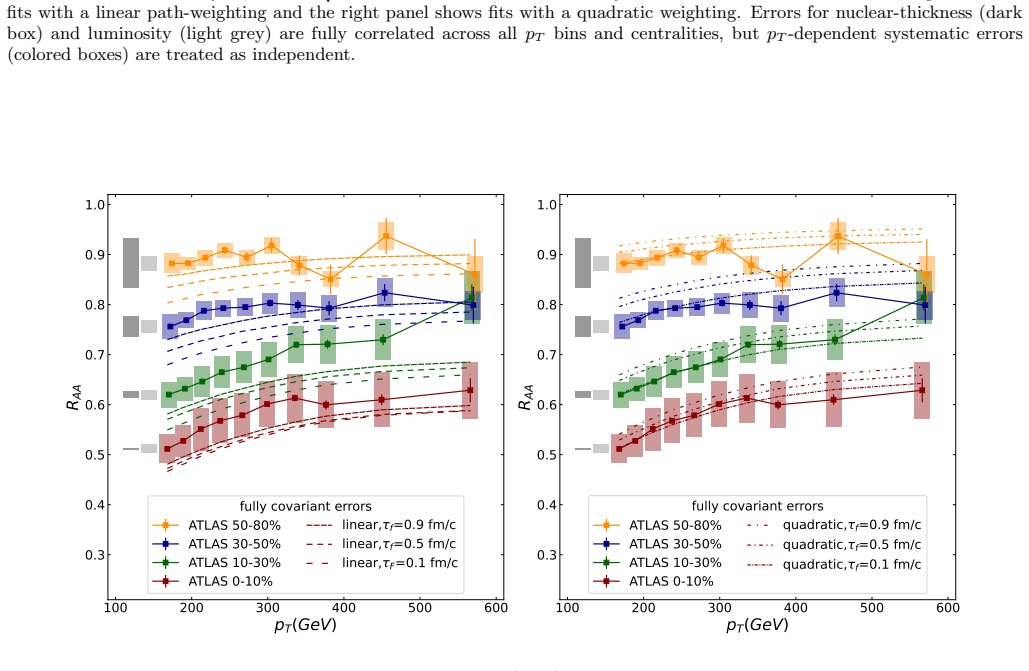
The load-bearing object is the two-parameter mean energy-loss function $\langle \Delta p_T\rangle = \alpha (p_T)^\beta \log(p_T)$, which shifts the measured proton–proton jet spectrum down in transverse momentum. The same mean is inserted into two competing loss distributions, a gamma distribution (motivated as a convolution of $k$ exponential scatterings) and a delta function, to test shape sensitivity. For the centrality extension, the model takes initial geometry from the TRENTo model, with parameters fixed from an earlier Bayesian fit, and weights the medium energy density along each dijet path by an inverse-time factor starting at a formation time $\tau_f$, using either a linear or quadratic path-length weighting. The analysis also constructs covariance error matrices from the published systematic-error components, assuming different correlation structures, and uses a log-likelihood transformation to address the known tendency of fits with strongly correlated relative errors to undershoot the data.
What would settle it
Vary the TRENTo initial-state parameters within their posterior uncertainties and refit the centrality-dependent $R_{AA}$: if the optimal $\tau_f$ no longer shifts from 0.9 fm/c under linear path weighting to 0.1 fm/c under quadratic weighting, the formation-time conclusion fails. Alternatively, a precise dijet-asymmetry measurement that cannot be described by a delta-distribution loss with the same mean would falsify the claim that $R_{AA}$ alone constrains only the mean energy loss.
Extended reading notes
Core claim
The central claim is that measurements of jet $R_{AA}$ in lead-lead collisions, by themselves, constrain only the mean jet energy loss $\langle \Delta p_T \rangle = \alpha (p_T)^\beta \log(p_T)$, not the shape of the energy-loss distribution. Fitting the same mean loss with a gamma distribution and with a delta function yields equivalent agreement with the measured 0–10% central data, and the gamma shape parameter $k$ is not well constrained. The paper therefore concludes that $R_{AA}$ data fix the mean loss but that an observable such as dijet asymmetry is needed to determine the distribution's shape. Extending the model to all centralities with TRENTo geometry, the centrality dependence of $R_{AA}$ is reproduced, and the preferred formation time shifts from 0.9 fm/c for linear path-length weighting to 0.1 fm/c for quadratic weighting. The treatment of systematic errors also matters: constructing the covariance matrix by summing components versus by multiplying sums, and evaluating the likelihood on the data or its logarithm, both change the most-probable parameters and $\chi^2_d$ values.
Load-bearing premise
The formation-time preference depends on the TRENTo geometry parameters being fixed correctly and on the assumed linear or quadratic path-length weighting; if either is wrong, the inferred $\tau_f$ values would change.
Editorial extensions
If this is right
- If $R_{AA}$ alone fixes only the mean loss, then model comparisons should report $\langle \Delta p_T\rangle(p_T)$ rather than the full loss distribution, and discriminating between energy-loss mechanisms will require observables such as dijet asymmetry.
- Under the model, formation time and path-length weighting trade off: longer $\tau_f$ pairs with linear weighting and shorter $\tau_f$ with quadratic weighting, so the two cannot be separated using centrality-dependent $R_{AA}$ alone.
- Fits with highly correlated systematic errors can land systematically below the data; the log-likelihood transformation mitigates but does not fully remove this, and residual shape mismatch remains the likely explanation.
- The assumption about systematic-error correlations (summed components vs. full covariance) changes the most-probable parameters and $\chi^2_d$, so any model-to-data comparison must state the correlation assumption explicitly.
Reading between the lines
- A natural extension is to fit the same two-parameter model to dijet asymmetry alongside $R_{AA}$, which would test whether the gamma shape parameter $k$ becomes constrained; the paper leaves exactly this as future work.
- The formation-time shift with path-length weighting suggests that a single effective formation time extracted from $R_{AA}$ is model-dependent; future studies that treat jet and medium formation times separately could reinterpret the current $\tau_f$ preference as an effective combination.
- The correlated-error analysis implies that experimental papers should report per-component systematic covariance matrices; without them, model fits may systematically undershoot or overshoot the measured points, independent of the physics model.
Editorial analysis
A structured set of objections, weighed in public.
Referee Report
Summary. The paper presents a two-parameter empirical model for the mean transverse-momentum loss of jets in heavy-ion collisions, with the loss distribution taken either as a gamma distribution or a delta function. Bayesian fits to the ATLAS 0-10% central Pb+Pb jet R_AA at 5.02 TeV show that the two functional forms give equivalent agreement and that the gamma shape parameter is poorly constrained, leading the authors to conclude that these central data constrain only the mean energy loss. The model is then extended to centrality-dependent R_AA by embedding a 2D TRENTo initial geometry with either linear or quadratic path-length weighting and with the formation time tau_f treated as a fixed input in a sensitivity scan. Fits to the centrality-dependent ATLAS data for several tau_f values show that longer formation times are preferred for linear weighting while shorter formation times are preferred for quadratic weighting. The paper also constructs covariance matrices for the ATLAS systematic errors under different correlation assumptions, and shows that the fitted functions and chi2_d values are sensitive to these assumptions. Appendices examine alternative covariance constructions and investigate the role of Peele's Pertinent Puzzle in the low fitted curves.
Significance. If the claims hold, the paper provides a fast, public, and transparent platform for sensitivity studies of jet quenching, with code available at github.com/llnl/ez-quench. The systematic comparison of error-correlation treatments is a useful methodological contribution, and the demonstration that Peele's Pertinent Puzzle is not the sole cause of the low fits is a valuable negative result. The tau_f sensitivity to the path-length weighting is a concrete, falsifiable prediction that can be tested in more complete frameworks. The main limitation is that the centrality-dependent conclusion rests on an untested shape assumption and on fixed initial-state parameters; addressing these points would considerably strengthen the paper.
major comments (2)
- [Sec. V (and Secs. III-IV)] The conclusion that "R_AA measurements constrain only the mean value of ΔpT" is supported only by the fits to the 0-10% central bin in Sec. III, where the gamma- and delta-distribution fits give equivalent agreement and the gamma shape parameter k is poorly constrained. The centrality-dependent analysis in Sec. IV and Table IV uses only the delta-distribution (Eq. 4) and never tests whether the full centrality-dependent R_AA data, which span a much wider range of path lengths and medium densities, can constrain the gamma shape parameter. Because the reported tau_f preference is obtained under this delta-only assumption, it is conditional on an untested shape hypothesis; a gamma distribution with moderate k could in principle alter the centrality dependence of R_AA(pT) and shift the optimal tau_f for linear versus quadratic weighting. Please either add a gamma-distribution sensitivity scan to the centrality-dependent fits, or soften the conclusion to state explicitly that the mean-only constraint is demonstrated for the central bin and assumed, not tested, in the centrality-dependent extension.
- [Sec. IV and Table III] The TRENTo initial-state parameters are fixed to values from a prior Bayesian fit [12] (Table III) without propagating their uncertainties. Since the tau_f inference is driven by the path-length and density weighting of the medium, the sensitivity of the tau_f preference to plausible variations in these geometry parameters (for example, the nucleon width w, the fluctuation parameter k, or the reduced-thickness parameter p) should be quantified, or at least the limitation should be stated explicitly, so that the reader can judge the robustness of the main sensitivity claim.
minor comments (8)
- [Introduction] In the last paragraph of Sec. I, "Centrality dependent extensions and comparisons are provided in Sec. III" should refer to Sec. IV, not Sec. III.
- [Eq. (4)] The delta-distribution in Eq. (4) is written as f(ΔpT) = δ(pT − µ(pT)), which is inconsistent with the argument on the left-hand side; it should presumably read δ(ΔpT − µ(pT)) or use a different symbolic convention.
- [Sec. III] No chi-squared values are reported for the central gamma- and delta-distribution fits shown in Fig. 2, so the claim of "equivalent agreement" is not quantified; adding the chi2_d values for the four fits would strengthen the comparison.
- [Sec. III, text near Fig. 5] There is a typo in the sentence "we conclude that the jet-RAA measurements are sensitive only the the mean-value of the pT-loss" — "only the the" should be "only to the".
- [Sec. II] The word "scale-paramter" in the description of the gamma distribution should be "scale-parameter".
- [Table IV and Sec. IV] The table caption does not indicate that the fully-covariant fits are performed on log(R_AA) after the logarithmic transformation described in Sec. IV; adding this note would prevent confusion when comparing alpha and beta values to the semi-diagonal fits.
- [Fig. 10 caption] The legend label "ALICE 0-10" is missing the percent sign; it should be "ALICE 0-10%".
- [Sec. IV, final paragraph] The sentence "the higher pT of 800 GeV does not permit an extrapolation of the quenched cross-section above the highest ATLAS pT bin" is unclear; rephrasing would help, for example by stating that the pp parameterization is only fitted up to 800 GeV and the model is not extrapolated above that value.
Circularity Check
No significant circularity: the paper consistently reports Bayesian fits and sensitivity scans rather than predictions, and its load-bearing inputs are external data sets or externally determined model parameters.
full rationale
The paper's derivation chain is not circular. The two energy-loss parameters α and β in Eq. (2) are calibrated by Bayesian fits to the ATLAS jet R_AA data and then displayed against those same data, but the text is explicit that these are fits, not predictions: it refers to 'Bayesian calibrations', 'most-probable fits', and 'fit parameters', and Table IV lists χ²_d values for fits to centrality-dependent R_AA. The unquenched baseline is an independent ATLAS pp inclusive jet cross-section parameterized in Eq. (1) from Ref. [27], so it is an external input rather than something derived from the target R_AA. The gamma-versus-delta shape-insensitivity conclusion in Section III is a posterior comparison within the central-bin data: the gamma shape parameter k is poorly constrained while the delta fit gives equivalent agreement, so the statement that R_AA constrains only the mean energy loss is a data-sensitivity finding, not an input. The centrality-dependent extension in Section IV refits α and β to the centrality-dependent R_AA values; the TRENTo parameters are adopted from the external JETSCAPE Bayesian analysis [12], and the formation time τ_f is explicitly treated as a fixed parameter in a sensitivity scan, not inferred from the data. No self-citation is load-bearing, and no equation reduces to its own input. The acknowledged limitations—fixed TRENTo parameters, delta-only centrality fits, and simplified error correlations—are scope restrictions and uncertainty caveats, not circular reasoning.
Assumptions & free parameters
free parameters (6)
- alpha (α) =
0.22 (diagonal), 0.14 (covariant) for central gamma fit; values in Table IV for centrality-dependent fits
- beta (β) =
0.18 (diagonal), 0.25 (covariant) for central gamma fit; values in Table IV
- k (gamma shape) =
7.18 (diagonal), 8.19 (covariant)
- c1, c2, c3 (pp cross-section parameters) =
c1=103.85, c2=2.505, c3=0.591 for the combined-error fit; c4=700 and c5=150 fixed by hand
- TRENTo initial-state parameters =
p=0, k=1.0, w=1.0 fm, d=1.4 fm, sigma=6.4 fm
- Formation time tau_f =
Scanned over 0.1, 0.5, 0.9 fm/c; not fitted
assumptions (6)
- domain assumption The unquenched pp jet cross-section is described by Eq. (1) with fitted coefficients.
- domain assumption Jet energy loss follows a gamma or delta distribution with mean mu(pT) = alpha (pT)^beta log(pT).
- domain assumption TRENTo parameters from Ref. [12] describe the initial nuclear geometry.
- domain assumption The medium density along a dijet path scales as 1/tau after a sudden formation time tau_f, with linear or quadratic path-length weighting.
- domain assumption In the fully-covariant treatment, each ATLAS systematic error component is 100% correlated across pT and centrality.
- standard math Bayesian likelihoods use uniform priors on alpha, beta, and k.
Cite this review
Pith. "Pith review of A simple model to investigate jet quenching and correlated errors for centrality-dependent nuclear-modification factors in relativistic heavy-ion collisions." pith.science (2026). https://pith.science/paper/6IKLO3PD
@misc{pith2026241203724,
  author       = {Pith},
  title        = {Pith review of: A simple model to investigate jet quenching and correlated errors for centrality-dependent nuclear-modification factors in relativistic heavy-ion collisions},
  year         = {2026},
  howpublished = {\url{https://pith.science/paper/6IKLO3PD}},
  note         = {Machine review of arXiv:2412.03724}
}
abstract
We apply Bayesian techniques to compare a simple, empirical model for jet-quenching in heavy-ion collisions to centrality-dependent jet-$R_{AA}$ measured by ATLAS for Pb+Pb collisions at $\sqrt{s_{NN}}=5.02$~TeV. We find that the $R_{AA}$ values for central collisions are adequately described with a model for the mean $p_T$-dependent jet energy-loss using only 2-parameters. This model is extended by incorporating 2D initial geometry information from TRENTO and compared to centrality-dependent $R_{AA}$ values. We find that the results are sensitive to value of the jet-quenching formation time, $\tau_f$, and that the optimal value of $\tau_f$ varies with the assumed path-length dependence of the energy-loss. We construct a covariance error matrix for the data from the $p_T$ dependent contributions to the ATLAS systematic errors and perform Bayesian calibrations for several different assumptions for the systematic error correlations. We show that most-probable functions and $\chi^2$ values are sensitive to assumptions made when fitting to correlated errors.
Figures


Figures from the paper (12 more)




Forward citations
Cited by 1 Pith paper
-
Longitudinal Dynamics of Large and Small Systems from a 3D Bayesian Calibration of RHIC Top-energy Collision Data
A 3D Bayesian calibration of RHIC Au-Au and d-Au data constrains the longitudinal initial state and QGP viscosity, and its posterior predicts p-Au and 3He-Au flow measurements.
Reference graph
Works this paper leans on
-
[12]
Everett et al., Physical Review C 103, 054904 (2021), 2011.01430
D. Everett et al., Physical Review C 103, 054904 (2021), 2011.01430
arXiv 2021
- [1]
-
[2]
Adcox et al., Nuclear Physics A 757, 184 (2005)
K. Adcox et al., Nuclear Physics A 757, 184 (2005)
work page 2005
-
[3]
Adams et al., Nuclear Physics A 757, 102 (2005)
J. Adams et al., Nuclear Physics A 757, 102 (2005)
2005
-
[4]
Nattrass, EPJ Web of Conferences 296, 01006 (2024)
C. Nattrass, EPJ Web of Conferences 296, 01006 (2024)
work page 2024
- [5]
-
[6]
O’Brien, EPJ Web of Conferences 296, 01007 (2024)
E. O’Brien, EPJ Web of Conferences 296, 01007 (2024)
work page 2024
-
[7]
I. C. Arsene, EPJ Web of Conferences 296, 01001 (2024)
work page 2024
Show all 36 references
-
[8]
Baty, EPJ Web of Conferences 296, 01002 (2024)
A. Baty, EPJ Web of Conferences 296, 01002 (2024)
2024
-
[9]
Novak et al., Physical Review C 89 (2014)
J. Novak et al., Physical Review C 89 (2014)
2014
-
[10]
J. E. Bernhard, J. S. Moreland, and S. A. Bass, Nature Physics 15, 1113 (2019)
2019
-
[11]
G. Nijs, W. v. d. Schee, U. G¨ ursoy, and R. Snellings, Physical Review C 103, 054909 (2021), 2010.15134
2021 arXiv
-
[13]
He et al., Physical Review C 99, 054911 (2019), 1809.02525
Y. He et al., Physical Review C 99, 054911 (2019), 1809.02525
2019 arXiv
-
[14]
Z.-B. Kang, F. Ringer, and I. Vitev, Physics Letters B 769, 242 (2017), 1701.05839
2017 arXiv
-
[15]
Casalderrey-Solana, G
J. Casalderrey-Solana, G. Milhano, D. Pablos, and K. Rajagopal, Journal of High Energy Physics 2020, 44 (2020), 1907.11248
2020 arXiv
-
[16]
J. S. Moreland, J. E. Bernhard, and S. A. Bass, Physical Review C 92, 011901 (2015)
2015
-
[17]
Gyulassy and M
M. Gyulassy and M. Pl¨ umer, Physics Letters B243, 432 (1990)
1990
-
[18]
Wang and M
X.-N. Wang and M. Gyulassy, Physical Review Letters 68, 1480 (1992)
1992
-
[19]
U. A. Wiedemann, arXiv , 521 (2009), 0908.2306
2009 arXiv
-
[20]
He, L.-G
Y. He, L.-G. Pang, and X.-N. Wang, Physical Review Letters 122, 252302 (2019), 1808.05310
2019 arXiv
-
[21]
Cao et al., Physical Review C 104, 024905 (2021), 2102.11337
S. Cao et al., Physical Review C 104, 024905 (2021), 2102.11337
2021 arXiv
-
[22]
Liyanage et al., Physical Review C 105, 034910 (2022), 2201.07302
D. Liyanage et al., Physical Review C 105, 034910 (2022), 2201.07302
2022 arXiv
-
[23]
Aad et al., Physical Review C 107, 054909 (2023), 2211.11470
G. Aad et al., Physical Review C 107, 054909 (2023), 2211.11470
2023 arXiv
-
[24]
A. M. Sirunyan et al., Journal of High Energy Physics 2021, 284 (2021), 2102.13080
2021 arXiv
-
[25]
Acharya et al., Physical Review C 101, 034911 (2020), 1909.09718
S. Acharya et al., Physical Review C 101, 034911 (2020), 1909.09718
2020 arXiv
- [26]
-
[27]
Aaboud et al., Physics Letters B 790, 108 (2019), 1805.05635
M. Aaboud et al., Physics Letters B 790, 108 (2019), 1805.05635
2019 arXiv
-
[28]
Foreman-Mackey, D
D. Foreman-Mackey, D. W. Hogg, D. Lang, and J. Good- man, Publications of the Astronomical Society of the Pacific 125, 306 (2013), 1202.3665
2013 arXiv
-
[29]
K. M. Hanson, T. Kawano, and P. Talou, AIP Conference Proceedings 769, 304 (2005)
2005
-
[30]
Modarresi-Yazdi, S
R. Modarresi-Yazdi, S. Shi, C. Gale, and S. Jeon, arXiv (2024), 2407.19966
2024 arXiv
-
[31]
https://github.com/llnl/ez-quench. Appendix A: Covariance error matrix comparison As described in Section III, the covariance error matrix was constructed by first summing the individual contri- butions to the systematic error, assuming each contri- bution to be fully correlat...
-
[32]
stat-only: statistical errors,
-
[33]
stat-sys: independent combined errors,
-
[34]
cov-sum: covariant errors (Eq. A1),
-
[35]
cov-all: covariant errors (Eq. A2),
-
[36]
A3), where the cov-20 error matrix is defined with α=2 and l=0.2
cov-20%: covariant errors (Eq. A3), where the cov-20 error matrix is defined with α=2 and l=0.2. All covariance error matrices include uncorre- lated statistical errors, but the luminosity and nuclear- thickness contributions are neglected for this study. The fits are performe...
Reviewed August 11, 2026 · model on record in the stance chip above.
Discussion (0). Continue with ORCID to comment.