REVIEW 5 major objections 6 minor 35 references
Leveraging Time-Series Foundation Model for Subsurface Well Logs Prediction and Anomaly Detection
T0 review · 5 major / 6 minor · reviewed 2026-08-11 · deepseek-v4-flash
Pith's one-line read A fine-tuned time-series foundation model, TimeGPT, forecasts borehole well logs with R-squared up to 87% and flags subtle anomalies with reported accuracy around 92%, all without retraining on new log types.
desk verdict The forecasting results are a real, if incomplete, benchmark; the anomaly detection claim is undercut by the paper's own Table 2. read the letter →
The pith
A machine-rendered reading of the paper's core claim, the machinery that carries it, and where it could break.
The reading
What carries the argument
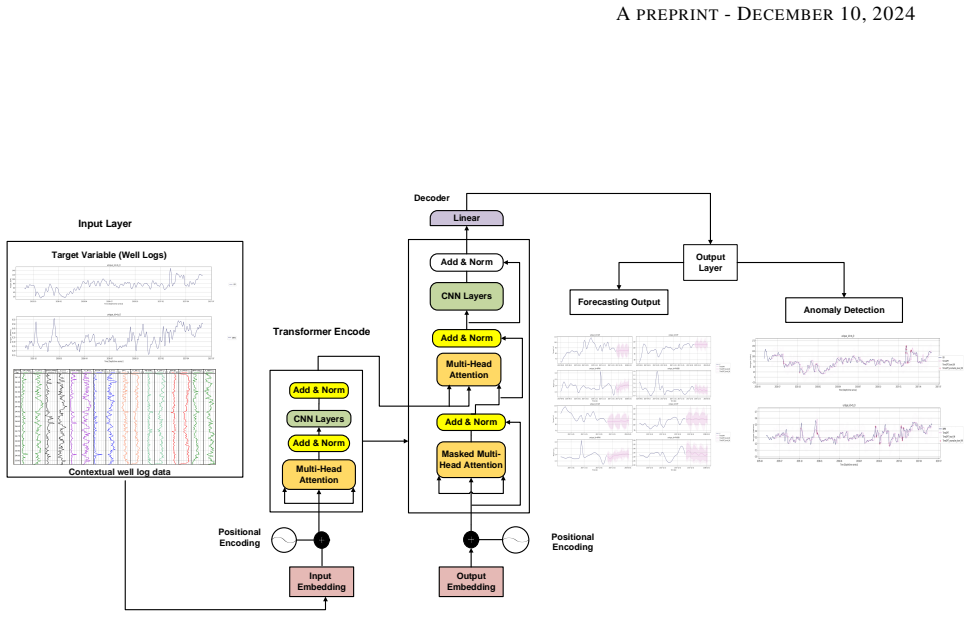
The load-bearing object is TimeGPT, a generative pre-trained transformer for time series built on GPT-2-style blocks: multi-head self-attention, positional encoding, feed-forward networks, residual connections, and layer normalization. The paper fine-tunes this model on well-log sequences and uses conformal prediction to output intervals; the forecast is the next value in the sequence, and anomalies are observations that fall outside those intervals. This single architecture carries both the prediction and anomaly-detection results.
What would settle it
Compute ROC-AUC and Matthews correlation coefficient using anomaly labels from an independent source, such as core descriptions, drilling-event reports, caliper logs, or image logs, instead of labels derived from the model's own prediction-interval violations; if those metrics remain near 0.51 and 0.01, the reported accuracy is an artifact of class imbalance.
Extended reading notes
Core claim
The paper claims that fine-tuning the pre-trained time-series foundation model TimeGPT on well-log data yields a single model that both forecasts log responses and detects anomalies. On the North Sea Dutch well logs, gamma-ray prediction reaches $R^2 = 0.87$, while resistivity, neutron, sonic, and density range from $R^2 = 0.48$ to $0.77$; the model also tracks abrupt high-to-low changes and extrapolates beyond measured depth. For anomaly detection, observations falling outside conformal prediction intervals are flagged with reported accuracy between 89% and 92% across confidence levels, which the paper interprets as identifying genuine geological or tool-related events. The distinctive advance claimed is zero-shot deployment: after fine-tuning, the model applies to logs without retraining, establishing a benchmark for subsequent well-log prediction and anomaly-detection studies.
Load-bearing premise
The anomaly-detection accuracy is only meaningful if the labels marking which depth points are truly anomalous come from an independent source, and the paper never states what those labels are.
Editorial extensions
If this is right
- Fine-tuned TimeGPT can be used as a no-retraining forecaster for common well logs in the same geological setting, accurate enough for preliminary screening and gap filling.
- Anomalies flagged at the same depth across several logs can be read as tool or borehole problems, while anomalies in only one log point to lithological or fluid changes.
- Conformal prediction intervals attach an uncertainty band to every forecast, so operational decisions can weigh confidence instead of relying on point estimates.
- The model's ability to extrapolate beyond measured depth offers a practical route for pre-drill log prediction in nearby wells.
- The reported results establish a zero-shot benchmark that future supervised, unsupervised, and foundation-model studies of well logs can be measured against.
Reading between the lines
- Because the reported ROC-AUC values hover near 0.5, the accuracy figures are best read as coverage rates; an independent-label study is needed to show the detector separates true anomalies from normal variability.
- The cross-basin promise should be tested directly: fine-tune on one basin, then forecast and flag anomalies on wells from a basin with different geology.
- The same conformal-interval recipe transfers naturally to other depth-indexed geophysical series, such as mud-gas readings, production logs, or seismic attributes, where missing sections and abrupt events are expensive.
- A same-split comparison against LSTM and convolutional baselines would reveal how much of the gain comes from pre-training rather than from the transformer architecture alone.
Editorial analysis
A structured set of objections, weighed in public.
Referee Report
Summary. The paper fine-tunes TimeGPT, a transformer-based time-series foundation model, on well-log data from the North Sea Dutch region (GR, DT, NPHI, RHOB, ILD logs; depth 1925–2065 m, 6553 points). It reports forecasting metrics (Table 1) with the best result for GR (R2 = 0.865, MAPE = 5.57%) and anomaly-detection metrics (Table 2) with accuracies around 88–92%. The abstract claims high-performance prediction and a zero-shot capability to detect anomalies with 93% accuracy. The forecasting evaluation appears to be a held-out test, but the anomaly-detection evaluation lacks a defined ground truth and the reported ROC-AUC and MCC values contradict the accuracy claim.
Significance. If the claims were valid, a fine-tuned time-series foundation model that forecasts well logs across basins and detects anomalies in a zero-shot manner would be a valuable contribution to subsurface characterization. The forecasting result for GR (R2 = 0.865) is a plausible empirical result on a held-out split, although no baselines, error bars, or code/data are provided. The anomaly-detection claim, however, is the paper's most distinctive contribution and it is not supported: the reported ROC-AUC values (~0.51) and MCC values (<0.05) indicate near-random discrimination, and no external ground-truth labels are described. The paper would need a complete re-evaluation of the anomaly-detection protocol before the central claim can be accepted.
major comments (5)
- [Section 4.3, Table 2] The ground-truth labels for anomaly detection are never defined. Section 4.3 reports results from conformal prediction intervals at 90% and 99% confidence, and Table 2 lists accuracy, ROC-AUC, and MCC, but the manuscript does not state how the 'actual' anomaly status was determined for any sample. Without external labels, the true-positive, true-negative, false-positive, and false-negative counts required by Eqs. (5) and (6) cannot be computed. If the labels were derived from the model's own interval violations, the reported 92–93% accuracy is self-referential and does not measure detection of real geological or drilling anomalies. This is the abstract's headline claim and it is currently unsubstantiated.
- [Table 2] The reported metrics are internally incompatible with the accuracy claim. Across all logs and confidence intervals, ROC-AUC values are between 0.503 and 0.518 and MCC values are between 0.007 and 0.041, which indicate that the binary decisions are essentially uncorrelated with the labels. Under class imbalance, an accuracy near 0.92 can be achieved by predicting the majority class almost always, so the accuracy numbers do not demonstrate anomaly-detection skill. The paper should report the class balance, confusion matrices, and balanced accuracy or precision-recall metrics; as reported, Table 2 contradicts the abstract's '93% accuracy' claim.
- [Sections 3.1, 3.3, 4.3; Abstract] The 'zero-shot' framing is not supported by the experimental design. The dataset is described as a single North Sea Dutch region (Section 3.1), and Section 3.3 says the test set is '10% of the total dataset collected from various basins,' but no basin-level split or evaluation on a basin unseen during fine-tuning is described. The abstract's combination of 'zero-shot approach' and 'zero-shot inference via a fine-tuning approach' is also internally contradictory. If cross-basin zero-shot generalization is a key claim, it must be tested on a genuinely held-out basin.
- [Section 3.4.1, Eq. (1)] Equation (1) defines the Pearson correlation coefficient, not the coefficient of determination R2. The text repeatedly calls this quantity R2, and Table 1 lists both R and R2 columns without stating the relationship between them (presumably R2 = R^2 for a univariate regression). The metric definitions need to be corrected and clarified so that readers can interpret the forecasting scores in Table 1.
- [Section 4.2, Table 1] The forecasting evaluation is a single held-out split without baseline comparisons. To support the claim of a 'significant advancement' over prior models, the authors should compare against at least one standard baseline (e.g., ARIMA, LSTM, or a supervised well-log imputation method) on the same split and report error bars or results over repeated splits. Without these, the R2 values in Table 1 cannot be assessed as state-of-the-art, and the paper currently provides no evidence that TimeGPT outperforms simpler or domain-specific models.
minor comments (6)
- [Abstract] The text contains typos and formatting errors: 'R2up to 87%' is missing a space, the parenthetical after MAPE is unbalanced, and 'retaining' should be 'retraining' in the introduction.
- [Section 4.1] The heatmap description reports a negative correlation (-0.6) between NPHI and DT, but the pair-plot paragraph states that NPHI exhibits a strong positive relationship with DT; these descriptions are contradictory and should be reconciled.
- [Section 3.1] The dataset description is incomplete for reproducibility: it gives one depth range and total point count but does not state how many wells are included, which logs are available per well, or how the train/test split was performed.
- [Section 3.3] Hyperparameter details are incomplete: the grid-search ranges for learning rate, batch size, and attention heads are not reported, and the validation-set size is not given, so the fine-tuning protocol cannot be reproduced.
- [Figure 5 caption] The caption says 'show a good correlation between actual and forecast logs' but the figure displays anomaly-detection results, which are binary classifications rather than a correlation plot.
- [Table 1] The columns labeled 'R' and 'R2' should be defined explicitly; the text should state that R is the Pearson correlation and R2 is the coefficient of determination, and the relationship between them, to match the formulae in Section 3.4.1.
Circularity Check
No significant circularity; forecasting is a held-out empirical test, and the anomaly-detection gap is an evidentiary issue rather than a demonstrated self-referential reduction.
full rationale
The central forecasting claim is not circular. The paper fine-tunes the externally defined TimeGPT architecture [10] and evaluates on a held-out test set ('The evaluation was conducted on the test set (10% of the total dataset collected from various basins)', Section 3.3). The reported R2, MAPE, and related metrics in Table 1 are comparisons of model outputs against actual well-log values, which is a standard empirical evaluation with no fitted parameter being renamed as a prediction. The anomaly-detection section, however, reports accuracy, ROC-AUC, and MCC without ever stating how 'actual' anomaly labels were obtained. Section 4.3 describes only the use of 90% and 99% confidence intervals, and the low ROC-AUC (~0.51) and MCC (<0.05) in Table 2 are inconsistent with the claimed 92% accuracy. This is a serious validation gap and an internal inconsistency, but the paper does not explicitly define the labels as the model's own interval violations, so a specific circular reduction cannot be demonstrated from the text under the hard rule. Same-author self-citations appear in the references, but the load-bearing architecture and pretraining claims rest on the external TimeGPT paper [10], and the forecasting evaluation is self-contained against held-out data. The phrase 'zero-shot inference via a fine-tuning approach' is terminologically inconsistent, but it is not a circular derivation. Overall, no step in the claimed derivation chain reduces by construction to its own inputs.
Assumptions & free parameters
free parameters (4)
- Fine-tuned TimeGPT weights =
not disclosed
- Conformal prediction confidence levels =
90% and 99%
- Fine-tuning hyperparameters =
learning rate 1e-4, batch size 64, early stopping patience 10
- Train/test split ratio =
90/10
assumptions (4)
- domain assumption Depth-indexed well logs can be treated as a time series for TimeGPT pretraining to transfer.
- domain assumption Anomalies flagged by conformal prediction intervals correspond to real geological or tool anomalies and can be scored without independent labels.
- domain assumption The single North Sea Dutch dataset is representative of 'various basins' and supports claims of cross-basin generalization.
- domain assumption Nixtla's TimeGPT API implements the architecture described in TimeGPT-1.
Cite this review
Pith. "Pith review of Leveraging Time-Series Foundation Model for Subsurface Well Logs Prediction and Anomaly Detection." pith.science (2026). https://pith.science/paper/UY7QI52O
@misc{pith2026241205681,
  author       = {Pith},
  title        = {Pith review of: Leveraging Time-Series Foundation Model for Subsurface Well Logs Prediction and Anomaly Detection},
  year         = {2026},
  howpublished = {\url{https://pith.science/paper/UY7QI52O}},
  note         = {Machine review of arXiv:2412.05681}
}
read the original abstract
The rise in energy demand highlights the importance of suitable subsurface storage, requiring detailed and accurate subsurface characterization often reliant on high-quality borehole well log data. However, obtaining complete well-log data is costly and time-consuming, with missing data being common due to borehole conditions or tool errors. While machine learning and deep learning algorithms have been implemented to address these issues, they often fail to capture the intricate, nonlinear relationships and long-term dependencies in complex well log sequences. Additionally, prior AI-driven models typically require retraining when introduced to new datasets and are constrained to deployment in the same basin. In this study, we explored and evaluated the potential of a time-series foundation model leveraging transformer architecture and a generative pre-trained approach for predicting and detecting anomalies in borehole well log data. Specifically, we fine-tuned and adopted the TimeGPT architecture to forecast key log responses and detect anomalies with high accuracy. Our proposed model demonstrated excellent performance, achieving R2 of up to 87% and a mean absolute percentage error (MAPE) as low as 1.95%. Additionally, the model's zero-shot capability successfully identified subtle yet critical anomalies, such as drilling hazards or unexpected geological formations, with an overall accuracy of 93%. The model represents a significant advancement in predictive accuracy and computational efficiency, enabling zero-shot inference through fine-tuning. Its application in well-log prediction enhances operational decision-making while reducing risks associated with subsurface exploration. These findings demonstrate the model's potential to transform well-log data analysis, particularly in complex geological settings.
Figures


Figures from the paper (2 more)


Reference graph
Works this paper leans on
-
[1]
Well log data generation and imputation using sequence-based generative adversarial networks
A. Al-Fakih, A. Koeshidayatullah, and S. Kaka. Well log data generation and imputation using sequence-based generative adversarial networks. ArXiv, 2024. https://arxiv.org/abs/2412.00718
work page Pith review arXiv 2024
-
[2]
Enhanced anomaly detection in well log data through the application of ensemble GANs
A. Al-Fakih, A. Koeshidayatullah, and S. Kaka. Enhanced anomaly detection in well log data through the application of ensemble GANs. ArXiv, 2024. https://arxiv.org/abs/2411.19875
work page Pith review arXiv 2024
-
[3]
A. Al-Fakih and A. Koeshidayatullah. Reservoir Property Prediction in the North Sea Using Machine Learning. IEEE Access, 2023. https://doi.org/10.1109/ACCESS.2023.3336623
arXiv 2023
-
[4]
A. Al-Fakih and S. Kaka. Application of Artificial Intelligence in Static Formation Temperature Estima- tion. Arab Journal of Science and Engineering , 48, 16791–16804, 2023. https://doi.org/10.1007/ s13369-023-08096-x
work page 2023
-
[5]
A. Al-Fakih, A.F. Ibrahim, S. Elkatatny, et al. Estimating electrical resistivity from logging data for oil wells using machine learning. Journal of Petroleum Exploration and Production Technology, 2023. https://doi.org/10. 1007/s13202-023-01617-2
work page 2023
-
[6]
M.C. Altindal, P. Nivlet, M. Tabib, A. Rasheed, T.G. Kristiansen, and R. Khosravanian. Anomaly detection in multivariate time series of drilling data. Geoenergy Science and Engineering, 237, 212778, 2024
work page 2024
-
[7]
G. Antariksa, R. Muammar, A. Nugraha, and J. Lee. Deep sequence model-based approach to well log data imputation and petrophysical analysis: A case study on the West Natuna Basin, Indonesia. Journal of Applied Geophysics, 218, 105213, 2023
work page 2023
-
[8]
R. Feng. Uncertainty analysis in well log classification by Bayesian long short-term memory networks. Journal of Petroleum Science and Engineering, 205, 108816, 2021
work page 2021
Show all 35 references
-
[9]
Ferreira, L
I. Ferreira, L. Ochoa, and A. Koeshidayatullah. On the generation of realistic synthetic petrographic datasets using a style-based GAN. Scientific Reports, 12(1), 12845, 2022
2022
-
[10]
Garza, C
A. Garza, C. Challu, and M. Mergenthaler-Canseco. TimeGPT-1. arXiv preprint, arXiv:2310.03589, 2023
2023 arXiv
-
[11]
W. Guo, S. Li, and J. Yang. Scattering Prompt Tuning: A Fine-tuned Foundation Model for SAR Object Recognition. In Proceedings of the IEEE/CVF Conference on Computer Vision and Pattern Recognition, pages 3056–3065, 2024
2024
-
[12]
Hewamalage, K
H. Hewamalage, K. Ackermann, and C. Bergmeir. Forecast evaluation for data scientists: common pitfalls and best practices. Data Mining and Knowledge Discovery, 37(2), 788–832, 2023
2023
-
[13]
Koeshidayatullah, I
A. Koeshidayatullah, I. Ferreira-Chacua, and W. Li. Is attention all geosciences need? Advancing quantitative petrography with attention-based deep learning. Computers & Geosciences, 181, 105466, 2023
2023
-
[14]
Jeong, E
J. Jeong, E. Park, I. Emelyanova, M. Pervukhina, L. Esteban, and S.-T. Yun. Application of conditional generative model for sonic log estimation considering measurement uncertainty.Journal of Petroleum Science and Engineering, 196, 108028, 2021. https://doi.org/10.1016/j.petro...
2021
-
[15]
M. Kwon, J. Yoo, C. Kang, Y . Hong, H. Jeong, and S. Yoon. Accurate and Convenient Missing Well Log Synthesis using Generative Model. In Abu Dhabi International Petroleum Exhibition and Conference, page D011S021R002, 2020
2020
-
[16]
Liang, H
Y . Liang, H. Wen, Y . Nie, Y . Jiang, M. Jin, D. Song, S. Pan, and Q. Wen. Foundation models for time series analysis: A tutorial and survey. In Proceedings of the 30th ACM SIGKDD Conference on Knowledge Discovery and Data Mining, pages 6555–6565, 2024
2024
-
[17]
W. Liao, F. Porte-Agel, J. Fang, C. Rehtanz, S. Wang, D. Yang, and Z. Yang. TimeGPT in Load Forecasting: A Large Time Series Model Perspective. arXiv preprint, arXiv:2404.04885, 2024
2024 arXiv
-
[18]
L. Lin, H. Wei, T. Wu, P. Zhang, and Z. Zhong. Mwlt: Transformer-Based Missing Well Log Prediction. Available at SSRN 4236228, 2023. 12 A PREPRINT - D ECEMBER 10, 2024
2023
-
[19]
Y . Liu, H. Zhang, C. Li, X. Huang, J. Wang, and M. Long. Timer: Generative Pre-trained Transformers Are Large Time Series Models. In Forty-first International Conference on Machine Learning, 2024
2024
-
[20]
Masini, M.C
R.P. Masini, M.C. Medeiros, and E.F. Mendes. Machine learning advances for time series forecasting. Journal of Economic Surveys, 37(1), 76–111, 2023
2023
-
[21]
Mohammed, N.P
M.A. Mohammed, N.P. Szabó, and P. Sz˝ ucs. Multi-step modeling of well logging data combining unsupervised and deep learning algorithms for enhanced characterization of the Quaternary aquifer system in Debrecen area, Hungary. Modeling Earth Systems and Environment, 10(3), 3693...
2024
-
[22]
Mohamed, S
B.A. Mohamed, S. Aliyev, A.F. Ibrahim, and T. Al-Shafloot. Real-Time Forecasting of Subsurface Porosity During Drilling Using Advanced Time Series Models. In Abu Dhabi International Petroleum Exhibition and Conference, page D041S140R004, 2024
2024
-
[23]
Mukherjee, K
B. Mukherjee, K. Sain, and S. Kar. Deep learning-aided simultaneous missing well log prediction in multiple stratigraphic units: a case study from the Bhogpara oil field, Upper Assam, Northeast India. Earth Science Informatics, 2024
2024
-
[24]
F. Qu, H. Liao, J. Liu, T. Wu, F. Shi, and Y . Xu. A novel well log data imputation method with CGAN and swarm intelligence optimization. Energy, 293, 130694, 2024
2024
-
[25]
Paroha and A
A.D. Paroha and A. Chotrani. A Comparative Analysis of TimeGPT and Time-LLM in Predicting ESP Maintenance Needs in the Oil and Gas Sector. International Journal of Computer Applications, 975, 8887, 2024
2024
-
[26]
Pham and E.Z
N. Pham and E.Z. Naeini. Missing well log prediction using deep recurrent neural networks. In 81st EAGE Conference and Exhibition, pages 1–5, 2019
2019
-
[27]
N. Pham, X. Wu, and E. Zabihi Naeini. Missing well log prediction using convolutional long short-term memory network. Geophysics, 85(4), W A159–W A171, 2020
2020
-
[28]
Radford, J
A. Radford, J. Wu, R. Child, D. Luan, D. Amodei, and I. Sutskever. Language models are unsupervised multitask learners. OpenAI Blog, 1(8), 9, 2019
2019
-
[29]
G. Shen, J. Zhao, Q. Chen, J. Leng, C. Li, and M. Guo. SALO: an efficient spatial accelerator enabling hybrid sparse attention mechanisms for long sequences. In Proceedings of the 59th ACM/IEEE Design Automation Conference, pages 571–576, 2022
2022
-
[30]
Struminskiy, A
K. Struminskiy, A. Klenitskiy, A. Reshytko, D. Egorov, A. Shchepetnov, A. Sabirov, D. Vetrov, A. Semenikhin, O. Osmonalieva, and B. Belozerov. Well log data standardization, imputation and anomaly detection using hidden Markov models. In Petroleum Geostatistics, pages 1–5, 2019
2019
-
[31]
Vaswani, N
A. Vaswani, N. Shazeer, N. Parmar, J. Uszkoreit, L. Jones, A.N. Gomez, L. Kaiser, and I. Polosukhin. Attention Is All You Need. In Advances in Neural Information Processing Systems, arXiv preprint arXiv:1706.03762, 2017
2017 arXiv
-
[32]
J. Wang, J. Cao, J. You, M. Cheng, and P. Zhou. A method for well log data generation based on a spatio-temporal neural network. Journal of Geophysics and Engineering, 18(5), 700–711, 2021
2021
-
[33]
D. Wang, Y . Zheng, and G. Li, High-dimensional low-rank tensor autoregressive time series modeling,Journal of Econometrics, vol. 238, no. 1, pp. 105544, 2024
2024
-
[34]
D. Xie, Z. Liu, F. Wang, and Z. Song. A Transformer and LSTM-Based Approach for Blind Well Lithology Prediction. Symmetry, 16(5), 616, 2024
2024
-
[35]
Zhang, Y
H. Zhang, Y . Zeng, H. Bao, L. Liao, J. Song, Z. Huang, X. Chen, Z. Wang, Y . Xu, and X. Jin. Drilling and completion anomaly detection in daily reports by deep learning and natural language processing techniques. In SPE/AAPG/SEG Unconventional Resources Technology Conference,...
2020
Reviewed August 11, 2026 · model on record in the stance chip above.
Discussion (0). Continue with ORCID to comment.