REVIEW 3 major objections 5 minor 1 cited by
Noise-induced quantum-circuit refrigeration
T0 review · 3 major / 5 minor · reviewed 2026-08-11 · deepseek-v4-flash
Pith's one-line read Broadband noise alone can power a quantum-circuit refrigerator, damping a coherent state and cooling a superconducting resonator from about 300 mK to 130 mK.
desk verdict Noise-driven QCR damping is a real, visible effect; the 300-to-130 mK number rests on a thermometer that isn't validated at high noise power. read the letter →
The pith
A machine-rendered reading of the paper's core claim, the machinery that carries it, and where it could break.
The reading
What carries the argument
The load-bearing element is the quantum-circuit refrigerator (QCR): a normal-metal–insulator–superconductor tunnel junction whose inelastic photon-assisted quasiparticle tunneling removes photons from the galvanically coupled resonator. The theoretical machinery is the ac-drive model of Ref. [37], in which the finite-bandwidth noise is approximated by a sinusoidal voltage $V_{\rm ac}\cos(\omega_{\rm ac}t)$ at the noise center frequency; the resulting Fock-state transition rates (Eq. (1)) feed the QCR-induced decay rate $\gamma_{\rm QCR}(V)$ in Eq. (6) and the weighted-average steady-state population $\bar{n}(V)=[n_{\rm QCR}(V)\gamma_{\rm QCR}(V)+n_c\gamma_c]/[\gamma_{\rm QCR}(V)+\gamma_c]$ in Eq. (7). This lets the authors predict the observed noise-power dependence from device parameters such as tunneling resistance, gap, Dynes parameter, and quasiparticle temperature, rather than treating the cooling as a free fit.
What would settle it
Measure the resonator's mean photon number with an independent readout that does not rely on qubit-spectroscopy peak heights—for example, the resonator's own linear transmission—while sweeping the same far-detuned noise power; if the independently extracted temperature does not drop from roughly 300 mK to 130 mK, the reported cooling is a readout artifact.
Extended reading notes
Core claim
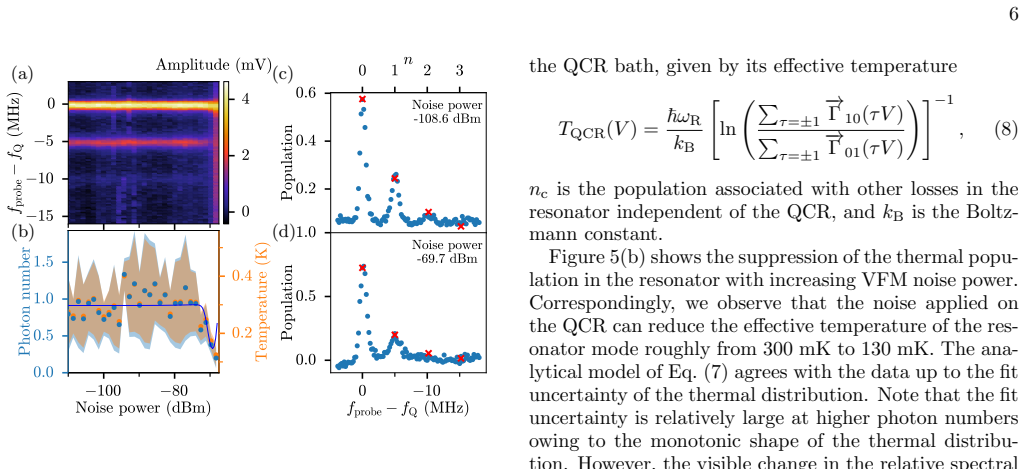
The paper's central claim is that a quantum-circuit refrigerator attached to a superconducting microwave resonator can be operated with zero dc bias and driven purely by broadband noise, provided the noise band is far detuned from the resonator frequency. Using a transmon qubit to resolve the resonator's Fock states, the authors observe that increasing the off-resonant noise power damps a coherent state and reduces the effective temperature of a thermal state from roughly 300 mK to 130 mK. The same noise applied on resonance instead heats the resonator into a thermal distribution, confirming that the off-resonant drive acts as a filtered thermal bath rather than as a direct heater. The authors model the noise as an equivalent sinusoidal drive at the noise center frequency and find that the measured decay rates and steady-state populations agree with the photon-assisted quasiparticle-tunneling rates of their QCR model.
Load-bearing premise
The reported cooling rests on the assumption that the heights of the qubit-spectroscopy peaks still faithfully encode the resonator's photon-number distribution when the noise drive is strong enough to distort the spectrum.
Editorial extensions
If this is right
- A qubit-reset element for a superconducting processor can in principle be powered by noise alone, removing the dc bias line and its associated control electronics.
- The noise source acts as a tunable thermal bath: resonant noise heats the resonator, while far-detuned noise cools it, giving a single device both heating and cooling functionality.
- Because the measured decay rates match the photon-assisted-tunneling model, device parameters such as junction resistance and gap can be used to engineer the cooling rate without empirical tuning.
- The demonstrated reduction from roughly 300 mK to 130 mK places the resonator closer to the quantum ground state, which is the regime needed for high-fidelity qubit operations.
Reading between the lines
- Extending beyond the paper, the required noise power could be lowered by raising the resonator impedance and mode frequency, eventually allowing an on-chip resistor thermalized at a higher cryostat stage to serve as the noise source.
- The same zero-dc-bias dissipation mechanism could be applied directly to qubit initialization, replacing coherent reset pulses with a thermal-noise-driven reset element.
- Because the steady-state population in Eq. (7) is a weighted average of two baths, the noise-driven QCR offers a way to tune a resonator's effective bath temperature continuously, which could be used to study quantum heat engines and thermal machines.
Signed reviews
Editorial analysis
A structured set of objections, weighed in public.
Referee Report
Summary. This manuscript reports an experimental study of a superconducting resonator coupled to a quantum-circuit refrigerator (QCR) driven by broadband noise rather than dc bias. The authors reconstruct resonator Fock-state populations from dispersive transmon spectroscopy and observe that resonant noise heats the resonator to a thermal distribution, while noise detuned far from the resonator and applied to the QCR dampens a coherent state and reduces the mean photon number of an initially thermal state from n̄≈0.92 (~300 mK) to n̄≈0.22 (~130 mK). They model the noise drive as a monochromatic ac bias at the noise center frequency and compare measured decay rates and steady-state populations with the model using Eq. (6) and Eq. (7).
Significance. If verified, the work demonstrates a qualitatively new operating mode for QCRs—refrigeration powered by noise only—and would support proposals for autonomous thermal machines and qubit reset driven by waste heat. The paper's strengths include direct spectroscopic evidence of noise-induced damping, quantitative IV-curve fits, and a transparent analytical model. However, the central quantitative claim (a ~0.7-photon reduction in thermal population) rests on qubit-spectroscopy peak-height fits at high noise power, where line-shape distortions are observed and not independently calibrated; the model comparison also uses parameters that appear chosen to match the data. These issues affect the strength of the cooling claim but not the existence of the damping effect.
major comments (3)
- [Sec. III, Figs. 3(a), 4(a), 5(a); Sec. V] The qubit-spectroscopy thermometer is not independently validated in the high-noise regime where the cooling effect is claimed. In Fig. 3(a) the authors report power-dependent line splitting, qubit linewidth broadening, a qubit-state-independent background phase shift, and loss of readout signal at strong noise drive. The photon-number extraction in Figs. 4(b) and 5(b) fits only the relative magnitudes of the spectral peaks to Poisson or thermal distributions, with no correction for these line-shape distortions and no systematic-error budget. Because the central cooling claim is a shift of only about 0.7 photons (from n̄≈0.92 to ≈0.22), a modest bias in the peak-height-to-population mapping due to uneven broadening or a tilted baseline could account for the entire effect. I recommend an independent calibration of the thermometer in the high-noise regime, for example by applying a known coherent drive to produce a reference Poisson distribution or by comparing with an alternative measurement of the resonator population such as the ac Stark shift or the resonator transmission linewidth.
- [Sec. V, Eq. (7), Fig. 5(b)] The model comparison in Fig. 5(b) uses nc=0.92 and Tqp=60 mK. The value nc=0.92 is essentially the zero-noise measured mean photon number, so the model is forced through the initial data point. Moreover, Tqp=60 mK differs from the quasiparticle temperatures Tqp=248 mK and 250 mK used to fit the IV curves in Figs. 2(b) and 2(d). If Tqp and nc are free parameters, the agreement in Fig. 5(b) is partly by construction; if they are independently determined, their derivation should be stated explicitly. The paper should also show how the predicted cooling curve shifts under the uncertainty in Tqp and nc, because this determines whether the data support a specific cooling magnitude or only a qualitative trend.
- [Sec. IV, Eq. (1) and Sec. V, Eq. (6)] The replacement of the finite-band noise drive by a monochromatic ac drive at the center frequency, with Vac=2√(2PNZ0), is a crude approximation that is not quantitatively validated. The IV-curve fits in Figs. 2(b) and 2(d) use the same model but require slightly different Tqp values (248 mK vs 250 mK), so the agreement does not constitute a stringent test of the monochromatic approximation. Since the predicted QCR-induced decay rate in Eq. (6) depends sensitively on the Bessel-function weights in Eq. (1), the authors should discuss the expected sensitivity to the finite noise bandwidth and, if possible, compare with a multi-tone or broadband calculation. Without this, the theoretical support for the extracted decay rates is weaker than implied.
minor comments (5)
- [Sec. III] The phrase "AFM noiseform" appears to be a typo; it should be "AFM noise form" or "AFM noise waveform."
- [Sec. III, Fig. 3(d)] The sentence attributing the asymmetry in Fig. 3(d) to "the asymmetric resonance peak of the resonator (data not shown)" is unverifiable; either show the relevant resonance data or soften the attribution.
- [Sec. V, Eq. (8)] The bosonic population nQCR(V) is used in Eq. (7) but is not explicitly defined; after Eq. (8) it would be helpful to state nQCR = [exp(ℏωR/(kBTQCR))−1]^{-1}.
- [Sec. V, Figs. 4(a) and 5(a)] The color-bar axes for noise power are labeled only "Noise power" without units; the caption provides values in dBm, but the axis labels should include the units for clarity.
- [Sec. V, Fig. 5(b)] The paper notes that fit uncertainty is relatively large at higher photon numbers due to the monotonic shape of the thermal distribution, but this uncertainty is not quantified in the figure or text; adding representative error bars on the extracted points would strengthen the presentation.
Circularity Check
No significant circularity: the core noise-driven cooling and damping observations are direct spectroscopic measurements, and the analytical model is a stated-parameter comparison rather than a fitted prediction.
full rationale
The paper's central experimental claims—noise-driven damping of a coherent resonator state and suppression of thermal photon number from roughly n=0.92 to n=0.22—are obtained directly from qubit-spectroscopy peak-height fits in Figs. 4 and 5, converted to photon number via Poisson/thermal distributions and to decay rate via the power-balance relation Eq. (4). These conversions do not use the QCR model being validated; the driveline and excess decay rates gamma_dr and gamma0 are independently characterized experimental parameters from Table I. The analytical model (Eqs. (1)-(8), following Ref. [37]) is presented as a comparison with the data, with Tqp=60 mK and nc=0.92 stated explicitly as model inputs rather than hidden fitted outputs. Although Tqp differs from the IV-curve fit values (248/250 mK) and may be adjustable, the paper does not rename a fitted parameter as a prediction, and the observed cooling and damping do not depend on the model curve. Self-citations to prior QCR theory (Refs. [26,31,37]) provide supporting theoretical background with externally grounded derivations; no uniqueness theorem or forced-ansatz claim is imported from the authors' prior work. No equation in the paper reduces to its own input by construction, so the analysis is self-contained for the core observations.
Assumptions & free parameters
free parameters (2)
- Quasiparticle temperature in cooling model (Tqp) =
60 mK
- QCR-independent thermal population (nc) =
0.92
assumptions (5)
- ad hoc to paper Finite-band noise drive can be replaced by a monochromatic ac drive at the noise center frequency, V(t)=Vdc+Vac cos(omega_ac t), with Vac=2 sqrt(2 PN Z0).
- domain assumption Elastic quasiparticle tunneling dominates; inelastic m-to-m' rates are negligible for the junction current (Eq. 3).
- domain assumption Both QCR electrodes share the same effective temperature in the Fermi functions of Eq. (2).
- domain assumption The steady-state resonator population is a weighted average of the QCR bath and the other loss baths, Eq. (7).
- domain assumption The heights of the qubit-spectroscopy resonance peaks faithfully encode the Fock-state populations in the strong-dispersive regime.
Cite this review
Pith. "Pith review of Noise-induced quantum-circuit refrigeration." pith.science (2026). https://pith.science/paper/L2GUUQOX
@misc{pith2026241205886,
  author       = {Pith},
  title        = {Pith review of: Noise-induced quantum-circuit refrigeration},
  year         = {2026},
  howpublished = {\url{https://pith.science/paper/L2GUUQOX}},
  note         = {Machine review of arXiv:2412.05886}
}
read the original abstract
We use a transmon qubit and its dispersively coupled readout resonator to measure the Fock state populations of another microwave resonator, to which we have attached a quantum-circuit refrigerator (QCR). First, we apply noise generated at room temperature to the resonator and show that such noise drive leads to a thermal distribution of the resonator Fock states. Subsequently, we detune the noise frequency band far away from the resonance condition and vary the power of the noise applied on the QCR. We observe that such artificial thermal noise may lead to major damping of a coherent state of the resonator. Importantly, we also demonstrate that the effective temperature of a thermal resonator state can be reduced from roughly 300 mK to 130 mK by the introduction of the artificial thermal noise. These observations pave the way for a purely thermally powered quantum-circuit refrigerator which may unlock the use of waste heat in resetting superconducting qubits in a quantum processor and in building autonomous quantum heat engines.
Figures


Figures from the paper (1 more)
Forward citations
Cited by 1 Pith paper
-
Photonic heat amplifiers based on a disordered semiconductor
A proposed photonic heat amplifier uses variable-range-hopping semiconductor reservoirs to achieve negative differential thermal conductance, yielding predicted heat-current amplification up to 15x and temperature gai...
Reference graph
Works this paper leans on
-
[37]
H. Hsu, M. Silveri, V. Sevriuk, M. M¨ ott¨ onen, and G. Catelani, Charge dynamics in quantum-circuit refrig- eration: Thermalization and microwave gain, A VS Quan- tum Science 3, 042001 (2021)
work page 2021
-
[1]
Blais, A
A. Blais, A. L. Grimsmo, S. M. Girvin, and A. Wall- raff, Circuit quantum electrodynamics, Reviews of Mod- ern Physics 93, 025005 (2021)
2021
-
[2]
Krantz, M
P. Krantz, M. Kjaergaard, F. Yan, T. P. Orlando, S. Gus- tavsson, and W. D. Oliver, A quantum engineer’s guide to superconducting qubits, Applied Physics Reviews 6, 021318 (2019)
2019
-
[3]
H. L. Huang, D. Wu, D. Fan, and X. Zhu, Supercon- ducting quantum computing: a review, Science China Information Sciences 63, 180501 (2020)
work page 2020
-
[4]
M. Kjaergaard, M. E. Schwartz, J. Braum¨ uller, P. Krantz, J. I.-J. Wang, S. Gustavsson, and W. D. Oliver, Superconducting qubits: current state of play, Annual Review of Condensed Matter Physics 11, 369 (2020)
work page 2020
-
[5]
R. Barends et al., Superconducting quantum circuits at the surface code threshold for fault tolerance, Nature 508, 500 (2014)
work page 2014
-
[6]
A. M. Gunyh´ o, S. Kundu, J. Ma, W. Liu, S. Niemel¨ a, G. Catto, V. Vadimov, V. Vesterinen, P. Singh, Q. Chen, and M. M¨ ott¨ onen, Single-shot readout of a superconduct- ing qubit using a thermal detector, Nature Electronics 7, 288 (2024)
work page 2024
- [7]
Show all 51 references
-
[8]
Geerlings, Z
K. Geerlings, Z. Leghtas, I. M. Pop, S. Shankar, L. Frun- zio, R. J. Schoelkopf, M. Mirrahimi, and M. H. De- voret, Demonstrating a driven reset protocol for a super- conducting qubit, Physical Review Letters 110, 120501 (2013)
2013
-
[9]
Magnard, P
P. Magnard, P. Kurpiers, B. Royer, T. Walter, J.-C. Besse, S. Gasparinetti, M. Pechal, J. Heinsoo, S. Storz, A. Blais, and A. Wallraff, Fast and unconditional all- microwave reset of a superconducting qubit, Physical Re- view Letters 121, 060502 (2018)
2018
-
[10]
Arute et al
F. Arute et al. , Quantum supremacy using a pro- grammable superconducting processor, Nature 574, 505 (2019)
2019
-
[11]
Y. Kim, A. Eddins, S. Anand, K. X. Wei, E. van den Berg, S. Rosenblatt, H. Nayfeh, Y. Wu, M. Zaletel, K. Temme, and A. Kandala, Evidence for the utility of quantum computing before fault tolerance, Nature 618, 500 (2023)
2023
-
[12]
Ezratty, Perspective on superconducting qubit quan- tum computing, European Physical Journal A 59, 94 (2023)
O. Ezratty, Perspective on superconducting qubit quan- tum computing, European Physical Journal A 59, 94 (2023)
2023
-
[13]
Krinner, S
S. Krinner, S. Storz, P. Kurpiers, P. Magnard, J. Heinsoo, R. Keller, J. L¨ utolf, C. Eichler, and A. Wallraff, Engineer- ing cryogenic setups for 100-qubit scale superconducting circuit systems, EPJ Quantum Technology 6, 2 (2019)
2019
-
[14]
C. G. Almudever, L. Lao, X. Fu, N. Khammassi, I. Ashraf, D. Iorga, S. Varsamopoulos, C. Eichler, A. Wallraff, L. Geck, A. Kruth, J. Knoch, H. Bluhm, and K. Bertels, The engineering challenges in quantum com- puting, in Design, Automation & Test in Europe Confer- ence & Exhibit...
2017
-
[15]
J. P. Pekola and F. W. Hekking, Normal-metal- superconductor tunnel junction as a Brownian refrigera- tor, Physical Review Letters 98, 210604 (2007)
2007
-
[16]
J. V. Koski, V. F. Maisi, J. P. Pekola, and D. V. Averin, Experimental realization of a Szilard engine with a sin- gle electron, Proceedings of the National Academy of Sci- ences of the United States of America 111, 13786 (2014)
2014
-
[17]
Cottet, S
N. Cottet, S. Jezouin, L. Bretheau, P. Campagne-Ibarcq, Q. Ficheux, J. Anders, A. Auff` eves, R. Azouit, P. Rou- chon, and B. Huard, Observing a quantum Maxwell de- mon at work, Proceedings of the National Academy of Sciences of the United States of America 114, 7561 (2017)
2017
-
[18]
J. B. Brask, G. Haack, N. Brunner, and M. Huber, Autonomous quantum thermal machine for generating steady-state entanglement, New Journal of Physics 17, 113029 (2015)
2015
-
[19]
Rasola and M
M. Rasola and M. M¨ ott¨ onen, Autonomous quantum heat engine based on non-Markovian dynamics of an optome- chanical Hamiltonian, Scientific Reports 14, 9448 (2024)
2024
-
[20]
Marchegiani, P
G. Marchegiani, P. Virtanen, and F. Giazotto, On-chip cooling by heating with superconducting tunnel junc- tions, Europhysics Letters 124, 48005 (2018)
2018
-
[21]
M. A. Aamir, P. J. Suria, J. A. M. Guzm´ an, C. Castillo-Moreno, J. M. Epstein, N. Y. Halpern, and S. Gasparinetti, Thermally driven quantum re- frigerator autonomously resets superconducting qubit, arXiv:2305.16710 (2023)
2023 arXiv
-
[22]
Sundelin, M
S. Sundelin, M. A. Aamir, V. M. Kulkarni, C. Castillo- Moreno, and S. Gasparinetti, Quantum refrigera- tion powered by noise in a superconducting circuit, arXiv:2403.03373 (2024)
2024 arXiv
-
[23]
Nyquist, Thermal agitation of electric charge in con- ductors, Physical Review 32, 110 (1928)
H. Nyquist, Thermal agitation of electric charge in con- ductors, Physical Review 32, 110 (1928)
1928
-
[24]
D. M. Pozar, Microwave engineering, 4th ed. (John Wiley & Sons, Hoboken, 2012) pp. 498–501
2012
-
[25]
K. Y. Tan, M. Partanen, R. E. Lake, J. Govenius, S. Ma- suda, and M. M¨ ott¨ onen, Quantum-circuit refrigerator, Nature Communications 8, 15189 (2017)
2017
-
[26]
Silveri, H
M. Silveri, H. Grabert, S. Masuda, K. Y. Tan, and M. M¨ ott¨ onen, Theory of quantum-circuit refrigeration by photon-assisted electron tunneling, Physical Review B 96, 094524 (2017)
2017
-
[27]
Vadimov, A
V. Vadimov, A. Viitanen, T. M¨ orstedt, T. Ala-Nissila, and M. M¨ ott¨ onen, Single-junction quantum-circuit re- 8 frigerator, AIP Advances 12, 075005 (2022)
2022
-
[28]
Silveri, S
M. Silveri, S. Masuda, V. Sevriuk, K. Y. Tan, M. Jenei, E. Hyypp¨ a, F. Hassler, M. Partanen, J. Goetz, R. E. Lake, L. Gr¨ onberg, and M. M¨ ott¨ onen, Broadband Lamb shift in an engineered quantum system, Nature Physics 15, 533 (2019)
2019
-
[29]
V. A. Sevriuk, K. Y. Tan, E. Hyypp¨ a, M. Silveri, M. Par- tanen, M. Jenei, S. Masuda, J. Goetz, V. Vesterinen, L. Gr¨ onberg, and M. M¨ ott¨ onen, Fast control of dissi- pation in a superconducting resonator, Applied Physics Letters 115, 082601 (2019)
2019
-
[30]
Viitanen, M
A. Viitanen, M. Silveri, M. Jenei, V. Sevriuk, K. Y. Tan, M. Partanen, J. Goetz, L. Gr¨ onberg, V. Vadi- mov, V. Lahtinen, and M. M¨ ott¨ onen, Photon-number- dependent effective Lamb shift, Physical Review Re- search 3, 033126 (2021)
2021
-
[31]
Viitanen, T
A. Viitanen, T. M¨ orstedt, W. S. Teixeira, M. Tiiri, J. R¨ abin¨ a, M. Silveri, and M. M¨ ott¨ onen, Quantum-circuit refrigeration of a superconducting microwave resonator well below a single quantum, Physical Review Research 6, 023262 (2024)
2024
-
[32]
Masuda, K
S. Masuda, K. Y. Tan, M. Partanen, R. E. Lake, J. Gove- nius, M. Silveri, H. Grabert, and M. M¨ ott¨ onen, Ob- servation of microwave absorption and emission from incoherent electron tunneling through a normal-metal- insulator-superconductor junction, Scientific Reports 8, 3966 (2018)
2018
-
[33]
M¨ orstedt, W
T. M¨ orstedt, W. S. Teixeira, A. Viitanen, H. Kivij¨ arvi, M. Tiiri, M. Rasola, A. M. Gunyho, S. Kundu, L. Lat- tier, V. Vadimov, G. Catelani, V. Sevriuk, J. Heinsoo, J. R¨ abin¨ a, J. Ankerhold, and M. M¨ ott¨ onen, Rapid on- demand generation of thermal states in supercondu...
2024
-
[34]
V. A. Sevriuk, W. Liu, J. R¨ onkk¨ o, H. Hsu, F. Marxer, T. F. M¨ orstedt, M. Partanen, J. R¨ abin¨ a, M. Venkatesh, J. Hotari, L. Gr¨ onberg, J. Heinsoo, J. Tuorila, K. W. Chan, J. Hassel, K. Y. Tan, and M. M¨ ott¨ onen, Initial experimental results on a superconducting-qubit...
2022
-
[35]
Yoshioka, H
T. Yoshioka, H. Mukai, A. Tomonaga, S. Takada, Y. Okazaki, N.-H. Kaneko, S. Nakamura, and J.-S. Tsai, Active initialization experiment of a superconducting qubit using a quantum circuit refrigerator, Physical Re- view Applied 20, 044077 (2023)
2023
-
[36]
Teixeira, T
W. Teixeira, T. M¨ orstedt, A. Viitanen, H. Kivij¨ arvi, A. Gunyh´ o, M. Tiiri, S. Kundu, A. Sah, V. Vadimov, and M. M¨ ott¨ onen, Many-excitation removal of a trans- mon qubit using a single-junction quantum-circuit refrig- erator and a two-tone microwave drive, Scientific Re...
2024
-
[38]
T. F. M¨ orstedt, A. Viitanen, V. Vadimov, V. Sevriuk, M. Partanen, E. Hyypp¨ a, G. Catelani, M. Silveri, K. Y. Tan, and M. M¨ ott¨ onen, Recent developments in quantum-circuit refrigeration, Annalen der Physik 534, 2100543 (2022)
2022
-
[39]
H. Hsu, M. Silveri, A. Gunyh´ o, J. Goetz, G. Catelani, and M. M¨ ott¨ onen, Tunable refrigerator for nonlinear quan- tum electric circuits, Physical Review B 101, 235422 (2020)
2020
-
[40]
J. A. M. Guzm´ an, P. Erker, S. Gasparinetti, M. Hu- ber, and N. Y. Halpern, Key issues review: Useful au- tonomous quantum machines, Reports on Progress in Physics 87, 122001 (2024)
2024
-
[41]
Erker, M
P. Erker, M. T. Mitchison, R. Silva, M. P. Woods, N. Brunner, and M. Huber, Autonomous quantum clocks: Does thermodynamics limit our ability to measure time?, Physical Review X 7, 031022 (2017)
2017
-
[42]
Bhattacharjee and A
S. Bhattacharjee and A. Dutta, Quantum thermal ma- chines and batteries, European Physical Journal B 94, 239 (2021)
2021
-
[43]
P. P. Hofer, J. B. Brask, M. Perarnau-Llobet, and N. Brunner, Quantum thermal machine as a thermome- ter, Physical Review Letters 119, 090603 (2017)
2017
-
[44]
N. M. Myers, O. Abah, and S. Deffner, Quantum thermo- dynamic devices: From theoretical proposals to experi- mental reality, A VS Quantum Science4, 027101 (2022)
2022
-
[45]
D. I. Schuster, A. A. Houck, J. A. Schreier, A. Wallraff, J. M. Gambetta, A. Blais, L. Frunzio, J. Majer, B. John- son, M. H. Devoret, S. M. Girvin, and R. J. Schoelkopf, Resolving photon number states in a superconducting cir- cuit, Nature 445, 515 (2007)
2007
-
[46]
Giazotto, T
F. Giazotto, T. T. Heikkil¨ a, A. Luukanen, A. M. Savin, and J. P. Pekola, Opportunities for mesoscopics in ther- mometry and refrigeration: Physics and applications, Re- views of Modern Physics 78, 217 (2006)
2006
-
[47]
Zhang, P
X. Zhang, P. J. Lowell, B. L. Wilson, G. C. O’Neil, and J. N. Ullom, Macroscopic subkelvin refrigerator employ- ing superconducting tunnel junctions, Physical Review Applied 4, 024006 (2015)
2015
-
[48]
J. P. Pekola, F. Giazotto, and O.-P. Saira, Radio- frequency single-electron refrigerator, Physical Review Letters 98, 037201 (2007)
2007
-
[49]
Saira, M
O.-P. Saira, M. Meschke, F. Giazotto, A. M. Savin, M. M¨ ott¨ onen, and J. P. Pekola, Heat transistor: Demon- stration of gate-controlled electronic refrigeration, Phys- ical Review Letters 99, 027203 (2007)
2007
-
[50]
Gambetta, A
J. Gambetta, A. Blais, D. I. Schuster, A. Wallraff, L. Frunzio, J. Majer, M. H. Devoret, S. M. Girvin, and R. J. Schoelkopf, Qubit-photon interactions in a cavity: Measurement-induced dephasing and number splitting, Physical Review A 74, 042318 (2006)
2006
-
[51]
R. C. Dynes, V. Narayanamurti, and J. P. Garno, Di- rect measurement of quasiparticle-lifetime broadening in a strong-coupled superconductor, Physical Review Let- ters 41, 1509 (1978)
1978
Reviewed August 11, 2026 · model on record in the stance chip above.
Discussion (0). Continue with ORCID to comment.