REVIEW 4 major objections 5 minor 1 cited by
Exploring Multi-Grained Concept Annotations for Multimodal Large Language Models
T0 review · 4 major / 5 minor · reviewed 2026-08-11 · deepseek-v4-flash
Pith's one-line read Adding object labels, descriptions, and cropped regions to image captions helps multimodal LLMs locate and generate concepts, with absolute gains of 3.95% and 2.34% on POPE and SEED-Bench when the two data types are combined.
desk verdict A genuinely new multi-grained pretraining dataset with a mostly clean comparison; the object-region ablation is confounded with added text, and the evaluation needs error bars, but the dataset and curriculum findings are worth taking seriously. read the letter →
The pith
A machine-rendered reading of the paper's core claim, the machinery that carries it, and where it could break.
The reading
What carries the argument
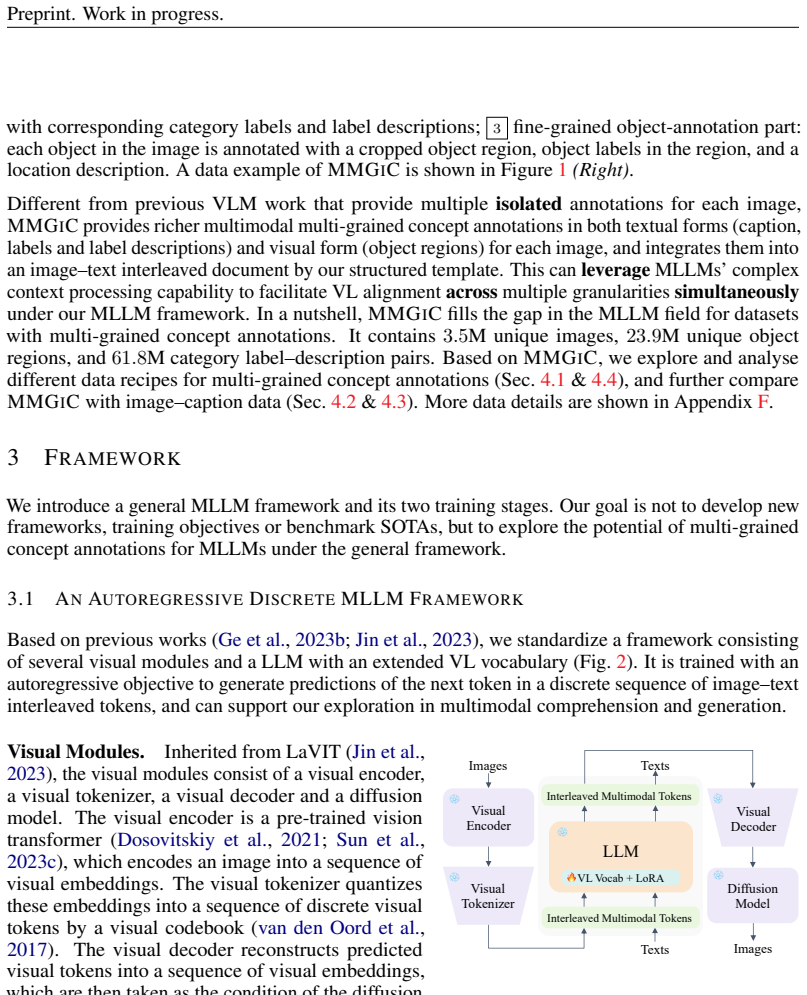
The load-bearing mechanism is the structured template that converts each image into an interleaved document containing the whole image, its caption, fine-grained labels with descriptions, and cropped object regions with location descriptions. This document is tokenized into a discrete sequence of visual and textual tokens and trained with an autoregressive next-token objective, with no extra loss functions or grounding components. The template is what lets coarse and fine annotations complement each other within one context, and it is also what lets the dataset drop into existing MLLM frameworks.
What would settle it
Retrain the same MLLM on a variant of MMGiC where each object-region crop is replaced by a random square crop of the same size and location statistics, keeping all text annotations identical; if the observed gains on POPE, SEED-Bench, and image generation persist, the benefit is not from region-level visual grounding.
Extended reading notes
Core claim
MMGiC provides multimodal multi-grained concept annotations — coarse image captions, fine-grained object/attribute/relationship labels with descriptions, and visual object-region crops — organized by a structured template into image–text interleaved documents. Under a standard autoregressive discrete MLLM trained only with next-token prediction, these annotations integrate and complement each other: label descriptions anchor labels to visual detail, and object regions ground text to specific image locations. The paper claims this improves both comprehension and generation, and that MMGiC and conventional caption data have complementary strengths in depth versus breadth of concept representation, so appropriately combining them improves performance further.
Load-bearing premise
The frozen visual tokenizer must preserve enough visual detail in the discrete tokens of small object-region crops for the model to learn from them; the paper itself notes that text-rich and chart images are poorly reconstructed, so if region detail is lost, gains attributed to object regions could instead come from label descriptions or other components.
Editorial extensions
If this is right
- Training MLLMs with MMGiC instead of captions alone improves zero-shot image captioning and text-to-image generation even with roughly an order of magnitude less data.
- Adding caption data (IC) to MMGiC further improves downstream comprehension, including gains of 3.95% on POPE and 2.34% on SEED-Bench over captions alone.
- Fine-grained labels without descriptions or regions can hurt; descriptions and object regions are needed to anchor those labels.
- Training order matters: caption data first, then MMGiC, outperforms joint training on several tasks, while joint training first and MMGiC last gives the best average performance.
- MMGiC also works as instruction fine-tuning data, improving an MLLM pre-trained on captions only across all evaluated benchmarks.
Reading between the lines
- Because the paper's gains concentrate on dimensions like instance identity, spatial relation, and instance interaction, a testable prediction is that models trained on MMGiC should show larger improvements on spatially demanding VQA than on holistic scene questions.
- The template mechanism suggests that automatically synthesizing multi-grained annotations for web-scale caption data could scale these gains, though the paper's own caution about annotation noise implies quality filtering will be critical.
- The frozen tokenizer's poor reconstruction of text-rich and chart images predicts that switching to a higher-fidelity visual tokenizer should extend MMGiC's benefits to OCR-heavy and table/chart benchmarks, which the current model underperforms on.
- The method is dataset-agnostic in principle, so one could construct MMGiC-style documents for other concept types, such as events or abstract attributes, and test whether the same integration effect appears.
Signed reviews
Editorial analysis
A structured set of objections, weighed in public.
Referee Report
Summary. This paper introduces MMGiC, a new multimodal dataset of 3.5M images with multi-grained concept annotations (captions, category labels, label descriptions, and object regions), built from four object detection datasets, and a general autoregressive discrete MLLM framework. It reports controlled data-recipe experiments (Table 1), a comparison and collaboration study with large-scale image-caption data (Table 2), supervised fine-tuning (SFT) evaluation on 12 comprehension and generation benchmarks (Tables 3-4), and a per-dimension analysis on SEED-Bench (Section 4.4). The paper claims that multi-grained annotations help MLLMs better locate and learn concepts, that MMGiC outperforms image-caption data even at much smaller scale, and that combining MMGiC with captions yields further gains, e.g., 3.95% and 2.34% absolute improvements on POPE and SEED-Bench over captions alone.
Significance. The dataset is a substantial new public resource, and the paper provides three controlled baselines that differ only in pre-training data, with a common SFT protocol and evaluation on a broad set of benchmarks. The authors are transparent about several limitations, especially the frozen visual tokenizer's poor reconstruction of text-rich and chart images (Appendix B.3) and the difficulty of fair cross-dataset comparison (Appendix C.1). If the core claims hold, the work would be a useful demonstration that multi-grained annotations can improve both comprehension and generation in MLLMs. However, the central mechanistic claim about object regions grounding concepts is not yet supported by the current ablations, and the evaluation protocol involves selection on the test benchmarks, so the headline numbers are optimistically biased. The paper's strengths are its scale, its controlled within-dataset recipe comparisons, and its honest discussion of known limitations.
major comments (4)
- [Section 4.1, Table 1 (rows 2 vs. 3)] The comparison that motivates the paper's flagship claim about object regions bundles several changes at once: adding R simultaneously introduces cropped-region visual tokens, location text (e.g., 'Bottom Right'), and region-specific object labels. The observed gains (e.g., +4.66 CIDEr on COCO, +3.4 on NoCaps) could therefore be driven by the additional textual annotations rather than by the model grounding concepts in the region images. Please add ablations over the row-2 recipe: (a) row-2 plus region text without the region image, and (b) row-2 plus the region image without the new region text. In addition, because Appendix B.3 documents that the frozen LaVIT tokenizer loses detail on text-rich and chart images, please quantify the tokenizer's fidelity on the actual cropped object regions used in training (e.g., reconstruction similarity or a region classification probe) so the grounding interpretation can be evaluated.
- [Appendix E.2 and Appendix E.1] The evaluation protocol selects the best of 'at least 8 task instruction templates' per benchmark, and the hyperparameter mask_prob is tuned on the same image captioning and generation benchmarks used in Tables 1 and 2 (swept from 0 to 1 in steps of 0.1, with 0.9 chosen). This constitutes selection on the test set, and no variance or seed information is reported. The headline improvements, including the 3.95% POPE and 2.34% SEED-Bench gains in Table 3, may partly reflect this selection rather than a robust effect of the dataset. Please report the mean and standard deviation (or range) over templates, fix mask_prob before evaluation using a held-out validation split, and provide results across at least 3 seeds, or explicitly justify why seed and template variation is negligible.
- [Section 3.3 and Table 3] The baseline MLLM-IC is not actually trained with image-caption data alone: the shared SFT recipe includes 1M MMGiC 'playback' samples for all three baselines. Therefore the abstract's claim that the combination achieves gains 'over image-caption data alone' is not supported by Table 3, because the image-caption baseline also received multi-grained MMGiC annotations during SFT. Please either fine-tune an IC-only variant without MMGiC playback, or restrict the 'image-caption data alone' phrasing to the pre-training comparison in Table 2 and describe Table 3 as comparing pre-training strategies under a shared mixed SFT protocol.
- [Section 4.2, Table 2 and Appendix C.1] The cross-dataset comparison between MMGiC and IC does not isolate annotation granularity, because the two data pools differ in image source and content: MMGiC is built from human-annotated object detection datasets, while IC is web-caption data. Appendix C.1 itself attributes part of MMGiC(C)'s advantage over IC-PART to the 'higher quality' of the images (more noun chunks per image). The phrase 'fair comparison' should therefore be qualified: the controlled evidence for the multi-grained hypothesis is the within-MMGiC recipe ablation in Table 1, whereas Table 2 varies data source and image complexity alongside annotation type.
minor comments (5)
- [Section 4.3 and Tables 3-4] The term 'zero-shot' is misleading after SFT; consider using 'direct transfer' or 'unseen benchmark' to describe evaluation on tasks not seen during SFT.
- [Throughout] The dataset name is written inconsistently as 'MMG IC', 'MMGiC', and 'MMGIC'; please standardize on one spelling. There are also typos such as 'th' in 'th "bagel"' (Section 4.1) and 'laying' where 'lying' is intended in Figure 3.
- [Appendix E.1] The loss-scale hyperparameter α=0.1 is introduced without any ablation or sensitivity analysis; since the paper already tunes mask_prob, α is another free parameter that should be fixed before evaluation or shown to be robust.
- [Table 2 caption] The notation 'MMGiC → IC' and 'IC → MMGiC' is used without definition in the caption; please define the arrow as sequential curriculum training in the table caption or in the main text near the table.
- [Section 4.4] The selection of 9 evaluation dimensions from SEED-Bench and the exclusion of 'Text Recognition' is reported only in a footnote; this is a substantive design choice that should be stated in the main text, along with its rationale.
Circularity Check
No circular derivation; the results are an empirical dataset study evaluated on external benchmarks, with only minor non-load-bearing self-citations.
full rationale
The paper's central claim is empirical rather than derivational: MMGiC is constructed from public object-detection annotations plus synthesized captions and GPT-4 label descriptions, and its value is assessed by pre-training MLLMs and measuring performance on held-out benchmarks (COCO, NoCaps, POPE, SEED-Bench, etc.). None of the reported predictions are defined in terms of the training annotations by construction; the benchmark scores are external to the dataset and the training objective. The data-recipe ablations in Table 1 are model-selection comparisons, not fitted parameters renamed as predictions. The comparison between MMGiC and image-caption data is a controlled training-data comparison, and the headline gains (e.g., 3.95% and 2.34% absolute improvements on POPE and SEED-Bench) come from evaluating fully trained models on benchmarks whose answers are not derived from the annotation template. Self-citations by the authors (e.g., Xu et al. 2023a,b, Qin et al. 2024a,b, Chen et al. 2024) appear in related work and future-directions discussion and are not load-bearing for the main claim. The acknowledged limitation in Appendix B.3 that the frozen LaVIT visual tokenizer poorly reconstructs text-rich and chart images is a fidelity concern that could weaken the mechanistic interpretation of the object-region gains, and the ablation adding object regions also adds location text and labels, so the region-visual contribution is somewhat confounded. However, these are experimental and interpretability weaknesses, not instances where the paper's conclusion is equivalent to its input by definition or by a self-citation chain. On the specified circularity scale, the appropriate finding is no significant circularity, with a low score reflecting only the presence of routine, non-load-bearing self-citations.
Assumptions & free parameters
free parameters (6)
- mask_prob =
0.9
- visual loss scale alpha =
0.1
- IC noun-phrase frequency threshold =
20 min, 50 cap
- region IoA merge threshold =
0.8
- region edge-size range =
28 to 182 pixels
- label frequency thresholds =
V3Det < 3, VG < 2; relations/attributes < 5
assumptions (4)
- domain assumption BLIP-2 synthesized captions and GPT-4 label descriptions are accurate enough to serve as training signal.
- domain assumption The frozen LaVIT visual tokenizer preserves sufficient object-level detail for the model to learn from cropped object regions.
- domain assumption The 12 chosen benchmarks are valid measures of multimodal comprehension and generation for common concrete concepts.
- domain assumption Autoregressive next-token prediction is an effective training objective for leveraging fine-grained annotations.
Cite this review
Pith. "Pith review of Exploring Multi-Grained Concept Annotations for Multimodal Large Language Models." pith.science (2026). https://pith.science/paper/HU5PAZE5
@misc{pith2026241205939,
  author       = {Pith},
  title        = {Pith review of: Exploring Multi-Grained Concept Annotations for Multimodal Large Language Models},
  year         = {2026},
  howpublished = {\url{https://pith.science/paper/HU5PAZE5}},
  note         = {Machine review of arXiv:2412.05939}
}
read the original abstract
Multimodal Large Language Models (MLLMs) excel in vision--language tasks by pre-training solely on coarse-grained concept annotations (e.g., image captions). We hypothesize that integrating fine-grained concept annotations (e.g., object labels and object regions) will further improve performance, as both data granularities complement each other in terms of breadth and depth in concept representation. We introduce a new dataset featuring Multimodal Multi-Grained Concept annotations (MMGiC) for MLLMs. In constructing MMGiC, we explore the impact of different data recipes on multimodal comprehension and generation. Our analyses reveal that multi-grained concept annotations integrate and complement each other, under our structured template and a general MLLM framework. We clearly explore and demonstrate the potential of MMGiC to help MLLMs better locate and learn concepts, aligning vision and language at multiple granularities. We further validate our hypothesis by investigating the fair comparison and effective collaboration between MMGiC and image--caption data on 12 multimodal comprehension and generation benchmarks, e.g., their appropriate combination achieve 3.95% and 2.34% absolute improvements over image--caption data alone on POPE and SEED-Bench. Code, data and models will be available at https://github.com/LooperXX/MMGiC.
Figures


Figures from the paper (9 more)


Forward citations
Cited by 1 Pith paper
-
Manager: Aggregating Insights from Unimodal Experts in Two-Tower VLMs and MLLMs
Manager aggregates multi-layer unimodal representations and improves both two-tower VLMs (ManagerTower) and MLLMs (LLaVA-OV-Manager) on 24 downstream tasks.
Reference graph
Works this paper leans on
-
[1]
For V3Det, we remove object labels with frequency less than 3
Clean labels: to remove the noise that may be introduced by long-tail distribution, we count the number of occurrences of each label in each dataset, and then select a threshold to remove low-frequency labels (typically noise). For V3Det, we remove object labels with frequency less than 3. For Open Images and Objects365, we don’t remove any label since ea...
-
[2]
Clean objects and object-related information: we remove objects that have illegal coordinates, exceed the image range or the corresponding label is already removed. For Open Images, we also remove the attribute and relationship annotations corresponding to these illegal objects
-
[3]
Clean images: since the de-facto visual encoder ( i.e., Vision Transformer, ViT) requires a square input image, we resize all images to a fixed resolution of 224 × 224 pixels. Following standard practices (Zeng et al., 2023), to improve the data quality, we first remove images with short edges less than 224 pixels or aspect ratios greater than 3.0 or less...
work page 2023
-
[4]
Clean images again: we remove all the images that don’t have any object annotation
-
[5]
Zhiliang Peng, Li Dong, Hangbo Bao, Qixiang Ye, and Furu Wei
URL https://arxiv.org/abs/2310.02992. Zhiliang Peng, Li Dong, Hangbo Bao, Qixiang Ye, and Furu Wei. Beit v2: Masked image modeling with vector-quantized visual tokenizers. ArXiv preprint, abs/2208.06366, 2022. URL https: //arxiv.org/abs/2208.06366. Zhiliang Peng, Wenhui Wang, Li Dong, Yaru Hao, Shaohan Huang, Shuming Ma, and Furu Wei. Kosmos-2: Grounding ...
arXiv 2022
-
[6]
URL https://arxiv.org/abs/2310.11441. Lewei Yao, Jianhua Han, Youpeng Wen, Xiaodan Liang, Dan Xu, Wei Zhang, Zhenguo Li, Chunjing Xu, and Hang Xu. Detclip: Dictionary-enriched visual-concept paralleled pre-training for open- world detection. In Sanmi Koyejo, S. Mohamed, A. Agarwal, Danielle Belgrave, K. Cho, and A. Oh (eds.), Advances in Neural Informatio...
-
[7]
URL https://openreview.net/forum?id=5KojubHBr8. Jinguo Zhu, Xiaohan Ding, Yixiao Ge, Yuying Ge, Sijie Zhao, Hengshuang Zhao, Xiaohua Wang, and Ying Shan. Vl-gpt: A generative pre-trained transformer for vision and language understanding and generation. ArXiv preprint, abs/2312.09251, 2023a. URL https://arxiv.org/abs/ 2312.09251. Wanrong Zhu, Jack Hessel, ...
arXiv 2023
-
[8]
Instance Location, Instance Interaction, Visual Reasoning
and curriculum learning (Soviany et al., 2022). Automatic annotation synthesis for large-scale image–caption data we discussed in Appendix B.1 is also a promising solution to scale up to more concepts and continuously improve MLLMs without suffering from the problem of data duplication. B.3 A MLLM F RAMEWORK FOR MULTIMODAL COMPREHENSION AND GENERATION In ...
work page 2023
Show all 62 references
-
[10]
batter” → “batter (ballplayer)
or in the four open-source datasets used in this paper, since the target labels are common concepts, LLM can generate label descriptions with good generality and rich visual information even without seeing the image. • Disambiguate Polysemous Labels. We also use WordNet to dis...
2022
-
[14]
Clean images: since all images need to be resized to 224 × 224 and input to the visual modules, we remove the images with the shorter side length less than 224, images with an aspect ratio greater than 3 or less than 0.33 to prevent the image from changing too much after resize
-
[15]
We also remove objects that have illegal coordinates or exceed the image range
Clean object annotations: we remove all objects that have more than one synset as we found that they are mostly noisy. We also remove objects that have illegal coordinates or exceed the image range
-
[16]
batter (baseball player)
Construct, clean object label, clean object annotations again: in Visual Genome, the same object label may have different semantics distinguished by the synsets they are mapped to. To mitigate the noise brought by long-tail distribution, firstly, we count the frequency of each...
-
[18]
Secondly, we count the frequency of each label and remove the relationship/attribute whose frequency is less than 5 or is empty
Clean relationship and attribute annotations: firstly, we remove all the relationships where the corresponding object is removed by step 2 and step 3. Secondly, we count the frequency of each label and remove the relationship/attribute whose frequency is less than 5 or is empt...
-
[19]
For unreasonable labels, we remove them and the corresponding object, attribute, relationship annotations
Remove unreasonable labels and annotations : for each label, we ask ChatGPT if it is an reasonable label in Section F.5. For unreasonable labels, we remove them and the corresponding object, attribute, relationship annotations
-
[20]
For images in Visual Genome with a flickr id but no coco id, we match them with images from flickr30k and discard the matched images
Dataset split: for images in Visual Genome with a coco id, we follow Karpathy’s split: images in ‘val’ and ‘restval’ are used as the validation set, and images in ‘test’ are discarded. For images in Visual Genome with a flickr id but no coco id, we match them with images from ...
2023
-
[21]
Generate 10 candidate captions for each image with BLIP-2 (Li et al., 2023b)
-
[22]
Rank candidate captions based on image–caption similarity scores calculated by CLIP (Radford et al., 2021)
2021
-
[23]
Filter too short (< 5 words) or too long ( > 25 words) captions or captions with low image– caption similarity scores (< 0.25)
-
[24]
If no caption is selected, we select the caption with the highest similarity score
Select the Top-1 caption as the final caption if exists, otherwise repeat the above steps for 10 times. If no caption is selected, we select the caption with the highest similarity score. F.5 L ABEL DESCRIPTION GENERATION Label descriptions are corresponding concept descriptio...
2022
-
[25]
Select a template: we randomly select the image-first or text-first template with a probability of 0.5
-
[26]
Then we remove the descriptions with a probability of 0.5 to prevent model overfitting which might be caused by description repetitions
Fill in the template with textual annotations: For image-annotation part, we first fill the corresponding text. Then we remove the descriptions with a probability of 0.5 to prevent model overfitting which might be caused by description repetitions. For each object-annotation, ...
-
[27]
Secondly, we replace the positions corresponding to [IMG] using the corresponding visual token sequence with [IMG] and [/IMG] inserted before and after it
Tokenize the data and fill the template with visual annotations: firstly, we tokenize the data using the tokenizer of with [IMG], [/IMG] added as special tokens. Secondly, we replace the positions corresponding to [IMG] using the corresponding visual token sequence with [IMG] ...
-
[28]
Detail caption instruction
Dealing with samples with token length more than 2048: for those samples with object regions, we remove one region a time and go back to step 2 until the token sequence length is less than 2048. For those samples without regions but with descriptions, we go back to step 2 but ...
2011
-
[37]
It resembles a large pig in shape, with a short, prehensile trunk, small eyes, and pointed ears
What are the key visual indicators that help identify the object category label in an image? Here are some examples: “‘ Object Category Label: malayan tapir Category Description: The Malayan tapir, a distinctive mammal found predominantly in Southeast Asia, is known for its un...
-
[46]
What are the key visual indicators that help identify the attribute category label in an image? Here are some examples: “‘ Attribute Category Label: smiling Related Object Category Labels: Man, Woman, Girl, Boy, Baby, Child, Animal, ... Attribute Category Description: Smiling ...
-
[47]
Universality:Focus on features common to most instances of the relationship category
-
[55]
Invalid
What are the key visual indicators that help identify the relationship category in an image? Here are some examples: “‘ Relationship Category Label: on Related Subject-Object Pairs: [Bell pepper, Countertop], [Woman, Bicycle], [Tomato, Cutting board], ... Relationship Category...
-
[56]
Universality: Focus on features common to most instances of the object category
-
[57]
bank" can be
Multiple Semantics: Select the meaning of the most relevant and likely object category label in an image. For instance, as an object category label, "bank" can be "a financial institution" or "a landform alongside a river", and the former is more likely to be the meaning in an image
-
[58]
Distinctive Features: Emphasize unique aspects differentiating the object from other similar objects
-
[59]
Relevant Knowledge: Incorporate important concepts, historical, or cultural information that enrich the understanding of the object but avoid excessive details
-
[60]
You can optionally focus on the following aspects when generating category descriptions:
-
[61]
What are useful features for distinguishing the object of the given category label in an image?
-
[62]
What does the object of the given category label in an image look like?
-
[63]
What are the identifying characteristics of the object with the given category label in an image?
-
[64]
It resembles a large pig in shape, with a short, prehensile trunk, small eyes, and pointed ears
What are the key visual indicators that help identify the object category label in an image? Here are some examples: “‘ Object Category Label: malayan tapir Category Description: The Malayan tapir, a distinctive mammal found predominantly in Southeast Asia, is known for its un...
-
[65]
You should disregard such noisy related object category labels
The given related object category labels may be invalid or not be associated with the given attribute category label. You should disregard such noisy related object category labels
-
[66]
Invalid
The given attribute category label may be invalid. You should generate "Invalid." as its description and then explain why it is invalid after "Invalid.". Here are some useful tips for generating attribute category descriptions when the given attribute category label is valid:
-
[67]
Universality: Focus on features common to most instances of the attribute category
-
[68]
awake" is an adjective meaning
Multiple Semantics: Select the meaning of the most relevant and likely attribute category label in an image. For instance, as an attribute category label, "awake" is an adjective meaning "not asleep" rather than a verb meaning "to stop sleeping or wake up from sleep"
-
[69]
Distinctive Features: Emphasize unique aspects differentiating the attribute from other similar attributes
-
[70]
This could include color, texture, size, sense, function, or any other aspect that is significant for the attribute
Appearance, Sensory and Effect: Describe how the attribute typically appears or is perceived on the objects. This could include color, texture, size, sense, function, or any other aspect that is significant for the attribute
-
[72]
How is the attribute category label usually observed or sensed?
-
[73]
What impact does this attribute have on the object, its perception or function?
-
[74]
What are the identifying characteristics of the given category label of an object in an image?
-
[75]
What are the key visual indicators that help identify the attribute category label in an image? Here are some examples: {examples} ...... User Prompt # Attribute Category Description Generation Please directly generate an informative, concise, accurate and clear description fo...
-
[76]
You should disregard such noisy related subject-object pairs
The given related subject-object pairs may be invalid or not be associated with the given relationship category label. You should disregard such noisy related subject-object pairs
-
[77]
Invalid
The given relationship category label may be invalid. You should generate "Invalid." as its description and then explain why it is invalid after "Invalid.". Here are some useful tips for generating attribute category descriptions when the given relationship category label is valid:
-
[78]
Universality: Focus on features common to most instances of the relationship category
-
[79]
truck" is a verb meaning
Multiple Semantics: Select the meaning of the most relevant and likely relationship category label in an image. For instance, as a relationship category label, "truck" is a verb meaning "convey by truck" rather than a noun meaning "a large, heavy road vehicle used for carrying...
-
[80]
Distinctive Features: Emphasize unique aspects differentiating the relationship from other similar relationships
-
[81]
Nature of Relationship: Describe the nature of the relationship (e.g., spatial, action, functional, hierarchical, temporal, social) and how the subject and object interact or relate to each other
-
[82]
You can optionally focus on the following aspects when generating attribute category descriptions:
-
[83]
How is the relationship expressed or manifested in the image?
-
[84]
What are the key characteristics or significance of the relationship?
-
[85]
What are common or typical scenarios in which this relationship is observed?
-
[86]
What are the key visual indicators that help identify the relationship category in an image? Here are some examples: {examples} ...... User Prompt # Relationship Category Description Generation Please directly generate an informative, concise, accurate and clear description fo...
-
[2020]
batter” → “batter (ballplayer)
to replace visual token embeddings |V| ×4096 with two smaller embedding matrices |V| ×32, 32 × 4096, where |V| is the number of visual tokens in the VL vocabulary. The former matrix is directly initialized with visual latent codes in the visual codebook. In our preliminary exp...
2023
-
[2021]
Jonathan Ho, Ajay Jain, and Pieter Abbeel
URL https://openreview.net/forum?id=d7KBjmI3GmQ. Jonathan Ho, Ajay Jain, and Pieter Abbeel. Denoising diffusion probabilistic models. In Hugo Larochelle, Marc’Aurelio Ranzato, Raia Hadsell, Maria-Florina Balcan, and Hsuan- Tien Lin (eds.), Advances in Neural Information Proces...
2020 arXiv
-
[2023]
URL https://openreview.net/pdf?id=E01k9048soZ
OpenReview.net, 2023. URL https://openreview.net/pdf?id=E01k9048soZ. Jiasen Lu, Christopher Clark, Sangho Lee, Zichen Zhang, Savya Khosla, Ryan Marten, Derek Hoiem, and Aniruddha Kembhavi. Unified-io 2: Scaling autoregressive multimodal models with vision language audio and ac...
2023 arXiv
-
[2024]
doi: 10.18653/v1/2024.acl-long.446
Association for Computational Linguistics. doi: 10.18653/v1/2024.acl-long.446. URL https://aclanthology.org/2024.acl-long.446. Ting Chen, Saurabh Saxena, Lala Li, David J. Fleet, and Geoffrey E. Hinton. Pix2seq: A language modeling framework for object detection. In The Tenth ...
2024 arXiv
-
[6709]
doi: 10.1109/CVPR.2019.00686
Computer Vision Foundation / IEEE, 2019. doi: 10.1109/CVPR.2019.00686. URL http://openaccess.thecvf.com/content_CVPR_2019/html/Hudson_GQA_ A_New_Dataset_for_Real-World_Visual_Reasoning_and_Compositional_ CVPR_2019_paper.html. Yang Jin, Kun Xu, Liwei Chen, Chao Liao, Jianchao T...
2019
Reviewed August 11, 2026 · model on record in the stance chip above.
Discussion (0). Continue with ORCID to comment.