REVIEW 5 major objections 7 minor 66 references
Generating floorplans for various building functionalities via latent diffusion model
T0 review · 5 major / 7 minor · reviewed 2026-08-11 · deepseek-v4-flash
Pith's one-line read A single latent diffusion model can generate floorplans for many building types from a footprint mask and a text brief, without being given the scale.
desk verdict A useful multi-type floorplan dataset and a plausible LDM+ControlNet baseline, but the evaluation never tests the conditional claim it leads with. read the letter →
The pith
A machine-rendered reading of the paper's core claim, the machinery that carries it, and where it could break.
The reading
What carries the argument
The machinery is a two-stage latent diffusion architecture. The first stage is a text-conditioned latent diffusion model with cross-attention over tokenized text, pretrained on a large general image–text corpus. The second stage freezes that model, clones it, and connects the clone through zero-initialized convolution layers—a ControlNet-style adapter—so that the footprint mask is injected as a second conditioning signal. The training objective is the standard denoising loss $L = \mathbb{E}_{z_0, t, y_1, y_2, \epsilon}\left[\lVert \epsilon - \epsilon_\theta(z_t, t, y_1, y_2)\rVert_2^2\right]$, where $y_1$ is the text prompt and $y_2$ is the footprint image; the zero convolutions let the adapter be added without disrupting the pretrained text-conditioned model.
What would settle it
Compute the overlap between the generated floorplan and the input footprint mask (for instance, the intersection-over-union of the building outline), or check that changing the text prompt with a fixed footprint produces substantially different room layouts; if the mask overlap is no better than an unconditioned baseline, or the layout barely changes with the prompt, the central claim of condition-following generation would fail.
Extended reading notes
Core claim
The central claim is that a conditional latent diffusion model can learn the mapping from a building footprint mask plus a text design brief to a floorplan, and that it does so in a scale-agnostic way—without the scale being provided explicitly. The authors support this with generated examples across several building functionalities and with quantitative metrics: their model achieves the lowest FID (22.436), the lowest KID (1.844), the highest SSIM (0.130), and the highest PSNR (7.596) when compared with two baseline text-to-image models. They also present a human evaluation in which architects gave generated floorplans an average score of 5.36 out of 10 versus 6.89 for real floorplans, a difference that is statistically significant (p = 0.001).
Load-bearing premise
The model actually obeys the input footprint and text prompt rather than ignoring them and generating a generic floorplan; the paper shows only visual examples and gives no quantitative measure of conditioning adherence.
Editorial extensions
If this is right
- A single model can serve multiple building typologies, unlike earlier floorplan generators that focus almost exclusively on residential layouts.
- Designers can explore alternative programs on the same footprint by changing only the text prompt, without recomputing scale or dimensions.
- Non-experts could generate plausible floorplan starting points quickly, potentially accelerating early-stage architectural ideation.
- The model's reported ability to fuse design elements across building types suggests it can produce configurations that are not simple copies of training examples.
Reading between the lines
- The claimed generality rests on a dataset of only 500 triples, so conditioning fidelity is unverified quantitatively; a dedicated test of whether the output respects the input mask and prompt would be needed.
- Image-level metrics such as FID and SSIM do not measure whether the text and footprint are actually followed; a prompt-consistency or footprint-overlap metric would be more informative.
- The human evaluation, while suggestive, uses a small sample of 30 images and 10 architects, so a larger blind study would be needed to confirm that generated floorplans are close to real ones in functional quality.
- The latent-space visualization suggests the model learns functional proximity between building types, but this is qualitative; a quantitative clustering evaluation could strengthen the claim.
Editorial analysis
A structured set of objections, weighed in public.
Referee Report
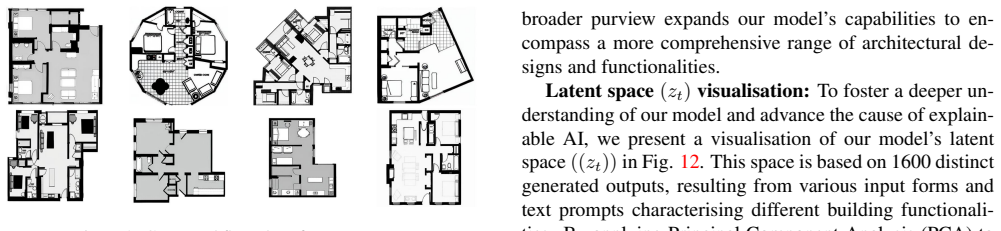
Summary. The paper proposes a latent diffusion model for generating architectural floorplans conditioned on two inputs: a building footprint mask (image) and a textual design brief. The method follows the ControlNet recipe: a frozen text-to-image LDM is augmented with a trainable copy controlled by the footprint mask, and the two-stage objective is the standard denoising loss with conditions y1 (text) and y2 (footprint). The authors introduce a new dataset of 500 (mask, prompt, floorplan) triplets, report FID/KID/SSIM/PSNR comparisons against LDM and DALL-E 2, present a blinded human rating game with architects, visualize denoising behavior and latent space structure, and claim a scale-agnostic capability across building types such as stadiums, offices, apartments, libraries, and auditoriums.
Significance. If the conditional-generation claim is solid, the work would be a useful step toward practical AI-assisted architectural design: it addresses a real gap (most floorplan generators are residential-only and require expert zoning inputs), contributes a novel multimodal dataset, and proposes a gamified human-evaluation protocol that is more appropriate for design quality than generic image metrics. The blinded human game is a genuine strength, as is the use of an external frozen foundation model. However, the current evidence does not establish that the model actually respects the footprint or the text prompt, and several quantitative claims are internally inconsistent. The significance will depend on whether the authors can supply conditional-fidelity measurements and correct the evaluation framing.
major comments (5)
- [Section 4, Table 1] The reported quantitative metrics are both internally implausible and not diagnostic of conditioning. SSIM=0.130 (on a scale where 1.0 is identical) and PSNR=7.596 dB are far below values normally described as 'excellent image quality' (typically SSIM>0.9 and PSNR>30 for reconstruction tasks); the text in 'Model Performance' should be corrected. More importantly, FID, KID, SSIM, and PSNR compare marginal image distributions between generated and real floorplans; they can be excellent even if the model ignores y1 and y2 and simply samples plausible generic floorplans. The paper needs conditional fidelity metrics, for example overlap between the generated layout and the input footprint mask, consistency of room labels with the requested program, or a correlation measure between varied prompts and outputs while holding the footprint fixed.
- [Section 4, Table 2 and Figure 5] The human evaluation results contradict the text's characterization. Real floorplans scored 6.89 vs. generated 5.36 with p=0.001 and t=3.917; this is a statistically significant gap, not 'slightly notable differences' or 'closeness of the scores' as stated in 'Model Performance' and the caption of Figure 5. Furthermore, the game asked architects to rate 'composition and architectural integrity' only, so it does not test whether the generated image follows the given footprint or design brief. A conditional adherence task (e.g., 'does the layout fit the provided outline?' or 'does it include the requested room types?') is needed to support the central p(x|y1,y2) claim.
- [Section 4, 'Model Performance' and Section 6.1] Training on only 500 author-created triplets with batch size 1 raises a real risk that the frozen LDM dominates and the ControlNet adapter learns a trivial or partially ignored mapping from y2. The paper shows training/validation losses in Figure 4, but no split details and no condition-dropout or input-randomization ablations are reported. A concrete test would be to shuffle the footprint masks (or prompts) against the training pairs and measure whether generated outputs change accordingly; alternatively, report metrics such as mask-conditioned FID or per-prompt layout similarity to demonstrate that the conditions are load-bearing.
- [Section 4, 'Scale-agnostic approach' and Figure 6] The scale-agnostic claim is only supported by qualitative figures. The text states the model 'seamlessly adapt to diverse scales' and 'relies on a ratio-based driven approach,' but no operational definition of scale-agnosticism or quantitative test is given. I suggest fixing the footprint while varying the intended building type (or vice versa), then measuring properties such as internal room proportions, corridor widths, or the footprint-occupancy ratio to show that the model adapts its output to the input conditions rather than producing a generic layout.
- [Section 4, 'Comparing the results to baselines' and Table 1] The baseline comparison is not sufficient to support the paper's superiority claims. LDM and DALL-E 2 are text-to-image models that do not receive the footprint condition y2, so Table 1 conflates conditioning ability with generic image quality; a model that outputs plausible images without respecting the footprint could still win on FID. To isolate the contribution of the ControlNet stage, the authors should compare against conditional baselines (e.g., pix2pix-style footprint-to-floorplan translation, ControlNet without text conditioning, or graph-based floorplan generators) under the same evaluation protocol.
minor comments (7)
- [Section 1] The list of contributions numbers two items as '3)'; renumber the contributions.
- [Section 4, 'Datasets'] There is a typo 'residdential'; should be 'residential'.
- [Section 4, 'Model Performance'] The text references 'Figure 15' for human evaluation results, but the figure appearing in the main text is Figure 5; the supplementary material also contains a Figure 15, creating confusion. Please renumber or disambiguate.
- [Section 4, 'Model Performance'] The FloorplanGame link is missing a URL; provide an accessible link or a detailed description of the game interface in the supplementary material.
- [Section 6.1] There is a discrepancy in training epochs: the main text says '549 training cycles (epochs)' while the supplementary says '429 epochs'. Please reconcile.
- [Section 6.1] Minor typos: 'monitoried' should be 'monitored', 'transfrom' should be 'transform', and 'createdd' should be 'created'.
- [Section 3.1, Eq. (4)] The notation F(x; Θ) is ambiguous: x is described as the input image, but in Eq. (4) x also appears as the argument inside Z(y2; Θz1). Clarify the role of x (the original image versus the latent) in the residual connection.
Circularity Check
No significant circularity: the conditioning model is trained on an external base model plus a new dataset, and no claimed prediction reduces to a fitted input or to a self-citation chain.
full rationale
The paper's derivation chain is empirical rather than analytic. The model is defined by a standard two-stage latent diffusion/ControlNet construction: Eq. (5) optimizes text-conditioned denoising on LAION-pretrained weights [44], and Eq. (6) adds the footprint condition y2 through a frozen cloned U-Net with zero convolutions, Eq. (4), following the external ControlNet formulation [62]. The only fitted quantities are network weights trained on the authors' 500-pair dataset; the evaluation (Table 1, Table 2, Fig. 14) compares generated images against external baselines and against real floorplans rated by blinded architects. No equation defines one reported quantity in terms of another reported quantity, no parameter fitted to a subset is later renamed as a prediction of that same subset, and no load-bearing premise is justified solely by a citation to the present authors. The manuscript itself notes that producing multiple samples for identical inputs makes quantitative evaluation challenging (Sec. 4, Evaluation Metrics), and the paper indeed provides no quantitative check that outputs respect y2 or y1; that is a missing-support/correctness concern, not a circularity. The latent-space PCA (Fig. 12) and scale-agnostic discussion are descriptive claims about trained representations, not derivations that assume their conclusions. No self-citations by Ibrahim/Musil/Gallou appear anywhere in the reference list, so the self-citation patterns enumerated in the rubric are absent. Accordingly the circularity score is 0.
Assumptions & free parameters
assumptions (4)
- domain assumption The latent diffusion objective (Equations 5 and 6) is an effective surrogate for generating plausible images.
- domain assumption OpenCLIP text embeddings preserve the intended design brief semantics.
- domain assumption The 500 manually labeled internet floorplans accurately pair footprint masks, textual briefs, and final designs.
- domain assumption Blind scores from 10 architects on a 1-10 scale measure architectural quality of floorplans.
Cite this review
Pith. "Pith review of Generating floorplans for various building functionalities via latent diffusion model." pith.science (2026). https://pith.science/paper/ZGUFMFMS
@misc{pith2026241206859,
  author       = {Pith},
  title        = {Pith review of: Generating floorplans for various building functionalities via latent diffusion model},
  year         = {2026},
  howpublished = {\url{https://pith.science/paper/ZGUFMFMS}},
  note         = {Machine review of arXiv:2412.06859}
}
read the original abstract
In the domain of architectural design, the foundational essence of creativity and human intelligence lies in the mastery of solving floorplans, a skill demanding distinctive expertise and years of experience. Traditionally, the architectural design process of creating floorplans often requires substantial manual labour and architectural expertise. Even when relying on parametric design approaches, the process is limited based on the designer's ability to build a complex set of parameters to iteratively explore design alternatives. As a result, these approaches hinder creativity and limit discovery of an optimal solution. Here, we present a generative latent diffusion model that learns to generate floorplans for various building types based on building footprints and design briefs. The introduced model learns from the complexity of the inter-connections between diverse building types and the mutations of architectural designs. By harnessing the power of latent diffusion models, this research surpasses conventional limitations in the design process. The model's ability to learn from diverse building types means that it cannot only replicate existing designs but also produce entirely new configurations that fuse design elements in unexpected ways. This innovation introduces a new dimension of creativity into architectural design, allowing architects, urban planners and even individuals without specialised expertise to explore uncharted territories of form and function with speed and cost-effectiveness.
Figures


Figures from the paper (14 more)




Reference graph
Works this paper leans on
-
[44]
High-resolution image syn- thesis with latent diffusion models, 2022
Robin Rombach, Andreas Blattmann, Dominik Lorenz, Patrick Esser, and Bj¨orn Ommer. High-resolution image syn- thesis with latent diffusion models, 2022. 2, 4, 5, 8, 12
work page 2022
-
[62]
Adding conditional control to text-to-image diffusion models, 2023
Lvmin Zhang and Maneesh Agrawala. Adding conditional control to text-to-image diffusion models, 2023. 2, 4, 12
work page 2023
- [1]
-
[2]
Fan Bao, Dong-Ming Yan, Niloy J. Mitra, and Peter Wonka. Generating and exploring good building layouts. ACM Transactions on Graphics, 32(4):1–10, 2013. 3
work page 2013
-
[3]
A study on the evaluation of generative models, 2022
Eyal Betzalel, Coby Penso, Aviv Navon, and Ethan Fetaya. A study on the evaluation of generative models, 2022. 4
work page 2022
-
[4]
Sutherland, Michael Arbel, and Arthur Gretton
Mikołaj Bi ´nkowski, Danica J. Sutherland, Michael Arbel, and Arthur Gretton. Demystifying mmd gans, 2021. 4
work page 2021
- [5]
-
[6]
Photographic image syn- thesis with cascaded refinement networks
Qifeng Chen and Vladlen Koltun. Photographic image syn- thesis with cascaded refinement networks. In 2017 IEEE In- ternational Conference on Computer Vision (ICCV) , pages 1520–1529. IEEE, 2017. 2
work page 2017
Show all 66 references
-
[7]
Del R ´ıo-Cidoncha, J.E
M.G. Del R ´ıo-Cidoncha, J.E. Iglesias, and J. Mart ´ınez- Palacios. A comparison of floorplan design strategies in ar- chitecture and engineering, 2007. 3
2007
-
[8]
Diffusion models beat GANs on image synthesis, 2021
Prafulla Dhariwal and Alex Nichol. Diffusion models beat GANs on image synthesis, 2021. 2, 5
2021
-
[9]
Fardo, Victor H
Fernando A. Fardo, Victor H. Conforto, Francisco C. de Oliveira, and Paulo S. Rodrigues. A formal evaluation of psnr as quality measurement parameter for image segmenta- tion algorithms, 2016. 4
2016
-
[10]
Automatic 2d floorplan CAD generation from 3d point clouds, 2020
Uuganbayar Gankhuyag and Ji-Hyeong Han. Automatic 2d floorplan CAD generation from 3d point clouds, 2020. 3
2020
-
[11]
Goodfellow, Jean Pouget-Abadie, Mehdi Mirza, Bing Xu, David Warde-Farley, Sherjil Ozair, Aaron Courville, and Yoshua Bengio
Ian J. Goodfellow, Jean Pouget-Abadie, Mehdi Mirza, Bing Xu, David Warde-Farley, Sherjil Ozair, Aaron Courville, and Yoshua Bengio. Generative adversarial networks. In Neural Information Processing Systems conference, 2014. 2
2014
-
[12]
Non-linear architectural design process
Yasha Jacob Grobman, Abraham Yezioro, and Isaac Guedi Capeluto. Non-linear architectural design process. Inter- national Journal of Architectural Computing , 8(1):41–53,
-
[13]
The architectural design process
Gilbert Herbert. The architectural design process. British Journal of Aesthetics, 6(2), 1966. 1
1966
-
[14]
Thinking parametric de- sign: introducing parametric gaudi
Carlos Roberto Barrios Hernandez. Thinking parametric de- sign: introducing parametric gaudi. Design Studies, 27(3): 309–324, 2006. 2
2006
-
[15]
Stacked generative adversarial networks
Xun Huang, Yixuan Li, Omid Poursaeed, John Hopcroft, and Serge Belongie. Stacked generative adversarial networks. In 2017 IEEE Conference on Computer Vision and Pattern Recognition (CVPR), pages 1866–1875. IEEE, 2017. 2
2017
-
[16]
Concept of creativity and innovation in architec- tural design process
Danfulani Babangida Idi and Khairul Anwar Bin Mohamed Khaidzir. Concept of creativity and innovation in architec- tural design process. International Journal of Innovation, Management and Technology, 6(1):16, 2015. 1
2015
-
[17]
Iterative design of seamless collaboration media
Hiroshi Ishii, Minoru Kobayashi, and Kazuho Arita. Iterative design of seamless collaboration media. Communications of the ACM, 37(8):83–97, 1994. 2
1994
-
[18]
Phillip Isola, Jun-Yan Zhu, Tinghui Zhou, and Alexei A. Efros. Image-to-image translation with conditional adver- sarial networks, 2016. Reporter: arXiv:1611.07004 [cs]. 2
2016 arXiv
-
[19]
Parametric design for architecture
Wassim Jabi. Parametric design for architecture. Hachette UK, 2013. 2
2013
-
[20]
Feifeng Jiang, Jun Ma, Christopher John Webster, Xiao Li, and Vincent J.L. Gan. Building layout generation using site- embedded GAN model, 2023. 3
2023
-
[21]
Instructional design as design prob- lem solving: An iterative process
David H Jonassen. Instructional design as design prob- lem solving: An iterative process. Educational Technology, pages 21–26, 2008. 2
2008
-
[22]
Mapping and visualizing deep- learning urban beautification
Tobias Kauer, Sagar Joglekar, Miriam Redi, Luca Maria Aiello, and Daniele Quercia. Mapping and visualizing deep- learning urban beautification. IEEE Computer Graphics and Applications, 38(5):70–83, 2018. Number: 5. 2
2018
-
[23]
Kingma and Jimmy Ba
Diederik P. Kingma and Jimmy Ba. Adam: A method for stochastic optimization. International Conference on Learn- ing Representations (ICLR), 2015. 12
2015
-
[24]
Transient attributes for high-level under- standing and editing of outdoor scenes, 2014
Pierre-Yves Laffont, Zhile Ren, Xiaofeng Tao, Chao Qian, and James Hays. Transient attributes for high-level under- standing and editing of outdoor scenes, 2014. Number: 4. 2
2014
-
[25]
Automatic generation of AI-powered architectural floor plans using grid data, 2023
Hun Lim. Automatic generation of AI-powered architectural floor plans using grid data, 2023. 3
2023
-
[26]
Interactive 3d modeling with a generative adversarial network, 2017
Jerry Liu, Fisher Yu, and Thomas Funkhouser. Interactive 3d modeling with a generative adversarial network, 2017. Re- porter: arXiv:1706.05170 [cs]. 2
2017 arXiv
-
[27]
Unsupervised image-to-image translation networks, 2018
Ming-Yu Liu, Thomas Breuel, and Jan Kautz. Unsupervised image-to-image translation networks, 2018. 2
2018
-
[28]
Design guidelines for prompt engineering text-to-image generative models
Vivian Liu and Lydia B Chilton. Design guidelines for prompt engineering text-to-image generative models. InPro- ceedings of the 2022 CHI Conference on Human Factors in Computing Systems, pages 1–23, 2022. 12
2022
-
[29]
FloorplanGAN: Vector resi- dential floorplan adversarial generation, 2022
Ziniu Luo and Weixin Huang. FloorplanGAN: Vector resi- dential floorplan adversarial generation, 2022. 2, 3
2022
-
[30]
Automatic real- time generation of floor plans based on squarified treemaps algorithm
Fernando Marson and Soraia Raupp Musse. Automatic real- time generation of floor plans based on squarified treemaps algorithm. International Journal of Computer Games Tech- nology, 2010:1–10, 2010. 3
2010
-
[31]
A theory of ar- chitectural design
Randall H McGuire and Michael B Schiffer. A theory of ar- chitectural design. Journal of anthropological archaeology, 2(3):277–303, 1983. 1
1983
-
[32]
Computer- generated residential building layouts
Paul Merrell, Eric Schkufza, and Vladlen Koltun. Computer- generated residential building layouts. In ACM SIGGRAPH Asia 2010 papers on - SIGGRAPH ASIA ’10 , page 1. ACM Press, 2010. 3
2010
-
[33]
Parametric design: a review and some ex- periences
Javier Monedero. Parametric design: a review and some ex- periences. Automation in construction, 9(4):369–377, 2000. 2
2000
-
[34]
House-GAN: Relational gen- erative adversarial networks for graph-constrained house lay- out generation
Nelson Nauata, Kai-Hung Chang, Chin-Yi Cheng, Greg Mori, and Yasutaka Furukawa. House-GAN: Relational gen- erative adversarial networks for graph-constrained house lay- out generation. In Computer Vision – ECCV 2020 , pages 162–177. Springer International Publishing, 2020. Ser...
2020
-
[35]
House-GAN++: Generative adversarial layout refinement networks
Nelson Nauata, Hang Chu, Sepidehsadat Hosseini, Kai- Hung Chang, Chin-Yi Cheng, and Yasutaka Furukawa. House-GAN++: Generative adversarial layout refinement networks. 2021 IEEE/CVF Conference on Computer Vision and Pattern Recognition (CVPR), 2021. 3 9
2021
-
[36]
GLIDE: Towards photorealistic image gener- ation and editing with text-guided diffusion models
Alex Nichol, Prafulla Dhariwal, Aditya Ramesh, Pranav Shyam, Pamela Mishkin, Bob McGrew, Ilya Sutskever, and Mark Chen. GLIDE: Towards photorealistic image gener- ation and editing with text-guided diffusion models. Pro- ceedings of the 39th International Conference on Machine...
2022
-
[37]
Dall·e 2: Ai art generation
OpenAI. Dall·e 2: Ai art generation. https://openai. com/dall-e-2/, 2023. 5
2023
-
[38]
Fractal architecture: the philosophical implications of an iterative design process
Michael J Ostwald. Fractal architecture: the philosophical implications of an iterative design process. Communication and Cognition, 36:263–296, 2003. 2
2003
-
[39]
Thinking difference: Theories and models of parametric design thinking
Rivka Oxman. Thinking difference: Theories and models of parametric design thinking. Design studies, 52:4–39, 2017. 2
2017
-
[40]
Generative layout modeling using con- straint graphs
Wamiq Para, Paul Guerrero, Tom Kelly, Leonidas Guibas, and Peter Wonka. Generative layout modeling using con- straint graphs. In 2021 IEEE/CVF International Conference on Computer Vision (ICCV), pages 6670–6680. IEEE, 2021. 3
2021
-
[41]
Semantic image synthesis with spatially-adaptive nor- malization
Taesung Park, Ming-Yu Liu, Ting-Chun Wang, and Jun-Yan Zhu. Semantic image synthesis with spatially-adaptive nor- malization. arXiv:1903.07291 [cs], 2019. 2
1903 arXiv
-
[42]
Automated approach for design generation and ther- mal assessment of alternative floor plans
Eug ´enio Rodrigues, Ad ´elio Rodrigues Gaspar, and ´Alvaro Gomes. Automated approach for design generation and ther- mal assessment of alternative floor plans. Energy and Build- ings, 81:170–181, 2014. 3
2014
-
[43]
An approach to computer-aided parametric design
Dieter Roller. An approach to computer-aided parametric design. Computer-Aided Design, 23(5):385–391, 1991. 2
1991
-
[45]
Using bim to facilitate iterative design
MH Sakikhales and Spyridon Stravoravdis. Using bim to facilitate iterative design. Building Information Modelling (BIM) in Design, Construction and Operations, WIT Trans- actions on The Built Environment, 149:9–20, 2015. 2
2015
-
[46]
Laion-400m: Open dataset of clip-filtered 400 million image-text pairs,
Christoph Schuhmann, Richard Vencu, Romain Beaumont, Robert Kaczmarczyk, Clayton Mullis, Aarush Katta, Theo Coombes, Jenia Jitsev, and Aran Komatsuzaki. Laion-400m: Open dataset of clip-filtered 400 million image-text pairs,
-
[47]
LAION-5b: An open large-scale dataset for train- ing next generation image-text models
Christoph Schuhmann, Romain Beaumont, Richard Vencu, Cade W Gordon, Ross Wightman, Mehdi Cherti, Theo Coombes, Aarush Katta, Clayton Mullis, Mitchell Worts- man, Patrick Schramowski, Srivatsa R Kundurthy, Katherine Crowson, Ludwig Schmidt, Robert Kaczmarczyk, and Jenia Jitsev....
2022
-
[48]
Iterative geo- metric design for architecture
Ivo Stotz, Gilles Gouaty, and Yves Weinand. Iterative geo- metric design for architecture. Journal of the International Association for Shell and Spatial Structures , 50(1):11–20,
-
[49]
FLNet: Graph constrained floor layout generation
Abhinav Upadhyay, Alpana Dubey, Veenu Arora, Suma Mani Kuriakose, and Shaurya Agarawal. FLNet: Graph constrained floor layout generation. In 2022 IEEE In- ternational Conference on Multimedia and Expo Workshops (ICMEW), pages 1–6. IEEE, 2022. 3
2022
-
[50]
FloorGAN: Generative network for automated floor layout generation
Abhinav Upadhyay, Alpana Dubey, Suma Mani Kuriakose, and Shaurya Agarawal. FloorGAN: Generative network for automated floor layout generation. In Proceedings of the 6th Joint International Conference on Data Science & Manage- ment of Data (10th ACM IKDD CODS and 28th COMAD) , ...
2023
-
[51]
Automated generation of dimensioned rect- angular floorplans
Nitant Upasani, Krishnendra Shekhawat, and Garv Sachdeva. Automated generation of dimensioned rect- angular floorplans. Automation in Construction , 113: 103149, 2020. 3
2020
-
[52]
Review of large vision models and vi- sual prompt engineering
Jiaqi Wang, Zhengliang Liu, Lin Zhao, Zihao Wu, Chong Ma, Sigang Yu, Haixing Dai, Qiushi Yang, Yiheng Liu, Songyao Zhang, et al. Review of large vision models and vi- sual prompt engineering. arXiv preprint arXiv:2307.00855,
-
[53]
High-resolution image syn- thesis and semantic manipulation with conditional GANs,
Ting-Chun Wang, Ming-Yu Liu, Jun-Yan Zhu, Andrew Tao, Jan Kautz, and Bryan Catanzaro. High-resolution image syn- thesis and semantic manipulation with conditional GANs,
-
[54]
Generating layout designs from high-level specifications
Xiao-Yu Wang and Kang Zhang. Generating layout designs from high-level specifications. Automation in Construction, 119:103288, 2020. 3
2020
-
[55]
Image quality assessment: from error visibility to structural similarity
Zhou Wang, Alan C Bovik, Hamid R Sheikh, and Eero P Si- moncelli. Image quality assessment: from error visibility to structural similarity. IEEE transactions on image processing, 13(4):600–612, 2004. 4
2004
-
[56]
Zhengwei Wang, Qi She, and Tomas E. Ward. Generative adversarial networks in computer vision: A survey and tax- onomy, 2020. 2, 4
2020
-
[57]
Automated floorplan generation in architectural design: A review of methods and applications
Ramon Elias Weber, Caitlin Mueller, and Christoph Rein- hart. Automated floorplan generation in architectural design: A review of methods and applications. Automation in Con- struction, 140:104385, 2022. 3
2022
-
[58]
Your” what” is my” how”: Iteration and hierarchy in system design
Michael W Whalen, Andrew Gacek, Darren Cofer, Anitha Murugesan, Mats PE Heimdahl, and Sanjai Rayadurgam. Your” what” is my” how”: Iteration and hierarchy in system design. IEEE software, 30(2):54–60, 2012. 2
2012
-
[59]
Data-driven interior plan generation for residential buildings
Wenming Wu, Xiao-Ming Fu, Rui Tang, Yuhan Wang, Yu- Hao Qi, and Ligang Liu. Data-driven interior plan generation for residential buildings. ACM Transactions on Graphics, 38 (6):1–12, 2019. 3
2019
-
[60]
Yeh, Andreas Paepcke, and Scott R
Ron B. Yeh, Andreas Paepcke, and Scott R. Klemmer. It- erative design and evaluation of an event architecture for pen-and-paper interfaces. In Proceedings of the 21st Annual ACM Symposium on User Interface Software and Technol- ogy, page 111–120, New York, NY , USA, 2008. Asso...
2008
-
[61]
Frechet inception dis- tance (fid) for evaluating gans
Yu Yu, Weibin Zhang, and Yun Deng. Frechet inception dis- tance (fid) for evaluating gans. China University of Mining Technology Beijing Graduate School: Beijing, China, 2021. 4
2021
-
[63]
Neural-guided room lay- out generation with bubble diagram constraints
Zhaohua Zheng and Frank Petzold. Neural-guided room lay- out generation with bubble diagram constraints. Automation in Construction, 154:104962, 2023. 3
2023
-
[64]
Large 10 language models are human-level prompt engineers
Yongchao Zhou, Andrei Ioan Muresanu, Ziwen Han, Keiran Paster, Silviu Pitis, Harris Chan, and Jimmy Ba. Large 10 language models are human-level prompt engineers. arXiv preprint arXiv:2211.01910, 2022. 12
2022 arXiv
-
[65]
´Slusarczyk
G. ´Slusarczyk. Graph-based representation of design proper- ties in creating building floorplans. Computer-Aided Design, 95:24–39, 2018. 3 11
2018
-
[66]
Training and implementation details We followed closely the implementation of latent diffusion described by [44, 62]
Supplementary Material 6.1. Training and implementation details We followed closely the implementation of latent diffusion described by [44, 62]. At the first stage of our method, we leveraged the existing pretrained weights for a diffusion model trained on LAION dataset [46] ...
Reviewed August 11, 2026 · model on record in the stance chip above.
Discussion (0). Continue with ORCID to comment.