REVIEW 3 major objections 5 minor 76 references
Trustworthy artificial intelligence in the energy sector: Landscape analysis and evaluation framework
T0 review · 3 major / 5 minor · reviewed 2026-08-12 · deepseek-v4-flash
Pith's one-line read The paper claims that E-TAI, a framework built on EU ethics guidelines, enables energy-sector AI developers to build and assess trustworthy AI, with evidence from 9 pilots and 15 use cases.
desk verdict A useful energy-specific adaptation of EGTAI/ALTAI that overstates its evaluation evidence; the framework deserves refereeing, but the 'applied and evaluated' claim needs substance or a rewrite. read the letter →
The pith
A machine-rendered reading of the paper's core claim, the machinery that carries it, and where it could break.
The reading
What carries the argument
The load-bearing machinery is the E-TAI framework itself: a set of seven risk-and-mitigation tables, one per EGTAI requirement, plus an iterative assessment loop centered on the ALTAI questionnaire. The tables give energy-domain stakeholders a starting point for spotting ethical risks and choosing mitigation tools, while the assessment loop makes trustworthiness an ongoing process rather than a one-time check, with the option of involving a TAI expert during each cycle.
What would settle it
Show an energy AI system that passes a full E-TAI assessment yet produces a demonstrable trustworthiness failure, such as a demand-response scheme that systematically disadvantages low-income households. One such documented case would refute the claim that E-TAI facilitates trustworthiness compliance.
Extended reading notes
Core claim
The central claim is that E-TAI is a usable, energy-specific instantiation of the EU's trustworthy AI framework. It translates the seven EGTAI requirements into concrete checklists of risks and technical and non-technical methods for electric power and energy systems, and couples them with an iterative evaluation procedure in which stakeholders fill the ALTAI questionnaire, identify the most important risks per requirement, and adopt mitigation actions. The paper asserts that this method facilitates the development and later evaluation of TAI systems in terms of TAI compliance, and that it has been applied and evaluated in an EU-funded energy AI project by nine pilots in fifteen use cases, helping to produce nineteen successful AI services for energy networks, distributed energy resources, and energy efficiency.
Load-bearing premise
The framework assumes that the seven EGTAI requirements and the ALTAI questionnaire are the correct and sufficient foundation for trustworthiness in the energy domain; if those miss energy-specific harms, E-TAI inherits the gap.
Editorial extensions
If this is right
- Smart-grid and smart-building AI developers get a concrete procedure to align with EU trustworthiness expectations before the AI Act's obligations fully apply.
- Regulators and project evaluators can use the same seven-requirement structure to compare AI services across pilots and projects on a common basis.
- The framework's extension to successor projects in other domains suggests the requirement tables can be adapted beyond energy to other critical infrastructure.
- If the AI Act's final requirements diverge from the seven EGTAI requirements, E-TAI will need updating; the paper itself flags this as future work.
Reading between the lines
- The paper's evaluation claim is experiential rather than formal: it does not measure whether the nineteen services actually became more trustworthy, only that the framework was applied. A quantitative before-and-after trustworthiness audit would test that claim.
- The framework's reliance on self-assessment through ALTAI means its effectiveness depends on stakeholders answering honestly; an independent audit layer could close that gap.
- The energy-specific risks catalogued in the tables (such as demand-response fairness and smart-meter privacy) could serve as a seed for the sectoral standards that European standardization bodies are currently developing under the AI Act.
Editorial analysis
A structured set of objections, weighed in public.
Referee Report
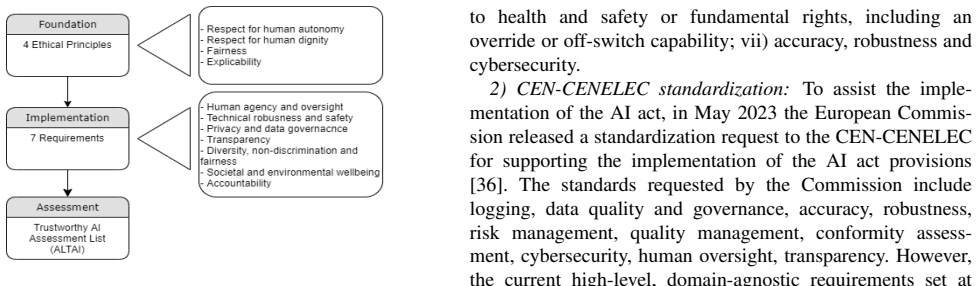
Summary. The paper surveys the EU landscape for trustworthy AI (TAI) — including the Ethics Guidelines for Trustworthy AI (EGTAI), the Assessment List for Trustworthy AI (ALTAI), the AI Act, CEN-CENELEC standardization, and the AI4EU and SHERPA projects — and proposes E-TAI, a framework for developing and evaluating TAI in the energy sector. E-TAI is built around the seven EGTAI requirements, with energy-specific risk and mitigation tables (Tables I–VII) and an iterative assessment loop (Fig. 2). The authors claim that E-TAI is a novel, generalized methodology for the EPES domain and that it has been applied and evaluated in the I-NERGY EU project across 9 pilots, 15 use cases, and 19 successful TAI services.
Significance. If substantiated, the contribution is useful: it operationalizes high-level EU TAI guidance into an energy-domain checklist with concrete tool suggestions, which could help practitioners bridge ALTAI-style self-assessment and project delivery. The paper's landscape review is generally traceable to the cited standards and directives, and its framework is explicitly derivative of external sources rather than self-referential, so the circularity risk is low. The main weakness is that the central empirical claim — that E-TAI was applied and evaluated successfully — is asserted without supporting evidence, leaving the paper's utility as a proposal rather than a demonstrated method.
major comments (3)
- [Section III-C] The evaluation claim is load-bearing but unsupported. The paragraph states that E-TAI was applied by 9 pilots in 15 use cases, helping produce 19 successful TAI services, yet it provides no metrics, no definition of 'successful', no description of what the framework changed in the pilots, and no comparison to ALTAI-only assessment. Since the abstract and introduction present this as demonstrated evidence of E-TAI's utility, this single assertion cannot carry the claim. Please either add concrete evaluation data (e.g., how many risks were identified, which mitigations were selected, how compliance scores changed over iterations) or reframe the paper as presenting the framework as a proposal with only anecdotal usage.
- [Section III-A and III-B] The incremental value of E-TAI relative to ALTAI is not shown. E-TAI is described as ALTAI plus Tables I–VII, and the text itself says the reader should 'revisit the EGTAI and the ALTAI' and use the guidelines only as an auxiliary tool. Without evidence that the additional tables change assessment outcomes, the claim of a novel energy-specific methodology collapses to a recommendation to use ALTAI with energy-tailored risk lists. Please provide at least one worked example or a reasoned argument showing how the framework's output differs from ALTAI alone.
- [Section I, Contributions] The novelty claim that 'no previous work has proposed such a generalized methodology in the EPES domain' is asserted without a systematic comparison to existing frameworks, including the two cited works [29] and [30]. Since the framework is essentially an adaptation of EGTAI/ALTAI, the paper should justify the 'generalized methodology' claim by explaining what specifically distinguishes E-TAI from prior TAI approaches and from the AI4EU abbreviated assessment list described in Section II-C.
minor comments (5)
- [Section III, first paragraph] Typo: 'introduces the the proposed methodological framework' should read 'introduces the proposed methodological framework'.
- [Section I, risk enumeration] The list of dangers skips 'v)' and jumps from 'iv)' to 'vi)', and the last item is labelled 'vii)' instead of 'v)'. Please renumber.
- [Section II-A-1] The descriptions of requirements (e) and (f) appear swapped: 'Societal and environmental well-being' is described with content about inclusion and bias, while 'Diversity, non-discrimination and fairness' is described with content about environmental impact and social impact, which are the opposite of the EGTAI definitions.
- [Abstract] The abstract says the study aims to 'evaluate' the fuzzy landscape of TAI, but the paper provides a review, not an evaluation with criteria or comparison. Please align the wording.
- [Section III-C] The phrase 'assist the development of 19 successful TAI services' is ambiguous about whether E-TAI was used during development, in evaluation, or both. Please clarify.
Circularity Check
No significant circularity: E-TAI is an explicit adaptation of external EGTAI/ALTAI standards; the self-reported I-NERGY evaluation lacks metrics but does not reduce the central claim to its own inputs.
full rationale
The paper's central contribution, the E-TAI framework, is explicitly constructed from the external European Commission EGTAI principles and ALTAI assessment list (Section III: 'The EGTAI and ALTAI are in the heart of the E-TAI'), supplemented by energy-domain risk tables drawn from SHERPA and other cited sources. This is a design proposal, not a derivation: there are no equations, fitted parameters, or quantitative predictions whose value is predetermined by the framework's definitions. The claimed empirical support (Section III-C: 'E-TAI has been applied and evaluated in the I-NERGY EU project... 19 successful TAI services') is asserted without outcome metrics, a definition of 'successful,' or a comparison against ALTAI alone, but this is an evidentiary weakness or correctness risk, not circularity. Self-citations (e.g., [22] describing I-NERGY) provide project context and are not load-bearing for the framework's structure, which rests on external normative documents. The authors explicitly disclaim completeness (the risk tables are repeatedly labeled 'non-exhaustive,' and readers are 'strongly encouraged to revisit the EGTAI and the ALTAI'). No enumerated circularity pattern—self-definition, fitted-input-as-prediction, self-citation chain, imported uniqueness, ansatz-by-citation, or renaming-known-result—is present. The framework is a domain adaptation of public standards, and its claimed utility remains externally falsifiable in principle even if the reported evaluation is thin.
Assumptions & free parameters
assumptions (2)
- domain assumption The seven EGTAI requirements are the correct and sufficient taxonomy for trustworthiness in energy AI.
- domain assumption Most smart-grid AI systems count as high-risk under the AI Act, triggering the corresponding obligations.
Cite this review
Pith. "Pith review of Trustworthy artificial intelligence in the energy sector: Landscape analysis and evaluation framework." pith.science (2026). https://pith.science/paper/4ZFKSBDC
@misc{pith2026241207782,
  author       = {Pith},
  title        = {Pith review of: Trustworthy artificial intelligence in the energy sector: Landscape analysis and evaluation framework},
  year         = {2026},
  howpublished = {\url{https://pith.science/paper/4ZFKSBDC}},
  note         = {Machine review of arXiv:2412.07782}
}
read the original abstract
The present study aims to evaluate the current fuzzy landscape of Trustworthy AI (TAI) within the European Union (EU), with a specific focus on the energy sector. The analysis encompasses legal frameworks, directives, initiatives, and standards like the AI Ethics Guidelines for Trustworthy AI (EGTAI), the Assessment List for Trustworthy AI (ALTAI), the AI act, and relevant CEN-CENELEC standardization efforts, as well as EU-funded projects such as AI4EU and SHERPA. Subsequently, we introduce a new TAI application framework, called E-TAI, tailored for energy applications, including smart grid and smart building systems. This framework draws inspiration from EGTAI but is customized for AI systems in the energy domain. It is designed for stakeholders in electrical power and energy systems (EPES), including researchers, developers, and energy experts linked to transmission system operators, distribution system operators, utilities, and aggregators. These stakeholders can utilize E-TAI to develop and evaluate AI services for the energy sector with a focus on ensuring trustworthiness throughout their development and iterative assessment processes.
Figures

Reference graph
Works this paper leans on
-
[29]
Trustworthy AI: From Principles to Practices,
B. Li, P. Qi, B. Liu, et al. , “Trustworthy AI: From Principles to Practices,” ACM Computing Surveys, vol. 55, no. 9, p. 177, Jan. 2023
work page 2023
-
[30]
S. Otoum and H. T. Mouftah, “Enabling Trustworthiness in Sustainable Energy Infrastructure Through Blockchain and AI-Assisted Solutions,” IEEE Wireless Communications, vol. 28, no. 6, pp. 19–25, Dec. 2021
work page 2021
-
[1]
A. C. Serban and M. D. Lytras, “Artificial intelligence for smart renewable energy sector in europe - Smart energy infrastructures for next generation smart cities,” IEEE Access, vol. 8, pp. 77 364–77 377, 2020
work page 2020
-
[2]
S. Pelekis, E. Karakolis, F. Silva, et al., “In Search of Deep Learning Architectures for Load Forecasting: A Comparative Analysis and the Impact of the Covid-19 Pandemic on Model Performance,” in 2022 13th International Conference on Information, Intelligence, Systems & Applications (IISA), IEEE, Jul. 2022, pp. 1–8
work page 2022
-
[3]
S. Pelekis, I.-K. Seisopoulos, E. Spiliotis, et al. , “A comparative assessment of deep learning models for day-ahead load forecasting: Investigating key accuracy drivers,” arXiv:2302.12168, Feb. 2023
work page Pith review arXiv 2023
-
[4]
A. M. Tzortzis, S. Pelekis, E. Spiliotis, et al., “Transfer Learning for Day-Ahead Load Forecasting: A Case Study on European National Electricity Demand Time Series,” Mathematics 2024, V ol. 12, Page 19, vol. 12, no. 1, p. 19, Dec. 2023
work page 2024
-
[5]
V . Michalakopoulos, E. Sarmas, I. Papias, P. Skaloumpakas, V . Mari- nakis, and H. Doukas, “A machine learning-based framework for clus- tering residential electricity load profiles to enhance demand response programs,” Applied Energy, vol. 361, p. 122 943, May 2024
work page 2024
-
[6]
Q. Chen and K. A. Folly, “Application of Artificial Intelligence for EV Charging and Discharging Scheduling and Dynamic Pricing: A Review,” Energies 2023, V ol. 16, Page 146, vol. 16, no. 1, p. 146, Dec. 2022
work page 2023
Show all 76 references
-
[7]
Non-Intrusive Load Monitoring: A Review,
P. A. Schirmer and I. Mporas, “Non-Intrusive Load Monitoring: A Review,” IEEE Transactions on Smart Grid, vol. 14, no. 1, pp. 769– 784, Jan. 2023
2023
-
[8]
The Current State of the Art in Research on Predictive Main- tenance in Smart Grid Distribution Network: Fault’s Types, Causes, and Prediction Methods—A Systematic Review,
M. A. Mahmoud, N. R. Md Nasir, M. Gurunathan, P. Raj, and S. A. Mostafa, “The Current State of the Art in Research on Predictive Main- tenance in Smart Grid Distribution Network: Fault’s Types, Causes, and Prediction Methods—A Systematic Review,” Energies 2021, V ol. 14, Page ...
2021
-
[9]
Analysis of cyber-attacks on smart grid applications,
M. Z. Gunduz and R. Das, “Analysis of cyber-attacks on smart grid applications,” 2018 International Conference on Artificial Intelligence and Data Processing, IDAP 2018, Jan. 2019
2018
-
[10]
Adversarial attacks on deep learning models in smart grids,
J. Hao and Y . Tao, “Adversarial attacks on deep learning models in smart grids,” Energy Reports, vol. 8, pp. 123–129, May 2022
2022
-
[11]
Avoiding Occupancy Detection from Smart Meter Using Adversarial Machine Learning,
I. Yilmaz and A. Siraj, “Avoiding Occupancy Detection from Smart Meter Using Adversarial Machine Learning,” IEEE Access, vol. 9, pp. 35 411–35 430, 2021
2021
-
[12]
Smart Cities: A Survey on Data Management, Security, and Enabling Technologies,
A. Gharaibeh, M. A. Salahuddin, S. J. Hussini, et al., “Smart Cities: A Survey on Data Management, Security, and Enabling Technologies,” IEEE Communications Surveys and Tutorials, vol. 19, no. 4, pp. 2456– 2501, Oct. 2017
2017
-
[13]
‘Human oversight’ in the EU artificial intelligence act: what, when and by whom?
L. Enqvist, “‘Human oversight’ in the EU artificial intelligence act: what, when and by whom?” Law, Innovation and Technology, vol. 15, no. 2, pp. 508–535, Jul. 2023
2023
-
[14]
Sustainable AI: Environ- mental Implications, Challenges and Opportunities,
C.-J. Wu, R. Raghavendra, U. Gupta, et al., “Sustainable AI: Environ- mental Implications, Challenges and Opportunities,” in Proceedings of Machine Learning and Systems , vol. 4, Apr. 2022, pp. 795–813
2022
-
[15]
Concrete Problems in AI Safety,
D. Amodei, C. Olah, G. Brain, et al. , “Concrete Problems in AI Safety,” Arxiv, Jun. 2016
2016
-
[16]
AI and Energy Justice,
M. Noorman, B. Espinosa Apr ´aez, and S. Lavrijssen, “AI and Energy Justice,” Energies 2023, V ol. 16, Page 2110, vol. 16, no. 5, p. 2110, Feb. 2023
2023
-
[17]
A Novel Cyberattack-Resilient Frequency Control Method for Interconnected Power Systems Using SMO-based Attack Estimation,
A. D. Syrmakesis, H. H. Alhelou, and N. D. Hatziargyriou, “A Novel Cyberattack-Resilient Frequency Control Method for Interconnected Power Systems Using SMO-based Attack Estimation,” IEEE Transac- tions on Power Systems, 2023
2023
-
[18]
SearchFromFree: Adversarial Mea- surements for Machine Learning-based Energy Theft Detection,
J. Li, Y . Yang, and J. S. Sun, “SearchFromFree: Adversarial Mea- surements for Machine Learning-based Energy Theft Detection,” 2020 IEEE International Conference on Communications, Control, and Computing Technologies for Smart Grids, SmartGridComm 2020, Nov. 2020
2020
-
[19]
Ethics guidelines for trustworthy AI — Shaping Europe’s digital future,
High-Level Expert Group on AI, “Ethics guidelines for trustworthy AI — Shaping Europe’s digital future,” Aug. 2019
2019
-
[20]
White Paper On Artificial Intelligence - A European approach to excellence and trust,
European Commission, “White Paper On Artificial Intelligence - A European approach to excellence and trust,” European Commission, Tech. Rep., 2020
2020
-
[21]
European Commission, EU Artificial Intelligence Act (Final Draft), 2024
2024
-
[22]
Artificial intelligence for next generation energy services across Europe - The I-NERGY project,
E. Karakolis, S. Pelekis, S. Mouzakitis, et al., “Artificial intelligence for next generation energy services across Europe - The I-NERGY project,” in ES 2021 : 19th International Conference e-Society 2021 , Lisbon, 2022, pp. 61–68
2021
-
[23]
Targeted demand response for flexible energy communities using clustering techniques,
S. Pelekis, A. Pipergias, E. Karakolis, et al. , “Targeted demand response for flexible energy communities using clustering techniques,” Sustainable Energy, Grids and Networks, vol. 36, p. 101 134, Dec. 2023
2023
-
[24]
DeepTSF: Codeless machine learning operations for time series forecasting,
S. Pelekis, E. Karakolis, T. Pountridis, et al. , “DeepTSF: Codeless machine learning operations for time series forecasting,” Arxiv, Jul. 2023
2023
-
[25]
Data-driven building energy efficiency prediction based on envelope heat losses using physics-informed neural networks,
V . Michalakopoulos, S. Pelekis, G. Kormpakis, V . Karakolis, S. Mouzakitis, and D. Askounis, “Data-driven building energy efficiency prediction based on envelope heat losses using physics-informed neural networks,” Arxiv, Nov. 2023
2023
-
[26]
AI4EU, AI4EU - The European AI on Demand Platform, 2020
P. AI4EU, AI4EU - The European AI on Demand Platform, 2020
2020
-
[27]
EnerShare, Eneshare Project, 2022
2022
-
[28]
iTrust6G, iTrust6G project, 2023
2023
-
[31]
European Commission, Building Trust in Human Centric Artificial Intelligence, Apr. 2019
2019
-
[32]
European Commission, The European AI Alliance, 2018
2018
-
[33]
Charter of Fundamental Rights of the European Union,
European Union, “Charter of Fundamental Rights of the European Union,” Official Journal of the European Union, Dec. 2012
2012
-
[34]
European AI Alliance, ALTAI portal, 2020
2020
-
[35]
Policy and investment recommendations for trustworthy Artificial Intelligence,
European Commission, “Policy and investment recommendations for trustworthy Artificial Intelligence,” European Commission, Tech. Rep., 2019
2019
-
[36]
CEN-CENELEC, CEN/TC 428 White paper-Artificial Intelligence (AI) and ICT Professionalism: Foundation for trustworthy and robust AI Ensuring a harmonised AI and ICT Professionalism standardisation, Jun. 2023
2023
-
[37]
AI4EU project, AI4EU — AI-on-Demand, 2019
2019
-
[38]
Assessment list for the responsible development and use of AI,
AI4EU and Ume ˚a University, “Assessment list for the responsible development and use of AI,” Ume ˚a University, Tech. Rep., 2021
2021
-
[39]
World Energy Council, World Energy Trilemma Index, 2024
2024
-
[40]
Smart Grids and Eth-ics,
T. Hatzakis, R. Rodrigues, and W. David, “Smart Grids and Eth-ics,” ORBIT Journal, vol. 2, no. 2, 2019
2019
-
[41]
ENISA, The European Union Agency for Cybersecurity, 2024
2024
-
[42]
The cost of incidents affecting CIIs,
Nikolakopoulos Theodoros and Tofan Dan, “The cost of incidents affecting CIIs,” ENISA, Tech. Rep., 2016
2016
-
[43]
Energy justice: Conceptual insights and practical applications,
B. K. Sovacool and M. H. Dworkin, “Energy justice: Conceptual insights and practical applications,” Applied Energy, vol. 142, pp. 435– 444, Mar. 2015
2015
-
[44]
European Commission, Energy Poverty Advisory Hub, 2024
2024
-
[45]
Quantifying the Carbon Emissions of Machine Learning,
A. Lacoste, A. Luccioni, V . Schmidt, and T. Dandres, “Quantifying the Carbon Emissions of Machine Learning,” arXiv, Oct. 2019
2019
-
[46]
G. Sias, “UCLA Electronic Theses and Dissertations Title Characteri- zation of the Life Cycle Environmental Impacts and Benefits of Smart Electric Meters and Consequences of their Deployment in California,” UCLA, Tech. Rep., 2017
2017
-
[47]
Life cycle assessment of greenhouse gas emissions,
L. Reijnders, “Life cycle assessment of greenhouse gas emissions,” in Handbook of Climate Change Mitigation , vol. 1, Springer US, Jan. 2012, pp. 13–41
2012
-
[48]
Women at the Table, AI & Equality — A Human Rights Toolbox, 2023
2023
-
[49]
An approach for a fundamental rights impact assess- ment to automated decision-making,
H. L. Janssen, “An approach for a fundamental rights impact assess- ment to automated decision-making,” International Data Privacy Law, vol. 10, no. 1, pp. 76–106, Feb. 2020
2020
-
[50]
European Justice, Fundamental rights interactive tool, 2023
2023
-
[51]
European Parliament, Regulation (EU) 2019/881 of the European Parliament and of the Council of 17 April 2019 on ENISA and on information and communications technology cybersecurity certification and repealing Regulation (EU) No 526/2013 (Cybersecurity Act), 2019
2019
-
[52]
Adversarial Robustness Toolbox v1.0.0,
M.-I. Nicolae, M. Sinn, M. N. Tran, et al. , “Adversarial Robustness Toolbox v1.0.0,” arXiv, Jul. 2018
2018
-
[53]
OpenMined, PySyft: Perform data science on data that remains in someone else’s server, 2023
2023
-
[54]
Securing Web Services with Keycloak,
G. Camposo, “Securing Web Services with Keycloak,” Cloud Native Integration with Apache Camel, pp. 77–115, 2021
2021
-
[55]
What Is MLOps?
S. Alla and S. K. Adari, “What Is MLOps?” In Beginning MLOps with MLFlow, Apress, Berkeley, CA, 2021, ch. 3, pp. 79–124
2021
-
[56]
European Parliament, Regulation 2016/679 of the European Parliament and of the Council on the protection of natural persons with regard to the processing of personal data and on the free movement of such data, and repealing Directive 95/46/EC (General Data Protection Regulation), 2016
2016
-
[57]
Open Data Institute, The Data Ethics Canvas, 2021
2021
-
[58]
Datasheets for datasets,
T. Gebru, J. Morgenstern, B. Vecchione, et al. , “Datasheets for datasets,” Communications of the ACM, vol. 64, no. 12, pp. 86–92, Dec. 2021
2021
-
[59]
Ribeiro Marco, Lime: Explaining the predictions of any machine learning classifier, 2016
2016
-
[60]
SHAP, SHAP: A game theoretic approach to explain the output of any machine learning model, 2018
2018
-
[61]
N-BEATS: Neural basis expansion analysis for interpretable time series forecast- ing,
B. N. Oreshkin, D. Carpov, N. Chapados, and Y . Bengio, “N-BEATS: Neural basis expansion analysis for interpretable time series forecast- ing,” in International Conference on Learning Representations , 2020
2020
-
[62]
Temporal Fusion Trans- formers for Interpretable Multi-horizon Time Series Forecasting,
B. Lim, S. Arık, N. Loeff, and T. Pfister, “Temporal Fusion Trans- formers for Interpretable Multi-horizon Time Series Forecasting,” International Journal of Forecasting, vol. 37, no. 4, pp. 1748–1764, Dec. 2019
2019
-
[63]
AI Fairness 360: An ex- tensible toolkit for detecting, understanding, and mitigating unwanted algorithmic bias,
R. K. E. Bellamy, K. Dey, M. Hind, et al., “AI Fairness 360: An ex- tensible toolkit for detecting, understanding, and mitigating unwanted algorithmic bias,” IBM Journal of Research and Development, vol. 63, no. 4/5, pp. 1–4, 2018
2018
-
[64]
Aequitas: A Bias and Fairness Audit Toolkit,
P. Saleiro, B. Kuester, L. Hinkson, et al. , “Aequitas: A Bias and Fairness Audit Toolkit,” Arxiv, Nov. 2018
2018
-
[65]
FairTest: Discovering Unwarranted Associations in Data-Driven Applications,
F. Tram `er, V . Atlidakis, R. Geambasu, et al. , “FairTest: Discovering Unwarranted Associations in Data-Driven Applications,” Proceedings - 2nd IEEE European Symposium on Security and Privacy, EuroS and P 2017, pp. 401–416, Jun. 2017
2017
-
[66]
Themis-ml: A Fairness-aware Machine Learning Inter- face for End-to-end Discrimination Discovery and Mitigation,
N. Bantilan, “Themis-ml: A Fairness-aware Machine Learning Inter- face for End-to-end Discrimination Discovery and Mitigation,” Journal of Technology in Human Services, vol. 36, no. 1, pp. 15–30, Oct. 2017
2017
-
[67]
Using AI to help achieve Sustainable Development Goals — United Nations Develop- ment Programme,
Chui Michael, Chung Rita, and van Heteren Ashey, “Using AI to help achieve Sustainable Development Goals — United Nations Develop- ment Programme,” McKinsey, Tech. Rep., Jan. 2019
2019
-
[68]
The role of artificial intelligence in achieving the Sustainable Development Goals,
R. Vinuesa, H. Azizpour, I. Leite, et al. , “The role of artificial intelligence in achieving the Sustainable Development Goals,” Nature Communications 2020 11:1, vol. 11, no. 1, pp. 1–10, Jan. 2020
2020
-
[69]
Aligning artificial intelligence with climate change miti- gation,
L. H. Kaack, P. L. Donti, E. Strubell, G. Kamiya, F. Creutzig, and D. Rolnick, “Aligning artificial intelligence with climate change miti- gation,” Nature Climate Change 2022 12:6, vol. 12, no. 6, pp. 518–527, Jun. 2022
2022
-
[70]
Maillet Alb ´eric, Introducing the Human-Centered AI Canvas, 2019
2019
-
[71]
IEA, IEA - International Energy Agency, 2024
2024
-
[72]
IRENA, IRENA – International Renewable Energy Agency, 2024
2024
-
[73]
Erbach, Energy Union Strategy, 2015
G. Erbach, Energy Union Strategy, 2015
2015
-
[74]
European Parliament, Directive (EU) 2018/2001 of the European Parliament and of the Council of 11 December 2018 on the promotion of the use of energy from renewable sources (recast), 2018
2018
-
[75]
European Parliament, Directive 2010/31/EU of the European Parlia- ment on the energy performance of buildings, May 2010
2010
-
[76]
European Parliament, Regulation (EU) 2018/1999 of the European Parliament and of the Council of 11 December 2018 on the Governance of the Energy Union and Climate Action, 2018
2018
Reviewed August 12, 2026 · model on record in the stance chip above.
Discussion (0). Continue with ORCID to comment.