REVIEW 2 major objections 4 minor 2 cited by
Effective temperatures of the QGP from thermal photon and dilepton production
T0 review · 2 major / 4 minor · reviewed 2026-08-11 · deepseek-v4-flash
Pith's one-line read Dilepton invariant-mass spectra track the true quark–gluon plasma temperature, while thermal photon effective temperatures are dominated by radial flow.
desk verdict Solid Trajectum calibration study showing dilepton Teff tracks fluid temperature while photon Teff is flow-dominated; the sub-1 fm/c early-time claims are the genuinely fragile part. read the letter →
The pith
A machine-rendered reading of the paper's core claim, the machinery that carries it, and where it could break.
The reading
What carries the argument
The load-bearing machinery is the event-by-event implementation of next-to-leading-order thermal emission rates for photons and dileptons in the Trajectum hybrid model, which evolves a generalized initial state through a pre-equilibrium stage, 2+1D viscous hydrodynamics, and a hadronic afterburner. Photon and dilepton yields are sampled per fluid cell from the NLO production rates, built on the electromagnetic current-current correlator; the hadron-resonance-gas contribution to photons is added through the afterburner. Effective temperatures are extracted by fitting the Boltzmann form $\exp(-p_T/T_{\rm eff})$ for photons and the $(m_{ll} T_{\rm eff})^{3/2} \exp(-m_{ll}/T_{\rm eff})$ form for dileptons in the intermediate mass region $1<m_{ll}<3$ GeV/c². The identity that carries the argument is that the dilepton invariant mass is Lorentz invariant, so the slope of $dN/dm_{ll}$ is not blue-shifted by flow, while the photon $p_T$ is; this is what lets $m_{ll}$ selections act as a clock for the fluid temperature.
What would settle it
Repeat the same Trajectum calculation with $\tau_{\rm hydro}$ varied over its Bayesian uncertainty, $0.38 \pm 0.17$ fm/c, and with pre-equilibrium emission included; if the extracted effective temperature in the 2–3 GeV/c² mass window moves by more than the quoted systematic band, the claimed early-time thermometer would fail. A precise measurement of the dilepton invariant-mass spectrum in that window at collider energies that disagrees with the model's predicted $T_{\rm eff}$ would also falsify the correspondence.
Extended reading notes
Core claim
The paper claims that, within the Trajectum framework, the effective temperature extracted from the thermal dilepton invariant-mass distribution in the intermediate mass region is a faithful thermometer for the quark–gluon plasma, whereas the photon effective temperature is not. Because the dilepton pair mass is Lorentz invariant, the extracted $T_{\rm eff}$ in each mass bin equals the average temperature of the fluid cells that dominate that bin, and this correspondence holds across centralities: the $T_{\rm eff}$ points lie on the model's own $\langle T\rangle(\tau)$ curve when plotted at the median emission time. Thermal photons, by contrast, have their transverse momentum blue-shifted by radial flow, so their $T_{\rm eff}$ saturates near 250–300 MeV regardless of the actual plasma temperature; observing a photon temperature above the crossover therefore does not prove the plasma was that hot. Using $p_T$ and $m_{ll}$ selections, the model resolves emission-time windows from late ($\langle \tau \rangle \approx 5.6$ fm/c) to very early ($\langle \tau \rangle < 1.0$ fm/c), and the corresponding dilepton elliptic flow maps how flow builds up over time, with high-mass pairs showing near-zero $v_2$ because they come from the earliest stages.
Load-bearing premise
The paper's early-time temperatures assume hydrodynamics starts near 0.38 fm/c and that nothing radiates before that time; if the starting time is wrong or pre-equilibrium emission is sizeable in the mass and $p_T$ windows used, the sub-1 fm/c temperatures and the high-mass $T_{\rm eff}$ values would shift.
Editorial extensions
If this is right
- A measured dilepton spectrum in the intermediate mass region gives direct access to the quark–gluon plasma temperature evolution, not just a single integrated number.
- Photon-only effective temperatures near 300 MeV should not be quoted as evidence that the plasma reached a particular temperature; the same plateau can come from a cooler fluid with radial flow.
- Selections on dilepton invariant mass and transverse momentum can map both temperature and elliptic flow as functions of emission time, from about 5.6 fm/c to below 1 fm/c.
- High-mass, high-$p_T$ dileptons are sensitive to the earliest, least-constrained stage of the collision, so precise measurements there can tighten the parameters that govern the initial state.
- The hadron-resonance-gas contribution to photons matters mainly at low $p_T$; separating it from the QGP contribution is needed before using photon slopes as temperature indicators.
Reading between the lines
- Because the model's $T_{\rm eff}(m_{ll})$ curve sits on its own $\langle T\rangle(\tau)$ curve, comparing the same extraction with experimental dilepton spectra would directly test the hydrodynamic temperature profile; a mismatch would point to the starting time or equation of state rather than to the emission rates.
- The sub-1 fm/c temperatures are the least robust part of the map: they depend on $\tau_{\rm hydro}$ and ignore pre-equilibrium emission, so the early-time values are likely to shift once those contributions are included.
- The centrality independence of the photon plateau suggests the same 250–300 MeV effective temperature would appear at lower collision energies, meaning historical photon-based temperature estimates may partly measure flow rather than heat.
- A two-dimensional selection in $m_{ll}$ and $p_T$ could sharpen the emission-time resolution further and turn the dilepton spectrum into a tomographic cooling curve; this extension is not worked out in the paper.
Editorial analysis
A structured set of objections, weighed in public.
Referee Report
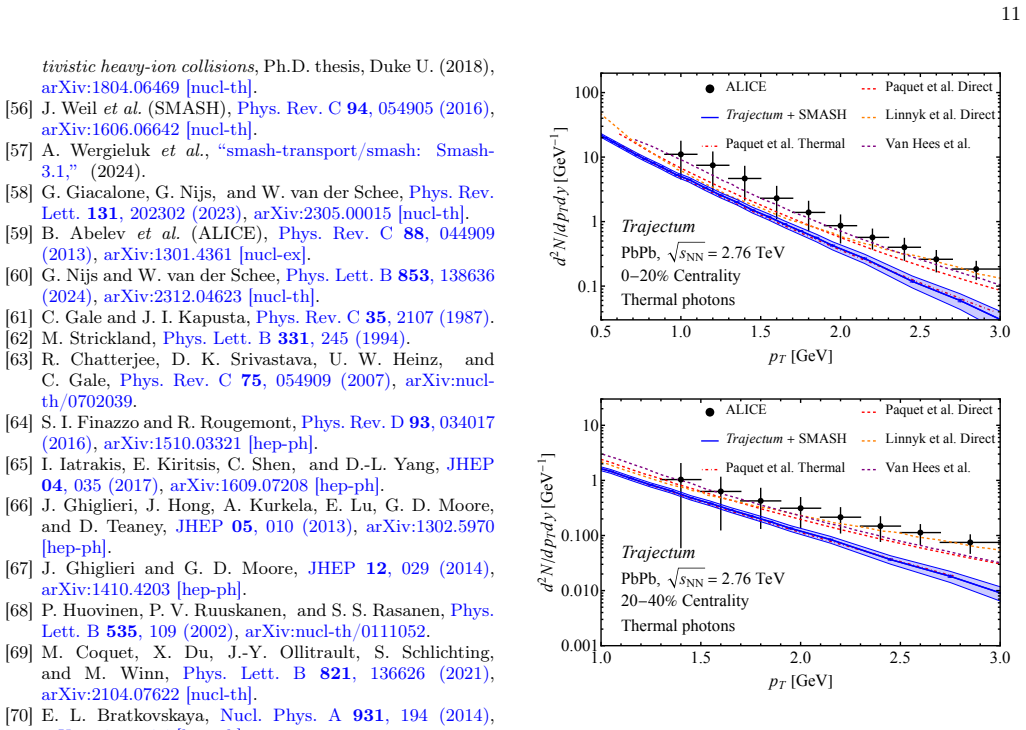
Summary. The authors extend the Trajectum hybrid model with next-to-leading-order thermal photon and dilepton emission rates from a weakly coupled QGP, use 20 posterior parameter samples to estimate systematic uncertainties, and compute transverse-momentum and invariant-mass spectra, effective temperatures, average emission times, and elliptic flow for Pb-Pb collisions at sqrt(s_NN)=5.02 TeV over several centrality classes. They find that the photon T_eff is approximately 250-300 MeV and largely insensitive to the true fluid temperature because of radial-flow blue-shift, while the dilepton T_eff extracted from the intermediate-mass-region spectrum tracks the fluid temperature. They further show that selecting on dilepton mass and transverse momentum selects average emission times from late emission (about 5.6 fm/c) down to below 1.0 fm/c, and that dilepton elliptic flow can be mapped as a function of emission time. The appendix compares the photon spectra and flow with ALICE data and with previous theoretical calculations, and compares the dilepton results with those from Kasmaei and Strickland and from Garcia-Montero et al.
Significance. If the conclusions hold, this is a useful model-based study: it provides a physics interpretation of measured effective temperatures, argues that thermal dileptons are better thermometers than thermal photons, and demonstrates how mass and transverse-momentum selections can map the temperature and flow history of the quark-gluon plasma. The manuscript has clear strengths: it is built on a Bayesian-constrained dynamical model, it propagates posterior-based uncertainties, it compares with ALICE data and several prior calculations, and it states explicit caveats about omitted pre-equilibrium and Drell-Yan contributions. The main weakness is that the most novel part of the claim, namely access to average emission times below 1 fm/c, depends on the weakly constrained hydrodynamic starting time tau_hydro and on the absence of pre-equilibrium emission, both of which the authors themselves flag as the dominant early-time uncertainty.
major comments (2)
- [Section III, Table I, Fig. 7] The headline result that dilepton mass selection gives average emission times below 1 fm/c is carried by exactly the two ingredients the paper identifies as least reliable. Section II quotes tau_hydro = 0.38 +/- 0.17 fm/c from the Bayesian fit, and Section III states that the dominant parameter contributing to the early-time uncertainty is tau_hydro because pre-hydrodynamic photon and dilepton production is not implemented. The 3 < m_ll < 4 GeV/c^2 bins in Table I have mean emission times of 0.83-0.96 fm/c, only a few tenths of a fm/c after the central tau_hydro; within one sigma tau_hydro ranges from 0.21 to 0.55 fm/c, which changes both the amount of hot fluid available before 1 fm/c and the temperature assigned to the earliest fluid cells. The appendix comparison with Garcia-Montero et al. shows their thermal+pre-equilibrium curve within the Trajectum systematic band, but their thermal emission starts at tau = 1.0 fm/c, so it does not validate the sub-1 fm/c mapping. I therefore request a sensitivity study that varies tau_hydro over its posterior (or fixes it to several values) and, if possible, an estimate of pre-equilibrium dilepton emission in the high-mass windows before the paper claims extraction of fluid temperatures at average times below about 1 fm/c.
- [Section IV, Fig. 5] The relation T_eff approximately T_fluid for dileptons is established in Fig. 5 by generating the spectrum from rates that depend on T and then fitting that spectrum with Eqs. (1)-(2); the agreement is therefore a calibration of the extraction procedure inside the model, not an independent test of the relationship in the real QGP. The manuscript should state this limitation explicitly and, where possible, confront the prediction with LHC dilepton spectra or an independent rate implementation rather than only with other thermal-model calculations and the ALICE photon spectrum. This does not undermine the later-time part of the analysis, but it sets the appropriate strength of the claim that thermal dileptons are much better probes of the QGP temperature.
minor comments (4)
- [Section III, Table I] The text says the table shows average emission times specifically for 0-10% and 30-40% collision centralities, but Table I contains only 0-10% columns; either add the 30-40% values or correct the sentence.
- [References] Reference [27] is incomplete: it gives only '(2024), arXiv:2402.01998 [nucl-ex]' without author or title; please complete the citation.
- [Abstract and Section II] The text contains several instances of the missing space in 'theTrajectum' (e.g., in the abstract and at the start of Section II); please fix these formatting issues throughout.
- [Section VI] The sentence 'we have showcased in Fig. 6 that by applying different selection criteria on the transverse momentum and the invariant mass it is possible to discriminate between different average emission times' refers to a figure that shows effective temperatures versus centrality; the average-emission-time discrimination is actually presented in Table I and Fig. 7, so the cross-reference should be corrected.
Circularity Check
No significant circularity: the Teff-vs-T relation is a model-internal consistency check of standard rates, and the model is externally constrained; early-time uncertainties are openly flagged but not circular.
full rationale
The paper does not claim to derive the Teff-vs-T relation from first principles independently of the thermal rates; rather, it embeds standard NLO rates into the Trajectum hydrodynamic framework and studies what effective temperatures extracted from the resulting spectra measure. The correspondence shown in Fig. 5 is a consistency check of the fit formula against the rate, not a fitted parameter renamed as a prediction: the dilepton rate is an input, and the fit recovering the input temperature is a calibration, not a circular derivation. The model parameters come from a separate Bayesian analysis [58] constrained by external ALICE bulk data, and the appendix benchmarks the results against ALICE photon data and independent calculations (Paquet et al., Linnyk et al., van Hees et al., Kasmaei and Strickland, Garcia-Montero et al.), so the self-citations to Trajectum are not load-bearing in a circular sense. The paper explicitly flags the fragility of the early-time claims: Section III states that 'the dominant parameter contributing to this uncertainty is the starting time of hydrodynamics tau_hyd' and that pre-equilibrium and Drell-Yan contributions become important at higher invariant masses; this is an honesty about model limitations, not a circular step. No equation in the paper is defined in terms of itself, and no observable is simultaneously used as an input and then reported as a prediction. The photon insensitivity and the time-resolved flow results are non-trivial outputs of the simulation rather than built-in consequences of the fit ansatz. The overall derivation is therefore self-contained and externally grounded, with no significant circularity.
Assumptions & free parameters
free parameters (3)
- Hydrodynamic starting time tau_hydro =
0.38 +/- 0.17 fm/c (from Bayesian posterior of [58])
- Trajectum model parameters (20 posterior samples) =
Not tabulated; sampled from the posterior of [58]
- Effective temperature fit windows =
Photons: 0.5-1, 1-2, 2-3 or 2-4 GeV/c; dileptons: 1-1.5, 1.5-2, 2-2.5, 2.5-3 GeV/c^2
assumptions (4)
- domain assumption NLO thermal rates of [66,67] accurately describe photon and dilepton emission from a weakly coupled QGP in local thermal equilibrium.
- domain assumption The QGP evolution is described by Trajectum's 2+1D boost-invariant viscous hydrodynamics with parameters from the Bayesian fit of [58].
- domain assumption Kinematic cuts (photon pT>0.1 GeV/c, dilepton pT>0.2 GeV/c and mll>0.2 GeV/c^2) remove regions where rates are theoretically uncertain, and the neglected low-momentum region does not affect Teff in the fitted windows.
- domain assumption Equation (2), a Boltzmann-like form in mll, is valid for the intermediate mass range 1-3 GeV/c^2, and pre-equilibrium or Drell-Yan contributions are negligible there.
Cite this review
Pith. "Pith review of Effective temperatures of the QGP from thermal photon and dilepton production." pith.science (2026). https://pith.science/paper/DFU6IJTG
@misc{pith2026241209671,
  author       = {Pith},
  title        = {Pith review of: Effective temperatures of the QGP from thermal photon and dilepton production},
  year         = {2026},
  howpublished = {\url{https://pith.science/paper/DFU6IJTG}},
  note         = {Machine review of arXiv:2412.09671}
}
abstract
Thermal electromagnetic radiation is emitted by the quark-gluon plasma (QGP) throughout its space-time evolution, with production rates that depend characteristically on the temperature. We study this temperature using thermal photons and dileptons using the Trajectum heavy ion code, which is constrained by Bayesian analysis. In addition we present the elliptic flow of both the thermal photons and thermal dileptons including systematic uncertainties corresponding to the model parameter uncertainty. We give a comprehensive overview of the resulting effective temperatures $T_{\rm eff}$, obtained from thermal photon transverse momentum and thermal dilepton invariant mass distributions, as well as the dependence of $T_{\rm eff}$ on various selection criteria of these probes. We conclude that the $T_{\rm eff}$ obtained from thermal photons is mostly insensitive to the temperature of the QGP with a value of $T_{\rm eff} \sim$ 250-300 MeV depending on their transverse momentum, almost independent of collision centrality. Thermal dileptons are much better probes of the QGP temperature as they do not suffer from a blue shift as their invariant mass is used, allowing for a more precise constraint of the QGP temperature during different stages of the evolution of the system. By applying selection criteria on the dilepton transverse momentum and the invariant mass we are able to extract fluid temperatures on average times ranging from late emission ($\langle \tau \rangle = 5.6\,$fm$/c$) to very early emissions ($\langle \tau \rangle < 1.0\,$fm$/c$). Furthermore, we show how these selection criteria can be used to map the elliptic flow of the system all throughout its evolution.
Figures


Figures from the paper (9 more)




Forward citations
Cited by 2 Pith papers
-
Thermal Dilepton Polarization under Rotation or Magnetic Field in Heavy-ion Collisions
Vorticity and magnetic fields induce characteristically different dilepton polarization spectra via modified quark propagators, with λ_θ decreasing monotonically under rotation but oscillating under magnetic fields du...
-
What is the Quark-Gluon Plasma made of?
The quark-gluon plasma is best described as a strongly coupled liquid of massive, very short-lived quark and gluon quasiparticles, with sound (phonon) modes becoming the most well-defined collective excitation at low momenta.
Reference graph
Works this paper leans on
-
[1]
U. Heinz and R. Snellings, Ann. Rev. Nucl. Part. Sci.63, 123 (2013), arXiv:1301.2826 [nucl-th]
arXiv 2013
-
[2]
are used to fit the respectivepT and mll distributions. These fits are performed in three differentpT regions and 4 different mll regions for the photons and dileptons re- spectively. The bands show the systematic uncertainty on the effective temperature whereas the fences on the plot markers show the combined fitting uncertainty and statistical uncertain...
- [3]
-
[4]
Y. Aoki, Z. Fodor, S. D. Katz, and K. K. Szabo, Phys. Lett. B 643, 46 (2006), arXiv:hep-lat/0609068
arXiv 2006
-
[5]
A. Bazavov et al., Phys. Rev. D 85, 054503 (2012), arXiv:1111.1710 [hep-lat]
arXiv 2012
-
[6]
A. Bazavovet al. (HotQCD), Phys. Rev. D90, 094503 (2014), arXiv:1407.6387 [hep-lat]
arXiv 2014
-
[7]
J. N. Guenther, Eur. Phys. J. A 57, 136 (2021), arXiv:2010.15503 [hep-lat]
arXiv 2021
-
[8]
Ollitrault, (1997), arXiv:nucl-ex/9711003
J.-Y. Ollitrault, (1997), arXiv:nucl-ex/9711003
arXiv 1997
Show all 78 references
-
[9]
S. A. Bass, M. Gyulassy, H. Stoecker, and W. Greiner, J. Phys. G25, R1 (1999), arXiv:hep-ph/9810281
1999 arXiv
-
[10]
S. A. Voloshin, A. M. Poskanzer, and R. Snellings, Landolt-Bornstein 23, 293 (2010), arXiv:0809.2949 [nucl- ex]
2010 arXiv
-
[11]
J. E. Bernhard, J. S. Moreland, and S. A. Bass, Nature Phys. 15, 1113 (2019)
2019
-
[12]
F. G. Gardim, G. Giacalone, M. Luzum, and J.-Y. Ol- litrault, Nature Phys. 16, 615 (2020), arXiv:1908.09728 [nucl-th]
2020 arXiv
-
[13]
128, 104004 (2023), arXiv:2210.01622 [hep-ph]
F.GeurtsandR.-A.Tripolt,Prog.Part.Nucl.Phys. 128, 104004 (2023), arXiv:2210.01622 [hep-ph]
2023 arXiv
- [14]
-
[15]
Rapp and H
R. Rapp and H. van Hees, Eur. Phys. J. A52, 257 (2016), arXiv:1608.05279 [hep-ph]
2016 arXiv
-
[16]
Acharya et al
S. Acharya et al. (ALICE), Eur. Phys. J. C 84, 813 (2024), arXiv:2211.04384 [nucl-ex]
2024 arXiv
-
[17]
Peitzmann and M
T. Peitzmann and M. H. Thoma, Phys. Rept.364, 175 (2002), arXiv:hep-ph/0111114
2002 arXiv
- [18]
-
[19]
L. D. McLerran and T. Toimela, Phys. Rev. D31, 545 (1985)
1985
-
[20]
P. B. Arnold, G. D. Moore, and L. G. Yaffe, JHEP11, 057 (2001), arXiv:hep-ph/0109064
2001 arXiv
-
[21]
P. B. Arnold, G. D. Moore, and L. G. Yaffe, JHEP12, 009 (2001), arXiv:hep-ph/0111107
2001 arXiv
-
[22]
P. B. Arnold, G. D. Moore, and L. G. Yaffe, JHEP06, 030 (2002), arXiv:hep-ph/0204343
2002 arXiv
-
[23]
Adamet al.(ALICE), Phys
J. Adamet al.(ALICE), Phys. Lett. B754, 235 (2016), arXiv:1509.07324 [nucl-ex]
2016 arXiv
-
[24]
Adamczyk et al
L. Adamczyk et al. (STAR), Phys. Lett. B 770, 451 (2017), arXiv:1607.01447 [nucl-ex]
2017 arXiv
-
[25]
N. J. Abdulameeret al. (PHENIX), Phys. Rev. C109, 044912 (2024), arXiv:2203.17187 [nucl-ex]
2024
-
[26]
N. J. Abdulameeret al. (PHENIX), Phys. Rev. C107, 024914 (2023), arXiv:2203.12354 [nucl-ex]
2023
-
[27]
Acharya et al
S. Acharya et al. (ALICE), (2023), arXiv:2308.16704 [nucl-ex]
2023
-
[28]
(2024), arXiv:2402.01998 [nucl-ex]
2024 arXiv
-
[29]
C. Shen, U. W. Heinz, J.-F. Paquet, and C. Gale, Phys. Rev. C 89, 044910 (2014), arXiv:1308.2440 [nucl-th]
2014 arXiv
- [30]
- [31]
- [32]
-
[33]
J. Deng, Q. Wang, N. Xu, and P. Zhuang, Phys. Lett. B 701, 581 (2011), arXiv:1009.3091 [nucl-th]
2011 arXiv
-
[34]
Vujanovic, C
G. Vujanovic, C. Young, B. Schenke, R. Rapp, S. Jeon, and C. Gale, Phys. Rev. C89, 034904 (2014), arXiv:1312.0676 [nucl-th]
2014 arXiv
-
[35]
Linnyk, V
O. Linnyk, V. P. Konchakovski, W. Cassing, and E. L. Bratkovskaya, Phys. Rev. C 88, 034904 (2013), arXiv:1304.7030 [nucl-th]
2013 arXiv
-
[36]
C. Gale, Y. Hidaka, S. Jeon, S. Lin, J.-F. Paquet, R. D. Pisarski, D. Satow, V. V. Skokov, and G. Vujanovic, Phys. Rev. Lett. 114, 072301 (2015), arXiv:1409.4778 [hep-ph]
2015 arXiv
-
[37]
L.Bhattacharya, R.Ryblewski, andM.Strickland,Phys. Rev. D 93, 065005 (2016), arXiv:1507.06605 [hep-ph]
2016 arXiv
-
[38]
Vujanovic, J.-F
G. Vujanovic, J.-F. Paquet, G. S. Denicol, M. Luzum, S. Jeon, and C. Gale, Phys. Rev. C94, 014904 (2016), arXiv:1602.01455 [nucl-th]
2016 arXiv
-
[39]
Endres, H
S. Endres, H. van Hees, and M. Bleicher, Phys. Rev. C 94, 024912 (2016), arXiv:1604.06415 [nucl-th]
2016 arXiv
-
[40]
Hauksson, S
S. Hauksson, S. Jeon, and C. Gale, Phys. Rev. C 97, 014901 (2018), arXiv:1709.03598 [nucl-th]
2018 arXiv
- [41]
-
[42]
B. S. Kasmaei and M. Strickland, Phys. Rev. D 99, 034015 (2019), arXiv:1811.07486 [hep-ph]
2019 arXiv
-
[43]
Churchill, L
J. Churchill, L. Du, C. Gale, G. Jackson, and S. Jeon, Phys. Rev. C 109, 044915 (2024), arXiv:2311.06675 [nucl-th]
2024 arXiv
-
[44]
Churchill, L
J. Churchill, L. Du, C. Gale, G. Jackson, and S. Jeon, Phys. Rev. Lett. 132, 172301 (2024), arXiv:2311.06951 [nucl-th]
2024 arXiv
-
[45]
X.-Y. Wu, L. Du, C. Gale, and S. Jeon, Phys. Rev. C 110, 054904 (2024), arXiv:2407.04156 [nucl-th]
2024 arXiv
-
[46]
Paquet, C
J.-F. Paquet, C. Shen, G. S. Denicol, M. Luzum, B. Schenke, S. Jeon, and C. Gale, Phys. Rev. C 93, 044906 (2016), arXiv:1509.06738 [hep-ph]
2016 arXiv
-
[47]
Garcia-Montero, A
O. Garcia-Montero, A. Mazeliauskas, P. Plaschke, and S. Schlichting, JHEP 03, 053 (2024), arXiv:2308.09747 [hep-ph]
2024 arXiv
-
[48]
Turbide, R
S. Turbide, R. Rapp, and C. Gale, Phys. Rev. C 69, 014903 (2004), arXiv:hep-ph/0308085
2004 arXiv
-
[49]
van Hees, M
H. van Hees, M. He, and R. Rapp, Nucl. Phys. A933, 256 (2015), arXiv:1404.2846 [nucl-th]
2015 arXiv
-
[50]
Linnyk, V
O. Linnyk, V. Konchakovski, T. Steinert, W. Cassing, and E. L. Bratkovskaya, Phys. Rev. C92, 054914 (2015), arXiv:1504.05699 [nucl-th]
2015 arXiv
-
[51]
G. Nijs, W. van der Schee, U. Gürsoy, and R. Snellings, Phys. Rev. Lett. 126, 202301 (2021), arXiv:2010.15130 [nucl-th]
2021 arXiv
-
[52]
G. Nijs, W. van der Schee, U. Gürsoy, and R. Snellings, Phys. Rev. C 103, 054909 (2021), arXiv:2010.15134 [nucl-th]
2021 arXiv
-
[53]
https://sites.google.com/view/govertnijs/ trajectum
-
[54]
J. S. Moreland, J. E. Bernhard, and S. A. Bass, Phys. Rev. C 92, 011901 (2015), arXiv:1412.4708 [nucl-th]
2015 arXiv
-
[55]
Pratt and G
S. Pratt and G. Torrieri, Phys. Rev. C82, 044901 (2010), arXiv:1003.0413 [nucl-th]
2010 arXiv
-
[56]
J. E. Bernhard,Bayesian parameter estimation for rela- 11 tivistic heavy-ion collisions,Ph.D.thesis,DukeU.(2018), arXiv:1804.06469 [nucl-th]
2018 arXiv
-
[57]
Weilet al.(SMASH), Phys
J. Weilet al.(SMASH), Phys. Rev. C94, 054905 (2016), arXiv:1606.06642 [nucl-th]
2016 arXiv
-
[58]
smash-transport/smash: Smash- 3.1,
A. Wergieluk et al., “smash-transport/smash: Smash- 3.1,” (2024)
2024
-
[59]
Giacalone, G
G. Giacalone, G. Nijs, and W. van der Schee, Phys. Rev. Lett. 131, 202302 (2023), arXiv:2305.00015 [nucl-th]
2023 arXiv
-
[60]
Abelev et al
B. Abelev et al. (ALICE), Phys. Rev. C 88, 044909 (2013), arXiv:1301.4361 [nucl-ex]
2013 arXiv
-
[61]
Nijs and W
G. Nijs and W. van der Schee, Phys. Lett. B853, 138636 (2024), arXiv:2312.04623 [nucl-th]
2024 arXiv
-
[62]
Gale and J
C. Gale and J. I. Kapusta, Phys. Rev. C35, 2107 (1987)
1987
-
[63]
Strickland, Phys
M. Strickland, Phys. Lett. B331, 245 (1994)
1994
-
[64]
Chatterjee, D
R. Chatterjee, D. K. Srivastava, U. W. Heinz, and C. Gale, Phys. Rev. C 75, 054909 (2007), arXiv:nucl- th/0702039
2007
-
[65]
S.I.FinazzoandR.Rougemont,Phys.Rev.D 93,034017 (2016), arXiv:1510.03321 [hep-ph]
2016 arXiv
-
[66]
Iatrakis, E
I. Iatrakis, E. Kiritsis, C. Shen, and D.-L. Yang, JHEP 04, 035 (2017), arXiv:1609.07208 [hep-ph]
2017 arXiv
-
[67]
Ghiglieri, J
J. Ghiglieri, J. Hong, A. Kurkela, E. Lu, G. D. Moore, and D. Teaney, JHEP05, 010 (2013), arXiv:1302.5970 [hep-ph]
2013 arXiv
-
[68]
Ghiglieri and G
J. Ghiglieri and G. D. Moore, JHEP 12, 029 (2014), arXiv:1410.4203 [hep-ph]
2014 arXiv
-
[69]
Huovinen, P
P. Huovinen, P. V. Ruuskanen, and S. S. Rasanen, Phys. Lett. B 535, 109 (2002), arXiv:nucl-th/0111052
2002 arXiv
-
[70]
Coquet, X
M. Coquet, X. Du, J.-Y. Ollitrault, S. Schlichting, and M. Winn, Phys. Lett. B 821, 136626 (2021), arXiv:2104.07622 [nucl-th]
2021 arXiv
-
[71]
E. L. Bratkovskaya, Nucl. Phys. A 931, 194 (2014), arXiv:1408.3674 [hep-ph]
2014 arXiv
-
[72]
Bilandzic, R
A. Bilandzic, R. Snellings, and S. Voloshin, Phys. Rev. C 83, 044913 (2011), arXiv:1010.0233 [nucl-ex]
2011 arXiv
-
[73]
Bilandzic,Anisotropic flow measurements in ALICE at the large hadron collider, Ph.D
A. Bilandzic,Anisotropic flow measurements in ALICE at the large hadron collider, Ph.D. thesis, Utrecht U. (2012)
2012
-
[74]
Garcia-Montero, P
O. Garcia-Montero, P. Plaschke, and S. Schlichting, (2024), arXiv:2403.04846 [hep-ph]
2024 arXiv
-
[75]
F. Seck, B. Friman, T. Galatyuk, H. van Hees, E. Speranza, R. Rapp, and J. Wambach, (2023), arXiv:2309.03189 [nucl-th]
2023 arXiv
-
[76]
Coquet, X
M. Coquet, X. Du, J.-Y. Ollitrault, S. Schlichting, and M. Winn, Nucl. Phys. A 1030, 122579 (2023), arXiv:2112.13876 [nucl-th]
2023 arXiv
-
[77]
Coquet, M
M. Coquet, M. Winn, X. Du, J.-Y. Ollitrault, and S. Schlichting, Phys. Rev. Lett. 132, 232301 (2024), arXiv:2309.00555 [nucl-th]
2024 arXiv
-
[78]
Alqahtani, M
M. Alqahtani, M. Nopoush, and M. Strickland, Prog. Part. Nucl. Phys. 101, 204 (2018), arXiv:1712.03282 [nucl-th]. APPENDIX: COMP ARISON TO OTHER THEORETICAL CALCULA TIONS In this appendix we show how the results presented in this work compare with other theoretical and experi-...
2018 arXiv
Reviewed August 11, 2026 · model on record in the stance chip above.
Discussion (0). Continue with ORCID to comment.