REVIEW 3 major objections 5 minor 1 cited by
Charged Particle in Lie-Poisson Electrodynamics
T0 review · 3 major / 5 minor · reviewed 2026-08-11 · deepseek-v4-flash
Pith's one-line read For any Lie-algebra-type noncommutative spacetime, the paper constructs a universal gauge-invariant position $\xi = e^{-\hat A}x$ and a gauge-invariant action that reduces to standard relativistic dynamics in the commutative limit, and it…
desk verdict Useful, explicit construction of gauge-invariant particle dynamics in Lie-Poisson electrodynamics, but the one-parameter family in the gauge-invariant momenta leaves the action underdetermined. read the letter →
The pith
A machine-rendered reading of the paper's core claim, the machinery that carries it, and where it could break.
The reading
What carries the argument
The machinery is a pair of universal matrices that solve the two master equations of Lie-Poisson gauge theory: $\gamma(p) = G(\hat p)$ with form factor $G(s) = s/2 + (s/2)\coth(s/2)$ and $\hat p{}^\mu{}_\nu = C^{\sigma\mu}{}_\nu p_\sigma$, together with $\rho(p) = (\gamma(p) - \hat p)^{-1} = 1/G(-\hat p)$. The paper's key step is the identity $G^{-1}(s)G(-s) = e^{-s}$, which makes the gauge-invariant coordinate matrix reduce to the ordinary matrix exponential, $\Delta(p) = \bar\rho(p)\bar\gamma(p) = e^{-\hat p}$. The second piece is the Darboux-coordinate transformation $X = x\bar\gamma(p)$, $P = p$, which sends the deformed brackets to canonical ones and produces the action (3.40); gauge invariance of the action follows from the Maurer–Cartan identity (3.37) obeyed by $\bar\gamma$.
What would settle it
Take a nontrivial gauge background, for instance $A_0 = E x^1$ in the λ-Minkowski spacetime, and verify by direct expansion in powers of the deformation parameter $\lambda$ whether the gauge variation of $\xi = \exp(-\hat A)x$ vanishes identically under the deformed transformations (2.20); any nonzero term at third order would invalidate the universal position formula.
Extended reading notes
Core claim
The paper's claim, stated on its own terms, is that Lie-algebra-type noncommutativity does not obstruct a fully explicit treatment of charged-particle mechanics. The gauge-invariant position is $\xi^\mu = (\exp(-\hat A(x))){}^\mu{}_\nu x^\nu$, where $\hat A{}^\mu{}_\nu = C^{\sigma\mu}{}_\nu A_\sigma$, obtained from the identity $\Delta(p) = G^{-1}(\hat p) G(-\hat p) = e^{-\hat p}$ that combines the two universal solutions of the master equations of Lie-Poisson gauge theory. The dynamics is governed by the Hamiltonian $H = \pi^\mu \pi_\mu - m^2$ built from gauge-invariant momenta that solve the partial differential equation (3.31), with the first-order action (3.40) providing the equations of motion (3.34). Explicit gauge-invariant momenta are given for κ-Minkowski, su(2), and λ-Minkowski noncommutativities. In the λ-Minkowski case, the Coulomb (Kepler) problem is exactly solvable: the noncommutative solutions are obtained from the commutative ones by the rotation (4.88), and the deformed angular momentum and Laplace–Runge–Lenz vectors satisfy the same algebra as in the commutative case.
Load-bearing premise
The entire construction assumes that the momentum-dependent matrices $\gamma(p)$ and $\rho(p)$ are invertible along every trajectory; in the su(2) case this fails on the momentum sphere $|p| = \pi/(2\alpha)$, where the form factor $\sqrt{t}\cot\sqrt{t}$ vanishes, and the paper does not address how to handle trajectories crossing that sphere.
Editorial extensions
If this is right
- For any Lie-algebra-type noncommutative background, the measurable position of a charged test particle is the gauge-invariant combination $\xi = e^{-\hat A}x$, so experiments on noncommutative spacetime must compare data with this quantity rather than with the bare coordinates.
- The action (3.40) and equations of motion (3.34) provide a complete Hamiltonian dynamics that reproduces the standard relativistic Lorentz-force motion in the commutative limit $\Theta \to 0$.
- In purely spatial noncommutativities, the formalism reduces to an ordinary Hamiltonian system with no Lagrange multipliers, so trajectories can be integrated by standard numerical methods.
- For λ-Minkowski noncommutativity and any gauge background with axial symmetry, noncommutative trajectories are exactly the commutative ones rotated by the matrix $\rho(P)$, as in Eq. (4.88); the Coulomb and constant-electric-field cases are worked out explicitly.
- The gauge-invariant momenta $\pi$ are given explicitly for κ-Minkowski, su(2), and λ-Minkowski spacetimes, making the construction applicable without further model building.
Reading between the lines
- The identity $\Delta(p) = e^{-\hat p}$ suggests that the gauge-invariant position $\xi$ is a non-Abelian Wilson-line-like exponential of the gauge field along the group generated by the structure constants; the paper does not explore this interpretation.
- In the su(2) case, the matrix $\bar\gamma(p)$ is singular on the momentum sphere $|p| = \pi/(2\alpha)$ because the form factor $\sqrt{t}\cot\sqrt{t}$ vanishes there; whether physical trajectories can be continued across this sphere is an open problem the paper leaves unaddressed.
- The one-parameter families of gauge-invariant momenta (parameter $\omega$ for κ-Minkowski and λ-Minkowski) may produce $\omega$-dependent equations of motion, so checking whether on-shell observables are $\omega$-independent would determine whether the dynamics is unique.
- Because the λ-Minkowski Kepler problem maps exactly to the commutative one, semiclassical quantization could be carried out in commutative variables, and exact integrability might persist in a quantum version of the model.
Editorial analysis
A structured set of objections, weighed in public.
Referee Report
Summary. The paper develops a Hamiltonian description of a charged point particle in Lie-Poisson electrodynamics. Its central results are a universal gauge-invariant position variable ξ^μ(x,A(x)) = (exp(−Â(x)))^μ_ν x^ν (Eq. 3.55), and a gauge-invariant action S = −∫dτ [\dot p_ν \barγ^ν_α(p) x^α + ΛH] (Eq. 3.40), with H = π^μπ_μ − m^2 and gauge-invariant momenta π satisfying Eq. (3.31). The equations of motion are shown to reduce to standard relativistic dynamics as the non-commutativity parameter Θ → 0. The formalism is illustrated for κ-Minkowski, su(2), and λ-Minkowski non-commutativities, and the λ-Minkowski Kepler problem is solved by mapping to the commutative Kepler problem via a Darboux transformation.
Significance. If correct, the paper provides a systematic, first-principles kinematics and dynamics for charged particles in Lie-algebra-type non-commutative gauge backgrounds. The explicit formula for gauge-invariant position (3.55) is elegant and universal, and the action (3.40) is a concrete starting point for studying non-commutative corrections to particle motion. The paper also gives explicit solvable examples, including the λ-Minkowski Kepler problem, with clear numerical trajectories. The main results are stated in closed form and reduce properly to the commutative limit. However, the significance is tempered by two unresolved issues: the gauge-invariant momenta (and hence the action) are underdetermined by the stated conditions, and the construction assumes invertibility of γ and ρ along all trajectories without specifying the domain. These are load-bearing for the central claim of 'the' gauge-invariant dynamics.
major comments (3)
- [Sec. 3.c, Eq. (3.47); Sec. 4.c, Eq. (4.82)] The gauge-invariant momenta are not uniquely determined. For κ-Minkowski, Eq. (3.47) gives a one-parameter family π_μ = [ω ρ(A) + (1−ω) ρ(p)](p−A)_μ with arbitrary real ω. Substituting this into H = π²−m² changes the equations of motion: for A=0, π_i = [ω + (1−ω)e^{κ p_0}] p_i, so the free-particle Hamiltonian and the resulting trajectories depend explicitly on ω. The condition lim_{Θ→0}π = p−A does not select a preferred member, and the paper offers no physical selection principle; in λ-Minkowski it simply sets ω=1 'for simplicity' (Sec. 4.c), while in su(2) it performs a separate nonlinear redefinition (Eqs. 4.73 and 5.112) to enforce π|_{A=0}=p. Consequently, the action (3.40) describes a family of inequivalent dynamics rather than a single gauge-invariant dynamics. The authors should either impose a physical condition (e.g., π(p,0)=p, which fixes ω=1 in the κ-Minkowski case) or explicitly present ω as a free parameter of the framework.
- [Sec. 3.b, Eqs. (3.36), (3.40); Sec. 4.b, Eq. (4.71)] The construction assumes that γ(p) and ρ(p) are invertible along every trajectory, since the Darboux coordinates X=x\barγ(p) in Eq. (3.36) and the action (3.40) use the inverse matrices. For su(2) non-commutativity, the universal form factor G(s)=s/(1−e^{−s}) in Eq. (2.22) has poles when the matrix p̂ has eigenvalues 2π i n, which corresponds to α|p| = 2π n for nonzero integer n. At those momenta γ(p) and ρ(p) are singular, so \barγ and \barρ are undefined. The paper does not specify the domain of validity of the action and Darboux coordinates, nor how to handle trajectories that cross these singular surfaces. This is load-bearing because the action and the canonical transformation are literally undefined at those points.
- [Sec. 3.b, Eqs. (3.37) and (3.42)] The gauge invariance of the central action (3.40) is established by asserting that 'it is straightforward to verify' the identity (3.37) and that δ_f L in (3.42) reduces to a total derivative using it. Since this is the core symmetry property on which the paper's main result rests, the derivation should be presented in detail or at least sketched in an appendix. As written, the reader cannot check the calculation without redoing the entire algebra, and any error in this step would invalidiate the central claim.
minor comments (5)
- [Sec. 3.a] The perturbative solution for π in the general case is given only to O(C^3). The paper should state explicitly that, for a generic Lie algebra, the action (3.40) is not fully explicit until higher-order corrections are computed, and that the exact solutions presented later cover only the specific algebras analyzed.
- [Sec. 4.b, Eq. (4.71)] The matrix γ in Eq. (4.71) has indices written as 'p_a p_k' which is slightly ambiguous; it would be clearer to write p_a p_k with explicit index placement or as a dyadic product p p^T.
- [Sec. 4.c] There is a typo: 'satisfiy' should be 'satisfy'.
- [Summary, item 4] The word 'construciton' should be 'construction'.
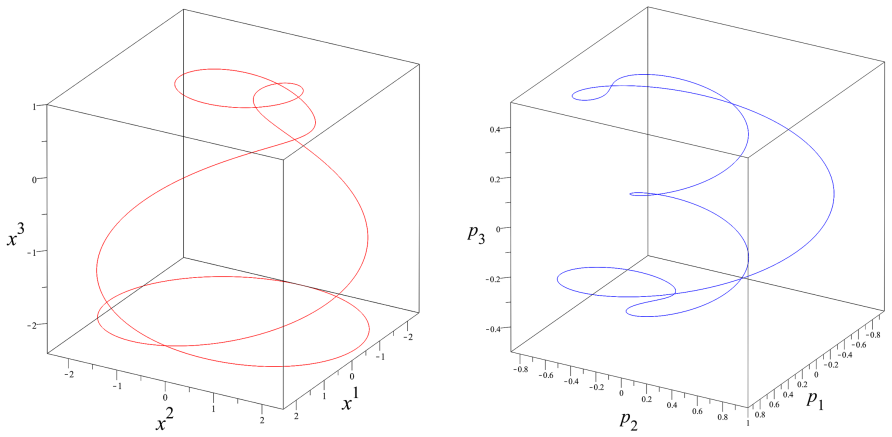
- [Figure captions] The captions of Figs. 1 and 2 refer to 'red and blue lines' without identifying which line corresponds to which variable or initial condition. A brief description would improve readability.
Circularity Check
No significant circularity; the acknowledged one-parameter family of gauge-invariant momenta is an underdetermination, not a circular reduction.
full rationale
The paper's derivation chain is self-contained at the level of its new claims. The gauge-invariant position xi (Eq. 3.55) follows from the ansatz xi = Delta x, the invariance PDE (3.51), and the algebraic identity Delta = bar-rho bar-gamma using the universal gamma and rho imported from Refs. [10,25]; those imports are parameter-free solutions of the stated master equations (2.16) and (2.25) with stated commutative limits, and they are not the target result. The action (3.40) is obtained by a canonical transformation to the Darboux coordinates (3.36), and gauge invariance is verified by explicit computation in Eqs. (3.42)-(3.43). The remaining freedom (the one-parameter family of gauge-invariant momenta in Eq. (3.47) with arbitrary omega, and the freedom in J(pi) noted in Eq. (4.68)) makes the dynamics underdetermined, but the paper explicitly writes 'can be chosen' and 'for all omega in R', so this is not a fitted parameter renamed as a prediction. No load-bearing step reduces to its own input by definition, and the self-citations to [10,24,25] serve as ordinary mathematical background rather than as an unverified premise for the central claim.
Assumptions & free parameters
free parameters (1)
- omega (gauge-invariant momentum ambiguity) =
arbitrary real number (set to 1 in λ-Minkowski analysis)
assumptions (6)
- domain assumption The universal matrix γ(p)=G(ˆp), with G(s)=s/(1-e^{-s}), solves the first master equation (2.16) and has the commutative limit (2.17).
- domain assumption The matrix ρ(p)=1/G(-ˆp) solves the second master equation (2.25) with the commutative limit.
- domain assumption The deformed gauge transformations (2.20) close the algebra (1.3), and the field strength (2.24) is gauge-covariant.
- ad hoc to paper The matrix γ(p) is invertible along the trajectories.
- domain assumption For purely spatial noncommutativity the temporal gauge τ=t is admissible and p0, Λ can be eliminated.
- standard math The form-factor identity T(s)=G^{-1}(s)G(-s)=e^{-s} holds.
Cite this review
Pith. "Pith review of Charged Particle in Lie-Poisson Electrodynamics." pith.science (2026). https://pith.science/paper/PZKX42MK
@misc{pith2026241210247,
  author       = {Pith},
  title        = {Pith review of: Charged Particle in Lie-Poisson Electrodynamics},
  year         = {2026},
  howpublished = {\url{https://pith.science/paper/PZKX42MK}},
  note         = {Machine review of arXiv:2412.10247}
}
abstract
Lie-Poisson electrodynamics describes the semi-classical limit of non-commutative $U(1)$ gauge theory, characterized by Lie-algebra-type non-commutativity. We focus on the mechanics of a charged point-like particle moving in a given gauge background. First, we derive explicit expressions for gauge-invariant variables representing the particle's position. Second, we provide a detailed formulation of the classical action and the corresponding equations of motion, which recover standard relativistic dynamics in the commutative limit. We illustrate our findings by exploring the exactly solvable Kepler problem in the context of the $\lambda$-Minkowski (or the angular) non-commutativity, along with other examples.
Figures

Forward citations
Cited by 1 Pith paper
-
Curved momentum space and finite Landau spectrum in $\kappa$-Minkowski spacetime
In κ-Minkowski spacetime, the deformed dispersion relation with its maximal momentum makes the Landau spectrum finite — levels exist only while k_z²+(2n+1)qB<κ² — and makes the highest orbital spin-polarized for fermions.
Reference graph
Works this paper leans on
-
[1]
String theory and noncommutative geometry,
N. Seiberg and E. Witten, “String theory and noncommutative geometry,” JHEP09 (1999), 032 doi:10.1088/1126-6708/1999/09/032
-
[2]
3D Quantum Gravity and Effective Noncommutative Quantum Field Theory,
L. Freidel and E. R. Livine, “3D Quantum Gravity and Effective Noncommutative Quantum Field Theory,” Phys. Rev. Lett.96 (2006), 221301 doi:10.1103/PhysRevLett.96.221301
-
[3]
Quantum field theory on noncommutative spaces,
R. J. Szabo, “Quantum field theory on noncommutative spaces,” Phys. Rept.378 (2003), 207-299 doi:10.1016/S0370-1573(03)00059-0
-
[4]
Symmetry, Gravity and Noncommutativity
R.J.Szabo,“Symmetry,gravityandnoncommutativity,”Class.Quant.Grav. 23(2006),R199-R242 doi:10.1088/0264-9381/23/22/R01 [arXiv:hep-th/0606233 [hep-th]]
work page Pith review arXiv 2006
-
[5]
Gauge theories on quantum spaces,
K. Hersent, P. Mathieu and J. C. Wallet, “Gauge theories on quantum spaces,” Phys. Rept.1014 (2023), 1-83 doi:10.1016/j.physrep.2023.03.002
-
[6]
Braidedquantumelectrodynam- ics,
M.DimitrijevićĆirić,N.Konjik,V.RadovanovićandR.J.Szabo,“Braidedquantumelectrodynam- ics,” JHEP08(2023), 211 doi:10.1007/JHEP08(2023)211 [arXiv:2302.10713 [hep-th]]
arXiv 2023
-
[7]
QuadraticTwist-NoncommutativeGaugeTheory,
T.MeierandS.J.vanTongeren,“QuadraticTwist-NoncommutativeGaugeTheory,”Phys.Rev.Lett. 131 (2023) no.12, 121603 doi:10.1103/PhysRevLett.131.121603 [arXiv:2301.08757 [hep-th]]
arXiv 2023
-
[8]
Gaugetheoryontwist-noncommutativespaces,
T.MeierandS.J.vanTongeren,“Gaugetheoryontwist-noncommutativespaces,”JHEP 12(2023), 045 doi:10.1007/JHEP12(2023)045 [arXiv:2305.15470 [hep-th]]
arXiv 2023
Show all 31 references
-
[9]
Non-commutative deformation of Chern–Simons theory,
V. G. Kupriyanov, “Non-commutative deformation of Chern–Simons theory,” Eur. Phys. J. C80 (2020) no.1, 42 doi:10.1140/epjc/s10052-019-7573-y [arXiv:1905.08753 [hep-th]]
2020 arXiv
-
[10]
Symplecticembeddings,homotopyalgebrasandalmostPoisson gauge symmetry,
V.G.KupriyanovandR.J.Szabo,“Symplecticembeddings,homotopyalgebrasandalmostPoisson gauge symmetry,” J. Phys. A55(2022) no.3, 035201
2022
-
[11]
Poisson gauge theory,
V. G. Kupriyanov, “Poisson gauge theory,” JHEP09(2021), 016
2021
-
[12]
Single Extra Dimension fromκ-Poincar\’e and Gauge Invariance,
P. Mathieu and J. C. Wallet, “Single Extra Dimension fromκ-Poincar\’e and Gauge Invariance,” JHEP 03 (2021), 209 doi:10.1007/JHEP03(2021)209 [arXiv:2007.14187 [hep-th]]
2021 arXiv
-
[13]
κ-Poincaré-comodules, Braided Tensor Products and Noncommutative Quantum Field Theory,
F. Lizzi and F. Mercati, “κ-Poincaré-comodules, Braided Tensor Products and Noncommutative Quantum Field Theory,” Phys. Rev. D103 (2021), 126009 doi:10.1103/PhysRevD.103.126009 [arXiv:2101.09683 [hep-th]]. 17
2021 arXiv
-
[14]
Twisted BRST symmetry in gauge theories on the κ- Minkowski spacetime,
P. Mathieu and J. C. Wallet, “Twisted BRST symmetry in gauge theories on the κ- Minkowski spacetime,” Phys. Rev. D103 (2021) no.8, 086018 doi:10.1103/PhysRevD.103.086018 [arXiv:2102.10860 [hep-th]]
2021 arXiv
-
[15]
Coherent state induced star product on R**3(lambda) and the fuzzy sphere,
A. B. Hammou, M. Lagraa and M. M. Sheikh-Jabbari, “Coherent state induced star product on R**3(lambda) and the fuzzy sphere,” Phys. Rev. D 66 (2002), 025025 doi:10.1103/PhysRevD.66.025025 [arXiv:hep-th/0110291 [hep-th]]
2002 arXiv
-
[16]
Infinitelymanystarproductstoplaywith,
J.M.Gracia-Bondia,F.Lizzi,G.MarmoandP.Vitale,“Infinitelymanystarproductstoplaywith,” JHEP 04 (2002), 026 doi:10.1088/1126-6708/2002/04/026 [arXiv:hep-th/0112092 [hep-th]]
2002 arXiv
-
[17]
Quantization maps, algebra representation and non-commutative Fourier transform for Lie groups,
C. Guedes, D. Oriti and M. Raasakka, “Quantization maps, algebra representation and non-commutative Fourier transform for Lie groups,” J. Math. Phys. 54 (2013), 083508 doi:10.1063/1.4818638 [arXiv:1301.7750 [math-ph]]
2013 arXiv
-
[18]
Noncommutativefieldtheorieson R3 λ: TowardUV/IRmixingfreedom,
P.VitaleandJ.C.Wallet,“Noncommutativefieldtheorieson R3 λ: TowardUV/IRmixingfreedom,” JHEP 04 (2013), 115 doi:10.1007/JHEP04(2013)115 [arXiv:1212.5131 [hep-th]]
2013 arXiv
-
[19]
New Lie-algebraic and quadratic deformations of Minkowski space from twisted Poincare symmetries,
J. Lukierski and M. Woronowicz, “New Lie-algebraic and quadratic deformations of Minkowski space from twisted Poincare symmetries,” Phys. Lett. B 633 (2006), 116-124 doi:10.1016/j.physletb.2005.11.052
2006 doi
-
[20]
Noncommutative field theoryfromangulartwist,
M. Dimitrijevic Ciric, N. Konjik, M. A. Kurkov, F. Lizzi and P. Vitale, “Noncommutative field theoryfromangulartwist,”Phys.Rev.D 98(2018)no.8,085011doi:10.1103/PhysRevD.98.085011 [arXiv:1806.06678 [hep-th]]
2018 arXiv
-
[21]
PT -symmetric quantum field theory on the noncommutative spacetime,
O. O. Novikov, “PT -symmetric quantum field theory on the noncommutative spacetime,” Mod. Phys. Lett. A35(2019) no.05, 2050012 doi:10.1142/S0217732320500121
2019 doi
-
[22]
Noncommutativescalarfieldinthenonextremal Reissner-Nordström background: Quasinormal mode spectrum,
M.DimitrijevićĆirić,N.KonjikandA.Samsarov,“Noncommutativescalarfieldinthenonextremal Reissner-Nordström background: Quasinormal mode spectrum,” Phys. Rev. D101 (2020) no.11, 116009 doi:10.1103/PhysRevD.101.116009
2020 doi
-
[23]
Time Discretization From Noncommutativity,
F. Lizzi and P. Vitale, “Time Discretization From Noncommutativity,” Phys. Lett. B818 (2021), 136372 doi:10.1016/j.physletb.2021.136372
2021
-
[24]
Lie-Poissongaugetheoriesand κ-Minkowskielec- trodynamics,
V.G.Kupriyanov, M.A.KurkovandP.Vitale, “Lie-Poissongaugetheoriesand κ-Minkowskielec- trodynamics,” JHEP11 (2023), 200 doi:10.1007/JHEP11(2023)200
2023 doi
-
[25]
Poisson gauge models and Seiberg-Witten map,
V. G. Kupriyanov, M. A. Kurkov and P. Vitale, “Poisson gauge models and Seiberg-Witten map,” JHEP 11(2022), 062
2022
-
[26]
Symplectic groupoids and Poisson electrody- namics,
V. G. Kupriyanov, A. A. Sharapov and R. J. Szabo, “Symplectic groupoids and Poisson electrody- namics,” JHEP03 (2024), 039
2024
-
[27]
Symplectic realizations and Lie groupoids in Poisson Electrodynamics,
F. Di Cosmo, A. Ibort, G. Marmo and P. Vitale, “Symplectic realizations and Lie groupoids in Poisson Electrodynamics,” [arXiv:2312.16308 [hep-th]]
-
[28]
Classicalmechanicsinnoncommutativespaces: con- finement and more,
V.Kupriyanov,M.KurkovandA.Sharapov,“Classicalmechanicsinnoncommutativespaces: con- finement and more,” Eur. Phys. J. C84(2024) no.10, 1068 doi:10.1140/epjc/s10052-024-13372-7 18
2024 doi
-
[29]
Poisson electrodynamics with charged matter fields,
A. A. Sharapov, “Poisson electrodynamics with charged matter fields,” J. Phys. A57 (2024) no.31, 315401 doi:10.1088/1751-8121/ad62c7 [arXiv:2402.14439 [hep-th]]
2024 arXiv
-
[30]
Lifshitz,The classical theory of fields, Vol
L.D Landau, E.M. Lifshitz,The classical theory of fields, Vol. 2, Pergamon Press
-
[31]
DeformedHamiltonMechanicsinNoncommutativePhaseSpace,
S.D.Liang,“DeformedHamiltonMechanicsinNoncommutativePhaseSpace,”Int.J.Theor.Phys. 63(2024) no.10, 262 doi:10.1007/s10773-024-05795-5 19
2024 doi
Reviewed August 11, 2026 · model on record in the stance chip above.
Discussion (0). Continue with ORCID to comment.