REVIEW 4 major objections 5 minor 22 references
Do Large Language Models Show Biases in Causal Learning?
T0 review · 4 major / 5 minor · reviewed 2026-08-11 · deepseek-v4-flash
Pith's one-line read Large language models infer causation where the evidence shows none, with GPT-4o-Mini averaging 75.21/100 on null-contingency medical cases and never answering 0 in 1,000 trials.
desk verdict Good headline-generation study, but the numeric contingency task that carries the main claim is compromised by the prompt's own '50 = quite effective' anchor. read the letter →
The pith
A machine-rendered reading of the paper's core claim, the machinery that carries it, and where it could break.
The reading
What carries the argument
The central mechanism is the adapted contingency judgment task, a standard human experimental procedure in which trial-by-trial observations of a potential cause (drug given) and outcome (recovery) are summarized, and the model rates the cause's effectiveness on a 0–100 scale. The paper's null-contingency datasets ensure that the outcome probability is identical whether the cause is present or absent, which normatively should yield a rating of 0 (no causal effectiveness). Alongside this, the headline-generation task classifies outputs into correlational, conditional-causal, direct-causal, and no-claim categories, and the superstitious-thinking task inserts temporal and alternative-cause cues; both are designed to detect causal claims where evidence is absent.
What would settle it
Run the same null-contingency medical trials but change the response instruction to 0 = 'no causal relationship' and 100 = 'definite causal relationship', or ask a binary causal question (cause or no cause) before the numeric rating. If the near-75 average and the absence of zero responses persist, the illusion is robust; if ratings collapse toward 0 or binary causal choices become rare, the reported bias is largely an artifact of the 0–100 effectiveness scale with its '50 = quite effective' anchor.
Extended reading notes
Core claim
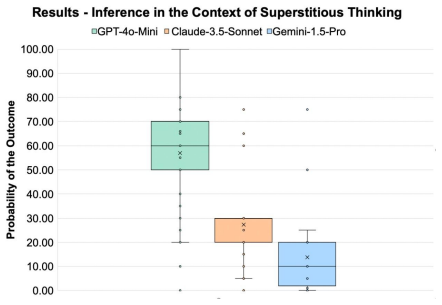
The central claim is that LLMs exhibit a strong, measurable illusion of causality in causal learning tasks, particularly when quantitative judgment scales are used. Across three tasks—generating headlines from spurious-correlation abstracts, rating drug effectiveness from null-contingency trial lists, and judging superstitious outcomes given temporal counterevidence—the models made causal claims unsupported by the evidence. In the numeric tasks the effect was pronounced: GPT-4o-Mini's mean null-contingency effectiveness rating was 75.21 (SD = 12.52) with no zero responses out of 1,000; Claude-3.5-Sonnet averaged 43.46 with 12.1% zeros; Gemini-1.5-Pro averaged 33.75 with 28.5% zeros but also high variability. The paper interprets this as evidence that the models have not uniformly, consistently, or reliably internalized normative principles such as contingency and temporal ordering, and it reads the failure to use temporal cues as contrary to some prior LLM results.
Load-bearing premise
The measurement of causal bias assumes that a model's 0–100 effectiveness rating is a neutral readout of the contingency evidence, yet the prompts in Section 5.2 and Appendix A explicitly tell the model that 50 means 'quite effective', so higher scores could reflect anchoring or prior beliefs about drugs rather than an inferred causal relationship.
Editorial extensions
If this is right
- If the paper is right, LLM outputs in health, science communication, and belief-related domains cannot be assumed to reflect evidence-based causal reasoning.
- Numeric causal ratings from LLMs are not reliable for null-contingency evidence; a widely deployed assistant could tell a patient that an ineffective treatment is quite effective.
- Explicit textual cues such as 'correlation does not imply causation' do not reliably reduce causal illusion in headline generation.
- Models differ substantially in bias strength, so safety assessments for causal reasoning should be model-specific.
- Temporal information that places the effect before the cause fails to negate causal inference in most cases, despite earlier evidence that some LLMs use temporal cues.
Reading between the lines
- Editorial inference: the 0–100 response scale itself may inflate the illusion measure, since the prompt defines 50 as 'quite effective'; a null-contingency judgment near 50 may express scale anchoring or prior beliefs about drugs rather than an inferred causal link.
- Testable extension: repeat the contingency task with a causal-only scale (0 = no causal relationship, 100 = definite causal relationship) and with abstract variables like 'X' and 'Y'; if mean ratings fall near zero, the reported bias is partly a scale artifact.
- Editorial inference: if the illusion is genuinely driven by text priors, fine-tuning on explicit null-contingency trials or chain-of-thought instructions may reduce it—a mitigation the paper lists as future work, not something it demonstrates.
- Testable extension: a direct human-vs-model comparison on the exact same prompts would place the reported effect sizes in clearer perspective, since the paper's human comparisons come mostly from earlier psychology studies rather than a matched sample.
Signed reviews
Editorial analysis
A structured set of objections, weighed in public.
Referee Report
Summary. The paper investigates whether three LLMs (GPT-4o-Mini, Claude-3.5-Sonnet, Gemini-1.5-Pro) exhibit the illusion of causality across three tasks: headline generation from spurious-correlation abstracts, a 0-100 contingency judgment task in medical scenarios, and a superstitious-thinking inference task with temporal and alternative-cause cues. The authors report strong causal-illusion bias in open-ended headline generation at levels comparable to or lower than human press-release exaggeration, and significantly higher bias in the numeric 0-100 tasks, concluding that the models have not reliably internalized normative causal-learning principles. The dataset and generation code are made available.
Significance. If the numeric-task results are valid, this is an important contribution to the study of cognitive biases in LLMs and to AI-safety evaluation. The headline-generation task is carefully annotated with high inter-annotator agreement (kappa 0.80-0.84), the three-domain dataset is a useful public resource, and the paper is transparent about several limitations. However, the central numeric-task conclusion is not yet secure because the 0-100 response scale is pragmatically anchored and confounded with world-knowledge priors; the paper's own Limitations section concedes that the scale 'may not be ideal for evaluating LLMs, and could partly explain the results.' The finding therefore needs additional control conditions or a more cautious interpretation before the 'significantly higher bias' claim can be accepted.
major comments (4)
- [Section 5.2 and Appendix A] The 0-100 effectiveness rating is not a neutral readout of perceived contingency. The prompt explicitly tells models that 0 means 'non-effective', 50 means 'quite effective', and 100 means 'totally effective', and several prompts use real drug names such as paracetamol for fever. This invites scale anchoring and activation of prior knowledge about drug efficacy, independent of the zero-contingency trial list. Since Section 2 defines any score above 0 in a null-contingency scenario as evidence of the illusion, the GPT-4o-Mini result of mean 75.21 with zero 0-responses (Section 6.2) is consistent with response-format artifacts. The Limitations section (Section 7) concedes that the scale 'may not be ideal for evaluating LLMs, and could partly explain the results'; this concession directly weakens the abstract's 'significantly higher bias' claim for numeric tasks.
- [Section 6.2] The claim that GPT-4o-Mini 'failed to recognize, in any of the 1,000 zero-contingency scenarios, that there was no causal relationship' equates 'no causal relationship' with a response of exactly 0. However, the prompt describes 50 as 'quite effective' and never tells the model that 0 is the only correct answer under null contingency. A score around 50 could be a neutral default or an anchoring artifact rather than an inference of causation. The normative definition of bias should be adapted to the LLM setting, or control prompts with a neutral midpoint and invented or generic drug names should be used.
- [Section 5.2 and Section 7] The paper states that the contingency-task results 'bear a resemblance' to human results but provides no human baseline data or statistical comparison. The abstract's 'significantly higher bias' claim for numeric tasks needs an explicit comparison group or a pre-registered threshold; qualitative resemblance to the literature is not sufficient to support the strength of the conclusion. Running a small human sample or reusing published human distributions would make the claim testable.
- [Section 4] The description of null-contingency trial generation is under-specified. The text says that '80% of each half assigned to combinations where one variable remained constant while the other varied (e.g., potential cause present and potential outcome absent), and the remaining 20% assigned to configurations where both variables either remained fixed or varied together.' This does not uniquely determine the joint probabilities needed to verify that delta P = 0 for every generated scenario. Please provide the exact generation rule or include a code-level check that all scenarios satisfy the null-contingency condition.
minor comments (5)
- [Section 3] In the sentence 'They recommend to extent the evaluation to more real-world false beliefs,' 'extent' should be 'extend'.
- [Section 6.1] The text uses the decimal comma in '17,5%' while other percentages use a decimal point; please standardize the notation.
- [Figures 4 and 6] The captions state 'All model pairs show statistically significant differences (p <0.0001)' without reporting the test used or whether multiple-comparison corrections were applied; please add this information.
- [Section 5.3] The superstitious-thinking prompts are described but not shown in Appendix A, which only contains contingency-task prompts; including them would improve reproducibility.
- [Section 6.1] The sentence about Claude-3.5-Sonnet says its performance 'aligns closely' with a 22% human exaggeration rate while 'shows a lower bias (17,5%)'; please clarify whether 17.5% is the direct/conditional causal rate or a combined measure, and whether the comparison is statistically meaningful.
Circularity Check
No circularity: the study empirically measures LLM outputs against an external psychological operationalization; no prediction reduces to a fitted input or self-citation chain.
full rationale
The paper makes no formal derivation and fits no parameters. Its claims are empirical measurements of LLM outputs in three tasks, scored against normative criteria from the human psychological literature (e.g., contingency, temporal order, delta-P). The statement that any score above 0 on a null-contingency task indicates causal illusion is an operational definition imported from prior human studies (Vinas et al., 2023), not a conclusion derived from the model outputs themselves; the paper then reports the actual score distributions rather than assuming the conclusion. The headline bias conclusion for the 0-100 tasks is sensitive to prompt design—Appendix A anchors 50 as 'quite effective' and the Limitations section concedes the scale 'may not be ideal for evaluating LLMs, and could partly explain the results'—but this is a measurement-validity concern, not circularity: the construct being measured (illusion of causality) is not defined in terms of the model's responses, and no equation in the paper is equal to its input by construction. The human-comparison benchmark in the headline task is external, and the authors' own prior work plays no role in generating the results. No self-citation, uniqueness theorem, or ansatz-smuggling is load-bearing. The paper is self-contained as an empirical study; the numeric-scale concern belongs in a correctness/validity assessment, not in a circularity finding.
Assumptions & free parameters
assumptions (5)
- domain assumption The null-contingency scenarios generated by the 80/20 algorithm have delta-P = 0 and are presented in a way an LLM could in principle compute from the text.
- domain assumption A response above 0 on the 0-100 effectiveness scale indicates causal illusion rather than scale-use artifact or prior expectation.
- domain assumption Temporal precedence, with the effect before the cause, is a normatively sufficient cue that should eliminate causal inference in the superstitious task.
- domain assumption LLM textual and numeric outputs can be treated as causal judgments comparable to human cognitive judgments.
- domain assumption The single human exaggeration rate of 22% from Yu et al. (2020) is a valid baseline for the headline task.
Cite this review
Pith. "Pith review of Do Large Language Models Show Biases in Causal Learning?." pith.science (2026). https://pith.science/paper/HIE2RW67
@misc{pith2026241210509,
  author       = {Pith},
  title        = {Pith review of: Do Large Language Models Show Biases in Causal Learning?},
  year         = {2026},
  howpublished = {\url{https://pith.science/paper/HIE2RW67}},
  note         = {Machine review of arXiv:2412.10509}
}
read the original abstract
Causal learning is the cognitive process of developing the capability of making causal inferences based on available information, often guided by normative principles. This process is prone to errors and biases, such as the illusion of causality, in which people perceive a causal relationship between two variables despite lacking supporting evidence. This cognitive bias has been proposed to underlie many societal problems, including social prejudice, stereotype formation, misinformation, and superstitious thinking. In this research, we investigate whether large language models (LLMs) develop causal illusions, both in real-world and controlled laboratory contexts of causal learning and inference. To this end, we built a dataset of over 2K samples including purely correlational cases, situations with null contingency, and cases where temporal information excludes the possibility of causality by placing the potential effect before the cause. We then prompted the models to make statements or answer causal questions to evaluate their tendencies to infer causation erroneously in these structured settings. Our findings show a strong presence of causal illusion bias in LLMs. Specifically, in open-ended generation tasks involving spurious correlations, the models displayed bias at levels comparable to, or even lower than, those observed in similar studies on human subjects. However, when faced with null-contingency scenarios or temporal cues that negate causal relationships, where it was required to respond on a 0-100 scale, the models exhibited significantly higher bias. These findings suggest that the models have not uniformly, consistently, or reliably internalized the normative principles essential for accurate causal learning.
Figures


Figures from the paper (3 more)


Reference graph
Works this paper leans on
-
[1]
Positive and negative implications of the causal illusion
Fernando Blanco. Positive and negative implications of the causal illusion. Consciousness and Cognition, 50: 0 56--68, 2017
work page 2017
-
[2]
Causal illusions in the service of political attitudes in spain and the united kingdom
Fernando Blanco, Braulio Gómez-Fortes, and Helena Matute. Causal illusions in the service of political attitudes in spain and the united kingdom. Frontiers in Psychology Volume 9, 2018
work page 2018
-
[3]
Julie Y. L. Chow, Micah B. Goldwater, Ben Colagiuri, and Evan J. Livesey. Instruction on the scientific method provides (some) protection against illusions of causality. Open Mind: Discoveries in Cognitive Science, 8, 639–665, 2024
work page 2024
-
[4]
Death by homeopathy: issues for civil, criminal and coronial law and for health service policy
Ian Freckelton. Death by homeopathy: issues for civil, criminal and coronial law and for health service policy. Journal of law and Medicine, 2012
work page 2012
-
[5]
David L. Hamilton and Robert K. Gifford. Illusory correlation in interpersonal perception: A cognitive basis of stereotypic judgments. J. Exp. Soc. Psychol., 12 0 (4): 0 392--407, 1976
work page 1976
-
[6]
Zhijing Jin, Abhinav Lalwani, Tejas Vaidhya, Xiaoyu Shen, Yiwen Ding, Zhiheng Lyu, Mrinmaya Sachan, Rada Mihalcea, and Bernhard Schoelkopf. Logical fallacy detection. Findings of the Association for Computational Linguistics: EMNLP, 2022
work page 2022
-
[7]
Can large language models infer causation from correlation? In Proc
Zhijing Jin, Jiarui Liu, LYU Zhiheng, Spencer Poff, Mrinmaya Sachan, Rada Mihalcea, Mona T Diab, and Bernhard Sch \"o lkopf. Can large language models infer causation from correlation? In Proc. ICLR, 2024
work page 2024
-
[8]
LLMs Are Prone to Fallacies in Causal Inference
Nitish Joshi, Abulhair Saparov, Yixin Wang, and He He. Llms are prone to fallacies in causal inference. arXiv preprint arXiv:2406.12158, 2024
work page Pith review arXiv 2024
Show all 22 references
-
[9]
Chain versus common cause: Biased causal strength judgments in humans and large language models
Anita Keshmirian, Moritz Willig, Babak Hemmatian, Ulrike Hahn, Kristian Kersting, and Tobias Gerstenberg. Chain versus common cause: Biased causal strength judgments in humans and large language models. Proc.\ Re-Align @ ICLR, 2024
2024
-
[10]
A robust classic: Illusory correlations are maintained under extended operant learning
Florian Kutzner, Tobias Vogel, Peter Freytag, and Klaus Fiedler. A robust classic: Illusory correlations are maintained under extended operant learning. J. Exp. Psychol., 58 0 (6): 0 443–453, 2011
2011
-
[11]
Causal reasoning and large language models: Opening a new frontier for causality
Emre Kıcıman, Robert Ness, Amit Sharma, and Chenhao Tan. Causal reasoning and large language models: Opening a new frontier for causality. arXiv preprint arXiv:2305.00050, 2023
2023 arXiv
-
[12]
Lagnado, Michael R
David A. Lagnado, Michael R. Waldmann, York Hagmayer, and Steven A. Sloman. Beyond covariation: Cues to causal structure. A. Gopnik & L. Schulz (Eds.), Causal learning: Psychology, philosophy, and computation. Oxford University Press, pages 154--172, 2007
2007
-
[13]
The measurement of observer agreement for categorical data
Richard Landis and Gary Koch. The measurement of observer agreement for categorical data. Biometrics, Vol. 33, No. 1, pp. 159-174,, 1977
1977
-
[14]
Vadillo, and Itxaso Barberia
Helena Matute, Fernando Blanco, Ion Yarritu, Marcos Díaz-Lago, Miguel A. Vadillo, and Itxaso Barberia. Illusions of causality: how they bias our everyday thinking and how they could be reduced. Frontiers in Psychology Volume 6, 2015
2015
-
[15]
The tendency to stop collecting information is linked to illusions of causality
María Manuela Moreno-Fernández, Fernando Blanco, and Helena Matute. The tendency to stop collecting information is linked to illusions of causality. Scientific Reports volume 11, 2021
2021
-
[16]
Context and time in causal learning: contingency and mood dependent effects
Rachel M Msetfi, Caroline Wade, and Robin A Murphy. Context and time in causal learning: contingency and mood dependent effects. PLoS One, 2013
2013
-
[17]
Effects of question formats on causal judgments and model evaluation
Yiyun Shou and Michael Smithson. Effects of question formats on causal judgments and model evaluation. Front. Psychol., 6 0 (467), 2015
2015
-
[18]
Venetis, Leanne Whelan, Bethan Hughes, and Christopher D
Petroc Sumner, Solveiga Vivian-Griffiths, Jacky Boivin, Andrew Williams, Lewis Bott, Rachel Adams, Christos A. Venetis, Leanne Whelan, Bethan Hughes, and Christopher D. Chambers. Exaggerations and caveats in press releases and health-related science news. PloS one, 11(12), e01...
2016
-
[19]
Being honest with causal language in writing for publication
Deependra K Thapa, Denis C Visentin, Glenn E Hunt, Roger Watson, and Michelle Cleary. Being honest with causal language in writing for publication. J.\ Adv.\ Nurs., 76 0 (6): 0 1285--1288, 2020
2020
-
[20]
Scarcity affects cognitive biases: The case of the illusion of causality
Aranzazu Vinas, Fernando Blanco, and Helena Matute. Scarcity affects cognitive biases: The case of the illusion of causality. Acta Psychologica Volume 239, 2023
2023
-
[21]
Illusion of causality in visualized data
Cindy Xiong, Joel Shapiro, Jessica Hullman, and Steven Franconeri. Illusion of causality in visualized data. IEEE TVCG, 26: 0 853--862, 2020
2020
-
[22]
Measuring correlation-to-causation exaggeration in press releases
Bei Yu, Jun Wang, Lu Guo, and Yingya Li. Measuring correlation-to-causation exaggeration in press releases. Proc.\ COLING, pages 4860--4872, 2020
2020
Reviewed August 11, 2026 · model on record in the stance chip above.
Discussion (0). Continue with ORCID to comment.