REVIEW 3 major objections 4 minor 79 references
Reentrant phase behavior in binary topological flocks with nonreciprocal alignment
T0 review · 3 major / 4 minor · reviewed 2026-08-11 · deepseek-v4-flash
Pith's one-line read A tiny fraction of non-aligning particles makes topological flocks reentrant in noise, producing traveling bands near the transition and again at low noise, with a polar liquid in between.
desk verdict Simulation finding is new and worth taking seriously, but the kinetic theory's low-noise instability shrinks with truncation order and nearly vanishes at K=100, which undercuts the paper's claim that the theory explains the reentrant low-noise bands. read the letter →
The pith
A machine-rendered reading of the paper's core claim, the machinery that carries it, and where it could break.
The reading
What carries the argument
The carrying object is the two-species Boltzmann kinetic theory for metric-free flocks, written as an infinite hierarchy for angular Fourier modes $f_{k,S}(r,t)=\int d\theta\, f_S(r,\theta,t)e^{ik\theta}$. The paper linearizes this hierarchy around the homogeneous ordered state and computes growth rates of perturbations; near the order-disorder transition the instability condition reduces to $[\mu'-\xi'\mu/\xi-\gamma\mu]^2>\gamma^2\mu^2+2\mu\xi$, which is satisfied whenever $\mu'\neq 0$, i.e. whenever dissenters couple local A density to local polarity. Because the usual hydrodynamic closure, which keeps only density and polarization, produces a spurious low-noise instability even in the one-species case, the paper instead performs linear stability of the kinetic equations truncated at order $K$; the diagram at $K=100$ matches the simulated reentrant phases. The role of the high-order modes is to remove that spurious instability and leave the low-noise band regime bounded correctly.
What would settle it
Simulate the binary Voronoi-VM at $\bar\rho_B=0.03$ and $\eta=0.1$ in boxes of side $L=4000$ or larger for times well beyond $10^6$ steps, tracking density and polarity profiles; if the banded pattern anneals into a spatially homogeneous polar liquid, the reentrant low-noise band phase is not a stable phase.
Extended reading notes
Core claim
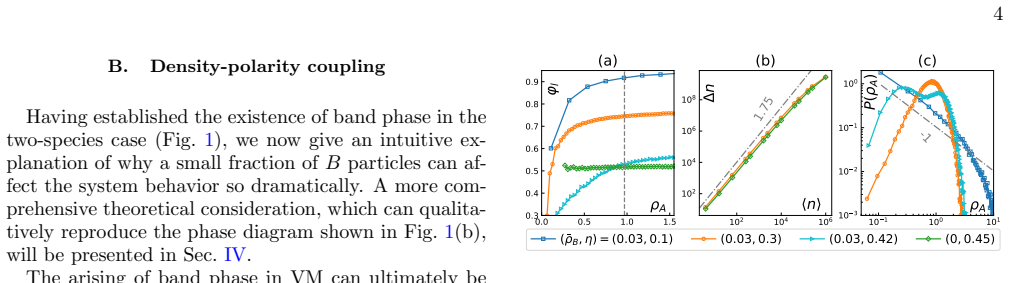
Using agent-based simulations of the two-species Voronoi Vicsek model with $J_{AA}=J_{AB}=1$ and $J_{BA}=J_{BB}=0$, the paper shows that at a dissenter fraction of about 3 percent the finite-size phase diagram in the $(\bar\rho_B, \eta)$ plane is reentrant: bands form near the order-disorder transition and again at $\eta$ far below it, with a polar liquid in between. Raising the dissenter fraction shrinks the polar liquid window, which disappears near $\bar\rho_B\approx 0.05$, and above $\bar\rho_B\approx 0.48$ the system is always disordered. In the low-noise band regime the coexisting background is polar and inhomogeneous, with a density probability distribution that decays monotonically, in contrast to the bimodal distribution and disordered gas of the high-noise bands. On the theory side, linear stability analysis of the two-species Boltzmann hierarchy with truncation order $K=100$ reproduces the simulation phase diagram, whereas the hydrodynamic equations obtained by enslaving the second angular mode give a spurious low-noise instability in the one-species limit. The paper concludes that the higher-order angular modes are essential for the reentrant behavior.
Load-bearing premise
The load-bearing premise is that the low-noise traveling-band state seen in snapshots at L=400 and at L=2000 for three noise values is a genuine steady-state phase of the infinite system, not a long-lived transient or finite-size artifact.
Editorial extensions
If this is right
- The one-species Voronoi-VM transition is a limiting case; any positive density of non-aligning dissenters makes the approach to the transition qualitatively different, likely driving the order-disorder transition discontinuous in the thermodynamic limit.
- Traveling bands are no longer a signature only of the coexistence region near the transition; they can be a low-noise phase, so phase diagrams of binary topological flocks must be mapped in the full (dissenter fraction, noise) plane.
- Hydrodynamic descriptions truncated at density and polarization are insufficient for low-noise topological flocks; kinetic closures with high angular modes are needed to predict instabilities.
- The low-noise bands represent microphase separation between two ordered states, a coexistence form not present in standard metric-flock band pictures.
Reading between the lines
- Beyond the paper's Voronoi simulations, a clean test would replace Voronoi shells with k-nearest-neighbor shells; the authors expect the same reentrant bands, but this is not demonstrated here.
- An engineering corollary: for robot swarms using topological communication, adding a small set of non-aligning agents and tuning noise could produce persistent band patterns rather than destroying alignment, reversing the usual intuition that heterogeneity only disorders a flock.
- The reentrant mechanism is likely generic to any perturbation that couples local density to local order in metric-free systems, e.g. two species with different noise temperatures; the paper gestures at this but does not simulate it.
Signed reviews
Editorial analysis
A structured set of objections, weighed in public.
Referee Report
Summary. The paper studies a two-species metric-free Vicsek model with Voronoi neighbors, in which A particles align with all neighbors while B particles align with nothing. Simulations at L=400, with selected checks at L=2000, indicate that adding a small fraction of B dissenters makes the phase diagram reentrant in noise: traveling bands appear both near the order-disorder transition and at low noise, separated by a homogeneous polar liquid. The low-noise bands are reported to travel through an ordered, inhomogeneous background, in contrast to the usual bands in metric flocks. The authors derive a two-species kinetic theory from a low-collision-rate Boltzmann equation, truncate the angular-mode hierarchy at order K, and perform linear stability analyses at both hydrodynamic and kinetic levels. They conclude that the kinetic equations with higher-order angular modes account for the reentrant phase behavior.
Significance. If the reentrant phase behavior is robust, the result is significant: it shows that a tiny non-aligning minority can qualitatively change the phase behavior of a topological flock, and that topological flocks can be more sensitive to population heterogeneity than their metric counterparts. The paper has clear strengths: the kinetic theory is derived from the microscopic rules with stated assumptions rather than fitted to simulation data, the stability analysis is carried out at several truncation orders, and the simulation evidence includes order parameters, Binder cumulants, density distributions, and L=2000 snapshots. However, the reported K-dependence of the low-noise instability currently conflicts with the paper's stated theoretical mechanism, and the finite-size evidence for the low-noise band regime is thinner than the central claim requires. Both issues need to be resolved before the theoretical account can be accepted.
major comments (3)
- [Sec. IV.B.3, Fig. 4(b-d)] The central theoretical claim in Sec. V—that the kinetic equations 'can account for the reentrant phase behavior qualitatively, provided the higher-order angular modes are taken into consideration'—is undermined by the K-dependence reported in Sec. IV.B.3. The text states that as K increases from 2 to 100, 'the instability regime on the left-hand side of the homogeneous ordered regime shrinks, and almost vanishes at K = 100' (Fig. 4(d)). That left-hand regime is precisely the low-noise instability intended to explain the low-noise bands in Fig. 1(b). The convergence behavior therefore indicates that the higher-order modes suppress the low-noise instability rather than making it robust. The authors need to show quantitatively whether a finite low-noise unstable region remains at K=100 for the simulated parameter window (e.g., rho_B=0.03, eta=0.1), for instance by overlaying the K=100 instability boundaries on the simulation phase diagram. Without this, the resemblance of Fig. 4(d) to Fig. 1(b) is at most partial and does not support the stated conclusion.
- [Sec. III A, Fig. 1] The reentrant band regime is the central simulation result, but its phase boundaries in Fig. 1(b) are 'delineated by visual inspection of snapshots' (Sec. III A), and the L=2000 confirmation is limited to three noise values at rho_B=0.03 (Figs. 1(d-f)). This leaves open the possibility that the low-noise band state is a long-lived transient or a finite-size microphase-separation pattern rather than a genuine steady-state phase in the thermodynamic limit. The Binder cumulant data in Fig. 1(c) are consistent with reentrance, but the paper does not provide systematic finite-size scaling of the phase boundaries, error bars for the boundaries, or time-resolved evidence of stationarity beyond t=10^6. The authors should quantify the L-dependence of the low-noise band regime, for example by varying L at several eta values inside and outside the claimed band region, or should soften the claim to a finite-size observation.
- [Sec. IV.B.2 and IV.B.3] The label 'spurious' for the hydrodynamic low-noise instability is justified by the observation that it exists at rho_B=0, where simulations show no bands. The same diagnostic is not applied to the kinetic-level low-noise instability. If the K=100 kinetic instability also persists at rho_B=0, or if it disappears entirely as K grows, then by the paper's own criterion it should also be considered spurious, and the theoretical explanation of the reentrant low-noise bands would lose its support. Please report the rho_B=0 behavior of the kinetic instability at K=100 and the K-dependence of its boundary for fixed small rho_B, so that the distinction between the hydrodynamic and kinetic instabilities is established rather than assumed.
minor comments (4)
- [Fig. 2 caption] The caption lists panels (a), (b), and (d), skipping (c); the probability distribution function panel should be labeled (c) consistently with the text.
- [Sec. IV A] The phrase 'In Fig. (5b)' should read 'In Eq. (5b)', since the text is discussing the coefficient of the linear term in Eq. (5b).
- [Sec. IV.B.3] The sentence 'for eta > eta_t the homogeneous disordered solution is always stable (gray regions in Fig. 2)' should refer to Fig. 4, not Fig. 2.
- [Sec. II] The notation bar_rho_B is used both as a density and as a fraction; because rho_0=1, this is harmless, but the paper should state explicitly that bar_rho_B is measured in units of the total mean density.
Circularity Check
No significant circularity: the kinetic theory is derived from the microscopic collision rules with stated assumptions and no fitted parameters; the K-dependence concern is a robustness issue, not a circular reduction.
full rationale
The paper's central claim is based on agent-based simulations of the Voronoi-VM, and the continuous theory is derived from a two-species Boltzmann equation (Eq. 2) using the low-collision-rate assumptions of Ref. [39], extended to the binary case with B particles as passive dissenters (Eq. 3). No parameter is fitted to the simulation phase diagram: the truncation order K is a convergence choice, and the stability diagrams in Fig. 4 are computed from the same microscopic rules with stated assumptions. The self-citation to Refs. [48,65] is anecdotal contextual support for the role of higher-order angular modes, not load-bearing for the derivation. The reported shrinkage of the low-noise instability with increasing K (Sec. IV.B.3) is an internal robustness concern for the theoretical account, but it does not make the derivation equivalent to its inputs; the theory would still be an independent calculation even if the prediction fails. The phase boundaries by visual inspection are subjective but not circular. Therefore no circularity is found.
Assumptions & free parameters
free parameters (2)
- Collision rate alpha in rescaled units =
1 (set for simplicity)
- Kinetic hierarchy truncation order K =
100 (chosen for convergence)
assumptions (5)
- domain assumption Low collision rate approximation: binary collisions dominate and orientations decorrelate between collisions
- domain assumption Collision kernel independent of relative angles and inversely proportional to total local density
- domain assumption Scaling ansatz near onset of polar order (Eq. 4)
- domain assumption Quasi-stationary enslaving of the second angular mode f_2,A
- domain assumption Uniform and angularly isotropic solution for species B (Eq. 3)
Cite this review
Pith. "Pith review of Reentrant phase behavior in binary topological flocks with nonreciprocal alignment." pith.science (2026). https://pith.science/paper/ONG5A3JO
@misc{pith2026241211871,
  author       = {Pith},
  title        = {Pith review of: Reentrant phase behavior in binary topological flocks with nonreciprocal alignment},
  year         = {2026},
  howpublished = {\url{https://pith.science/paper/ONG5A3JO}},
  note         = {Machine review of arXiv:2412.11871}
}
abstract
We study a binary metric-free Vicsek model involving two species of self-propelled particles aligning with their Voronoi neighbors, focusing on a weakly nonreciprocal regime, where species $A$ aligns with both $A$ and $B$, but species $B$ does not align with either. Using agent-based simulations, we find that even with a small fraction of $B$ particles, the phase behavior of the system can be changed qualitatively, which becomes reentrant as a function of noise strength: traveling bands arise not only near the flocking transition, but also in the low-noise regime, separated in the phase diagram by a homogeneous polar liquid regime. We find that the ordered bands in the low-noise regime travel through an ordered background, in contrast to their metric counterparts. We develop a coarse-grained field theory, which can account for the reentrant phase behavior qualitatively, provided the higher-order angular modes are taken into consideration.
Figures


Figures from the paper (2 more)


Reference graph
Works this paper leans on
-
[1]
Linear instability near the order-disorder transition Near the order-disorder transition, we show in Ap- pendix C 1 a that dynamics of δnA is decoupled from those of δρA and δwA, so that we only need to consider the coupled equations about the latter two. Solving the corresponding quadratic eigenvalue problem and denot- ing by σ the growth rates of pertur...
-
[2]
Spurious linear instability for hydrodynamic equations Now we solve numerically the cubic eigenvalue prob- lem for the linear system (8), taking into account the coupled dynamics of δρ, δwA and δnA. Following the procedure detailed in Appendix C 1 b, we get the lin- ear stability diagram shown in Fig. 4(a). Remarkably, now a low-noise instability regime a...
-
[3]
Linear instability for kinetic equations To get round the spurious instability that arises at hydrodynamic level (Fig. 4(a)), we turn to performing the linear stability analysis for the kinetic equations (2) directly. After truncating the infinite hierarchy (2a) at a given order K by setting fk,A = 0 for all |k| > K, we get K + 1 closed kinetic equations ...
-
[4]
Hydrodynamic level Following Ref. [72], we write wA in terms of its mag- nitude and direction, letting wA = wˆn, where we have omitted the subscript A for magnitude w and unit vec- tor ˆn in order to lighten the notation. Perturbations in wA can then be written as δwA = ˆn0δw + w0δn, where w0 = p µ/ξ, and ˆn0 · δn = 0 to ensure |ˆn| = 1 to linear order. S...
-
[5]
After some algebra, we find ℜ(σ) > 0 iff w2 0(2(µ′ − ξ′w2
− 2(µ′ − ξ′w2 0)). After some algebra, we find ℜ(σ) > 0 iff w2 0(2(µ′ − ξ′w2
-
[6]
(9) as q → 0 by noting that w2 0 = µ/ξ
− γ(νq 2 + 2ξw 2 0))2 > (νq 2 + 2ξw 2 0)2(2 + w2 0γ2), (C6) which is reduced to Eq. (9) as q → 0 by noting that w2 0 = µ/ξ. b. Numerical method for the cubic eigenvalue problem To calculate the growth rates of linear system (8), for given ¯ρB, η and wave vector q = q(cos ϕ, sin ϕ), from Eqs. (B6) and (C3) we obtain the corresponding matrix M (q), whose ei...
-
[7]
Kinetic level Here we show the details how we perform linear in- stability analysis at kinetic level leading to the linear diagrams shown in Fig. 4(b-d). Given that the stable solution for species B has been given by Eq. (3), we only need to perform the linear instability analysis on the ki- netic equation for species A. To get closed equations for specie...
- [8]
Show all 79 references
-
[9]
Chat´ e, Dry aligning dilute active matter, Annual Re- view of Condensed Matter Physics 11, 189 (2020)
H. Chat´ e, Dry aligning dilute active matter, Annual Re- view of Condensed Matter Physics 11, 189 (2020)
2020
-
[10]
Toner, The Physics of Flocking: Birth, Death, and Flight in Active Matter (Cambridge University Press, 2024)
J. Toner, The Physics of Flocking: Birth, Death, and Flight in Active Matter (Cambridge University Press, 2024)
2024
-
[11]
Solon, Thirty years of surprises about collective mo- tion, Europhysics News 55, 28 (2024)
A. Solon, Thirty years of surprises about collective mo- tion, Europhysics News 55, 28 (2024)
2024
-
[12]
Bain and D
N. Bain and D. Bartolo, Dynamic response and hydro- dynamics of polarized crowds, Science 363, 46 (2019)
2019
-
[13]
Ballerini, N
M. Ballerini, N. Cabibbo, R. Candelier, A. Cavagna, E. Cisbani, I. Giardina, V. Lecomte, A. Orlandi, G. Parisi, A. Procaccini, et al., Interaction ruling an- imal collective behavior depends on topological rather than metric distance: Evidence from a field study, Pro- ceedings...
2008
-
[14]
Cavagna, A
A. Cavagna, A. Cimarelli, I. Giardina, G. Parisi, R. San- tagati, F. Stefanini, and M. Viale, Scale-free correlations in starling flocks, Proceedings of the National Academy of Sciences 107, 11865 (2010)
2010
-
[15]
Nishiguchi, K
D. Nishiguchi, K. H. Nagai, H. Chat´ e, and M. Sano, Long-range nematic order and anomalous fluctuations in suspensions of swimming filamentous bacteria, Phys- ical Review E 95, 020601 (2017)
2017
-
[16]
Schaller, C
V. Schaller, C. Weber, C. Semmrich, E. Frey, and A. R. Bausch, Polar patterns of driven filaments, Nature 467, 73 (2010)
2010
-
[17]
Bricard, J.-B
A. Bricard, J.-B. Caussin, N. Desreumaux, O. Dauchot, and D. Bartolo, Emergence of macroscopic directed mo- tion in populations of motile colloids, Nature 503, 95 (2013)
2013
-
[18]
S. Das, M. Ciarchi, Z. Zhou, J. Yan, J. Zhang, and R. Alert, Flocking by turning away, Physical Review X 14, 031008 (2024)
2024
-
[19]
Deseigne, O
J. Deseigne, O. Dauchot, and H. Chat´ e, Collective mo- tion of vibrated polar disks, Physical review letters 105, 098001 (2010)
2010
-
[20]
Kumar, H
N. Kumar, H. Soni, S. Ramaswamy, and A. Sood, Flock- ing at a distance in active granular matter, Nature com- munications 5, 4688 (2014)
2014
-
[21]
V´ as´ arhelyi, C
G. V´ as´ arhelyi, C. Vir´ agh, G. Somorjai, T. Nepusz, A. E. Eiben, and T. Vicsek, Optimized flocking of autonomous drones in confined environments, Science Robotics 3, eaat3536 (2018)
2018
-
[22]
Y. Tu, J. Toner, and M. Ulm, Sound waves and the absence of galilean invariance in flocks, Physical review letters 80, 4819 (1998)
1998
-
[23]
Geyer, A
D. Geyer, A. Morin, and D. Bartolo, Sounds and hydro- dynamics of polar active fluids, Nature materials17, 789 (2018)
2018
-
[24]
Mahault, F
B. Mahault, F. Ginelli, and H. Chat´ e, Quantitative As- sessment of the Toner and Tu Theory of Polar Flocks, Phys. Rev. Lett. 123, 218001 (2019)
2019
-
[25]
Tasaki, Hohenberg-mermin-wagner-type theorems for equilibrium models of flocking, Physical Review Let- ters 125, 220601 (2020)
H. Tasaki, Hohenberg-mermin-wagner-type theorems for equilibrium models of flocking, Physical Review Let- ters 125, 220601 (2020)
2020
-
[26]
Mahault and H
B. Mahault and H. Chat´ e, Long-range nematic order in two-dimensional active matter, Physical Review Letters 127, 048003 (2021)
2021
-
[27]
G. Fava, A. Gambassi, and F. Ginelli, Strong casimir- like forces in flocking active matter, Physical Review Letters 133, 148301 (2024)
2024
-
[28]
Ginelli and H
F. Ginelli and H. Chat´ e, Relevance of metric-free inter- actions in flocking phenomena, Physical review letters 105, 168103 (2010)
2010
-
[29]
Martin, H
D. Martin, H. Chat´ e, C. Nardini, A. Solon, J. Tailleur, and F. Van Wijland, Fluctuation-induced phase separa- tion in metric and topological models of collective mo- tion, Physical Review Letters 126, 148001 (2021)
2021
-
[30]
Martin, G
D. Martin, G. Spera, H. Chat´ e, C. Duclut, C. Nardini, J. Tailleur, and F. van Wijland, Fluctuation-induced first order transition to collective motion, Journal of Statistical Mechanics: Theory and Experiment 2024, 084003 (2024)
2024
-
[31]
Rahmani, F
P. Rahmani, F. Peruani, and P. Romanczuk, Topologi- cal flocking models in spatially heterogeneous environ- ments, Communications Physics 4, 206 (2021)
2021
-
[32]
Shi, L.-C
H.-D. Shi, L.-C. Du, F.-J. Huang, and W. Guo, Collec- tive topological active particles: Non-ergodic superdif- fusion and ageing in complex environments, Chaos, Soli- tons & Fractals 157, 111935 (2022)
2022
-
[33]
Ito and N
S. Ito and N. Uchida, Boltzmann approach to collective motion via non-local visual interaction, arXiv preprint arXiv:2408.09917 (2024). 13
2024 arXiv
-
[34]
A. P. Solon, H. Chat´ e, and J. Tailleur, From phase to microphase separation in flocking models: The essen- tial role of nonequilibrium fluctuations, Physical review letters 114, 068101 (2015)
2015
-
[35]
Y. Duan, B. Mahault, Y.-q. Ma, X.-q. Shi, and H. Chat´ e, Breakdown of ergodicity and self-averaging in polar flocks with quenched disorder, Physical Review Letters 126, 178001 (2021)
2021
-
[36]
Bertrand and C
T. Bertrand and C. F. Lee, Diversity of phase transitions and phase separations in active fluids, Physical Review Research 4, L022046 (2022)
2022
-
[37]
Jentsch and C
P. Jentsch and C. F. Lee, Critical phenomena in com- pressible polar active fluids: Dynamical and functional renormalization group studies, Physical Review Re- search 5, 023061 (2023)
2023
-
[38]
Agranov, R
T. Agranov, R. L. Jack, M. E. Cates, and ´E. Fodor, Thermodynamically consistent flocking: from discontin- uous to continuous transitions, New Journal of Physics 26, 063006 (2024)
2024
-
[39]
Gautrais, F
J. Gautrais, F. Ginelli, R. Fournier, S. Blanco, M. Soria, H. Chat´ e, and G. Theraulaz, Deciphering interactions in moving animal groups, PLoS Computational Biology 8 (2012)
2012
-
[40]
Camperi, A
M. Camperi, A. Cavagna, I. Giardina, G. Parisi, and E. Silvestri, Spatially balanced topological interaction grants optimal cohesion in flocking models, Interface fo- cus 2, 715 (2012)
2012
-
[41]
Ginelli, F
F. Ginelli, F. Peruani, M.-H. Pillot, H. Chat´ e, G. Ther- aulaz, and R. Bon, Intermittent collective dynamics emerge from conflicting imperatives in sheep herds, Pro- ceedings of the National Academy of Sciences 112, 12729 (2015)
2015
-
[42]
D. J. Pearce, A. M. Miller, G. Rowlands, and M. S. Turner, Role of projection in the control of bird flocks, Proceedings of the National Academy of Sciences 111, 10422 (2014)
2014
-
[43]
Jiang, L
L. Jiang, L. Giuggioli, A. Perna, R. Escobedo, V. Lecheval, C. Sire, Z. Han, and G. Theraulaz, Iden- tifying influential neighbors in animal flocking, PLoS Computational Biology 13 (2017)
2017
-
[44]
Jhawar, R
J. Jhawar, R. G. Morris, U. Amith-Kumar, M. Danny Raj, T. Rogers, H. Rajendran, and V. Guttal, Noise-induced schooling of fish, Nature Physics 16, 488 (2020)
2020
-
[45]
Moussa ¨ ıd, D
M. Moussa ¨ ıd, D. Helbing, and G. Theraulaz, How sim- ple rules determine pedestrian behavior and crowd dis- asters, Proceedings of the National Academy of Sciences 108, 6884 (2011)
2011
-
[46]
Peshkov, S
A. Peshkov, S. Ngo, E. Bertin, H. Chat´ e, and F. Ginelli, Continuous theory of active matter systems with metric- free interactions, Physical review letters 109, 098101 (2012)
2012
-
[47]
Y.-L. Chou, R. Wolfe, and T. Ihle, Kinetic theory for systems of self-propelled particles with metric-free in- teractions, Physical Review E—Statistical, Nonlinear, and Soft Matter Physics 86, 021120 (2012)
2012
-
[48]
C. R. Packard and D. M. Sussman, Banded phases in topological flocks, arXiv preprint arXiv:2409.05198 (2024)
2024 arXiv
-
[49]
Maity and A
S. Maity and A. Morin, Spontaneous demixing of binary colloidal flocks, Phys. Rev. Lett. 131, 178304 (2023)
2023
-
[50]
Soto and R
R. Soto and R. Golestanian, Self-assembly of cat- alytically active colloidal molecules: tailoring activity through surface chemistry, Physical review letters 112, 068301 (2014)
2014
-
[51]
F. A. Lavergne, H. Wendehenne, T. B¨ auerle, and C. Bechinger, Group formation and cohesion of ac- tive particles with visual perception–dependent motil- ity, Science 364, 70 (2019)
2019
-
[52]
Fruchart, R
M. Fruchart, R. Hanai, P. B. Littlewood, and V. Vitelli, Non-reciprocal phase transitions, Nature 592, 363 (2021)
2021
-
[53]
S. Saha, J. Agudo-Canalejo, and R. Golestanian, Scalar active mixtures: The nonreciprocal Cahn-Hilliard model, Phys. Rev. X 10, 041009 (2020)
2020
-
[54]
Z. You, A. Baskaran, and M. C. Marchetti, Nonreciproc- ity as a generic route to traveling states, Proc. Natl. Acad. Sci. USA. 117, 19767 (2020)
2020
-
[55]
Y. Duan, J. Agudo-Canalejo, R. Golestanian, and B. Mahault, Dynamical Pattern Formation without Self-Attraction in Quorum-Sensing Active Matter: The Interplay between Nonreciprocity and Motility, Phys. Rev. Lett. 131, 148301 (2023)
2023
-
[56]
Dinelli, J
A. Dinelli, J. O’Byrne, A. Curatolo, Y. Zhao, P. Sollich, and J. Tailleur, Non-reciprocity across scales in active mixtures, Nat. Commun. 14, 7035 (2023)
2023
-
[57]
J. Chen, X. Lei, Y. Xiang, M. Duan, X. Peng, and H. Zhang, Emergent chirality and hyperuniformity in an active mixture with nonreciprocal interactions, Physical Review Letters 132, 118301 (2024)
2024
-
[58]
R. Kant, R. K. Gupta, H. Soni, A. Sood, and S. Ra- maswamy, Bulk condensation by an active interface, Physical Review Letters 133, 208301 (2024)
2024
-
[59]
Q.-s. Chen, A. Patelli, H. Chat´ e, Y.-q. Ma, and X.-q. Shi, Fore-aft asymmetric flocking, Physical Review E 96, 020601 (2017)
2017
-
[60]
Martin, D
D. Martin, D. Seara, Y. Avni, M. Fruchart, and V. Vitelli, An exact model for the transition to collective motion in nonreciprocal active matter, arXiv preprint arXiv:2307.08251 (2023)
2023
-
[61]
K. L. Kreienkamp and S. H. Klapp, Non-reciprocal alignment induces asymmetric clustering in active repul- sive mixtures, arXiv preprint arXiv:2403.19291 (2024)
2024 arXiv
-
[62]
Mangeat, S
M. Mangeat, S. Chatterjee, J. D. Noh, and H. Rieger, Emergent complex phases in a discrete flocking model with reciprocal and non-reciprocal interactions, arXiv preprint arXiv:2412.02501 (2024)
2024 arXiv
-
[63]
P. K. Bera and A. Sood, Motile dissenters disrupt the flocking of active granular matter, Physical Review E 101, 052615 (2020)
2020
-
[64]
Yllanes, M
D. Yllanes, M. Leoni, and M. Marchetti, How many dissenters does it take to disorder a flock?, New Journal of Physics 19, 103026 (2017)
2017
-
[65]
Bertin, M
E. Bertin, M. Droz, and G. Gr´ egoire, Hydrody- namic equations for self-propelled particles: microscopic derivation and stability analysis, Journal of Physics A: Mathematical and Theoretical 42, 445001 (2009)
2009
-
[66]
Mishra, A
S. Mishra, A. Baskaran, and M. C. Marchetti, Fluc- 14 tuations and pattern formation in self-propelled par- ticles, Physical Review E—Statistical, Nonlinear, and Soft Matter Physics 81, 061916 (2010)
2010
-
[67]
Miller and J
M. Miller and J. Toner, Following your nose: Au- tochemotaxis and other mechanisms for spinodal de- composition in flocks, Physical Review Letters 132, 128301 (2024)
2024
-
[68]
A. P. Solon, J.-B. Caussin, D. Bartolo, H. Chat´ e, and J. Tailleur, Pattern formation in flocking models: A hy- drodynamic description, Physical Review E 92, 062111 (2015)
2015
-
[69]
Mahault, Outstanding problems in the statistical physics of active matter, Ph.D
B. Mahault, Outstanding problems in the statistical physics of active matter, Ph.D. thesis, Universit´ e Paris Saclay (COmUE) (2018)
2018
-
[70]
Peshkov, E
A. Peshkov, E. Bertin, F. Ginelli, and H. Chat´ e, Boltzmann-ginzburg-landau approach for continuous descriptions of generic vicsek-like models, The European Physical Journal Special Topics 223, 1315 (2014)
2014
-
[71]
Bertin, M
E. Bertin, M. Droz, and G. Gr´ egoire, Boltzmann and hydrodynamic description for self-propelled particles, Physical Review E—Statistical, Nonlinear, and Soft Matter Physics 74, 022101 (2006)
2006
-
[72]
Y. Duan, J. Agudo-Canalejo, R. Golestanian, and B. Mahault, Phase coexistence in nonrecipro- cal quorum-sensing active matter, arXiv preprint arXiv:2411.05465 (2024)
2024 arXiv
-
[73]
Seyed-Allaei, L
H. Seyed-Allaei, L. Schimansky-Geier, and M. R. Ejte- hadi, Gaussian theory for spatially distributed self- propelled particles, Physical Review E 94, 062603 (2016)
2016
-
[74]
Joanny, Nonequilibrium statistical mechanics of mixtures of particles in contact with different ther- mostats, Physical Review E 92, 032118 (2015)
J.-F. Joanny, Nonequilibrium statistical mechanics of mixtures of particles in contact with different ther- mostats, Physical Review E 92, 032118 (2015)
2015
-
[75]
S. N. Weber, C. A. Weber, and E. Frey, Binary mixtures of particles with different diffusivities demix, Physical review letters 116, 058301 (2016)
2016
-
[76]
Damman, V
P. Damman, V. D´ emery, G. Palumbo, and Q. Thomas, Algebraic depletion interactions in two-temperature mixtures, arXiv preprint arXiv:2406.11616 (2024)
2024 arXiv
-
[77]
Dorigo, D
M. Dorigo, D. Floreano, L. M. Gambardella, F. Mon- dada, S. Nolfi, T. Baaboura, M. Birattari, M. Bonani, M. Brambilla, A. Brutschy, et al., Swarmanoid: a novel concept for the study of heterogeneous robotic swarms, IEEE Robotics & Automation Magazine 20, 60 (2013)
2013
-
[78]
Yasuda, A
T. Yasuda, A. Adachi, and K. Ohkura, Self-organized flocking of a mobile robot swarm by topological distance-based interactions, in 2014 IEEE/SICE In- ternational Symposium on System Integration (IEEE,
2014
-
[79]
M. C. Marchetti, J. F. Joanny, S. Ramaswamy, T. B. Liverpool, J. Prost, M. Rao, and R. A. Simha, Hydro- dynamics of soft active matter, Rev. Mod. Phys. 85, 1143 (2013)
2013
Reviewed August 11, 2026 · model on record in the stance chip above.
Discussion (0). Continue with ORCID to comment.