REVIEW 4 major objections 5 minor 147 references
Accelerating lensed quasar discovery and modeling with physics-informed variational autoencoders
T0 review · 4 major / 5 minor · reviewed 2026-08-11 · deepseek-v4-flash
Pith's one-line read The paper presents VariLens, a physics-informed variational autoencoder that detects lensed quasars and estimates their singular-isothermal-ellipsoid mass parameters in a single forward pass, and reports 42 candidate systems from Hyper…
desk verdict A genuinely integrated VAE-based pipeline for lensed quasar detection and SIE parameter estimation, with solid mock-data results but weaker and partly circular real-data validation; worth refereeing with revisions. read the letter →
The pith
A machine-rendered reading of the paper's core claim, the machinery that carries it, and where it could break.
The reading
What carries the argument
The load-bearing object is VariLens, a physics-informed variational autoencoder whose 64-dimensional latent space is shared by three heads: a decoder that reconstructs the input image, a regressor that maps the latent vector to a Gaussian distribution over the SIE-plus-shear and source parameters, and a classification layer added after training. A singular isothermal ellipsoid is a standard mass profile whose Einstein radius sets the image scale of the lensed source. The physics-informed part is the Gaussian negative-log-likelihood loss on the predicted parameters, which forces the latent representation to encode the lens configuration while the reconstruction and KL terms keep it generative and regularized. This shared-latent design is what lets one forward pass return both a lens probability and a mass model in milliseconds.
What would settle it
The decisive observation is spectroscopic confirmation of the 42 grade A and B candidates plus high-resolution Einstein-radius measurements of the confirmed systems: if most of the grade A candidates turn out not to be lenses, or if confirmed systems at $\theta_\mathrm{E}<3$ arcsec disagree with VariLens by more than $2\sigma$, the central claim of fast, reliable end-to-end lens modeling is not supported.
Extended reading notes
Core claim
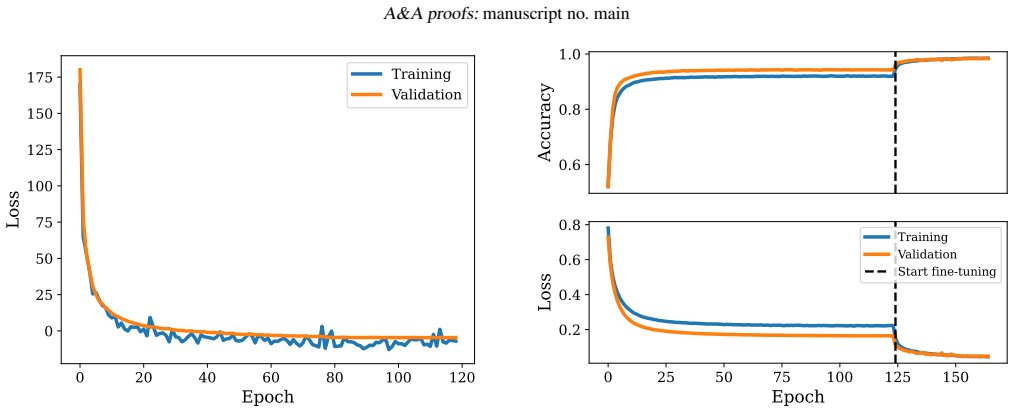
The paper claims that a single physics-informed variational autoencoder can replace separate detection, classification, and modeling stages in strong-lens searches. Its encoder-decoder reconstructs five-band HSC cutouts, a regressor branch predicts 11 physical parameters (lens center, complex ellipticity, Einstein radius, external shear, deflector and source redshifts, and source position) from the latent vector, and a fine-tuned classification head turns the same encoder into a lens/non-lens classifier. The physics enters through the loss: reconstruction mean squared error plus Kullback-Leibler divergence plus a Gaussian negative log-likelihood that ties the latent representation to parameters of an SIE + external-shear lens model. On simulated test data the network recovers most parameters with $R^2 \gtrsim 0.8$, except external shear, which it pins near zero; on real data, VariLens and traditional modeling agree within $2\sigma$ for the Einstein radius and positions of systems with $\theta_\mathrm{E}<3$ arcsec, and the full pipeline yields 42 grade A and B candidates from 80 million HSC sources.
Load-bearing premise
The load-bearing premise is that the simulated training images—real galaxy cutouts with fake quasar point sources bent through a standard elliptical mass model—are representative enough of real HSC lensed quasars that the network's detection and parameter estimates carry over to survey data.
Editorial extensions
If this is right
- One CPU can screen survey-scale catalogs: the 80-million-source HSC parent sample is reduced to 13,831 network-ranked candidates and then to 42 visually confirmed candidate lenses, making spectroscopic follow-up feasible.
- For lenses with $\theta_\mathrm{E}\lesssim2$ arcsec, VariLens's Einstein radius, center, and source-position estimates can warm-start or cross-check traditional lens models, which otherwise take hours to weeks per system.
- The same architecture transfers to upcoming wide surveys such as LSST and Euclid once retrained on their bandpasses, seeing, and pixel scale, with the learned Lyman-break feature giving more reliable source redshifts at $z\gtrsim3$.
- Because external shear is not recoverable from ground-based HSC images with this approach, shear-sensitive time-delay cosmography targets would still need higher-resolution or deeper data.
Reading between the lines
- The training-set bias toward bright SDSS luminous red galaxies at $z\lesssim1$ likely limits completeness for compact, faint, or high-redshift deflectors; resampling the simulation to a uniform $\theta_\mathrm{E}$-$z_\mathrm{gal}$ distribution is an implicit, testable remedy the paper leaves for future work.
- A natural extension is to use VariLens's latent vector itself as a ranking feature, since the t-SNE analysis shows lenses and contaminants separate in the learned representation even before classifier fine-tuning.
- If the 42 candidates are confirmed, their predicted Einstein radii and source redshifts could immediately prioritize which objects enter time-delay monitoring, connecting the discovery pipeline to $H_0$ measurements.
- Running the same network on known lenses with $\theta_\mathrm{E}>2$ arcsec would quantify how much of the reported underestimation at large Einstein radii comes from training-set scarcity versus the SIE prior itself.
Editorial analysis
A structured set of objections, weighed in public.
Referee Report
Summary. The manuscript presents VariLens, a physics-informed variational autoencoder that jointly performs image reconstruction, lens/non-lens classification, and SIE+γext parameter estimation for lensed quasars in HSC imaging. The network is trained on 137,552 simulated lensed quasar images built from real HSC galaxy cutouts and SIMQSO quasar spectra. On a held-out mock test set, the model achieves high R² values for the Einstein radius, lens centers, ellipticities, and source positions, but fails to recover external shear. The paper then compares the network's parameter estimates with PyAutoLens models for 20 known GLQD lenses and reports consistency within 2σ for θ_E<3". Finally, applying a multiwavelength preselection (80 million to 710,966 sources) and the VariLens classifier yields 13,831 candidates, of which 42 are visually graded A or B.
Significance. If the accuracy claims hold, VariLens would be a valuable tool for rapid triage and preliminary modeling of lensed quasars in upcoming surveys such as LSST and Euclid, where traditional modeling is computationally expensive. The paper's strengths include the use of realistic simulations on actual HSC galaxy images, the explicit public release of candidate tables on Zenodo, and the candid discussion of known failure modes (external shear, source redshift, classifier purity). The integrated classification-plus-regression architecture is a useful engineering contribution. However, the current validation does not independently establish the headline accuracy, because the external comparison uses the same SIE+γext model shared by the training simulations and the traditional fitting, and the mock test set comes from the same simulator as the training data.
major comments (4)
- [Section 4.5.2, Fig. 12] The 2σ consistency between VariLens and PyAutoLens is not an independent accuracy check, because both methods assume the same SIE+γext mass model and the paper itself states that for doubly imaged quasars the point-source constraints are insufficient, producing fitting degeneracy. Agreement within 2σ can therefore hold even if both models are jointly biased. Please validate against independently measured quantities (e.g., stellar velocity dispersions, time-delay models, or spectroscopic source redshifts) or explicitly reframe the comparison as model consistency rather than accuracy.
- [Section 3.3, Eq. (17)] The uncertainty calibration is performed on the same test set used to report the mock R² values and the 2σ consistency in Fig. 12. Because the scaling factors are derived from the empirical errors on that set, the calibrated uncertainties are not an out-of-sample test of calibration; this circularity should be acknowledged and, ideally, the calibration should be checked on an independent validation set or through recalibration on real data.
- [Sections 4.4 and 4.5.2, Figs. 10 and 12] The transfer from simulations to real data is incomplete for several headline parameters: external shear recovery is essentially absent (R²≈0.03–0.07), source redshift is systematically overestimated with R²=0.16 and MAE=0.95, and ellipticity R² drops to 0.26–0.47 on real data. The abstract and conclusions should state these performance limits explicitly rather than describing the key parameters as reliably determined; at minimum, the 'key parameters' claim should be scoped to θ_E, lens centers, and (with caveats) ellipticity.
- [Section 4.5.1, Fig. 11] The classifier's real-data performance (16 of 22 known lenses recovered, 73% completeness, ~1% purity) is substantially below the near-perfect mock AUROC of 0.998. The discovery claims should present these real-data rates in the abstract and conclusions alongside the 42 candidates, and the paper should discuss whether the 42 visually selected candidates are consistent with the expected purity and with the 68% recovery rate of the catalog-level preselection.
minor comments (5)
- [Sections 4.5.1 and 4.5.2] The text reports 22 GLQD systems with HSC images for the classifier evaluation, but the regression comparison in Section 4.5.2 uses 20 systems; please clarify how the two systems are excluded from the regression analysis.
- [Section 2.4, Eq. (8)] The piecewise definition of the external shear orientation uses the notation 's/2' without clear parentheses; since s is defined in Eq. (9) via an arcsine, the expression should be rewritten with explicit brackets to avoid ambiguity.
- [Appendix C, Eq. (C.6)] There is a typo 'is is typically approximated', and the approximation for b_n should be described as an asymptotic or approximate expression rather than an equality over the full range of n.
- [Figure 12] The legend distinguishes doubles from quadruples, but the text does not discuss whether the agreement differs between these subclasses; adding one sentence would be useful because the degeneracy argument is specific to doubly imaged systems.
- [Section 2.3] The deflector sample is dominated by SDSS LRGs at z≲1, a bias that is acknowledged later in the paper; I recommend stating this bias when the training set is first introduced, since it directly affects the claimed transferability of the model.
Circularity Check
Real-data parameter validation reduces to a same-model (SIE+gamma_ext) consistency check; classification retains independent GLQD support.
-
self definitional
[Section 4.5.2 (Regression performance); training setup in Section 2.4]
"To evaluate the performance of our regression module compared to traditional, non-machine learning-based methods, we will utilize PyAutoLens for modeling the lensed quasars from GLQD. ... It is important to note that the number of data points for doubly imaged quasars in point-source lens modeling is insufficient to constrain the SIE + gamma_ext parameters, resulting in fitting degeneracy. Nonetheless, we adopt this approach for consistency in matching the output parameters predicted by VariLens."
VariLens's training labels are SIE+gamma_ext parameters produced by the mock generator in Section 2.4, and the PyAutoLens benchmark fits the same SIE+gamma_ext model, with mass ellipticity and center fixed to the light profile and Sersic index fixed to 4. The paper explicitly concedes that doubly imaged quasars have insufficient point-source constraints to determine SIE+gamma_ext parameters, so 2-sigma agreement can hold even when VariLens is biased because the traditional posterior is degenerate. Thus the abstract's claim that VariLens parameter estimates are validated by traditional modeling is a same-ansatz consistency check, not an accuracy test against independent ground truth.
full rationale
The core network architecture and the classification claim are not circular: VariLens is trained on mocks built from real HSC galaxy images plus simulated quasars, and its classifier is tested on 22 independently catalogued GLQD lenses (73% completeness, ~1% purity). The held-out test-set R2 values in Section 4.4 are standard in-distribution machine-learning evaluation and are not by themselves circular. The circular element is the parameter-estimation benchmark: the paper validates millisecond SIE+gamma_ext parameter estimates by comparing with PyAutoLens fits that assume the same SIE+gamma_ext model, and it explicitly states that double-image constraints are degenerate. Agreement within 2-sigma therefore demonstrates consistency between two implementations of the same assumed model, not accuracy on real lenses. This is partial circularity; the classification and discovery side remains independently supported, so the score is 4.
Assumptions & free parameters
free parameters (3)
- External shear distribution width =
σ=0.058 (Gaussian)
- Uncertainty calibration scaling factors =
per-parameter factors, values not tabulated
- Sérsic index in traditional modeling benchmark =
n = 4 (de Vaucouleurs)
assumptions (5)
- domain assumption SIE plus external shear describes real galaxy-scale lens mass distributions well enough for detection and first-pass modeling
- domain assumption Mass follows light: SIE ellipticity and center are taken from the HSC i-band light profile fit
- domain assumption SIMQSO quasar spectra with broken power-law continuum, iron templates, emission lines, IGM absorption, and dust reddening are representative of the real quasar population
- domain assumption The SDSS deflector sample with 50≤σ_v≤500 km/s, z<4, classified as galaxies, represents the real lens galaxy population in HSC
- domain assumption The PyAutoLens fits with fixed Sérsic index and light-profile-fixed mass ellipticity provide a valid reference for VariLens parameters
Cite this review
Pith. "Pith review of Accelerating lensed quasar discovery and modeling with physics-informed variational autoencoders." pith.science (2026). https://pith.science/paper/FZLBEOHD
@misc{pith2026241212709,
  author       = {Pith},
  title        = {Pith review of: Accelerating lensed quasar discovery and modeling with physics-informed variational autoencoders},
  year         = {2026},
  howpublished = {\url{https://pith.science/paper/FZLBEOHD}},
  note         = {Machine review of arXiv:2412.12709}
}
abstract
Strongly lensed quasars provide valuable insights into the rate of cosmic expansion, the distribution of dark matter in foreground deflectors, and the characteristics of quasar hosts. However, detecting them in astronomical images is difficult due to the prevalence of non-lensing objects. To address this challenge, we developed a generative deep learning model called VariLens, built upon a physics-informed variational autoencoder. This model seamlessly integrates three essential modules: image reconstruction, object classification, and lens modeling, offering a fast and comprehensive approach to strong lens analysis. VariLens is capable of rapidly determining both (1) the probability that an object is a lens system and (2) key parameters of a singular isothermal ellipsoid (SIE) mass model -- including the Einstein radius ($\theta_\mathrm{E}$), lens center, and ellipticity -- in just milliseconds using a single CPU. A direct comparison of VariLens estimates with traditional lens modeling for 20 known lensed quasars within the Subaru Hyper Suprime-Cam (HSC) footprint shows good agreement, with both results consistent within $2\sigma$ for systems with $\theta_\mathrm{E}<3$ arcsecs. To identify new lensed quasar candidates, we begin with an initial sample of approximately 80 million sources, combining HSC data with multiwavelength information from various surveys. After applying a photometric preselection aimed at locating $z>1.5$ sources, the number of candidates was reduced to 710,966. Subsequently, VariLens highlights 13,831 sources, each showing a high likelihood of being a lens. A visual assessment of these objects results in 42 promising candidates that await spectroscopic confirmation. These results underscore the potential of automated deep learning pipelines to efficiently detect and model strong lenses in large datasets.
Figures


Figures from the paper (7 more)


Reference graph
Works this paper leans on
-
[1]
, " * write output.state after.block = add.period write newline
ENTRY address archiveprefix author booktitle chapter edition editor howpublished institution eprint journal key month note number organization pages publisher school series title type volume year label extra.label sort.label short.list INTEGERS output.state before.all mid.sentence after.sentence after.block FUNCTION init.state.consts #0 'before.all := #1 ...
-
[2]
write newline
" write newline "" before.all 'output.state := FUNCTION n.dashify 't := "" t empty not t #1 #1 substring "-" = t #1 #2 substring "--" = not "--" * t #2 global.max substring 't := t #1 #1 substring "-" = "-" * t #2 global.max substring 't := while if t #1 #1 substring * t #2 global.max substring 't := if while FUNCTION word.in bbl.in " " * FUNCTION format....
-
[3]
2016, arXiv e-prints, arXiv:1605.08695
Abadi , M., Barham , P., Chen , J., et al. 2016, arXiv e-prints, arXiv:1605.08695
arXiv 2016
-
[4]
C., Treu , T., & Marshall , P
Agnello , A., Kelly , B. C., Treu , T., & Marshall , P. J. 2015, , 448, 1446
2015
-
[5]
L., Morgan , N
Agnello , A., Schechter , P. L., Morgan , N. D., et al. 2018, , 475, 2086
2018
-
[6]
2019, , 71, 114
Aihara , H., AlSayyad , Y., Ando , M., et al. 2019, , 71, 114
2019
-
[7]
2022, , 74, 247
Aihara , H., AlSayyad , Y., Ando , M., et al. 2022, , 74, 247
2022
-
[8]
2018, , 70, S8
Aihara , H., Armstrong , R., Bickerton , S., et al. 2018, , 70, S8
2018
Show all 147 references
-
[9]
F., Argudo-Fern \'a ndez , M., et al
Almeida , A., Anderson , S. F., Argudo-Fern \'a ndez , M., et al. 2023, , 267, 44
2023
-
[10]
Andika , I. T. 2022, PhD thesis, Max-Planck-Institute for Astronomy, Heidelberg
2022
-
[11]
T., Jahnke , K., Ba \ n ados , E., et al
Andika , I. T., Jahnke , K., Ba \ n ados , E., et al. 2022, , 163, 251
2022
-
[12]
T., Jahnke , K., Onoue , M., et al
Andika , I. T., Jahnke , K., Onoue , M., et al. 2020, , 903, 34
2020
-
[13]
T., Jahnke , K., van der Wel , A., et al
Andika , I. T., Jahnke , K., van der Wel , A., et al. 2023 a , , 943, 150
2023
-
[14]
T., Suyu , S
Andika , I. T., Suyu , S. H., Ca \ n ameras , R., et al. 2023 b , , 678, A103
2023
-
[15]
2021, , 500, 531
Arcelin , B., Doux , C., Aubourg , E., Roucelle , C., & LSST Dark Energy Science Collaboration . 2021, , 500, 531
2021
-
[16]
M., Sip o cz , B
Astropy Collaboration , Price-Whelan , A. M., Sip o cz , B. M., et al. 2018, , 156, 123
2018
-
[17]
P., Tollerud , E
Astropy Collaboration , Robitaille , T. P., Tollerud , E. J., et al. 2013, , 558, A33
2013
-
[18]
2020, arXiv e-prints, arXiv:2003.05991
Bank , D., Koenigstein , N., & Giryes , R. 2020, arXiv e-prints, arXiv:2003.05991
2020 arXiv
-
[19]
1998, , 502, 531
Barkana , R. 1998, , 502, 531
1998
-
[20]
W., Moiseev , A., et al
Belokurov , V., Evans , N. W., Moiseev , A., et al. 2007, , 671, L9
2007
-
[21]
Best , W. M. J., Magnier , E. A., Liu , M. C., et al. 2018, , 234, 1
2018
-
[22]
R., Bershady , M
Blanton , M. R., Bershady , M. A., Abolfathi , B., et al. 2017, , 154, 28
2017
-
[23]
H., et al
Bonvin , V., Courbin , F., Suyu , S. H., et al. 2017, , 465, 4914
2017
-
[24]
Boroson , T. A. & Green , R. F. 1992, , 80, 109
1992
-
[25]
B., van Dokkum , P
Brammer , G. B., van Dokkum , P. G., & Coppi , P. 2008, , 686, 1503
2008
-
[26]
2021, , 653, L6
Ca \ n ameras , R., Schuldt , S., Shu , Y., et al. 2021, , 653, L6
2021
-
[27]
H., et al
Ca \ n ameras , R., Schuldt , S., Suyu , S. H., et al. 2020, , 644, A163
2020
-
[28]
C., et al
Calzetti , D., Armus , L., Bohlin , R. C., et al. 2000, , 533, 682
2000
-
[29]
2023, arXiv e-prints, arXiv:2306.03136
Canameras , R., Schuldt , S., Shu , Y., et al. 2023, arXiv e-prints, arXiv:2306.03136
2023 arXiv
-
[30]
2019, , 489, 5301
Carnero Rosell , A., Santiago , B., dal Ponte , M., et al. 2019, , 489, 5301
2019
-
[31]
A., Droettboom , M., Lee , A., et al
Caswell , T. A., Droettboom , M., Lee , A., et al. 2021, matplotlib/matplotlib: REL: v3.5.1 , Zenodo
2021
-
[32]
Chan , J. H. H., Lemon , C., Courbin , F., et al. 2022, , 659, A140
2022
-
[33]
Chan , J. H. H., Suyu , S. H., Chiueh , T., et al. 2015, , 807, 138
2015
-
[34]
Chan , J. H. H., Suyu , S. H., Sonnenfeld , A., et al. 2020, , 636, A87
2020
-
[35]
Chan , J. H. H., Wong , K. C., Ding , X., et al. 2024, , 527, 6253
2024
-
[36]
S., Kneib , J.-P., Percival , W
Dawson , K. S., Kneib , J.-P., Percival , W. J., et al. 2016, , 151, 44
2016
-
[37]
S., Schlegel , D
Dawson , K. S., Schlegel , D. J., Ahn , C. P., et al. 2013, , 145, 10
2013
-
[38]
2022, TensorFlow , Zenodo
Developers , T. 2022, TensorFlow , Zenodo
2022
-
[39]
2021, , 501, 269
Ding , X., Treu , T., Birrer , S., et al. 2021, , 501, 269
2021
-
[40]
2024, , 682, A47
Dux , F., Lemon , C., Courbin , F., et al. 2024, , 682, A47
2024
-
[41]
A., et al
Dye , S., Lawrence , A., Read , M. A., et al. 2018, , 473, 5113
2018
-
[42]
2013, The Messenger, 154, 32
Edge , A., Sutherland , W., Kuijken , K., et al. 2013, The Messenger, 154, 32
2013
-
[43]
H., et al
Ertl , S., Schuldt , S., Suyu , S. H., et al. 2023, , 672, A2
2023
-
[44]
W., Massey , R., et al
Etherington , A., Nightingale , J. W., Massey , R., et al. 2022, , 517, 3275
2022
-
[45]
J., et al
Euclid Collaboration , Barnett , R., Warren , S. J., et al. 2019, , 631, A85
2019
-
[46]
2022, , 662, A112
Euclid Collaboration , Scaramella , R., Amiaux , J., et al. 2022, , 662, A112
2022
-
[47]
Fan , X., Ba \ n ados , E., & Simcoe , R. A. 2023, , 61, 373
2023
-
[48]
Fitzpatrick , E. L. 1999, , 111, 63
1999
-
[49]
Flesch , E. W. 2021, arXiv e-prints, arXiv:2105.12985
2021 arXiv
-
[50]
Gaia Collaboration , Prusti , T., de Bruijne , J. H. J., et al. 2016, , 595, A1
2016
-
[51]
Gaia Collaboration , Vallenari , A., Brown , A. G. A., et al. 2022, arXiv e-prints, arXiv:2208.00211
2022 arXiv
-
[52]
E., Chen , G
Glikman , E., Rusu , C. E., Chen , G. C. F., et al. 2023, , 943, 25
2023
-
[53]
A., Boyce , M
Gordon , Y. A., Boyce , M. M., O'Dea , C. P., et al. 2020, Research Notes of the American Astronomical Society, 4, 175
2020
-
[54]
A., Boyce , M
Gordon , Y. A., Boyce , M. M., O'Dea , C. P., et al. 2021, , 255, 30
2021
-
[55]
A., Rudnick , L., Andernach , H., et al
Gordon , Y. A., Rudnick , L., Andernach , H., et al. 2023, , 267, 37
2023
-
[56]
Green , G. M. 2018, The Journal of Open Source Software, 3, 695
2018
-
[57]
2022, , 935, 49
Gu , A., Huang , X., Sheu , W., et al. 2022, , 935, 49
2022
-
[58]
R., Millman , K
Harris , C. R., Millman , K. J., van der Walt , S. J., et al. 2020, , 585, 357
2020
-
[59]
D., Perreault Levasseur , L., & Marshall , P
Hezaveh , Y. D., Perreault Levasseur , L., & Marshall , P. J. 2017, , 548, 555
2017
-
[60]
H., Burles , S., et al
Inada , N., Becker , R. H., Burles , S., et al. 2003, , 126, 666
2003
-
[61]
H., et al
Inada , N., Oguri , M., Becker , R. H., et al. 2008, , 135, 496
2008
-
[62]
2012, , 143, 119
Inada , N., Oguri , M., Shin , M.-S., et al. 2012, , 143, 119
2012
-
[63]
2020, , 58, 27
Inayoshi , K., Visbal , E., & Haiman , Z. 2020, , 58, 27
2020
-
[64]
M., Tyson , J
Ivezi \'c , Z ., Kahn , S. M., Tyson , J. A., et al. 2019, , 873, 111
2019
-
[65]
G., Myers , S., et al
Jackson , N., de Bruyn , A. G., Myers , S., et al. 1995, , 274, L25
1995
-
[66]
O., & Oguri , M
Jackson , N., Ofek , E. O., & Oguri , M. 2008, , 387, 741
2008
-
[67]
2019, , 243, 17
Jacobs , C., Collett , T., Glazebrook , K., et al. 2019, , 243, 17
2019
-
[68]
T., More , A., Oguri , M., et al
Jaelani , A. T., More , A., Oguri , M., et al. 2020, , 495, 1291
2020
-
[69]
T., Rusu , C
Jaelani , A. T., Rusu , C. E., Kayo , I., et al. 2021, , 502, 1487
2021
-
[70]
Kingma , D. P. & Ba , J. 2014, arXiv e-prints, arXiv:1412.6980
2014 arXiv
-
[71]
Kingma , D. P. & Welling , M. 2019, arXiv e-prints, arXiv:1906.02691
2019 arXiv
-
[72]
J., Stern , D., et al
Krone-Martins , A., Graham , M. J., Stern , D., et al. 2019, arXiv e-prints, arXiv:1912.08977
2019 arXiv
-
[73]
A., Chandler , C
Lacy , M., Baum , S. A., Chandler , C. J., et al. 2020, , 132, 035001
2020
-
[74]
2011, arXiv e-prints, arXiv:1110.3193
Laureijs , R., Amiaux , J., Arduini , S., et al. 2011, arXiv e-prints, arXiv:1110.3193
2011 arXiv
-
[75]
J., Almaini , O., et al
Lawrence , A., Warren , S. J., Almaini , O., et al. 2007, , 379, 1599
2007
-
[76]
W., et al
Lemon , C., Anguita , T., Auger-Williams , M. W., et al. 2023, , 520, 3305
2023
-
[77]
W., McMahon , R., et al
Lemon , C., Auger , M. W., McMahon , R., et al. 2020, , 494, 3491
2020
-
[78]
A., Auger , M
Lemon , C. A., Auger , M. W., & McMahon , R. G. 2019, , 483, 4242
2019
-
[79]
A., Auger , M
Lemon , C. A., Auger , M. W., McMahon , R. G., & Ostrovski , F. 2018, , 479, 5060
2018
-
[80]
2019, arXiv e-prints, arXiv:1911.03867
Madireddy , S., Ramachandra , N., Li , N., et al. 2019, arXiv e-prints, arXiv:1911.03867
2019 arXiv
-
[81]
A., Treu , T., Schmidt , K
Mason , C. A., Treu , T., Schmidt , K. B., et al. 2015, , 805, 79
2015
-
[82]
D., Jiang , L., Fan , X., et al
McGreer , I. D., Jiang , L., Fan , X., et al. 2013, , 768, 105
2013
-
[83]
1992, GEMINI Newsletter Royal Greenwich Observatory, 36, 1
McMahon , R., Irwin , M., & Hazard , C. 1992, GEMINI Newsletter Royal Greenwich Observatory, 36, 1
1992
-
[84]
G., Banerji , M., Gonzalez , E., et al
McMahon , R. G., Banerji , M., Gonzalez , E., et al. 2013, The Messenger, 154, 35
2013
-
[85]
2024, , 682, A34
Merloni , A., Lamer , G., Liu , T., et al. 2024, , 682, A34
2024
-
[86]
2020, , 640, A105
Millon , M., Courbin , F., Bonvin , V., et al. 2020, , 640, A105
2020
-
[87]
1998, , 501, 15
Miralda-Escud \'e , J. 1998, , 501, 15
1998
-
[88]
Moffat , A. F. J. 1969, , 3, 455
1969
-
[89]
T., et al
More , A., Ca \ n ameras , R., Jaelani , A. T., et al. 2024, , 533, 525
2024
-
[90]
2016, , 456, 1595
More , A., Oguri , M., Kayo , I., et al. 2016, , 456, 1595
2016
-
[91]
R., Hezaveh , Y
Morningstar , W. R., Hezaveh , Y. D., Perreault Levasseur , L., et al. 2018, arXiv e-prints, arXiv:1808.00011
2018 arXiv
-
[92]
2007, , 133, 214
Morokuma , T., Inada , N., Oguri , M., et al. 2007, , 133, 214
2007
-
[93]
2023, The Journal of Open Source Software, 8, 4475
Nightingale , J., Amvrosiadis , A., Hayes , R., et al. 2023, The Journal of Open Source Software, 8, 4475
2023
-
[94]
2021, The Journal of Open Source Software, 6, 2825
Nightingale , J., Hayes , R., Kelly , A., et al. 2021, The Journal of Open Source Software, 6, 2825
2021
-
[95]
W., Dye , S., & Massey , R
Nightingale , J. W., Dye , S., & Massey , R. J. 2018, , 478, 4738
2018
-
[96]
2010, , 62, 1017
Oguri , M. 2010, , 62, 1017
2010
-
[97]
J., et al
Oguri , M., Inada , N., Castander , F. J., et al. 2004, , 56, 399
2004
-
[98]
2008, , 135, 520
Oguri , M., Inada , N., Clocchiatti , A., et al. 2008, , 135, 520
2008
-
[99]
& Marshall , P
Oguri , M. & Marshall , P. J. 2010, , 405, 2579
2010
-
[100]
& Loeb , A
Pacucci , F. & Loeb , A. 2019, , 870, L12
2019
-
[101]
2021, , 505, 4362
Pearson , J., Maresca , J., Li , N., & Dye , S. 2021, , 505, 4362
2021
-
[102]
D., & Wechsler , R
Perreault Levasseur , L., Hezaveh , Y. D., & Wechsler , R. H. 2017, , 850, L7
2017
-
[103]
2020, , 641, A6
Planck Collaboration , Aghanim , N., Akrami , Y., et al. 2020, , 641, A6
2020
-
[104]
C., Newman , J
Prakash , A., Licquia , T. C., Newman , J. A., et al. 2016, , 224, 34
2016
-
[105]
2023, arXiv e-prints, arXiv:2312.09311
Queirolo , G., Seitz , S., Riffeser , A., et al. 2023, arXiv e-prints, arXiv:2312.09311
2023
-
[106]
2022, pandas-dev/pandas: Pandas 1.4.2 , Zenodo
Reback , J., jbrockmendel , McKinney , W., et al. 2022, pandas-dev/pandas: Pandas 1.4.2 , Zenodo
2022
-
[107]
1964, , 128, 307
Refsdal , S. 1964, , 128, 307
1964
-
[108]
G., Yuan , W., Macri , L
Riess , A. G., Yuan , W., Macri , L. M., et al. 2022, , 934, L7
2022
-
[109]
2015, in Proceedings of the 14th Python in Science Conference, ed
Rocklin, M. 2015, in Proceedings of the 14th Python in Science Conference, ed. K. Huff & J. Bergstra, 130--136
2015
-
[110]
2022 a , , 668, A73
Rojas , K., Savary , E., Cl \'e ment , B., et al. 2022 a , , 668, A73
2022
-
[111]
2022 b , , 668, A73
Rojas , K., Savary , E., Cl \'e ment , B., et al. 2022 b , , 668, A73
2022
-
[112]
D., McKean , J
Rumbaugh , N., Fassnacht , C. D., McKean , J. P., et al. 2015, , 450, 1042
2015
-
[113]
2022, , 666, A1
Savary , E., Rojas , K., Maus , M., et al. 2022, , 666, A1
2022
-
[114]
Schlafly , E. F. & Finkbeiner , D. P. 2011, , 737, 103
2011
-
[115]
F., Meisner , A
Schlafly , E. F., Meisner , A. M., & Green , G. M. 2019, , 240, 30
2019
-
[116]
J., Finkbeiner , D
Schlegel , D. J., Finkbeiner , D. P., & Davis , M. 1998, , 500, 525
1998
-
[117]
2023, , 518, 1260
Schmidt , T., Treu , T., Birrer , S., et al. 2023, , 518, 1260
2023
-
[118]
2023 a , , 671, A147
Schuldt , S., Ca \ n ameras , R., Shu , Y., et al. 2023 a , , 671, A147
2023
-
[119]
T., et al
Schuldt , S., Canameras , R., Andika , I. T., et al. 2024, arXiv e-prints, arXiv:2405.20383
2024 arXiv
-
[120]
H., et al
Schuldt , S., Chiriv \` , G., Suyu , S. H., et al. 2019, , 631, A40
2019
-
[121]
H., Ca \ n ameras , R., et al
Schuldt , S., Suyu , S. H., Ca \ n ameras , R., et al. 2023 b , , 673, A33
2023
-
[122]
H., Meinhardt , T., et al
Schuldt , S., Suyu , S. H., Meinhardt , T., et al. 2021, , 646, A126
2021
-
[123]
S \'e rsic , J. L. 1963, Boletin de la Asociacion Argentina de Astronomia La Plata Argentina, 6, 41
1963
-
[124]
J., Birrer , S., Treu , T., et al
Shajib , A. J., Birrer , S., Treu , T., et al. 2020, , 494, 6072
2020
-
[125]
J., Vernardos , G., Collett , T
Shajib , A. J., Vernardos , G., Collett , T. E., et al. 2022, arXiv e-prints, arXiv:2210.10790
2022 arXiv
-
[126]
2022, , 662, A4
Shu , Y., Ca \ n ameras , R., Schuldt , S., et al. 2022, , 662, A4
2022
-
[127]
& Cowie , L
Songaila , A. & Cowie , L. L. 2010, , 721, 1448
2010
-
[128]
Sonnenfeld , A., Chan , J. H. H., Shu , Y., et al. 2018, , 70, S29
2018
-
[129]
2020, , 642, A148
Sonnenfeld , A., Verma , A., More , A., et al. 2020, , 642, A148
2020
-
[130]
R., et al
Spiniello , C., Agnello , A., Napolitano , N. R., et al. 2018, , 480, 1163
2018
-
[131]
R., Costa , T., McKean , J
Stacey , H. R., Costa , T., McKean , J. P., et al. 2022, , 517, 3377
2022
-
[132]
2022, , 932, 107
Stein , G., Blaum , J., Harrington , P., Medan , T., & Luki \'c , Z. 2022, , 932, 107
2022
-
[133]
Taylor , M. B. 2005, in Astronomical Society of the Pacific Conference Series, Vol. 347, Astronomical Data Analysis Software and Systems XIV, ed. P. Shopbell , M. Britton , & R. Ebert , 29
2005
-
[134]
H., & Marshall , P
Treu , T., Suyu , S. H., & Marshall , P. J. 2022, , 30, 8
2022
-
[135]
Verde , L., Treu , T., & Riess , A. G. 2019, Nature Astronomy, 3, 891
2019
-
[136]
& Wilkes , B
Vestergaard , M. & Wilkes , B. J. 2001, , 134, 1
2001
-
[137]
2021, The Journal of Open Source Software, 6, 3021
Waskom , M. 2021, The Journal of Open Source Software, 6, 3021
2021
-
[138]
R., Agnello , A., Treu , T., et al
Williams , P. R., Agnello , A., Treu , T., et al. 2018, , 477, L70
2018
-
[139]
C., Suyu , S
Wong , K. C., Suyu , S. H., Chen , G. C. F., et al. 2020, , 498, 1420
2020
-
[140]
J., et al
Woodfinden , A., Nadathur , S., Percival , W. J., et al. 2022, , 516, 4307
2022
-
[141]
& Prochaska , J
Worseck , G. & Prochaska , J. X. 2011, , 728, 23
2011
-
[142]
L., Eisenhardt , P
Wright , E. L., Eisenhardt , P. R. M., Mainzer , A. K., et al. 2010, , 140, 1868
2010
-
[143]
2016, , 829, 33
Yang , J., Wang , F., Wu , X.-B., et al. 2016, , 829, 33
2016
-
[144]
2022, , 163, 139
Yue , M., Fan , X., Yang , J., & Wang , F. 2022, , 163, 139
2022
-
[145]
2023, , 165, 191
Yue , M., Fan , X., Yang , J., & Wang , F. 2023, , 165, 191
2023
-
[146]
2021, , 917, 99
Yue , M., Yang , J., Fan , X., et al. 2021, , 917, 99
2021
-
[147]
2022, , 511, 5492
Zhao , C., Variu , A., He , M., et al. 2022, , 511, 5492
2022
Reviewed August 11, 2026 · model on record in the stance chip above.
Discussion (0). Continue with ORCID to comment.