REVIEW 2 major objections 5 minor 1 cited by
Expansion Span: Combining Fading Memory and Retrieval in Hybrid State Space Models
T0 review · 2 major / 5 minor · reviewed 2026-08-11 · deepseek-v4-flash
Pith's one-line read A hybrid state space model can expand its eidetic memory span by reserving part of its attention context for tokens retrieved by relevance rather than recency.
desk verdict Useful efficient fine-tuning recipe for hybrid SSMs, but the eidetic-memory-at-inference claim is not supported by the experiments. read the letter →
The pith
A machine-rendered reading of the paper's core claim, the machinery that carries it, and where it could break.
The reading
What carries the argument
The load-bearing object is the 'expansion span': a reserved fraction of each attention chunk's context, populated not by the most recent tokens but by the top-k 'memory blocks' retrieved from the past. Each memory block is summarized by a single vector c_j, the average of a non-causal self-attention output over the block; a chunk's queries score all blocks by a cross-attention relevancy score, a causal mask blocks future blocks, and softmax plus top-k selects which blocks enter the expansion span. This keeps the per-chunk attention computation at a fixed size, a few hundred retrieved tokens plus the chunk itself, while giving the layer access to tokens from arbitrarily far back. It is trained end-to-end with HyLoRA, which adapts attention projections with low-rank adapters and also trains the 1D convolutions inside SSM layers.
What would settle it
Fine-tune the same hybrid model with SE-Attn, with SE-Attn-Random (random memory-block retrieval), and with SE-Attn-NoMem (no retrieval), keeping HyLoRA and all training details identical, then evaluate all three with full attention on RULER at 16k tokens: if relevance-based retrieval does not clearly beat random retrieval, the paper's claim that retrieval quality drives the expanded memory span is unsupported.
Extended reading notes
Core claim
The paper's central claim is that a hybrid SSM's eidetic (verbatim) memory span can be expanded by making a small part of each attention layer's context a 'reserve' populated through retrieval rather than recency. SE-Attn splits the input into chunks and, for each chunk, computes relevancy scores between the chunk's queries and compressed summaries of past memory blocks, retrieves the top-k blocks, and concatenates their keys and values into the chunk's attention context. Because the model is trained with this retrieval pattern, it learns to allocate memory where it matters; at inference the authors revert to full attention, which benefits from the retrieval-trained weights. The authors report that on RULER, LM Harness long-context tasks, and LongBench, models fine-tuned this way match full-attention fine-tuning and beat sliding-window and shifted-sparse attention, and that HyLoRA, which augments LoRA+ by training the small 1D convolutional layers inside SSM blocks, is what makes the adaptation work.
Load-bearing premise
All headline results are obtained by fine-tuning with SE-Attn but evaluating with full attention, so the load-bearing premise is that retrieval during training alone, not the fine-tuning protocol or the adapted convolutional layers, is what creates the expanded recall; if that transfer fails, the central eidetic-expansion claim is not established.
Editorial extensions
If this is right
- Pre-trained hybrid SSMs with short 2k contexts can be adapted to sequences up to 8 times longer without expensive full-length fine-tuning.
- SE-Attn offers a runtime-memory trade-off comparable to sliding-window attention while giving better long-context task accuracy, so relevance-based retrieval can replace recency-based windows without extra hardware.
- The method transfers beyond the main test model: it improves long-context performance on Llama 1 7B and extends Zamba2-Hybrid's context from 4k to 12k tokens.
- HyLoRA, which trains the 1D convolution layers in addition to LoRA+ on attention layers, is necessary for strong long-context adaptation of hybrid SSMs; LoRA or LoRA+ alone underperform.
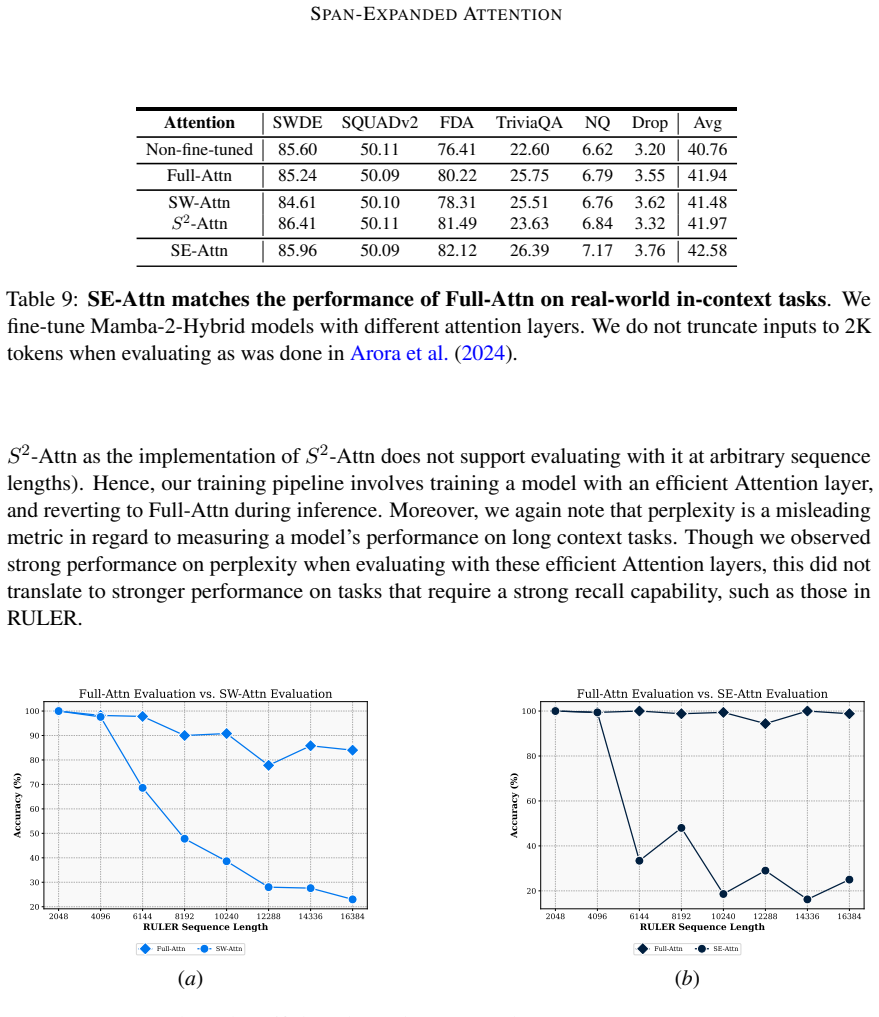
- Perplexity is not a faithful indicator of long-context recall; retrieval-style benchmarks like RULER reveal differences that perplexity hides.
Reading between the lines
- Because the paper evaluates retrieval benefit under a full-attention decoder, a natural next step is to make the retrieval mechanism itself inference-friendly, such as caching retrieved block summaries, to close the gap shown in the appendix between SE-Attn evaluation and full-attention evaluation.
- The relevance-scoring idea could combine with learned compression tokens or hierarchical summaries, allowing the expansion span to scale sublinearly with history while keeping the retrieval decision cheap.
- Relevance-based memory allocation may also benefit pure recurrent models or linear-attention models, where the analogous failing is that the state is updated uniformly by recency rather than by importance.
- Since random retrieval already helps over no retrieval, part of the gain may be a regularizing effect of variable-length chunked training; ablating retrieval quality while holding chunking constant would separate the two effects.
Signed reviews
Editorial analysis
A structured set of objections, weighed in public.
Referee Report
Summary. The paper proposes Span-Expanded Attention (SE-Attn), a sparse attention mechanism that reserves part of the context for past memory blocks retrieved by relevance to the current query, and HyLoRA, a LoRA-based fine-tuning method that also adapts 1D convolutional layers in hybrid SSMs. The authors claim that SE-Attn expands the eidetic memory span of hybrid SSMs and allows efficient fine-tuning of pre-trained models on sequences up to 8 times longer than the pre-training context. The main experiments fine-tune Mamba-2-Hybrid 2.7B, Zamba2 1.2B, and Llama1 7B, evaluating on PG-19, RULER, LM Harness, LongBench, and in-context recall tasks, comparing against Full-Attn, SW-Attn, and S2-Attn.
Significance. If the central claim were established, SE-Attn would be a valuable drop-in mechanism for extending the effective context of hybrid SSMs with modest training cost, and HyLoRA would be a useful recipe for adapting the recurrent and convolutional components of such models. The manuscript has several strengths: it ships a clean ablation chain (retrieval vs. random vs. no retrieval; chunk size; block size/top-k), an empirical runtime-memory analysis, and evaluation across three model families. The internal comparisons are consistent, and the paper is honest about the limitations of perplexity as a long-context metric. However, the headline claim is not validated in the deployed configuration, because the retrieval mechanism is disabled at inference, and the one direct inference-time test shows substantial degradation.
major comments (2)
- [§4.1, Appendix A] The experimental protocol replaces SE-Attn with Full-Attn at evaluation: §4.1 states that SE-Attn is used for efficient fine-tuning and evaluation reverts to Full-Attn, and Appendix A repeats this. Consequently, all headline results in Table 1, Figure 2, and Tables 6–9 measure a model whose inference-time attention is standard full attention. The abstract's claim that 'our models can eidetically access tokens from beyond the Attention span' is therefore not supported by these experiments, since the retrieval mechanism—the relevancy scoring and top-k block selection—is not exercised at inference.
- [Appendix E.4, Figure 11] The only direct evaluation of SE-Attn at inference, Figure 11(b), shows a clear degradation on the NIAH-Single-1 RULER task compared to evaluating the same checkpoint with Full-Attn. This is load-bearing because it undermines the interpretation that the training-time gains are caused by an expanded eidetic span; the gains could instead come from the HyLoRA fine-tuning protocol or from retrieval acting as a regularizer during training. The authors should either provide SE-Attn-at-inference results across the full RULER suite (and ideally on the other benchmarks) showing competitive performance, or explicitly reframe the contribution as an efficient long-context fine-tuning method rather than an inference-time memory expansion.
minor comments (5)
- [Abstract/Introduction] The fact that evaluation reverts to Full-Attn is disclosed only in §4.1 and Appendix A; it should be stated prominently in the abstract or introduction, because the current abstract implies that SE-Attn is the deployed mechanism.
- [Appendix E.4, Figure 11] The SE-Attn versus Full-Attn curves in Figure 11 would be easier to interpret with numeric values or error bars, since the differences are small at some sequence lengths and the curves are read only from the plot.
- [Table 1 and Figure 2] No variance or statistical significance is reported for the RULER and LM Harness comparisons; given that several gaps between SE-Attn and Full-Attn are under one or two percentage points, reporting standard deviations across seeds would strengthen the claims.
- [Appendix J] The abbreviation list contains a typo: 'ScorllsNarrativeQA' should be 'ScrollsNarrativeQA'.
- [Appendix E.1] There is a typo in the text: 'perfromance' should be 'performance'.
Circularity Check
No significant circularity: the central claims are empirical benchmark results; the train-with-SE-Attn/evaluate-with-Full-Attn protocol is a validity limitation, not a definitional reduction.
full rationale
I walked the paper's claimed derivation chain. The core proposals (SE-Attn retrieval and HyLoRA) are defined constructively in Section 3, and their benefits are established by benchmark comparisons in Section 4; no equation defines SE-Attn in terms of the RULER or LM-Harness results it is said to predict, and no fitted parameter is renamed as a prediction. The only self-citation of the authors' prior work, Zancato et al. (2024), is used to motivate adapting 1D convolution layers in HyLoRA ('building upon previous observations Zancato et al. (2024); Yang et al. (2024b), we also adapt the 1D convolutional layers'); that design choice is then verified empirically in Figure 2(b) and Appendix B, so the citation is not load-bearing. The main weakness is not circularity: the paper fine-tunes with SE-Attn but evaluates with Full-Attn (Section 4.1 and Appendix A), and Figure 11 shows that evaluating the SE-Attn-fine-tuned checkpoint with SE-Attn on NIAH-Single-1 is worse than evaluating it with Full-Attn. This means the headline 'eidetic access at inference' claim is not validated in the deployed configuration, but that is a scope/protocol limitation rather than the reduction of a derivation to its own inputs. Hyperparameters such as block size, top-k, and chunk sizes were selected on RULER, which is tuning rather than circular prediction. Accordingly, no circular step is exhibited and the circularity score is minimal.
Assumptions & free parameters
free parameters (5)
- memory block size S =
32
- top-k K =
8
- chunk size M =
sampled uniformly from {2048, 4096}
- LoRA rank r and alpha =
r=32, alpha=64
- learning rate =
2e-4 for SE-Attn/SW-Attn/Full-Attn; 2e-5 for S2-Attn
assumptions (4)
- domain assumption Block summaries computed as the mean of non-causal attention outputs preserve enough information for effective retrieval.
- domain assumption Cross-attention relevancy scores between chunk queries and block summaries identify the most useful past blocks.
- domain assumption Training with an efficient retrieval-based attention transfers to inference with full attention without loss.
- domain assumption RULER benchmark scores are a reliable proxy for long-context recall capabilities.
Cite this review
Pith. "Pith review of Expansion Span: Combining Fading Memory and Retrieval in Hybrid State Space Models." pith.science (2026). https://pith.science/paper/YKTIGY5M
@misc{pith2026241213328,
  author       = {Pith},
  title        = {Pith review of: Expansion Span: Combining Fading Memory and Retrieval in Hybrid State Space Models},
  year         = {2026},
  howpublished = {\url{https://pith.science/paper/YKTIGY5M}},
  note         = {Machine review of arXiv:2412.13328}
}
read the original abstract
The "state" of State Space Models (SSMs) represents their memory, which fades exponentially over an unbounded span. By contrast, Attention-based models have "eidetic" (i.e., verbatim, or photographic) memory over a finite span (context size). Hybrid architectures combine State Space layers with Attention, but still cannot recall the distant past and can access only the most recent tokens eidetically. Unlike current methods of combining SSM and Attention layers, we allow the state to be allocated based on relevancy rather than recency. In this way, for every new set of query tokens, our models can "eidetically" access tokens from beyond the Attention span of current Hybrid SSMs without requiring extra hardware resources. We introduce a method to expand the memory span of the hybrid state by "reserving" a fraction of the Attention context for tokens retrieved from arbitrarily distant in the past, thus expanding the eidetic memory span of the overall state. We call this reserved fraction of tokens the "expansion span," and the mechanism to retrieve and aggregate it "Span-Expanded Attention" (SE-Attn). To adapt Hybrid models to using SE-Attn, we propose a novel fine-tuning method that extends LoRA to Hybrid models (HyLoRA) and allows efficient adaptation on long spans of tokens. We show that SE-Attn enables us to efficiently adapt pre-trained Hybrid models on sequences of tokens up to 8 times longer than the ones used for pre-training. We show that HyLoRA with SE-Attn is cheaper and more performant than alternatives like LongLoRA when applied to Hybrid models on natural language benchmarks with long-range dependencies, such as PG-19, RULER, and other common natural language downstream tasks.
Figures


Figures from the paper (10 more)




Forward citations
Cited by 1 Pith paper
-
The Capability Convergence Hypothesis: Capability from Access Structure, Not Scale
Long-context capability converges to hybrid architectures pairing O(1) state with a scalable index; pure scaling of SSMs or Transformers alone hits information, horizon, or circuit walls.
Reference graph
Works this paper leans on
-
[1]
Just read twice: closing the recall gap for recurrent language models
Simran Arora, Aman Timalsina, Aaryan Singhal, Benjamin Spector, Sabri Eyuboglu, Xinyi Zhao, Ashish Rao, Atri Rudra, and Christopher R \'e . Just read twice: closing the recall gap for recurrent language models. arXiv preprint arXiv:2407.05483, 2024
arXiv 2024
-
[2]
L ong B ench: A bilingual, multitask benchmark for long context understanding
Yushi Bai, Xin Lv, Jiajie Zhang, Hongchang Lyu, Jiankai Tang, Zhidian Huang, Zhengxiao Du, Xiao Liu, Aohan Zeng, Lei Hou, Yuxiao Dong, Jie Tang, and Juanzi Li. L ong B ench: A bilingual, multitask benchmark for long context understanding. In Lun-Wei Ku, Andre Martins, and Vivek Srikumar, editors, Proceedings of the 62nd Annual Meeting of the Association f...
2024
-
[3]
Longformer: The long-document transformer
Iz Beltagy, Matthew E Peters, and Arman Cohan. Longformer: The long-document transformer. arXiv preprint arXiv:2004.05150, 2020
arXiv 2004
-
[4]
Extending context window of large language models via positional interpolation
Shouyuan Chen, Sherman Wong, Liangjian Chen, and Yuandong Tian. Extending context window of large language models via positional interpolation. arXiv preprint arXiv:2306.15595, 2023
arXiv 2023
-
[5]
Longlo RA : Efficient fine-tuning of long-context large language models
Yukang Chen, Shengju Qian, Haotian Tang, Xin Lai, Zhijian Liu, Song Han, and Jiaya Jia. Longlo RA : Efficient fine-tuning of long-context large language models. In The Twelfth International Conference on Learning Representations, 2024. URL https://openreview.net/forum?id=6PmJoRfdaK
work page 2024
-
[6]
Transformer-xl: Attentive language models beyond a fixed-length context
Zihang Dai. Transformer-xl: Attentive language models beyond a fixed-length context. arXiv preprint arXiv:1901.02860, 2019
arXiv 1901
-
[7]
Flashattention-2: Faster attention with better parallelism and work partitioning
Tri Dao. Flashattention-2: Faster attention with better parallelism and work partitioning. In The Twelfth International Conference on Learning Representations, 2024. URL https://openreview.net/forum?id=mZn2Xyh9Ec
2024
-
[8]
Tri Dao and Albert Gu. Transformers are ssms: generalized models and efficient algorithms through structured state space duality. In Proceedings of the 41st International Conference on Machine Learning, ICML'24. JMLR.org, 2024
work page 2024
Show all 40 references
-
[9]
Griffin: Mixing gated linear recurrences with local attention for efficient language models
Soham De, Samuel L Smith, Anushan Fernando, Aleksandar Botev, George Cristian-Muraru, Albert Gu, Ruba Haroun, Leonard Berrada, Yutian Chen, Srivatsan Srinivasan, et al. Griffin: Mixing gated linear recurrences with local attention for efficient language models. arXiv preprint ...
2024 arXiv
-
[10]
The llama 3 herd of models
Abhimanyu Dubey, Abhinav Jauhri, Abhinav Pandey, Abhishek Kadian, Ahmad Al-Dahle, Aiesha Letman, Akhil Mathur, Alan Schelten, Amy Yang, Angela Fan, et al. The llama 3 herd of models. arXiv preprint arXiv:2407.21783, 2024
2024 arXiv
-
[11]
Parameter-efficient fine-tuning of state space models
Kevin Galim, Wonjun Kang, Yuchen Zeng, Hyung Il Koo, and Kangwook Lee. Parameter-efficient fine-tuning of state space models. arXiv preprint arXiv:2410.09016, 2024
2024 arXiv
-
[12]
A framework for few-shot language model evaluation, 07 2024
Leo Gao, Jonathan Tow, Baber Abbasi, Stella Biderman, Sid Black, Anthony DiPofi, Charles Foster, Laurence Golding, Jeffrey Hsu, Alain Le Noac'h, Haonan Li, Kyle McDonell, Niklas Muennighoff, Chris Ociepa, Jason Phang, Laria Reynolds, Hailey Schoelkopf, Aviya Skowron, Lintang S...
2024
-
[13]
The zamba2 suite: Technical report
Paolo Glorioso, Quentin Anthony, Yury Tokpanov, Anna Golubeva, Vasudev Shyam, James Whittington, Jonathan Pilault, and Beren Millidge. The zamba2 suite: Technical report. arXiv preprint arXiv:2411.15242, 2024 a
2024 arXiv
-
[14]
Zamba: A compact 7b ssm hybrid model
Paolo Glorioso, Quentin Anthony, Yury Tokpanov, James Whittington, Jonathan Pilault, Adam Ibrahim, and Beren Millidge. Zamba: A compact 7b ssm hybrid model. arXiv preprint arXiv:2405.16712, 2024 b
2024 arXiv
-
[15]
Mamba: Linear-time sequence modeling with selective state spaces
Albert Gu and Tri Dao. Mamba: Linear-time sequence modeling with selective state spaces. arXiv preprint arXiv:2312.00752, 2023
2023 arXiv
-
[16]
Combining recurrent, convolutional, and continuous-time models with linear state space layers
Albert Gu, Isys Johnson, Karan Goel, Khaled Saab, Tri Dao, Atri Rudra, and Christopher R\' e . Combining recurrent, convolutional, and continuous-time models with linear state space layers. In M. Ranzato, A. Beygelzimer, Y. Dauphin, P.S. Liang, and J. Wortman Vaughan, editors,...
2021
-
[17]
Efficiently modeling long sequences with structured state spaces
Albert Gu, Karan Goel, and Christopher Re. Efficiently modeling long sequences with structured state spaces. In International Conference on Learning Representations, 2022. URL https://openreview.net/forum?id=uYLFoz1vlAC
2022
-
[18]
Ruler: What's the real context size of your long-context language models? arXiv preprint arXiv:2404.06654, 2024
Cheng-Ping Hsieh, Simeng Sun, Samuel Kriman, Shantanu Acharya, Dima Rekesh, Fei Jia, Yang Zhang, and Boris Ginsburg. Ruler: What's the real context size of your long-context language models? arXiv preprint arXiv:2404.06654, 2024
2024 arXiv
-
[19]
Lo RA : Low-rank adaptation of large language models
Edward J Hu, yelong shen, Phillip Wallis, Zeyuan Allen-Zhu, Yuanzhi Li, Shean Wang, Lu Wang, and Weizhu Chen. Lo RA : Low-rank adaptation of large language models. In International Conference on Learning Representations, 2022. URL https://openreview.net/forum?id=nZeVKeeFYf9
2022
-
[20]
Kakade, and Eran Malach
Samy Jelassi, David Brandfonbrener, Sham M. Kakade, and Eran Malach. Repeat after me: transformers are better than state space models at copying. In Proceedings of the 41st International Conference on Machine Learning, ICML'24. JMLR.org, 2024
2024
-
[21]
A new approach to linear filtering and prediction problems
Rudolph Emil Kalman. A new approach to linear filtering and prediction problems. 1960
1960
-
[22]
Needle in a haystack - pressure testing llms., 2023
Gregory Kamradt. Needle in a haystack - pressure testing llms., 2023. URL https://github.com/gkamradt/LLMTest_NeedleInAHaystack/tree/main
2023
-
[23]
Reformer: The efficient transformer
Nikita Kitaev, Lukasz Kaiser, and Anselm Levskaya. Reformer: The efficient transformer. In The International Conference on Learning Representations (ICLR), 2020
2020
-
[24]
Jamba: A hybrid transformer-mamba language model
Opher Lieber, Barak Lenz, Hofit Bata, Gal Cohen, Jhonathan Osin, Itay Dalmedigos, Erez Safahi, Shaked Meirom, Yonatan Belinkov, Shai Shalev-Shwartz, et al. Jamba: A hybrid transformer-mamba language model. arXiv preprint arXiv:2403.19887, 2024
2024 arXiv
-
[25]
Random-access infinite context length for transformers
Amirkeivan Mohtashami and Martin Jaggi. Random-access infinite context length for transformers. In Proceedings of the 37th International Conference on Neural Information Processing Systems, NIPS '23, Red Hook, NY, USA, 2023. Curran Associates Inc
2023
-
[26]
Leave no context behind: Efficient infinite context transformers with infini-attention
Tsendsuren Munkhdalai, Manaal Faruqui, and Siddharth Gopal. Leave no context behind: Efficient infinite context transformers with infini-attention. arXiv preprint arXiv:2404.07143, 2024
2024 arXiv
-
[27]
Resurrecting recurrent neural networks for long sequences
Antonio Orvieto, Samuel L Smith, Albert Gu, Anushan Fernando, Caglar Gulcehre, Razvan Pascanu, and Soham De. Resurrecting recurrent neural networks for long sequences. In International Conference on Machine Learning, pages 26670--26698. PMLR, 2023
2023
-
[29]
Compressive transformers for long-range sequence modelling
Jack W Rae, Anna Potapenko, Siddhant M Jayakumar, and Timothy P Lillicrap. Compressive transformers for long-range sequence modelling. arXiv preprint arXiv:1911.05507, 2019 b
1911 arXiv
-
[30]
Deepspeed: System optimizations enable training deep learning models with over 100 billion parameters
Jeff Rasley, Samyam Rajbhandari, Olatunji Ruwase, and Yuxiong He. Deepspeed: System optimizations enable training deep learning models with over 100 billion parameters. In Proceedings of the 26th ACM SIGKDD International Conference on Knowledge Discovery & Data Mining, pages 3...
2020
-
[31]
Roformer: Enhanced transformer with rotary position embedding
Jianlin Su, Murtadha Ahmed, Yu Lu, Shengfeng Pan, Wen Bo, and Yunfeng Liu. Roformer: Enhanced transformer with rotary position embedding. Neurocomputing, 568: 0 127063, 2024
2024
-
[32]
Retentive network: A successor to transformer for large language models
Yutao Sun, Li Dong, Shaohan Huang, Shuming Ma, Yuqing Xia, Jilong Xue, Jianyong Wang, and Furu Wei. Retentive network: A successor to transformer for large language models. arXiv preprint arXiv:2307.08621, 2023
2023 arXiv
-
[33]
Llama: Open and efficient foundation language models
Hugo Touvron, Thibaut Lavril, Gautier Izacard, Xavier Martinet, Marie-Anne Lachaux, Timoth \'e e Lacroix, Baptiste Rozi \`e re, Naman Goyal, Eric Hambro, Faisal Azhar, et al. Llama: Open and efficient foundation language models. arXiv preprint arXiv:2302.13971, 2023 a
2023 arXiv
-
[34]
Llama 2: Open foundation and fine-tuned chat models
Hugo Touvron, Louis Martin, Kevin Stone, Peter Albert, Amjad Almahairi, Yasmine Babaei, Nikolay Bashlykov, Soumya Batra, Prajjwal Bhargava, Shruti Bhosale, et al. Llama 2: Open foundation and fine-tuned chat models. arXiv preprint arXiv:2307.09288, 2023 b
2023 arXiv
-
[35]
Attention is all you need
Ashish Vaswani, Noam Shazeer, Niki Parmar, Jakob Uszkoreit, Llion Jones, Aidan N Gomez, ukasz Kaiser, and Illia Polosukhin. Attention is all you need. In I. Guyon, U. Von Luxburg, S. Bengio, H. Wallach, R. Fergus, S. Vishwanathan, and R. Garnett, editors, Advances in Neural In...
2017
-
[36]
An empirical study of mamba-based language models
Roger Waleffe, Wonmin Byeon, Duncan Riach, Brandon Norick, Vijay Korthikanti, Tri Dao, Albert Gu, Ali Hatamizadeh, Sudhakar Singh, Deepak Narayanan, et al. An empirical study of mamba-based language models. arXiv preprint arXiv:2406.07887, 2024
2024 arXiv
-
[37]
Gated linear attention transformers with hardware-efficient training
Songlin Yang, Bailin Wang, Yikang Shen, Rameswar Panda, and Yoon Kim. Gated linear attention transformers with hardware-efficient training. In Proceedings of the 41st International Conference on Machine Learning, ICML'24. JMLR.org, 2024 a
2024
-
[38]
Parallelizing linear transformers with the delta rule over sequence length
Songlin Yang, Bailin Wang, Yu Zhang, Yikang Shen, and Yoon Kim. Parallelizing linear transformers with the delta rule over sequence length. In A. Globerson, L. Mackey, D. Belgrave, A. Fan, U. Paquet, J. Tomczak, and C. Zhang, editors, Advances in Neural Information Processing ...
2024
-
[39]
Gated delta networks: Improving mamba2 with delta rule
Songlin Yang, Jan Kautz, and Ali Hatamizadeh. Gated delta networks: Improving mamba2 with delta rule. In The Thirteenth International Conference on Learning Representations, 2025. URL https://openreview.net/forum?id=r8H7xhYPwz
2025
-
[40]
B mojo: Hybrid state space realizations of foundation models with eidetic and fading memory
Luca Zancato, Arjun Seshadri, Yonatan Dukler, Aditya Golatkar, Yantao Shen, Benjamin Bowman, Matthew Trager, Alessandro Achille, and Stefano Soatto. B mojo: Hybrid state space realizations of foundation models with eidetic and fading memory. In A. Globerson, L. Mackey, D. Belg...
2024
-
[41]
Lots of code, 2017
Vladislav Zavadskyy. Lots of code, 2017. URL https://www.kaggle.com/datasets/zavadskyy/lots-of-code. Accessed: 2024-10-27
2017
Reviewed August 11, 2026 · model on record in the stance chip above.
Discussion (0). Continue with ORCID to comment.