REVIEW 2 major objections 5 minor 60 references
Under a fixed per-token inference budget, capability converges toward the access-complete class — a compressive state channel paired with a scalable verbatim index — not toward a single representation.
Reviewed by Pith at T0; open to challenge. T0 means a machine referee read the full paper against a public rubric. the ladder, T0–T4 →
T0 review · deepseek-v4-flash
2026-08-03 01:56 UTC pith:5NAMPT2Q
load-bearing objection Worth engaging: an unusually honest, well-scoped framework paper whose central strict-inclusion claim is real but conditional on an unverified separability assumption that the paper's own measurements show is strained for numeric and code keys. the 2 major comments →
The Capability Convergence Hypothesis: Capability from Access Structure, Not Scale
The pith
A machine-rendered reading of the paper's core claim, the machinery that carries it, and where it could break.
Core claim
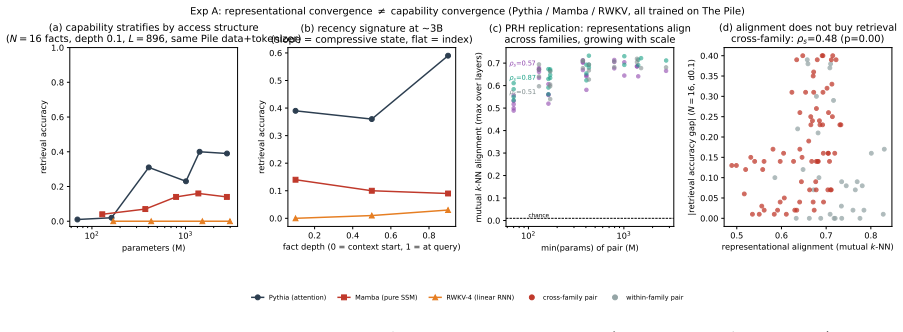
The central claim is the Capability Convergence Hypothesis: under a fixed per-token inference budget, representational convergence does not entail capability convergence. Capability instead converges toward a class — the access-complete hybrid — any architecture holding both a compressive state channel (O(1) memory, the 'Idea') and a scalable verbatim-index channel (Θ(L) memory, the 'Shadow'). On the witness task, no pure state-space family can solve exact long-range retrieval at any scale (the Shannon wall, unconditional), no fixed-window architecture can see past its horizon (the horizon wall, unconditional), and no fixed-depth attention-only stack can compose a serial reference chain (the
What carries the argument
The load-bearing object is the query-time accessible state Σt with capacity B=H(Σt). Attention realizes a near-lossless index channel (B=Θ(L)); a state-space model realizes a lossy compressive channel (B=O(1)). The witness protocol plants N independent key–value bindings, interleaves Θ(L) semantic-overlap distractors, and drives a reference chain through the permutation group S5; an information-theoretic floor bounds per-binding accessible information by B/N. The hybrid combines the two channels, and the contraction of its advantage rests on Assumption 1 (write-time code separability): target bindings carry anchor codewords recoverable from the query, and all distractors stay at distance ≥δκ
Load-bearing premise
The hybrid's advantage on the witness rests on Assumption 1 — that target bindings carry anchor codewords recoverable from the query and that distractors stay code-separated in the index's matching space; if natural workloads do not supply this separability, the hybrid's edge collapses to the information-theoretic ambiguity floor.
What would settle it
Measure, on a natural corpus, the fraction of retrieval-relevant key pairs that are within an ε-ball of each other in the write-time embedding; if that fraction is high, the hybrid's advantage should shrink toward the chance floor, directly testing whether the separability assumption holds for real workloads.
If this is right
- Pure state-space models are barred from exact long-range retrieval at any scale under the fixed-budget regime, regardless of parameter count or representational alignment.
- Fixed-window architectures cannot escape a cliff: near-perfect retrieval inside the window, chance outside it, and no amount of scale fixes the blind spot.
- A hybrid that pays the Θ(ρL) index capacity can recover a specific binding after 10^7 tokens of noise, deferring — not eliminating — the horizon by a factor of 1/ρ.
- Capability closure is strictly super-additive under composition: there exists a witness task family that neither pure family solves at any scale while the hybrid does, a phenomenon the paper calls compositional emergence.
- If the convergence conjecture holds, production models should increasingly land in a narrow band of global-attention share (roughly 1/12 to 1/4), while pure families remain at a characteristic capability distance.
Where Pith is reading between the lines
- The same two-channel logic should apply one level up to agentic systems: an agent with external retrieval tools is access-complete as a system, so capability should track the presence of a scalable index at some level rather than the base architecture alone.
- The separability assumption is the empirical crux. A natural measurement of the fraction of retrieval-relevant key pairs that are code-separable in the write-time embedding would directly predict where hybrid advantage is real; the paper's own surface-form numbers suggest entity-like keys are separable while numeric IDs and code identifiers are not.
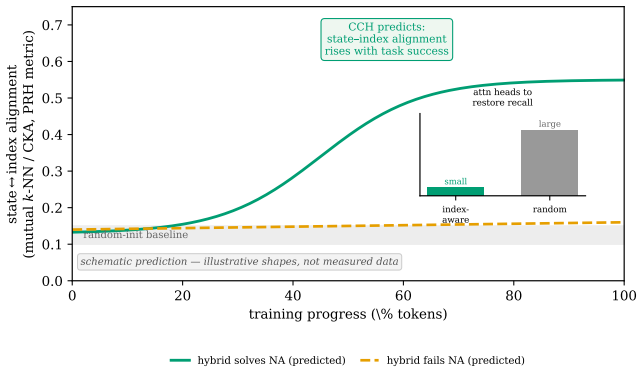
- The failed channel-commensurability prediction hints that cross-channel alignment is the wrong signature of successful composition; channel differentiation or complementarity may be the better predictor, testable with probing or intervention studies.
- The load-ratio formulation (difficulty set by Nb/B, not absolute scale) implies small-scale experiments can be legitimate mechanism probes of frontier behavior; an explicit test would train the same hybrid at several sizes and check whether the scissors gap scales with load ratio.
Editorial analysis
A structured set of objections, weighed in public.
Referee Report
Summary. The paper proposes the Capability Convergence Hypothesis (CCH): under a fixed per-token inference budget, representational convergence does not imply capability convergence; instead capability converges toward an 'access-complete' class of architectures that combine a compressive O(1)-state channel and a scalable verbatim-index channel. The authors formalize a witness task (Newton's apple in an infinite stream) and identify three walls: a Shannon wall (Theorem 1), a horizon wall (Proposition 1), and a circuit wall (Proposition 2, conditional on TC0≠NC1). These lead to Proposition 3, a strict inclusion of capability closures under regime R, Assumption 1, and TC0≠NC1. The paper also reports pre-registered small-scale experiments, a census of production architectures, and explicitly separates proven claims from conjectures. The central formal result is conditional on Assumption 1, whose natural-language incidence is only partially measured.
Significance. If the access-completeness principle is correct, it offers a principled explanation for the practical success of hybrid SSM–attention designs and clarifies why scale alone cannot buy long-range retrieval and state tracking. The formal lower bound in Theorem 1 is clean, and the two unconditional walls (Shannon and horizon) are valuable independent of the rest of the framework. The paper is exemplary in its pre-registration, timestamped amendment log, public code and data, and honest reporting of a failed prediction (P3). The main caveat is that the strict-inclusion result is conditional on Assumption 1 and TC0≠NC1; the paper's own measurement in G.6 shows the assumption is strained for numeric IDs (50.7%) and code identifiers (56.2%), which are canonical long-context retrieval targets. The field-level convergence conjecture is explicitly labeled as a conjecture and is not tested by the reported data.
major comments (2)
- [Section 2.10, Assumption 1; Appendix G.6] The positive clause of Proposition 3 depends on Assumption 1, which requires that write-time anchor codewords be separable from all Θ(L) distractors in the index's matching space. The paper's own surface-form measurement (G.6) finds this holds for entity-like keys (87.5%) but not for numeric IDs (50.7%) or code identifiers (56.2%). Numeric IDs and code identifiers are not exotic: they are among the most common targets in long-context retrieval. The collision control (G.2 ix) confirms the hinge: at zero code distance the trained hybrid lands exactly on the architecture-independent ambiguity floor c/(c+1). Without a demonstration that natural workloads supply separable anchors, the strict inclusion is a result about a constructed witness family, not about typical long-context workloads. The paper's scoping statements are honest, but the title and abstract risk overstating the practical rea
- [Section 4.2 and G.2, Figure 4] The quantitative collapse of the information floor in Figure 4(b,c) uses a single fitted constant peff = 0.39 bits/scalar. The paper correctly states that this is 'consistent with the floor, not an independent verification of H(Σ)' (Section 4.2). However, the same section presents P1 as supported with the floor-shape collapse as a key element; as a pre-registered prediction, the collapse is only a one-parameter fit, while the independent falsifiable content is the scissors gap (0.994 vs 0.000), which is measured outright. To make the empirical support clean, either derive peff a priori from an independent capacity estimate or explicitly label the curve collapse as a consistency check rather than a test. This would strengthen the paper's own methodological standards and avoid the appearance of post-hoc calibration.
minor comments (5)
- [Section 2.2, Eq. (1)] Postulate 1 uses Shannon entropy H(Σ_t) for a state that is continuous for SSMs. Finite-precision regularization is introduced only later in Definition 1. Consider adding a forward reference or reordering so the entropy is well-defined at the point of use.
- [Section 2.10 and Appendix G.2] The collision control is introduced in Section 2.10 as 'point 3' in one place and as 'point 2' elsewhere; likewise the internal references to 'Section 2.10 point 2' vs 'point 3' are inconsistent. Please harmonize these cross-references.
- [Figure 4 caption] The caption states '3 seeds' for Experiment B, but the doubled-budget run used 6 seeds and the pure-state m=64 runs had 6 runs. The caption should state both phases and seed counts explicitly.
- [Section 6.3, Limitation (iii)] The percentages 87%, 51%, 56% in the limitation text are rounded from G.6's 87.5%, 50.7%, 56.2%. Use the exact values or a consistent rounding convention.
- [Section 5, AV3] The discussion of AV3 (economics all the way down) is clear, but the paper could more explicitly say in the abstract that the field-level convergence trend is a conjecture with no discriminating evidence, not a measured phenomenon.
Circularity Check
Only the auxiliary P1 floor-collapse is partially circular (fitted peff); the formal separation is independent and no self-citation is load-bearing.
specific steps
-
fitted input called prediction
[Section 4.2 (P1, Experiment B), Appendix G.2 (item ii), and G.7 scorecard]
"P1 is supported in two senses kept separate: the scissors gap is measured outright, while the floor-shape collapse holds under one fitted effective capacity, consistent with but not an independent verification of Theorem 1 at nominal capacity. ... with the single frozen constant peff=0.39 bits/scalar (fit on m=256), the 50%-crossings land at x = Nb/(m peff) ∈ [0.82, 1.03]"
The empirical 'tracking the floor' claim is evaluated at x = Nb/(m peff), where peff is fit to the same experimental data (m=256). Since the Fano floor crosses 0.5 near x=1, fitting peff to a curve's observed 50% crossing places that curve at the floor by construction. The m=1024 curve provides a genuine partial check, but the m=256 'collapse' is not an independent test. The paper explicitly disclaims independence, so this is an auxiliary calibration issue, not the load-bearing formal derivation.
full rationale
The central claim, Proposition 3, rests on Theorem 1 (a data-processing/Fano lower bound), the horizon/circuit walls, and Assumption 1; none of these are fitted or self-referential. The pre-registered scissors gap, bifurcation, and collision control are independent mechanism-level tests, and the collision control directly probes Assumption 1 by removing it. The only circularity-adjacent step I can exhibit is the P1 information-floor collapse, where one effective-capacity constant peff is fit on the data and then used in the abscissa x=Nb/(m peff); the paper itself marks this as 'not an independent verification of H(Σ)' and scores P1 as partial. R1-R4 are explicitly labeled consistency-level, and the convergence conjecture is explicitly not demonstrated, so no circularity is hidden there. There is also no load-bearing self-citation: the cited walls, TC0 bound, and hybrid primitives are external results, and the paper repeatedly disclaims inventing them. Overall, the formal derivation is self-contained; only one auxiliary empirical prediction is partly circular, yielding a low score.
Axiom & Free-Parameter Ledger
free parameters (1)
- peff (effective bits per scalar of SSM state) =
0.39 bits/scalar
axioms (7)
- domain assumption State-channel postulate: Σt is the unique data-bearing channel from history to prediction, so I(X1:t; ŷt | qt, θ) ≤ H(Σt) ≤ B
- domain assumption Finite-precision regularization B = dstate·p with idealized p = O(log L)
- domain assumption Assumption 1: write-time code separability of bindings and distractors
- domain assumption TC0 ≠ NC1
- standard math Barrington's theorem: S5 word problem is NC1-complete
- standard math DPI, Fano, Gibbs, Yao minimax
- standard math Hopfield retrieval error bound (M e^{-β_H Δ})
read the original abstract
The Platonic Representation Hypothesis (PRH) holds that as models scale, representations of heterogeneous networks converge toward a shared model of reality. We propose its sequel and boundary, the Capability Convergence Hypothesis (CCH): under a fixed per-token inference budget, representational convergence does not entail capability convergence. Capability instead converges toward a class, the access-complete hybrid: any architecture holding both a compressive O(1)-state channel and a scalable verbatim-index channel. We anchor it on a witness task, the Newton's-apple problem in an infinite stream, and name three resource walls: a Shannon wall barring any o(Nb)-state architecture, a horizon wall barring any fixed window, and a circuit wall barring fixed-depth attention-only composition (conditional on TC0 != NC1). Under an explicit separability assumption a hybrid crosses all three by paying each wall's price, so capability is strictly super-additive under composition. We separate what we prove from what we conjecture: the access-completeness principle rests on information-theoretic lower bounds and pre-registered experiments, while the field-level convergence trend is an economics-motivated conjecture. We report the first pre-registered small-scale tests under criteria frozen before the data: the predicted scissors gap is measured (exact-retrieval error 0.994 vs. 0.000 once a 64-scalar state gains one global-attention layer), the state-tracking bifurcation lands at the registered boundary, and a conjunction witness shows an irreducibly two-channel solution; one prediction failed with its direction reversed and is reported as such. Representational convergence is given freely by scale; capability convergence must be purchased by access structure.
Figures




Reference graph
Works this paper leans on
-
[1]
Simran Arora, Sabri Eyuboglu, Aman Timalsina, Isys Johnson, Michael Poli, James Zou, Atri Rudra, and Christopher Ré. Zoology: Measuring and improving recall in efficient language models.arXiv preprint arXiv:2312.04927, 2023
Pith/arXiv arXiv 2023
-
[2]
Simran Arora, Sabri Eyuboglu, Michael Zhang, Aman Timalsina, Silas Alberti, Dylan Zinsley, James Zou, Atri Rudra, and Christopher Ré. Simple linear attention language models balance the recall-throughput tradeoff.arXiv preprint arXiv:2402.18668, 2024
Pith/arXiv arXiv 2024
-
[3]
Sangmin Bae, Bilge Acun, Chien-Yu Lin, Haroun Habeeb, Seungyeon Kim, Liang Luo, Junjie Wang, and Carole-Jean Wu. Hybrid architectures for language models: Systematic analysis and design insights.arXiv preprint arXiv:2510.04800, 2025
Pith/arXiv arXiv 2025
-
[4]
Barrington
David A. Barrington. Bounded-width polynomial-size branching programs recognize exactly those languages in NC1.Journal of Computer and System Sciences, 38(1):150–164, 1989
1989
-
[5]
Aaron Blakeman, Aarti Basant, Abhinav Khattar, Adithya Renduchintala, et al. Nemotron- H: A family of accurate and efficient hybrid Mamba-Transformer models.arXiv preprint arXiv:2504.03624, 2025
Pith/arXiv arXiv 2025
-
[6]
Aditya Chattopadhyay, Elvis Nunez, Prannay Kaul, Benjamin Bowman, Evan Becker, Luca Zancato, David Thomas, Wei Xia, and Stefano Soatto. Priming: Hybrid state space models from pre-trained transformers.arXiv preprint arXiv:2605.08301, 2026
Pith/arXiv arXiv 2026
-
[7]
Cover and Joy A
Thomas M. Cover and Joy A. Thomas.Elements of Information Theory. Wiley-Interscience, 2nd edition, 2006
2006
-
[8]
Tri Dao and Albert Gu. Transformers are SSMs: Generalized models and efficient algorithms through structured state space duality. InInternational Conference on Machine Learning (ICML), 2024. arXiv:2405.21060
Pith/arXiv arXiv 2024
-
[9]
Fu, Stefano Ermon, Atri Rudra, and Christopher Ré
Tri Dao, Daniel Y. Fu, Stefano Ermon, Atri Rudra, and Christopher Ré. FlashAttention: Fast and memory-efficient exact attention with IO-awareness. InAdvances in Neural Information Processing Systems (NeurIPS), 2022
2022
-
[10]
Smith, Anushan Fernando, et al
Soham De, Samuel L. Smith, Anushan Fernando, et al. Griffin: Mixing gated linear recur- rences with local attention for efficient language models.arXiv preprint arXiv:2402.19427, 2024
Pith/arXiv arXiv 2024
-
[11]
Language modeling is compression
Grégoire Delétang, Anian Ruoss, Paul-Ambroise Duquenne, Elliot Catt, Tim Genewein, Christopher Mattern, Jordi Grau-Moya, Li Kevin Wenliang, Matthew Aitchison, Laurent Orseau, Marcus Hutter, and Joel Veness. Language modeling is compression. InInternational Conference on Learning Representations (ICLR), 2024. arXiv:2309.10668. 39
Pith/arXiv arXiv 2024
-
[12]
Hymba: A hybrid-head architecture for small language models.arXiv preprint arXiv:2411.13676, 2024
Xin Dong, Yonggan Fu, Shizhe Diao, Wonmin Byeon, Zijia Chen, Ameya Sunil Mahabalesh- warkar, et al. Hymba: A hybrid-head architecture for small language models.arXiv preprint arXiv:2411.13676, 2024
Pith/arXiv arXiv 2024
-
[13]
Springer, 1999
Bernhard Ganter and Rudolf Wille.Formal Concept Analysis: Mathematical Foundations. Springer, 1999
1999
-
[14]
The Zamba2 suite: Technical report.arXiv preprint arXiv:2411.15242, 2024
Paolo Glorioso, Quentin Anthony, Yury Tokpanov, Anna Golubeva, Vasudev Shyam, and Beren Millidge. The Zamba2 suite: Technical report.arXiv preprint arXiv:2411.15242, 2024
Pith/arXiv arXiv 2024
-
[15]
Zamba: A compact 7B SSM hybrid model.arXiv preprint arXiv:2405.16712, 2024
Paolo Glorioso, Quentin Anthony, Yury Tokpanov, James Whittington, Jonathan Pilault, Adam Ibrahim, and Beren Millidge. Zamba: A compact 7B SSM hybrid model.arXiv preprint arXiv:2405.16712, 2024
Pith/arXiv arXiv 2024
-
[16]
Riccardo Grazzi, Julien Siems, Arber Zela, Jörg K. H. Franke, Frank Hutter, and Massimil- iano Pontil. Unlocking state-tracking in linear RNNs through negative eigenvalues.arXiv preprint arXiv:2411.12537, 2024
Pith/arXiv arXiv 2024
-
[17]
Mamba: Linear-time sequence modeling with selective state spaces
Albert Gu and Tri Dao. Mamba: Linear-time sequence modeling with selective state spaces. arXiv preprint arXiv:2312.00752, 2023
Pith/arXiv arXiv 2023
-
[18]
Albert Gu, Karan Goel, and Christopher Ré. Efficiently modeling long sequences with structured state spaces.arXiv preprint arXiv:2111.00396, 2022
Pith/arXiv arXiv 2022
-
[19]
Training compute-optimal large language models.arXiv preprint arXiv:2203.15556, 2022
Jordan Hoffmann, Sebastian Borgeaud, Arthur Mensch, et al. Training compute-optimal large language models.arXiv preprint arXiv:2203.15556, 2022
Pith/arXiv arXiv 2022
-
[20]
Cheng-Ping Hsieh, Simeng Sun, Samuel Kriman, et al. RULER: What’s the real context size of your long-context language models?arXiv preprint arXiv:2404.06654, 2024
Pith/arXiv arXiv 2024
-
[21]
The platonic repre- sentation hypothesis
Minyoung Huh, Brian Cheung, Tongzhou Wang, and Phillip Isola. The platonic repre- sentation hypothesis. InInternational Conference on Machine Learning (ICML), 2024. arXiv:2405.07987
Pith/arXiv arXiv 2024
-
[22]
IBM granite 4.0: Hybrid Mamba-2/Transformer open models
IBM Granite Team. IBM granite 4.0: Hybrid Mamba-2/Transformer open models. IBM technical report, 2025
2025
-
[23]
Samy Jelassi, David Brandfonbrener, Sham M. Kakade, and Eran Malach. Repeat after me: Transformers are better than state space models at copying.arXiv preprint arXiv:2402.01032, 2024
Pith/arXiv arXiv 2024
-
[24]
Rishi Jha, Collin Zhang, Vitaly Shmatikov, and John X. Morris. Harnessing the universal geometry of embeddings.arXiv preprint arXiv:2505.12540, 2025
arXiv 2025
-
[25]
Scaling laws for neural language models.arXiv preprint arXiv:2001.08361, 2020
Jared Kaplan, Sam McCandlish, Tom Henighan, et al. Scaling laws for neural language models.arXiv preprint arXiv:2001.08361, 2020
Pith/arXiv arXiv 2001
-
[26]
Transformers are RNNs: Fast autoregressive transformers with linear attention.International Conference on Machine Learning (ICML), 2020
Angelos Katharopoulos, Apoorv Vyas, Nikolaos Pappas, and François Fleuret. Transformers are RNNs: Fast autoregressive transformers with linear attention.International Conference on Machine Learning (ICML), 2020
2020
-
[27]
Kimi linear: An expressive, efficient attention architecture.arXiv preprint arXiv:2510.26692, 2025
Kimi Team. Kimi linear: An expressive, efficient attention architecture.arXiv preprint arXiv:2510.26692, 2025
Pith/arXiv arXiv 2025
-
[28]
Kimi K3: Open frontier intelligence.arXiv preprint arXiv:2607.24653, 2026
Kimi Team. Kimi K3: Open frontier intelligence.arXiv preprint arXiv:2607.24653, 2026. 40
arXiv 2026
-
[29]
Sophia Koepke, Daniil Zverev, Shiry Ginosar, and Alexei A
A. Sophia Koepke, Daniil Zverev, Shiry Ginosar, and Alexei A. Efros. Back into Plato’s cave: Examining cross-modal representational convergence at scale.arXiv preprint arXiv:2604.18572, 2026
Pith/arXiv arXiv 2026
-
[30]
On randomized one-round communication complexity.Computational Complexity, 8(1):21–49, 1999
Ilan Kremer, Noam Nisan, and Dana Ron. On randomized one-round communication complexity.Computational Complexity, 8(1):21–49, 1999
1999
-
[31]
Efficient memory management for large language model serving with PagedAttention
Woosuk Kwon, Zhuohan Li, Siyuan Zhuang, et al. Efficient memory management for large language model serving with PagedAttention. InSymposium on Operating Systems Principles (SOSP), 2023. arXiv:2309.06180
Pith/arXiv arXiv 2023
-
[32]
Hyunji Lee et al. Understanding and enhancing mamba-transformer hybrids for memory recall and language modeling.arXiv preprint arXiv:2510.26912, 2025
arXiv 2025
-
[33]
Universal intelligence: A definition of machine intelligence
Shane Legg and Marcus Hutter. Universal intelligence: A definition of machine intelligence. Minds and Machines, 17(4):391–444, 2007
2007
-
[34]
Zhiyuan Li, Hong Liu, Denny Zhou, and Tengyu Ma. Chain of thought empowers trans- formers to solve inherently serial problems.arXiv preprint arXiv:2402.12875, 2024
Pith/arXiv arXiv 2024
-
[35]
Jamba: A hybrid Transformer-Mamba language model.arXiv preprint arXiv:2403.19887, 2024
Opher Lieber, Barak Lenz, Hofit Bata, Gal Cohen, Jhonathan Osin, Itay Dalmedigos, et al. Jamba: A hybrid Transformer-Mamba language model.arXiv preprint arXiv:2403.19887, 2024
Pith/arXiv arXiv 2024
-
[36]
Liu, Kevin Lin, John Hewitt, Ashwin Paranjape, Michele Bevilacqua, Fabio Petroni, and Percy Liang
Nelson F. Liu, Kevin Lin, John Hewitt, Ashwin Paranjape, Michele Bevilacqua, Fabio Petroni, and Percy Liang. Lost in the middle: How language models use long contexts. Transactions of the Association for Computational Linguistics (TACL), 2023
2023
-
[37]
Matthew V. Mahoney. Text compression as a test for artificial intelligence. InProceedings of the AAAI Conference on Artificial Intelligence (AAAI), 1999
1999
-
[38]
William Merrill and Ashish Sabharwal. The parallelism tradeoff: Limitations of log-precision transformers.Transactions of the Association for Computational Linguistics (TACL), 2023. arXiv:2207.00729
Pith/arXiv arXiv 2023
-
[39]
The illusion of state in state-space models.arXiv preprint arXiv:2404.08819, 2024
William Merrill, Jackson Petty, and Ashish Sabharwal. The illusion of state in state-space models.arXiv preprint arXiv:2404.08819, 2024
Pith/arXiv arXiv 2024
-
[40]
Some attention is all you need for retrieval.arXiv preprint arXiv:2510.19861, 2025
Felix Michalak and Steven Abreu. Some attention is all you need for retrieval.arXiv preprint arXiv:2510.19861, 2025
arXiv 2025
-
[41]
MiniMax-01: Scaling foundation models with lightning attention.arXiv preprint arXiv:2501.08313, 2025
MiniMax. MiniMax-01: Scaling foundation models with lightning attention.arXiv preprint arXiv:2501.08313, 2025
Pith/arXiv arXiv 2025
-
[42]
Elvis Nunez, Luca Zancato, Benjamin Bowman, Aditya Golatkar, Wei Xia, and Stefano Soatto. Expansion span: Combining fading memory and retrieval in hybrid state space models.arXiv preprint arXiv:2412.13328, 2024
Pith/arXiv arXiv 2024
-
[43]
Georgios Pantazopoulos, Malvina Nikandrou, Ioannis Konstas, and Alessandro Suglia. Retrievit: In-context retrieval capabilities of transformers, state space models, and hybrid architectures.arXiv preprint arXiv:2603.02874, 2026
Pith/arXiv arXiv 2026
-
[44]
RWKV: Reinventing RNNs for the transformer era.arXiv preprint arXiv:2305.13048, 2023
Bo Peng, Eric Alcaide, Quentin Anthony, et al. RWKV: Reinventing RNNs for the transformer era.arXiv preprint arXiv:2305.13048, 2023
Pith/arXiv arXiv 2023
-
[45]
Ziqing Qiao et al. Rethinking the role of efficient attention in hybrid architectures.arXiv preprint arXiv:2606.15378, 2026. 41
arXiv 2026
-
[46]
Qwen3-next: Towards ultimate training and inference efficiency
Qwen Team. Qwen3-next: Towards ultimate training and inference efficiency. Alibaba Cloud technical blog, 2025
2025
-
[47]
Qwen3.8-Max preview
Qwen Team. Qwen3.8-Max preview. Alibaba Cloud announcement, World AI Conference (WAIC), 2026-07-19, 2026
2026
-
[48]
Hopfield networks is all you need
Hubert Ramsauer, Bernhard Schäfl, Johannes Lehner, et al. Hopfield networks is all you need. International Conference on Learning Representations (ICLR), 2021. arXiv:2008.02217
Pith/arXiv arXiv 2021
-
[49]
Shivam Rawat, Lucie Flek, Florian Mai, and Nicholas Kluge Corrêa. Reasoning primitives in hybrid and non-hybrid LLMs: Do architectural differences yield advantages in state-tracking and recall?arXiv preprint arXiv:2604.21454, 2026
Pith/arXiv arXiv 2026
-
[50]
The expressive capacity of state space models: A formal language perspective
Yash Sarrof, Yana Veitsman, and Michael Hahn. The expressive capacity of state space models: A formal language perspective. InAdvances in Neural Information Processing Systems (NeurIPS), 2024. arXiv:2405.17394
arXiv 2024
-
[51]
Claude E. Shannon. A mathematical theory of communication.Bell System Technical Journal, 27(3):379–423, 1948
1948
-
[52]
Julien Siems, Timur Carstensen, Arber Zela, Frank Hutter, Massimiliano Pontil, and Riccardo Grazzi. DeltaProduct: Improving state-tracking in linear RNNs via householder products.arXiv preprint arXiv:2502.10297, 2025
arXiv 2025
-
[53]
Yutao Sun, Li Dong, Shaohan Huang, Shuming Ma, Yuqing Xia, Jilong Xue, Jianyong Wang, and Furu Wei. Retentive network: A successor to Transformer for large language models.arXiv preprint arXiv:2307.08621, 2023
Pith/arXiv arXiv 2023
-
[54]
Muhammad Usama and Dong Eui Chang. Convergence without understanding: When language models agree on representations but disagree on reasoning.arXiv preprint arXiv:2605.23315, 2026
Pith/arXiv arXiv 2026
-
[55]
Gomez, Lukasz Kaiser, and Illia Polosukhin
Ashish Vaswani, Noam Shazeer, Niki Parmar, Jakob Uszkoreit, Llion Jones, Aidan N. Gomez, Lukasz Kaiser, and Illia Polosukhin. Attention is all you need. InAdvances in Neural Information Processing Systems (NeurIPS), 2017
2017
-
[56]
An empirical study of Mamba-based language models.arXiv preprint arXiv:2406.07887, 2024
Roger Waleffe, Wonmin Byeon, Duncan Riach, Brandon Norick, Vijay Korthikanti, Tri Dao, Albert Gu, Ali Hatamizadeh, Sudhakar Singh, Deepak Narayanan, Garvit Kulshreshtha, Vartika Singh, Jared Casper, Jan Kautz, Mohammad Shoeybi, and Bryan Catanzaro. An empirical study of Mamba-based language models.arXiv preprint arXiv:2406.07887, 2024
Pith/arXiv arXiv 2024
-
[57]
Junxiong Wang, Daniele Paliotta, Avner May, Alexander M. Rush, and Tri Dao. The mamba in the llama: Distilling and accelerating hybrid models. InAdvances in Neural Information Processing Systems (NeurIPS), 2024. arXiv:2408.15237
Pith/arXiv arXiv 2024
-
[58]
Peihao Wang, Ruisi Cai, Yuehao Wang, Jiajun Zhu, Pragya Srivastava, Zhangyang Wang, and Pan Li. Understanding and mitigating bottlenecks of state space models through the lens of recency and over-smoothing.arXiv preprint arXiv:2501.00658, 2025
Pith/arXiv arXiv 2025
-
[59]
Songlin Yang, Bailin Wang, Yikang Shen, Rameswar Panda, and Yoon Kim. Gated linear attention transformers with hardware-efficient training.arXiv preprint arXiv:2312.06635, 2024
Pith/arXiv arXiv 2024
-
[60]
Probabilistic computations: Toward a unified measure of complexity
Andrew Chi-Chih Yao. Probabilistic computations: Toward a unified measure of complexity. 18th Annual Symposium on Foundations of Computer Science (FOCS), 1977. 42
1977
discussion (0)
Sign in with ORCID, Apple, or X to comment. Anyone can read and Pith papers without signing in.