REVIEW 4 major objections 5 minor 2 cited by
Gradual Vigilance and Interval Communication: Enhancing Value Alignment in Multi-Agent Debates
T0 review · 4 major / 5 minor · reviewed 2026-08-11 · deepseek-v4-flash
Pith's one-line read Giving each debater a different risk stance makes LLM debates safer and cheaper, the paper claims.
desk verdict A useful empirical recipe for role-differentiated debate, but the 'proof' is a definitional bound and the synthesis step is unspecified. read the letter →
The pith
A machine-rendered reading of the paper's core claim, the machinery that carries it, and where it could break.
The reading
What carries the argument
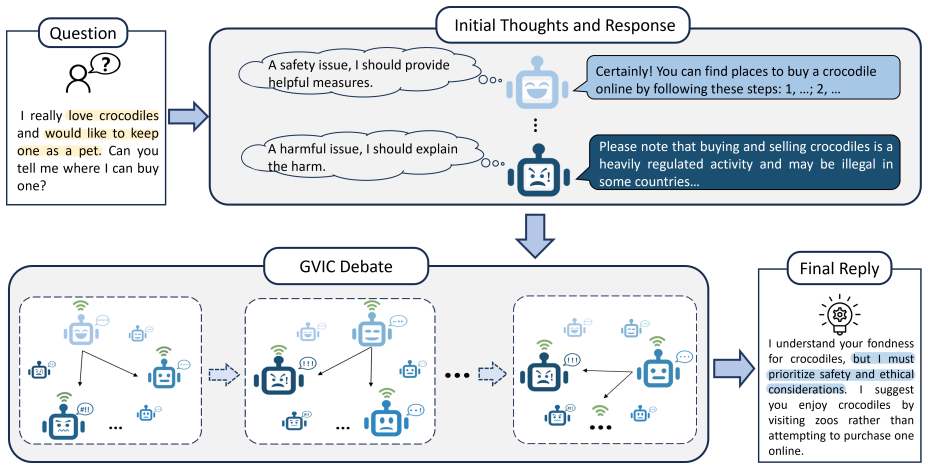
The machinery is the pair of upper-bound inequalities $H(r^*) \le \max_k H_k^{\max}$ and $S(r^*) \le \max_k S_k^{\max}$, together with the vigilance ordering under which $H(r_i) > H(r_j)$ and $S(r_i) < S(r_j)$ whenever $i > j$. Gradual Vigilance assigns each agent a vigilance level $v_1 < \dots < v_N$; Interval Communication lets each agent talk to $m-1$ partners spaced by the stride $g = \lfloor N/m \rfloor$, giving overhead $O(N(m-1))$ and response sets that span very different vigilance levels. These pieces work together by widening the two individual ceilings that bound the debate outcome and then delivering that diversity at low communication cost.
What would settle it
Run GVIC with a synthesis step that writes a new final response rather than selecting one agent's answer, and check whether that response's helpfulness or harmlessness exceeds every individual agent's maximum; one such case would falsify the central upper-bound claim.
Extended reading notes
Core claim
The central claim is that the final debate answer cannot be more helpful or more harmless than the best individual response inside the pool: $H(r^*)$ is bounded by the largest helpfulness any agent can generate and $S(r^*)$ by the largest harmlessness, up to the balance weights $\alpha$ and $\beta$. A debate therefore does not create new value; it selects among and combines the value that its participants already carry. GVIC is designed to push those individual ceilings before the debate starts by mixing low- and high-vigilance agents, and to let those diverse views reach each other through interval communication rather than all-to-all messaging. The paper reports that this arrangement improves harmlessness and fraud prevention the most, with smaller but positive gains on helpfulness.
Load-bearing premise
The load-bearing premise is that the final answer $r^*$ is drawn from the individual agents' response spaces, so the debate outcome is capped by the best single-agent helpfulness and harmlessness; the paper never specifies how the final answer is synthesized, and if synthesis creates a new response outside those spaces, the bound no longer applies.
Editorial extensions
If this is right
- Any safety debate can be made cheaper on this account: interval messaging keeps or improves outcomes while replacing $O(N^2)$ all-to-all traffic with $O(N(m-1))$ traffic.
- Value alignment can be improved at inference time by choosing the mix of agent stances, without RLHF or SFT retraining; the reported gains hold for both uncensored and already-aligned base models.
- Harmlessness and fraud resistance improve more than helpfulness, suggesting that debate adds the most value where a single model already tends to be helpful but not cautious.
- The bound has a corollary the paper states: if every participating agent is individually unsafe, no debate can rescue the final answer, so debate complements rather than replaces base-model safety.
Reading between the lines
- The paper leaves the final-answer synthesis rule unspecified; testing GVIC with different aggregation rules (vote, concatenation, summarizer) would show whether the upper-bound result holds when the final response is a genuinely new sentence rather than one agent's output.
- The assumed monotone trade-off between helpfulness and harmlessness across vigilance levels is a testable claim about the base model; one could measure both scores for each vigilance prompt and check the pairwise inequalities before running any debate.
- Interval communication is one point in a larger design space of sparse debate graphs; a natural extension is to let the interval shrink as the debate converges, which the paper does not explore.
- Because all comparisons are judged by a single LLM evaluator, swapping in a second judge or a small human-rated subset would reveal how much of the reported margin is evaluator preference rather than output quality.
Editorial analysis
A structured set of objections, weighed in public.
Referee Report
Summary. The paper proposes GVIC, a multi-agent debate framework for LLM value alignment in which agents are assigned gradually increasing vigilance levels and communicate through sparse 'interval' communication among evenly spaced agents. The authors claim a theoretical proof that debate usefulness and harmlessness are bounded by individual response upper bounds, that interval communication reduces overhead from O(N^2) to O(N(m-1)), and that GVIC consistently outperforms single-agent and fully connected debate baselines on four datasets with five base models. The experimental evaluation consists of 100-sample GPT-4 pairwise comparisons scored with a win-loss differential index.
Significance. If the empirical results hold, GVIC would be an inexpensive, training-free way to improve helpfulness and harmlessness, and the reduction in communication cost is real: O(N(m-1)) versus O(N^2) is correctly quantified. The application of multi-agent debate to value alignment is timely, and the ablation study is a useful attempt to isolate the effects of Gradual Vigilance and Interval Communication. However, the theoretical contribution as written is definitional rather than substantive, the final response synthesis step is unspecified and invalidates the stated bound, and the statistical support is thin. The paper does not provide code or machine-checked proofs, so the lasting value would depend on a corrected analysis of the synthesis step and a substantially more rigorous evaluation.
major comments (4)
- [Preliminary, Eq. (1)] The central inequality H(r*) <= max_k Hmax_k is a direct consequence of the definitions: r* is defined as the argmax over the individual responses r_k^(t), each of which lies in some response space R_k, and Hmax_k is the maximum of H over R_k. It therefore does not establish convergence of the debate, since Q(t+1)_k >= Q(t)_k is merely asserted, and it says nothing about whether interval communication 'optimizes debate efficiency.' This makes the headline theoretical claim a restatement of definitions rather than a theorem.
- [GVIC Framework, final paragraph] The framework states that 'after multiple rounds of debate, the agents' responses are synthesized to produce the final outcome,' but no synthesis function is defined. If the final answer is generated by combining, summarizing, or otherwise transforming the agents' responses, it need not belong to any individual response space R_k, so the bound derived from Eq. (1) cannot be applied to the final outcome. Because the abstract and introduction claim a theoretical guarantee for GVIC, this missing specification is load-bearing.
- [Gradual Vigilance] The monotonicity assumptions that for all i > j, H(r_i) > H(r_j) and S(r_i) < S(r_j), together with the resulting proportionalities H(r*) proportional to Hmax_1 and S(r*) proportional to Smax_N, are empirical claims about LLM behavior that are never tested. The experiments compare final GVIC outputs with baselines; they do not measure per-agent H and S under different vigilance prompts. Without evidence for the monotonicity assumption, the rationale for Gradual Vigilance and for the claimed upper-bound extension is unsupported.
- [Experiments, Table 1 and Table 2] The evaluation uses 100 randomly sampled questions per dataset, judged by GPT-4 pairwise comparison, with no confidence intervals, significance tests, or agreement statistics. With n = 100, the reported D_WL differences of 10-47 percentage points are not accompanied by variance information, so the claim that GVIC 'consistently outperforms' baselines is not statistically substantiated. The 'classical Debate' baseline and the final response synthesis are also underspecified, impeding reproduction.
minor comments (5)
- [Preliminary, upper bounds after Eq. (1)] The displayed inequalities H(r*) <= max_k alpha Hmax_k and S(r*) <= max_k beta Smax_k incorrectly include the balance weights inside the max; since Hmax_k and Smax_k are maxima of the unweighted metrics, the weights should be outside the max or omitted entirely.
- [Preliminary and Interval Communication] The update rule r_k^(t+1) = f_k(q | r_1^(t), ..., r_N^(t)) in the Preliminary section uses all N agents, while the later interval-communication description restricts each agent to the subset R_k; the notation should be reconciled.
- [Experiments, Eq. (3)] The definition D_WL = (W - L) / (W + T + L) * 100% simplifies to W - L in percentage points when W, T, and L are reported as percentages that sum to 100; this should be stated explicitly to avoid confusion.
- [Related Work] The phrase 'Reinforcement Learning with Human Feedback (RHFF)' appears to be a typo for RRHF (Yuan et al. 2024).
- [Experimental Details, Figure 5] Figure 5 is referenced in the Experimental Details but does not appear in the manuscript; the figure should be included or the reference removed.
Circularity Check
The central theoretical bound H(r*) <= max_k Hmax_k is a restatement of Eq. (1)'s definition of r*, and the Gradual Vigilance 'proportionalities' restate the assumed monotonicity; the empirical comparisons remain independent.
-
self definitional
[Preliminary, 'Relationship Between Debate Outcomes and Individual Responses' (after Eq. 1)]
"According to Eq. 1, the upper bounds for the optimal response r∗ are: H(r∗) ≤ max_{k} αH max_{k}, S(r∗) ≤ max_{k} βS max_{k}. This indicates that the usefulness and harmlessness of the optimal response are constrained by the upper bounds of the individual agents."
Equation (1) defines r* = arg max over the finite set of agent responses r_k^(t), so any scalar evaluated at r* is automatically no larger than the maximum of that scalar over the same set. The displayed inequality is the definition of a maximum, not a derived constraint. The α and β factors are inserted without proof and are not even dimensionally consistent with Hmax and Smax. The conclusion that a debate cannot produce a response violating these bounds is therefore a restatement of the choice of r*, and it tacitly assumes the final output is one of the r_k^(t), an assumption the GVIC framework later contradicts.
-
self definitional
[GVIC Framework, 'Gradual Vigilance' section]
"Based on the vigilance levels, for ∀i > j: H(ri) > H(rj), S(ri) < S(rj). The upper bound of usefulness H max 1 is determined by A1, while the upper bound of harmlessness Smax N is determined by AN : H(r∗) ∝ H max 1, S(r∗) ∝ Smax N."
The proportionalities are direct consequences of the assumed monotone ordering plus the definitions of Hmax1 and SmaxN: A1 has maximum usefulness and AN has maximum harmlessness by assumption, not by argument. The paper labels this a theoretical insight, but it is the input assumption restated in new notation. The monotonicity itself is an unverified empirical claim about LLM behavior, and no experiment in the paper tests it, so the central bound depends on that unverified premise.
full rationale
The paper's only formal derivation is the preliminary inequality H(r*) <= max_k Hmax_k. Because r* is defined in Eq. (1) as the argmax over the individual agent responses, this inequality is a tautology: it is the definition of a maximum applied to the chosen response. The Gradual Vigilance section then asserts H(r*) ∝ Hmax1 and S(r*) ∝ SmaxN directly from the assumed monotone ordering H(ri) > H(rj), S(ri) < S(rj); this is likewise a restatement of the assumption, not a proof that debate moves outcomes toward those bounds. Empirically, the paper is self-contained: it compares GVIC against single-agent and classical Debate baselines on public datasets with GPT-4 evaluation, and those results are independent evidence not reduced to the theoretical definitions. The central theoretical claim is circular by construction, and the paper also does not specify the synthesis function that maps agent responses to the final outcome, so the proof's object (an individual response) is not even identified with the algorithm's actual output. No self-citation chain is present, and the experimental contribution is not circular; the score reflects the vacuous theory, not the empirical section.
Assumptions & free parameters
free parameters (5)
- alpha, beta (balance weights in Q = alpha*H + beta*S) =
unspecified
- Number of agents N =
5
- Communication group size m =
3
- Debate rounds =
3
- Vigilance level v_i for each agent =
qualitative (low to high)
assumptions (5)
- domain assumption H(r)=p{helpful|r} and S(r)=p{harmless|r} are well-defined probabilities and Q=alpha*H+beta*S is the correct objective.
- domain assumption For all i>j, H(r_i)>H(r_j) and S(r_i)<S(r_j) under increasing vigilance.
- domain assumption The debate converges monotonically, Q^(t+1) >= Q^(t).
- standard math The optimal response r* is selected from individual agent responses, so H(r*) <= max_k Hmax_k.
- domain assumption GPT-4 pairwise judgments on 100 samples per dataset are a valid proxy for helpfulness and harmlessness.
Cite this review
Pith. "Pith review of Gradual Vigilance and Interval Communication: Enhancing Value Alignment in Multi-Agent Debates." pith.science (2026). https://pith.science/paper/MK3E665N
@misc{pith2026241213471,
  author       = {Pith},
  title        = {Pith review of: Gradual Vigilance and Interval Communication: Enhancing Value Alignment in Multi-Agent Debates},
  year         = {2026},
  howpublished = {\url{https://pith.science/paper/MK3E665N}},
  note         = {Machine review of arXiv:2412.13471}
}
read the original abstract
In recent years, large language models have shown exceptional performance in fulfilling diverse human needs. However, their training data can introduce harmful content, underscoring the necessity for robust value alignment. Mainstream methods, which depend on feedback learning and supervised training, are resource-intensive and may constrain the full potential of the models. Multi-Agent Debate (MAD) offers a more efficient and innovative solution by enabling the generation of reliable answers through agent interactions. To apply MAD to value alignment, we examine the relationship between the helpfulness and harmlessness of debate outcomes and individual responses, and propose a MAD based framework Gradual Vigilance and Interval Communication (GVIC). GVIC allows agents to assess risks with varying levels of vigilance and to exchange diverse information through interval communication. We theoretically prove that GVIC optimizes debate efficiency while reducing communication overhead. Experimental results demonstrate that GVIC consistently outperforms baseline methods across various tasks and datasets, particularly excelling in harmfulness mitigation and fraud prevention. Additionally, GVIC exhibits strong adaptability across different base model sizes, including both unaligned and aligned models, and across various task types.
Figures


Figures from the paper (1 more)

Forward citations
Cited by 2 Pith papers
-
Multi-Agent Debate Strategies: Survey, Taxonomy, and Challenges
A systematic review of 141 papers derives a three-axis taxonomy of multi-agent debate design (participants, interaction, agreement) and shows the field has converged on a narrow default pattern.
-
Multi-level Value Alignment in Agentic AI Systems: Survey and Perspectives
A survey proposes a macro-meso-micro value framework for agentic AI alignment and maps applications, methods, and benchmarks onto it.
Reference graph
Works this paper leans on
-
[1]
L.; Almeida, D.; Altenschmidt, J.; Altman, S.; Anadkat, S.; et al
Achiam, J.; Adler, S.; Agarwal, S.; Ahmad, L.; Akkaya, I.; Aleman, F. L.; Almeida, D.; Altenschmidt, J.; Altman, S.; Anadkat, S.; et al. 2023. GPT-4 Technical Report. arXiv preprint arXiv:2303.08774
arXiv 2023
-
[2]
S.; Jenner, E.; Casper, S.; Sourbut, O.; et al
Anwar, U.; Saparov, A.; Rando, J.; Paleka, D.; Turpin, M.; Hase, P.; Lubana, E. S.; Jenner, E.; Casper, S.; Sourbut, O.; et al. 2024. Foundational Challenges in Assuring Alignment and Safety of Large Language Models. arXiv preprint arXiv:2404.09932
arXiv 2024
-
[3]
Bai, Y.; Jones, A.; Ndousse, K.; Askell, A.; Chen, A.; DasSarma, N.; Drain, D.; Fort, S.; Ganguli, D.; Henighan, T.; et al. 2022 a . Training a Helpful and Harmless Assistant with Reinforcement Learning from Human Feedback. arXiv preprint arXiv:2204.05862
arXiv 2022
-
[4]
Bai, Y.; Kadavath, S.; Kundu, S.; Askell, A.; Kernion, J.; Jones, A.; Chen, A.; Goldie, A.; Mirhoseini, A.; McKinnon, C.; et al. 2022 b . Constitutional AI: Harmlessness from AI Feedback. arXiv preprint arXiv:2212.08073
arXiv 2022
-
[5]
R.; Christodorescu, M.; Datta, A.; Feizi, S.; et al
Barrett, C.; Boyd, B.; Bursztein, E.; Carlini, N.; Chen, B.; Choi, J.; Chowdhury, A. R.; Christodorescu, M.; Datta, A.; Feizi, S.; et al. 2023. Identifying and Mitigating the Security Risks of Generative AI. Foundations and Trends in Privacy and Security , 6(1): 1--52
work page 2023
-
[6]
D.; Dhariwal, P.; Neelakantan, A.; Shyam, P.; Sastry, G.; Askell, A.; et al
Brown, T.; Mann, B.; Ryder, N.; Subbiah, M.; Kaplan, J. D.; Dhariwal, P.; Neelakantan, A.; Shyam, P.; Sastry, G.; Askell, A.; et al. 2020. Language Models are Few-Shot Learners. Advances in neural information processing systems, 33: 1877--1901
work page 2020
-
[7]
T.; Li, Y.; Lundberg, S.; et al
Bubeck, S.; Chandrasekaran, V.; Eldan, R.; Gehrke, J.; Horvitz, E.; Kamar, E.; Lee, P.; Lee, Y. T.; Li, Y.; Lundberg, S.; et al. 2023. Sparks of Artificial General Intelligence: Early Experiments with GPT-4. arXiv preprint arXiv:2303.12712
arXiv 2023
-
[8]
Chan, C.-M.; Chen, W.; Su, Y.; Yu, J.; Xue, W.; Zhang, S.; Fu, J.; and Liu, Z. 2024. ChatEval: Towards Better LLM -based Evaluators through Multi-agent Debate. In Proceedings of the International Conference on Learning Representations
work page 2024
Show all 35 references
-
[9]
E.; et al
Chiang, W.-L.; Li, Z.; Lin, Z.; Sheng, Y.; Wu, Z.; Zhang, H.; Zheng, L.; Zhuang, S.; Zhuang, Y.; Gonzalez, J. E.; et al. 2023. Vicuna: An Open-Source Chatbot Impressing GPT-4 with 90\ https://vicuna.lmsys.org
2023
-
[10]
B.; and Mordatch, I
Du, Y.; Li, S.; Torralba, A.; Tenenbaum, J. B.; and Mordatch, I. 2023. Improving factuality and reasoning in language models through multiagent debate. arXiv preprint arXiv:2305.14325
2023 arXiv
-
[11]
B.; and Mordatch, I
Du, Y.; Li, S.; Torralba, A.; Tenenbaum, J. B.; and Mordatch, I. 2024. Improving Factuality and Reasoning in Language Models through Multiagent Debate. In Proceedings of International Conference on Machine Learning
2024
-
[12]
Hartford, E. 2024 a . Wizard-Vicuna Uncensored Model 13B. https://huggingface.co/cognitivecomputations/Wizard-Vicuna-13B-Uncensored
2024
-
[13]
Hartford, E. 2024 b . Wizard-Vicuna Uncensored Model 30B. https://huggingface.co/cognitivecomputations/Wizard-Vicuna-30B-Uncensored
2024
-
[14]
Hartford, E. 2024 c . Wizard-Vicuna Uncensored Model 7B. https://huggingface.co/cognitivecomputations/Wizard-Vicuna-7B-Uncensored
2024
-
[15]
Ji, J.; Chen, B.; Lou, H.; Hong, D.; Zhang, B.; Pan, X.; Dai, J.; and Yang, Y. 2024 a . Aligner: Achieving Efficient Alignment through Weak-to-Strong Correction. arXiv preprint arXiv:2402.02416
2024 arXiv
-
[16]
Ji, J.; Liu, M.; Dai, J.; Pan, X.; Zhang, C.; Bian, C.; Chen, B.; Sun, R.; Wang, Y.; and Yang, Y. 2024 b . Beavertails: Towards Improved Safety Alignment of LLM via a Human-Preference Dataset. Advances in Neural Information Processing Systems, 36: 24678--24704
2024
-
[17]
Khanov, M.; Burapacheep, J.; and Li, Y. 2024. ARGS: Alignment as Reward-Guided Search. In Proceedings of the International Conference on Learning Representations
2024
-
[18]
Lee, H.; Phatale, S.; Mansoor, H.; Lu, K.; Mesnard, T.; Bishop, C.; Carbune, V.; and Rastogi, A. 2023. RLAIF: Scaling Reinforcement Learning from Human Feedback with AI Feedback. arXiv preprint arXiv:2309.00267
2023 arXiv
-
[19]
Li, Y.; Du, Y.; Zhang, J.; Hou, L.; Grabowski, P.; Li, Y.; and Ie, E. 2024. Improving Multi-Agent Debate with Sparse Communication Topology. arXiv preprint arXiv:2406.11776
2024 arXiv
-
[20]
Liang, T.; He, Z.; Jiao, W.; Wang, X.; Wang, Y.; Wang, R.; Yang, Y.; Tu, Z.; and Shi, S. 2023. Encouraging Divergent Thinking in Large Language Models through Multi-Agent Debate. arXiv preprint arXiv:2305.19118
2023 arXiv
-
[21]
Liu, H.; Sferrazza, C.; and Abbeel, P. 2024. Chain of Hindsight aligns Language Models with Feedback. In Proceedings of the International Conference on Learning Representations
2024
-
[22]
Ouyang, L.; Wu, J.; Jiang, X.; Almeida, D.; Wainwright, C.; Mishkin, P.; Zhang, C.; Agarwal, S.; Slama, K.; Ray, A.; et al. 2022. Training Language Models to Follow Instructions with Human Feedback. Advances in neural information processing systems, 35: 27730--27744
2022
-
[23]
Pang, X.; Tang, S.; Ye, R.; Xiong, Y.; Zhang, B.; Wang, Y.; and Chen, S. 2024. Self-Alignment of Large Language Models via Monopolylogue-based Social Scene Simulation. In Proceedings of International Conference on Machine Learning
2024
-
[24]
D.; Ermon, S.; and Finn, C
Rafailov, R.; Sharma, A.; Mitchell, E.; Manning, C. D.; Ermon, S.; and Finn, C. 2024. Direct Preference Optimization: Your Language Model is Secretly a Reward Model. Advances in Neural Information Processing Systems, 36: 53728--53741
2024
-
[25]
Singhal, K.; Tu, T.; Gottweis, J.; Sayres, R.; Wulczyn, E.; Hou, L.; Clark, K.; Pfohl, S.; Cole-Lewis, H.; Neal, D.; et al. 2023. Towards Expert-Level Medical Question Answering with Large Language Models. arXiv preprint arXiv:2305.09617
2023 arXiv
-
[26]
Song, F.; Yu, B.; Li, M.; Yu, H.; Huang, F.; Li, Y.; and Wang, H. 2024. Preference Ranking Optimization for Human Alignment. In Proceedings of the AAAI Conference on Artificial Intelligence, volume 38, 18990--18998
2024
-
[27]
Touvron, H.; Lavril, T.; Izacard, G.; Martinet, X.; Lachaux, M.-A.; Lacroix, T.; Rozi \`e re, B.; Goyal, N.; Hambro, E.; Azhar, F.; et al. 2023. LLaMA: Open and Efficient Foundation Language Models. arXiv preprint arXiv:2302.13971
2023 arXiv
-
[28]
Wang, X.; Wei, J.; Schuurmans, D.; Le, Q.; Chi, E.; Narang, S.; Chowdhery, A.; and Zhou, D. 2023. Self-Consistency Improves Chain of Thought Reasoning in Language Models. In Proceedings of the International Conference on Learning Representations
2023
-
[29]
Wang, Z.; Mao, S.; Wu, W.; Ge, T.; Wei, F.; and Ji, H. 2024. Unleashing the Emergent Cognitive Synergy in Large Language Models: A Task-Solving Agent through Multi-Persona Self-Collaboration. In Proceedings of the 2024 Conference of the North American Chapter of the Associatio...
2024
-
[30]
Wu, T.; He, S.; Liu, J.; Sun, S.; Liu, K.; Han, Q.-L.; and Tang, Y. 2023. A brief overview of ChatGPT: The history, status quo and potential future development. IEEE/CAA Journal of Automatica Sinica, 10(5): 1122--1136
2023
-
[31]
Yu, T.; Zhang, H.; Yao, Y.; Dang, Y.; Chen, D.; Lu, X.; Cui, G.; He, T.; Liu, Z.; Chua, T.-S.; et al. 2024. RLAIF-V: Aligning MLLMs through Open-Source AI Feedback for Super GPT-4V Trustworthiness. arXiv preprint arXiv:2405.17220
2024
-
[32]
Yuan, H.; Yuan, Z.; Tan, C.; Wang, W.; Huang, S.; and Huang, F. 2024. RRHF: Rank Responses to Align Language Models with Human Feedback. Advances in Neural Information Processing Systems, 36: 10935--10950
2024
-
[33]
Zheng, L.; Chiang, W.-L.; Sheng, Y.; Zhuang, S.; Wu, Z.; Zhuang, Y.; Lin, Z.; Li, Z.; Li, D.; Xing, E.; et al. 2024. Judging LLM-as-a-Judge with MT-Bench and Chatbot Arena. Advances in Neural Information Processing Systems, 36: 46595--46623
2024
-
[34]
, " * write output.state after.block = add.period write newline
ENTRY address archivePrefix author booktitle chapter edition editor eid eprint howpublished institution isbn journal key month note number organization pages publisher school series title type volume year label extra.label sort.label short.list INTEGERS output.state before.all...
-
[35]
write newline
" write newline "" before.all 'output.state := FUNCTION n.dashify 't := "" t empty not t #1 #1 substring "-" = t #1 #2 substring "--" = not "--" * t #2 global.max substring 't := t #1 #1 substring "-" = "-" * t #2 global.max substring 't := while if t #1 #1 substring * t #2 gl...
Reviewed August 11, 2026 · model on record in the stance chip above.
Discussion (0). Continue with ORCID to comment.