REVIEW 3 major objections 6 minor 87 references
Data-driven Discovery of Biophysical T Cell Receptor Co-specificity Rules
T0 review · 3 major / 6 minor · reviewed 2026-08-11 · deepseek-v4-flash
Pith's one-line read The paper claims that simple, interpretable distance metrics learned from T cell receptor sequence data predict whether two receptors share a peptide target, and that these rules transfer to peptides highly dissimilar from any seen in…
desk verdict A genuinely useful TCR distance metric with a real generalization claim, but the headline extrapolation rests on a subset whose size the paper never reports. read the letter →
The pith
A machine-rendered reading of the paper's core claim, the machinery that carries it, and where it could break.
The reading
What carries the argument
The machinery is a factorized, interpretable distance metric defined over edit steps between TCR CDR3 sequences. For each edit step $i$, the metric combines a site weight $S(k_i, \ell)$ and an amino-acid substitution weight $A(\Delta_i)$ through $d_{AS}(\sigma,\sigma') = -\sum_i \log\left[1 - \left(1 - e^{-S(k_i,\ell)}\right)\left(1 - e^{-A(\Delta_i)}\right)\right]$, which corresponds to a co-selection factor $Q_{AS}$ proportional to the product over sites of $[1 - P_S(k_i,\ell)(1 - P_A(\Delta_i))]$, with $P_S$ a per-site contribution probability and $P_A$ a per-substitution co-specificity retention probability. Parameters are fitted by minimizing a contrastive loss that the paper derives as a negative log-pseudo-likelihood, whose optimum sets each feature weight to the log-ratio of co-specific pair frequency to unlabeled pair frequency — a direct data-driven analog of log-odds substitution matrices. This two-point-statistics view is what lets the learned rules generalize across ligand landscapes rather than fitting one peptide at a time.
What would settle it
Measure co-specificity rates for TCR pairs that differ at two positions where each single substitution is known to preserve co-specificity: the factorized model (Eq. 14) predicts the double-substitution co-specificity should be the product of the two single-site probabilities; if the observed double-mutant co-specificity is substantially lower, the independence assumption fails and the metric's weights are mis-calibrated.
Extended reading notes
Core claim
On the paper's own terms, the central discovery is that TCR co-specificity — whether two receptors share a ligand — is governed by local and largely ligand-independent sequence rules that can be learned from data. Fitting an exponential model of co-selection factors, the authors optimize a factorized distance metric $d_{AS}$ that assigns separate weights to the position of an amino-acid substitution and the identity of the substitution, with the two combined as independent probabilities per edit step. This metric outperforms BLOSUM-based TCRdist on both held-out SARS-CoV-2 specificity groups and an external dataset covering other pathogens, and it continues to separate co-specific from cross-specific pairs when the peptide differs by at least six amino acids from any training peptide. The learned substitution matrix is only moderately correlated with BLOSUM62 and tracks steric properties more strongly than hydrophobicity, while the learned site weights show that positions not contacting the peptide matter for specificity. The paper concludes that simple learned distance metrics can substitute for heuristic ones and that contrastive learning provides a principled route to two-point statistics of receptor–ligand maps.
Load-bearing premise
Everything rests on the assumption that the impact of an amino-acid change depends only on the site and the amino-acid identity, with these two factors multiplying independently per edit step; if a substitution's effect changes with its sequence context, the learned weights are biased and the demonstrated extrapolation to multi-edit pairs is not assured.
Editorial extensions
If this is right
- Learned TCR distance metrics can replace heuristic ones like TCRdist as drop-in similarity scores for clustering and annotation of TCR repertoires.
- The same contrastive framework can be retrained on larger paired-chain data to yield a machine-optimized metric with more parameters and, presumably, further reach.
- Because the learned substitution matrix emphasizes steric shape over hydrophobicity, sequence-similarity tools for T cells should be recalibrated accordingly rather than relying on BLOSUM.
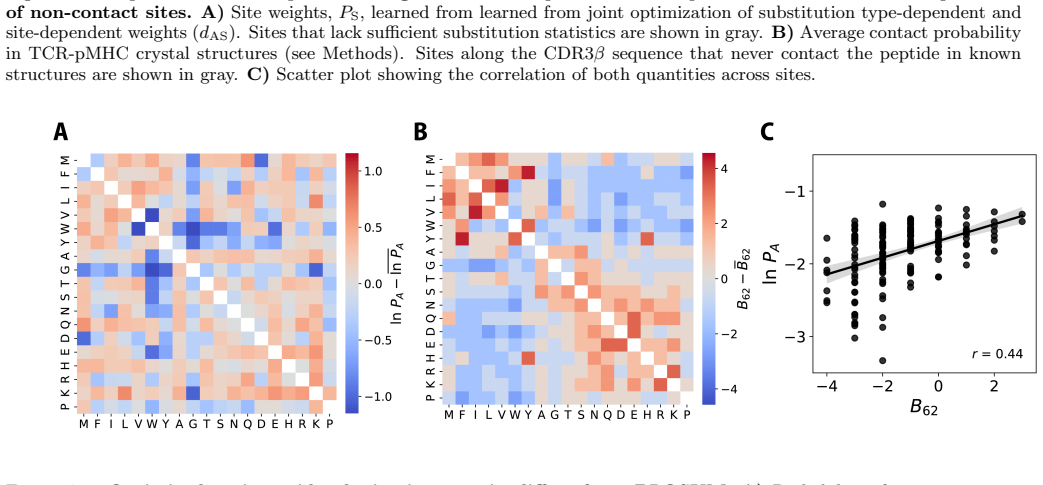
- The finding that non-contact CDR3 positions influence co-specificity argues against trimming loop edges when scoring TCR similarity.
- Some co-specificity rules are shared between the $\alpha$ and $\beta$ chains, since metrics trained on CDR3$\beta$ transfer to CDR3$\alpha$ pairs in external data.
Reading between the lines
- A consequence not explored in the paper: the same two-point, pseudo-likelihood machinery should transfer to antibody–antigen co-specificity data, where the learned substitution matrix could be compared directly.
- Because the factorized model degrades past 3–4 edits, an explicit next step is to add pairwise, context-dependent terms to Eq. 14; if that restores performance at larger edit distances, the independence assumption is the bottleneck.
- The paper's property analysis suggests a broader rule: flexible binding loops (TCR, antibody) are governed by steric matching, while rigid pockets (protease) are governed by hydrophobicity; this can be tested on additional protein–protein interaction classes.
- The successful transfer from one virus's peptides to unrelated epitopes implies co-specificity rules could serve as a zero-shot prior for newly discovered epitopes with no known TCRs, something the paper mentions only as an eventual aim.
Signed reviews
Editorial analysis
A structured set of objections, weighed in public.
Referee Report
Summary. The paper proposes a supervised contrastive learning framework, derived from pseudo-likelihood maximization, to learn interpretable sequence distance metrics for TCR co-specificity. Using single-edit CDR3beta pairs from the MIRA SARS-CoV-2 dataset with matched V genes and restricted lengths, the authors learn an amino-acid substitution matrix A, a site-weight matrix S, and a joint factorized metric d_AS. They report that d_AS outperforms TCRdist on held-out MIRA pMHC groups and on external VDJdb data, including for TCR pairs with multiple edit steps. They also claim the learned rules generalize to pMHCs that differ by at least six amino acids from any training peptide. In addition, they find that steric properties of amino acids correlate more strongly with the learned substitution penalties than hydrophobic properties, and that non-contact CDR3beta positions contribute substantially to co-specificity.
Significance. If fully supported, this is a valuable contribution to TCR specificity prediction. The pseudo-likelihood derivation connects contrastive metric learning to established statistical physics inference, and the learned metrics are simple, interpretable, and available as drop-in replacements for TCRdist. The external validation on VDJdb and the transfer to TCRalpha chains strengthen the claim that local co-specificity rules are shared across ligands and chains. The authors provide public code and a clear data-availability statement, and they explicitly discuss several limitations, including the factorization assumption and the positive-unlabeled nature of the evaluation. The paper's central empirical assertion, however, requires stronger statistical support for the specific claim of generalization to pMHCs at least six amino acids away from the training set, which is currently not quantified at the group level.
major comments (3)
- [Section IV D, Fig. S5C] The headline empirical claim—that the learned rules generalize to pMHCs differing by at least six amino acids from the nearest training peptide—is not supported with sufficient quantitative detail. Fig. S5A shows a distribution of minimum peptide Levenshtein distances, but the paper does not report how many of the 24 held-out MIRA pMHC groups fall in the >=6 amino-acid category, nor how many TCR pairs contribute to that subset. The error bars in Fig. S5C are computed over resampled training/test batches, which resample within the same pMHC groups and therefore do not capture group-level variability. If only a few groups satisfy the >=6 condition, the reported AUROC could be driven by easy-to-discriminate groups, and the conclusion that the rules generalize broadly to dissimilar peptides would not be established. I request that the authors report the number of pMHC groups and TCR pairs in the dissimilar-peptide subset, and provide either per-group AUROC values or a bootstrap over pMHC groups (e.g., cluster bootstrap) to quantify group-level uncertainty.
- [Section III, Section VI] The evaluation treats all pairs from different specificity groups as negative, which is a positive-unlabeled (PU) setup because cross-reactive pairs are labeled as negative. The authors acknowledge this and note that about one in ten single edits maintain co-specificity, bounding AUROC below one. However, this labeling issue can also affect the comparison between metrics if the rate of cross-reactivity differs across edit distances or between the MIRA and VDJdb test sets. For instance, at edit distance 1 the mislabeling rate may be higher than at distance 5, and if the composition of true positives differs between datasets, the reported AUROC gap between d_AS and TCRdist could be partly an artifact of label noise rather than metric quality. I recommend a sensitivity analysis that either restricts to high-confidence negatives (e.g., pairs with large TCR sequence dissimilarity or different HLA restrictions) or estimates and corrects for mislabeling rates, to confirm that the relative improvements are robust.
- [Section IV D, Eq. 14-15] The joint metric d_AS assumes that site contributions and amino-acid substitution effects factorize, i.e., that P_S and P_A are statistically independent. The authors mention this assumption in the Discussion, but the empirical section does not test it. Because the metric's extrapolation to multi-edit pairs and to dissimilar pMHCs relies on this factorization, I ask the authors to report how the model's performance compares with a non-factorized alternative (e.g., a full site-by-amino-acid matrix trained on the same data) or to provide diagnostic evidence that the independence assumption is not the main cause of the observed performance decline at edit distances beyond 3-4. This would strengthen the interpretation of the learned weights as biophysical quantities rather than as phenomenological fit parameters.
minor comments (6)
- [Section I] In the sentence 'P(σ) represents the highly highly non-uniform', 'highly' is repeated; this typo should be corrected.
- [Figure S3 and S4 captions] The captions state 'resampling training data with replacement fiveteen times'; 'fiveteen' should be 'fifteen'.
- [Section V] The word 'biopysical' in 'biopysical interpretation' should be 'biophysical'.
- [Table S1] In the Steric Property rows, 'STERMIMOL' should be 'STERIMOL' (three occurrences).
- [Section IV D, Eq. 14] The notation switches between A(Δ_i) in Eq. 12 and P_A(Δ_i) in Eq. 15; please define the relationship explicitly to avoid confusion when interpreting the learned matrix A.
- [Figure S5] Fig. S5C reports error bars 'across 10 test batches', while other figures use 15 resampled batches; please clarify why the number differs and ensure the caption describes the resampling procedure consistently.
Circularity Check
No circularity: learned metrics are fit on training pMHC groups and evaluated on held-out and external data, so the generalization claim is out-of-sample.
full rationale
The paper's central derivation is empirical risk minimization: parameters of d_A, d_S, and d_AS are optimized by minimizing the contrastive/pseudo-likelihood loss (Eq. 7) on positive pairs from 26 SARS-CoV-2 MIRA pMHC groups and unlabeled pairs. The headline generalization claims are then evaluated on 24 MIRA pMHC groups excluded from training and on VDJdb groups with pMHCs not present in MIRA, with AUROCs computed over resampled balanced batches. This is a genuine out-of-sample evaluation, not a refit of test labels. The factorized ansatz in Eqs. 14-15 is explicitly presented as a modeling assumption ('Most naively', 'Assuming further ... statistically independent'), and its parameters are freely fitted, so the reported predictive performance is not forced by construction. Self-citations (refs. 20, 26-28) supply empirical context, such as the previously observed Levenshtein-distance decay of co-selection factors, but these are external, falsifiable results rather than uniqueness theorems or fitted parameters imported into the loss; the optimized matrices and their held-out performance do not reduce to those citations. The structural contact-probability comparison (r = 0.47) and amino-acid property correlations are independent external analyses rather than outputs of the optimization. Concerns about the possibly small subset of test pMHCs at >=6 amino-acid distance (Fig. S5) are statistical robustness issues, not definitional circularity, and do not change the circularity score.
Assumptions & free parameters
free parameters (3)
- Amino-acid substitution matrix A (with gap) / P_A(Delta) =
20x20 plus gap, learned via gradient descent; values shown in Fig. 4A and Fig. S1C
- Site weight matrix S(k,l) =
Length-dependent position weights for CDR3beta lengths 11-15; shown in Fig. 3A and Fig. S2
- Training hyperparameters (learning rate, steps, batch resampling) =
lr=1e-3; 3000-12000 Adam steps; 15 subsampled batches of 1000 per pMHC
assumptions (5)
- domain assumption Exponential ansatz: average co-selection factor Q(sigma,sigma') is proportional to e^{-d_theta(sigma,sigma')} (Eq. 4).
- domain assumption Ligand averaging: Q_{pi_i}(sigma)Q_{pi_i}(sigma') approximately equals Q(sigma,sigma'), the average over ligands (Eq. 3).
- domain assumption Factorization of substitution contributions: Q_AS(sigma,sigma') is proportional to the product over edit steps of [1 - P_S(k_i,l)(1-P_A(Delta_i))] (Eq. 15).
- domain assumption Empirical unlabeled-set average approximates the generative pair distribution: the denominator in Eq. 5-7 is computed from the same training pairs, including co-specific pairs as a regularizer.
- ad hoc to paper Data curation exclusions (CDR3beta lengths 11-15, identical V genes, no cysteine, single-edit training pairs) preserve the co-specificity signal of interest (Section III).
Cite this review
Pith. "Pith review of Data-driven Discovery of Biophysical T Cell Receptor Co-specificity Rules." pith.science (2026). https://pith.science/paper/HSCUFWGY
@misc{pith2026241213722,
  author       = {Pith},
  title        = {Pith review of: Data-driven Discovery of Biophysical T Cell Receptor Co-specificity Rules},
  year         = {2026},
  howpublished = {\url{https://pith.science/paper/HSCUFWGY}},
  note         = {Machine review of arXiv:2412.13722}
}
read the original abstract
The biophysical interactions between the T cell receptor (TCR) and its ligands determine the specificity of the cellular immune response. However, the immense diversity of receptors and ligands has made it challenging to discover generalizable rules across the distinct binding affinity landscapes created by different ligands. Here, we present an optimization framework for discovering biophysical rules that predict whether TCRs share specificity to a ligand. Applying this framework to TCRs associated with a collection of SARS-CoV-2 peptides we systematically characterize how co-specificity depends on the type and position of amino-acid differences between receptors. We also demonstrate that the inferred rules generalize to ligands highly dissimilar to any seen during training. Our analysis reveals that matching of steric properties between substituted amino acids is more important for receptor co-specificity than the hydrophobic properties that prominently determine evolutionary substitutability. Our analysis also quantifies the substantial importance of positions not in direct contact with the peptide for specificity. These findings highlight the potential for data-driven approaches to uncover the molecular mechanisms underpinning the specificity of adaptive immune responses.
Figures


Figures from the paper (3 more)


Reference graph
Works this paper leans on
-
[1]
M. M. Davis and P. J. Bjorkman, The T cell receptor genes and T cell recognition, Nature334, 395 (1988)
1988
-
[2]
H. Chi, M. Pepper, and P. G. Thomas, Principles and therapeutic applications of adaptive immunity, Cell187, 2052 (2024)
2024
-
[3]
P. Dash, A. J. Fiore-Gartland, T. Hertz, G. C. Wang, S. Sharma, A. Souquette, J. C. Crawford, E. B. Clemens, T. H. O. Nguyen, K. Kedzierska, N. L. La Gruta, P. Bradley, and P. G. Thomas, Quantifiable predictive features define epitope-specific T cell receptor reper- toires, Nature547, 89 (2017)
2017
-
[4]
Glanville, H
J. Glanville, H. Huang, A. Nau, O. Hatton, L. E. Wa- gar, F. Rubelt, X. Ji, A. Han, S. M. Krams, C. Pettus, N. Haas, C. S. L. Arlehamn, A. Sette, S. D. Boyd, T. J. Scriba, O. M. Martinez, and M. M. Davis, Identifying specificity groups in the T cell receptor repertoire, Na- ture547, 94 (2017)
2017
-
[5]
C. S. Dobson, A. N. Reich, S. Gaglione, B. E. Smith, E. J. Kim, J. Dong, L. Ronsard, V. Okonkwo, D. Ling- wood, M. Dougan, S. K. Dougan, and M. E. Birnbaum, Antigen identification and high-throughput interaction mapping by reprogramming viral entry, Nature Methods 19, 449–460 (2022)
2022
-
[6]
A. V. Joglekar, M. T. Leonard, J. D. Jeppson, M. Swift, G. Li, S. Wong, S. Peng, J. M. Zaretsky, J. R. Heath, A. Ribas,et al., T cell antigen discovery via signaling and antigen-presenting bifunctional receptors, Nature meth- ods16, 191 (2019)
2019
-
[7]
S. Sureshchandra, J. Henderson, E. Levendosky, S. Bhat- tacharyya, J. M. Kastenschmidt, A. M. Sorn, M. T. Mi- tul, A. Benchorin, K. Batucal, A. Daugherty,et al., Tis- sue determinants of the human T cell receptor repertoire, bioRxiv preprint 10.1101/2024.08.17.608295 (2024)
-
[8]
D. V. Bagaev, R. M. A. Vroomans, J. Samir, U. Stervbo, C. Rius, G. Dolton, A. Greenshields-Watson, M. Attaf, E. S. Egorov, I. V. Zvyagin, N. Babel, D. K. Cole, A. J. Godkin, A. K. Sewell, C. Kesmir, D. M. Chudakov, F. Lu- ciani, and M. Shugay, VDJdb in 2019: database exten- sion, new analysis infrastructure and a T-cell receptor motif compendium, Nucleic ...
2020
Show all 87 references
-
[9]
Tickotsky, T
N. Tickotsky, T. Sagiv, J. Prilusky, E. Shifrut, and N. Friedman, McPAS-TCR: a manually curated cata- logue of pathology-associated T cell receptor sequences, Bioinformatics33, 2924–2929 (2017)
2017
-
[10]
R. Vita, S. Mahajan, J. A. Overton, S. K. Dhanda, S. Martini, J. R. Cantrell, D. K. Wheeler, A. Sette, and B. Peters, The immune epitope database (IEDB): 2018 update, Nucleic Acids Research47, D339–D343 (2018)
2018
-
[11]
Nolan, M
S. Nolan, M. Vignali, M. Klinger, J. N. Dines, I. M. Ka- plan, E. Svejnoha, T. Craft, K. Boland, M. W. Pesesky, R. M. Gittelman,et al., A large-scale database of T-cell receptor beta sequences and binding associations from natural and synthetic exposure to SARS-CoV-2, Fron- ti...
2025
-
[12]
Gielis, P
S. Gielis, P. Moris, W. Bittremieux, N. De Neuter, B. Ogunjimi, K. Laukens, and P. Meysman, Detection of Enriched T Cell Epitope Specificity in Full T Cell Receptor Sequence Repertoires, Frontiers in Immunology 10(2019)
2019
-
[13]
X. Lin, J. T. George, N. P. Schafer, K. Ng Chau, M. E. Birnbaum, C. Clementi, J. N. Onuchic, and H. Levine, Rapid assessment of T-cell receptor specificity of the im- mune repertoire, Nature Computational Science1, 362 (2021)
2021
-
[14]
D. S. Fischer, Y. Wu, B. Schubert, and F. J. Theis, Predicting antigen specificity of single T cells based on TCR CDR3 regions, Molecular Systems Biology16, e9416 (2020)
2020
-
[15]
Jokinen, J
E. Jokinen, J. Huuhtanen, S. Mustjoki, M. Heinonen, and H. L¨ ahdesm¨ aki, Predicting recognition between T cell receptors and epitopes with TCRGP, PLOS Compu- tational Biology17, e1008814 (2021)
2021
-
[16]
Croce, S
G. Croce, S. Bobisse, D. L. Moreno, J. Schmidt, P. Guil- lame, A. Harari, and D. Gfeller, Deep learning predic- tions of TCR-epitope interactions reveal epitope-specific chains in dual alpha T cells, Nature Communications15, 10.1038/s41467-024-47461-8 (2024)
2024 doi
-
[17]
A. Wang, X. Lin, K. N. Chau, J. N. Onuchic, H. Levine, and J. T. George, RACER-m leverages structural fea- tures for sparse T cell specificity prediction, Science Ad- vances10, 10.1126/sciadv.adl0161 (2024)
2024 doi
-
[18]
Meynard-Piganeau, C
B. Meynard-Piganeau, C. Feinauer, M. Weigt, A. M. Walczak, and T. Mora, TULIP: a transformer-based un- supervised language model for interacting peptides and T cell receptors that generalizes to unseen epitopes, Proceedings of the National Academy of Sciences121, e2316401121 (2024)
2024
-
[19]
Zhang, Z
Y. Zhang, Z. Wang, Y. Jiang, D. R. Littler, M. Ger- stein, A. W. Purcell, J. Rossjohn, H.-Y. Ou, and J. Song, Epitope-anchored contrastive transfer learning for paired CD8+ T cell receptor–antigen recognition, Nature Ma- chine Intelligence6, 1344–1358 (2024)
2024
-
[20]
Nagano, A
Y. Nagano, A. G. Pyo, M. Milighetti, J. Henderson, J. Shawe-Taylor, B. Chain, and A. Tiffeau-Mayer, Con- trastive learning of T cell receptor representations, Cell 12 Systems16(2025)
2025
-
[21]
Nielsen, A
M. Nielsen, A. Eugster, M. F. Jensen, M. Goel, A. Tiffeau-Mayer, A. Pelissier, S. Valkiers, M. R. Mart ´ ınez, B. Meynard-Piganeeau, V. Greiff, T. Mora, A. M. Walczak, G. Croce, D. L. Moreno, D. Gfeller, P. Meysman, and J. Barton, Lessons learned from the IMMREP23 TCR-epitope ...
2024
-
[22]
Bellet, A
A. Bellet, A. Habrard, and M. Sebban, A survey on metric learning for feature vectors and structured data (2014), arXiv:1306.6709 [cs.LG]
2014 arXiv
-
[23]
Vinyals, C
O. Vinyals, C. Blundell, T. Lillicrap, K. Kavukcuoglu, and D. Wierstra, Matching networks for one shot learning (2016)
2016
-
[24]
Henikoff and J
S. Henikoff and J. G. Henikoff, Amino acid substitution matrices from protein blocks., Proceedings of the Na- tional Academy of Sciences of the United States of Amer- ica89, 10915 (1992)
1992
-
[25]
Milighetti, J
M. Milighetti, J. Shawe-Taylor, and B. Chain, Predict- ing T cell receptor antigen specificity from structural fea- tures derived from homology models of receptor-peptide- major histocompatibility complexes, Frontiers in Physi- ology12, 730908 (2021)
2021
-
[26]
Mayer and C
A. Mayer and C. G. Callan, Measures of epitope binding degeneracy from T cell receptor repertoires, Proceedings of the National Academy of Sciences120, e2213264120 (2023)
2023
-
[27]
Tiffeau-Mayer, Unbiased estimation of sampling vari- ance for Simpson’s diversity index, Physical Review E 109, 064411 (2024)
A. Tiffeau-Mayer, Unbiased estimation of sampling vari- ance for Simpson’s diversity index, Physical Review E 109, 064411 (2024)
2024
-
[28]
Henderson, Y
J. Henderson, Y. Nagano, M. Milighetti, and A. Tiffeau- Mayer, Limits on inferring T cell specificity from partial information, Proceedings of the National Academy of Sci- ences121, e2408696121 (2024)
2024
-
[29]
Drost, L
F. Drost, L. Schiefelbein, and B. Schubert, meTCRs - Learning a metric for T-cell receptors, bioRxiv preprint , 2022.10.24.513533 (2022)
2022
-
[30]
Pertseva, O
M. Pertseva, O. Follonier, D. Scarcella, and S. T. Reddy, TCR clustering by contrastive learning on antigen speci- ficity, Briefings in Bioinformatics25, bbae375 (2024)
2024
-
[31]
Murugan, T
A. Murugan, T. Mora, A. M. Walczak, and C. G. Callan, Statistical inference of the generation probability of T- cell receptors from sequence repertoires, Proceedings of the National Academy of Sciences109, 16161 (2012)
2012
-
[32]
Sethna, G
Z. Sethna, G. Isacchini, T. Dupic, T. Mora, A. M. Wal- czak, and Y. Elhanati, Population variability in the gen- eration and selection of T-cell repertoires, PLOS Com- putational Biology16, e1008394 (2020)
2020
-
[33]
Elhanati, A
Y. Elhanati, A. Murugan, C. G. Callan, T. Mora, and A. M. Walczak, Quantifying Selection in Immune Recep- tor Repertoires, Proceedings of the National Academy of Sciences111, 9875 (2014)
2014
-
[34]
Bravi, A
B. Bravi, A. Di Gioacchino, J. Fernandez-de Cossio-Diaz, A. M. Walczak, T. Mora, S. Cocco, and R. Monasson, A transfer-learning approach to predict antigen immuno- genicity and T-cell receptor specificity, ELife12, e85126 (2023)
2023
-
[35]
S. F. Edwards and P. W. Anderson, Theory of spin glasses, Journal of Physics F: Metal Physics5, 965 (1975)
1975
- [36]
-
[37]
Ekeberg, C
M. Ekeberg, C. L¨ ovkvist, Y. Lan, M. Weigt, and E. Au- rell, Improved contact prediction in proteins: using pseu- dolikelihoods to infer Potts models, Physical Review E 87, 012707 (2013)
2013
- [38]
-
[39]
S. F. Altschul, Amino acid substitution matrices from an information theoretic perspective, Journal of molecular biology219, 555 (1991)
1991
-
[40]
Bekker and J
J. Bekker and J. Davis, Learning from positive and unla- beled data: A survey, Machine Learning109, 719 (2020)
2020
-
[41]
Goncharov, D
M. Goncharov, D. Bagaev, D. Shcherbinin, I. Zvyagin, D. Bolotin, P. G. Thomas, A. A. Minervina, M. V. Pogorelyy, K. Ladell, J. E. McLaren, D. A. Price, T. H. O. Nguyen, L. C. Rowntree, E. B. Clemens, K. Kedzierska, G. Dolton, C. R. Rius, A. Sewell, J. Samir, F. Luciani, K. V. ...
2022
-
[42]
W. D. Chronister, A. Crinklaw, S. Mahajan, R. Vita, Z. Ko¸ salo˘ glu-Yal¸ cın, Z. Yan, J. A. Greenbaum, L. E. Jessen, M. Nielsen, S. Christley, L. G. Cowell, A. Sette, and B. Peters, TCRMatch: predicting T-cell receptor specificity based on sequence similarity to previously ch...
2021
-
[43]
Mayer-Blackwell, S
K. Mayer-Blackwell, S. Schattgen, L. Cohen-Lavi, J. C. Crawford, A. Souquette, J. A. Gaevert, T. Hertz, P. G. Thomas, P. Bradley, and A. Fiore-Gartland, TCR meta- clonotypes for biomarker discovery with tcrdist3 enabled identification of public, HLA-restricted clusters of SARS...
2021
-
[44]
V. I. Levenshtein, Binary Codes Capable of Correcting Deletions, Insertions and Reversals, Soviet Physics Dok- lady10, 707 (1966)
1966
-
[45]
Koˇ smrlj, A
A. Koˇ smrlj, A. K. Jha, E. S. Huseby, M. Kardar, and A. K. Chakraborty, How the thymus designs antigen- specific and self-tolerant T cell receptor sequences, Pro- ceedings of the National Academy of Sciences105, 16671 (2008)
2008
-
[46]
J. Leem, S. H. P. de Oliveira, K. Krawczyk, and C. M. Deane, STCRDab: the structural T-cell receptor database, Nucleic Acids Research46, D406–D412 (2017)
2017
-
[47]
H. Mei, Z. H. Liao, Y. Zhou, and S. Z. Li, A new set of amino acid descriptors and its application in peptide QSARs, Peptide Science80, 775–786 (2005)
2005
-
[48]
Jankauskait˙ e, B
J. Jankauskait˙ e, B. Jim´ enez-Garc ´ ıa, J. Dapk¯ unas, J. Fern´ andez-Recio, and I. H. Moal, SKEMPI 2.0: an updated benchmark of changes in protein–protein bind- ing energy, kinetics and thermodynamics upon mutation, Bioinformatics35, 462–469 (2018)
2018
-
[49]
Postovskaya, K
A. Postovskaya, K. Vercauteren, P. Meysman, and K. Laukens, tcrBLOSUM: an amino acid substitution matrix for sensitive alignment of distant epitope-specific TCRs, Briefings in Bioinformatics26, bbae602 (2025)
2025
-
[50]
A. S. Perelson and G. F. Oster, Theoretical studies of clonal selection: minimal antibody repertoire size and reliability of self-non-self discrimination, Journal of the- oretical biology81, 645 (1979). 13
1979
-
[51]
B. D. Stadinski, K. Shekhar, I. G´ omez-Touri˜ no, J. Jung, K. Sasaki, A. K. Sewell, M. Peakman, A. K. Chakraborty, and E. S. Huseby, Hydrophobic CDR3 residues promote the development of self-reactive T cells, Nature immunol- ogy17, 946 (2016)
2016
-
[52]
V. K. Karnaukhov, D. S. Shcherbinin, A. O. Chugunov, D. M. Chudakov, R. G. Efremov, I. V. Zvyagin, and M. Shugay, Structure-based prediction of T cell recep- tor recognition of unseen epitopes using TCRen, Nature Computational Science4, 510 (2024)
2024
-
[53]
A. Y. Leary, D. Scott, N. T. Gupta, J. C. Waite, D. Skokos, G. S. Atwal, and P. G. Hawkins, Designing meaningful continuous representations of T cell receptor sequences with deep generative models, Nature Commu- nications15, 10.1038/s41467-024-48198-0 (2024)
2024 doi
-
[54]
H. F. Jones, Z. Molvi, M. G. Klatt, T. Dao, and D. A. Scheinberg, Empirical and rational design of T cell receptor-based immunotherapies, Frontiers in Immunol- ogy11, 10.3389/fimmu.2020.585385 (2021)
2021
-
[55]
Paszke, S
A. Paszke, S. Gross, S. Chintala, G. Chanan, E. Yang, Z. DeVito, Z. Lin, A. Desmaison, L. Antiga, and A. Lerer, Automatic differentiation in PyTorch, Conference on Neural Information Processing System (2017)
2017
-
[56]
Pyo, Inference code for TCR co-specificity prediction, Zenodo repository 10.5281/zenodo.15707892 (2025)
A. Pyo, Inference code for TCR co-specificity prediction, Zenodo repository 10.5281/zenodo.15707892 (2025). 14 SUPPLEMENT AR Y FIGURES AND T ABLES Figure S1.Comparison of amino-acid substitution matrices (supplement to Fig. 4). A)Substitution penalties, ˜dTd, used in TCRdist.B...
2025 doi
-
[57]
Free energy of solution in water
-
[58]
Solvation free energy
-
[59]
Number of hydrogen-bond donors
-
[60]
Number of full nonbonding orbitals
-
[61]
Retention coefficient in high performance liquid chromatography (HPLC), pH 7.4
-
[62]
Retention coefficient in HPLC, pH 2.1
-
[63]
Partition coefficient in thin-layer chromatography
-
[64]
Retention coefficient at pH 2 13.R f for 1-N-(4-nitrobenzofurazono)-amino acids in ethyl acetate/pyridine/water
-
[65]
∆Gof transfer from organic solvent to water
-
[66]
Hydration potential or free energy of transfer from vapor phase to water 16.R f salt chromatography
-
[67]
logD, partition coefficient at pH 7.1 for acetylamide derivatives of amino acids in octanol/water
-
[68]
Average volume of buried residue
∆G=RTlogf,f= fraction buried/accessible amino acids in 22 proteins Steric Property 19. Average volume of buried residue
-
[69]
Residue accessible surface area in tripeptide
-
[70]
Normalized van der Waals volume
-
[71]
STERMIMOL length of the side chain
-
[72]
STERMIMOL minimum width of the side chain
-
[73]
STERMIMOL maximum width of the side chain
-
[74]
Average accessible surface area
-
[75]
Distance between C α and centroid of side chain
-
[76]
Side-chain torsion angleϕ
-
[77]
Radius of gyration of side chain
-
[78]
Van der Waals parameterR 0
-
[79]
Van der Waals parameterϵ
-
[80]
Substituent van der Waals volume Electronic Property 36.αCH chemical shifts 37.αNH chemical shifts
-
[81]
A parameter of charge transfer capability
-
[82]
A parameter of charge transfer donor capability
-
[83]
Nuclear magnetic resonance (NMR) chemical shift ofαcarbon
-
[84]
Localized electrical effect
-
[85]
Amphipathicity index
-
[86]
Electron-ion interaction potential values
-
[87]
Table of amino-acid properties
pKCOOH(COOH on C α) Table SI. Table of amino-acid properties. This table lists the physical and chemical properties of amino acids used for comparison with substitution matrices in Fig. 5. The values were obtained from Mei et al.,Biopolymers(2005)
2005
Reviewed August 11, 2026 · model on record in the stance chip above.
Discussion (0). Continue with ORCID to comment.