REVIEW 4 major objections 5 minor 65 references
USEFUSE: Uniform Stride for Enhanced Performance in Fused Layer Architecture of Deep Neural Networks
T0 review · 4 major / 5 minor · reviewed 2026-08-11 · deepseek-v4-flash
Pith's one-line read USEFUSE, a fused CNN accelerator using most-significant-digit-first arithmetic, reports 1.43x-1.87x speedups and 42-49% energy savings without accuracy loss.
desk verdict The uniform-stride scheduling idea is solid and worth a look; the early-termination scheme is the load-bearing part that isn't proven. read the letter →
The pith
A machine-rendered reading of the paper's core claim, the machinery that carries it, and where it could break.
The reading
What carries the argument
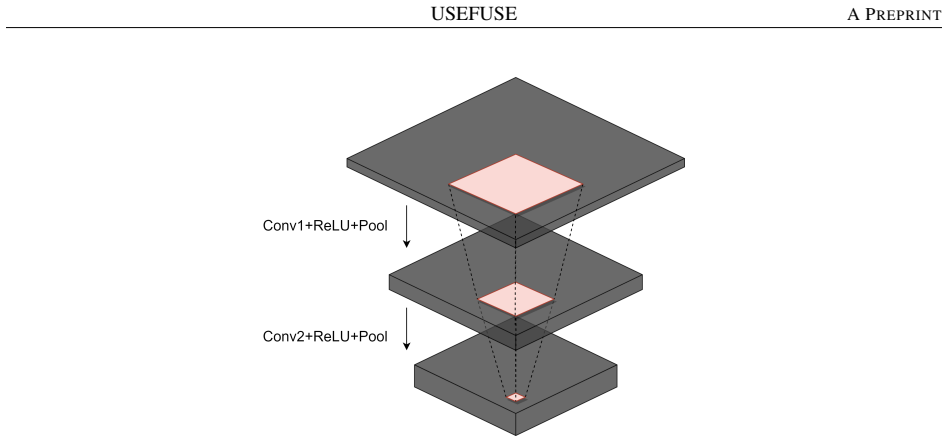
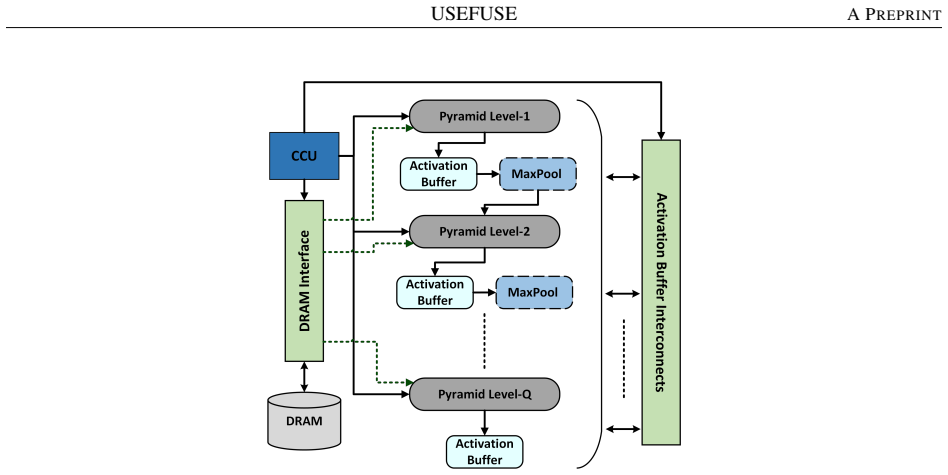
The load-bearing mechanism is the fusion pyramid combined with most-significant-digit-first online arithmetic. Tile dimensions are propagated backward from an output region with $D_l = (D_o - 1)S_l + K_l$, and a uniform tile stride is chosen per layer so that the number of tile movements $\alpha = (IFM_j - H_j)/p + 1$ is the same integer at every level, maximizing the stride to minimize overlap. Inside each pixel processing unit, window processing units compute $K \times K \times N$ inner products with online serial-parallel multipliers using radix-2 signed digits $\{-1,0,1\}$ and online delay $\delta = 2$; an early negative detection unit compares the accumulated positive and negative output digit streams $z^+[j]$ and $z^-[j]$ and stops a convolution when $z^+[j] < z^-[j]$. The most-significant-digit-first output lets the next pyramid level start before the previous one finishes, which is what reduces intermediate buffering.
What would settle it
Take one fused convolution layer with fixed n-bit quantized inputs and weights and compare the exact signed convolution output against the early-termination decision of Algorithm 2 for all input patches, or a large randomized sample. If any patch has a negative prefix but a positive exact output, the skipped computation would change the ReLU result and the no-accuracy-loss claim fails; a brute-force search over 8-bit operands should reveal such a case if the missing tail bound is false.
Extended reading notes
Core claim
On its own terms, the paper claims that the bottleneck in fused CNN accelerators is not just arithmetic speed but the stride of the moving tile: if each pyramid level strides by its own convolution stride, levels move at different rates, forcing stalls, extra overlap, and re-buffering. USEFUSE selects, for each layer, the largest tile stride that keeps the number of tile movements integer and identical across all pyramid levels, and it shows this uniform stride improves operational intensity while reusing overlapped output pixels rather than recomputing them. The compute units are sum-of-products (SOP) engines built from online serial-parallel multipliers operating in a radix-2 signed-digit representation, whose most-significant-digit-first output lets an early negative detection unit terminate a convolution as soon as the redundant positive and negative digit streams show a negative prefix. Measured on an FPGA at 100 MHz, the spatial design outperforms the conventional bit-serial fused design by 1.43x-1.87x and cuts energy by 42.6-48.5% for VGG-16, AlexNet, and LeNet-5, while the temporal design achieves 1.46x-1.68x speedups with a fraction of the logic area.
Load-bearing premise
The load-bearing premise is that once the most-significant-digit partial sum is negative, the uncomputed lower-order digits cannot make the final convolution output positive, so terminating early never changes the post-ReLU result; the paper verifies this empirically on selected filters but gives no mathematical bound.
Editorial extensions
If this is right
- If the measured speedups hold, fused-layer CNN accelerators can shrink on-chip buffers, because most-significant-digit-first output digits can be fed to the next layer immediately, cutting BRAM use by up to 5.2x on VGG-16 in the temporal design.
- Uniform tile stride would make multi-layer fusion practical for deeper networks, such as the four fused convolution layers tested in VGG-16, without cross-level synchronization stalls.
- Early negative detection would reduce energy for any ReLU-based CNN, with roughly 41-43% of first-layer activations detected negative on AlexNet and VGG-16 in the paper's measurements.
- The temporal design gives a resource-constrained path to similar speedups, achieving 1.46x-1.68x over the conventional bit-serial fused baseline while using a fraction of the logic resources.
- For ResNet-18, the early detection technique saves up to 50.1% of effective computation cycles in an end-to-end fused run in the paper's experiment.
Reading between the lines
- The no-accuracy-loss claim is only as strong as an unproven tail bound: if low-order digits can flip a negative prefix to a positive total, some pruned convolutions would be computed incorrectly. A conservative detector that waits until the maximum possible tail contribution is below the current negative margin would make the guarantee rigorous at some cost in savings.
- The reported energy savings are measured on ten random filters of first convolution layers over 10,000 images; real deployments with different data and weights could see different fractions of negative activations and thus different savings.
- The uniform-stride idea is a general nested-tiling principle and could be applied outside CNNs, for example to fused transformer attention or multi-stage stencil pipelines where tiles of different sizes must move in lockstep.
- Because early termination relies on ReLU, the method's benefit is tied to ReLU-dominated networks; extending it to GELU or softmax would require implementing those activations in online arithmetic, which the paper leaves as future work.
Signed reviews
Editorial analysis
A structured set of objections, weighed in public.
Referee Report
Summary. The paper proposes USEFUSE, a fused-layer CNN accelerator built around most-significant-digit-first (MSDF) online arithmetic sum-of-products units. The contributions are (i) online-arithmetic window processing units, (ii) a layer-fusion methodology with a uniform tile stride computed by Algorithm 4, (iii) early termination of convolutions whose activations would be zeroed by ReLU (Algorithm 2), and (iv) two accelerator variants, a spatial design DS-1 and a temporal design DS-2. Against three baselines, the paper reports 1.43x-1.87x speedups and 42.6%-48.5% energy savings, and it also compares with several previous FPGA accelerators. The main claims are that the uniform stride improves operational intensity and that early termination saves energy without accuracy loss.
Significance. If the speedup, energy, and no-accuracy-loss claims are established, the paper makes a useful contribution: it combines online arithmetic with fused-layer tiling in a concrete FPGA-oriented design, and the Baseline-3 comparison isolates the benefit of the proposed tile stride from the benefit of online arithmetic. The paper also provides RTL descriptions and FPGA implementation results, which is a strength. However, the central correctness property of the early termination rule is asserted rather than proved, and the cycle counts underlying the headline speedups are not validated against RTL simulation, which leaves the quantitative claims less firmly supported than they could be.
major comments (4)
- [Section 3.2, Algorithm 2] The no-accuracy-loss claim for early termination is not rigorously established. The condition z+[j] < z−[j] can be made correct by a short tail-bound argument: because the positive and negative bit strings are compared as length-j binary fractions, a strict negative prefix is at most −2^{−j}, while the maximum contribution of all remaining radix-2 signed digits is 2^{−j}, so the final result cannot be positive. The manuscript, however, does not provide this or any equivalent argument, and instead relies on the post-hoc feature-map inspection in Section 4.3 (Fig. 12), which covers only 10 random filters of the first convolution layers and does not report end-to-end classification accuracy with and without END. Please add a formal correctness proof for Algorithm 2 and report accuracy comparisons for the full tested networks; otherwise the phrase 'without accuracy loss' is unsupported.
- [Section 3.3.2, Algorithm 4] The uniform stride method is not shown to be always feasible. Algorithm 4 collects candidate strides p that make alpha(i,j,p) integral, and the text states that values of ST resulting in the same alpha for every layer 'can be evaluated' and 'obtained,' but no proof is given that such a common integer alpha exists for arbitrary CNN layer dimensions and tile sizes. Since the central fusion claim is that a uniform tile movement is guaranteed, please either prove existence under explicit conditions, state the conditions under which Algorithm 4 succeeds, or describe the fallback when no common alpha exists, and report the chosen alpha/ST values for LeNet-5, AlexNet, VGG, and ResNet-18.
- [Section 4.2, Eqs. (3)-(4); Section 4.3, Tables 1-4] The performance and latency numbers appear to be computed from analytic cycle formulas, but the paper does not validate Eqs. (3)-(4) against cycle-accurate RTL simulation or on-FPGA timing. The RTL is described as 'functionally verified,' which does not establish that the analytic cycle counts capture pipeline stalls, tile-movement overhead, or memory conflicts. This is load-bearing because the 1.43x-1.87x speedups are derived from these durations. In addition, Table 2 contains an arithmetically inconsistent VGG CONV1 row: 173,408,256 operations at 1243.10 GOPS requires 139.5 microseconds, not 13.95 microseconds, and the proposed-design entry correspondingly requires 86.4 microseconds, not 8.64 microseconds; with these corrected values the per-layer durations no longer sum to the reported fused duration. Please validate the cycle model against RTL and correct the table.
- [Section 4.3, Figs. 12-14 and Section 5] The claimed energy savings from early termination are not accompanied by an accuracy measurement. Figures 12-14 quantify how many activations are terminated and how many cycles are saved, but the paper never reports classification accuracy of the full network with and without the END mechanism. The statement in the limitations section that END 'limits the applicability to models relying on ReLU' is appropriate, but it does not replace a correctness or accuracy evaluation. Please report top-1 accuracy for the evaluated workloads under both configurations.
minor comments (5)
- [Section 3.3.2] The pseudocode of Algorithm 4 uses the expression 'IFM_j −H_j /p + 1' without parentheses; it should be written as (IFM_j − H_j)/p + 1 to avoid ambiguity.
- [Section 4.1] The text refers to 'Xilinx Ultrascale+ Vertix-7 VU19P'; the correct spelling is Virtex-7, and the device family should be stated consistently in Tables 3-4.
- [Abstract and Section 6] The phrase 'utile stride' appears in the abstract, while the paper otherwise uses 'uniform stride'; please make the terminology consistent.
- [Section 4.3, Table 5] The comparison with previous accelerators uses different FPGA devices, frequencies, and resource budgets; the throughput and latency ratios should be accompanied by a caveat that these are not iso-resource or iso-technology comparisons.
- [Section 4.3, Figs. 12-14] The figures report results for '10 randomly selected filters' and '10 randomly selected output feature maps,' but no random seed or confidence interval is given; please state whether these selections are representative and add variability information.
Circularity Check
No significant circularity: the fused-layer, tile-stride, and online-arithmetic claims are self-contained; the early-termination safety gap is a correctness risk, not circular reasoning.
full rationale
The paper's central claims—fused-layer tiling, uniform stride selection, online-arithmetic SOP units, and the reported performance/energy numbers—are evaluated against external baselines rather than derived from the claims themselves. Baseline-3 shares the proposed tile stride, isolating the contribution of online arithmetic. Algorithms 3 and 4 select tile strides by an integer-movement and uniformity constraint, not by fitting the reported speedups. The only author self-citation is [54] for the online serial-parallel multiplier, but that component has independent derivations in the cited digital-arithmetic literature [20] and is not the target claim being verified. Algorithm 2's early-termination rule lacks a tail bound, so the 'without accuracy loss' statement is unsupported; however, this is an unproven correctness assumption about radix-2 online arithmetic, not a reduction of the output claim to its own inputs. No fitted parameter is renamed as a prediction, and no uniqueness theorem is imported from the authors' prior work. Therefore the derivation chain is not circular, though the END claim needs additional proof of safety.
Assumptions & free parameters
assumptions (4)
- ad hoc to paper The early termination condition z+[j] < z-[j] reliably indicates a final negative result in radix-2 signed-digit online arithmetic.
- ad hoc to paper An integer tile stride exists for every layer such that the movement counts alpha are equal across all fusion pyramid levels.
- domain assumption ReLU is the activation function in the fused layers, and negative convolution outputs are discarded.
- domain assumption Square tiles are used at every pyramid level.
Cite this review
Pith. "Pith review of USEFUSE: Uniform Stride for Enhanced Performance in Fused Layer Architecture of Deep Neural Networks." pith.science (2026). https://pith.science/paper/MSL2YDDW
@misc{pith2026241213724,
  author       = {Pith},
  title        = {Pith review of: USEFUSE: Uniform Stride for Enhanced Performance in Fused Layer Architecture of Deep Neural Networks},
  year         = {2026},
  howpublished = {\url{https://pith.science/paper/MSL2YDDW}},
  note         = {Machine review of arXiv:2412.13724}
}
read the original abstract
Convolutional Neural Networks (CNNs) are crucial in various applications, but their deployment on resource-constrained edge devices poses challenges. This study presents the Sum-of-Products (SOP) units for convolution, which utilize low-latency left-to-right bit-serial arithmetic to minimize response time and enhance overall performance. The study proposes a methodology for fusing multiple convolution layers to reduce off-chip memory communication and increase overall performance. An effective mechanism detects and skips inefficient convolutions after ReLU layers, minimizing power consumption without compromising accuracy. Furthermore, efficient tile movement guarantees uniform access to the fusion pyramid. An analysis demonstrates the utile stride strategy improves operational intensity. Two designs cater to varied demands: one focuses on minimal response time for mission-critical applications, and another focuses on resource-constrained devices with comparable latency. This approach notably reduced redundant computations, improving the efficiency of CNN deployment on edge devices.
Figures


Figures from the paper (11 more)


Reference graph
Works this paper leans on
-
[1]
Automatically designing cnn architectures using the genetic algorithm for image classification
Yanan Sun, Bing Xue, Mengjie Zhang, Gary G Yen, and Jiancheng Lv. Automatically designing cnn architectures using the genetic algorithm for image classification. IEEE transactions on cybernetics, 50(9):3840–3854, 2020
work page 2020
-
[2]
Fully convolutional networks for semantic segmentation
Jonathan Long, Evan Shelhamer, and Trevor Darrell. Fully convolutional networks for semantic segmentation. In Proceedings of the IEEE conference on computer vision and pattern recognition, pages 3431–3440, 2015
2015
-
[3]
Efficient b-mode ultrasound image reconstruction from sub-sampled rf data using deep learning
Yeo Hun Yoon, Shujaat Khan, Jaeyoung Huh, and Jong Chul Ye. Efficient b-mode ultrasound image reconstruction from sub-sampled rf data using deep learning. IEEE transactions on medical imaging, 38(2):325–336, 2018
work page 2018
-
[4]
Afp-src: identification of antifreeze proteins using sparse representation classifier
Muhammad Usman, Shujaat Khan, Seongyong Park, and Abdul Wahab. Afp-src: identification of antifreeze proteins using sparse representation classifier. Neural Computing and Applications, pages 1–11, 2022
work page 2022
-
[5]
Citisen: A deep learning-based speech signal-processing mobile application
Yu-Wen Chen, Kuo-Hsuan Hung, You-Jin Li, Alexander Chao-Fu Kang, Ya-Hsin Lai, Kai-Chun Liu, Szu-Wei Fu, Syu-Siang Wang, and Yu Tsao. Citisen: A deep learning-based speech signal-processing mobile application. IEEE Access, 10:46082–46099, 2022
work page 2022
-
[6]
Dnnoff: offloading dnn-based intelligent iot applications in mobile edge computing
Xing Chen, Ming Li, Hao Zhong, Yun Ma, and Ching-Hsien Hsu. Dnnoff: offloading dnn-based intelligent iot applications in mobile edge computing. IEEE transactions on industrial informatics, 18(4):2820–2829, 2021
work page 2021
-
[7]
Intermittent-aware neural network pruning
Chih-Chia Lin, Chia-Yin Liu, Chih-Hsuan Yen, Tei-Wei Kuo, and Pi-Cheng Hsiu. Intermittent-aware neural network pruning. In 2023 60th ACM/IEEE Design Automation Conference (DAC), pages 1–6. IEEE, 2023
work page 2023
-
[8]
Non-uniform step size quantization for accurate post-training quantization
Sangyun Oh, Hyeonuk Sim, Jounghyun Kim, and Jongeun Lee. Non-uniform step size quantization for accurate post-training quantization. In European Conference on Computer Vision, pages 658–673. Springer, 2022
work page 2022
Show all 65 references
-
[9]
Adapt: Fast emulation of approximate dnn accelerators in pytorch.IEEE Transactions on Computer-Aided Design of Integrated Circuits and Systems, 2022
Dimitrios Danopoulos, Georgios Zervakis, Kostas Siozios, Dimitrios Soudris, and Jörg Henkel. Adapt: Fast emulation of approximate dnn accelerators in pytorch.IEEE Transactions on Computer-Aided Design of Integrated Circuits and Systems, 2022
2022
-
[10]
A 1.93 tops/w scalable deep learning/inference processor with tetra-parallel mimd architecture for big data applications
Hoi-Jun Yoo, Seongwook Park, Kyeongryeol Bong, Dongjoo Shin, Jinmook Lee, and Sungpill Choi. A 1.93 tops/w scalable deep learning/inference processor with tetra-parallel mimd architecture for big data applications. In IEEE international solid-state circuits conference, pages 8...
2015
-
[11]
Shidiannao: Shifting vision processing closer to the sensor
Zidong Du, Robert Fasthuber, Tianshi Chen, Paolo Ienne, Ling Li, Tao Luo, Xiaobing Feng, Yunji Chen, and Olivier Temam. Shidiannao: Shifting vision processing closer to the sensor. In Proceedings of the 42nd Annual International Symposium on Computer Architecture, pages 92–104, 2015
2015
-
[12]
Eyeriss: An energy-efficient reconfigurable accelerator for deep convolutional neural networks
Yu-Hsin Chen, Tushar Krishna, Joel S Emer, and Vivienne Sze. Eyeriss: An energy-efficient reconfigurable accelerator for deep convolutional neural networks. IEEE journal of solid-state circuits, 52(1):127–138, 2016
2016
-
[13]
Stripes: Bit-serial deep neural network computing
Patrick Judd, Jorge Albericio, Tayler Hetherington, Tor M Aamodt, and Andreas Moshovos. Stripes: Bit-serial deep neural network computing. In 2016 49th Annual IEEE/ACM International Symposium on Microarchitecture (MICRO), pages 1–12. IEEE, 2016
2016
-
[14]
Unpu: An energy-efficient deep neural network accelerator with fully variable weight bit precision
Jinmook Lee, Changhyeon Kim, Sanghoon Kang, Dongjoo Shin, Sangyeob Kim, and Hoi-Jun Yoo. Unpu: An energy-efficient deep neural network accelerator with fully variable weight bit precision. IEEE Journal of Solid-State Circuits, 54(1):173–185, 2018
2018
-
[15]
Bit fusion: Bit-level dynamically composable architecture for accelerating deep neural network
Hardik Sharma, Jongse Park, Naveen Suda, Liangzhen Lai, Benson Chau, Vikas Chandra, and Hadi Esmaeilzadeh. Bit fusion: Bit-level dynamically composable architecture for accelerating deep neural network. In 2018 ACM/IEEE 45th Annual International Symposium on Computer Architect...
2018
-
[16]
Compreend: Computation pruning through predictive early negative detection for relu in a deep neural network accelerator
Namhyung Kim, Hanmin Park, Dongwoo Lee, Sungbum Kang, Jinho Lee, and Kiyoung Choi. Compreend: Computation pruning through predictive early negative detection for relu in a deep neural network accelerator. IEEE Transactions on Computers, 2021
2021
-
[17]
Snapea: Predictive early activation for reducing computation in deep convolutional neural networks
Vahideh Akhlaghi, Amir Yazdanbakhsh, Kambiz Samadi, Rajesh K Gupta, and Hadi Esmaeilzadeh. Snapea: Predictive early activation for reducing computation in deep convolutional neural networks. In 2018 ACM/IEEE 45th Annual International Symposium on Computer Architecture (ISCA), ...
2018
-
[18]
Compend: Computation pruning through early negative detection for relu in a deep neural network accelerator
Dongwoo Lee, Sungbum Kang, and Kiyoung Choi. Compend: Computation pruning through early negative detection for relu in a deep neural network accelerator. In Proceedings of the 2018 International Conference on Supercomputing, pages 139–148, 2018
2018
-
[19]
Comprrae: Rram-based convolutional neural network accelerator with r educed computations through ar untime a ctivation e stimation
Xizi Chen, Jingyang Zhu, Jingbo Jiang, and Chi-Ying Tsui. Comprrae: Rram-based convolutional neural network accelerator with r educed computations through ar untime a ctivation e stimation. In Proceedings of the 24th Asia and South Pacific design automation conference, pages 1...
2019
-
[20]
Digital arithmetic
Milos D Ercegovac and Tomas Lang. Digital arithmetic. Elsevier, 2004. 21 USEFUSE A PREPRINT
2004
-
[21]
Fused-layer cnn accelerators
Manoj Alwani, Han Chen, Michael Ferdman, and Peter Milder. Fused-layer cnn accelerators. In 2016 49th Annual IEEE/ACM International Symposium on Microarchitecture (MICRO), pages 1–12. IEEE, 2016
2016
-
[22]
Proteus: Exploiting precision variability in deep neural networks
Patrick Judd, Jorge Albericio, Tayler Hetherington, Tor Aamodt, Natalie Enright Jerger, Raquel Urtasun, and Andreas Moshovos. Proteus: Exploiting precision variability in deep neural networks. Parallel Computing, 73:40–51, 2018
2018
-
[23]
Fixed-point optimization of deep neural networks with adaptive step size retraining
Sungho Shin, Yoonho Boo, and Wonyong Sung. Fixed-point optimization of deep neural networks with adaptive step size retraining. In 2017 IEEE International conference on acoustics, speech and signal processing (ICASSP), pages 1203–1207. IEEE, 2017
2017
-
[24]
Distilling bit- level sparsity parallelism for general purpose deep learning acceleration
Hang Lu, Liang Chang, Chenglong Li, Zixuan Zhu, Shengjian Lu, Yanhuan Liu, and Mingzhe Zhang. Distilling bit- level sparsity parallelism for general purpose deep learning acceleration. In MICRO-54: 54th Annual IEEE/ACM International Symposium on Microarchitecture, pages 963–976, 2021
2021
-
[25]
Design of high-throughput mixed-precision cnn acceler- ators on fpga
Cecilia Latotzke, Tim Ciesielski, and Tobias Gemmeke. Design of high-throughput mixed-precision cnn acceler- ators on fpga. In 2022 32nd International Conference on Field-Programmable Logic and Applications (FPL), pages 358–365. IEEE, 2022
2022
-
[26]
T-dla: An open-source deep learning accelerator for ternarized dnn models on embedded fpga
Yao Chen, Kai Zhang, Cheng Gong, Cong Hao, Xiaofan Zhang, Tao Li, and Deming Chen. T-dla: An open-source deep learning accelerator for ternarized dnn models on embedded fpga. In 2019 IEEE Computer Society Annual Symposium on VLSI (ISVLSI), pages 13–18. IEEE, 2019
2019
-
[27]
Talipot: Energy-efficient dnn booster employing hybrid bit parallel- serial processing in msb-first fashion
Mahmut Burak Karadeniz and Mustafa Altun. Talipot: Energy-efficient dnn booster employing hybrid bit parallel- serial processing in msb-first fashion. IEEE Transactions on Computer-Aided Design of Integrated Circuits and Systems, 41(8):2714–2727, 2021
2021
-
[28]
A precision-scalable energy-efficient convolutional neural network accelerator
Wenjian Liu, Jun Lin, and Zhongfeng Wang. A precision-scalable energy-efficient convolutional neural network accelerator. IEEE Transactions on Circuits and Systems I: Regular Papers, 67(10):3484–3497, 2020
2020
-
[29]
Bit-pragmatic deep neural network computing
Jorge Albericio, Alberto Delmás, Patrick Judd, Sayeh Sharify, Gerard O’Leary, Roman Genov, and Andreas Moshovos. Bit-pragmatic deep neural network computing. In 2017 50th Annual IEEE/ACM International Symposium on Microarchitecture (MICRO), pages 382–394, 2017
2017
-
[30]
Towards a reconfigurable bit-serial/bit-parallel vector accelerator using in-situ processing-in-sram
Khalid Al-Hawaj, Olalekan Afuye, Shady Agwa, Alyssa Apsel, and Christopher Batten. Towards a reconfigurable bit-serial/bit-parallel vector accelerator using in-situ processing-in-sram. In 2020 IEEE International Symposium on Circuits and Systems (ISCAS), pages 1–5. IEEE, 2020
2020
-
[31]
Convfusion: A model for layer fusion in convolutional neural networks
Luc Waeijen, Savvas Sioutas, Maurice Peemen, Menno Lindwer, and Henk Corporaal. Convfusion: A model for layer fusion in convolutional neural networks. IEEE Access, 9:168245–168267, 2021
2021
-
[32]
Deepthings: Distributed adaptive deep learning inference on resource-constrained iot edge clusters
Zhuoran Zhao, Kamyar Mirzazad Barijough, and Andreas Gerstlauer. Deepthings: Distributed adaptive deep learning inference on resource-constrained iot edge clusters. IEEE Transactions on Computer-Aided Design of Integrated Circuits and Systems, 37(11):2348–2359, 2018
2018
-
[33]
Tgpa: Tile-grained pipeline architecture for low latency cnn inference
Xuechao Wei, Yun Liang, Xiuhong Li, Cody Hao Yu, Peng Zhang, and Jason Cong. Tgpa: Tile-grained pipeline architecture for low latency cnn inference. In 2018 IEEE/ACM International Conference on Computer-Aided Design (ICCAD), pages 1–8. ACM, 2018
2018
-
[34]
Exploring heterogeneous algorithms for accelerating deep convolutional neural networks on fpgas
Qingcheng Xiao, Yun Liang, Liqiang Lu, Shengen Yan, and Yu-Wing Tai. Exploring heterogeneous algorithms for accelerating deep convolutional neural networks on fpgas. In Proceedings of the 54th Annual Design Automation Conference 2017, pages 1–6, 2017
2017
-
[35]
Fused-layer-based dnn model parallelism and partial computation offloading
Mingze Li, Ning Wang, Huan Zhou, Yubin Duan, and Jie Wu. Fused-layer-based dnn model parallelism and partial computation offloading. In GLOBECOM 2022-2022 IEEE Global Communications Conference, pages 5195–5200. IEEE, 2022
2022
-
[36]
Accelerating deep learning inference via model parallelism and partial computation offloading
Huan Zhou, Mingze Li, Ning Wang, Geyong Min, and Jie Wu. Accelerating deep learning inference via model parallelism and partial computation offloading. IEEE Transactions on Parallel and Distributed Systems, 34(2):475–488, 2022
2022
-
[37]
Olympus: Reaching memory-optimality on dnn processors
Xuyi Cai, Ying Wang, Kaijie Tu, Chengsi Gao, and Lei Zhang. Olympus: Reaching memory-optimality on dnn processors. IEEE Transactions on Computers, 71(8):1939–1951, 2021
1939
-
[38]
Minimizing off-chip memory access for cnn accelerators
Saurabh Tewari, Anshul Kumar, and Kolin Paul. Minimizing off-chip memory access for cnn accelerators. IEEE Consumer Electronics Magazine, 11(3):95–104, 2021
2021
-
[39]
Superslash: A unified design space exploration and model compression methodology for design of deep learning accelerators with reduced off-chip memory access volume
Hazoor Ahmad, Tabasher Arif, Muhammad Abdullah Hanif, Rehan Hafiz, and Muhammad Shafique. Superslash: A unified design space exploration and model compression methodology for design of deep learning accelerators with reduced off-chip memory access volume. IEEE Transactions on ...
2020
-
[40]
Bus width aware off-chip memory access minimization for cnn accelerators
Saurabh Tewari, Anshul Kumar, and Kolin Paul. Bus width aware off-chip memory access minimization for cnn accelerators. In 2020 IEEE Computer Society Annual Symposium on VLSI (ISVLSI), pages 240–245. IEEE, 2020
2020
-
[41]
Multi-bank on-chip memory management techniques for cnn accelerators
Duseok Kang, Donghyun Kang, and Soonhoi Ha. Multi-bank on-chip memory management techniques for cnn accelerators. IEEE Transactions on Computers, 71(5):1181–1193, 2021
2021
-
[42]
Practical blind image denoising via swin-conv-unet and data synthesis
Kai Zhang, Yawei Li, Jingyun Liang, Jiezhang Cao, Yulun Zhang, Hao Tang, Deng-Ping Fan, Radu Timofte, and Luc Van Gool. Practical blind image denoising via swin-conv-unet and data synthesis. Machine Intelligence Research, 20(6):822–836, 2023
2023
-
[43]
An image denoising method based on swin transformer v2 and u-net architecture
Mingkang Li, Wei Liu, and Weidong Chen. An image denoising method based on swin transformer v2 and u-net architecture. In 2024 IEEE 16th International Conference on Advanced Infocomm Technology (ICAIT), pages 204–209. IEEE, 2024
2024
-
[44]
Plug-and-play image restora- tion with deep denoiser prior.IEEE Transactions on Pattern Analysis and Machine Intelligence, 44(10):6360–6376, 2021
Kai Zhang, Yawei Li, Wangmeng Zuo, Lei Zhang, Luc Van Gool, and Radu Timofte. Plug-and-play image restora- tion with deep denoiser prior.IEEE Transactions on Pattern Analysis and Machine Intelligence, 44(10):6360–6376, 2021
2021
-
[45]
Artadapter: Text-to-image style transfer using multi-level style encoder and explicit adaptation
Dar-Yen Chen, Hamish Tennent, and Ching-Wen Hsu. Artadapter: Text-to-image style transfer using multi-level style encoder and explicit adaptation. In Proceedings of the IEEE/CVF Conference on Computer Vision and Pattern Recognition, pages 8619–8628, 2024
2024
-
[46]
Stylitgan: Image-based relighting via latent control
Anand Bhattad, James Soole, and DA Forsyth. Stylitgan: Image-based relighting via latent control. InProceedings of the IEEE/CVF Conference on Computer Vision and Pattern Recognition, pages 4231–4240, 2024
2024
-
[47]
Sharingan: A transformer architecture for multi-person gaze following
Samy Tafasca, Anshul Gupta, and Jean-Marc Odobez. Sharingan: A transformer architecture for multi-person gaze following. In Proceedings of the IEEE/CVF Conference on Computer Vision and Pattern Recognition, pages 2008–2017, 2024
2008
-
[48]
A study on relu and softmax in transformer
Kai Shen, Junliang Guo, Xu Tan, Siliang Tang, Rui Wang, and Jiang Bian. A study on relu and softmax in transformer. arXiv preprint arXiv:2302.06461, 2023
2023 arXiv
-
[49]
Replacing softmax with relu in vision transformers
Mitchell Wortsman, Jaehoon Lee, Justin Gilmer, and Simon Kornblith. Replacing softmax with relu in vision transformers. arXiv preprint arXiv:2309.08586, 2023
2023 arXiv
-
[50]
Terminetor: Early convolution termination for efficient deep neural networks
Uday Mallappa, Pranav Gangwar, Behnam Khaleghi, Haichao Yang, and Tajana Rosing. Terminetor: Early convolution termination for efficient deep neural networks. In 2022 IEEE 40th International Conference on Computer Design (ICCD), pages 635–643. IEEE, 2022
2022
-
[51]
Bitset: Bit-serial early termination for computation reduction in convolutional neural networks
Yunjie Pan, Jiecao Yu, Andrew Lukefahr, Reetuparna Das, and Scott Mahlke. Bitset: Bit-serial early termination for computation reduction in convolutional neural networks. ACM Transactions on Embedded Computing Systems, 22(5s):1–24, 2023
2023
-
[52]
A novel architecture for early detection of negative output features in deep neural network accelerators
Mohammadreza Asadikouhanjani and Seok-Bum Ko. A novel architecture for early detection of negative output features in deep neural network accelerators. IEEE Transactions on Circuits and Systems II: Express Briefs , 67(12):3332–3336, 2020
2020
-
[53]
Msb-first distributed arithmetic circuit for convolution neural network computation
Md Kamruzzaman Shuvo, David E Thompson, and Haibo Wang. Msb-first distributed arithmetic circuit for convolution neural network computation. In 2020 IEEE 63rd International Midwest Symposium on Circuits and Systems (MWSCAS), pages 399–402. IEEE, 2020
2020
-
[54]
Ercegovac, and Jeong-A Lee
Muhammad Usman, Miloš D. Ercegovac, and Jeong-A Lee. Low-latency online multiplier with reduced activities and minimized interconnect for inner product arrays. Journal of Signal Processing Systems, pages 1–20, 2023
2023
-
[55]
Optimizing fpga-based accelerator design for deep convolutional neural networks
Chen Zhang, Peng Li, Guangyu Sun, Yijin Guan, Bingjun Xiao, and Jason Cong. Optimizing fpga-based accelerator design for deep convolutional neural networks. In Proceedings of the 2015 ACM/SIGDA international symposium on field-programmable gate arrays, pages 161–170, 2015
2015
-
[56]
Gradient-based learning applied to document recognition
Yann LeCun, Léon Bottou, Yoshua Bengio, and Patrick Haffner. Gradient-based learning applied to document recognition. Proceedings of the IEEE, 86(11):2278–2324, 1998
1998
-
[57]
Imagenet classification with deep convolutional neural networks
Alex Krizhevsky, Ilya Sutskever, and Geoffrey E Hinton. Imagenet classification with deep convolutional neural networks. Advances in neural information processing systems, 25, 2012
2012
-
[58]
Very deep convolutional networks for large-scale image recognition
Karen Simonyan and Andrew Zisserman. Very deep convolutional networks for large-scale image recognition. arXiv preprint arXiv:1409.1556, 2014
2014 arXiv
-
[59]
Applying the roofline model
Georg Ofenbeck, Ruedi Steinmann, Victoria Caparros, Daniele G Spampinato, and Markus Püschel. Applying the roofline model. In 2014 IEEE International Symposium on Performance Analysis of Systems and Software (ISPASS), pages 76–85. IEEE, 2014. 23 USEFUSE A PREPRINT
2014
-
[60]
Pytorch: An imperative style, high-performance deep learning library
Adam Paszke, Sam Gross, Francisco Massa, Adam Lerer, James Bradbury, Gregory Chanan, Trevor Killeen, Zeming Lin, Natalia Gimelshein, Luca Antiga, et al. Pytorch: An imperative style, high-performance deep learning library. Advances in neural information processing systems, 32, 2019
2019
-
[61]
Automatic compilation of diverse cnns onto high- performance fpga accelerators
Yufei Ma, Yu Cao, Sarma Vrudhula, and Jae-sun Seo. Automatic compilation of diverse cnns onto high- performance fpga accelerators. IEEE Transactions on Computer-Aided Design of Integrated Circuits and Systems, 39(2):424–437, 2018
2018
-
[62]
Shortcutfusion: From tensorflow to fpga-based accelerator with a reuse-aware memory allocation for shortcut data
Duy Thanh Nguyen, Hyeonseung Je, Tuan Nghia Nguyen, Soojung Ryu, Kyujoong Lee, and Hyuk-Jae Lee. Shortcutfusion: From tensorflow to fpga-based accelerator with a reuse-aware memory allocation for shortcut data. IEEE Transactions on Circuits and Systems I: Regular Papers, 69(6)...
2022
-
[63]
Accelerating deep convolutional neural networks using number theoretic transform
Seongmin Hong, Yashael Faith Arthanto, Joo-Young Kim, et al. Accelerating deep convolutional neural networks using number theoretic transform. IEEE Transactions on Circuits and Systems I: Regular Papers, 70(1):315–326, 2022
2022
-
[64]
An efficient and flexible accelerator design for sparse convolutional neural networks
Xiaoru Xie, Jun Lin, Zhongfeng Wang, and Jinghe Wei. An efficient and flexible accelerator design for sparse convolutional neural networks. IEEE Transactions on Circuits and Systems I: Regular Papers, 68(7):2936–2949, 2021
2021
-
[65]
Multiplication-free lookup-based cnn accelerator using residual vector quantization and its fpga implementation
Hiroshi Fuketa, Toshihiro Katashita, Yohei Hori, and Masakazu Hioki. Multiplication-free lookup-based cnn accelerator using residual vector quantization and its fpga implementation. IEEE Access, 2024. 24
2024
Reviewed August 11, 2026 · model on record in the stance chip above.
Discussion (0). Continue with ORCID to comment.