REVIEW 2 major objections 4 minor 229 references
Gravitational wave astronomy and the expansion history of the Universe
T0 review · 2 major / 4 minor · reviewed 2026-08-11 · deepseek-v4-flash
Pith's one-line read This topical review argues that the relic-graviton background, spanning the aHz to THz range, is the only direct diagnostic of the expansion history between the end of inflation and big bang nucleosynthesis.
desk verdict A competent topical review whose central diagnostic thesis holds up, but whose 'absolute' THz bound rests on an unproved interpolation and should be treated as conditional. read the letter →
The pith
A machine-rendered reading of the paper's core claim, the machinery that carries it, and where it could break.
The reading
What carries the argument
The carrying object is the spectral energy density of relic gravitons, $\Omega_{\mathrm{gw}}(\nu,\tau_0) = (128\pi^3/3)\,\nu^4\, n(\nu,\tau_0)/(H_0^2 M_P^2)$, written in terms of the averaged multiplicity $n(\nu,\tau_0)$ of graviton pairs produced with opposite momenta. The argument runs on four identities: (i) the slope formula $n_T = 2 - 2\delta + O(r_T)$, which maps the expansion-rate parameter $\delta$ (the exponent of the scale factor in each stage; $\delta=1$ for radiation) to the tilt of the spectrum; (ii) the e-fold shift $N_{\mathrm{max}} = \overline{N}_{\mathrm{max}} + \sum_i [(\delta_i-1)/(2(\delta_i+1))] \ln \xi_i$, showing how post-inflationary stages change the number of e-folds of inflation required to fit the current Hubble patch; (iii) the frequency ladder $\nu_{\mathrm{max}}, \nu_m, \nu_r$ built from the same ratios $\xi_i = H_{i+1}/H_i$, which locates the spectral breaks; and (iv) the interpolating pair multiplicity $n(\nu,\tau_0) = \gamma x^{n_T-3}/(e^{\gamma x}-1)$ with $x = \nu/\nu_{\mathrm{max}}$, which joins the power-law spectrum to an exponential cutoff and yields the claimed absolute bound $\nu_{\mathrm{max}} < \mathrm{THz}$ when a single graviton pair is demanded at the spectral maximum.
What would settle it
Two observations would settle the central claims. First, a gravitational-wave signal recorded above roughly $1\,\mathrm{THz}$ would directly falsify the claimed absolute bound $\nu_{\mathrm{max}} < \mathrm{THz}$. Second, the mapping between expansion stages and spectral slopes could be tested by measuring the slope of $\Omega_{\mathrm{gw}}$ in any band: if a measured slope disagrees with $n_T = 2 - 2\delta$ for the stage sequence inferred from the break frequencies, or if a search in the MHz–GHz range reaches the amplitude required by a slower-than-radiation stage and finds nothing, the claimed correspondence between expansion history and the relic spectrum would be broken.
Extended reading notes
Core claim
On the paper's own terms, the central discovery is an explicit correspondence between the expansion history and the relic-graviton spectrum. For a sequence of post-inflationary stages with expansion-rate parameters $\delta_i$ ($\delta=1$ for radiation, $\delta>1$ faster, $\delta<1$ slower than radiation), the spectral energy density $\Omega_{\mathrm{gw}}(\nu,\tau_0)$ has a low-frequency slope fixed by the tensor-to-scalar ratio, a high-frequency slope $n_T = 2 - 2\delta + O(r_T)$, break frequencies $\nu_m$ and $\nu_r$ determined by the products of Hubble-rate ratios $\xi_i$ over the stages, and a maximal frequency $\nu_{\mathrm{max}}$ related to its radiation-dominated value by the same ratios. Each observed frequency band therefore reads off the expansion rate of the epoch in which those wavelengths reentered the horizon: aHz scales constrain the inflationary rate through $r_T$, nHz scales (pulsar timing arrays) can constrain inflation and the post-inflationary timeline, and kHz–THz scales carry the humps produced by stages slower than radiation. A further quantum-mechanical claim is that single-pair production sets a model-independent upper bound $\nu_{\mathrm{max}} < \mathrm{THz}$. The review applies the correspondence to current data and concludes that the nHz excess reported by pulsar timing arrays cannot come from a modified post-inflationary expansion rate within this framework, whereas a refractive index acting during inflation can reproduce it.
Load-bearing premise
The strongest quantitative claim, that relic gravitons cannot exist above roughly a terahertz, rests on an assumed formula for the number of graviton pairs produced near the spectral maximum, $n(\nu,\tau_0) = \gamma x^{n_T-3}/(e^{\gamma x}-1)$, which the review presents as suggestive and does not derive, so if the true pair-production rate differs, the ceiling and the high-frequency predictions built on it would weaken.
Editorial extensions
If this is right
- A measured relic-graviton spectrum across any extended band turns the post-inflationary expansion rate into an observable; the slope of $\Omega_{\mathrm{gw}}$ in that band fixes $\delta$ of the stage that dominated when those wavelengths reentered the horizon.
- Tighter bounds on the tensor-to-scalar ratio $r_T$ at CMB scales, combined with the e-fold consistency condition, translate directly into constraints on the whole post-inflationary timeline, not just on inflation itself.
- The claimed bound $\nu_{\mathrm{max}} < \mathrm{THz}$ delimits the search band for high-frequency and quantum-sensing detectors such as cavities, waveguides, and small interferometers: no relic signal is expected above roughly a terahertz within the standard framework.
- The non-stationarity result implies that the standard spectral-amplitude description of a stationary stochastic process is inappropriate for the relic background, since its autocorrelation depends on the sum of the two times as well as their difference.
- Within the review's own calculation, the nHz excess seen by pulsar timing arrays cannot be produced by a modified post-inflationary expansion rate, because the required amplitude is orders of magnitude too small, but a dynamical refractive index acting during inflation can account for it.
Reading between the lines
- Because the slope map $n_T = 2 - 2\delta$ is invertible, a future measurement of $\Omega_{\mathrm{gw}}$ in two or more bands could in principle reconstruct the whole sequence of post-inflationary stages, a cosmic equation-of-state tomography, rather than merely confirm or exclude one assumed timeline.
- If the $\nu_{\mathrm{max}} < \mathrm{THz}$ bound survives scrutiny of the heuristic multiplicity formula, it sets a hard ceiling on where to look for high-frequency gravitational effects, effectively telling experimentalists to concentrate cavity and light-particle detectors below roughly a terahertz.
- The homogeneous-but-non-stationary character of the relic background suggests a concrete observational discriminator: relic gravitons should show correlations depending on the sum of observation times, which stationary astrophysical foregrounds would not, so a pulsar-timing-array-style search for such a signature could separate the relic component from the binary-merger foreground.
- A testable extension of the formalism is that even a null result from space-borne interferometers in the mHz band would already exclude the fastest post-inflationary stages, since those stages would have to produce a hump whose amplitude the same formulas predict in that band.
Signed reviews
Editorial analysis
A structured set of objections, weighed in public.
Referee Report
Summary. This topical review argues that the stochastic background of relic gravitons is the only direct probe of the post-inflationary expansion history before big bang nucleosynthesis. It develops the FRW timeline with multiple post-inflationary stages, derives the spectral slopes and characteristic frequencies of the relic graviton energy density, and partitions the spectrum into low-frequency (aHz), intermediate-frequency (nHz), and high-frequency (kHz–THz) bands. The review further claims an absolute upper bound on the maximal frequency, νmax < THz, obtained from the BBN bound and from quantum-mechanical pair production, and proposes a dynamical refractive index for tensor modes as a possible explanation of the pulsar-timing-array excess.
Significance. If its main claims hold, the review provides a coherent framework connecting gravitational-wave observations from the aHz to the THz range with the pre-BBN expansion history, and it gives concrete, falsifiable statements: the standard post-inflationary modification cannot explain the PTA amplitude, whereas the refractive-index model predicts a specific high-frequency branch. Strengths include internally consistent standard derivations of the e-fold shifts, spectral slopes, BBN integrals, and a careful discussion of unitarity in the WKB approximation. However, the absolute high-frequency bound and the PTA explanation rest on unproved model assumptions, so the significance of the review is conditional on those assumptions being made rigorous.
major comments (2)
- [3.2.3, Eqs. (3.49)–(3.51)] The claimed absolute bound νmax < THz is load-bearing for the high-frequency sections and for the abstract's aHz–THz range, but its derivation is not shown. The text states that Eq. (3.51) follows by inserting Eq. (3.50) into Eq. (3.46) and imposing Eq. (3.47). Equation (3.50) is introduced 'in a suggestive form' with no derivation, and no numerical estimate of γ is reported despite the statement that it can be obtained by integrating the mode functions. Under the paper's own definition n = |β|^2, Eq. (3.49) as printed, |n|^2/(1+|n|^2) = e^{-γx}, is dimensionally inconsistent; even the natural correction n/(1+n)=e^{-γx} is not reproduced by Eq. (3.50) for large x unless nT = 3 and γ = 1. The integrated bound and the numerical coefficient 0.165 in Eq. (3.51) therefore depend on an unverified interpolating form. The qualitative statement that νmax should lie below the THz may survive, but the 'absolute' character and the distorted-thermal spectrum are not established. Please derive Eq. (3.50) from the mode evolution, including the value of γ, or replace the bound with a general argument that does not depend on this interpolation.
- [5.2.3, Eqs. (5.24)–(5.27)] The conclusion that the PTA excess can be explained by a relic signal rests entirely on the dynamical refractive-index model. The action (5.24) and the parametrization (5.27) are postulated rather than derived, and α, n∗, and N∗ are free parameters that are then adjusted to match the PTA slope and amplitude, as in Eqs. (5.40)–(5.42). This makes the explanation partly circular: the model is defined by the effect it is supposed to produce. The paper should either provide a derivation of n(a) from an underlying microscopic action or state explicitly that (5.27) is an illustrative toy model, and it should identify an independent, testable prediction—for example, the high-frequency branch in Eq. (5.38) or a specific LVK-band signature—that could distinguish this scenario from an astrophysical foreground.
minor comments (4)
- [3.2.2] The multiplicity notation is inconsistent: Eq. (3.43) defines n(k,τ) = |v_k(τ)|^2, while Eq. (3.80) defines n(k,τ) = |β_k(τ)|^2. Please define v_k and β_k explicitly and use a single symbol for the averaged pair multiplicity.
- [Eq. (3.49)] If n denotes the averaged multiplicity, the left-hand side of Eq. (3.49) should be n/(1+n), not |n|^2/(1+|n|^2). This typo contributes to the mismatch with Eq. (3.50) noted in the major comments.
- [3.2.2, after Eq. (3.44)] The statement that Ωgw ∝ ℏ^2 proves a 'truly quantum mechanical origin' is not compelling: a classical stochastic background with non-vacuum initial conditions would have an ℏ-independent energy density. The ℏ dependence only reflects the vacuum normalization of the produced state, so the sentence should be rephrased.
- [Throughout] The manuscript contains numerous typographical errors and missing words (e.g., 'paradign', 'inlationary', 'f aster', 'te literature', 'infirm or confirm'). A careful proofread would improve readability.
Circularity Check
Central diagnostic claim is self-contained; the PTA 'explanation' via a dynamical refractive index is a post-hoc fit to the observed slope and amplitude, making that sub-argument circular by construction.
-
fitted input called prediction
[Section 5.2.3, Eqs. (5.32)-(5.41), Figs. 10-11]
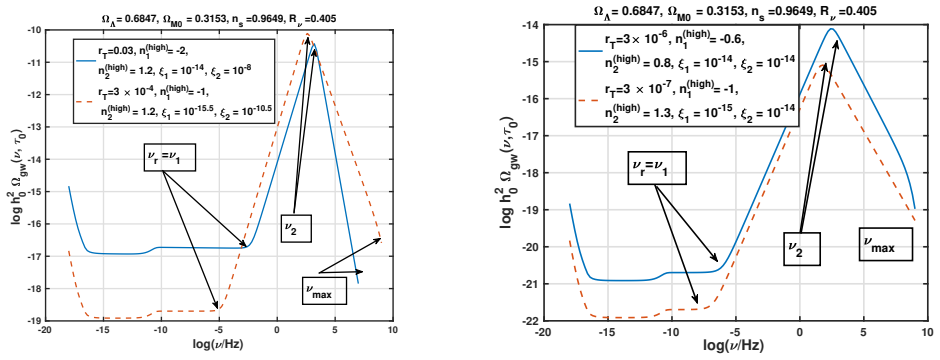
"Since, by definition, the intermediate spectral index is given as 2 + 2β = n(low)_T, Eq. (5.32) implies a relation that determines α as a function of ϵk (or rT) and β: α = 2[β(ϵk − 1) − 1]/(2β − 1). Moreover, given that q0 depends on all the other parameters determining the amplitude of Ωgw(ν,τ0), we can demand that β and q0 fall within the phenomenologically allowed ranges."
The model's free parameters are fixed by the PTA data themselves: Eq. (5.40) sets α from the observed β, and the amplitude parameters (N∗, n∗) are chosen so that q0 falls in the observed range. The text says 'we can demand that β and q0 fall within the phenomenologically allowed ranges.' The subsequent claim that the refractive-index model 'can explain the PTA excess' is therefore the same statement as the fit; the agreement in Figs. 10-11 is produced after the parameters are selected, not predicted before. No independent, pre-fit prediction of the nHz signal is made, so this sub-argument reduces to its input by construction.
full rationale
The central thesis — that relic gravitons can probe the post-inflationary expansion history — is derived in the text from standard inflationary perturbation theory and the BBN bound on extra radiation, and is not equivalent to its inputs. The spectral-slope formulas (e.g., Eq. (3.75)) and the frequency bookkeeping of Sec. 3.3 are re-derived rather than imported. The claimed absolute bound νmax < THz is the single-graviton limit of the BBN integral; although Eq. (3.50) is introduced as a 'suggestive form' with the numerical γ not evaluated, the final inequality does not reduce to that interpolation, so this is a derivation gap rather than circularity. The main circular feature is confined to Sec. 5.2.3, where the dynamical-refractive-index model is tuned to the PTA slope and amplitude and then presented as an explanation of the PTA excess. The paper also relies heavily on the author's prior results, but the equations are largely re-derived here, so the self-citations are not themselves the load-bearing reduction. Overall, the central claim has independent content; only the PTA accommodation is circular by construction.
Assumptions & free parameters
free parameters (3)
- γ (smoothness parameter in pair multiplicity) =
O(1), not computed in the paper
- α and N* (refractive index model parameters) =
α set by Eq. (5.40) to observed β; N* chosen in the range 12 to 18 in Fig. 10
- δ_i, ξ_i (post-inflationary expansion rate and duration parameters) =
varied, not fitted
assumptions (6)
- domain assumption Tensor perturbations are quantized from the Bunch-Davies vacuum during inflation and evolve unitarily.
- domain assumption The BBN bound on extra relativistic species, Eq. (3.47), applies to the integrated relic graviton energy density.
- ad hoc to paper The interpolation formula Eq. (3.50) for the pair multiplicity is valid.
- domain assumption Single-field inflationary consistency relations rT ≈ 16 ϵk and nT ≈ -rT/8 hold.
- domain assumption Radiation dominance is established at BBN and the post-inflationary expansion before BBN is unknown but bounded by Hbbn.
- ad hoc to paper The dynamical refractive index n(a) in Eq. (5.27) is a valid effective description of tensor mode propagation.
invented entities (1)
-
Dynamical refractive index for gravitational waves, n(a)
Cite this review
Pith. "Pith review of Gravitational wave astronomy and the expansion history of the Universe." pith.science (2026). https://pith.science/paper/HBQG7W7C
@misc{pith2026241213968,
  author       = {Pith},
  title        = {Pith review of: Gravitational wave astronomy and the expansion history of the Universe},
  year         = {2026},
  howpublished = {\url{https://pith.science/paper/HBQG7W7C}},
  note         = {Machine review of arXiv:2412.13968}
}
read the original abstract
The timeline of the expansion rate ultimately defines the interplay between high energy physics, astrophysics and cosmology. The guiding theme of this topical review is provided by the scrutiny of the early history of the space-time curvature through the diffuse backgrounds of gravitational radiation that are sensitive to all the stages of the evolution of the plasma. Due to their broad spectrum (extending from the aHz region to the THz domain) they bridge the macroworld described by general relativity and the microworld of the fundamental constituents of matter. It is argued that during the next score year the analysis of the relic gravitons may infirm or confirm the current paradigm where a radiation plasma is assumed to dominate the whole post-inflationary epoch. The role of high frequency and ultra-high frequency signals between the MHz and the THz is emphasized in the perspective of quantum sensing. The multiparticle final state of the relic gravitons and its macroscopic quantumness is also discussed with particular attention to the interplay between the entanglement entropy and the maximal frequency of the spectrum.
Figures


Figures from the paper (15 more)







Reference graph
Works this paper leans on
-
[1]
Einstein, Preuss
A. Einstein, Preuss. Akad. Wiss. Berlin 1, 688 (1916)
1916
-
[2]
Einstein, Preuss
A. Einstein, Preuss. Akad. Wiss. Berlin 1, 154 (1918)
1918
-
[3]
Einstein and N
A. Einstein and N. Rosen, Journal of the Franklin Institute 223, 43 (1937)
1937
-
[4]
Weber and J
J. Weber and J. A. Wheeler, Rev. Mod. Phys. 29, 509 (1957)
1957
-
[5]
F. A. E. Pirani, Acta Phys. Polon. 15, 389 (1956) [Gen. Rel. Grav. 41, 1215 (2009)]
1956
-
[6]
Weber, Phys
J. Weber, Phys. Rev. Lett. 18, 498 (1967)
1967
-
[7]
Weber, Phys
J. Weber, Phys. Rev. Lett. 24, 276 (1970)
1970
-
[8]
J. H. Taylor snd J. M. Weisberg, Astrophys. J. 253, 908 (1982)
1982
Show all 229 references
-
[9]
B. P. Abbott et al. , Phys. Rev. Lett. 116, 061102 (2016)
2016
-
[10]
B. P. Abbott et al. , Phys. Rev. Lett. 116, 241103 (2016)
2016
-
[11]
B. P. Abbott et al. , Phys. Rev. Lett. 118, 221101 (2017)
2017
-
[12]
Parker, Phys
L. Parker, Phys. Rev. Lett. 21, 562 (1968)
1968
-
[13]
Parker, Phys
L. Parker, Phys. Rev. 183, 1057 (1969)
1969
-
[14]
L. P. Grishchuk, Sov. Phys. JETP 40, 409 (1975) [Zh. Eksp. Teor. Fiz. 67, 825 (1974)]
1975
-
[15]
L. P. Grishchuk, Annals N. Y. Acad. Sci. 302, 439 (1977)
1977
-
[16]
L. H. Ford and L. Parker, Phys. Rev. D 16, 245 (1977)
1977
-
[17]
B. L. Hu and L. Parker, Phys. Lett. A 63, 217 (1977)
1977
-
[18]
A. A. Starobinsky, Phys. Lett. B 91, 99 (1980) [Adv. Ser. Astrophys. Cosmol. 3, 130 (1987)]
1980
-
[19]
A. H. Guth, Phys. Rev. D 23, 347 (1981) [Adv. Ser. Astrophys. Cosmol. 3, 139 (1987)]
1981
-
[20]
A. D. Linde, Phys. Lett. 108B, 389 (1982) [Adv. Ser. Astrophys. Cosmol. 3, 149 (1987)]
1982
-
[21]
Albrecht and P
A. Albrecht and P. J. Steinhardt, Phys. Rev. Lett. 48, 1220 (1982) [Adv. Ser. Astrophys. Cosmol. 3, 158 (1987)]
1982
-
[22]
A. A. Starobinsky, JETP Lett. 30, 682 (1979) [Pis’ma Zh. Eksp. Teor. Fiz. 30, 719 (1979)]
1979
-
[23]
L. F. Abbott and M. B. Wise, Nucl. Phys. B 244, 541 (1984)
1984
-
[24]
S. W. Hawking, Phys. Lett. 150B, 339 (1985)
1985
-
[25]
V. A. Rubakov, M. V. Sazhin, and A. V. Veryaskin, Phys. Lett. B 115, 189 (1982)
1982
-
[26]
Gamow, Phys
G. Gamow, Phys. Rev. 70, 572 (1946)
1946
-
[27]
Alpher, H
R. Alpher, H. Bethe, and G. Gamow, Phys. Rev. 73, 803 (1948)
1948
-
[28]
Alpher and R
R. Alpher and R. Herman, Rev. Mod. Phys. 22, 153 (1950)
1950
-
[29]
A. A. Penzias and R. W. Wilson, Astrophys. J. 142, 419 (1965)
1965
-
[30]
P. J. E. Peebles, Astrophys. J. 142, 1317 (1965)
1965
-
[31]
P. J. E. Peebles, Phys. Rev. Lett. 16, 410 (1966)
1966
-
[32]
P. J. E. Peebles, L. A. Page Jr., R. B. Partridge, Finding the Big Bang , (Cambridge University Press, Cambridge, UK, 2009)
2009
-
[33]
Abbott et al
B. Abbott et al. [LIGO Collaboration], Phys. Rev. D 69, 122004 (2004); Phys. Rev. Lett. 95, 221101 (2005)
2004
-
[34]
Aasi et al
J. Aasi et al. [LIGO/Virgo Collaboration], Phys. Rev. Lett. 113, 231101 (2014); Phys. Rev. D 91, 022003 (2015)
2014
-
[35]
B. P. Abbott et al. [LIGO/Virgo Collaboration], Phys. Rev. Lett. 118, 121101 (2017) Erratum: [Phys. Rev. Lett. 119, 029901 (2017)]; Phys. Rev. D 100, 061101(R) (2019)
2017
-
[36]
Abbott et al
R. Abbott et al. [KAGRA, Virgo and LIGO Scientific], Phys. Rev. D 104, 022004 (2021)
2021
-
[37]
Giovannini, Prog
M. Giovannini, Prog. Part. Nucl. Phys. 112, 103774 (2020)
2020
-
[38]
Arzoumanian et al
Z. Arzoumanian et al. , Astrophys. J. Lett. 905, L34 (2020)
2020
-
[39]
Agazie et al
G. Agazie et al. [NANOGrav], Astrophys. J. Lett. 951, L8 (2023)
2023
-
[40]
Goncharov et al
B. Goncharov et al. Astrophys. J. Lett. 917, L19 (2021)
2021
-
[41]
D. J. Reardon, et al. , Astrophys. J. Lett. 951, L6 (2023)
2023
-
[42]
Akrami et al
Y. Akrami et al. [Planck Collaboration], Astron. Astrophys. 641, A10 (2020)
2020
-
[43]
Aghanim et al
N. Aghanim et al. [Planck Collaboration], Astron. Astrophys. 641, A6 (2020)
2020
-
[44]
Ade et al
P. Ade et al. [BICEP and Keck], Phys. Rev. Lett. 127, 151301 (2021)
2021
-
[45]
Giovannini, Phys
M. Giovannini, Phys. Rev. D 58, 083504 (1998). 86
1998
-
[46]
Giovannini, Phys
M. Giovannini, Phys. Rev. D 60, 123511 (1999)
1999
-
[47]
Giovannini, Class
M. Giovannini, Class. Quant. Grav. 16, 2905 (1999)
1999
-
[48]
P. J. E. Peebles and A. Vilenkin, Phys. Rev. D 59, 063505 (1999)
1999
-
[49]
Giovannini, Relic Gravitons, (World Scientific, Singapore, 2024)
M. Giovannini, Relic Gravitons, (World Scientific, Singapore, 2024)
2024
-
[50]
P. J. E. Peebles, Physical Cosmology, (Princeton University Press, Princeton NJ, 1971)
1971
-
[51]
Weinberg, Gravitation and Cosmology , (Wiley, New York, 1972)
S. Weinberg, Gravitation and Cosmology , (Wiley, New York, 1972)
1972
-
[52]
Weinberg, The first three minutes , (basic Books, New York, 1977)
S. Weinberg, The first three minutes , (basic Books, New York, 1977)
1977
-
[53]
Liddle, D
A.R. Liddle, D. Lyth, Cosmological Inflation and Large-Scale Structure , (Cambridge University Press, Cambridge, UK, 2000)
2000
-
[54]
Giovannini, A primer on the Physics of the Cosmic Microwave Background , (World Scientific, Singa- pore, 2008)
M. Giovannini, A primer on the Physics of the Cosmic Microwave Background , (World Scientific, Singa- pore, 2008)
2008
-
[55]
Weinberg, Cosmology (Oxford University Press, Oxford, UK, 2008)
S. Weinberg, Cosmology (Oxford University Press, Oxford, UK, 2008)
2008
-
[56]
Weinberg, Phys
S. Weinberg, Phys. Rev. D 77, 123541 (2008)
2008
-
[57]
J. M. Bardeen, Phys. Rev. D 22, 1882 (1980)
1980
-
[58]
Bardeen, P
J. Bardeen, P. Steinhardt, M. Turner, Phys. Rev. D 28, 679 (1983)
1983
-
[59]
Wands et al
D. Wands et al. , Phys. Rev. D 62, 043527 (2000)
2000
-
[60]
Weinberg, Phys
S. Weinberg, Phys. Rev. D 67, 123504 (2003)
2003
-
[61]
Weinberg, Phys
S. Weinberg, Phys. Rev. D 70, 043541 (2004)
2004
-
[62]
Weinberg, Phys.Rev.D 70, 083522 (2004)
S. Weinberg, Phys.Rev.D 70, 083522 (2004)
2004
-
[63]
Ma and E
C.-P. Ma and E. Bertschinger, Astrophys. J.455, 7 (1995)
1995
-
[64]
A. R. Liddle and S. M. Leach, Phys. Rev. D 68, 103503 (2003)
2003
-
[65]
Giovannini, Phys
M. Giovannini, Phys. Rev. D 105, 103524 (2022)
2022
-
[66]
M. S. Turner, Phys. Rev. D 28, 1243 (1983)
1983
-
[67]
Pathinayake and L
C. Pathinayake and L. H. Ford, Phys. Rev. D 35, 3709 (1987)
1987
-
[69]
J. D. Barrow, Phys. Rev. D 48, 1585 (1993)
1993
-
[70]
Giovannini, Phys
M. Giovannini, Phys. Rev. D 108, 123508 (2023)
2023
-
[71]
A. D. Sakharov, Sov. Phys. JETP 22, 241 (1966) [Zh. Eksp. Teor. Fiz. 49, 345 (1965)]
1966
-
[72]
P. J. E. Peebles and J. T. Yu, Astrophys. J. 162 815 (1970)
1970
-
[73]
R. A. Sunyaev and Y. B. Zeldovich, Astrophys. Space Sci. 7, 3 (1970)
1970
-
[74]
Sahni, Phys
V. Sahni, Phys. Rev. D 42, 453 (1990)
1990
-
[75]
L. P. Grishchuk and M. Solokhin, Phys. Rev. D 43, 2566 (1991)
1991
-
[76]
Giovannini, JCAP 11, 027 (2024)
M. Giovannini, JCAP 11, 027 (2024)
2024
-
[77]
L. P. Grishchuk, Usp. Fiz. Nauk 182, 222 (2012)
2012
-
[78]
Erdelyi, W
A. Erdelyi, W. Magnus, F. Oberhettinger, and F. R. Tricomi Higher Trascendental Functions (Mc Graw- Hill, New York, 1953)
1953
-
[79]
Abramowitz and I
M. Abramowitz and I. A. Stegun, Handbook of Mathematical Functions (Dover, New York, 1972)
1972
-
[80]
C. W. Gardiner, Handbook of stochastic methods , (Springer-Verlag, Berlin, 1987)
1987
-
[81]
Karlin and H
S. Karlin and H. M. Taylor, A first course in stochastic processes (Academic Press, New York, 1975)
1975
-
[82]
Wiener, Acta Math
N. Wiener, Acta Math. 55, 117 (1930)
1930
-
[83]
Khintchine, Math
A. Khintchine, Math. Ann. 104, 415 (1931)
1931
-
[84]
Michelson, Mon
P. Michelson, Mon. Not. Roy. Astron. Soc. 227, 933 (1987)
1987
-
[85]
Christensen, Phys
N. Christensen, Phys. Rev. D 46, 5250 (1992)
1992
-
[86]
Flanagan ,Phys
E. Flanagan ,Phys. Rev. D 48, 2389 (1993)
1993
-
[87]
Babusci and M
D. Babusci and M. Giovannini, Phys. Rev. D 60, 083511 (1999)
1999
-
[88]
Christensen, Rep
N. Christensen, Rep. Prog. Phys. 82, 016903 (2019)
2019
-
[89]
Parker, Nature 261, 20 (1976)
L. Parker, Nature 261, 20 (1976)
1976
-
[90]
N. D. Birrel and P. C. W. Davies, Quantum fields in curved spaces (Cambridge Univ. Press, Cambridge, England, 1982)
1982
-
[91]
Parker and D
L. Parker and D. Toms, Quantum Field Theory in Curved Space-time , (Cambridge University Press, Cambridge 2009). 87
2009
-
[92]
Mandel and E
L. Mandel and E. Wolf, Optical Coherence and Quantum Optics (Cambridge University Press, Cambridge, 1995)
1995
-
[93]
Loudon, The Quantum Theory of Light (Clarendon Press, Oxford, 1983)
R. Loudon, The Quantum Theory of Light (Clarendon Press, Oxford, 1983)
1983
-
[94]
W. H. Louisell, A. Yariv, and A. E. Siegman Phys. Rev. 124, 1646 (1961)
1961
-
[95]
B. L. Mollow and R. J. Glauber, Phys. Rev. 160, 1076 (1967)
1967
-
[96]
B. L. Mollow and R. J. Glauber, Phys. Rev. 160, 1097 (1967)
1967
-
[97]
L. P. Grishchuk and Y. V. Sidorov, Phys. Rev. D 42, 3413 (1990)
1990
-
[99]
L. M. Krauss and F. Wilczek, Phys. Rev. D 89, 047501 (2014)
2014
-
[100]
Giovannini, Phys
M. Giovannini, Phys. Lett. B 854, 138769 (2024)
2024
-
[101]
Giovannini, Phys
M. Giovannini, Phys. Rev. D 110, 123520 (2024)
2024
-
[102]
Schwartzman, Pis’ma Zh
V.F. Schwartzman, Pis’ma Zh. Eksp. Teor. Fiz. 9, 315 (1969) [JETP Lett. 9, 184 (1969)]
1969
-
[103]
Giovannini, H
M. Giovannini, H. Kurki-Suonio and E. Sihvola, Phys. Rev. D 66, 043504 (2002)
2002
-
[104]
Cyburt, B
R. Cyburt, B. D. Fields, K. A. Olive, and E. Skillman, Astropart. Phys. 23, 313 (2005)
2005
-
[106]
Lopes and J
I. Lopes and J. Silk, Astrophys. J. 794, 32 (2014)
2014
-
[107]
Giovannini, Phys
M. Giovannini, Phys. Lett. B 668, 44 (2008)
2008
-
[108]
Giovannini, Class
M. Giovannini, Class. Quant. Grav. 26, 045004 (2009)
2009
-
[109]
T. L. Smith, E. Pierpaoli and M. Kamionkowski, Phys. Rev. Lett. 97, 021301 (2006)
2006
-
[110]
D. M. Siegel and M. Roth, Astrophys. J. 784, 88 (2014)
2014
-
[111]
Giovannini, JCAP 05, 056 (2023)
M. Giovannini, JCAP 05, 056 (2023)
2023
-
[112]
Dyson, Int
F. Dyson, Int. J. Mod. Phys. A 28, 1330041 (2013)
2013
-
[113]
M. E. Gertsenshtein, Sov. Phys. JETP 14, 84 (1962) [Zh. Eksp. Teor. Fiz. 41, 113 (1961)]
1962
-
[114]
Anastassopoulos et al
V. Anastassopoulos et al. [CAST], Nature Phys. 13, 584-590 (2017)
2017
-
[115]
Y. Kahn, B. R. Safdi, and J. Thaler, Phys. Rev. Lett. 117, 141801 (2016)
2016
-
[116]
Chaudhuri, P
S. Chaudhuri, P. W. Graham, K. Irwin, J. Mardon, S. Rajendran and Y. Zhao, Phys. Rev. D 92, 075012 (2015)
2015
-
[117]
J. L. Ouellet et al. , Phys. Rev. Lett. 122 , 121802 (2019)
2019
-
[118]
Lasenby, Phys
R. Lasenby, Phys. Rev. D 102, 015008 (2020)
2020
-
[119]
Arvanitaki and A
A. Arvanitaki and A. A. Geraci, Phys. Rev. Lett. 113, 161801 (2014)
2014
-
[120]
Pegoraro, L
F. Pegoraro, L. Radicati, Ph. Bernard, and E. Picasso, Phys. Lett. A 68, 165 (1978)
1978
-
[121]
Pegoraro, E
F. Pegoraro, E. Picasso, and L. Radicati, J. Phys. A 11, 1949 (1978)
1978
-
[122]
C. M. Caves, Phys. Lett. B 80, 323 (1979)
1979
-
[123]
Reece, P
C. Reece, P. Reiner, and A. Melissinos, Nucl. Inst. and Methods, A 245, 299 (1986)
1986
-
[124]
Bernard, G
Ph. Bernard, G. Gemme, R. Parodi and E. Picasso, Rev. Sci. Instrum. 72, 2428 (2001)
2001
-
[125]
Ballantini, P
R. Ballantini, P. Bernard, A. Chincarini, G. Gemme, R. Parodi and E. Picasso, Class. Quant. Grav. 21, S1241 (2004)
2004
-
[126]
V. B. Braginsky and M. B. Menskii, Pis’ma Zh. Eksp. Teor. Fiz. 13, 585 (1971) [JETP Lett. 13, 417 (1971)]
1971
-
[127]
V. B. Braginsky, L.P. Grishchuk, A. G. Doroshkevich, Ya. B. Zeldovich, I. D. Novikov and M. Sazhin, Sov. Phys. JETP 38, 865 (1974) [Zh. Eksp. Teor. Fiz. 65, 1729 (1973)]
1974
-
[128]
A. M. Cruise, Class. Quantum Grav. 17 , 2525 (2000)
2000
-
[129]
A. M. Cruise and R. M. Ingley, Class. Quantum Grav. 23, 6185 (2006)
2006
-
[130]
F. Y. Li, M. X. Tang and D. P. Shi, Phys. Rev. D 67, 104008 (2003)
2003
-
[131]
Nishizawa, et al
A. Nishizawa, et al. Phys. Rev. D 77, 022002 (2008)
2008
-
[132]
Dimopoulos, P
S. Dimopoulos, P. Graham, J. Hogan, M. Kasevich, S. Rajendran Phys.Rev.D 78 122002 (2008)
2008
-
[133]
Dimopoulos, P
S. Dimopoulos, P. W. Graham, J. M. Hogan, M. A. Kasevich and S. Rajendran, Phys. Lett. B 678, 37 (2009)
2009
-
[134]
J. T. Hsiang and B. L. Hu, Universe 8, 27 (2022)
2022
-
[135]
L. Dai, M. Kamionkowski, J. Wang Phys. Rev. Lett. 113, 041302 (2014)
2014
-
[136]
J. B. Munoz and M. Kamionkowski, Phys. Rev. D 91, 043521 (2015)
2015
-
[137]
J. L. Cook, E. Dimastrogiovanni, D. A. Easson and L. M. Krauss, JCAP 04, 047 (2015). 88
2015
-
[138]
P. A. R. Ade et al. (BICEP2 Collaboration), Phys. Rev. Lett. 112, 241101 (2014)
2014
-
[139]
Giovannini, Phys
M. Giovannini, Phys. Rev. D 88, 021301 (2013)
2013
-
[140]
Giovannini, Phys
M. Giovannini, Phys. Rev. D 89, 123517 (2014)
2014
-
[141]
Easther, B
R. Easther, B. Bahr-Kalus, and D. Parkinson, Phys. Rev. D 106, L061301 (2022)
2022
-
[142]
Boubekeur and D
L. Boubekeur and D. H. Lyth, JCAP 07, 010 (2005)
2005
-
[143]
N. K. Stein and W. H. Kinney, JCAP 03, 027 (2023)
2023
-
[144]
W. J. Wolf, Phys. Rev. D 110, 043521 (2024)
2024
-
[145]
Motohashi and A
H. Motohashi and A. A. Starobinsky, JCAP 11, 025 (2019)
2019
-
[146]
Guerrero, D
M. Guerrero, D. Rubiera-Garcia and D. Saez-Chillon Gomez, Phys. Rev. D 102, 123528 (2020)
2020
-
[147]
Mohammadi, T
A. Mohammadi, T. Golanbari, S. Nasri and K. Saaidi, Phys. Rev. D 101, 123537 (2020)
2020
-
[148]
Mohammadi, N
A. Mohammadi, N. Ahmadi and M. Shokri, JCAP 06, 058 (2023)
2023
-
[149]
Giovannini, Phys
M. Giovannini, Phys. Rev. D 100, 083531 (2019)
2019
-
[150]
Zeldovich, Sov
Ya. Zeldovich, Sov. Phys. Usp. 6, 475 (1964) [Usp. Fiz. Nauk. 80, 357 (1963)]
1964
-
[151]
L. H. Ford, Phys. Rev. D 35, 2955 (1987)
1987
-
[152]
Spokoiny, Phys
B. Spokoiny, Phys. Lett. B 315, 40 (1993)
1993
-
[153]
P. J. E. Peebles and B. Ratra, Astrophys. J. 325, L17 (1988)
1988
-
[154]
R. R. Caldwell, R. Dave, and P. J. Steinhardt, Phys. Rev. Lett. 80, 1582 (1998)
1998
-
[155]
J. Haro, W. Yang and S. Pan, JCAP 01, 023 (2019)
2019
-
[156]
Gorghetto, E
M. Gorghetto, E. Hardy and H. Nicolaescu, JCAP 06, 034 (2021)
2021
-
[157]
Li and P
B. Li and P. R. Shapiro, JCAP 10, 024 (2021)
2021
-
[158]
Giovannini, Phys
M. Giovannini, Phys. Rev. D 61, 063004 (2000)
2000
-
[159]
Giovannini, Phys
M. Giovannini, Phys. Rev. D 61, 063502 (2000)
2000
-
[160]
Giovannini, Class
M. Giovannini, Class. Quant. Grav. 34, 135010 (2017)
2017
-
[161]
Weinberg, Phys
S. Weinberg, Phys. Rev. D 69, 023503 (2004)
2004
-
[162]
D. A. Dicus and W. W. Repko, Phys. Rev. D 72, 088302 (2005)
2005
-
[163]
H. X. Miao and Y. Zhang, Phys. Rev. D 75, 104009 (2007)
2007
-
[164]
B. A. Stefanek and W. W. Repko, Phys. Rev. D 88, 083536 (2013)
2013
-
[165]
K. W. Ng, Phys. Rev. D 86, 103510 (2012)
2012
-
[166]
Copi, D.N
C.J. Copi, D.N. Schramm, and M.S. Turner, Phys. Rev. D 55, 3389 (1997)
1997
-
[167]
Burles, K.M
S. Burles, K.M. Nollett, J.W. Truran, and M.S. Turner, Phys. Rev. Lett. 82, 4176 (1999)
1999
-
[168]
Cyburt, B
R. Cyburt, B. Fields, and K. Olive, Astropart. Phys. 17, 87 (2002)
2002
-
[169]
Cyburt, B
R. Cyburt, B. D. Fields, K. A. Olive and T. H. Yeh, Rev. Mod. Phys. 88, 015004 (2016)
2016
-
[170]
D. A. Kirzhnits and A. D. Linde, Phys. Lett. B 42, 471 (1972)
1972
-
[171]
D. A. Kirzhnits and A. D. Linde, Annals Phys. 101, 195-238 (1976)
1976
-
[172]
A. D. Linde, Rept. Prog. Phys. 42, 389 (1979)
1979
-
[173]
A. D. Linde, Phys. Lett. B 96, 289 (1980)
1980
-
[174]
Kajantie et al ., Nucl
K. Kajantie et al ., Nucl. Phys. B 458, 90 (1996)
1996
-
[175]
Kajantie et al ., Nucl
K. Kajantie et al ., Nucl. Phys. B 466, 189 (1996)
1996
-
[176]
Kajantie, et al ., Phys
K. Kajantie, et al ., Phys. Rev. Lett. 77, 2887 (1996)
1996
-
[177]
Csikor, Z
F. Csikor, Z. Fodor and J. Heitger, Phys. Lett. B 441, 354 (1998)
1998
-
[178]
Csikor, Z
F. Csikor, Z. Fodor and J. Heitger, Phys. Rev. Lett. 82, 21 (1999)
1999
-
[179]
Giovannini, Eur
M. Giovannini, Eur. Phys. J. C 84, 67 (2024)
2024
-
[180]
Chen, et al
S. Chen, et al. Mon. Not. Roy. Astron. Soc. 508, 4970 (2021)
2021
-
[181]
Antoniadis, et al
J. Antoniadis, et al. Astron. Astrophys. 678, 50 (2023)
2023
-
[182]
Antoniadis, et al
J. Antoniadis, et al. Mon. Not. Roy. Astron. Soc. 510, 4873 (2022)
2022
-
[183]
H. Xu, S. Chen, et al. Res. Astron. Astrophys. 23, 075024 (2023)
2023
-
[184]
M. V. Sazhin, Sov. Astron. 22, 36 (1978) [Astron. Zh. 55, 65 (1979)]
1978
-
[185]
Detweiler, Astrophys
S. Detweiler, Astrophys. J. 234, 1100 (1979)
1979
-
[186]
R. W. Hellings and G. S. Downs, Astrophys. J. Lett. 265 L39 (1983)
1983
-
[187]
V. M. Kaspi, J. H. Taylor, and M. F. Ryba, Astrophys. J. 428, 713 (1994)
1994
-
[188]
F. A. Jenet et al. , Astrophys. J. 653, 1571 (2006)
2006
-
[189]
Zhao, Phys
W. Zhao, Phys. Rev. D 83, 104021 (2011). 89
2011
-
[190]
P. B. Demorest et al. , Astrophys. J. 762, 94 (2013)
2013
-
[191]
Giovannini, Class
M. Giovannini, Class. Quant. Grav. 33, 125002 (2016)
2016
-
[192]
Szekeres, Annals Phys
P. Szekeres, Annals Phys. 64, 599 (1971)
1971
-
[193]
P. C. Peters, Phys. Rev. D 9, 2207 (1974)
1974
-
[194]
Giovannini, Eur
M. Giovannini, Eur. Phys. J. C 82, 117 (2022)
2022
-
[195]
Giovannini, Phys
M. Giovannini, Phys. Rev. D 98, 103509 (2018)
2018
-
[196]
Giovannini, Phys
M. Giovannini, Phys. Lett. B 789, 502 (2019)
2019
- [197]
-
[198]
LISA documents webpage, https://www.cosmos.esa.int/web/lisa/lisa-documents
-
[199]
N. Seto, S. Kawamura and T. Nakamura, Phys. Rev. Lett. 87, 221103 (2001)
2001
-
[200]
Kawamura et al
S. Kawamura et al. , Class. Quant. Grav. 28, 094011 (2011)
2011
-
[201]
Kudoh, A
H. Kudoh, A. Taruya, T. Hiramatsu and Y. Himemoto, Phys. Rev. D 73, 064006 (2006)
2006
-
[202]
G. M. Harry et al. , Class. Quant. Grav. 23, 4887 (2006)
2006
-
[203]
Hu and Y.-L
W.-R. Hu and Y.-L. Wu, Natl. Sci. Rev. 4, 685 (2017)
2017
- [204]
-
[205]
Luo et al
T.J. Luo et al. [TianQin], Class. Quant. Grav. 33, 035010 (2016)
2016
-
[206]
X. C. Hu et al. , Class. Quant. Grav. 35, 095008 (2018)
2018
-
[207]
Giovannini, Eur
M. Giovannini, Eur. Phys. J. C 82, 828 (2022)
2022
-
[208]
M. S. Turner, M. J. White and J. E. Lidsey, Phys. Rev. D 48, 4613 (1993)
1993
-
[209]
L. M. Krauss and M. J. White, Phys. Rev. Lett. 69, 869 (1992)
1992
-
[210]
Allen and S
B. Allen and S. Koranda, Phys. Rev. D 50, 3713 (1994)
1994
-
[211]
K. w. Ng and A. D. Speliotopoulos, Phys. Rev. D 52, 2112 (1995)
1995
-
[212]
Knox, Phys
L. Knox, Phys. Rev. D 52, 4307 (1995)
1995
-
[213]
Khoury, B
J. Khoury, B. A. Ovrut, P. J. Steinhardt and N. Turok, Phys. Rev. D 64, 123522 (2001)
2001
-
[214]
L. A. Boyle, P. J. Steinhardt and N. Turok, Phys. Rev. D 69, 127302 (2004)
2004
-
[215]
Gasperini and M
M. Gasperini and M. Giovannini, Phys. Rev. D 47, 1519 (1993)
1993
-
[216]
Brustein, M
R. Brustein, M. Gasperini, M. Giovannini and G. Veneziano, Phys. Lett. B 361, 45 (1995)
1995
-
[217]
R. J. Glauber, Phys. Rev. Lett. 10, 84 (1963); Phys. Rev. 130, 2529 (1963); Phys. Rev. 131, 2766 (1963)
1963
-
[218]
E. C. C. Sudarshan, Phys. Rev. Lett. 10, 277 (1963)
1963
-
[219]
Giovannini, Phys
M. Giovannini, Phys. Rev. D 99, 123507 (2019); Class. Quant. Grav. 34, 035019 (2017)
2019
-
[220]
Giovannini, Phys
M. Giovannini, Phys. Rev. D 83, 023515 (2011)
2011
-
[221]
Cocconi, Phys
G. Cocconi, Phys. Lett. B 49, 459 (1974)
1974
-
[222]
D. H. Boal, C. K. Gelbke, B. K. Jennings, Rev. Mod. Phys. 62, 553 (1990); G. Baym, Acta Phys. Polon. B 29, 1839 (1998)
1990
-
[223]
Hanbury Brown and R
R. Hanbury Brown and R. Q. Twiss, Nature 178, 1046 (1956)
1956
-
[224]
Hanbury Brown and R
R. Hanbury Brown and R. Q. Twiss, Proc. Roy. Soc. (London) A242, 300 (1957); Proc. Roy. Soc. (London) A243, 291 (1958)
1957
-
[225]
Bargmann, Ann
V. Bargmann, Ann. Math. 48, 568 (1947)
1947
-
[226]
B. L. Hu and H. E. Kandrup, Phys. Rev. D 35, 1776 (1987)
1987
-
[227]
H. E. Kandrup, Phys. Rev. D 37, 3505 (1988)
1988
-
[228]
Gasperini and M
M. Gasperini and M. Giovannini, Phys. Lett. B 301, 334 (1993)
1993
-
[229]
Gasperini and M
M. Gasperini and M. Giovannini, Class. Quant. Grav. 10, L133 (1993)
1993
-
[230]
B. L. Hu, G. Kang, and A. Matacz, Int. J. Mod. Phys. A 9, 991 (1994)
1994
-
[231]
Deutsch, Phys
D. Deutsch, Phys. Rev. Lett. 50, 631 (1983)
1983
-
[232]
M. H. Partovi, Phys. Rev. Lett. 50, 1883 (1983). 90
1983
Reviewed August 11, 2026 · model on record in the stance chip above.
Discussion (0). Continue with ORCID to comment.