REVIEW 3 major objections 6 minor 116 references
Massive graviton dark matter searches with long-baseline atom interferometers
T0 review · 3 major / 6 minor · reviewed 2026-08-11 · deepseek-v4-flash
Pith's one-line read Long-baseline atom interferometers can detect spin-2 dark matter through three distinct coupling mechanisms.
desk verdict A solid, transparent first pass at spin-2 ULDM in atom interferometers, with a real new target; the sensitivity curves are idealizations and the tables need cleanup, but the central derivation holds. read the letter →
The pith
A machine-rendered reading of the paper's core claim, the machinery that carries it, and where it could break.
The reading
What carries the argument
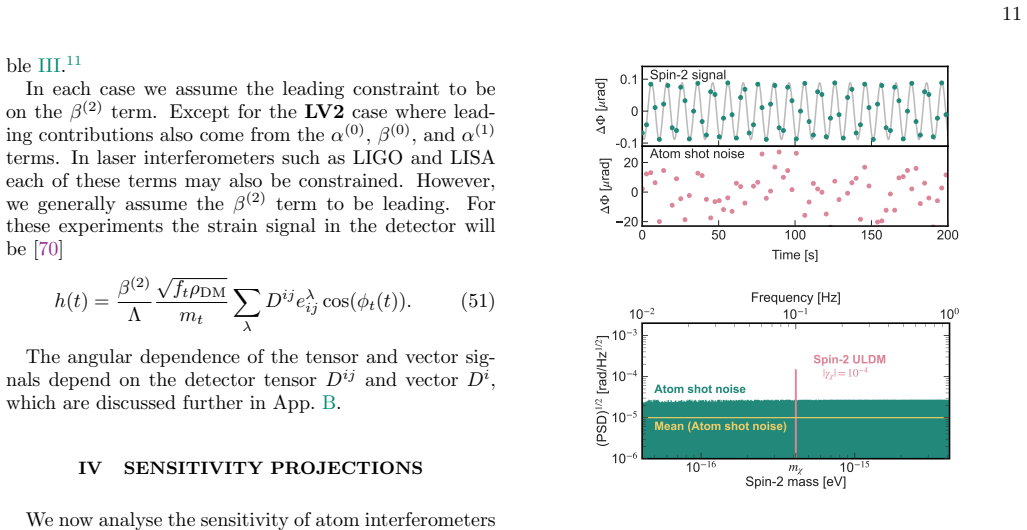
The central object is the differential phase shift of Eq. (50), a single sinusoidal formula in $m_\chi L$, $m_\chi T$, and $m_\chi(T-(n-1)L)$ that combines the three detection mechanisms. It rests on the $SO(3)$ decomposition of the massive spin-2 field into tensor, vector, and scalar modes, which in the Lorentz-violating frameworks can have different masses and propagation speeds, and on the coupling coefficients $\gamma_\chi$ of Table III, which encode how each framework couples to atoms and to light. The sensitivity calculation is carried by the atom-shot-noise power spectral density $S_n = 2\Delta t/(C^2 N_a)$ and the signal power $\langle\Delta\Phi_\chi^2\rangle$, which together set the minimum detectable coupling $|\gamma_\chi|^2 \simeq \mathrm{SNR}^2\, S_n / (\langle\Delta\Phi_r^2\rangle T_{\rm eff})$.
What would settle it
Measure the actual noise power spectral density of a 10 m or 100 m atom gradiometer in the $10^{-3}$ to $10$ Hz band and compare it with the assumed flat shot-noise level $S_n = 2\Delta t/(C^2 N_a)$; if the measured PSD is higher at any mass in the claimed range, the minimum detectable $|\gamma_\chi|^2$ in Eq. (56) rises proportionally, and the claimed first exploration of unconstrained tensor and vector couplings would not be achieved without extra noise mitigation.
Extended reading notes
Core claim
The paper's central claim is that coherent oscillations of a spin-2 ultralight dark matter field produce a measurable differential phase in an atom gradiometer, and that the phase has three physically distinct sources: a scalar interaction that shifts atomic transition frequencies via the electron mass and fine-structure constant, a vector interaction that delays the atoms' propagation, and a tensor interaction that delays the laser pulses. Working to linear order in the coupling, the authors reduce every signal to Eq. (50), where the amplitude is set by $\gamma_\chi$ (listed in Table III for the Fierz-Pauli, LV1, and LV2 frameworks), the dark matter mass, the baseline length, the interrogation time, and the number of large-momentum-transfer pulses. They convert this phase into sensitivity curves for 10 m, 100 m, and 1 km strontium-87 gradiometers under one-year integration and atom-shot-noise-limited operation. The conclusion is that atom interferometers open a new experimental window on spin-2 dark matter, complementing laser-interferometric gravitational-wave detectors by covering lower frequencies and by being sensitive to scalar and vector couplings those detectors do not see.
Load-bearing premise
Every sensitivity curve assumes the instrument noise is only the random counting scatter of atoms, with no gravity-gradient, seismic, or laser noise, so any real noise floor in the detection band directly raises the minimum detectable coupling and weakens the quoted reach.
Editorial extensions
If this is right
- A 10 m baseline instrument could reach spin-2 tensor and vector couplings that no current experiment constrains, in theories where the scalar mode is absent or weakly coupled.
- Baselines of 100 m and 1 km would probe deeper into the same couplings and would be needed to surpass existing fifth-force bounds in models with a light scalar mode.
- The sensitive mass range sits in the frequency band between laser-interferometric gravitational-wave detectors, so atom interferometers fill a mid-band gap for spin-2 dark matter searches.
- Because every signal is parametrized by a single $\gamma_\chi$ per mode, a measurement or bound on $|\gamma_\chi|^2$ translates directly into constraints on the Fierz-Pauli, LV1, and LV2 theories via Table III.
- If massive gravitons make up only a fraction of the local dark matter, all sensitivity curves rescale accordingly through the paper's $f_t$, $f_v$, $f_s$ parametrization.
Reading between the lines
- A single experiment that varies the interrogation time $T$ or the momentum-transfer number $n$ could separate scalar energy-level shifts from vector and tensor propagation delays, because the three terms enter Eq. (50) with different functional forms; the paper notes spectral differences but does not develop this diagnostic.
- The same $\gamma_\chi$ language could be exported to atomic clock and cavity experiments, which the paper names as future work; a clock network would be especially sensitive to the scalar couplings $\alpha^{(0)}$ and $\beta^{(0)}$, providing a cross-check on the atom-interferometer reach.
- If mid-band gravity-gradient noise cannot be reduced to the assumed shot-noise level, the reach degrades linearly in the noise power spectral density; a co-located network of interferometers, mentioned by the paper only for noise mitigation, could partly recover the sensitivity by exploiting the spatial correlation of the dark matter signal.
- The directional dependence in the detector pattern functions implies that the daily modulation of a candidate signal could distinguish tensor from vector polarizations; this is implicit in Appendix B but not worked out as an analysis strategy.
Editorial analysis
A structured set of objections, weighed in public.
Referee Report
Summary. The paper studies the sensitivity of long-baseline atom interferometers to ultra-light massive spin-2 dark matter. It constructs non-relativistic couplings of a massive spin-2 field to atomic and photonic degrees of freedom in three massive gravity frameworks (Fierz-Pauli and two Lorentz-violating phases, LV1 and LV2), reduces the signal to a single phase-shift formula in Eq. (50), and parameterizes the various coupling channels through the gamma_chi coefficients in Table III. Sensitivity projections are presented in Fig. 3 for 10 m, 100 m, and 1 km baseline instruments, assuming atom-shot-noise-limited operation. The headline claim is that a 10 m-scale instrument could explore previously unconstrained parameter space for spin-2 ULDM in theories without a scalar mode in the relevant mass range.
Significance. If the results hold, this is the first systematic treatment of spin-2 ULDM in atom interferometers and provides a useful framework for future experimental searches. The derivation chain from massive gravity Lagrangians to the atom interferometer phase is transparent and standard, and the authors explicitly cross-check the phase formula against prior work [32,90]. The separation into scalar, vector, and tensor mechanisms, and the associated gamma_chi table, are valuable reference tools. The main significance is the identification of a new experimental target; however, the quantitative reach claims are contingent on an idealized noise assumption that the paper itself flags as difficult to achieve.
major comments (3)
- [Sec. IV, Eq. (53)] The sensitivity projections in Fig. 3, combined with Eq. (56), scale linearly with the noise PSD S_n = 2 Delta t / (C^2 N_a) from Eq. (53), which assumes atom-shot-noise-limited white noise and no gravity gradient noise. The paper acknowledges that this assumption 'may be difficult to achieve across the whole frequency spectrum' and cites references on gravity gradient noise and mitigation, but it provides no quantitative estimate of how a gravity-gradient, seismic, or laser noise floor would raise the minimum detectable |gamma_chi|^2. Because the Sec. V claim that a 10 m instrument 'could explore unconstrained parameter space for the first time' is a statement about experimental reach, it is directly contingent on this unquantified performance premise. I recommend either adding a quantitative treatment of realistic noise floors or clearly restricting the claim to the shot-noise-limited target.
- [Table III, FP alpha(0) row; Eq. (21)] The FP alpha(0) entry in Table III appears inconsistent with the derivation. Equation (21) states that for free FP configurations the trace phi^mu_mu vanishes, so the alpha(0)_FP coupling in Eq. (20), which is proportional to phi^mu_mu, should not generate a scalar signal. However, Table III lists a nonzero FP alpha(0) gamma_chi, and Table I's FP alpha(0) X(t) entry is written in terms of alpha(2)_FP, suggesting a labeling error. This needs to be corrected and the mapping between Tables I/II and Table III verified, because Table III is the direct input to Eq. (50) and hence to the model-specific sensitivity curves.
- [Tables I-III normalization] The normalization of the gamma_chi entries in Table III relative to the Hamiltonian terms in Tables I and II is not demonstrated. For instance, the LV2 alpha(0) and beta(0) rows in Table I contain explicit 1/m_s factors inside X(t) and Y(t), while the corresponding Table III entries have no such factor, and numerical factors differ (e.g., sqrt(8/3) versus 8 sqrt(2)/sqrt(3)). Since Eq. (50) uses gamma_chi directly, the paper should present the intermediate steps that convert the time-dependent tensors in Tables I and II into the gamma_chi expressions in Table III, or state clearly which definitions of the field amplitude and phase are being used.
minor comments (6)
- [Table IV caption] The caption lists the parameter delta_phi, but the table column is S_n (defined in Eq. (53)); please align the caption with the table entries.
- [Eq. (54)] The notation T_int <Delta_Phi_chi^2> for the signal PSD should be defined more explicitly; it is currently unclear whether the average includes the angular average from App. B and how T_int enters the expression.
- [Sec. III B 1, Eq. (41)] The statement that both Y_1(t) and Y_2(t) modify the coupling to E^2 is compressed; please spell out the relation to the fine-structure constant modification, since Eq. (41) uses a combined Y(t).
- [Sec. V] The phrase 'the tensor and vector modes remain unconstrained' should be qualified, because Fig. 3 shows LIGO/LISA sensitivities on the same coupling axis; the unconstrained statement is only true below the existing sensitivity curves and for the specific couplings in Table III.
- [Footnote 12] The cited references [34,82,96-98] discuss gravity gradient noise and mitigation, but the main text does not summarize their conclusions; adding one sentence on the expected noise levels would help the reader assess the strength of the assumption.
- [Eq. (56)] Eq. (56) gives |gamma_chi|^2 proportional to SNR^2, but the target SNR is only mentioned in the text and in Fig. 3; the equation would benefit from stating that the sensitivity curves are evaluated at a fixed SNR (e.g., SNR = 1).
Circularity Check
No significant circularity: the spin-2 signal is derived from the massive-gravity Lagrangians and standard atom-interferometer response; sensitivity curves are forecasts built on declared detector parameters, not on fitted inputs.
full rationale
Walking the derivation chain: the spin-2 signal is constructed from (i) linearised massive-gravity Lagrangians (FP, LV1, LV2), (ii) SO(3) decompositions and non-propagating-field solutions in App. A, (iii) non-relativistic matter/light couplings in Sec. II C, (iv) a standard atom-gradiometer phase formula closing at Eq. (50), and (v) an SNR forecast using Eqs. (52)-(57). At no point is a quantity fitted to the data being 'predicted': the gamma_chi factors in Table III are derived from the Lagrangians, not calibrated, and the sensitivity curves are forecasts built on declared detector parameters (Table IV) and the stated atom-shot-noise-only premise (Sec. IV). Self-citations to [32] supply the scalar-ULDM phase template and shot-noise PSD, but the current paper re-derives the spin-2 phase through Eq. (49) and generalizes the couplings; [64] supplies the LV2 model's parameter-free properties, which do not include the atom-interferometer result. The acknowledged difficulty of achieving shot-noise-limited operation is a performance risk, not a logical circularity. Internal table discrepancies (e.g., FP scalar gamma rows versus Table I prefactors) are consistency errors, not input-output equivalence. No step reduces to its own input by construction.
Assumptions & free parameters
free parameters (5)
- SM coupling constants alpha(0), alpha(1), alpha(2), beta(0), beta(1), beta(2) per theory =
unconstrained (constraint axes of Fig. 3)
- LV2 kinetic parameters alpha, beta, lambda =
unset; only bounded to be much less than 1 if the graviton mediates gravity (App. A)
- fractional DM abundances f_t, f_v, f_s =
agnostic
- velocity dispersion sigma_0 approximately |v_DM| approximately 10^-3 =
10^-3
- experimental parameters of Table IV =
L=10/100/1000 m; T=0.74/1.4/1.4 s; n=1000; Delta r=5/90/980 m; S_n=10^-8/10^-10/0.09x10^-10 Hz^-1; T_int=1 yr
assumptions (6)
- domain assumption Massive gravity EFTs (FP, LV1, LV2) describe the low-energy dynamics of an ultra-light spin-2 field
- domain assumption ULDM classical wave description with local density rho_DM = 0.3 GeV/cm^3 and velocity dispersion sigma_0 ~ 10^-3
- domain assumption Non-relativistic expansion of the SM couplings keeps only the leading terms in v_DM and v_A
- domain assumption The AI phase response is captured by the laser-intersection-time framework of [28,32,90]
- domain assumption Shot-noise-limited operation with no gravity-gradient noise
- ad hoc to paper Leading-operator selection: beta(2) is leading for FP and LV1; alpha(0), beta(0), alpha(1) also contribute for LV2; couplings assumed pairwise equal (alpha(i) ~ beta(i))
invented entities (1)
-
massive spin-2 ULDM field phi_mu_nu (massive graviton dark matter)
independent evidence
Cite this review
Pith. "Pith review of Massive graviton dark matter searches with long-baseline atom interferometers." pith.science (2026). https://pith.science/paper/MAIA3OBE
@misc{pith2026241214282,
  author       = {Pith},
  title        = {Pith review of: Massive graviton dark matter searches with long-baseline atom interferometers},
  year         = {2026},
  howpublished = {\url{https://pith.science/paper/MAIA3OBE}},
  note         = {Machine review of arXiv:2412.14282}
}
read the original abstract
Atom interferometers offer exceptional sensitivity to ultra-light dark matter (ULDM) by precisely measuring effects on atomic systems. Previous studies have demonstrated their capability to detect scalar and vector ULDM candidates, yet their potential for probing spin-2 ULDM remains unexplored. In this work, we address this gap by investigating the sensitivity of atom interferometers to spin-2 ULDM across several frameworks for massive gravity, including the Lorentz-invariant Fierz-Pauli case and two distinct Lorentz-violating scenarios. We show that coherent oscillations of the spin-2 ULDM field induce measurable phase shifts in atom interferometers through three coupling mechanisms: scalar interactions that modify atomic energy levels, and vector and tensor effects that alter the propagation of both atoms and light. We demonstrate that these multifaceted interactions enable atom interferometers to probe a range of ULDM properties and mass scales that are inaccessible to laser interferometric gravitational wave detectors. Our results establish the potential of atom interferometers to open a new experimental frontier for spin-2 dark matter detection.
Figures


Reference graph
Works this paper leans on
-
[1]
(37) We have assumed that the polarisation tensor and vector are normalised such thate λ ijeλ′ ij =δ λλ′ ande λ i eλ′ i =δ λλ′. As a result, the amplitudes of the tensor, vector, and scalar modes of the field relative to their fractional con- tribution to the total dark matter density are φTT 0,λ = √2ftρDM mt , eA0,λ = √2fvρDM mv ,eπ0 = √2fsρDM ms , (38) ...
2021
-
[2]
O. Buchmuelleret al., Snowmass 2021: Quantum Sen- sors for HEP Science – Interferometers, Mechanics, Traps, and Clocks, in2022 Snowmass Summer Study (2022) arXiv:2203.07250 [quant-ph]
arXiv 2022
-
[3]
Morel, Z
L. Morel, Z. Yao, P. Clad´ e, and S. Guellati-Kh´ elifa, De- termination of the fine-structure constant with an accu- racy of 81 parts per trillion, Nature588, 61 (2020)
2020
-
[4]
G. Rosi, F. Sorrentino, L. Cacciapuoti, M. Prevedelli, and G. M. Tino, Precision Measurement of the Newto- nian Gravitational Constant Using Cold Atoms, Nature 510, 518 (2014), arXiv:1412.7954 [physics.atom-ph]
arXiv 2014
-
[5]
R. H. Parker, C. Yu,et al., Measurement of the fine- structure constant as a test of the Standard Model, Sci- ence360, 191 (2018)
2018
-
[6]
Arndt and K
M. Arndt and K. Hornberger, Testing the limits of quan- tum mechanical superpositions, Nature Physics10, 271 (2014)
2014
- [7]
-
[8]
A. G. Manning, R. I. Khakimov,et al., Wheeler’s delayed-choice gedanken experiment with a single atom, Nature Phys.11, 539 (2015)
2015
Show all 116 references
-
[9]
S. Vowe, S. Donadi, V. Schkolnik, A. Peters, B. Leykauf, and M. Krutzik, Light-pulse atom interferometric test of continuous spontaneous localization, Phys. Rev. A106, 043317 (2022), arXiv:2209.08818 [quant-ph]
2022 arXiv
-
[10]
Roura, Gravitational redshift in quantum-clock interferometry, Phys
A. Roura, Gravitational redshift in quantum-clock interferometry, Phys. Rev. X10, 021014 (2020), arXiv:1810.06744 [physics.atom-ph]
2020 arXiv
-
[11]
M. Zych, F. Costa,et al., Quantum interferometric visi- bility as a witness of general relativistic proper time, Na- ture Commun.2, 505 (2011), arXiv:1105.4531 [quant- ph]
2011 arXiv
-
[12]
V. Xu, M. Jaffe,et al., Probing gravity by holding atoms for 20 seconds, Science366, 745 (2019)
2019
-
[13]
Asenbaum, C
P. Asenbaum, C. Overstreet,et al., Atom- interferometric test of the equivalence principle at the 10 −12 level, Physical Review Letters125, 10.1103/physrevlett.125.191101 (2020)
2020 doi
-
[14]
G. W. Biedermann, X. Wu,et al., Testing gravity with cold-atom interferometers, Phys. Rev. A91, 033629 (2015)
2015
-
[15]
G. Rosi, G. D’Amico,et al., Quantum test of the equiv- alence principle for atoms in superpositions of internal energy eigenstates, Nature Commun.8, 5529 (2017), arXiv:1704.02296 [physics.atom-ph]
2017 arXiv
-
[16]
Hamilton, M
P. Hamilton, M. Jaffe,et al., Atom-interferometry constraints on dark energy, Science349, 849 (2015), arXiv:1502.03888 [physics.atom-ph]
2015 arXiv
-
[17]
Elder, J
B. Elder, J. Khoury,et al., Chameleon Dark Energy and Atom Interferometry, Phys. Rev. D94, 044051 (2016), arXiv:1603.06587 [astro-ph.CO]
2016 arXiv
-
[18]
Burrage, E
C. Burrage, E. J. Copeland, and E. A. Hinds, Probing Dark Energy with Atom Interferometry, JCAP2015 (03), arXiv:1408.1409 [astro-ph.CO]
-
[19]
D. O. Sabulsky, I. Dutta,et al., Experiment to de- tect dark energy forces using atom interferometry, Phys. Rev. Lett.123, 061102 (2019), arXiv:1812.08244 [physics.atom-ph]
2019 arXiv
-
[20]
J. S. Schelfhout, T. M. Hird, K. M. Hughes, and C. J. Foot, A single-photon large-momentum-transfer atom interferometry scheme for Sr or Yb atoms with applica- tion to determining the fine-structure constant, (2024), arXiv:2403.10225 [physics.atom-ph]
2024 arXiv
-
[21]
Roura, Atom interferometer as a freely falling clock for time-dilation measurements, Quantum Sci
A. Roura, Atom interferometer as a freely falling clock for time-dilation measurements, Quantum Sci. Technol. 10, 025004 (2025), arXiv:2402.11065 [physics.atom-ph]
2025 arXiv
-
[22]
Dimopoulos, P
S. Dimopoulos, P. W. Graham,et al., Gravitational Wave Detection with Atom Interferometry, Phys. Lett. B678, 37 (2009), arXiv:0712.1250 [gr-qc]
2009 arXiv
-
[23]
Dimopoulos, P
S. Dimopoulos, P. W. Graham,et al., An Atomic Grav- itational Wave Interferometric Sensor (AGIS), Phys. Rev. D78, 122002 (2008), arXiv:0806.2125 [gr-qc]
2008 arXiv
-
[24]
Yu and M
N. Yu and M. Tinto, Gravitational wave detection with single-laser atom interferometers, Gen. Rel. Grav.43, 1943 (2011), arXiv:1003.4218 [gr-qc]
2011 arXiv
-
[25]
Chaibi, R
W. Chaibi, R. Geiger,et al., Low Frequency Gravita- tional Wave Detection With Ground Based Atom In- terferometer Arrays, Phys. Rev. D93, 021101 (2016), arXiv:1601.00417 [physics.atom-ph]
2016 arXiv
-
[26]
P. W. Graham, J. M. Hogan,et al.(MAGIS), Mid-band gravitational wave detection with precision atomic sen- sors (2017) arXiv:1711.02225 [astro-ph.IM]
2017 arXiv
-
[27]
Lorianiet al., Atomic source selection in space-borne gravitational wave detection, New J
S. Lorianiet al., Atomic source selection in space-borne gravitational wave detection, New J. Phys.21, 063030 (2019), arXiv:1812.11348 [physics.atom-ph]
2019 arXiv
-
[28]
Schubert, D
C. Schubert, D. Schlippert,et al., Scalable, symmetric atom interferometer for infrasound gravitational wave detection (2019) arXiv:1909.01951 [quant-ph]
2019 arXiv
-
[29]
Badurina, Y
L. Badurina, Y. Du, V. S. H. Lee, Y. Wang, and K. M. Zurek, Signatures of Linearized Gravity in Atom In- terferometers: a Simplified Computational Framework, 17 (2024), arXiv:2409.03828 [gr-qc]
2024 arXiv
-
[30]
P. W. Graham, D. E. Kaplan,et al., Dark Matter Di- rect Detection with Accelerometers, Phys. Rev. D93, 075029 (2016), arXiv:1512.06165 [hep-ph]
2016 arXiv
-
[31]
A. A. Geraci and A. Derevianko, Sensitivity of atom interferometry to ultralight scalar field dark matter, Phys. Rev. Lett.117, 261301 (2016), arXiv:1605.04048 [physics.atom-ph]
2016 arXiv
-
[32]
Arvanitaki, P
A. Arvanitaki, P. W. Graham,et al., Search for light scalar dark matter with atomic gravitational wave detectors, Phys. Rev. D97, 075020 (2018), arXiv:1606.04541 [hep-ph]
2018 arXiv
-
[33]
Badurina, D
L. Badurina, D. Blas, and C. McCabe, Refined ul- tralight scalar dark matter searches with compact atom gradiometers, Phys. Rev. D105, 023006 (2022), arXiv:2109.10965 [astro-ph.CO]
2022 arXiv
-
[34]
Badurina, O
L. Badurina, O. Buchmueller, J. Ellis, M. Lewicki, C. McCabe, and V. Vaskonen, Prospective sensitivities of atom interferometers to gravitational waves and ul- tralight dark matter, Phil. Trans. A. Math. Phys. Eng. Sci.380, 20210060 (2021), arXiv:2108.02468 [gr-qc]
2021 arXiv
-
[35]
Badurina, V
L. Badurina, V. Gibson, C. McCabe, and J. Mitchell, Ultralight dark matter searches at the sub-Hz frontier with atom multigradiometry, Phys. Rev. D107, 055002 (2023), arXiv:2211.01854 [hep-ph]
2023 arXiv
-
[36]
Di Pumpo, A
F. Di Pumpo, A. Friedrich,et al., Light propagation and atom interferometry in gravity and dilaton fields, Phys. Rev. D105, 084065 (2022), arXiv:2201.07053 [quant- ph]
2022 arXiv
-
[37]
Canuelet al., Six-Axis Inertial Sensor Using Cold- Atom Interferometry, Phys
B. Canuelet al., Six-Axis Inertial Sensor Using Cold- Atom Interferometry, Phys. Rev. Lett.97, 010402 (2006), arXiv:physics/0604061
2006 arXiv
-
[38]
L. Hu, E. Wang,et al., Sr atom interferometry with the optical clock transition as a gravimeter and a grav- ity gradiometer, Classical and Quantum Gravity37, 014001 (2019)
2019
-
[39]
Buchmueller, J
O. Buchmueller, J. Ellis, and U. Schneider, Large-scale atom interferometry for fundamental physics, Contemp. Phys.64, 93 (2023), arXiv:2306.17726 [astro-ph.CO]
2023 arXiv
-
[40]
Badurinaet al., AION: An Atom Interferome- ter Observatory and Network, JCAP2020(05), 011, arXiv:1911.11755 [astro-ph.CO]
L. Badurinaet al., AION: An Atom Interferome- ter Observatory and Network, JCAP2020(05), 011, arXiv:1911.11755 [astro-ph.CO]
1911 arXiv
-
[41]
Canuelet al., Technologies for the ELGAR large scale atom interferometer array (2020) arXiv:2007.04014 [physics.atom-ph]
B. Canuelet al., Technologies for the ELGAR large scale atom interferometer array (2020) arXiv:2007.04014 [physics.atom-ph]
2020 arXiv
-
[42]
Abeet al.(MAGIS-100), Matter-wave Atomic Gra- diometer Interferometric Sensor (MAGIS-100), Quan- tum Sci
M. Abeet al.(MAGIS-100), Matter-wave Atomic Gra- diometer Interferometric Sensor (MAGIS-100), Quan- tum Sci. Technol.6, 044003 (2021), arXiv:2104.02835 [physics.atom-ph]
2021 arXiv
-
[43]
Canuelet al., Exploring gravity with the MIGA large scale atom interferometer, Sci
B. Canuelet al., Exploring gravity with the MIGA large scale atom interferometer, Sci. Rep.8, 14064 (2018), arXiv:1703.02490 [physics.atom-ph]
2018 arXiv
-
[44]
M.-S. Zhan, J. Wang,et al., ZAIGA: Zhaoshan long- baseline atom interferometer gravitation antenna, In- ternational Journal of Modern Physics D29, 1940005 (2019)
2019
-
[45]
Y. A. El-Neajet al.(AEDGE), AEDGE: Atomic Experiment for Dark Matter and Gravity Explo- ration in Space, EPJ Quant. Technol.7, 6 (2020), arXiv:1908.00802 [gr-qc]
2020 arXiv
-
[46]
D. N. Aguileraet al., STE-QUEST - Test of the Uni- versality of Free Fall Using Cold Atom Interferome- try, Class. Quant. Grav.31, 115010 (2014), [Erratum: Class.Quant.Grav. 31, 159502 (2014)], arXiv:1312.5980 [quant-ph]
2014 arXiv
-
[47]
Bertone and D
G. Bertone and D. Hooper, History of dark matter, Rev. Mod. Phys.90, 045002 (2018), arXiv:1605.04909 [astro- ph.CO]
2018 arXiv
-
[48]
Bertone,Particle Dark Matter: Observations, Mod- els and Searches(Cambridge University Press, 2010)
G. Bertone,Particle Dark Matter: Observations, Mod- els and Searches(Cambridge University Press, 2010)
2010
-
[49]
N. Bar, D. Blas, K. Blum, and S. Sibiryakov, Galactic rotation curves versus ultralight dark matter: Implica- tions of the soliton-host halo relation, Phys. Rev. D98, 083027 (2018), arXiv:1805.00122 [astro-ph.CO]
2018 arXiv
-
[50]
E. G. M. Ferreira, Ultra-light dark matter, Astron. As- trophys. Rev.29, 7 (2021), arXiv:2005.03254 [astro- ph.CO]
2021 arXiv
-
[51]
Zimmermann, J
T. Zimmermann, J. Alvey, D. J. E. Marsh, M. Fairbairn, and J. I. Read, Dwarf galaxies imply dark matter is heavier than2.2×10 −21 eV, arXiv:2405.20374 [astro- ph.CO] (2024)
2024 arXiv
-
[52]
Abendet al., Terrestrial very-long-baseline atom in- terferometry: Workshop summary, A VS Quantum Sci- ence6, 024701 (2024), arXiv:2310.08183 [hep-ex]
S. Abendet al., Terrestrial very-long-baseline atom in- terferometry: Workshop summary, A VS Quantum Sci- ence6, 024701 (2024), arXiv:2310.08183 [hep-ex]
2024 arXiv
-
[53]
Fierz and W
M. Fierz and W. Pauli, On relativistic wave equations for particles of arbitrary spin in an electromagnetic field, Proc. Roy. Soc. Lond. A173, 211 (1939)
1939
-
[54]
de Rham, Massive Gravity, Living Rev
C. de Rham, Massive Gravity, Living Rev. Rel.17, 7 (2014), arXiv:1401.4173 [hep-th]
2014 arXiv
-
[55]
V. A. Rubakov, Lorentz-violating graviton masses: Get- ting around ghosts, low strong coupling scale and VDVZ discontinuity, (2004), arXiv:hep-th/0407104
2004 arXiv
-
[56]
V. A. Rubakov and P. G. Tinyakov, Infrared-modified gravities and massive gravitons, Phys. Usp.51, 759 (2008), arXiv:0802.4379 [hep-th]
2008 arXiv
-
[57]
Bellazzini, G
B. Bellazzini, G. Isabella, S. Ricossa, and F. Riva, Mas- sive gravity is not positive, Phys. Rev. D109, 024051 (2024), arXiv:2304.02550 [hep-th]
2024 arXiv
-
[58]
de Rham, J
C. de Rham, J. T. Deskins, A. J. Tolley, and S.-Y. Zhou, Graviton Mass Bounds, Rev. Mod. Phys.89, 025004 (2017), arXiv:1606.08462 [astro-ph.CO]
2017 arXiv
-
[59]
Abbottet al.(LIGO Scientific, VIRGO, KAGRA), Tests of General Relativity with GWTC-3, (2021), arXiv:2112.06861 [gr-qc]
R. Abbottet al.(LIGO Scientific, VIRGO, KAGRA), Tests of General Relativity with GWTC-3, (2021), arXiv:2112.06861 [gr-qc]
2021 arXiv
-
[60]
T. K. Poddar, S. Mohanty, and S. Jana, Gravitational radiation from binary systems in massive graviton the- ories, JCAP03, 019, arXiv:2105.13335 [gr-qc]
-
[61]
D. Lust, C. Markou, P. Mazloumi, and S. Stieberger, Extracting bigravity from string theory, JHEP12, 220, arXiv:2106.04614 [hep-th]
-
[62]
S. L. Dubovsky, Phases of massive gravity, JHEP10, 076, arXiv:hep-th/0409124
-
[63]
S. L. Dubovsky, P. G. Tinyakov, and I. I. Tkachev, Massive graviton as a testable cold dark matter can- didate, Phys. Rev. Lett.94, 181102 (2005), arXiv:hep- th/0411158
2005
-
[64]
S. L. Dubovsky, P. G. Tinyakov, and I. I. Tkachev, Cos- mological attractors in massive gravity, Phys. Rev. D 72, 084011 (2005), arXiv:hep-th/0504067
2005 arXiv
-
[65]
Blas and S
D. Blas and S. Sibiryakov, Completing Lorentz violating massive gravity at high energies, Zh. Eksp. Teor. Fiz. 147, 578 (2015), arXiv:1410.2408 [hep-th]
2015 arXiv
-
[66]
D. Blas, O. Pujolas, and S. Sibiryakov, Consistent Ex- tension of Horava Gravity, Phys. Rev. Lett.104, 181302 (2010), arXiv:0909.3525 [hep-th]
2010 arXiv
-
[67]
Horava, Quantum Gravity at a Lifshitz Point, Phys
P. Horava, Quantum Gravity at a Lifshitz Point, Phys. Rev. D79, 084008 (2009), arXiv:0901.3775 [hep-th]
2009 arXiv
-
[68]
Liberati, Tests of Lorentz invariance: a 2013 update, 18 Class
S. Liberati, Tests of Lorentz invariance: a 2013 update, 18 Class. Quant. Grav.30, 133001 (2013), arXiv:1304.5795 [gr-qc]
2013 arXiv
-
[69]
Hui, Wave Dark Matter, Ann
L. Hui, Wave Dark Matter, Ann. Rev. Astron. Astro- phys.59, 247 (2021), arXiv:2101.11735 [astro-ph.CO]
2021 arXiv
-
[70]
J. M. Armaleo, D. L´ opez Nacir, and F. R. Urban, Searching for spin-2 ULDM with gravitational waves in- terferometers, JCAP04, 053, arXiv:2012.13997 [astro- ph.CO]
2012 arXiv
-
[71]
Manita, H
Y. Manita, H. Takeda, K. Aoki, T. Fujita, and S. Muko- hyama, Exploring spin of ultralight dark matter with gravitational wave detectors, (2023), arXiv:2310.10646 [hep-ph]
2023 arXiv
-
[72]
O. J. C. Dias, G. Lingetti, P. Pani, and J. E. San- tos, Black hole superradiant instability for massive spin-2 fields, Phys. Rev. D108, L041502 (2023), arXiv:2304.01265 [gr-qc]
2023 arXiv
-
[73]
Arkani-Hamed, H
N. Arkani-Hamed, H. Georgi, and M. D. Schwartz, Ef- fective field theory for massive gravitons and gravity in theory space, Annals Phys.305, 96 (2003), arXiv:hep- th/0210184
2003
-
[74]
Blas and E
D. Blas and E. Lim, Phenomenology of theories of gravity without Lorentz invariance: the preferred frame case, Int. J. Mod. Phys. D23, 1443009 (2015), arXiv:1412.4828 [gr-qc]
2015 arXiv
-
[75]
de Rham, G
C. de Rham, G. Gabadadze, L. Heisenberg, and D. Pirt- skhalava, Nonrenormalization and naturalness in a class of scalar-tensor theories, Phys. Rev. D87, 085017 (2013), arXiv:1212.4128 [hep-th]
2013 arXiv
-
[76]
Dubovsky, T
S. Dubovsky, T. Gregoire, A. Nicolis, and R. Rattazzi, Null energy condition and superluminal propagation, JHEP03, 025, arXiv:hep-th/0512260
-
[77]
Comelli, F
D. Comelli, F. Nesti, and L. Pilo, Massive gravity: a General Analysis, JHEP07, 161, arXiv:1305.0236 [hep- th]
-
[78]
K. Yagi, D. Blas, E. Barausse, and N. Yunes, Con- straints on Einstein-Æther theory and Hoˇ rava grav- ity from binary pulsar observations, Phys. Rev. D 89, 084067 (2014), [Erratum: Phys.Rev.D 90, 069902 (2014), Erratum: Phys.Rev.D 90, 069901 (2014)], arXiv:1311.7144 [gr-qc]
2014 arXiv
-
[79]
Arkani-Hamed, H.-C
N. Arkani-Hamed, H.-C. Cheng, M. Luty, and J. Thaler, Universal dynamics of spontaneous Lorentz violation and a new spin-dependent inverse-square law force, JHEP07, 029, arXiv:hep-ph/0407034
-
[80]
Marzola, M
L. Marzola, M. Raidal, and F. R. Urban, Oscillating Spin-2 Dark Matter, Phys. Rev. D97, 024010 (2018), arXiv:1708.04253 [hep-ph]
2018 arXiv
-
[81]
Manita, K
Y. Manita, K. Aoki, T. Fujita, and S. Mukohyama, Spin- 2 dark matter from an anisotropic universe in bigravity, Phys. Rev. D107, 104007 (2023), arXiv:2211.15873 [gr- qc]
2023 arXiv
-
[82]
Arvanitaki, J
A. Arvanitaki, J. Huang, and K. Van Tilburg, Searching for dilaton dark matter with atomic clocks, Phys. Rev. D91, 015015 (2015), arXiv:1405.2925 [hep-ph]
2015 arXiv
-
[83]
Carlton and C
J. Carlton and C. McCabe, From RATs to riches: mitigating anthropogenic and synanthropic noise in atom interferometer searches for ultra-light dark mat- ter, (2023), arXiv:2308.10731 [astro-ph.CO]
2023 arXiv
-
[84]
D. J. E. Marsh, Axion Cosmology, Phys. Rept.643, 1 (2016), arXiv:1510.07633 [astro-ph.CO]
2016 arXiv
-
[85]
Aoki and S
K. Aoki and S. Mukohyama, Massive gravitons as dark matter and gravitational waves, Phys. Rev. D94, 024001 (2016), arXiv:1604.06704 [hep-th]
2016 arXiv
-
[86]
Aoki and K.-i
K. Aoki and K.-i. Maeda, Condensate of Massive Gravi- ton and Dark Matter, Phys. Rev. D97, 044002 (2018), arXiv:1707.05003 [hep-th]
2018 arXiv
-
[87]
N. W. Evans, C. A. J. O’Hare, and C. McCabe, Re- finement of the standard halo model for dark matter searches in light of the Gaia Sausage, Phys. Rev. D99, 023012 (2019), arXiv:1810.11468 [astro-ph.GA]
2019 arXiv
-
[88]
Maggiore,Gravitational Waves
M. Maggiore,Gravitational Waves. Vol. 1: Theory and Experiments(Oxford University Press, 2007)
2007
-
[89]
J. I. Read, The Local Dark Matter Density, J. Phys. G 41, 063101 (2014), arXiv:1404.1938 [astro-ph.GA]
2014 arXiv
-
[90]
P. W. Graham, J. M. Hogan, M. A. Kasevich, and S. Ra- jendran, A New Method for Gravitational Wave Detec- tion with Atomic Sensors, Phys. Rev. Lett.110, 171102 (2013), arXiv:1206.0818 [quant-ph]
2013 arXiv
-
[91]
P. W. Graham, J. M. Hogan, M. A. Kasevich, and S. Ra- jendran, Resonant mode for gravitational wave detec- tors based on atom interferometry, Phys. Rev. D94, 104022 (2016), arXiv:1606.01860 [physics.atom-ph]
2016 arXiv
-
[92]
Y. V. Stadnik and V. V. Flambaum, Searching for dark matter and variation of fundamental constants with laser and maser interferometry, Phys. Rev. Lett.114, 161301 (2015), arXiv:1412.7801 [hep-ph]
2015 arXiv
-
[93]
E. J. Angstmann, V. A. Dzuba, and V. V. Flam- baum, Relativistic effects in two valence electron atoms and ions and the search for variation of the fine structure constant, Phys. Rev. A70, 014102 (2004), arXiv:physics/0404042
2004 arXiv
-
[94]
S. M. Carroll, G. B. Field, and R. Jackiw, Limits on a Lorentz and Parity Violating Modification of Electrody- namics, Phys. Rev. D41, 1231 (1990)
1990
-
[95]
H. Liu, B. D. Elwood, M. Evans, and J. Thaler, Search- ing for Axion Dark Matter with Birefringent Cavities, Phys. Rev. D100, 023548 (2019), arXiv:1809.01656 [hep-ph]
2019 arXiv
-
[96]
Obata, T
I. Obata, T. Fujita, and Y. Michimura, Optical Ring Cavity Search for Axion Dark Matter, Phys. Rev. Lett. 121, 161301 (2018), arXiv:1805.11753 [astro-ph.CO]
2018 arXiv
-
[97]
Carlton, V
J. Carlton, V. Gibson, T. Kovachy, C. McCabe, and J. Mitchell, Clear skies ahead: characterizing atmo- spheric gravity gradient noise for vertical atom inter- ferometers, (2024), arXiv:2412.05379 [gr-qc]
2024 arXiv
-
[98]
J. T. Mitchell, T. Kovachy, S. Hahn, P. Adamson, and S. Chattopadhyay, MAGIS-100 environmental charac- terization and noise analysis, JINST17(01), P01007, [Erratum: JINST 17, E02001 (2022)], arXiv:2202.04763 [physics.atom-ph]
2022 arXiv
-
[99]
Bertoldi, S
A. Bertoldi, S. Gaffet, M. Prevedelli, and D. A. Smith, Forecasting ocean wave-induced seismic noise, Scientific Reports14, 21002 (2024), publisher: Nature Publishing Group
2024
-
[100]
B. Lisa, F. Peter, E. Matthew, and G. Slawomir, Updated Advanced LIGO sensitivity design curve, LIGO Report No. LIGO-T1800044 (2018),https:// dcc.ligo.org/LIGO-T1800044/public
2018
-
[101]
Robson, N
T. Robson, N. J. Cornish, and C. Liu, The construction and use of LISA sensitivity curves, Class. Quant. Grav. 36, 105011 (2019), arXiv:1803.01944 [astro-ph.HE]
2019 arXiv
-
[102]
E. G. Adelberger, B. R. Heckel, and A. E. Nelson, Tests of the gravitational inverse square law, Ann. Rev. Nucl. Part. Sci.53, 77 (2003), arXiv:hep-ph/0307284
2003 arXiv
-
[103]
Sereno and P
M. Sereno and P. Jetzer, Dark matter vs. modifications of the gravitational inverse-square law. Results from planetary motion in the solar system, Mon. Not. Roy. Astron. Soc.371, 626 (2006), arXiv:astro-ph/0606197. 19
2006 arXiv
-
[104]
Badurina, A
L. Badurina, A. Beniwal, and C. McCabe, Super- Nyquist ultralight dark matter searches with broadband atom gradiometers, Phys. Rev. D108, 083016 (2023), arXiv:2306.16477 [hep-ph]
2023 arXiv
-
[105]
Y. Zhou, R. Ranson, M. Panagiotou, and C. Over- street, Ytterbium atom interferometry for dark matter searches, (2024), arXiv:2406.00716 [physics.atom-ph]
2024 arXiv
-
[106]
Touboulet al.(MICROSCOPE), MICROSCOPE Mission: Final Results of the Test of the Equiva- lence Principle, Phys
P. Touboulet al.(MICROSCOPE), MICROSCOPE Mission: Final Results of the Test of the Equiva- lence Principle, Phys. Rev. Lett.129, 121102 (2022), arXiv:2209.15487 [gr-qc]
2022 arXiv
-
[107]
Brito, V
R. Brito, V. Cardoso, and P. Pani, Massive spin- 2 fields on black hole spacetimes: Instability of the Schwarzschild and Kerr solutions and bounds on the graviton mass, Phys. Rev. D88, 023514 (2013), arXiv:1304.6725 [gr-qc]
2013 arXiv
-
[108]
Brito, S
R. Brito, S. Grillo, and P. Pani, Black Hole Superradi- ant Instability from Ultralight Spin-2 Fields, Phys. Rev. Lett.124, 211101 (2020), arXiv:2002.04055 [gr-qc]
2020 arXiv
-
[109]
Higuchi, Forbidden Mass Range for Spin-2 Field The- ory in De Sitter Space-time, Nucl
A. Higuchi, Forbidden Mass Range for Spin-2 Field The- ory in De Sitter Space-time, Nucl. Phys. B282, 397 (1987)
1987
-
[110]
D. Blas, D. Comelli, F. Nesti, and L. Pilo, Lorentz Breaking Massive Gravity in Curved Space, Phys. Rev. D80, 044025 (2009), arXiv:0905.1699 [hep-th]
2009 arXiv
-
[111]
Fasiello and A
M. Fasiello and A. J. Tolley, Cosmological Stability Bound in Massive Gravity and Bigravity, JCAP12, 002, arXiv:1308.1647 [hep-th]
-
[112]
Jain and M
M. Jain and M. A. Amin, Polarized solitons in higher- spin wave dark matter, Phys. Rev. D105, 056019 (2022), arXiv:2109.04892 [hep-th]
2022 arXiv
-
[113]
D. W. P. Amaral, M. Jain, M. A. Amin, and C. Tun- nell, Vector wave dark matter and terrestrial quantum sensors, JCAP06, 050, arXiv:2403.02381 [hep-ph]
-
[114]
D. Blas, M. M. Ivanov, and S. Sibiryakov, Testing Lorentz invariance of dark matter, JCAP10, 057, arXiv:1209.0464 [astro-ph.CO]
-
[115]
Bettoni, A
D. Bettoni, A. Nusser, D. Blas, and S. Sibiryakov, Testing Lorentz invariance of dark matter with satel- lite galaxies, JCAP05, 024, arXiv:1702.07726 [astro- ph.CO]
-
[116]
Caputo, A
A. Caputo, A. J. Millar, C. A. J. O’Hare, and E. Vitagliano, Dark photon limits: A handbook, Phys. Rev. D104, 095029 (2021), arXiv:2105.04565 [hep-ph]
2021 arXiv
Reviewed August 11, 2026 · model on record in the stance chip above.
Discussion (0). Continue with ORCID to comment.