REVIEW 3 major objections 6 minor 1 cited by
Balans: Multi-Armed Bandits-based Adaptive Large Neighborhood Search for Mixed-Integer Programming Problem
T0 review · 3 major / 6 minor · reviewed 2026-08-11 · deepseek-v4-flash
Pith's one-line read Balans claims that steering large-neighborhood search with multi-armed bandits, with no offline training, beats both the default solver and every single-neighborhood search on hard MIPs.
desk verdict Balans is a well-engineered ALNS(MIP) wrapper that plausibly improves primal bounds in practice, but the paper's central claim that bandit adaptation drives the gains is untested because there is no random/round-robin baseline. read the letter →
The pith
A machine-rendered reading of the paper's core claim, the machinery that carries it, and where it could break.
The reading
What carries the argument
The central object is the bandit-steered adaptive large-neighborhood search loop, ALNS(MIP), layered over a MIP solver. A portfolio of 16 arms is built from six unique destroy operators, Crossover, Local Branching, Mutation, Proximity, RENS, and RINS, each repeated at several destroy-size settings; selecting an arm destroys part of the current solution and immediately repairs it by re-optimizing the resulting sub-MIP. The reward signal is categorical, best, better, accepted, or rejected under the state-acceptance criterion, mapped to numeric or binary rewards, and e-Greedy, Softmax, and Thompson Sampling policies update arm estimates after each pull. The loop keeps a single MIP model and its root LP relaxation incrementally across iterations, which is what makes repeated destroy-repair calls computationally feasible.
What would settle it
Run the same 16-arm portfolio with random or round-robin selection, using identical destroy sizes, acceptance criteria, time limits, and instance sets; if it matches Balans's primal gap and primal integral, the central claim that adaptive bandit learning drives the improvement is falsified.
Extended reading notes
Core claim
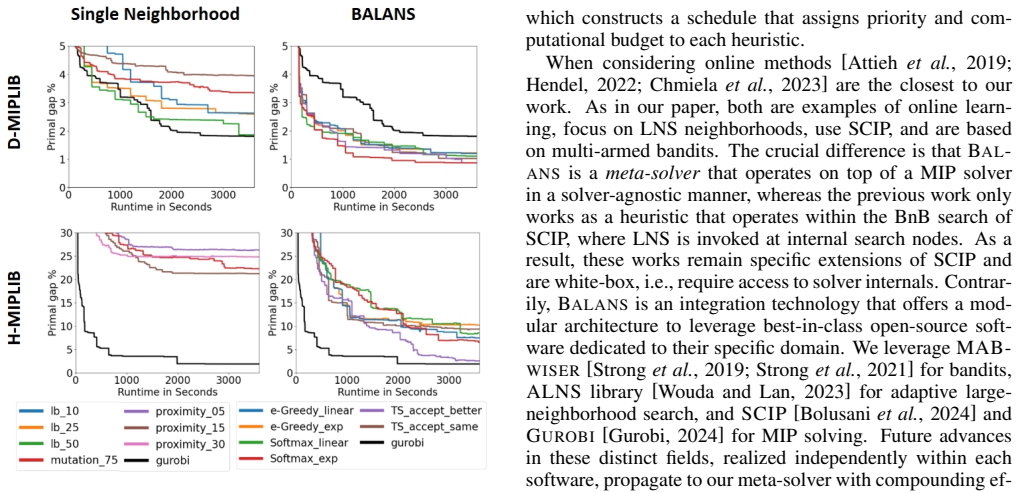
The discovery, stated on the paper's own terms, is that treating a portfolio of large-neighborhood-search operators as arms in a multi-armed bandit converts individually weak destroy operators into a search that beats both the default MIP solver and any single-neighborhood search. The bandit rewards each arm according to four acceptance-criterion outcomes (best, better, accepted, rejected) and continuously updates its choice policy, using e-Greedy, Softmax, or Thompson Sampling, as the solve progresses. Arm-selection statistics show that the single best standalone operator, local branching, is chosen only 0.6 percent of the time on H-MIPLIB, while RENS and RINS, which are poor when run alone, together account for roughly 40 percent of selections on D-MIPLIB and 60 percent on H-MIPLIB; the paper concludes that the gain comes from sequencing weaker neighborhoods with a deliberate exploration-exploitation balance. The claim is asserted for hard benchmark instances from D-MIPLIB and a feasible subset of MIPLIB2017-Hard, within a one-hour time limit, under both Hill Climbing and Simulated Annealing acceptance criteria, and the authors state that all configurations, without offline training and almost zero tuning, improve over the baselines.
Load-bearing premise
The load-bearing premise is that the gains come from learning to choose neighborhoods online, not just from having 16 diverse neighborhoods to try; if random or round-robin selection over the same arms matched Balans's results, the learning claim would collapse.
Editorial extensions
If this is right
- On any hard instance, running Balans with default settings should produce better primal bounds within one hour than the stock SCIP or Gurobi solver, because every tested bandit configuration beat both baselines on D-MIPLIB and H-MIPLIB.
- A practitioner no longer needs to pick a neighborhood and tune its destroy size: parameter variations are exposed as arms and selected online, avoiding the per-domain tuning that single-neighborhood LNS requires.
- The solver-agnostic design means the same wrapper can be placed on top of open-source or commercial MIP solvers, and the experiments show the improvement pattern holds for SCIP and Gurobi.
- The internal adaptive large-neighborhood search already inside SCIP explains little of the gain: the ablation attributes improvement on 79 of 94 instances to the bandit-based outer loop, with SCIP's internal ALNS helping only 8 instances by less than 0.2 percent gap.
- Weak operators can be load-bearing: RENS and RINS, poor standalone, account for roughly 40 to 60 percent of arm selections in the best configurations, so a diverse, adaptively scheduled portfolio outperforms committing to the single best neighborhood.
Reading between the lines
- Beyond the paper's reported experiments, a random or round-robin control over the same 16 arms would separate the contribution of bandit learning from the contribution of portfolio diversity; the paper does not include this control.
- If learning is the cause, the heavy selection of RENS and RINS suggests a smaller portfolio with only a few weak operators and randomized destroy sizes might reproduce much of the gain at lower per-iteration cost.
- A natural extension is to add offline-learned LNS policies as additional arms, a hybrid the authors list as future work; this would let training-based and training-free guidance compete and cooperate in one search.
- Logging per-iteration regret or switching costs would show whether the advantage comes from early adaptation or steady-state scheduling, which the aggregate traces do not distinguish.
Editorial analysis
A structured set of objections, weighed in public.
Referee Report
Summary. The paper proposes Balans, a meta-solver for mixed-integer programs that wraps a MIP solver (SCIP or Gurobi) in an adaptive large-neighborhood search (ALNS) loop. A portfolio of 16 destroy operators, derived from eight classic neighborhoods with parameter variations, is maintained, and a multi-armed bandit policy selects the next neighborhood online, with rewards based on the acceptance outcome of each repair step. The method requires no offline training. Experiments on D-MIPLIB (50 instances) and a filtered H-MIPLIB subset (43 instances) compare Balans against default SCIP/Gurobi, single-neighborhood LNS, and the lb-relax baseline, reporting primal gap and primal integral at a one-hour limit. The authors claim that all configurations of Balans significantly improve over the default solver and every single-neighborhood approach, and that the bandit-based online adaptation is the key to the gains.
Significance. If the empirical claims are substantiated, Balans is a practically valuable, solver-agnostic, training-free wrapper that improves primal bounds on hard MIPs; the open-source release and the ablation on Gurobi and on SCIP's internal ALNS are useful contributions. The paper's most interesting scientific claim—that online bandit learning sequences weak operators into an effective search—is currently underdetermined by the experiments. The missing non-adaptive control and the lack of statistical testing prevent the paper from establishing the learning attribution, although the practical wrapper may well be beneficial.
major comments (3)
- [§4.1, Table 1 and Figure 2] The central attribution of the performance gains to online bandit learning is not tested. The paper compares the 16-arm MAB portfolio against single neighborhoods and lb-relax, but never against a non-adaptive selection rule over the same 16 arms, such as uniform random, round-robin, or a fixed cyclic schedule, using identical per-iteration time limits and acceptance criteria. If a random or round-robin scheduler achieves comparable primal gaps and primal integrals, then the improvement over SCIP and over single neighborhoods is explained by the diversity of the portfolio and the parameter variations (lb 10/25/50, mutation 25/50/75, etc.) rather than by adaptive selection. The sentence in §4.1 that Balans improves 'by using weaker operators sequentially and carefully balancing the exploitation-exploration trade-off via online learning' is a causal interpretation that the experiments do not support. A control experiment with a non-adaptive selector is required to support the paper's main claim.
- [§4.1, Table 1 and §6] The word 'significantly' is used in the abstract, §1, and §6, but no statistical significance tests are reported. The standard deviations in Table 1 are large relative to the mean differences (for example, D-MIPLIB primal gap for Softmax linear SA is 0.49±0.81 vs SCIP 2.11±1.68), and no per-instance paired comparisons are shown. The '75+%' reduction claim is also presented without a confidence interval. The authors should report paired tests (e.g., Wilcoxon signed-rank) or confidence intervals for the primal gap and primal integral differences to substantiate the 'significant' language.
- [§4, 'State-of-the-art LNS(MIP)' baseline; §3.1] The comparison against lb-relax is potentially unfair. The paper states in §3.1 that lb-relax 'has a hyper-parameter to control the destroy size that must be chosen carefully for each problem domain,' but §4 does not report the hyper-parameter settings used for lb-relax or whether they were tuned on the test domains. Since the claimed improvement over the state-of-the-art LNS(MIP) relies on this baseline, the authors need to either tune lb-relax per domain, use the authors' recommended settings, or justify that the chosen settings are appropriate. Without this, the aggregate result that lb-relax performs worse than SCIP may be an artifact of an under-tuned baseline.
minor comments (6)
- [§4, Datasets] The H-MIPLIB subset is filtered to instances that permit a feasible solution within 20 seconds, yielding 43 instances. The paper should discuss how this selection affects the generality of the claim about 'hard optimization problems,' since instances where an initial feasible solution is difficult to find are excluded by construction.
- [§4.1, Table 1] The phrase 'any configuration of BALANS' should be qualified: Table 1 reports 6 learning policies under 2 acceptance criteria (12 configurations), not all possible reward-vector and temperature-schedule choices. The sentence 'any B ALANS configuration is better than the alternatives' should read 'any tested configuration.'
- [§4.1, Table 2] The arm-selection distribution is reported only for the 'best BALANS configurations,' but the criterion for 'best' is not defined. Please specify whether this is the configuration with the lowest mean primal gap or primal integral, and report the corresponding distributions for a few other configurations to show stability.
- [§3.1 and §4] The destroy-size variations (e.g., lb 10/25/50) are hand-chosen hyper-parameters, and the time limits (20-second initialization, 1-minute and 2.5-minute iterations) are also configured. The claim of 'almost zero tuning' should be qualified to acknowledge these choices, even if they are not instance-specific.
- [Appendix A] The GitHub URL appears as 'https://github.com/anonymous/balans/' in Appendix A but as 'https://github.com/skadio/balans' in the main text; please make these consistent.
- [Abstract] The phrase 'apriori training' should be 'a priori training'; also, the typesetting of 'B ALANS' is inconsistent in places and should be normalized.
Circularity Check
No significant circularity: Balans’ claims are empirical comparisons with fixed hyperparameters; no derived quantity reduces to its input.
full rationale
Balans is an empirical meta-solver paper rather than a derivation paper. The headline claims in Section 6 are comparative measurements against default solvers, single-neighborhood LNS variants, and the published lb-relax baseline. No quantity is predicted from another in a way that makes the output equal to the input by construction. The reward vectors ([3,2,1,0], [8,4,2,1], [1,1,0,0], [1,1,1,0]), acceptance criteria, and per-iteration time limits are fixed hyperparameters specified in Section 4; they are not fitted to reproduce the reported primal gaps or primal integrals. The only self-referential citation is [Cai et al. 2024c] in Section 3.1, which points to this paper’s own Appendix B for destroy-operator definitions; since those definitions appear in the same manuscript, this is a minor citation oddity and is not load-bearing for the empirical conclusion. The lb-relax comparison uses the original external implementation from [Huang et al. 2023a]; although there is author overlap, the baseline is a published algorithm with its own tuning, and the paper does not invoke that citation to forbid alternative explanations. The skeptic concern that no random or round-robin arm-selection baseline was run is a threat to the attribution of gains to bandit learning, but it is a missing control rather than a circular reduction: no reported metric is equal by construction to an input fit or to a self-citation. The paper is self-contained with respect to its experimental claims, and its comparisons are externally benchmarked against SCIP, Gurobi, and published LNS(MIP) methods.
Assumptions & free parameters
free parameters (4)
- MAB reward vectors =
linear [3,2,1,0], exponential [8,4,2,1], TS [1,1,0,0], TS [1,1,1,0]
- Simulated annealing temperature schedule =
initial 20, end 1, step 0.1
- Destroy size variations =
local branching 10/25/50, mutation 25/50/75, proximity 05/15/30, rens 25/50/75, rins 25/50/75
- Time limits =
20s initial solution, 1 minute per LNS iteration, 2.5 minutes for local branching, 1 hour total
assumptions (4)
- standard math MIP, LP relaxation, and branch-and-bound behave as standard background algorithms.
- domain assumption For the selected benchmark instances, a feasible initial solution can be found within 20 seconds.
- domain assumption Re-optimizing each sub-MIP with the base solver yields a useful candidate solution within the iteration time limit.
- domain assumption Reward signals from the four acceptance outcomes are a sufficient learning signal for arm selection.
Cite this review
Pith. "Pith review of Balans: Multi-Armed Bandits-based Adaptive Large Neighborhood Search for Mixed-Integer Programming Problem." pith.science (2026). https://pith.science/paper/QAXGNDKF
@misc{pith2026241214382,
  author       = {Pith},
  title        = {Pith review of: Balans: Multi-Armed Bandits-based Adaptive Large Neighborhood Search for Mixed-Integer Programming Problem},
  year         = {2026},
  howpublished = {\url{https://pith.science/paper/QAXGNDKF}},
  note         = {Machine review of arXiv:2412.14382}
}
read the original abstract
Mixed-integer programming (MIP) is a powerful paradigm for modeling and solving various important combinatorial optimization problems. Recently, learning-based approaches have shown a potential to speed up MIP solving via offline training that then guides important design decisions during the search. However, a significant drawback of these methods is their heavy reliance on offline training, which requires collecting training datasets and computationally costly training epochs yet offering only limited generalization to unseen (larger) instances. In this paper, we propose Balans, an adaptive meta-solver for MIPs with online learning capability that does not require any supervision or apriori training. At its core, Balans is based on adaptive large-neighborhood search, operating on top of an MIP solver by successive applications of destroy and repair neighborhood operators. During the search, the selection among different neighborhood definitions is guided on the fly for the instance at hand via multi-armed bandit algorithms. Our extensive experiments on hard optimization instances show that Balans offers significant performance gains over the default MIP solver, is better than committing to any single best neighborhood, and improves over the state-of-the-art large-neighborhood search for MIPs. Finally, we release Balans as a highly configurable, MIP solver agnostic, open-source software.
Figures


Figures from the paper (7 more)


Forward citations
Cited by 1 Pith paper
-
Multi-task Representation Learning for Mixed Integer Linear Programming
A two-step multi-task training strategy for MILP solving produces embeddings that match specialized models in-distribution and generalize better on larger instances and new tasks.
Reference graph
Works this paper leans on
-
[1]
Rounding and propagation heuristics for mixed integer programming
Tobias Achterberg, Timo Berthold, and Gregor Hendel. Rounding and propagation heuristics for mixed integer programming. In Operations Research Proceedings 2011: Selected Papers of the International Conference on Operations Research (OR 2011), August 30-September 2, 2011, Zurich, Switzerland , pages 71--76. Springer, 2012
work page 2011
-
[2]
Hyper-heuristics using multi-armed bandit models for multi-objective optimization
Carolina P Almeida, Richard A Gon c alves, Sandra Venske, Ricardo L \"u ders, and Myriam Delgado. Hyper-heuristics using multi-armed bandit models for multi-objective optimization. Applied Soft Computing , 95:106520, 2020
work page 2020
-
[3]
Athanor: high-level local search over abstract constraint specifications in essence
Saad Attieh, Nguyen Dang, Christopher Jefferson, Ian Miguel, and Peter Nightingale. Athanor: high-level local search over abstract constraint specifications in essence. In Proceedings of the Twenty-Eighth International Joint Conference on Artificial Intelligence (IJCAI-19) . International Joint Conferences on Artificial Intelligence, 2019
work page 2019
-
[4]
Finite-time analysis of the multiarmed bandit problem
Peter Auer, Nicolo Cesa-Bianchi, and Paul Fischer. Finite-time analysis of the multiarmed bandit problem. Machine learning , 47:235--256, 2002
work page 2002
-
[5]
Machine learning for combinatorial optimization: A methodological tour d’horizon
Yoshua Bengio, Andrea Lodi, and Antoine Prouvost. Machine learning for combinatorial optimization: A methodological tour d’horizon. European Journal of Operational Research , 290(2):405--421, 2021
work page 2021
-
[6]
Primal heuristics for mixed integer programs
Timo Berthold. Primal heuristics for mixed integer programs . PhD thesis, Zuse Institute Berlin (ZIB), 2006
work page 2006
-
[7]
Timo Berthold. Rens: the optimal rounding. Mathematical Programming Computation , 6:33--54, 2014
work page 2014
-
[8]
The scip optimization suite 9.0
Suresh Bolusani, Mathieu Besan c on, Ksenia Bestuzheva, Antonia Chmiela, Jo \ a o Dion \' sio, Tim Donkiewicz, Jasper van Doornmalen, Leon Eifler, Mohammed Ghannam, Ambros Gleixner, et al. The scip optimization suite 9.0. arXiv preprint arXiv:2402.17702 , 2024
arXiv 2024
Show all 50 references
-
[9]
Learning backdoors for mixed integer programs with contrastive learning
Junyang Cai, Taoan Huang, and Bistra Dilkina. Learning backdoors for mixed integer programs with contrastive learning. arXiv e-prints , pages arXiv--2401, 2024
2024
-
[10]
Multi-task representation learning for mixed integer linear programming
Junyang Cai, Taoan Huang, and Bistra Dilkina. Multi-task representation learning for mixed integer linear programming. arXiv preprint arXiv:2412.14409 , 2024
2024 arXiv
-
[11]
Balans: Multi-armed bandits-based adaptive large neighborhood search for mixed-integer programming problem
Junyang Cai, Serdar Kadioglu, and Bistra Dilkina. Balans: Multi-armed bandits-based adaptive large neighborhood search for mixed-integer programming problem. arXiv preprint arXiv:2412.14382 , 2024
2024 arXiv
-
[12]
Learning to schedule heuristics in branch and bound
Antonia Chmiela, Elias Khalil, Ambros Gleixner, Andrea Lodi, and Sebastian Pokutta. Learning to schedule heuristics in branch and bound. Advances in Neural Information Processing Systems , 34:24235--24246, 2021
2021
-
[13]
Online learning for scheduling mip heuristics
Antonia Chmiela, Ambros Gleixner, Pawel Lichocki, and Sebastian Pokutta. Online learning for scheduling mip heuristics. In International Conference on Integration of Constraint Programming, Artificial Intelligence, and Operations Research , pages 114--123. Springer, 2023
2023
-
[14]
Exploring relaxation induced neighborhoods to improve mip solutions
Emilie Danna, Edward Rothberg, and Claude Le Pape. Exploring relaxation induced neighborhoods to improve mip solutions. Mathematical Programming , 102:71--90, 2005
2005
-
[15]
Accelerating primal solution findings for mixed integer programs based on solution prediction
Jian-Ya Ding, Chao Zhang, Lei Shen, Shengyin Li, Bing Wang, Yinghui Xu, and Le Song. Accelerating primal solution findings for mixed integer programs based on solution prediction. In Proceedings of the aaai conference on artificial intelligence , volume 34, pages 1452--1459, 2020
2020
-
[16]
Local branching
Matteo Fischetti and Andrea Lodi. Local branching. Mathematical programming , 98:23--47, 2003
2003
-
[17]
Proximity search for 0-1 mixed-integer convex programming
Matteo Fischetti and Michele Monaci. Proximity search for 0-1 mixed-integer convex programming. Journal of Heuristics , 20:709--731, 2014
2014
-
[18]
Dins, a mip improvement heuristic
Shubhashis Ghosh. Dins, a mip improvement heuristic. In International Conference on Integer Programming and Combinatorial Optimization , pages 310--323. Springer, 2007
2007
-
[19]
Miplib 2017: data-driven compilation of the 6th mixed-integer programming library
Ambros Gleixner, Gregor Hendel, Gerald Gamrath, Tobias Achterberg, Michael Bastubbe, Timo Berthold, Philipp Christophel, Kati Jarck, Thorsten Koch, Jeff Linderoth, et al. Miplib 2017: data-driven compilation of the 6th mixed-integer programming library. Mathematical Programmin...
2017
-
[20]
Gurobi Optimizer Reference Manual , 2024
Gurobi . Gurobi Optimizer Reference Manual , 2024. Accessed: 2024-08-10
2024
-
[21]
Learning to search in branch and bound algorithms
He He, Hal Daume III, and Jason M Eisner. Learning to search in branch and bound algorithms. In Z. Ghahramani, M. Welling, C. Cortes, N. Lawrence, and K.Q. Weinberger, editors, Advances in Neural Information Processing Systems , volume 27. Curran Associates, Inc., 2014
2014
-
[22]
Adaptive large neighborhood search for mixed integer programming
Gregor Hendel. Adaptive large neighborhood search for mixed integer programming. Mathematical Programming Computation , 14(2):185--221, 2022
2022
-
[23]
Local branching relaxation heuristics for integer linear programs
Taoan Huang, Aaron Ferber, Yuandong Tian, Bistra Dilkina, and Benoit Steiner. Local branching relaxation heuristics for integer linear programs. In International Conference on Integration of Constraint Programming, Artificial Intelligence, and Operations Research , pages 96--1...
2023
-
[24]
Searching large neighborhoods for integer linear programs with contrastive learning
Taoan Huang, Aaron M Ferber, Yuandong Tian, Bistra Dilkina, and Benoit Steiner. Searching large neighborhoods for integer linear programs with contrastive learning. In International Conference on Machine Learning , pages 13869--13890. PMLR, 2023
2023
-
[25]
Distributional miplib: a multi-domain library for advancing ml-guided milp methods
Weimin Huang, Taoan Huang, Aaron M Ferber, and Bistra Dilkina. Distributional miplib: a multi-domain library for advancing ml-guided milp methods. arXiv preprint arXiv:2406.06954 , 2024
2024 arXiv
-
[26]
Building higher-order abstractions from the components of recommender systems
Serdar Kadioglu and Bernard Kleynhans. Building higher-order abstractions from the components of recommender systems. In Michael J. Wooldridge, Jennifer G. Dy, and Sriraam Natarajan, editors, Thirty-Eighth AAAI Conference on Artificial Intelligence, AAAI 2024, Thirty-Sixth Con...
2024
-
[27]
ISAC - instance-specific algorithm configuration
Serdar Kadioglu, Yuri Malitsky, Meinolf Sellmann, and Kevin Tierney. ISAC - instance-specific algorithm configuration. In Helder Coelho, Rudi Studer, and Michael J. Wooldridge, editors, ECAI 2010 - 19th European Conference on Artificial Intelligence, Lisbon, Portugal, August 1...
2010
-
[28]
Algorithm selection and scheduling
Serdar Kadioglu, Yuri Malitsky, Ashish Sabharwal, Horst Samulowitz, and Meinolf Sellmann. Algorithm selection and scheduling. In Jimmy Ho - Man Lee, editor, Principles and Practice of Constraint Programming - CP 2011 - 17th International Conference, CP 2011, Perugia, Italy, Se...
2011
-
[29]
Non-model-based search guidance for set partitioning problems
Serdar Kadioglu, Yuri Malitsky, and Meinolf Sellmann. Non-model-based search guidance for set partitioning problems. In J \" o rg Hoffmann and Bart Selman, editors, Proceedings of the Twenty-Sixth AAAI Conference on Artificial Intelligence, July 22-26, 2012, Toronto, Ontario, ...
2012
-
[30]
Learning to branch in mixed integer programming
Elias Khalil, Pierre Le Bodic, Le Song, George Nemhauser, and Bistra Dilkina. Learning to branch in mixed integer programming. In Proceedings of the AAAI Conference on Artificial Intelligence , volume 30, 2016
2016
-
[31]
Learning to run heuristics in tree search
Elias B Khalil, Bistra Dilkina, George L Nemhauser, Shabbir Ahmed, and Yufen Shao. Learning to run heuristics in tree search. In Ijcai , pages 659--666, 2017
2017
-
[32]
Algorithms for multi-armed bandit problems
Volodymyr Kuleshov and Doina Precup. Algorithms for multi-armed bandit problems. CoRR , abs/1402.6028, 2014
2014 arXiv
-
[33]
An automatic method for solving discrete programming problems
Ailsa H Land and Alison G Doig. An automatic method for solving discrete programming problems . Springer, 2010
2010
-
[34]
On learning and branching: a survey
Andrea Lodi and Giulia Zarpellon. On learning and branching: a survey. Top , 25(2):207--236, 2017
2017
-
[35]
The choice axiom after twenty years
R Duncan Luce. The choice axiom after twenty years. Journal of mathematical psychology , 15(3):215--233, 1977
1977
-
[36]
Adaptive anytime multi-agent path finding using bandit-based large neighborhood search
Thomy Phan, Taoan Huang, Bistra Dilkina, and Sven Koenig. Adaptive anytime multi-agent path finding using bandit-based large neighborhood search. In Proceedings of the AAAI Conference on Artificial Intelligence , volume 38, pages 17514--17522, 2024
2024
-
[37]
Large neighborhood search
David Pisinger and Stefan Ropke. Large neighborhood search. Handbook of metaheuristics , pages 99--127, 2019
2019
-
[38]
An evolutionary algorithm for polishing mixed integer programming solutions
Edward Rothberg. An evolutionary algorithm for polishing mixed integer programming solutions. INFORMS Journal on Computing , 19(4):534--541, 2007
2007
-
[39]
Adapting behaviour for learning progress
Tom Schaul, Diana Borsa, David Ding, David Szepesvari, Georg Ostrovski, Will Dabney, and Simon Osindero. Adapting behaviour for learning progress. arXiv preprint arXiv:1912.06910 , 2019
1912 arXiv
-
[40]
A general large neighborhood search framework for solving integer programs
Jialin Song, Ravi Lanka, Yisong Yue, and Bistra Dilkina. A general large neighborhood search framework for solving integer programs. In Annual Conference on Neural Information Processing Systems (NeurIPS) , 2020
2020
-
[41]
Learning a large neighborhood search algorithm for mixed integer programs
Nicolas Sonnerat, Pengming Wang, Ira Ktena, Sergey Bartunov, and Vinod Nair. Learning a large neighborhood search algorithm for mixed integer programs. arXiv preprint arXiv:2107.10201 , 2021
2021 arXiv
-
[42]
Mabwiser: A parallelizable contextual multi-armed bandit library for python
Emily Strong, Bernard Kleynhans, and Serdar Kadioglu. Mabwiser: A parallelizable contextual multi-armed bandit library for python. In 31st IEEE International Conference on Tools with Artificial Intelligence, ICTAI 2019, Portland, OR, USA, November 4-6, 2019 , pages 909--914. I...
2019
-
[43]
MABWiser: parallelizable contextual multi-armed bandits
Emily Strong, Bernard Kleynhans, and Serdar Kadioglu. MABWiser: parallelizable contextual multi-armed bandits. Int. J. Artif. Intell. Tools , 30(4):2150021:1--2150021:19, 2021
2021
-
[44]
On the likelihood that one unknown probability exceeds another in view of the evidence of two samples
William R Thompson. On the likelihood that one unknown probability exceeds another in view of the evidence of two samples. Biometrika , 25(3-4):285--294, 1933
1933
-
[45]
Optimization over trained neural networks: Taking a relaxing walk
Jiatai Tong, Junyang Cai, and Thiago Serra. Optimization over trained neural networks: Taking a relaxing walk. In International Conference on the Integration of Constraint Programming, Artificial Intelligence, and Operations Research , pages 221--233. Springer, 2024
2024
-
[46]
Multi-armed bandit algorithms and empirical evaluation
Joannes Vermorel and Mehryar Mohri. Multi-armed bandit algorithms and empirical evaluation. In European conference on machine learning , pages 437--448. Springer, 2005
2005
-
[47]
Wouda and Leon Lan
Niels A. Wouda and Leon Lan. ALNS : a P ython implementation of the adaptive large neighbourhood search metaheuristic. Journal of Open Source Software , 8(81):5028, 2023
2023
-
[48]
Learning large neighborhood search policy for integer programming
Yaoxin Wu, Wen Song, Zhiguang Cao, and Jie Zhang. Learning large neighborhood search policy for integer programming. Advances in Neural Information Processing Systems , 34:30075--30087, 2021
2021
-
[49]
Bandmaxsat: A local search maxsat solver with multi-armed bandit
Jiongzhi Zheng, Kun He, Jianrong Zhou, Yan Jin, Chu-Min Li, and Felip Manya. Bandmaxsat: A local search maxsat solver with multi-armed bandit. arXiv preprint arXiv:2201.05544 , 2022
2022 arXiv
-
[50]
write newline
" write newline "" before.all 'output.state := FUNCTION fin.entry add.period write newline FUNCTION new.block output.state before.all = 'skip after.block 'output.state := if FUNCTION new.sentence output.state after.block = 'skip output.state before.all = 'skip after.sentence '...
Reviewed August 11, 2026 · model on record in the stance chip above.
Discussion (0). Continue with ORCID to comment.