REVIEW 4 major objections 4 minor 1 cited by
Using SimTeEx to simplify polynomial expressions with tensors
T0 review · 4 major / 4 minor · reviewed 2026-08-11 · deepseek-v4-flash
Pith's one-line read This paper presents an algorithm, implemented in the SimTeEx package, that puts any tensor polynomial into a simplified form under arbitrary symmetries, including multi-term ones.
desk verdict Useful new tensor simplifier with a genuinely better input format, but the canonical-form claim is under-specified and needs a concrete graph ordering. read the letter →
The pith
A machine-rendered reading of the paper's core claim, the machinery that carries it, and where it could break.
The reading
What carries the argument
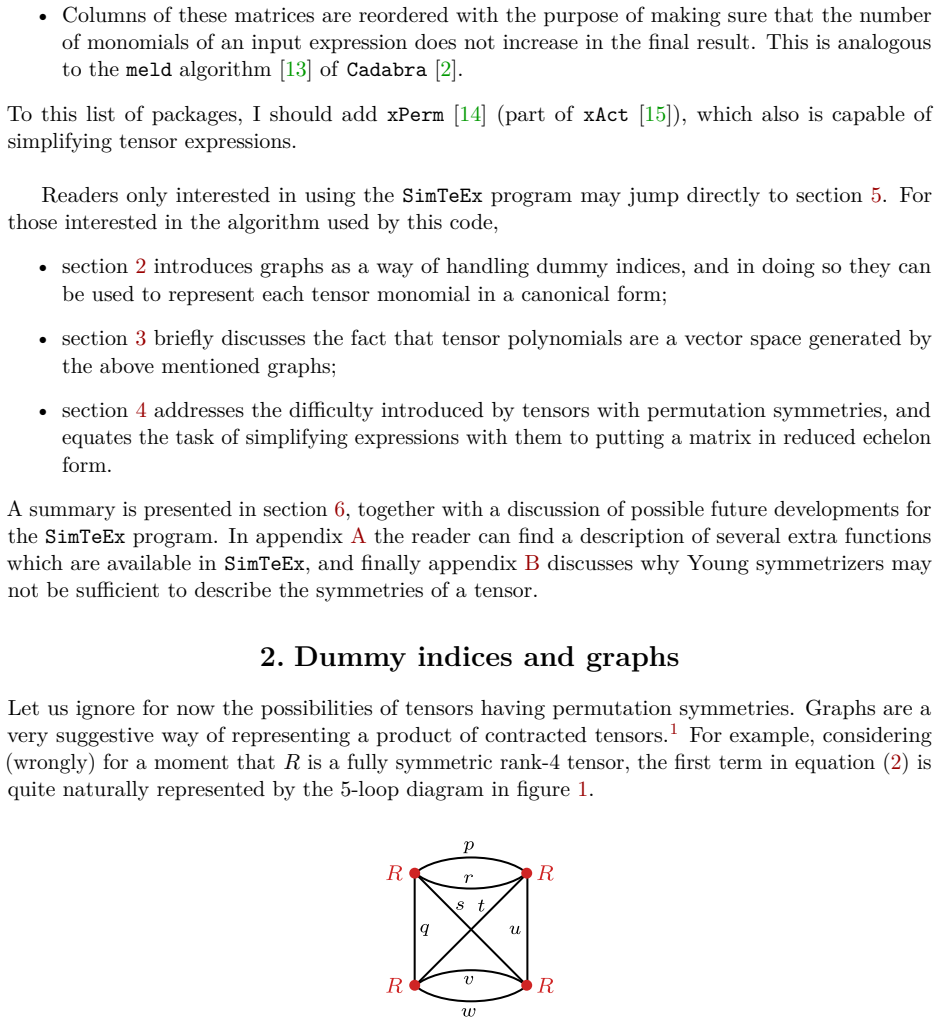
The central object is a labeled multigraph, encoded as a generalized adjacency matrix, that represents a tensor monomial; canonicalizing it by row and column permutations turns the question of whether two contractions are the same up to dummy-index relabeling into the question of whether two labelings are the same graph, which is decided by comparing canonical representatives. The second load-bearing mechanism is a matrix in reduced row echelon form: the first row holds the coefficients of the input polynomial, the remaining rows encode the symmetry null equations, and the simplified coefficients are read off the first row after reduction. A column ordering that places the columns belonging to monomials actually present in the input last is what the paper claims guarantees that the number of nonzero output coefficients never grows, mirroring the effect of the meld algorithm in earlier tensor computer algebra.
What would settle it
Run a brute-force scan over small symmetry systems (for example rank-3 and rank-4 tensors with a few multi-term relations) and over all inputs with few monomials, and check whether CanonicalForm with input-present columns placed last ever returns more nonzero terms than the input; the paper's own equation (29) shows the naive ordering fails, and the unproven assertion is precisely that the special reordering never does. One concrete counterexample would refute the simplification guarantee.
Extended reading notes
Core claim
At its core, the paper identifies a reduction: tensor-polynomial simplification with arbitrary permutation symmetries is equivalent to linear algebra over a vector space whose basis elements are canonical graphs. Dummy indices are handled exactly once by building a generalized adjacency matrix for each monomial, with vertices representing tensors and external indices and edges recording which slot of which tensor contracts with which slot of another, and then choosing a canonical representative among all isomorphic relabelings. Symmetries are supplied as null equations, each a sum of monomial graphs equal to zero; these become extra rows in a matrix whose first row is the coefficient vector of the input polynomial. Reduced row echelon form on this matrix yields simplified coefficients, and any set of linear null equations can be fed in, including the multi-term symmetries of the Riemann tensor or the SMEFT Wilson coefficient $\kappa$, including cases that cannot be described by Young symmetrizers. The paper is careful to state that the default output is a normal form, not a canonical form: two equivalent expressions may print differently, but their difference always simplifies to zero.
Load-bearing premise
The load-bearing premise is the unproven claim in Section 4 that putting the columns of the terms that already appear in the input last always keeps the number of nonzero output coefficients from increasing; unless that holds for every symmetry set, the algorithm's output can be longer than the input, contradicting its name.
Editorial extensions
If this is right
- Riemann-tensor identities such as equation (2) reduce automatically from the three standard symmetry equations, with no special-case code.
- Wilson-coefficient relations of the SMEFT, like equation (6), follow from a linear null equation such as equation (5), without computing Young tableaux.
- Tensor symmetries that cannot be expressed by Young symmetrizers, such as arbitrary linear relations between mixed-symmetry components, can still be simplified because the input format is general linear equations.
- Anti-commuting fermion fields are supported: declaring them as such and using noncommutative multiplication makes Grassmann parity part of the simplification.
- With default settings the result is a normal form (equivalent expressions may look different), while turning on the TrueCanonicalForm flag produces a true canonical form with canonical dummy indices.
Reading between the lines
- A natural test would be to search small symmetry sets exhaustively for an input where every column order gives more nonzero terms than the input; such a case would pin down exactly when the simplification guarantee can fail to shrink an expression.
- Because the dummy-index part is graph isomorphism, the worst case is exponential, so a practical benchmark suite of Riemann-type quartics would clarify where the package becomes slow.
- The linear-algebra formulation looks portable: any algebraic structure whose monomials can be canonicalized and whose relations are linear could use the same RREF-based simplification, not just tensors.
Editorial analysis
A structured set of objections, weighed in public.
Referee Report
Summary. The paper presents SimTeEx, a Mathematica package for simplifying polynomial expressions in tensors with dummy-index contractions and user-supplied permutation symmetries. Tensor monomials are encoded as labeled directed multigraphs, with equality of monomials reduced to graph isomorphism through canonicalized generalized adjacency matrices. Polynomials are treated as vectors over a basis of graph representatives, and tensor symmetries, including multi-term ones, are encoded as linear null relations among these representatives. The simplification step is phrased as reduced row echelon form (RREF) of a matrix whose first row holds the input coefficients and whose remaining rows hold the symmetry relations; columns corresponding to terms present in the input are placed last to control term growth. The paper documents the main CanonicalForm function, the TrueCanonicalForm option that renames dummy indices to a fixed list, handling of anti-commuting tensors, and several auxiliary group-theoretic functions. It validates the approach on the Riemann tensor identity (2) and on SMEFT-type examples.
Significance. If the advertised properties hold, SimTeEx fills a practical niche: it accepts arbitrary multi-term tensor symmetries directly as null equations, without requiring the user to provide Young symmetrizers, and the underlying linear-algebra-plus-graph-isomorphism strategy is simple and coherent. The paper has concrete strengths: the examples are reproducible and include a Riemann-tensor identity check with a symbolic parameter x, making the vanishing genuinely dependent on x = 1/4; the core construction is self-contained and parameter-free; and Appendix B makes a useful pedagogical point about the insufficiency of Young symmetrizers for general tensor symmetries. The significance is nevertheless conditional. The manuscript does not yet specify the total ordering needed for a true canonical form, does not describe the closure/orbit step needed to apply multi-term symmetries to arbitrary monomials, and asserts without proof the no-term-growth property. These are fixable gaps rather than refutations of the underlying approach.
major comments (4)
- [Section 4, after Eq. (30)] The assertion that placing columns for terms present in the input last guarantees that the number of non-zero coefficients never increases is stated without proof. This property is load-bearing for the claim that CanonicalForm is a simplifier rather than just a normal-form map; indeed Eq. (29) shows that without the reordering the number of non-zero terms can increase. Please supply a proof, or state precisely under which conditions the property holds and qualify the simplification guarantee accordingly.
- [Footnote 2 and Section 5 (TrueCanonicalForm mode)] The true-canonical claim is under-specified. Footnote 2 defines the canonical representative of a monomial by picking 'some sorting criteria' for generalized adjacency matrices, and Section 4 shows that the RREF result depends on the column order. For CanonicalForm(expr1) = CanonicalForm(expr2) to hold for all equivalent expr1 and expr2 in TrueCanonicalForm mode, the package must fix a concrete total order on the graph representatives that is independent of the input expression and specify how it is computed. The paper does not do this, so the advertised canonical form is not well defined. Please specify the ordering used in the implementation and explain why it yields a unique, input-independent representative.
- [Section 4, Eq. (24)] The application of multi-term symmetries is missing a closure step. In Eq. (24) the relations are written as linear combinations of the same basis graphs g_i that appear in the input, but a symmetry such as Eq. (21) or the Riemann relations (1) does not by itself specify which of the many slot-permuted monomials, with dummy indices relabeled, should be included in the matrix. The algorithm must generate the orbit of each input monomial under all permutations of tensor slots and all dummy-index renamings, canonicalize those graphs, and assemble the corresponding columns. The paper never states this construction or a bound on its size. Without it, Section 4 is not directly executable on the examples of Section 5.
- [Abstract, Section 1 and Section 5] The advertised claim of producing a canonical form and handling any tensor symmetry is stronger than what is demonstrated. Equations (31)-(32) explicitly concede that the default output is only a normal form, and the true-canonical mode depends on the unspecified ordering and the unproved no-growth step noted above. Please either supply the missing specifications and proofs, or revise the abstract and introduction to describe the default behavior as normal-form simplification with an optional canonical mode whose properties are fully stated.
minor comments (4)
- [Introduction and Appendix B] Several displayed equations are garbled in the text: the irreducible representations in Eqs. (7)-(8) and in Appendix B appear as empty or incomplete diagrams, which makes the group-theoretic discussion hard to follow.
- [Throughout] There are numerous typos and awkward phrasings, e.g. 'not does on need to know' in Section 1 and 'it is always be true' after Eq. (32). A careful proofread is needed.
- [Footnote 2] The phrase 'some sorting criteria' is too vague even for a footnote; if the full ordering cannot be described in the main text, the author should at least identify where in the code or an appendix the concrete criterion is defined.
- [Section 5, fermionic example] In the anti-commuting tensor example, the notation mixes ordinary multiplication and NonCommutativeMultiply; a brief explanation of why this is necessary would help readers unfamiliar with Mathematica's operator conventions.
Circularity Check
No significant circularity: the paper is a self-contained algorithmic description; its own caveats about normal versus canonical form are limitations, not circular reasoning.
full rationale
The paper presents an algorithm for simplifying tensor polynomials by (1) representing monomials as graphs to solve dummy-index relabeling, and (2) reducing multi-term symmetries to row-reduced echelon form of a matrix whose rows encode the symmetry relations. This is a direct construction from stated inputs; it does not fit parameters to a target result, and it does not rename an input as an output. The auxiliary functions in Appendix A use the author's GroupMath package, but the central CanonicalForm function does not depend on those tools, and GroupMath is an external, independently usable package rather than a source of the main claim. The paper explicitly concedes in Section 5, equations (31)-(32), that the default CanonicalForm is only a normal form and that equivalent expressions may yield different outputs; this admission undercuts the abstract's wording but is an openly stated limitation, not circularity. Similarly, the Section 4 assertion that placing input-present columns last prevents the number of nonzero coefficients from growing is an unproven algorithmic property, not a circular step. No load-bearing self-citation chain or definitionally forced prediction is present, so the honest finding is no significant circularity.
Assumptions & free parameters
assumptions (4)
- domain assumption Tensor monomials are faithfully represented by generalized adjacency matrices of labeled, directed multigraphs; graph isomorphism is equivalent to equality up to dummy index relabeling.
- domain assumption All tensor symmetries can be encoded as a finite set of linear null equations (24), and applying reduced row echelon form to matrix (26) yields a valid simplified representative of the input polynomial.
- ad hoc to paper A total order on generalized adjacency matrices exists and the selected smallest representative is unique for each isomorphism class of monomial graphs.
- ad hoc to paper Ordering matrix columns so that terms present in the input appear last guarantees that the number of non-zero coefficients never increases after row reduction.
Cite this review
Pith. "Pith review of Using SimTeEx to simplify polynomial expressions with tensors." pith.science (2026). https://pith.science/paper/FZEMZIYQ
@misc{pith2026241214390,
  author       = {Pith},
  title        = {Pith review of: Using SimTeEx to simplify polynomial expressions with tensors},
  year         = {2026},
  howpublished = {\url{https://pith.science/paper/FZEMZIYQ}},
  note         = {Machine review of arXiv:2412.14390}
}
abstract
Computations with tensors are ubiquitous in fundamental physics, and so is the usage of Einstein's dummy index convention for the contraction of indices. For instance, $T_{ia}U_{aj}$ is readily recognized as the same as $T_{ib}U_{bj}$, but a computer does not know that T[i,a]U[a,j] is equal to T[i,b]U[b,j]. Furthermore, tensors may have symmetries which can be used to simply expressions: if $U_{ij}$ is antisymmetric, then $\alpha T_{ia}U_{aj}+\beta T_{ib}U_{jb}=\left(\alpha-\beta\right)T_{ia}U_{aj}$. The fact that tensors can have elaborate symmetries, together with the problem of dummy indices, makes it complicated to simplify polynomial expressions with tensors. In this work I will present an algorithm for doing so, which was implemented in the Mathematica package SimTeEx (Simplify Tensor Expressions). It can handle any kind of tensor symmetry.
Figures


Forward citations
Cited by 1 Pith paper
-
Renormalization of general Effective Field Theories: Formalism and renormalization of bosonic operators
The authors compute, for the first time, the one-loop renormalization group equations of the bosonic operators of a completely general EFT up to mass dimension 6.
Reference graph
Works this paper leans on
-
[1]
Einstein,The foundation of the general theory of relativity., Annalen Phys.49 (1916) 7 769–822
A. Einstein,The foundation of the general theory of relativity., Annalen Phys.49 (1916) 7 769–822. 25
work page 1916
-
[2]
Peeters,Cadabra2: computer algebra for field theory revisited, J
K. Peeters,Cadabra2: computer algebra for field theory revisited, J. Open Source Softw.3 (2018) 32 1118
work page 2018
-
[3]
Weinberg,Baryon and lepton nonconserving processes, Phys
S. Weinberg,Baryon and lepton nonconserving processes, Phys. Rev. Lett.43 (1979) 1566– 1570
work page 1979
-
[4]
F. Wilczek and A. Zee,Operator Analysis of Nucleon Decay, Phys. Rev. Lett. 43 (1979) 1571–1573
work page 1979
-
[5]
L. F. Abbott and M. B. Wise,The effective hamiltonian for nucleon decay, Phys. Rev.D22 (1980) 2208
work page 1980
-
[6]
K. S. Babu and C. N. Leung,Classification of effective neutrino mass operators, Nucl. Phys. B 619 (2001) 667–689, arXiv:hep-ph/0106054
arXiv 2001
-
[7]
A. de Gouvea and J. Jenkins,A survey of lepton number violation via effective operators, Phys. Rev. D77 (2008) 013008, arXiv:0708.1344 [hep-ph]
arXiv 2008
-
[8]
R. M. Fonseca and M. Hirsch,∆L≥ 4 lepton number violating processes, Phys. Rev. D98 (2018) 1 015035,arXiv:1804.10545 [hep-ph]
work page Pith review arXiv 2018
Show all 20 references
-
[9]
Gargalionis and R
J. Gargalionis and R. R. Volkas,Exploding operators for Majorana neutrino masses and beyond, JHEP 01 (2021) 074, arXiv:2009.13537 [hep-ph]
2021 arXiv
-
[10]
Tung,Group theory in Physics, World Scientific (1985)
W. Tung,Group theory in Physics, World Scientific (1985)
1985
-
[11]
D. A. Bolotin and S. V. Poslavsky,Introduction to Redberry: a computer algebra system designed for tensor manipulation(2013), arXiv:1302.1219 [cs.SC]
2013 arXiv
-
[12]
V. A. Ilyin and A. P. Kryukov,ATENSOR – REDUCE program for tensor simplification, Comput. Phys. Commun.96 (1996) 1 36–52,arXiv:1811.05409 [cs.SC]
1996 arXiv
-
[13]
Price, K
D. Price, K. Peeters and M. Zamaklar,Hiding canonicalisation in tensor computer algebra (2022), arXiv:2208.11946 [cs.SC]
2022 arXiv
-
[14]
J. M. Martín-García,xPerm: fast index canonicalization for tensor computer algebra, Comput. Phys. Commun. 179 (2008) 8 597–603,arXiv:0803.0862 [cs.SC]
2008 arXiv
-
[15]
J. M. Martín-García et al.,xAct: Efficient tensor computer algebra for the Wolfram Language, URL http://www.xact.es/
-
[16]
R. M. Fonseca,GroupMath: A Mathematica package for group theory calculations, Comput. Phys. Commun. 267 (2021) 108085, arXiv:2011.01764 [hep-th]
2021 arXiv
-
[17]
K. O. Geddes, S. R. Czapor and G. Labahn,Algorithms for computer algebra, Kluwer Academic Publishers, USA (1992)
1992
-
[18]
Fonseca, P
R. Fonseca, P. Olgoso and J. Santiago,Renormalisation of general effective field theories: formalism and renormalisation of bosonic operators (in preparation)
-
[19]
R. M. Fonseca,Enumerating the operators of an effective field theory, Phys. Rev. D101 (2020) 3 035040, arXiv:1907.12584 [hep-ph] . 26
2020 arXiv
-
[20]
Keppeler and M
S. Keppeler and M. Sjödahl,Hermitian Young operators, J. Math. Phys.55 (2014) 021702, arXiv:1307.6147 [math-ph] . 27
2014 arXiv
Reviewed August 11, 2026 · model on record in the stance chip above.
Discussion (0). Continue with ORCID to comment.