REVIEW 3 major objections 4 minor 1 cited by
Heat and work in black hole thermodynamics via holography
T0 review · 3 major / 4 minor · reviewed 2026-08-11 · deepseek-v4-flash
Pith's one-line read Holography gives black hole thermodynamics a general notion of heat and work, with a horizon-area second law that needs no energy conditions.
desk verdict A genuinely new heat/work split for composite black holes with a clean boundary second law, but the advertised bulk area law is not yet proven in part of the parameter range because of a renormalization-scheme gap the authors themselves identify. read the letter →
The pith
A machine-rendered reading of the paper's core claim, the machinery that carries it, and where it could break.
The reading
What carries the argument
The load-bearing object is the maximum-entropy coarse-grained state, together with the relative-entropy inequality that controls its thermodynamic arrow. For a target system and a bath, the coarse-grained state is $\bar\rho(t)=Z^{(s)}(t)^{-1}e^{-\beta(t)(H_*^{(s)}-\mu(t)O)}\otimes Z^{(b)}(t)^{-1}e^{-B(t)H_*^{(b)}}$, with the Lagrange multipliers $\beta(t),\mu(t),B(t)$ fixed by matching the observed expectation values. The second law $S(t)\ge S(0)$ follows from $0\le S(\rho(t)\|\bar\rho(t))$ together with the initial condition $\rho(0)=\bar\rho(0)$. The translation to gravity uses the path-integral form of the double-trace deformation: the coupling $v\,O^{(s)}O^{(b)}$ and the source $w\,O^{(s)}$ become mixed boundary conditions $\hat\Phi^{(s)}+w+v\Pi^{(b)}=0$ and $\hat\Phi^{(b)}+v\Pi^{(s)}=0$ on two asymptotically AdS spacetimes glued along the boundary, with $\Pi$ the renormalized one-point function. Each coarse-grained partition function is a stationary Euclidean black hole, so its horizon area computes the coarse-grained entropy, and the nonnegativity of relative entropy becomes the bulk area inequality. The examples use the retarded Green's function of a two-dimensional CFT and its bulk counterpart to compute the second-order entropy production.
What would settle it
A concrete check is to compute the entropy production density $-\int_0^t dt'\,w(t')\dot\Pi(t')$ for the source (4.21) at $\Delta=1.5$ using the bulk expression (4.11) and, separately, using the CFT retarded Green's function (B.30) with the finite regulator (B.31). The paper predicts the bulk quantity is negative at early times while the regulated CFT quantity stays nonnegative; if both became negative for the same $t$, the violation would not be a renormalization artifact and the claimed second law would fail. Conversely, finding a renormalization scheme where the bulk one-point function equals the CFT expectation value even while the source is on would confirm the paper's central claim in the problematic window.
Extended reading notes
Core claim
The central claim is that a composite system of AdS black holes, a target black hole plus bath black holes interacting only through their common conformal boundary, has a well-defined thermodynamics whose second law is inherited from quantum mechanics. On the boundary, the state is replaced at each time $t$ by a maximum-entropy state $\bar\rho(t)$ that reproduces $\langle H_*^{(s)}\rangle_t$, $\langle O\rangle_t$, and $\langle H_*^{(b)}\rangle_t$; the coarse-grained entropy is $S(t)=S^{(s)}(t)+S^{(b)}(t)$. Since relative entropy is nonnegative and the initial state is assumed to already be of the coarse-grained form, $S(t)\ge S(0)$ for any unitary evolution. The AdS/CFT dictionary identifies the partition function of $\bar\rho(t)$ with a stationary Euclidean black hole; for Einstein gravity the coarse-grained entropy is the horizon area over $4G$, so the boundary second law becomes $\frac{A^{(s)}(t)}{4G^{(s)}}+\frac{A^{(b)}(t)}{4G^{(b)}}\ge\frac{A^{(s)}(0)}{4G^{(s)}}+\frac{A^{(b)}(0)}{4G^{(b)}}$. The first law is $\dot E=\delta W+\delta\tilde Q$ with $\delta W=\int d^{d-1}x\sqrt{\sigma}\,\dot w\,\Pi^{(s)}$, so work is the energy change driven by the external source and heat is the remainder. The paper verifies the second law perturbatively in a three-dimensional Einstein-scalar model around BTZ: it holds for $0<\Delta<1$, while for $1<\Delta<2$ the conventional counterterm renormalization of [68] makes the bulk entropy production negative, although the CFT with a finite regulator satisfies the second law; the paper concludes that the standard scheme, which acts like dimensional regularization, is incompatible with the non-negativity of relative entropy, and formulates the bulk area inequality as a necessary criterion for UV completeness. Section 5 also records a caveat: the dictionary (3.20) for a $U(1)$ current appears to require dropping the source term in the stress tensor for charged static black holes.
Load-bearing premise
The argument presumes that the bulk value computed for the field dual to $O$ agrees with the quantum expectation value of $O$ at every time entering the entropy production, including the instants when the external source is active. The paper itself finds that for $1<\Delta<2$ this equality is guaranteed only after the source is switched off, so if the equality fails at coincident times the bulk area inequality is not the relative-entropy second law in that regime.
Editorial extensions
If this is right
- Target and bath black holes exchanging energy through the glued asymptotic boundaries obey a second law on the summed horizon areas of their coarse-graining Euclidean black holes, Eq. (3.34), with no energy condition assumed.
- Work and heat acquire operational meanings in black hole thermodynamics: work is $\delta W=\int d^{d-1}x\sqrt{\sigma}\,\dot w(t,\vec x)\Pi^{(s)}(t,\vec x)$ from the external source, and the first law $\dot E=\delta W+\delta\tilde Q$ holds for the composite system.
- The bulk area inequality becomes a necessary criterion for a gravitational model to be UV-complete: a holographic model whose renormalized boundary one-point function violates the second law is incompatible with unitarity.
- In the Einstein-scalar example the entropy production is nonnegative for $0<\Delta<1$, while the standard holographic renormalization of [68] fails for $1<\Delta<2$; the paper therefore calls for a renormalization scheme that respects relative entropy.
- The framework extends to multiple interacting CFTs and to respecting additional conserved charges such as angular momentum, giving generalized Gibbs states dual to more general black holes.
Reading between the lines
- If a renormalization scheme that respects relative entropy is found, the same area inequality could be used as a practical scan over effective gravitational theories: any model whose Euclidean coarse-graining entropy decreases under a unitary boundary quench would be discarded as not UV-complete.
- The framework leaves open the more striking regime in which the target black hole's own entropy decreases while the bath absorbs heat; a time-dependent coupling $v(t)$ or a non-perturbative quench could realize such a black hole engine, which the paper lists as a future direction.
- The $1<\Delta<2$ breakdown is likely a symptom of a general operator-smearing problem in real-time holography: bulk computations automatically implement dimensional or analytic continuation, while the CFT needs a finite regulator at lightlike coincidences; tests in higher-dimensional CFTs or with non-uniform sources could show whether this scheme-dependence is universal.
Editorial analysis
A structured set of objections, weighed in public.
Referee Report
Summary. The paper develops a thermodynamic framework for composite black hole systems using holography. On the boundary, a target CFT and bath CFTs are coupled by double-trace deformations; the authors define a coarse-grained state at each time by maximizing entropy subject to expectation values of the Hamiltonians and selected operators. They derive a second law S(t) ≥ S(0) from unitary evolution and non-negativity of relative entropy, and a first law E-dot = δW + δQ-tilde with work δW from the protocol w(t). They then translate the construction to the bulk using path-integral manipulations, obtaining a composite system of asymptotically AdS spacetimes with interacting boundary conditions, and identify the coarse-grained entropy with horizon areas of auxiliary Euclidean black holes, yielding the area inequality (3.34) and the work formula (3.38). As a test, they compute perturbative entropy production for a scalar source on a BTZ black hole: the bulk result satisfies the second law for 0<Δ<1 but violates it for 1<Δ<2. They argue the violation is a renormalization-scheme artifact: the standard holographic renormalization [68] corresponds to dimensional regularization, and Appendix C shows the bulk one-point function equals the CFT expectation value only after the source is switched off. The paper concludes that the second law can serve as a UV-completeness criterion and that a new renormalization scheme is needed.
Significance. If the central translation were fully justified, the framework would be a significant conceptual advance: it provides a microscopic (boundary) derivation of the second law for composite black holes with heat and work, without invoking energy conditions, and it gives a concrete falsifiable diagnostic (positivity of entropy production) for gravitational models. The boundary maximum-entropy argument is concise, and the path-integral derivation of the double-trace gluing is explicit. The manuscript is also unusually candid: Appendix C and Section 5 openly state the coincident-time dictionary gap and the ambiguity in Eq. (3.20). However, because that gap is load-bearing for the advertised bulk second law in a range of conformal dimensions, the significance is at present conditional. The relative-entropy step is not circular: it uses an external theorem, and the bulk inequality is then a consequence of the dictionary. No parameters are fitted to make the example pass; the boundary computation is an independent check.
major comments (3)
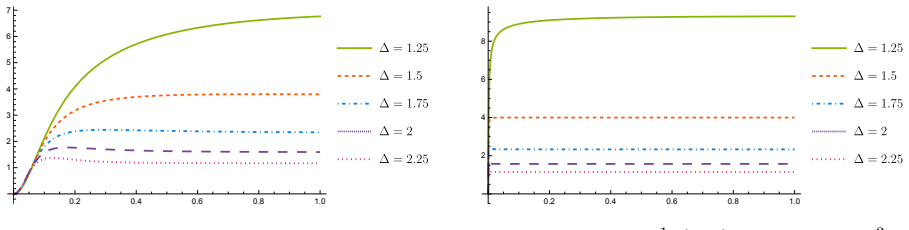
- [Sec. 4.1, Appendix C] The central translation from the boundary second law to the bulk area inequality (3.34) uses (3.16), i.e. Π(t) = ⟨O⟩_t, at all times appearing in the entropy production. Appendix C proves this equality only after the source w(t) has been switched off: the retarded Green's function is a distribution whose admissible test functions vanish at the coincident point, and the entropy production (4.20) integrates w(t′) times dΠ/dt′ over the whole source-active interval. Consequently, for 1<Δ<2 the quantity shown in Fig. 3 is not the CFT entropy production, and the apparent violation cannot be read as a failure of relative entropy; it is evidence that the holographic renormalization scheme [68] does not implement the boundary dictionary at coincident times. Since this step is load-bearing, the bulk second law (3.34) is not established in that regime, and the two-system inequality (4.32) inherits the same gap. The authors acknowledge this in Section 5, but the abstract and introduction state the result without this restriction.
- [Sec. 2.3, Sec. 3.2, Eq. (2.20)] The paper defines two heat notions, δQ in the second law and δQ-tilde in the first law, and identifies them only when [H^(s)+H^(b)_*, V] is negligible, referred to as a resonant interaction. No argument is given that the holographic double-trace interaction V = ∫√σ v O^(s)O^(b) satisfies this condition. In the bulk translation, δQ-tilde is then identified with the bath mass change M^(b)(t)-M^(b)(0) after Eq. (3.38). If the resonant condition is not met, the heat appearing in the first law differs from the energy lost by the bath, so the proposed notion of heat is not uniquely defined outside that regime. This should be either promoted to an explicit assumption on the allowed bulk couplings or separated into two named quantities.
- [Sec. 5, Eq. (3.20)] The paper itself flags an unresolved ambiguity in the dictionary (3.20) for U(1) currents and charged static black holes, concerning whether the source term should appear in ⟨T^(s)⟩. Equation (3.20) underlies the Hamiltonian definitions (3.22), the masses M(t), and the bulk work formula (3.38); therefore the advertised generality of the bulk thermodynamic framework for generic composite black holes is conditional. The scalar examples do not test this ambiguity, so the issue must be resolved or the claims restricted to neutral cases.
minor comments (4)
- [Eq. (4.21)] The displayed source is constant, λ e^4, on 0<t<1 because -1/(t-1) = 1/(1-t); presumably the intended bump function is exp(-1/t - 1/(1-t) + 4). This typo makes Fig. 3 non-reproducible as written.
- [Fig. 3 caption] The caption says the vertical axis is only specified 'up to a positive overall factor'; this is acceptable for a sign check, but the source amplitude λ and the scalar normalization C used in the numerical evaluation are not stated, so the plots cannot be reproduced quantitatively.
- [Eq. (B.30)] The branch of the complex powers and the precise iϵ prescription in the retarded Green's function should be specified; for non-integer Δ the expression is otherwise ambiguous.
- [Sec. 3.2, Eq. (3.33)] Footnote 10 acknowledges that matter entropy contributions can be needed; the main text should state explicitly that Eq. (3.34) is the classical Einstein-gravity special case rather than the general statement of the proposed framework.
Circularity Check
No significant circularity: boundary second law follows from an external relative-entropy theorem; the admitted bulk dictionary gaps are correctness caveats, not circular reductions.
full rationale
The derivation chain is not circular. The boundary second law Eq. (2.8) follows from the non-negativity of relative entropy Eq. (2.9) and unitary evolution, both external to this paper; the max-entropy coarse-graining is a definitional procedure, not fitted to any target bulk quantity. The bulk translation uses the standard AdS/CFT dictionary (3.16), (3.20) and the entropy-area identification (3.33), which cites the authors' prior work [32]; however, [32] supplies an independent, parameter-free derivation whose assumptions do not include the composite-bath setup, so this self-citation carries real evidence. The work formula (3.38) is just the dictionary applied to the boundary definition, and the first law (2.19) holds as a definitional accounting identity because heat is defined as the remainder; this is conventional in quantum thermodynamics, not a hidden prediction. The paper's own Appendix C admits that the bulk one-point function Pi(t) equals the CFT expectation value <O>_t only after the source is switched off, so the bulk inequality (4.20) is violated for 1 < Delta < 2; and Section 5 records an unresolved ambiguity in dictionary (3.20) from the erratum of [32]. These are honest validity gaps in a parameter regime, but they do not reduce the central claim to its own inputs. The score of 2 reflects minor self-citations and these admitted dictionary caveats, not a circular derivation.
Assumptions & free parameters
free parameters (5)
- Source amplitude lambda in w(t) =
small, O(lambda), not specified numerically
- Scalar normalization constant C =
positive, arbitrary
- Bath coupling v in the two-system example =
constant in Section 4.2
- BTZ horizon ratio r_+/L^2 =
set to 1 in Fig. 3
- UV regulator epsilon =
varies from 10^-1 to 10^-10 in Figs. 4-6
assumptions (8)
- domain assumption AdS/CFT correspondence provides a microscopic definition of the bulk quantum gravity and equates boundary and bulk partition functions.
- domain assumption Large N limit: the bulk theory is classical and the generating functional is dominated by a saddle point.
- domain assumption For Einstein gravity, the coarse-grained entropy of the boundary state equals the horizon area of the auxiliary Euclidean black hole, S = A/(4G).
- domain assumption Initial state is of generalized Gibbs form rho(0) = rho-bar(0).
- standard math Non-negativity of relative entropy S(rho || rho-bar) >= 0.
- ad hoc to paper Resonant interaction: [H^(s) + H^(b), V] is sufficiently small to identify delta-Q with delta-Q-tilde.
- domain assumption Spatially uniform source makes the thermal two-point function universal in 2D CFT and ties the bulk and boundary calculations.
- ad hoc to paper The class of test functions in Appendix C (decaying as e^{-1/t}, Schwartz) defines the retarded Green's function as a distribution.
Cite this review
Pith. "Pith review of Heat and work in black hole thermodynamics via holography." pith.science (2026). https://pith.science/paper/X2TZ35WY
@misc{pith2026241215697,
  author       = {Pith},
  title        = {Pith review of: Heat and work in black hole thermodynamics via holography},
  year         = {2026},
  howpublished = {\url{https://pith.science/paper/X2TZ35WY}},
  note         = {Machine review of arXiv:2412.15697}
}
read the original abstract
We propose a formulation of black hole thermodynamics that incorporates the notions of heat and work, based on the thermodynamics in quantum theory and the AdS/CFT correspondence. First, for coupled holographic CFTs, we define a coarse-graining procedure adopting the principle of maximum entropy. Employing this approach, when the system is divided into a target system and thermal baths, we formulate the first and second laws, as well as the fundamental thermodynamic relation. Then, by translating the resulting thermodynamics into the AdS gravity language, we construct a thermodynamic framework for composite black hole systems that encompasses both heat and work. This formulation relies on holography, but not on energy conditions on the gravity side. We also argue that the second law serves as a necessary criterion for the UV completeness of gravitational theories.
Figures


Figures from the paper (3 more)


Forward citations
Cited by 1 Pith paper
-
Work distribution and fluctuation theorem in AdS/CFT
The work distribution of a two-point measurement in a holographic CFT is expressed as a Schwinger-Keldysh bulk path integral, giving a bulk Tasaki-Crooks fluctuation theorem that is verified for a scalar probe on BTZ.
Reference graph
Works this paper leans on
-
[68]
S. de Haro, S.N. Solodukhin and K. Skenderis, Holographic reconstruction of space-time and renormalization in the AdS / CFT correspondence , Commun. Math. Phys. 217 (2001) 595 [ hep-th/0002230]
arXiv 2001
-
[32]
D. Takeda, Coarse-graining black holes out of equilibrium with boundary observables on time slice, JHEP 05 (2024) 319 [ 2403.07275]
arXiv 2024
-
[1]
A. Strominger and C. Vafa, Microscopic origin of the Bekenstein-Hawking entropy , Phys. Lett. B 379 (1996) 99 [ hep-th/9601029]
arXiv 1996
-
[2]
Maldacena, The Large N limit of superconformal field theories and supergravity , Adv
J.M. Maldacena, The Large N limit of superconformal field theories and supergravity , Adv. Theor. Math. Phys. 2 (1998) 231 [ hep-th/9711200]
arXiv 1998
-
[3]
S.S. Gubser, I.R. Klebanov and A.W. Peet, Entropy and temperature of black 3-branes , Phys. Rev. D 54 (1996) 3915 [ hep-th/9602135]
arXiv 1996
-
[4]
Witten, Anti-de Sitter space, thermal phase transition, and confinement in gauge theories, Adv
E. Witten, Anti-de Sitter space, thermal phase transition, and confinement in gauge theories, Adv. Theor. Math. Phys. 2 (1998) 505 [ hep-th/9803131]
arXiv 1998
-
[5]
Johnson, Holographic Heat Engines, Class
C.V. Johnson, Holographic Heat Engines, Class. Quant. Grav. 31 (2014) 205002 [1404.5982]
arXiv 2014
-
[6]
Teitelboim, THE COSMOLOGICAL CONSTANT AS A THERMODYNAMIC BLACK HOLE PARAMETER , Phys
C. Teitelboim, THE COSMOLOGICAL CONSTANT AS A THERMODYNAMIC BLACK HOLE PARAMETER , Phys. Lett. B 158 (1985) 293
1985
Show all 81 references
-
[7]
Caldarelli, G
M.M. Caldarelli, G. Cognola and D. Klemm, Thermodynamics of Kerr-Newman-AdS black holes and conformal field theories , Class. Quant. Grav. 17 (2000) 399 [hep-th/9908022]
2000 arXiv
-
[8]
Sekiwa, Thermodynamics of de Sitter black holes: Thermal cosmological constant , Phys
Y. Sekiwa, Thermodynamics of de Sitter black holes: Thermal cosmological constant , Phys. Rev. D 73 (2006) 084009 [ hep-th/0602269]
2006 arXiv
-
[9]
Kastor, S
D. Kastor, S. Ray and J. Traschen, Enthalpy and the Mechanics of AdS Black Holes , Class. Quant. Grav. 26 (2009) 195011 [ 0904.2765]
2009 arXiv
-
[10]
Dolan, The cosmological constant and the black hole equation of state , Class
B.P. Dolan, The cosmological constant and the black hole equation of state , Class. Quant. Grav. 28 (2011) 125020 [ 1008.5023]
2011 arXiv
-
[11]
Kubiznak and R.B
D. Kubiznak and R.B. Mann, Black hole chemistry , Can. J. Phys. 93 (2015) 999 [1404.2126]
2015 arXiv
-
[12]
Iyer and R.M
V. Iyer and R.M. Wald, Some properties of Noether charge and a proposal for dynamical black hole entropy , Phys. Rev. D 50 (1994) 846 [ gr-qc/9403028]
1994 arXiv
-
[13]
Dong, Holographic Entanglement Entropy for General Higher Derivative Gravity , JHEP 01 (2014) 044 [ 1310.5713]
X. Dong, Holographic Entanglement Entropy for General Higher Derivative Gravity , JHEP 01 (2014) 044 [ 1310.5713]
2014 arXiv
-
[14]
Wall, A Second Law for Higher Curvature Gravity , Int
A.C. Wall, A Second Law for Higher Curvature Gravity , Int. J. Mod. Phys. D 24 (2015) 1544014 [1504.08040]
2015 arXiv
-
[15]
Hollands, R.M
S. Hollands, R.M. Wald and V.G. Zhang, Entropy of dynamical black holes , Phys. Rev. D 110 (2024) 024070 [ 2402.00818]
2024 arXiv
-
[16]
Bekenstein, Black holes and entropy , Phys
J.D. Bekenstein, Black holes and entropy , Phys. Rev. D 7 (1973) 2333. 42
1973
-
[17]
Wall, Ten Proofs of the Generalized Second Law, JHEP 06 (2009) 021 [0901.3865]
A.C. Wall, Ten Proofs of the Generalized Second Law, JHEP 06 (2009) 021 [0901.3865]
2009 arXiv
-
[18]
Carlip, Black Hole Thermodynamics , Int
S. Carlip, Black Hole Thermodynamics , Int. J. Mod. Phys. D 23 (2014) 1430023 [1410.1486]
2014 arXiv
-
[19]
Wall, A Survey of Black Hole Thermodynamics , 1804.10610
A.C. Wall, A Survey of Black Hole Thermodynamics , 1804.10610
-
[20]
Sarkar, Black Hole Thermodynamics: General Relativity and Beyond , Gen
S. Sarkar, Black Hole Thermodynamics: General Relativity and Beyond , Gen. Rel. Grav. 51 (2019) 63 [ 1905.04466]
2019 arXiv
-
[21]
Evans, E.G.D
D.J. Evans, E.G.D. Cohen and G.P. Morriss, Probability of second law violations in shearing steady states , Physical review letters 71 (1993) 2401
1993
-
[22]
Kurchan, Fluctuation theorem for stochastic dynamics , Journal of Physics A: Mathematical and General 31 (1998) 3719
J. Kurchan, Fluctuation theorem for stochastic dynamics , Journal of Physics A: Mathematical and General 31 (1998) 3719
1998
-
[23]
Kelly and A.C
W.R. Kelly and A.C. Wall, Coarse-grained entropy and causal holographic information in AdS/CFT, JHEP 03 (2014) 118 [ 1309.3610]
2014 arXiv
-
[24]
Kelly, Deriving the First Law of Black Hole Thermodynamics without Entanglement, JHEP 10 (2014) 192 [ 1408.3705]
W.R. Kelly, Deriving the First Law of Black Hole Thermodynamics without Entanglement, JHEP 10 (2014) 192 [ 1408.3705]
2014 arXiv
-
[25]
Hubeny and M
V.E. Hubeny and M. Rangamani, Causal Holographic Information, JHEP 06 (2012) 114 [1204.1698]
2012 arXiv
-
[26]
Freivogel and B
B. Freivogel and B. Mosk, Properties of Causal Holographic Information , JHEP 09 (2013) 100 [ 1304.7229]
2013 arXiv
-
[27]
Engelhardt and A.C
N. Engelhardt and A.C. Wall, No Simple Dual to the Causal Holographic Information? , JHEP 04 (2017) 134 [ 1702.01748]
2017 arXiv
-
[28]
Engelhardt and A.C
N. Engelhardt and A.C. Wall, Decoding the Apparent Horizon: Coarse-Grained Holographic Entropy, Phys. Rev. Lett. 121 (2018) 211301 [ 1706.02038]
2018 arXiv
-
[29]
Grado-White and D
B. Grado-White and D. Marolf, Marginally Trapped Surfaces and AdS/CFT, JHEP 02 (2018) 049 [ 1708.00957]
2018 arXiv
-
[30]
Engelhardt and A.C
N. Engelhardt and A.C. Wall, Coarse Graining Holographic Black Holes , JHEP 05 (2019) 160 [ 1806.01281]
2019 arXiv
-
[31]
Chandra and T
J. Chandra and T. Hartman, Coarse graining pure states in AdS/CFT , JHEP 10 (2023) 030 [2206.03414]
2023 arXiv
-
[33]
Gubser, I.R
S.S. Gubser, I.R. Klebanov and A.M. Polyakov, Gauge theory correlators from noncritical string theory , Phys. Lett. B 428 (1998) 105 [ hep-th/9802109]. 43
1998 arXiv
-
[34]
Witten, Anti-de Sitter space and holography , Adv
E. Witten, Anti-de Sitter space and holography , Adv. Theor. Math. Phys. 2 (1998) 253 [hep-th/9802150]
1998 arXiv
-
[35]
Vedral, The role of relative entropy in quantum information theory , Rev
V. Vedral, The role of relative entropy in quantum information theory , Rev. Mod. Phys. 74 (2002) 197 [ quant-ph/0102094]
2002 arXiv
-
[36]
Sagawa, Second Law-Like Inequalities with Quantum Relative Entropy: An Introduction, 1202.0983
T. Sagawa, Second Law-Like Inequalities with Quantum Relative Entropy: An Introduction, 1202.0983
-
[37]
Casini, Relative entropy and the Bekenstein bound , Class
H. Casini, Relative entropy and the Bekenstein bound , Class. Quant. Grav. 25 (2008) 205021 [0804.2182]
2008 arXiv
-
[38]
Wall, A proof of the generalized second law for rapidly changing fields and arbitrary horizon slices , Phys
A.C. Wall, A proof of the generalized second law for rapidly changing fields and arbitrary horizon slices , Phys. Rev. D 85 (2012) 104049 [ 1105.3445]
2012 arXiv
-
[39]
Bousso, H
R. Bousso, H. Casini, Z. Fisher and J. Maldacena, Proof of a Quantum Bousso Bound , Phys. Rev. D 90 (2014) 044002 [ 1404.5635]
2014 arXiv
-
[40]
Faulkner, R.G
T. Faulkner, R.G. Leigh, O. Parrikar and H. Wang, Modular Hamiltonians for Deformed Half-Spaces and the Averaged Null Energy Condition , JHEP 09 (2016) 038 [1605.08072]
2016 arXiv
-
[41]
Blanco, H
D.D. Blanco, H. Casini, L.-Y. Hung and R.C. Myers, Relative Entropy and Holography , JHEP 08 (2013) 060 [ 1305.3182]
2013 arXiv
-
[42]
Lashkari, M.B
N. Lashkari, M.B. McDermott and M. Van Raamsdonk, Gravitational dynamics from entanglement ’thermodynamics’, JHEP 04 (2014) 195 [ 1308.3716]
2014 arXiv
-
[43]
Faulkner, M
T. Faulkner, M. Guica, T. Hartman, R.C. Myers and M. Van Raamsdonk, Gravitation from Entanglement in Holographic CFTs , JHEP 03 (2014) 051 [ 1312.7856]
2014 arXiv
-
[44]
Banerjee, A
S. Banerjee, A. Bhattacharyya, A. Kaviraj, K. Sen and A. Sinha, Constraining gravity using entanglement in AdS/CFT , JHEP 05 (2014) 029 [ 1401.5089]
2014 arXiv
-
[45]
Banerjee, A
S. Banerjee, A. Kaviraj and A. Sinha, Nonlinear constraints on gravity from entanglement, Class. Quant. Grav. 32 (2015) 065006 [ 1405.3743]
2015 arXiv
-
[46]
Lashkari, C
N. Lashkari, C. Rabideau, P. Sabella-Garnier and M. Van Raamsdonk, Inviolable energy conditions from entanglement inequalities , JHEP 06 (2015) 067 [ 1412.3514]
2015 arXiv
-
[47]
Jafferis, A
D.L. Jafferis, A. Lewkowycz, J. Maldacena and S.J. Suh, Relative entropy equals bulk relative entropy, JHEP 06 (2016) 004 [ 1512.06431]
2016 arXiv
-
[48]
Aharony, M
O. Aharony, M. Berkooz and E. Silverstein, Multiple trace operators and nonlocal string theories, JHEP 08 (2001) 006 [ hep-th/0105309]
2001 arXiv
-
[49]
Witten, Multitrace operators, boundary conditions, and AdS / CFT correspondence , hep-th/0112258
E. Witten, Multitrace operators, boundary conditions, and AdS / CFT correspondence , hep-th/0112258. 44
-
[50]
Bintanja, B
S. Bintanja, B. Freivogel and A. Rolph, Tunneling to Holographic Traversable Wormholes, SciPost Phys. 16 (2024) 066 [ 2308.00871]
2024 arXiv
-
[51]
Karch, M
A. Karch, M. Wang and M. Youssef, AdS Higgs mechanism from double trace deformed CFT, JHEP 02 (2024) 044 [ 2311.10135]
2024 arXiv
-
[52]
Geng, Open AdS/CFT via a double-trace deformation , JHEP 09 (2024) 012 [2311.13633]
H. Geng, Open AdS/CFT via a double-trace deformation , JHEP 09 (2024) 012 [2311.13633]
2024 arXiv
-
[53]
Berkooz, A
M. Berkooz, A. Sever and A. Shomer, ’Double trace’ deformations, boundary conditions and space-time singularities , JHEP 05 (2002) 034 [ hep-th/0112264]
2002 arXiv
-
[54]
Sever and A
A. Sever and A. Shomer, A Note on multitrace deformations and AdS/CFT , JHEP 07 (2002) 027 [ hep-th/0203168]
2002 arXiv
-
[55]
Aharony, M
O. Aharony, M. Berkooz and B. Katz, Non-local effects of multi-trace deformations in the AdS/CFT correspondence, JHEP 10 (2005) 097 [ hep-th/0504177]
2005 arXiv
-
[56]
Aharony, A.B
O. Aharony, A.B. Clark and A. Karch, The CFT/AdS correspondence, massive gravitons and a connectivity index conjecture , Phys. Rev. D 74 (2006) 086006 [ hep-th/0608089]
2006 arXiv
-
[57]
S.R. Das, T. Nishioka and T. Takayanagi, Probe Branes, Time-dependent Couplings and Thermalization in AdS/CFT , JHEP 07 (2010) 071 [ 1005.3348]
2010 arXiv
-
[58]
Basu and S.R
P. Basu and S.R. Das, Quantum Quench across a Holographic Critical Point , JHEP 01 (2012) 103 [ 1109.3909]
2012 arXiv
-
[59]
Buchel, L
A. Buchel, L. Lehner, R.C. Myers and A. van Niekerk, Quantum quenches of holographic plasmas, JHEP 05 (2013) 067 [ 1302.2924]
2013 arXiv
-
[60]
Das, D.A
S.R. Das, D.A. Galante and R.C. Myers, Universal scaling in fast quantum quenches in conformal field theories , Phys. Rev. Lett. 112 (2014) 171601 [ 1401.0560]
2014 arXiv
-
[61]
Berenstein and A
D. Berenstein and A. Miller, Conformal perturbation theory, dimensional regularization, and AdS/CFT correspondence, Phys. Rev. D 90 (2014) 086011 [ 1406.4142]
2014 arXiv
-
[62]
Jaynes, Information theory and statistical mechanics
E.T. Jaynes, Information theory and statistical mechanics. ii , Phys. Rev. 108 (1957) 171
1957
-
[63]
Majidy, W.F
S. Majidy, W.F. Braasch, A. Lasek, T. Upadhyaya, A. Kalev and N. Yunger Halpern, Noncommuting conserved charges in quantum thermodynamics and beyond , Nature Reviews Physics 5 (2023) 689
2023
-
[64]
Kosloff, Quantum thermodynamics: A dynamical viewpoint , Entropy 15 (2013) 2100
R. Kosloff, Quantum thermodynamics: A dynamical viewpoint , Entropy 15 (2013) 2100
2013
-
[65]
Potts, Introduction to quantum thermodynamics (lecture notes) , arXiv preprint arXiv:1906.07439 (2019)
P.P. Potts, Introduction to quantum thermodynamics (lecture notes) , arXiv preprint arXiv:1906.07439 (2019)
2019 arXiv
-
[66]
Brown and J.W
J.D. Brown and J.W. York, Jr., Quasilocal energy and conserved charges derived from the gravitational action , Phys. Rev. D 47 (1993) 1407 [ gr-qc/9209012]. 45
1993 arXiv
-
[67]
Balasubramanian and P
V. Balasubramanian and P. Kraus, A Stress tensor for Anti-de Sitter gravity , Commun. Math. Phys. 208 (1999) 413 [ hep-th/9902121]
1999 arXiv
-
[69]
Maldacena, Eternal black holes in anti-de Sitter , JHEP 04 (2003) 021 [hep-th/0106112]
J.M. Maldacena, Eternal black holes in anti-de Sitter , JHEP 04 (2003) 021 [hep-th/0106112]
2003 arXiv
-
[70]
Skenderis and B.C
K. Skenderis and B.C. van Rees, Real-time gauge/gravity duality: Prescription, Renormalization and Examples , JHEP 05 (2009) 085 [ 0812.2909]
2009 arXiv
-
[71]
Rocha and V
J.V. Rocha and V. Cardoso, Gravitational perturbation of the BTZ black hole induced by test particles and weak cosmic censorship in AdS spacetime , Phys. Rev. D 83 (2011) 104037 [1102.4352]
2011 arXiv
-
[72]
Maloney, G.S
A. Maloney, G.S. Ng, S.F. Ross and I. Tsiares, Thermal Correlation Functions of KdV Charges in 2D CFT , JHEP 02 (2019) 044 [ 1810.11053]
2019 arXiv
-
[73]
Dymarsky and S
A. Dymarsky and S. Sugishita, KdV-charged black holes , JHEP 05 (2020) 041 [2002.08368]
2020 arXiv
-
[74]
Hashimoto, D
K. Hashimoto, D. Takeda, K. Tanaka and S. Yonezawa, Spacetime-emergent ring toward tabletop quantum gravity experiments , Phys. Rev. Res. 5 (2023) 023168 [ 2211.13863]
2023 arXiv
-
[75]
Hashimoto, K
K. Hashimoto, K. Matsuo, M. Murata, G. Ogiwara and D. Takeda, Machine-learning emergent spacetime from linear response in future tabletop quantum gravity experiments , 2411.16052
-
[76]
Ryu and T
S. Ryu and T. Takayanagi, Holographic derivation of entanglement entropy from AdS/CFT, Phys. Rev. Lett. 96 (2006) 181602 [ hep-th/0603001]
2006 arXiv
-
[77]
Ryu and T
S. Ryu and T. Takayanagi, Aspects of Holographic Entanglement Entropy , JHEP 08 (2006) 045 [ hep-th/0605073]
2006 arXiv
-
[78]
Hartman, S
T. Hartman, S. Jain and S. Kundu, Causality Constraints in Conformal Field Theory , JHEP 05 (2016) 099 [ 1509.00014]
2016 arXiv
-
[79]
Simmons-Duffin, Tasi lectures on conformal field theory in lorentzian signature , Theoretical Advanced Study Institute in Elementary Particle Physics (TASI) (2019) 1
D. Simmons-Duffin, Tasi lectures on conformal field theory in lorentzian signature , Theoretical Advanced Study Institute in Elementary Particle Physics (TASI) (2019) 1
2019
-
[80]
Keski-Vakkuri, Bulk and boundary dynamics in BTZ black holes , Phys
E. Keski-Vakkuri, Bulk and boundary dynamics in BTZ black holes , Phys. Rev. D 59 (1999) 104001 [ hep-th/9808037]
1999 arXiv
-
[81]
Birmingham, I
D. Birmingham, I. Sachs and S.N. Solodukhin, Relaxation in conformal field theory, Hawking-Page transition, and quasinormal normal modes , Phys. Rev. D 67 (2003) 104026 [hep-th/0212308]. 46
2003 arXiv
Reviewed August 11, 2026 · model on record in the stance chip above.
Discussion (0). Continue with ORCID to comment.