REVIEW 5 major objections 6 minor 53 references
Machine-learnt potential highlights melting and freezing of aluminium nanoparticles
T0 review · 5 major / 6 minor · reviewed 2026-08-11 · deepseek-v4-flash
Pith's one-line read Aluminium nanoparticles switch shape at 2,100 and 25,000 atoms
desk verdict Useful Al-BFF potential with a solid training-data message, but the headline structural crossover map rests on an extrapolation that needs uncertainty checks before it can be trusted. read the letter →
The pith
A machine-rendered reading of the paper's core claim, the machinery that carries it, and where it could break.
The reading
What carries the argument
The load-bearing object is the Al-BFF 2 potential: a Gaussian-process Bayesian force field whose local energies are functions of atomic cluster expansion three-body descriptors, trained on energies, forces, and stresses and equipped with an active-learning loop that calls DFT when predictive uncertainty is high. The decisive technical addition is the inclusion of melted nanodroplet configurations in the training set, which removes non-physical sublimation seen with a first potential trained only on bulk, surfaces, and cold clusters. The analysis then runs on iterative heating and cooling schedules, with structural classification by common-neighbour signatures and unsupervised k-means clustering of local environments to separate core from surface ordering.
What would settle it
Compute DFT excess energies for relaxed icosahedral, decahedral, and fcc nanoparticles at sizes straddling the predicted crossovers, for example 2,000-3,000 and 20,000-30,000 atoms, and check whether the energy crossings match 2,100 and 25,000 atoms; alternatively, count the structural motifs by transmission electron microscopy for aluminium nanoparticles between 2 and 5 nm and see whether icosahedra dominate at the small end as claimed.
Extended reading notes
Core claim
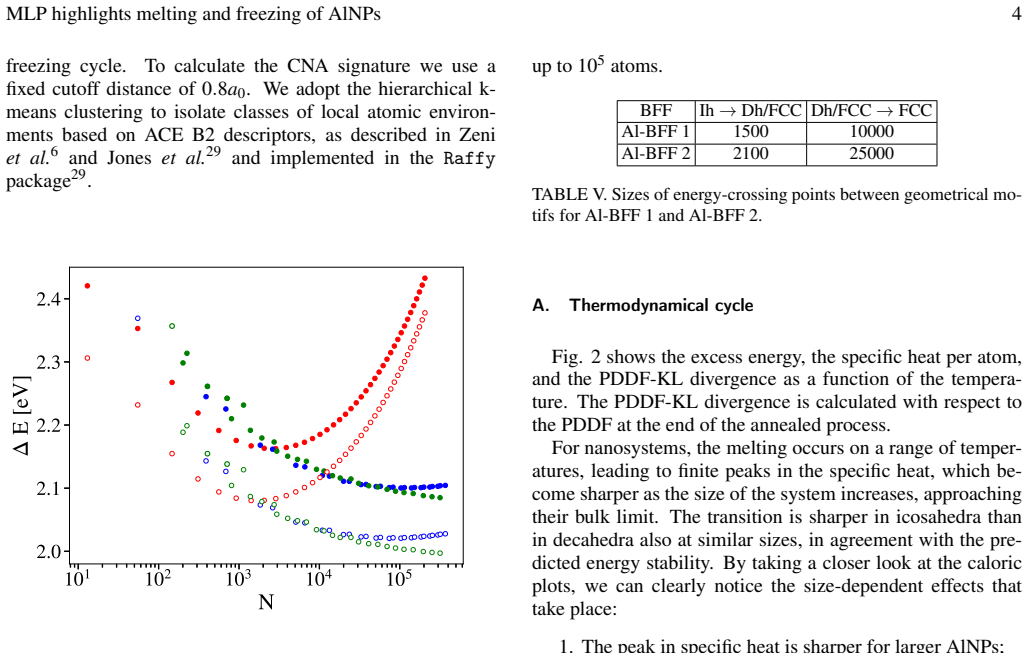
The central claim, stated on the paper's own terms, is that the Bayesian force field Al-BFF 2, trained on density-functional-theory energies, forces, and stresses from bulk aluminium, low-index surfaces, and small clusters together with deliberately included liquid nanodroplets, reproduces bulk properties such as a melting temperature of 906 ± 1 K (experimental value 933 K) and then predicts the size-dependent structural map of aluminium nanoparticles. Relaxed excess energies place the icosahedral-to-decahedral crossover at 2,100 atoms and the decahedral-to-fcc crossover at 25,000 atoms, and iterative molecular dynamics at 100 K/ns adds the dynamical claim that hysteresis loops enlarge with size, that annealing a liquid droplet extends icosahedral stability to about 5,000 atoms, and that there is no surface melting although the surface shows local order in the liquid. The paper argues this is a complete thermodynamic cycle simulated with one potential that stays close to ab initio accuracy at classical speed.
Load-bearing premise
The force field is trained on DFT data for clusters of only 55 to 150 atoms, yet it is used to predict behaviour of particles up to 300,000 atoms without any direct DFT check at those larger sizes.
Editorial extensions
If this is right
- Aluminium nanoparticles below about 2,000 atoms should be treated as icosahedral rather than fcc-like when modelling catalysis or other size-sensitive properties.
- The predicted size window for decahedral stability, roughly 2,100 to 25,000 atoms, gives a concrete target for electron-microscopy checks and for synthesis strategies aiming at fivefold shapes.
- At 100 K/ns heating, melting and freezing temperatures differ by up to 200 K, so kinetic effects must be folded into any comparison between simulated and measured transition temperatures.
- Annealing a liquid droplet before cooling shifts icosahedral stability upward to about 5,000 atoms, implying thermal history changes the resulting nanoparticle shape.
- The absence of surface melting, with ordered local environments persisting at the liquid surface, is a directly testable structural prediction.
Reading between the lines
- The practice of seeding training data with melted nanodroplets is likely transferable to other metals; it addresses a generic failure mode where machine-learned potentials trained on cold solids produce unphysical vaporisation near melting.
- Because the crossover sizes are set by the competition between surface energy and lattice strain, the same type of size map should hold for other aluminium-group metals, though the precise atom counts will shift with surface-energy ratios.
- A slower cooling rate should shrink the observed hysteresis and may shift the solidification outcome toward the energy-preferred motif, offering a direct test of the kinetic origin the paper assigns to the loop.
- If the structural crossovers are reproduced at larger sizes, the potential could replace empirical potentials in studies of nanoscale welding, sintering, and 3D printing of aluminium, where melting and resolidification are the controlling steps.
Signed reviews
Editorial analysis
A structured set of objections, weighed in public.
Referee Report
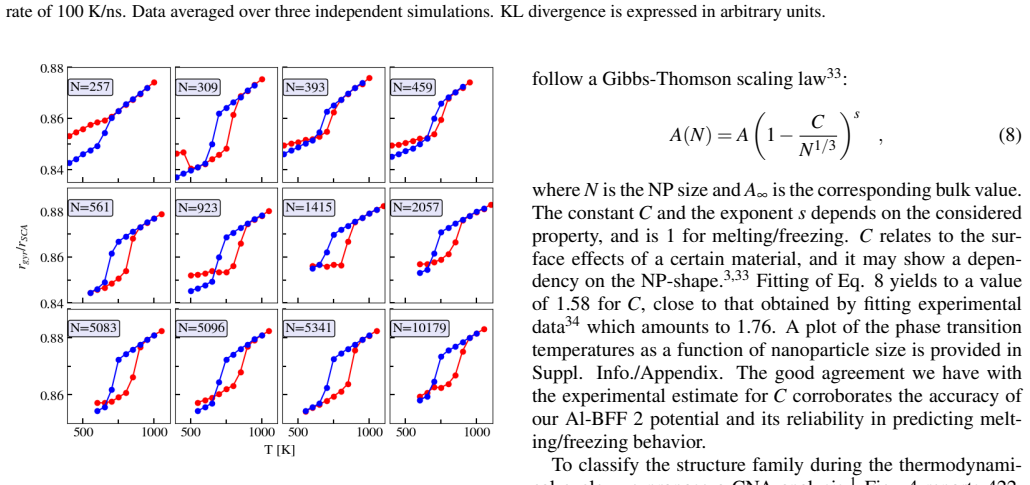
Summary. The paper introduces two FLARE Bayesian force fields for aluminium (Al-BFF1 and Al-BFF2), trained on QE-PBEsol data from bulk, low-index surfaces, and small clusters (55-150 atoms), with D2 adding melted nanodroplets to cure nonphysical sublimation. Using Al-BFF2, the authors compute excess energies of idealized icosahedral, decahedral, and FCC motifs up to 3×10^5 atoms, obtaining Ih stability up to ~2100 atoms, Dh from ~2100 to 25000 atoms, and FCC beyond. They perform iterative MD heating/cooling at 100 K/ns for nanoparticles between 257 and 10179 atoms, reporting a size-dependent melting/freezing hysteresis (with Tm up to ~200 K above Tf at the largest size), a Gibbs-Thomson constant C=1.58, and a CNA/clustering analysis that shows no surface melting and possible surface freezing. The paper concludes that annealing liquid droplets stabilizes icosahedral solidification outcomes up to 5000-6000 atoms.
Significance. If the phase map is correct, the paper would be an important demonstration that a small DFT dataset can produce a transferable MLP for size-dependent structural transitions in aluminium nanoparticles, with practical implications for the community. The strengths are real: the BFF gives bulk melting at 906±1 K versus 933 K experiment, the force/energy MAEs on held-out bulk/surface test sets are small (~0.026 eV/Å, ~0.005 eV), and the potentials, training database, and trajectories are openly available. The methodological point that melted nanodroplets must be included in the training set to avoid unphysical high-temperature behavior is useful. However, the central quantitative predictions—the crossover sizes and the extended icosahedral range after annealing—rest on unvalidated extrapolation and on energy comparisons of idealized motifs without global optimization, so the significance is conditional on additional validation.
major comments (5)
- [III (Fig. 1, Table V) and Conclusion] The central structural phase map is derived from energy differences between locally relaxed idealized motifs, and the Conclusion explicitly concedes that this is done 'without any formal global minimisation.' The abstract's statements that 'Al-BFF predicts an icosahedral stability range of up to 2000 atoms... a region of stability for decahedra, up to 25000 atoms' therefore overstate what is actually computed: these are relative stabilities of chosen ideal geometries under Al-BFF2, not equilibrium stability ranges. Please either perform global optimization (e.g., basin hopping or replica exchange) for representative sizes, or systematically rephrase the abstract and conclusion to describe the result as the relative stability of idealized motifs.
- [Table I, Table V, Eq. (22)] The crossover locations are an extrapolation that is never validated. The D2 dataset used for all MD and for the Al-BFF2 numbers in Table V contains no icosahedral cluster (Ih55 appears only in D1), and the largest DFT reference is 150 atoms, yet the energy comparisons extend to 3×10^5 atoms and the MD to 10,179 atoms. No DFT calculation is reported on relaxed large motifs near the crossover sizes. The BFF predictive uncertainty (Eq. 22) is available but is not used to test whether the energy differences between motifs at N≈2100 and N≈25000 exceed model error. The sensitivity of the crossings to the training set is visible in the shift between Al-BFF1 (1500/10000) and Al-BFF2 (2100/25000) in Table V. Please add single-point DFT checks on relaxed motifs at least at the two crossover sizes and report uncertainty estimates on the motif energy differences.
- [III.A and Conclusion] The claim that 'the annealing of a liquid droplet further stabilizes icosahedral structures, extending their stability range to 5000 atoms' conflates kinetic freezing outcomes with thermodynamic stability. The MD runs at 100 K/ns are non-equilibrium, and the same section notes that the annealed structures 'are not the global minimum.' The defective Ih and Dh solids obtained after freezing are kinetic products; they do not establish an equilibrium stability range. Please either compute free energies of the competing solid phases or reframe this statement as a description of solidification outcomes at the imposed cooling rate.
- [Eq. (8), III.A] The Gibbs-Thomson fit is used to argue that the good agreement with experiment 'corroborates the accuracy' of Al-BFF2. However, the fit uses (Tm+Tf)/2 from 100 K/ns simulations, and no uncertainty is reported for the fitted constant C=1.58. Without confidence intervals and a statement of the number and size range of fitting points, the comparison with the experimental C=1.76 is not quantitative. Moreover, the arithmetic mean of non-equilibrium hysteresis endpoints is not obviously the equilibrium melting temperature. Please report confidence intervals for C and, if possible, compare with a quasi-static or coexistence-based melting temperature for at least one nanoparticle size.
- [Table III, III] The Wulff construction and the FCC-motif energies used in the crossover analysis rely on the surface-energy ratio γ100/γ111=1.17. Table III shows that Al-BFF2's γ111 (0.94 J/m2) is 19% below the quoted experimental value (1.16 J/m2); because the BFF reproduces the PBEsol value (0.96 J/m2), the discrepancy is inherited from the reference functional. Since the Ih→Dh→FCC balance is a competition between surface energy and strain, the quantitative crossover sizes should be discussed with this systematic uncertainty in mind.
minor comments (6)
- [II.B, Eq. (7)] The definition of Tm and Tf as 'the temperatures showing the nearest larger and smaller DKL to the discontinuity' is not reproducible as written; please specify the exact algorithm (e.g., the largest jump in DKL, with a window or threshold) used to locate the transition.
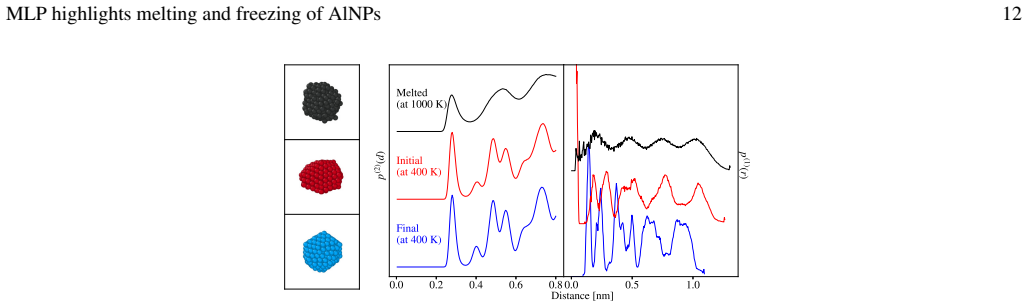
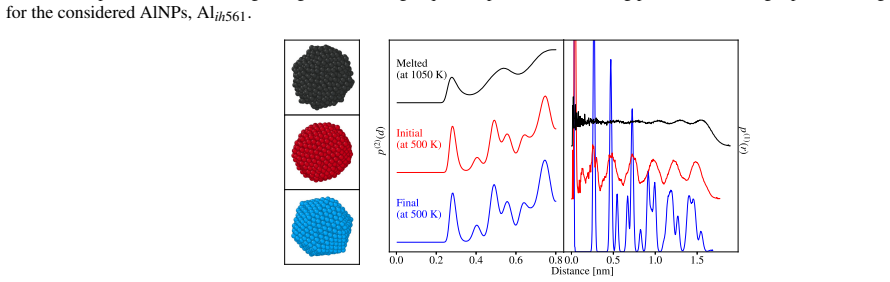
- [III.A, Fig. 6] The sentence 'we note an increment in the IH percentage sharper than that of SH, indicating that the surface organises first than the inner part' is internally inconsistent: if IH (inner ordered) increases more sharply, the core organizes more abruptly, not the surface. Please clarify the evidence for surface-first ordering during freezing.
- [II.A, Table IV] The test set used for the MAE values in Table IV comprises only bulk and surface configurations (33 entries in Table I), so these low MAEs do not directly validate the potential on nanoparticle environments; this limitation should be stated when the MAEs are presented.
- [II.B, Eq. (2)] Because both E(N) and ε_b are negative, the formula for the excess energy is ambiguous without an explicit statement of the sign convention; please state clearly that ΔE is defined as the positive energy cost per surface atom.
- [Conclusion] The phrase 'the nano-slush state is at least up to 3.4 nm' introduces a term and a size bound that are not defined earlier; please specify which descriptor supports this bound and what 'nano-slush' means.
- [Acknowledgments] There is a typo: 'We re grateful' should read 'We are grateful.'
Circularity Check
No load-bearing circularity: the structural crossovers and melting/freezing hysteresis are genuine predictions from a DFT-trained BFF; self-citations are methodological only.
full rationale
The paper's central claims are derived from a Bayesian force field trained on DFT data (Table I) and then used in energy relaxations and MD simulations; no target result is used as a fitting label. The Ih-to-Dh and Dh-to-FCC crossover sizes in Table V come from computing excess energies (Eq. 2) of relaxed ideal motifs, and no crossover size appears in the training set or as an adjustable parameter. The melting/freezing temperatures and hysteresis are read off MD trajectories via caloric curves and KL-divergence/CNA descriptors, and the Gibbs-Thomson constant C=1.58 is fit after the simulations and compared with the experimental value 1.76, which is validation rather than a fitted input renamed as a prediction. The inclusion of melted nanodroplets in D2 informs the potential about liquid environments at small sizes (Al100, Al150), but the simulated transition temperatures at 257-10179 atoms are emergent and not direct training labels. Self-citations (Zeni et al., Rossi et al., Delgado-Callico et al., Jones et al.) support analysis tools such as k-means clustering, CNA classification, and the PDDF-KL melting signature; none is invoked as a uniqueness theorem or as a substitute for the paper's own derivation. The main weakness is transferability extrapolation beyond the 150-atom DFT training data, which is a correctness risk, not circularity.
Assumptions & free parameters
free parameters (4)
- ACE descriptor hyperparameters (nmax, lmax, rc) =
8, 3, 4.5 Å
- GPR hyperparameters (sigma, lambda_E, lambda_f, lambda_tau) =
sigma=3.51 eV; lambda_E=0.15 eV; lambda_f=0.05-0.06 eV/A; lambda_tau=0.0005-0.0006 eV/A^3
- Gibbs-Thomson constant C =
1.58
- CNA cutoff =
0.8 a0
assumptions (5)
- domain assumption Total energy is a sum of local atomic energies within a cutoff radius rc (Eq. 9)
- domain assumption PBEsol DFT provides accurate reference energies and forces for Al bulk, surfaces, and clusters
- domain assumption The KL divergence discontinuity between PDDFs marks the melting/freezing temperature
- domain assumption The lowest excess energy among relaxed Ih, Dh, and FCC motifs determines the stable shape
- domain assumption A Langevin thermostat with tau=20 ps at 100 K/ns produces representative heating/cooling trajectories
Cite this review
Pith. "Pith review of Machine-learnt potential highlights melting and freezing of aluminium nanoparticles." pith.science (2026). https://pith.science/paper/MANKQ5MV
@misc{pith2026241216294,
  author       = {Pith},
  title        = {Pith review of: Machine-learnt potential highlights melting and freezing of aluminium nanoparticles},
  year         = {2026},
  howpublished = {\url{https://pith.science/paper/MANKQ5MV}},
  note         = {Machine review of arXiv:2412.16294}
}
abstract
We investigated the complete thermodynamic cycle of aluminium nanoparticles through classical molecular dynamics simulations, spanning a wide size range from 200 atoms to 11000 atoms. The aluminium-aluminium interactions are modelled using a newly developed Bayesian Force Field (BFF) from the FLARE suite, a cutting-edge tool in our field. We discuss the database requirements to include melted nanodroplets to avoid unphysical behaviour at the phase transition. Our study provides a comprehensive understanding of structural stability up to sizes as large as $3~ 10^5$ atoms. The developed Al-BFF predicts an icosahedral stability range of up to 2000 atoms, approximately 2 nm, followed by a region of stability for decahedra, up to 25000 atoms. Beyond this size, the expected structure favours face-centred cubic (FCC) shapes. At a fixed heating/cooling rate of 100K/ns, we consistently observe a hysteresis loop, where the melting temperatures are higher than those associated with solidification. The annealing of a liquid droplet further stabilizes icosahedral structures, extending their stability range to 5000 atoms. Using a hierarchical k-means clustering, we find no evidence of surface melting but observe some mild indication of surface freezing. In any event, the liquid droplet's surface shows local structural order at all sizes.
Figures

Figures from the paper (31 more)






Reference graph
Works this paper leans on
-
[1]
merlin.mbs aapmrev4-1.bst 2010-07-25 4.21a (PWD, AO, DPC) hacked
FUNCTION id.bst "merlin.mbs aapmrev4-1.bst 2010-07-25 4.21a (PWD, AO, DPC) hacked" ENTRY address archive archivePrefix author bookaddress booktitle chapter collaboration doi edition editor eid eprint howpublished institution isbn issn journal key language month note number organization pages primaryClass publisher school SLACcitation series title translat...
2010
-
[2]
merlin.mbs aipauth4-1.bst 2010-07-25 4.21a (PWD, AO, DPC) hacked
FUNCTION id.bst "merlin.mbs aipauth4-1.bst 2010-07-25 4.21a (PWD, AO, DPC) hacked" ENTRY address archive archivePrefix author bookaddress booktitle chapter collaboration doi edition editor eid eprint howpublished institution isbn issn journal key language month note number organization pages primaryClass publisher school SLACcitation series title translat...
2010
-
[3]
merlin.mbs aipnum4-1.bst 2010-07-25 4.21a (PWD, AO, DPC) hacked
FUNCTION id.bst "merlin.mbs aipnum4-1.bst 2010-07-25 4.21a (PWD, AO, DPC) hacked" ENTRY address archive archivePrefix author bookaddress booktitle chapter collaboration doi edition editor eid eprint howpublished institution isbn issn journal key language month note number organization pages primaryClass publisher school SLACcitation series title translati...
2010
-
[4]
author author F. Baletto \ and\ author R. Ferrando ,\ title title Structural properties of nanoclusters: Energetic, thermodynamic, and kinetic effects , \ 10.1103/RevModPhys.77.371 journal journal Rev. Mod. Phys. \ volume 77 ,\ pages 371--423 ( year 2005 ) NoStop
-
[5]
author author Z. H. \ Li \ and\ author D. G. \ Truhlar ,\ title title Nanothermodynamics of metal nanoparticles , \ @noop journal journal Chemical Science \ volume 5 ,\ pages 2605--2624 ( year 2014 a ) NoStop
work page 2014
-
[6]
author author Z. H. \ Li \ and\ author D. G. \ Truhlar ,\ title title Nanothermodynamics of metal nanoparticles , \ @noop journal journal Chemical Science \ volume 5 ,\ pages 2605--2624 ( year 2014 b ) NoStop
work page 2014
-
[7]
author author A. Das , author S. Rej , \ and\ author T. K. \ Panda ,\ title title Aluminium complexes: next-generation catalysts for selective hydroboration , \ 10.1039/D1DT03703J journal journal Dalton Trans. \ volume 51 ,\ pages 3027--3040 ( year 2022 ) NoStop
-
[8]
author author S. Zheng , author F. Fang , author G. Zhou , author G. Chen , author L. Ouyang , author M. Zhu , \ and\ author D. Sun ,\ title title Hydrogen storage properties of space-confined naalh4 nanoparticles in ordered mesoporous silica , \ @noop journal journal Chemistry of Materials \ volume 20 ,\ pages 3954--3958 ( year 2008 ) NoStop
work page 2008
Show all 53 references
-
[9]
Zeni , author K
author author C. Zeni , author K. Rossi , author T. Pavloudis , author J. Kioseoglou , author S. de Gironcoli , author R. E. \ Palmer , \ and\ author F. Baletto ,\ title title Data-driven simulation and characterisation of gold nanoparticle melting , \ @noop journal journal Na...
2021
-
[10]
Puri \ and\ author V
author author P. Puri \ and\ author V. Yang ,\ title title Effect of particle size on melting of aluminum at nano scales , \ @noop journal journal The Journal of Physical Chemistry C \ volume 111 ,\ pages 11776--11783 ( year 2007 ) NoStop
2007
-
[11]
Behler \ and\ author M
author author J. Behler \ and\ author M. Parrinello ,\ title title Generalized neural-network representation of high-dimensional potential-energy surfaces , \ 10.1103/PhysRevLett.98.146401 journal journal Phys. Rev. Lett. \ volume 98 ,\ pages 146401 ( year 2007 ) NoStop
-
[12]
author author A. P. \ Bart\'ok , author M. C. \ Payne , author R. Kondor , \ and\ author G. Cs\'anyi ,\ title title Gaussian approximation potentials: The accuracy of quantum mechanics, without the electrons , \ 10.1103/PhysRevLett.104.136403 journal journal Phys. Rev. Lett. \...
-
[13]
Jindal \ and\ author S
author author S. Jindal \ and\ author S. S. \ Bulusu ,\ title title Structural evolution in gold nanoparticles using artificial neural network based interatomic potentials , \ @noop journal journal The Journal of Chemical Physics \ volume 152 ,\ pages 154302 ( year 2020 ) NoStop
2020
-
[14]
Chapman \ and\ author R
author author J. Chapman \ and\ author R. Ramprasad ,\ title title Nanoscale modeling of surface phenomena in aluminum using machine learning force fields , \ @noop journal journal The Journal of Physical Chemistry C \ volume 124 ,\ pages 22127--22136 ( year 2020 ) NoStop
2020
-
[15]
Vandermause , author Y
author author J. Vandermause , author Y. Xie , author J. S. \ Lim , author C. J. \ Owen , \ and\ author B. Kozinsky ,\ title title Active learning of reactive bayesian force fields applied to heterogeneous catalysis dynamics of h/pt , \ @noop journal journal Nature Communicati...
2022
-
[16]
Vandermause , author S
author author J. Vandermause , author S. B. \ Torrisi , author S. Batzner , author Y. Xie , author L. Sun , author A. M. \ Kolpak , \ and\ author B. Kozinsky ,\ title title On-the-fly active learning of interpretable bayesian force fields for atomistic rare events , \ @noop jo...
2020
-
[17]
author author C. J. \ Owen , author Y. Xie , author A. Johansson , author L. Sun , \ and\ author B. Kozinsky ,\ @noop title Stability, mechanisms and kinetics of emergence of au surface reconstructions using bayesian force fields , \ ( year 2023 a ),\ http://arxiv.org/abs/2308...
2023 arXiv
-
[18]
author author C. J. \ Owen , author N. Marcella , author Y. Xie , author J. Vandermause , author A. I. \ Frenkel , author R. G. \ Nuzzo , \ and\ author B. Kozinsky ,\ @noop title Unraveling the catalytic effect of hydrogen adsorption on pt nanoparticle shape-change , \ ( year ...
2023 arXiv
-
[19]
Zeni , author K
author author C. Zeni , author K. Rossi , author A. Glielmo , \ and\ author S. De Gironcoli ,\ title title Compact atomic descriptors enable accurate predictions via linear models , \ @noop journal journal The Journal of Chemical Physics \ volume 154 ,\ pages 224112 ( year 202...
2021
-
[20]
author author A. P. \ Thompson , author H. M. \ Aktulga , author R. Berger , author D. S. \ Bolintineanu , author W. M. \ Brown , author P. S. \ Crozier , author P. J. \ in 't Veld , author A. Kohlmeyer , author S. G. \ Moore , author T. D. \ Nguyen , author R. Shan , author M...
-
[21]
Delgado-Callico , author K
author author L. Delgado-Callico , author K. Rossi , author R. Pinto-Miles , author P. Salzbrenner , \ and\ author F. Baletto ,\ title title A universal signature in the melting of metallic nanoparticles , \ @noop journal journal Nanoscale \ volume 13 ,\ pages 1172--1180 ( yea...
2021
-
[22]
Rossi , author L
author author K. Rossi , author L. B. \ P \'a rtay , author G. Cs \'a nyi , \ and\ author F. Baletto ,\ title title Thermodynamics of cupt nanoalloys , \ @noop journal journal Scientific reports \ volume 8 ,\ pages 1--9 ( year 2018 ) NoStop
2018
-
[23]
experiments
author author L. Verlet ,\ title title Computer "experiments" on classical fluids. i. thermodynamical properties of lennard-jones molecules , \ 10.1103/PhysRev.159.98 journal journal Phys. Rev. \ volume 159 ,\ pages 98--103 ( year 1967 ) NoStop
-
[24]
Giannozzi , author O
author author P. Giannozzi , author O. Andreussi , author T. Brumme , author O. Bunau , author M. B. \ Nardelli , author M. Calandra , author R. Car , author C. Cavazzoni , author D. Ceresoli , author M. Cococcioni , author N. Colonna , author I. Carnimeo , author A. D. \ Cors...
-
[25]
Drautz ,\ title title Atomic cluster expansion for accurate and transferable interatomic potentials , \ 10.1103/PhysRevB.99.014104 journal journal Phys
author author R. Drautz ,\ title title Atomic cluster expansion for accurate and transferable interatomic potentials , \ 10.1103/PhysRevB.99.014104 journal journal Phys. Rev. B \ volume 99 ,\ pages 014104 ( year 2019 ) NoStop
2019 doi
-
[26]
Gaudoin , author W
author author R. Gaudoin , author W. Foulkes , \ and\ author G. Rajagopal ,\ title title Ab initio calculations of the cohesive energy and the bulk modulus of aluminium , \ @noop journal journal Journal of Physics: Condensed Matter \ volume 14 ,\ pages 8787 ( year 2002 ) NoStop
2002
-
[27]
author author N. W. \ Ashcroft \ and\ author D. Mermin ,\ @noop title Solid State Physics \ ( publisher Harcourt, inc ,\ year 1976 ) NoStop
1976
-
[28]
author author F. R. \ Boer ,\ @noop title Cohesion in metals: transition metal alloys ,\ Vol. volume 1 \ ( publisher North Holland ,\ year 1988 ) NoStop
1988
-
[29]
Mishin , author D
author author Y. Mishin , author D. Farkas , author M. J. \ Mehl , \ and\ author D. A. \ Papaconstantopoulos ,\ title title Interatomic potentials for monoatomic metals from experimental data and ab initio calculations , \ 10.1103/PhysRevB.59.3393 journal journal Phys. Rev. B ...
-
[30]
author author J. R. \ Morris , author C. Z. \ Wang , author K. M. \ Ho , \ and\ author C. T. \ Chan ,\ title title Melting line of aluminum from simulations of coexisting phases , \ 10.1103/PhysRevB.49.3109 journal journal Phys. Rev. B \ volume 49 ,\ pages 3109--3115 ( year 19...
-
[31]
author author G. P. P. \ Pun , author V. Yamakov , author J. Hickman , author E. H. \ Glaessgen , \ and\ author Y. Mishin ,\ title title Development of a general-purpose machine-learning interatomic potential for aluminum by the physically informed neural network method , \ 10...
-
[32]
author author R. M. \ Jones , author K. Rossi , author C. Zeni , author M. Vanzan , author I. Vasiljevic , author A. Santana-Bonilla , \ and\ author F. Baletto ,\ title title Structural characterisation of nanoalloys for (photo) catalytic applications with the sapphire library...
2023
-
[33]
author author J. D. \ Honeycutt \ and\ author H. C. \ Andersen ,\ title title Molecular dynamics study of melting and freezing of small lennard-jones clusters , \ 10.1021/j100303a014 journal journal The Journal of Physical Chemistry \ volume 91 ,\ pages 4950--4963 ( year 1987 ...
-
[34]
author author F. Baletto ,\ title title Structural properties of sub-nanometer metallic clusters , \ @noop journal journal Journal of Physics: Condensed Matter \ volume 31 ,\ pages 113001 ( year 2019 ) NoStop
2019
-
[35]
Baletto , author R
author author F. Baletto , author R. Ferrando , author A. Fortunelli , author F. Montalenti , \ and\ author C. Mottet ,\ title title Crossover among structural motifs in transition and noble-metal clusters , \ @noop journal journal The Journal of chemical physics \ volume 116 ...
2002
-
[36]
author author G. Guisbiers ,\ title title Size-dependent materials properties toward a universal equation , \ @noop journal journal Nanoscale Research Letters \ volume 5 ,\ pages 1132--1136 ( year 2010 ) NoStop
2010
-
[37]
Lai , author J
author author S. Lai , author J. Carlsson , \ and\ author L. Allen ,\ title title Melting point depression of al clusters generated during the early stages of film growth: Nanocalorimetry measurements , \ @noop journal journal Applied Physics Letters \ volume 72 ,\ pages 1098-...
1998
-
[38]
Li , author P
author author H. Li , author P. Wang , author L. Qi , author H. Zuo , author S. Zhong , \ and\ author X. Hou ,\ title title 3d numerical simulation of successive deposition of uniform molten al droplets on a moving substrate and experimental validation , \ @noop journal journa...
2012
-
[39]
Tran , author Z
author author R. Tran , author Z. Xu , author B. Radhakrishnan , author D. Winston , author W. Sun , author K. A. \ Persson , \ and\ author S. P. \ Ong ,\ title title Surface energies of elemental crystals , \ @noop journal journal Scientific data \ volume 3 ,\ pages 1--13 ( y...
2016
-
[40]
author author V. I. \ Levitas \ and\ author K. Samani ,\ title title Size and mechanics effects in surface-induced melting of nanoparticles , \ @noop journal journal Nature communications \ volume 2 ,\ pages 284 ( year 2011 ) NoStop
2011
-
[41]
author author J. P. \ Perdew , author A. Ruzsinszky , author G. I. \ Csonka , author O. A. \ Vydrov , author G. E. \ Scuseria , author L. A. \ Constantin , author X. Zhou , \ and\ author K. Burke ,\ title title Restoring the density-gradient expansion for exchange in solids an...
-
[42]
Dal Corso ,\ title title Pseudopotentials periodic table: From h to pu , \ @noop journal journal Computational Materials Science \ volume 95 ,\ pages 337--350 ( year 2014 ) NoStop
author author A. Dal Corso ,\ title title Pseudopotentials periodic table: From h to pu , \ @noop journal journal Computational Materials Science \ volume 95 ,\ pages 337--350 ( year 2014 ) NoStop
2014
-
[43]
author author H. J. \ Monkhorst \ and\ author J. D. \ Pack ,\ title title Special points for brillouin-zone integrations , \ @noop journal journal Physical review B \ volume 13 ,\ pages 5188 ( year 1976 ) NoStop
1976
-
[44]
Marzari , author D
author author N. Marzari , author D. Vanderbilt , author A. De Vita , \ and\ author M. C. \ Payne ,\ title title Thermal contraction and disordering of the al(110) surface , \ 10.1103/PhysRevLett.82.3296 journal journal Phys. Rev. Lett. \ volume 82 ,\ pages 3296--3299 ( year 1...
-
[45]
author author C. E. \ Rasmussen \ and\ author C. K. I. \ Williams ,\ 10.7551/mitpress/3206.001.0001 title Gaussian Processes for Machine Learning \ ( publisher The MIT Press ,\ year 2005 ) NoStop
2005 doi
-
[46]
author author G. S. \ Kimeldorf \ and\ author G. Wahba ,\ title title A correspondence between bayesian estimation on stochastic processes and smoothing by splines , \ @noop journal journal The Annals of Mathematical Statistics \ volume 41 ,\ pages 495--502 ( year 1970 ) NoStop
1970
-
[47]
Glielmo , author C
author author A. Glielmo , author C. Zeni , author A. Fekete , \ and\ author A. D. \ Vita ,\ title title Building nonparametric n-body force fields using gaussian process regression , \ in\ 10.1007/978-3-030-40245-7_5 booktitle Machine Learning Meets Quantum Physics \ ( publis...
-
[48]
author author V. L. \ Deringer , author A. P. \ Bart \'o k , author N. Bernstein , author D. M. \ Wilkins , author M. Ceriotti , \ and\ author G. Cs \'a nyi ,\ title title Gaussian process regression for materials and molecules , \ @noop journal journal Chemical Reviews \ volu...
2021
-
[49]
Glielmo , author P
author author A. Glielmo , author P. Sollich , \ and\ author A. De Vita ,\ title title Accurate interatomic force fields via machine learning with covariant kernels , \ 10.1103/PhysRevB.95.214302 journal journal Phys. Rev. B \ volume 95 ,\ pages 214302 ( year 2017 ) NoStop
-
[50]
Qui \ n onero-Candela \ and\ author C
author author J. Qui \ n onero-Candela \ and\ author C. E. \ Rasmussen ,\ title title A unifying view of sparse approximate gaussian process regression , \ http://jmlr.org/papers/v6/quinonero-candela05a.html journal journal Journal of Machine Learning Research \ volume 6 ,\ pa...
1939
-
[51]
Bauer , author M
author author M. Bauer , author M. van der Wilk , \ and\ author C. E. \ Rasmussen ,\ @noop title Understanding probabilistic sparse gaussian process approximations , \ ( year 2017 ),\ http://arxiv.org/abs/1606.04820 arXiv:1606.04820 [stat.ML] NoStop
2017 arXiv
-
[52]
merlin.mbs apsrev4-1.bst 2010-07-25 4.21a (PWD, AO, DPC) hacked
FUNCTION id.bst "merlin.mbs apsrev4-1.bst 2010-07-25 4.21a (PWD, AO, DPC) hacked" ENTRY address archive archivePrefix author bookaddress booktitle chapter collaboration doi edition editor eid eprint howpublished institution isbn issn journal key language month note number orga...
2010
-
[53]
merlin.mbs apsrmp4-1.bst 2010-07-25 4.21a (PWD, AO, DPC) hacked
FUNCTION id.bst "merlin.mbs apsrmp4-1.bst 2010-07-25 4.21a (PWD, AO, DPC) hacked" ENTRY address archive archivePrefix author bookaddress booktitle chapter collaboration doi edition editor eid eprint howpublished institution isbn issn journal key language month note number orga...
2010
Reviewed August 11, 2026 · model on record in the stance chip above.
Discussion (0). Continue with ORCID to comment.